A toddler picks up a puzzle piece shaped like the letter A. Turns it in their hand. Places it in the slot. Says “A.” That moment — physical, visual, auditory, and symbolic all at once — is how language takes root.
Language development isn’t just about speaking. It’s about building a system: sound discrimination, vocabulary, symbolic understanding, and the ability to use words to think, communicate, and connect with others. And like all foundational skills, it develops through active engagement — not passive listening, but hands-on experiences that give language a physical anchor in the real world.
What Language Skills Actually Are

The core components of early language development:
- Phonological awareness — hearing and distinguishing the individual sounds that make up words.
- Vocabulary — the mental library of words connected to real objects, actions, and concepts.
- Symbolic understanding — grasping that a written letter or word represents something real.
- Expressive language — using words to communicate needs, observations, and ideas.
- Receptive language — understanding what others say.
These don’t develop in sequence — they build on each other simultaneously. A child who can’t yet distinguish similar sounds will struggle with phonics. A child with limited vocabulary will struggle with reading comprehension years before they encounter a book. The foundations matter more than most parents realize, and they’re laid in the first three years — what Maria Montessori called the absorbent mind period, when children acquire language effortlessly through immersion in their environment.
What Makes Montessori Approach to Language Different
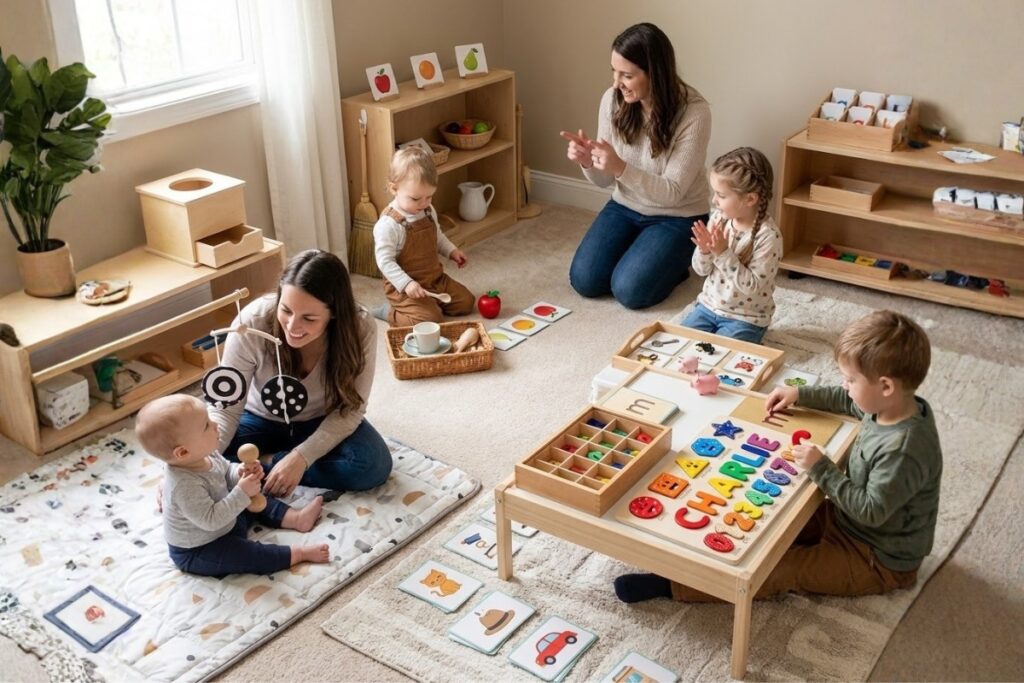
Montessori doesn’t teach language through drills or flashcards. It builds language through experience: objects are named when handled, letters are traced before they’re written, a child’s own name becomes the first meaningful text they encounter.
Three principles drive this:
- Object-word connection. Words are introduced alongside their referents — the real thing, or a concrete representation of it. A puzzle piece shaped like a giraffe, named “giraffe” while it’s held, builds a neural connection between sound, object, and meaning that flashcard repetition cannot replicate. Montessori formalizes this naming process through the Three-Period Lesson: Period 1 — the adult names the object (“This is a cow”); Period 2 — the child identifies it (“Show me the cow”); Period 3 — the child recalls the name (“What is this?”). This graduated structure ensures success at each stage — the child never faces recall before recognition is established. It’s the most effective vocabulary teaching method available for the 12–36 month window, and it works with any material: puzzle pieces, figurines, real objects, or picture cards.
- Personal relevance as a gateway. A child’s own name is the most meaningful text in the world to them. It’s the first word they recognize, the first letters they learn to identify, the first symbol that carries personal significance. Building language learning around the child’s own name leverages this natural motivation.
- Spoken language before written. Montessori never rushes to written letters before oral language is established. Rich vocabulary, clear articulation, and comfort with conversation come first. Literacy is built on that foundation, not alongside it.
Language Milestones & Activities by Age
0–12 Months: Auditory Foundation + First Sounds
- What’s happening: Infants are building the phonological foundation of their native language before producing a single word. By 6 months, a baby can already distinguish the sounds of their mother tongue from foreign language phonemes — a perceptual narrowing that reflects how much auditory processing is already happening. First babbles emerge between 4–6 months: consonant-vowel combinations (ba-ba, da-da) that are the building blocks of speech.
- Key milestones by 12 months: Turning toward familiar voices, responding to their own name, babbling with varied consonants, producing 1–3 recognizable words.
- Montessori activities: Narrating daily routines clearly and slowly, naming objects during handling, singing simple songs, sound play with objects that produce distinct tones.
The auditory system is the entry point to language. Before children can learn words, they need to accurately perceive the sounds those words are made of. Toys that produce consistent, varied sounds — different pitches, different timbres, different rhythms — build the auditory discrimination that later supports phonemic awareness, the core skill behind reading. The right toy at this stage produces predictable, varied sound through the child’s own action — see our full range of Montessori toys for babies under 12 months.
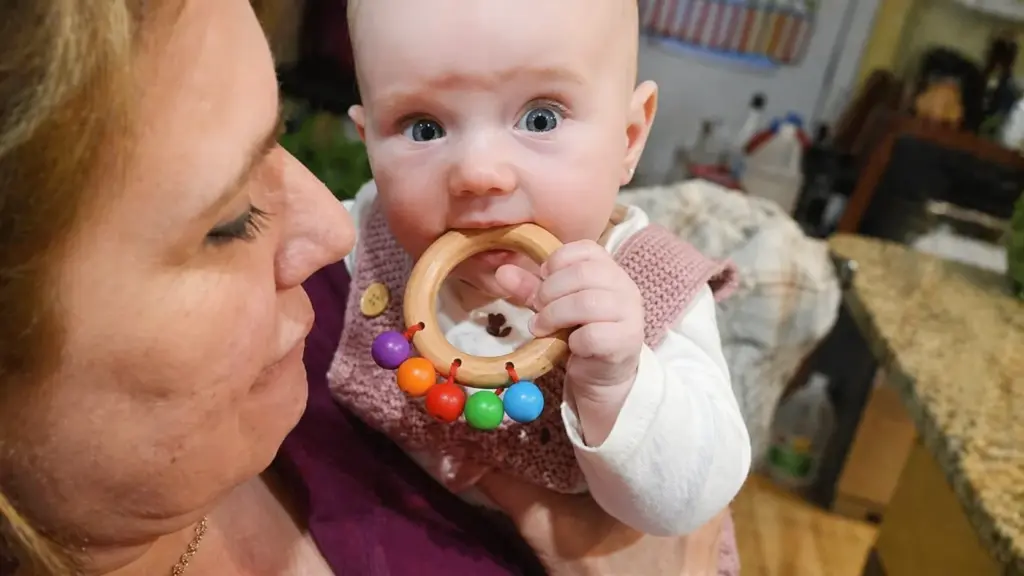
Wooden Baby Rattle Set
Red flags: Not responding to their own name by 9 months. No babbling by 9 months. No recognizable words by 15 months.
12–18 Months: Vocabulary Explosion + Object-Word Mapping
- What’s happening: This is the fastest vocabulary growth window in human development. Most children begin producing words around 12 months and add new words at an accelerating rate — reaching 20–50 words by 18 months, then entering the “vocabulary explosion” where new words are acquired at rates of several per day. Words at this stage are predominantly nouns: names for objects, people, and animals in the child’s immediate environment.
- Key milestones by 18 months: 20–50 expressive words, pointing to named objects, beginning to follow two-word instructions, naming familiar people and objects spontaneously.
- Montessori activities: Object-to-picture matching, naming toys during play, books with real photographs rather than abstract illustrations, vocabulary-rich play with themed toys.
The most powerful language activity at this stage is object-word mapping: connecting a physical thing to its name repeatedly, in varied contexts. Themed puzzles are particularly effective because each piece is a named object — a farm animal, a construction vehicle, a wild animal — that the child handles, names, places, and retrieves. Each repetition reinforces the object-word connection that forms the core of vocabulary acquisition. The theme matters: children build semantic categories (farm animals go together, wild animals go together) alongside individual word knowledge, which is how vocabulary organizes itself in long-term memory.
A themed name puzzle delivers object-word mapping and early letter exposure in a single activity — the most language-efficient toy format at this age. It works especially well for toddlers who are just starting to connect words to objects, typically between 12 and 24 months.
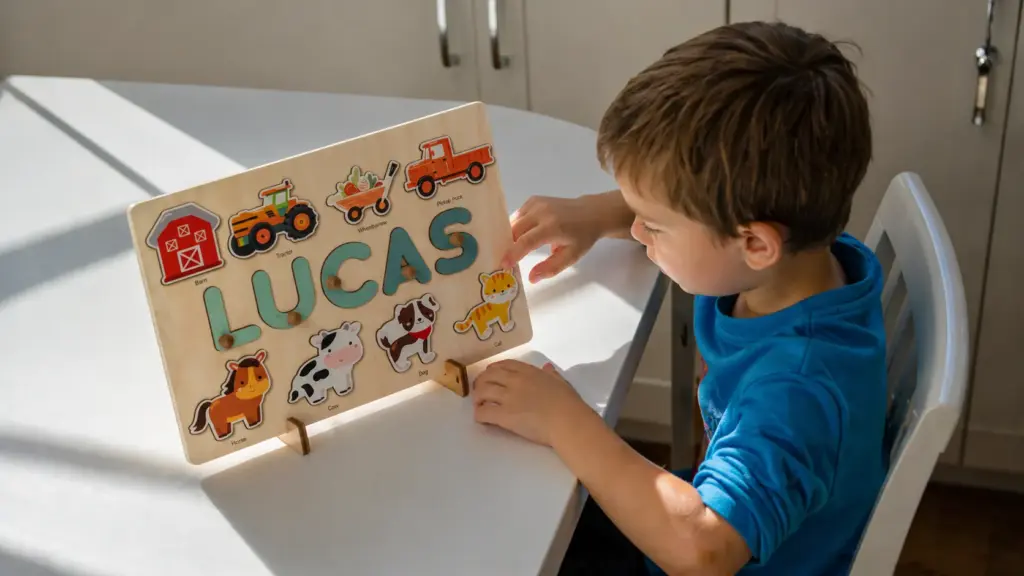
Farm Theme Name Puzzle
- Red flags: Fewer than 6 words by 15 months. Not pointing to objects when named by 15 months. Significant regression in babbling or early words.
18–24 Months: Name Recognition + Pre-Literacy Foundations
- What’s happening: Between 18 and 24 months, children begin recognizing their own name in written form — the first step toward symbolic literacy. They understand that specific letter shapes correspond to specific sounds, and that their name is a meaningful sequence, not a random collection of shapes. Two-word combinations (“more milk,” “daddy go”) emerge, signaling the beginning of syntactic development.
- Key milestones by 24 months: 200–300 receptive words, 50+ expressive words, two-word combinations, recognizing own name in print, beginning to “read” familiar labels.
- Montessori activities: Personalized materials that feature the child’s own name, matching activities with letters, labeling objects in the environment, reading aloud with real conversation.
A child’s own name is the most motivating piece of text in their world. It’s the first word they search for, the first letters they identify consistently, the first symbol that carries personal meaning. Personalized toys leverage this motivation directly: when the letters on the board spell your child’s name, the activity is never abstract. Every letter has a place, a sound, and a personal connection.
Personalized busy boards with the child’s name take this further — the child sees their name displayed prominently while practicing real-world mechanisms, connecting language recognition to purposeful physical activity. The name becomes part of the daily play environment, not a separate “lesson.”
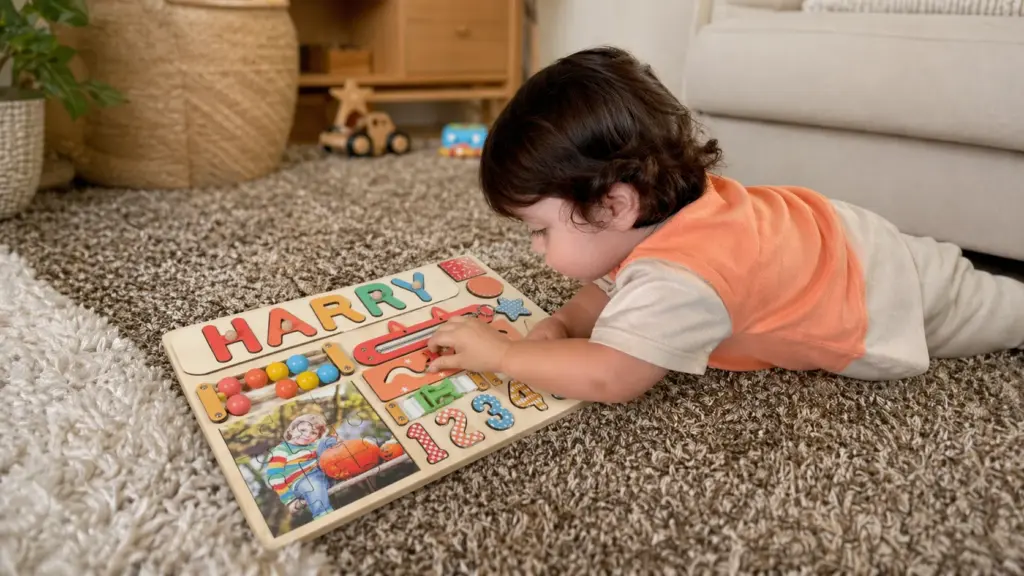
Photo & Name Busy Board
- Red flags: No two-word combinations by 24 months. Not following simple two-step instructions. Significant difficulty understanding speech compared to same-age peers.
2–3 Years: Letter Awareness + Expressive Language
- What’s happening: Vocabulary grows rapidly toward 200–1,000 words. Three-word sentences appear, then four-word, then simple grammatical structures. Crucially, children begin understanding that written letters correspond to sounds — phonemic awareness transitions to phonics readiness. This is the window where letter-shape recognition, letter names, and letter sounds can be introduced through concrete, hands-on materials.
- Key milestones at 3 years: 200–1,000 expressive words, three-to-four-word sentences, asking “what’s that?” about unfamiliar objects, recognizing some letters especially in their own name.
- Montessori activities: Alphabet puzzles, letter-tracing, labeling drawings, storytelling with picture support, expanding vocabulary through themed play.
Letter learning at this stage works best when each letter is physically handled — not traced on a worksheet but held as a wooden shape, placed in a specific slot, removed and replaced. The hand-letter-sound connection is what makes letters memorable. A puzzle where each letter piece corresponds to a number or shape adds a second semantic layer: children build letter knowledge and number/shape vocabulary simultaneously, which is exactly how cognitive processing and language reinforce each other in Montessori practice.
This format — concrete letter pieces, themed vocabulary, self-correcting placement — is the most effective pre-literacy tool for children building their first letter awareness, typically around age 2.

Shapes & Numbers Name Puzzle
- Red flags: Fewer than 50 expressive words by 24 months. Not combining words by 30 months. Speech significantly difficult to understand by age 3.
Activities by Language Skill
| Language skill | Sign it needs support | Best Montessori activities | Age focus |
|---|---|---|---|
| Phonological awareness | Difficulty rhyming; can’t clap syllables; doesn’t notice similar sounds | Sound matching, musical instruments, rhythm games | 12m–4yr |
| Vocabulary | Uses few words; points instead of naming; limited categories | Themed puzzles, object-word matching, naming during daily routines | 12m–3yr |
| Symbolic understanding | No interest in letters or written name; doesn’t recognize familiar labels | Name puzzle, letter manipulatives, labeled environment | 18m–4yr |
| Expressive language | Short responses; rarely initiates conversation; limited sentence structure | Open-ended play narration, “what happened” questions, storytelling | 18m–4yr |
| Receptive language | Doesn’t follow 2-step instructions; misses questions | Clear slow narration during routines, serve-and-return conversation | 12m–3yr |
- Phonological awareness: Sound matching games, rhythm and rhyme, musical instruments that produce varied tones, clapping syllables of familiar words.
- Vocabulary: Themed puzzles and matching games, naming objects during daily routines, books with real photographs, sorting sets that build semantic categories (animals, vehicles, food).
- Symbolic understanding: Name puzzles and letter manipulatives, labeling objects in the play environment, matching written labels to real objects.
- Expressive language: Open-ended play narration (“the cow goes to the barn”), describing what they’re doing while working, asking “what happened next?” during play sequences.
- Language through daily life: Narrating routines clearly and slowly (“now we’re washing hands — warm water, soap, scrub”), naming everything during cooking and dressing, asking genuine questions and waiting for responses. This serve and return conversation pattern is the most powerful language-building activity available — and it costs nothing
Toy Rotation for Language Development
Display 1–2 language-focused materials alongside the broader shelf. Rotate when a child completes a vocabulary puzzle without naming the pieces — that’s the signal they’ve internalized the vocabulary and are ready for a new theme.
Progression: start with themed puzzles that match the child’s existing vocabulary (farm animals before exotic animals, vehicles before ocean creatures). Extend to themes slightly beyond current knowledge — this is how vocabulary actively grows rather than just being reinforced.
For letter awareness: introduce letters from the child’s own name first. These are the most motivating and the most repeated. Extend to other familiar letters once name letters are solid.
Common Mistakes
- Too much correction, not enough conversation. Parents often focus on correcting pronunciation (“not ‘nana,’ say ‘banana'”) rather than extending conversation. Corrections interrupt the communicative intent and can reduce language output. Instead, model the correct form naturally: “Yes! Banana. The yellow banana.”
- Passive language exposure. Background television produces very little language learning — children need interactive, responsive conversation partners. The number of conversational turns per day predicts vocabulary size more reliably than any other factor.
- Rushing to letters before vocabulary is solid. Letter knowledge builds on vocabulary. A child who doesn’t know what a word means will struggle to retain its spelling. Rich vocabulary first, then letters, then phonics. The sequence matters.
- Ignoring the social-emotional dimension of language. Children learn language fastest in contexts of genuine connection — when communication succeeds and is met with warm response. Language and social-emotional development are deeply intertwined: a child who feels emotionally safe produces more language, takes more communicative risks, and retains vocabulary more effectively.
When Language Development Seems Stuck
- Understands everything but barely speaks? That’s an expressive gap with intact receptive language — very common at 18–24m. Increase “serve and return” conversations: say something, pause, wait for ANY response (gesture, sound, word), then respond to THAT. The pause is the key — most adults fill silence too quickly.
- Knows many words but won’t combine them? Model two-word combinations constantly: “more milk,” “big truck,” “daddy go.” The child needs to hear the pattern hundreds of times before producing it.
- Shows no interest in letters or their name in print? Normal before 18m. After 18m: place their name puzzle on the shelf and demonstrate once. Don’t push — the sensitive period for language will draw them when ready.
- Vocabulary seems stuck at 20–30 words? Expand through THEMES, not random words. Introduce 5 farm animals this week, 5 vehicles next week. Categorized vocabulary builds faster than isolated words.
Red Flags and When to Seek Support
- By ~12 months: Not babbling. Not responding to own name. No pointing or gesturing.
- By ~18 months: Fewer than 6 words. Not pointing to objects when named.
- By ~24 months: No two-word combinations. Fewer than 50 words. Significant regression in language.
- By ~3 years: Speech mostly unintelligible to unfamiliar adults. Not using three-word sentences. Very limited vocabulary compared to peers.
Language delays are among the most common and most treatable developmental concerns in early childhood. Early speech-language therapy, when needed, produces significantly better outcomes than waiting. Talk to your pediatrician and ask specifically about a speech-language evaluation.
FAQ
- When does language development actually begin?
Before birth. Fetuses begin processing the rhythms and intonation patterns of their mother’s voice in the third trimester. By birth, newborns already prefer their mother’s voice and show recognition of familiar stories heard in utero. Language development starts long before the first word.
- How many words should my child have at each age?
Rough guidelines: 1–3 words by 12 months, 20–50 by 18 months, 200–300 by 24 months, 1,000+ by 36 months. These are population averages with wide normal variation. A child with 10 words at 18 months but strong comprehension and communication intent is different from a child with 10 words and no pointing, no eye contact, and no apparent interest in communication. Context matters more than count.
- Do name puzzles really help with language development?
Yes — specifically for vocabulary and pre-literacy. Each puzzle piece is a named object handled repeatedly in a physical context. This object-word mapping is exactly how vocabulary is acquired most durably. Personalized name puzzles add letter-name and letter-sound exposure tied to the most motivating word in a child’s world: their own name. The full breakdown of name puzzle benefits covers exactly how each of these mechanisms works — and what to look for when choosing one.
- How important is talking to my baby before they can respond?
Critical. The number of words a child hears in the first three years — and the quality of conversational exchange — strongly predicts vocabulary size, reading readiness, and academic outcomes years later. Babies can’t respond verbally, but they’re processing everything. Narrate daily routines, name objects, describe what you’re doing. The investment compounds.
- When should I be concerned about language delays?
When you see patterns — not single missed milestones. Missing one milestone by a few weeks is usually not concerning. Missing multiple milestones, significant regression in language, or speech that’s consistently much harder to understand than same-age peers — these warrant a conversation with your pediatrician and potentially a speech-language evaluation.
Every skill your child needs, in one place — browse our Montessori skill guides for cognitive, language, fine motor, STEM, math, social-emotional, and practical life development.