
“The hands are the instruments of man’s intelligence.” — Dr. Maria Montessori
Watch a toddler pick up a Cheerio. Full concentration. They miss. Try again. Got it. That moment is fine motor development in action.
Fine motor skills are the coordinated use of small muscles in the hands, fingers, and wrists working with visual control. They’re the foundation for buttoning shirts, holding a pencil, tying shoes — for independence itself. You can’t rush development, but you can support it. Not with worksheets, but with purposeful play that builds strength and coordination one movement at a time.
The Science of Hand Development
- Control moves from center outward. Shoulder before elbow, elbow before wrist, wrist before fingers. Babies wave their whole arm before they can pinch a pea. This is proximodistal development — a predictable sequence you can’t skip, but can meet exactly where your child is.
- From reflex to precision. Newborns grip reflexively. Over three years, that becomes voluntary skill: palmar grasp → raking → pincer → tripod grip → dynamic tripod (writing-ready). Each stage builds on the last. Pushing pencil grip at two years skips the foundations that make it sustainable.
- Visual-motor integration: the hidden key. Fine motor isn’t just hands — it’s hands and eyes working together. A child might see a puzzle piece and the correct slot but still can’t align them. That gap closes through practice: stacking, fitting shapes, posting objects. Every “look here, move hand there” action strengthens this connection.
- Hand control and thinking develop together. Fine motor precision isn’t just a physical skill — it’s how children gather information to reason with. To understand “balance,” a child must first place each piece carefully enough to observe what happens, then reason about why it fell. The hand action is the entry point to the thinking. This is why activities like threading, stacking, and sorting build early cognitive skills alongside physical control — they’re inseparable in practice.
The six building blocks: hand strength, pincer grasp, bilateral coordination (one hand holds while the other works), wrist rotation, finger isolation, hand-eye coordination.
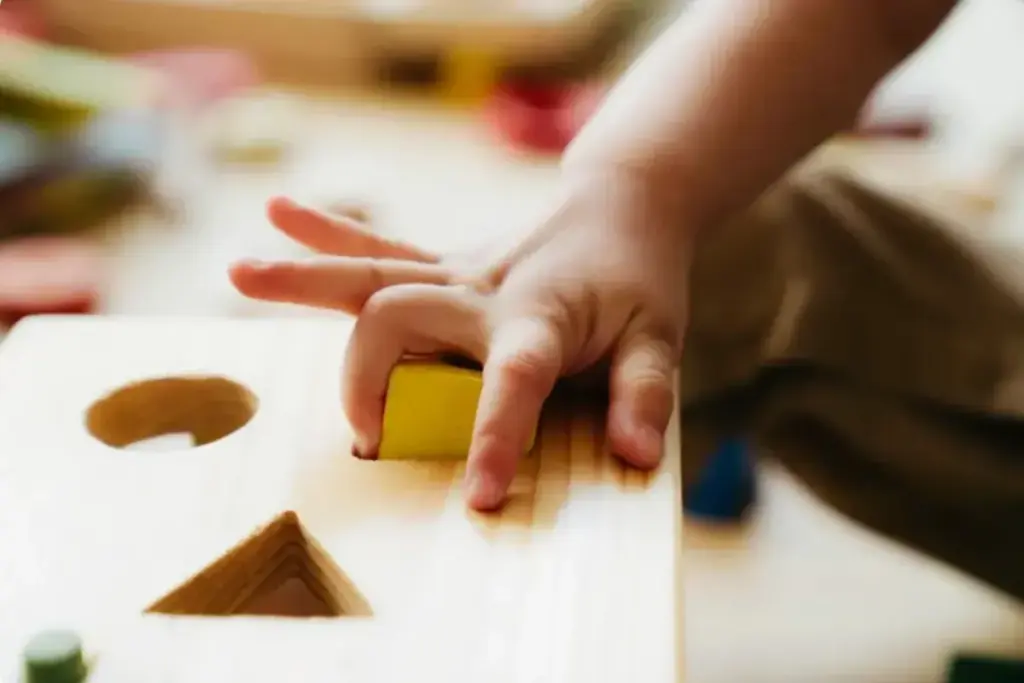
What Makes Montessori Fine Motor Training Different
Most toys present too many variables at once — colors, sounds, textures, mechanisms, all competing for attention. Montessori materials isolate one challenge at a time so children can focus deeply and achieve genuine mastery.
A name puzzle, for example, focuses on pincer grasp and visual matching — nothing else. Simple shapes, calm colors, one variable: placement. Once that’s mastered, the next challenge is introduced. Never all at once.
The best Montessori materials also have control of error built in: a puzzle piece that doesn’t fit won’t force. A tower stacked unevenly topples. The material gives feedback — immediate, honest, non-judgmental. Children adjust and try again without adult correction.
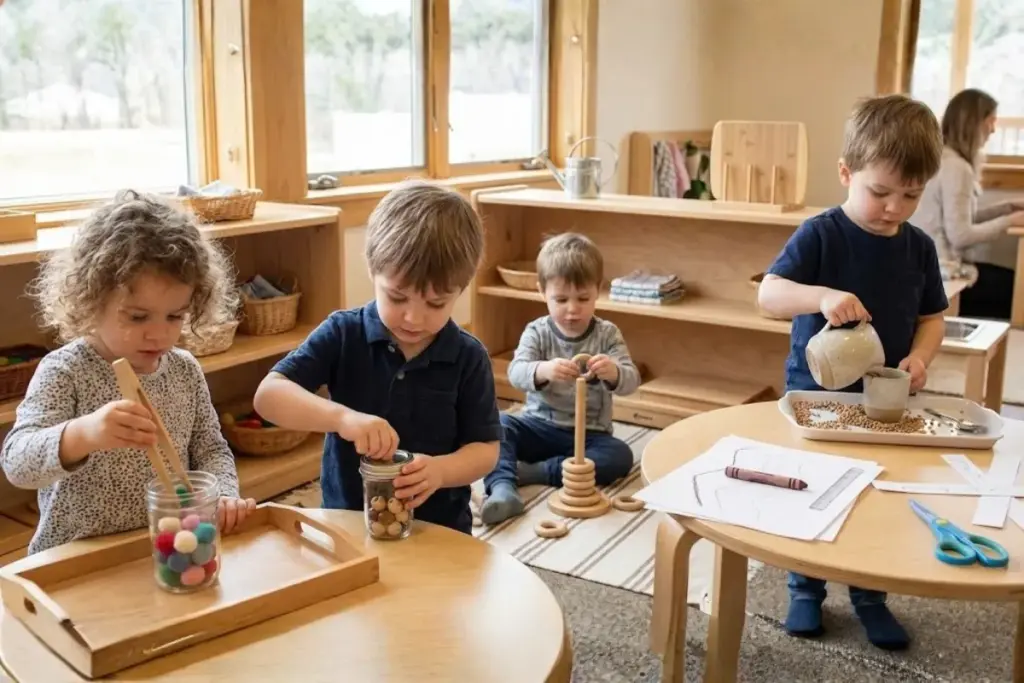
Fine motor development is inseparable from practical life activities: pouring water, twisting lids, peeling, buttoning, using a spoon. Every one of these daily tasks requires exactly the hand precision fine motor training builds — and because they’re purposeful and real, children engage more deeply than in any structured activity. You don’t need thirty toys. You need ten real tasks your child can do independently.
Material matters developmentally. Wood provides weight variation — a larger ring is noticeably heavier, and the child’s hands register that difference. It also provides natural grain texture and temperature variation that the sensory discrimination system builds from. Plastic pieces of different sizes often weigh the same, reducing the sensory information available per grip.
Fine Motor Milestones & Montessori Activities by Age
These age ranges align with the CDC’s developmental milestone framework, but every child progresses on their own timeline
0–12 Months: From Reflex to Grasping
- What’s happening: Reflexive grip transforms into intentional reaching, raking, hand-to-hand transfer, and the first pincer grasp.
- Key milestones by 12 months: Hand-to-hand transfers, index finger poking, picking up small objects with pincer grasp, dropping into containers purposefully.
- Montessori activities: Grasping toys with varied textures and weights, in-and-out container play, large posting boxes, object permanence boxes.
This stage has two distinct fine motor windows:
3–6 months — palmar grasp and wrist rotation. Babies can grip when an object is placed in their palm but can’t yet reach with precision. The goal is building grip strength and early wrist rotation. The right toy varies in size, weight, and texture so babies must continuously adjust how they hold it — different grip challenges in the same session. Good for babies in their first year from around 3 months.
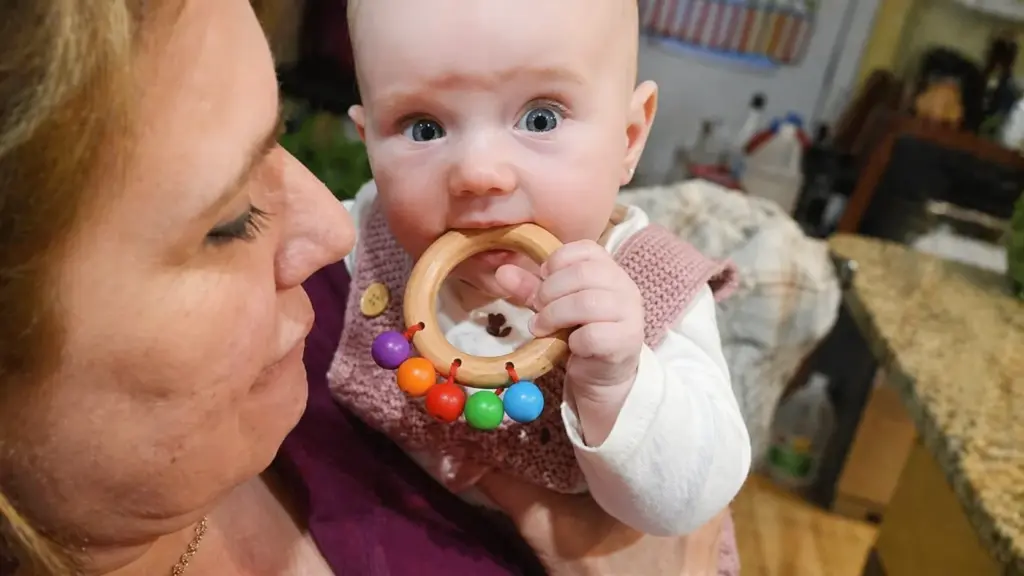
Colorful Wooden Baby Rattle Set
6–9 months — early pincer grasp and intentional release. Babies begin reaching deliberately and developing the first pincer: thumb and forefinger working together to pick up and release with purpose. “Dropping purposefully into a container” is a key milestone at 9–10 months. Unlike passive grasping, posting an object requires active, directed release — pick up, aim, let go intentionally.
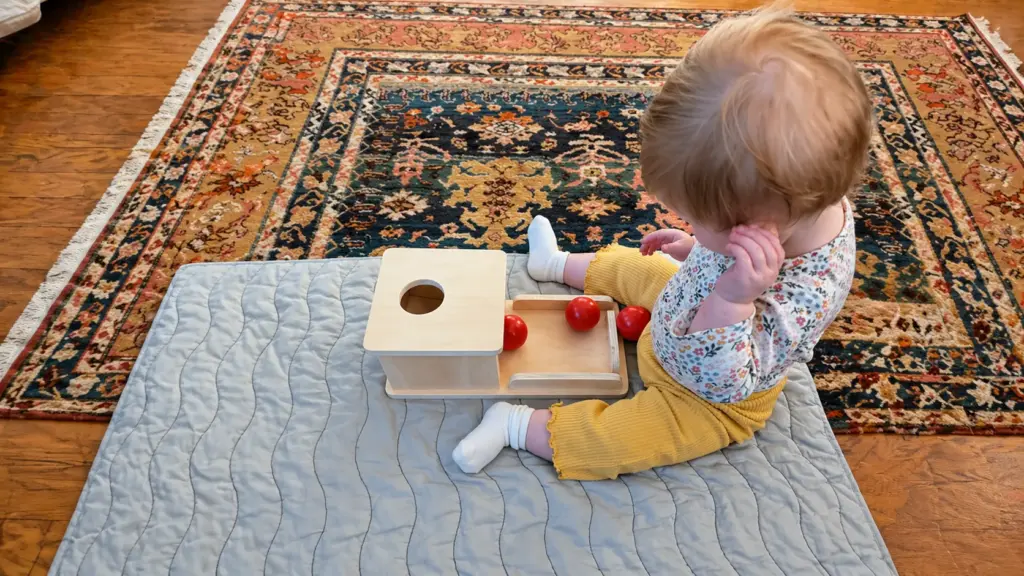
Montessori Object Permanence Box
Red flags: No grasp or release attempts by 12 months. Strong one-hand preference before 9 months.
1–2 Years: Pincer Refinement and Two-Hand Coordination
- What’s happening: Pincer grasp becomes consistent. Bilateral coordination emerges — one hand holds while the other works. Wrist rotation improves. Tool use begins.
- Key milestones by 24 months: Holding containers steady while removing items, stacking 3–5 blocks, intentional scribbling, early spoon feeding.
- Montessori activities: Knob puzzles, shape posting, spoon and tong transfers, twist-lid containers, ring stacking, early dressing mechanisms.
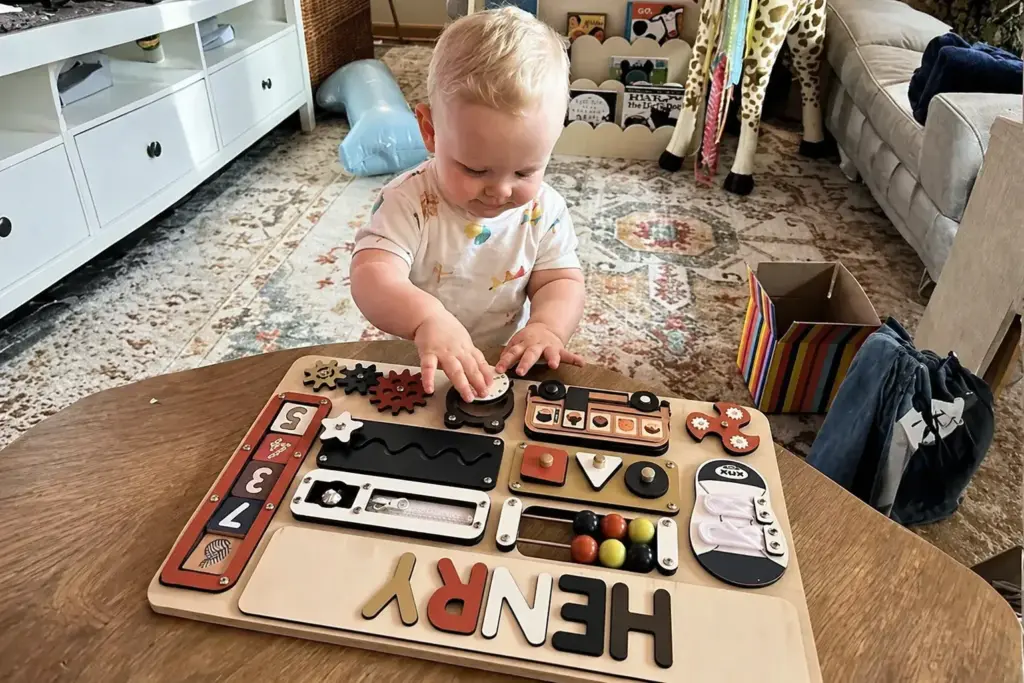
The most important development at this stage is bilateral coordination: assigning different roles to each hand simultaneously. One hand holds the fabric flat; the other pulls the zipper. One hand steadies the strap; the other threads the buckle. This is a learned skill that only develops through practice with mechanisms that require divided hand work.
Wrist rotation is the second key skill. Pulling a zipper is a different wrist motion than twisting a dial or pushing a button. Exposure to multiple mechanisms — each requiring a distinct hand action — builds the full wrist mobility toddlers need. Browse the full range of busy board designs to choose a theme that fits your child.
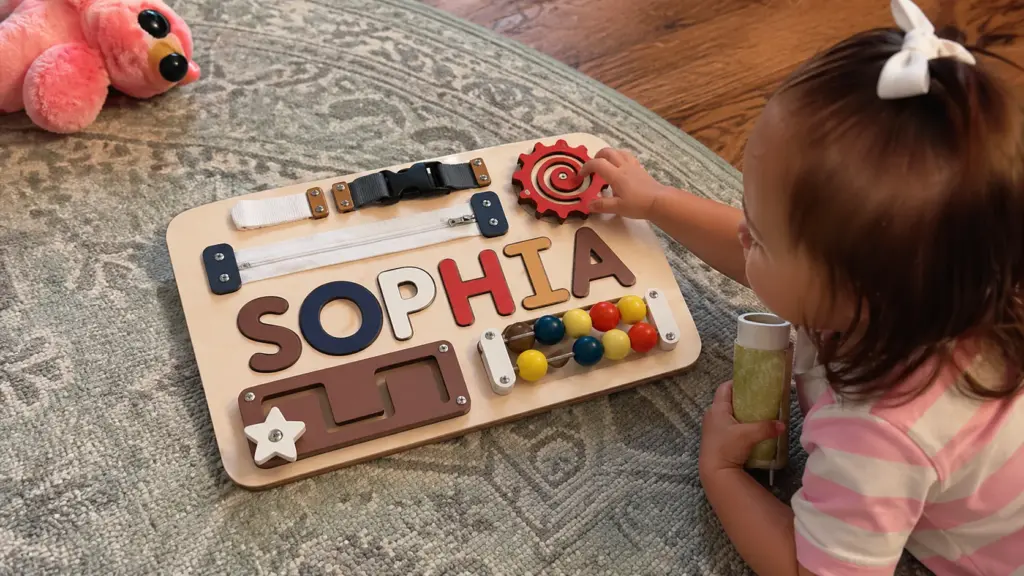
Zips & Buckles – Wooden Montessori Busy Board
Red flags: Very limited finger isolation by late toddlerhood. Consistent extreme frustration with all hand tasks.
2–3 Years: Wrist Rotation, Finger Isolation, Precision
- What’s happening: Finger isolation emerges — the index finger works independently from the others. Wrist rotation improves dramatically. Precision tools become manageable.
- Key milestones by 36 months: Turning knobs and lids independently, threading larger beads, completing 6–8 piece puzzles, drawing basic shapes, early scissors use.
- Montessori activities: Knob puzzles, bead threading, nuts-and-bolts boards, tweezers transfers, dry and water pouring.
Finger isolation — one finger working while the others stay still — is what unlocks writing, precise tool use, and detailed manipulation. It develops through activities where the index finger must aim at a specific target independently: poking, threading, pointing into small openings.
Threading beads trains three systems at once: finger isolation (pinching the bead), bilateral coordination (one hand holds the string, the other threads), and hand-eye coordination (aiming the bead’s hole at the string tip). Occupational therapists recommend it consistently for this stage. “Start with larger beads suitable for 2-year-olds and progress to smaller.
A name puzzle is equally effective here — pincer grip, spatial orientation, and shape matching in one activity. Letter recognition develops alongside hand control, not separately.
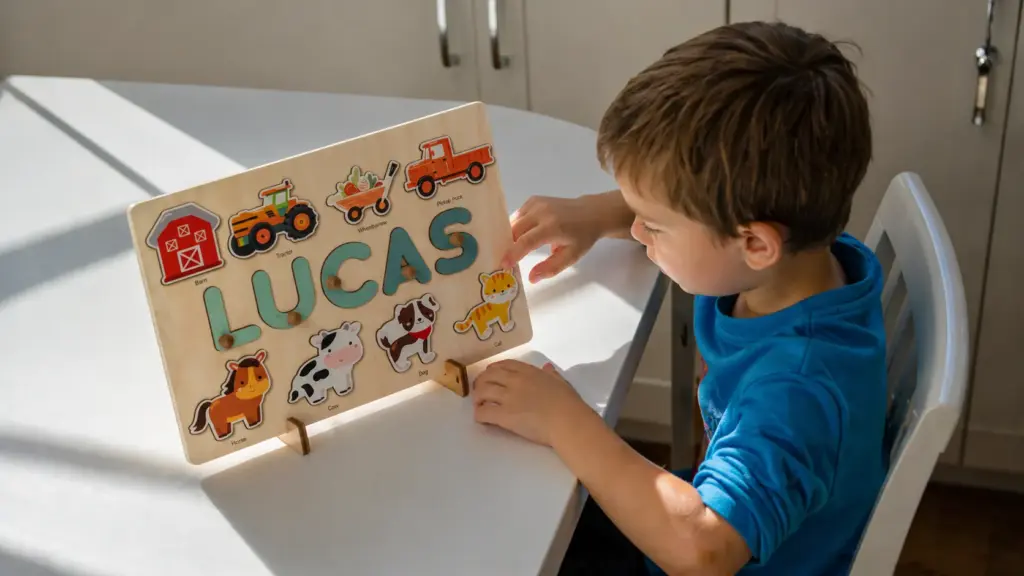
Farm Theme – Wooden Montessori Name Puzzle
Progression ladder: spoon → tongs → tweezers. Large beads → small beads. Dry pouring → water pouring. Build the sequence; don’t skip to the hardest version.
Red flags: Cannot stack simple blocks or make any controlled marks by age 3. Persistent avoidance of hand tasks with visible distress.
3-6 Years: Endurance, Refinement, Pre-Writing Precision
- What’s happening: Force control improves — gentle versus firm pressure with the same hand. Work cycles lengthen. Fine motor skills begin translating directly into independence and academic readiness.
- Key milestones at 3–4 years: Cutting along lines, drawing recognizable shapes, copying simple forms, complex building.
- Montessori activities: Dressing frames (zippers → buttons → snaps → laces), lock boxes, advanced lacing, multi-step practical life sequences.
Pre-writing follows a natural sequence: vertical and horizontal lines → diagonals → curves and circles → traced shapes → freehand shapes → controlled tracing → letter readiness. Letters come naturally after foundations are solid — forcing them before hand strength is ready creates fatigue, not fluency.
Stacking and building toys remain relevant here. Precision placement of irregular shapes requires exactly the fine-force control that supports pencil work and cutting — same muscles, different format.
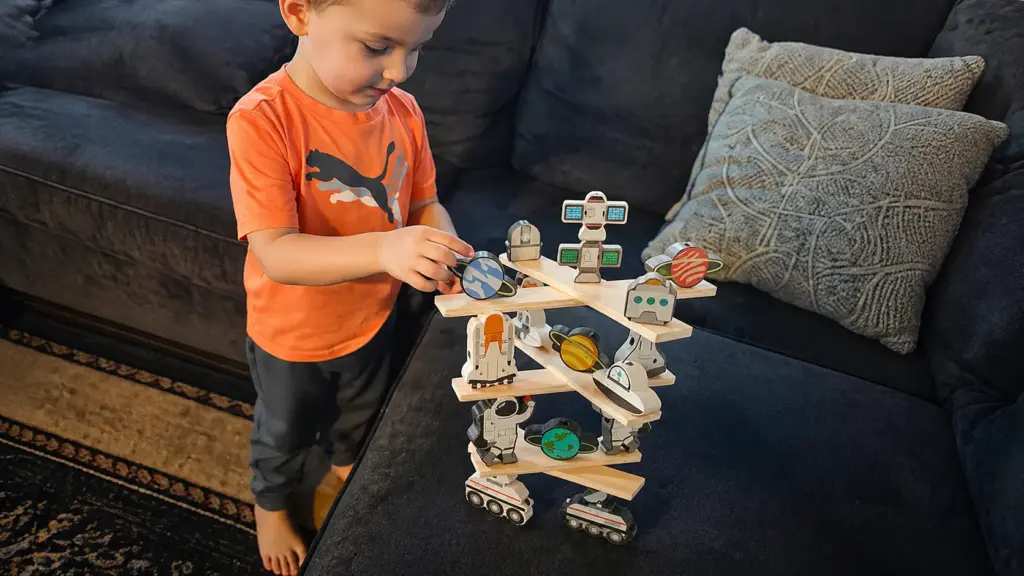
Astronaut Wooden Stacking Toy
Red flags: Very shaky control in basic tasks. Extreme hand fatigue after short periods.
Fine Motor Activities by Skill Type
| Fine motor skill | Sign it needs work | Best activities |
|---|---|---|
| Pincer grasp + finger strength | Raking instead of pinching small objects; drops easily | Pom-pom pickup, sticker peeling, coin slot posting, clothespin pinching, bead threading |
| Bilateral coordination | One hand passive during two-hand tasks; difficulty lacing | Twisting jar lids, paper tearing, lacing boards, opening containers |
| Wrist rotation + tool control | Wrong orientation on puzzle pieces; difficulty with utensils | Dry to water pouring, spoon transfers, spray bottles, screw boards |
| Finger isolation | Index finger doesn’t work independently from others | Threading, poking into small openings, pointing activities |
| Pre-writing precision (3–6yr) | Shaky lines, extreme fatigue, fist grip on crayon | Tracing paths, dot-to-dot, copying shapes, crayon rocks |
Montessori Toy Rotation for Fine Motor Growth
How Many Activities to Display
6-10 total activities on the shelf (all skill areas combined). Within that, 2-3 fine motor-focused activities at a time.
When to Rotate (Signals)
Don’t rotate on a schedule. Rotate based on what you observe:
- Ignored for days → swap it out
- Mastered too easily → time for progression
- Too hard → put away, try again in weeks
- Shelf feels chaotic → simplify
How Often to Rotate (By Age)
0-12 months: Every 1-2 weeks
1-2 years: Every 1-2 weeks
2-3 years: Every 2-3 weeks
3-6 years: Every 3-4 weeks
Mastery needs time. Rotate too often, your child never moves past fumbling to fluency.
Upgrade Ideas
- Tongs → tweezers
- Big beads → small beads
- Dry pouring → water pouring
- Single-shape puzzle → multi-piece puzzle
Common Mistakes + Quick Fixes
Mistake 1: Too Many Toys at Once
Fix: Display 6-10 activities max. Each on a tray with all pieces together.
Mistake 2: Adult Rescuing Too Early
Fix: Watch. Wait. Let them struggle productively. If truly stuck, offer smallest help: “What if you turn it this way?”
Mistake 3: Jumping Straight to Tiny Parts
Fix: Start where your child actually is. Large tongs before small. Big beads before tiny.
Mistake 4: Worksheets Before Hand Strength
Fix: Build foundations first—pouring, threading, posting, cutting. Real hand work before paper work.
Mistake 5: Forcing Pencil Grip Too Early
Fix: Let them use fist grip. As hand strength develops through play, grip naturally evolves around age 3-4.
When Development Seems Stuck
- Drops the piece before placing it? That’s an in-hand manipulation gap — the child can pick up but can’t adjust grip while holding. Try: coin drop with small discs, playdough (repositioning without putting down).
- Whole fist on everything? The three-jaw chuck grip hasn’t established yet. Try: small-knob puzzles (knob forces three-finger grip), broken crayon stubs (shape forces correct hold without correction).
- One hand does everything, the other hangs? Bilateral coordination gap. Try: lacing boards, pouring (both hands on pitchers), any activity where one hand holds while the other works.
- Avoids fine motor activities entirely? Go one stage back on the grip progression. Find where engagement becomes spontaneous — that’s the actual developmental starting point.
Red Flags & When to Seek Extra Support
Every child develops on their own timeline. Variation is normal. But sometimes delays signal a child could benefit from extra support. Early intervention—when needed—makes a profound difference.
Gentle “Red Flag” Checkpoints
- By ~12 months: Not attempting pincer-like picking at all. Not bringing hands to midline. Very strong one-hand preference at 6-9 months.
- By ~18 months: Rarely uses index finger to point, poke, or explore. Not attempting to stack blocks at all. No interest in any hand-based play.
- By ~3 years: Cannot stack 3-4 blocks at all. Cannot make basic strokes with crayons. Persistently avoids all fine motor tasks with significant distress. Extreme fatigue very quickly.
Important: One missed milestone isn’t a diagnosis. If you notice a pattern, talk to your pediatrician — the AAP’s Motor Delay: What to Look For tool can help you describe specific concerns
What to Do Next
- Track patterns over a few weeks
- Bring examples (videos can help)
- Ask for OT referral
- Early intervention (ages 0-3): Every US state has free evaluations. Google “[your state] early intervention.”
- Schools (ages 3-6): Local district responsible for evaluations/services
FAQ
- What are fine motor skills?
Coordinated use of small hand, finger, and wrist muscles working with visual control. Allow children to pick up objects, manipulate tools, button shirts, hold pencils, write.
- Fine motor vs. gross motor?
Gross motor = large muscles, big movements (running, jumping). Fine motor = small muscles, precise movements (grasping, threading, writing). Both essential.
- How often should I practice fine motor activities?
Daily, but not long forced sessions. 10-20 minutes focused work is plenty. Better: integrate into daily life (pouring at meals, dressing practice, food prep help). - When should I worry about fine motor delays?
If you notice patterns (not single missed milestones): persistent avoidance of all hand tasks with distress, extreme frustration, very shaky control beyond fumbling stage, or skills significantly behind peers. Talk to your pediatrician.
- Do wooden toys really make a difference?
Material matters less than design. But wood offers richer sensory feedback (weight, texture, warmth), honest resistance, and durability.
For all developmental skill areas, visit our Montessori skill guides — cognitive, language, sensory, STEM, math, social-emotional, and practical life.