
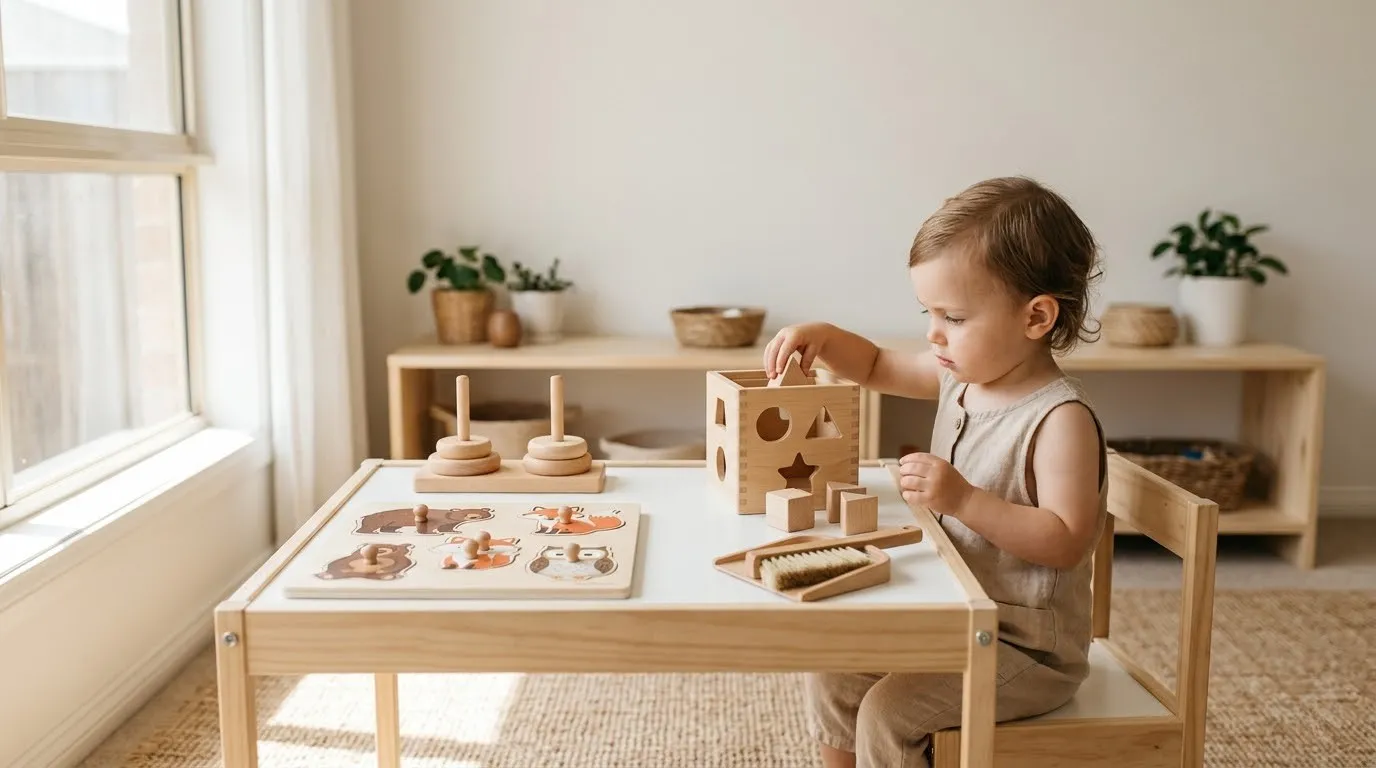
You’re standing in front of a toy labeled “Montessori Wooden Educational Toy.” It’s made of wood. Neutral colors. Looks minimal. But is it actually Montessori?
That’s exactly where most parents get stuck. The word “Montessori” has become a marketing label as much as a design description — slapped onto anything wooden, beige, or “educational-looking.” A toy doesn’t become Montessori because of its material or its color. What matters is whether it’s designed to help a child focus, self-correct, learn through their hands, and connect to something real.
This guide gives you a clear framework to evaluate that — and stop relying on labels.
What makes a toy Montessori? A Montessori toy is designed to help a child learn through focused, hands-on, independent exploration. The best Montessori-aligned toys focus on one main skill, allow the child to self-correct, require active use of the hands, and connect meaningfully to real life.
Why So Many Toys Are Called “Montessori” — Even When They Aren’t
Montessori is a design philosophy, not a style
The confusion starts here: most people associate Montessori with a visual aesthetic — natural wood, muted tones, simple shelves. But two toys made from identical wood can be wildly different in how Montessori-aligned they are. One might isolate a single skill and invite the child to self-correct. The other might be a busy board with twelve unrelated features, a few flashing LEDs, and no clear learning purpose.
Aesthetic is the surface. Design is what matters — and that design is rooted in a broader Montessori method that shapes how children learn, not just how toys look.
Wooden does not automatically mean Montessori
Wood is common in Montessori materials for good reasons: it’s tactile, durable, honest in weight, and free of electronic distractions. The specific developmental reasons wooden materials are worth choosing — from acoustic properties to proprioceptive feedback — go beyond what the label implies. But material is not a criterion. A wooden toy with multiple modes, unrelated tasks, and push-button feedback can miss every Montessori principle. A simple plastic sorting tray, by contrast, might satisfy several of them.
The question is never “what is it made of?” — it’s “how is it designed to be used?”
Parents need a framework, not a label
Once you stop asking “Does this look Montessori?” and start asking “How is this designed to work?”, toy selection becomes significantly clearer. The four principles below are that framework.
The 4 Design Principles Behind a Montessori Toy
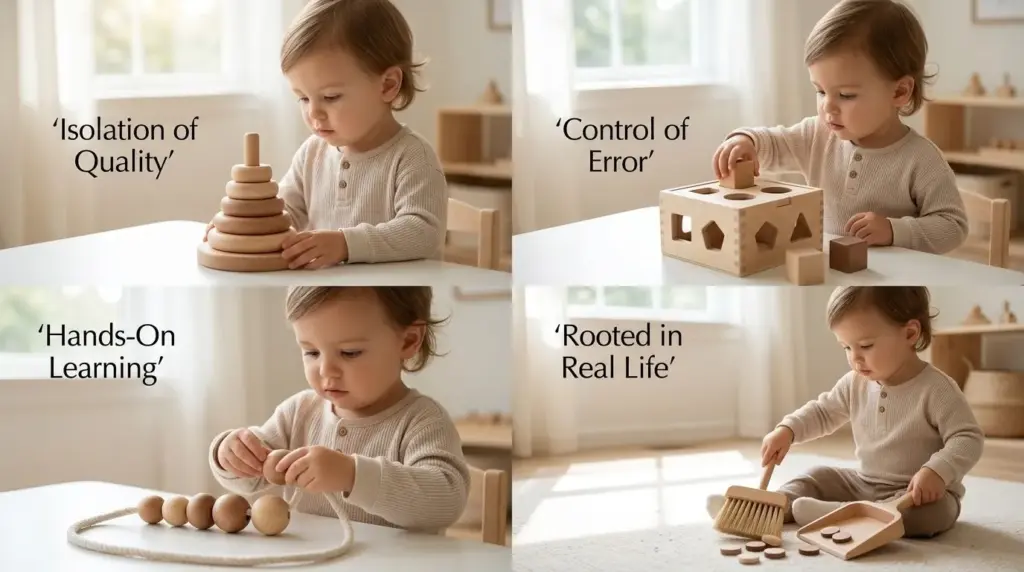
Montessori toys are different not because they look special, but because they’re designed to support how young children learn best: with focus, movement, repetition, and independent discovery. These four principles are a practical way for parents to evaluate any toy — before buying it.
- Isolation of Quality — one main skill at a time
- Control of Error — the toy helps the child self-correct
- Hands-On Learning — the child learns by doing, not watching
- Rooted in Real Life — the toy connects to reality and purpose
Principle 1: Isolation of Quality — One Main Skill at a Time
Isolation of Quality means a toy focuses attention on one clear concept or challenge instead of trying to teach many things at once.
What this means in plain language
One toy, one main job. The more features a toy tries to deliver simultaneously — colors, numbers, shapes, letters, and animal sounds all in one — the harder it becomes for a child to understand what they’re actually practicing. Simplicity here isn’t boredom. It’s instructional clarity.
When a toy isolates a single challenge, children can repeat it enough times to develop genuine mastery. Repetition is how young children build concentration and competence — and that’s only possible when there’s one clear thing to repeat.
What it looks like in Montessori-aligned toys
- A simple wooden stacker — one skill: building in sequence by size
- A shape sorter with four or five distinct forms — one skill: matching shape to opening
- A basic knob puzzle — one skill: spatial orientation and fine motor placement
- An object permanence box — one skill: cause and effect, object persistence
Each of these is intentionally constrained. That constraint is a feature, not a limitation.
Red flags that weaken this principle
- “Teaches colors, numbers, shapes, letters, AND animals!” in the product description
- A busy board with unrelated tasks — latch, abacus, clock, xylophone, spinner, and mirror all on one surface
- Toys with multiple “modes” or “lessons” layered on top of each other
A useful test: ask what is the one main thing this toy helps my child practice? If you easily name three or four lessons, the toy is likely too scattered to support deep focus.
A Montessori-aligned toy usually teaches less at once so a child can learn more deeply.
Principle 2: Control of Error — The Toy Helps the Child Self-Correct
Control of Error means the material itself gives the child feedback, so they can notice mistakes and correct them without depending on an adult to say “right” or “wrong.”
What self-correction looks like in practice
- A puzzle piece that only fits one way — the shape itself tells the child if they’re wrong
- A graded stacker that wobbles when built in the wrong order — physics provides the feedback
- An object permanence box where the ball either drops through or it doesn’t — immediate, visible result
- A cylinder block where cylinders don’t seat flush if placed incorrectly — the child sees it without being told
The feedback is built into the design, not delivered by an adult or an electronic sound.
Why this matters more than it might seem
When the material corrects rather than the adult, several things change. Mistakes become information rather than embarrassment. The child stays engaged longer because they’re problem-solving, not waiting for approval. Independence grows because the child doesn’t need to look up for a reaction. And adults can step back — genuinely — because the toy is doing the teaching.
In Montessori classrooms, this is one of the defining features of authentic materials — consistently identified in the American Montessori Society’s research literature as central to effective Montessori design. A toy that requires an adult to evaluate every attempt isn’t really supporting independence — it’s just supervised play.
What is not true self-correction
- Flashcards that require adult evaluation: “Is this right, Dad?”
- Toys that play a cheerful sound randomly, regardless of whether the child succeeded
- Puzzles that can be forced together incorrectly — the child completes it “wrong” and never knows
| Adult-corrected learning | Self-correcting learning |
|---|---|
| Child looks to parent for evaluation | Child looks to the material for feedback |
| Mistakes trigger adult response | Mistakes trigger another attempt |
| Builds dependence on external approval | Builds confidence and independence |
The distinction matters practically: if a child needs an adult present to know whether they got something right, the toy is not truly teaching independence.
A strong Montessori toy builds confidence by helping children discover and fix mistakes themselves.
Principle 3: Hands-On Learning — The Child Learns by Doing, Not Just Watching
Hands-on learning means the child has to physically act on the toy to create the result. Their hands, attention, coordination, and movement are part of the learning itself.
Why the hands matter in Montessori
Maria Montessori observed that young children think through their hands — that purposeful physical manipulation is not just a vehicle for learning but an integral part of it. Modern neuroscience supports this: fine motor actions engage the brain in ways that watching or listening alone cannot replicate. The toys that specifically build fine motor capacity — from grasping through writing readiness — are mapped by developmental stage in our skill guide.
When a child threads a bead, stacks a ring, or fits a piece into a puzzle, they are building neural connections between what they see, what they intend, and what their hands do. That connection — built through repetition and physical effort — is what makes learning stick.
What hands-on learning looks like in practice
Activities that genuinely engage the hands in Montessori-aligned ways: stacking, threading, pouring, tracing, fitting, balancing, transferring, opening and closing. The child is producing the outcome through their own physical action.
Examples of toys that support this:
- Bead threading — hand-eye coordination, sequencing
- A basic pouring set — control of movement, cause and effect
- Lacing cards — fine motor precision, sequencing
- Shape posting toys — spatial reasoning, hand control
- A balancing toy — weight distribution, concentration
When a toy becomes passive
A toy that performs when the child presses a button is a different kind of experience — the child triggers something, but the toy does the work. Watching is not the same as doing. When the toy entertains, the child can become a spectator even while physically present. The question to ask: Is the child producing the result, or is the toy performing it?
In Montessori, the child should be the active agent. The toy should invite action, not replace it.
Principle 4: Rooted in Real Life — The Toy Connects to Reality and Purpose
A Montessori-aligned toy is usually connected to something real: a real-world object, a meaningful daily skill, or a clear concept the child can relate to beyond the toy itself.
Why real life matters in early childhood
Young children are building their understanding of the world by observing it, participating in it, and imitating the people around them. They are drawn — naturally and powerfully — to what adults do. Sweeping, pouring, caring for plants, opening containers, preparing food. These aren’t just tasks; they’re the architecture of daily life, and children want to be part of them.
Montessori materials tap into this drive by making the activity meaningful, not just stimulating. A child pouring water from a small pitcher isn’t just building hand control — they’re participating in a real skill that connects to how their household actually functions. This is exactly the mechanism behind practical life activities — and why real tasks develop real capacity in ways that educational replicas can’t.
What “real life” means for toys
It doesn’t mean joyless or purely utilitarian. A toy can be beautiful, visually appealing, and deeply enjoyable and still be rooted in real purpose. The point is that the activity connects to something the child encounters and cares about outside of play.
Examples:
- A simple child-sized broom — care of environment, real skill
- A latch board with real door fasteners — practical life, cause and effect
- Realistic animal or food puzzle — vocabulary, classification
- A small pouring set — daily life skill, motor control
- Dressing practice — direct preparation for real independence
Fantasy-heavy toys: a realistic perspective
Not every imaginative or fantastical toy is a poor choice. But for younger children especially, Montessori-aligned materials tend to start with reality before moving toward abstraction. A three-year-old benefits more from matching real fruit images than from matching cartoon animals — not because imagination is bad, but because the connection to real life deepens the learning. Ask: does this connect to something real my child sees or does? Is there a meaningful skill here?
The strongest Montessori toys feel meaningful because they connect to the child’s real world, not just to novelty.
Montessori Toy vs. Regular Educational Toy: What’s the Difference?
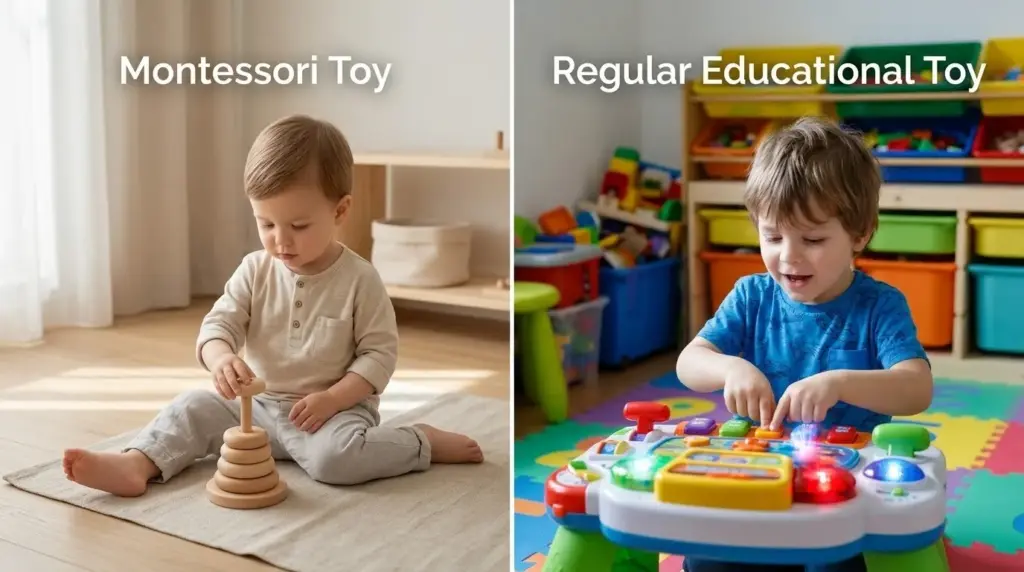
Understanding the distinction helps clarify what Montessori design is actually trying to do.
- Regular educational toys are often designed to teach content: letters, numbers, colors, shapes. The goal is information delivery. The child interacts with the toy to receive information — usually with adult guidance or electronic feedback confirming correct answers.
- Montessori-aligned toys are designed to build capacity: concentration, coordination, independence, persistence, and self-correction. The goal is not information delivery but developmental readiness. The child interacts with the material to practice a skill, discover a pattern, or master a challenge.
| Montessori-aligned toy | Regular educational toy |
|---|---|
| One main challenge | Multiple lessons at once |
| Feedback from the material | Feedback from adult or toy sound |
| Child actively manipulates | Toy often performs |
| Connected to real use or concept | Often entertainment-led |
| Builds process skills | Teaches content directly |
The simplest way to frame the difference: a regular educational toy asks, “What information can we give the child?” A Montessori toy asks, “What can the child discover and master through this material?”
For a deeper look at how these principles connect to the broader educational approach, the Montessori method guide covers the full philosophy and science behind child-directed learning.
Apply the 4 Principles: 3 Real-World Examples
Example 1 — A “Montessori” Busy Board with 20 Activities
| Principle | Assessment |
|---|---|
| Isolation of Quality | Weak — no single focus |
| Control of Error | Mixed — some tasks self-correct, many don’t |
| Hands-On Learning | Strong — lots of physical engagement |
| Rooted in Real Life | Mixed — some relevant, some not |
Verdict: Useful for occupying hands and introducing fine motor work, but the lack of focus means it works more like a collection of mini-activities than a purposeful Montessori material. Not a first-choice Montessori-aligned option, but not without value either.
Example 2 — A Simple Wooden Stacker (Graded Rings)
| Principle | Assessment |
|---|---|
| Isolation of Quality | Strong — one skill: size sequencing |
| Control of Error | Strong — wobbles or doesn’t complete when wrong |
| Hands-On Learning | Strong — full hand engagement required |
| Rooted in Real Life | Moderate — abstract, but purposeful and focused |
Verdict: A strong Montessori-aligned example. The design stays simple, the error is visible, and the challenge scales with the child. This is exactly what Montessori materials are designed to be.
Example 3 — An Electronic “Montessori” Learning Tablet
| Principle | Assessment |
|---|---|
| Isolation of Quality | Weak — multiple content areas, switching modes |
| Control of Error | Weak — feedback is electronic, not material-based |
| Hands-On Learning | Weak — screen tapping replaces physical manipulation |
| Rooted in Real Life | Weak — 2D symbol interaction, not real-world connection |
Verdict: This is label-first marketing. The design does not reflect Montessori principles regardless of how it’s positioned on packaging.
Now That You Know the Principles — How to Apply Them When Shopping
Understanding what makes a toy Montessori is the first step. The next is knowing how to use these principles when you’re actually evaluating options — by your child’s developmental stage, by skill, and by what’s worth buying versus what’s just a label.
For that, the complete Montessori toys buyer’s guide walks through how to choose authentic Montessori materials across age groups, common shopping mistakes to avoid, and what to look for in real products. The four principles above are the foundation — that guide is where they become a practical shopping framework.
Where Parents Often Get Confused
- “But it’s wooden — isn’t that enough?” No. Wood helps because of its tactile and weight properties, but design determines whether a toy is Montessori-aligned. An elaborate wooden toy with multiple electronic features and no clear focus fails the principles regardless of material.
- “My child loves lights and sounds. Does that mean Montessori toys won’t work?” Children can enjoy stimulating toys and still benefit meaningfully from calmer, more focused materials. These serve different purposes. Montessori-aligned toys are not competing with entertainment — they’re building different capacities.
- “Do Montessori toys have to be open-ended?” No, and this is a common misconception. Some of the strongest Montessori materials are precisely bounded — a cylinder block has one correct configuration. “Open-ended” is not the defining marker; focused, self-correcting, hands-on engagement is.
- “Can a toy still be useful even if it isn’t perfectly Montessori?” Absolutely. This framework is a filter for better choices, not a checklist for perfection. A toy that scores three out of four principles is still a good toy. The goal is to make more intentional decisions, not to discard everything imperfect.
Frequently Asked Questions About Montessori Toys
- What makes a toy authentically Montessori? A Montessori-aligned toy reflects four design principles: one main skill at a time, self-correcting feedback from the material, active use of the hands, and a meaningful connection to real life. A toy that reflects all four is authentically aligned; one that reflects only one or two is at most inspired.
- What is control of error in a Montessori toy? Control of error means the toy itself gives the child feedback about mistakes. A puzzle piece that doesn’t fit, a stacker that wobbles when built incorrectly — these are built-in corrections that let the child self-adjust without needing an adult to say “wrong.”
- How is a Montessori toy different from a regular educational toy? Regular educational toys often focus on delivering content — letters, numbers, colors. Montessori toys focus on building capacity: concentration, coordination, independence, and self-correction through purposeful interaction. The difference is between teaching information and developing the child who will later work with that information.
- Are battery-powered toys always non-Montessori? Not automatically, but most are less aligned because they add external stimulation and reduce the child’s active role. The question is whether the toy supports focused, hands-on, independent exploration — and most battery-powered toys don’t prioritize that.
- Can plastic toys be Montessori? Sometimes. The bigger question is whether the design supports the principles, not what material it uses. Some simple plastic items may be perfectly Montessori-aligned; many wooden ones are not.
- Do Montessori toys have to be open-ended? No — this is a common misconception, and one of many places where what Montessori at home actually requires differs sharply from what gets sold as necessary. Some of the strongest Montessori materials are precisely bounded. A cylinder block has one correct configuration. “Open-ended” is not the defining marker; focused, self-correcting, hands-on engagement is.
The 4 Principles Are Your Filter — Use Them Every Time
A toy is not Montessori because it’s wooden, beige, expensive, or labeled that way on the box. What matters is whether it’s designed to help a child focus on one skill, notice and correct mistakes independently, learn through their hands, and connect to something real and meaningful.
Every time you encounter a toy, run it through the four principles:
- Does it focus on one main skill?
- Does it help the child self-correct?
- Does it require the child to learn by doing?
- Does it connect to real life and meaningful purpose?
The more clearly a toy answers yes to those four questions, the more authentically Montessori-aligned it is — regardless of what the packaging says.
Now that you understand what makes a toy Montessori, the next step is applying that knowledge when you’re actually shopping — by age, by skill, and by what’s genuinely worth buying.
Browse Montessori-aligned toys by developmental stage at Kukoo Montessori — organized by age, skill, and category.