
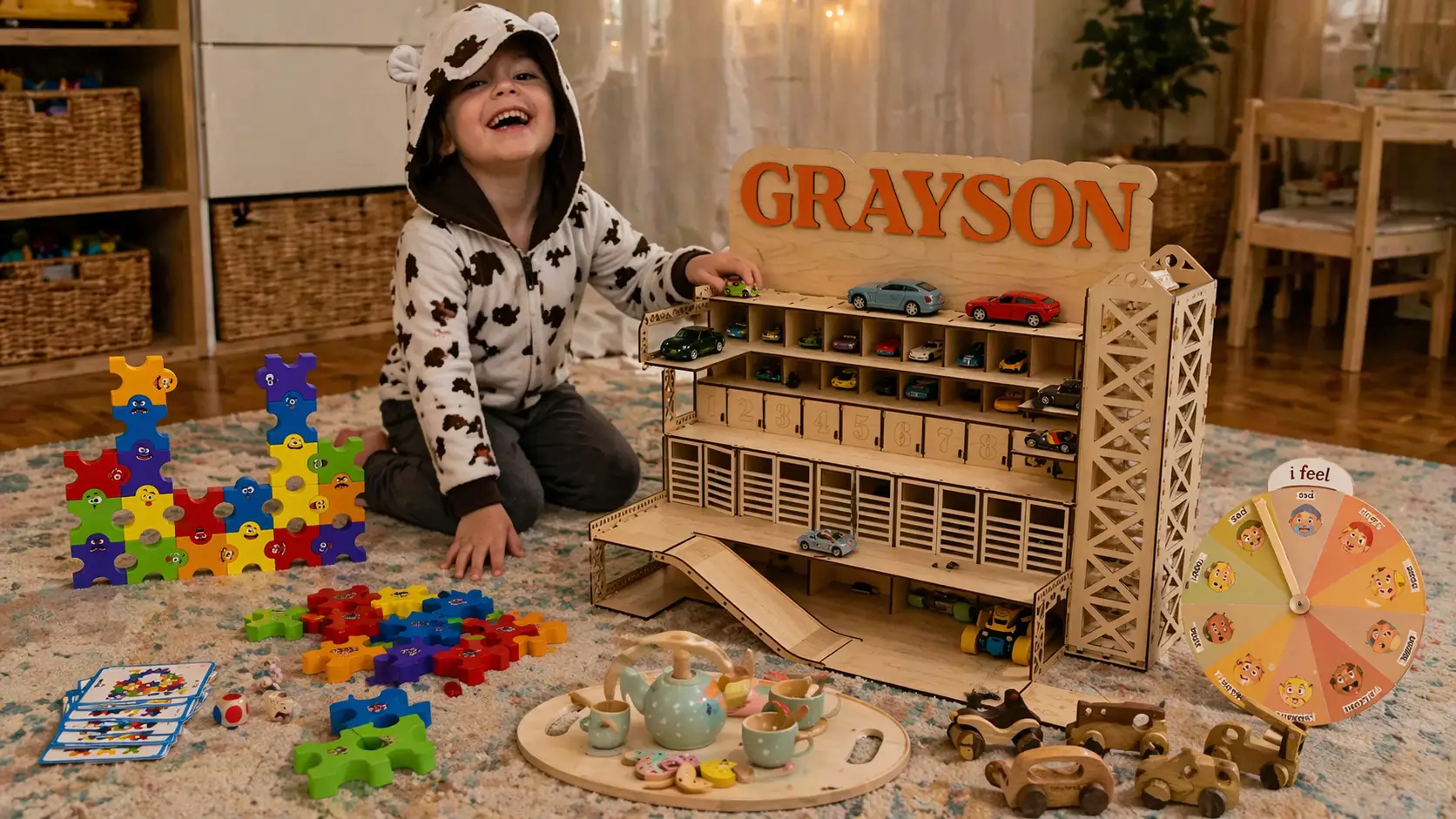
Five is the last year of the First Plane of Development — the six-year window Montessori identified as the most important in a child’s life. At 5, normalization is often occurring: sustained voluntary concentration, care for the environment, real collaborative play with social rules. The toys that work at 5 are not louder or flashier versions of 4-year-old toys — they are more complex, more collaborative, and more socially sophisticated.
| Best Montessori toys for 5-year-olds (summary): The best Montessori toys for 5-year-olds respond to the advanced developmental capacities of this age: early STEM and engineering thinking, fully collaborative rule-based play with peers, sophisticated emotional intelligence (causes and solutions for feelings, not just naming them), vocabulary expansion through real-world categorization, and the creative narrative complexity that arrives when symbolic thinking is at full maturity. 1. Wooden Car Garage with Ramp 2. 8-Vehicle Traffic Kit Toy 3. Wooden Excavator Toy 4. Multicolor Balancing Stones 5. Cube Face Change Building Blocks 6. Montessori Wooden Musical Instrument Set 7. Wooden Tea Party Toy Set 8. Wooden Emotion Wheel 9. Emotion Faces Wooden Puzzle Blocks |
Your 5-year-old has strong opinions about how the game should be played, who gets which role, and what the rules are. They also have the concentration to spend 45 minutes on something that genuinely interests them — and the social sophistication to negotiate, cooperate, and disagree verbally rather than physically. These are not small changes from age 4. These are the signals that the First Plane of Development is completing, and the right toys at this moment look completely different from what worked at 3 or 4. These toys are the materials — the activities that match the consolidation year and reading explosion at 5 show how each capacity translates into daily curriculum work across language, math, and practical life.
Five is the year when STEM thinking becomes genuinely collaborative (build WITH someone, not just in parallel), when emotional intelligence moves from recognizing feelings to understanding their causes and solutions, and when vocabulary and real-world knowledge expand fast enough that precise naming — excavator, not just ‘digger’ — is genuinely satisfying. Every material in this guide belongs to the final stretch of the First Plane — and you can find all of them alongside the rest of the 3–6 range in our wooden Montessori toys for 3–6 year olds collection.
The 9 Best Montessori Toys for 5-Year-Olds
Nine picks, nine developmental domains. Each evaluated with the same framework used across the entire Kukoo age-guide series: who it’s best for, why it works at this specific stage, and what to know before buying.
1. Wooden Car Garage with Ramp — Best for Engineering Thinking + Collaborative Play

⭐ 4.94 | $300.99
- BEST FOR: Five-year-olds who’ve graduated from single-player vehicle exploration and now build elaborate scenarios — assigning roles (“you’re the mechanic, I’m the driver”), planning multi-step sequences, and sustaining shared fiction for 30–40 minutes with another child.
- WHY IT WORKS: Multi-level wooden garage with a ramp system — no electronics, fully child-directed. The ramp introduces physics a 5-year-old is specifically ready to investigate: angle affects speed, speed affects stopping distance. This is early engineering thinking — physically verifiable through repeated experimentation. The collaborative dimension is equally important: two 5-year-olds at a car garage are negotiating roles, following shared rules, and maintaining coherent shared narrative — exactly the collaborative capacity defining this age. Harvard’s framework for executive function identifies cognitive flexibility — the capacity to shift perspective, hold multiple viewpoints, and adjust plans — as one of the three core executive capacities, and collaborative narrative play is one of its most natural developmental exercises at 5.
- GOOD TO KNOW: At $300.99, the premium pick. This is a distinct product from the garages in the 3yr and 4yr guides — different ramp architecture, different complexity level. Families report 30–45 minute sessions. The longevity of a well-designed wooden garage is 3–4 years of progressively sophisticated play.
2. 8-Vehicle Traffic Kit Toy — Best for STEM Vocabulary + Categorization

⭐ 5.00 | $40.99
- BEST FOR: Five-year-olds in the taxonomy phase — the child who wants to know the difference between a dump truck and an excavator, asks why different vehicles have different functions, and is ready for precise vocabulary.
- WHY IT WORKS: Eight wooden vehicles, each a distinct type, presented as a complete kit inviting categorization, sorting, and real-world connection. A 5-year-old can hold 8 vehicle types in working memory, sort them by function (“which ones dig? which ones carry?”), and use the precise vocabulary the closing sensitive period for language is requesting. The CDC’s 5-year milestone checklist includes counting to 10, sorting by category, and using future tense — all three of which the 8-vehicle traffic kit exercises through purposeful play rather than direct instruction. The kit format invites collaborative construction site scenarios where each vehicle has a job and a driver. The concrete-to-abstract math connection: 8 vehicles can be sorted, counted, compared — number work disguised as vehicle play.
- GOOD TO KNOW: Perfect 5.00 rating. At $40.99, strongest value-per-developmental-impact after the Emotion Wheel. Pairs naturally with the Excavator and Car Garage for a full construction setup.
3. Wooden Excavator Toy — Best for Construction STEM + Real-World Vocabulary

⭐ 5.00 | $35.99
- BEST FOR: Five-year-olds beyond “vehicle as moving object” play and ready for “vehicle as tool with a specific real-world job” — the child who asks what an excavator actually does on a construction site.
- WHY IT WORKS: A single wooden excavator, precisely detailed enough to model the real machine’s structure and function. At 5, the STEM taxonomy impulse demands the specific name (excavator), the specific function (dig, scoop, move material), and the specific design rationale (why is the arm jointed?). The single-vehicle format is intentional: one excavator invites deep investigation of one precise thing — how the 5-year-old’s focused mind prefers to work.
- GOOD TO KNOW: Perfect 5.00 rating. At $35.99, the most accessible STEM entry. Works standalone or as part of a construction fleet alongside the 8-Vehicle Traffic Kit. The precision vocabulary around construction equipment — excavator, bucket, arm, chassis — is part of the developmental value.
4. Multicolor Balancing Stones — Best for Physics + Creative Construction

⭐ 4.95 | $39.99
- BEST FOR: Five-year-olds who’ve moved beyond stacking as a physical challenge and now use balancing materials architecturally — building landscapes, creating scenes, testing structural combinations.
- WHY IT WORKS: Smooth wooden stones in varied sizes and colors — no prescribed outcome. At 5, what was balance-challenge play at 3 becomes architectural and investigative: the child builds a mountain landscape with stones, places vehicles at different points to test stability, and explores real physics questions about weight distribution. The color dimension adds a mathematical element — sorting, pattern creation, sequencing — that the 5-year-old’s mathematical mind pursues systematically. Control of error is physical: an unstable structure falls, revealing the physics without adult explanation.
- GOOD TO KNOW: The 4.50 rating reflects a smaller review sample. At $39.99, good value for an open-ended material serving multiple developmental domains. Pairs naturally with any vehicle or construction toy as a landscape base.
5. Cube Face Change Building Blocks — Best for Creative Building + Emotional Narrative

⭐ 4.97 | $45.99
- BEST FOR: Five-year-olds who build deliberately and narrate what they build — the child who constructs a structure and immediately assigns personalities, stories, and emotional states to the result.
- WHY IT WORKS: Wooden cubes with rotating face elements creating different emotional expressions — building and emotional storytelling happen simultaneously. At 5, building has full narrative complexity: the structure is a setting for characters who have feelings. By physically rotating a face from happy to sad, your child practices the mental modeling of emotion change — the cognitive skill underlying empathy. The multi-domain engagement (spatial construction + social-emotional cognition) is characteristic of materials producing the longest concentration sessions at 5.
- GOOD TO KNOW: Distinct from both the Emotion Faces Puzzle Blocks (#9) and the Emotion Matching Face Puzzle (4yr guide) — different format, different primary engagement. At $45.99, the dual-domain complexity justifies the price.
6. Montessori Wooden Musical Instrument Set — Best for Ensemble Play + Collaborative Music

⭐ 5.00 | $45.99
- BEST FOR: Five-year-olds ready to make music with someone else — the child who wants a “band,” assigns instrument roles, follows a rhythm together, and experiences the social dimension of musical collaboration.
- WHY IT WORKS: Complete wooden set of multiple instruments with varied timbres — no batteries. At 5, the critical advancement is the collaborative dimension: ensemble play requires listening to another player, matching tempo, taking turns, and sustaining a shared musical experience. Each instrument has its own technique (striking, shaking, scraping) developing varied fine motor patterns simultaneously. The instrument variety makes this a practical life activity: choosing, setting up the “concert,” and caring for instruments are all real-world competence.
- GOOD TO KNOW: Distinct from the Music Percussion Set (4yr) and Xylophone Toy (3yr) — different instruments, different collaborative emphasis. Perfect 5.00. At $45.99, solid value for a complete ensemble kit.
7. Wooden Tea Party Toy Set — Best for Social Hosting + Perspective-Taking

⭐ 5.00 | $35.99
- BEST FOR: Five-year-olds in the full height of collaborative social play — the child who enjoys hosting, thinks about what others might want, and can maintain a shared social script with another child for an extended period.
- WHY IT WORKS: Wooden tea set with cups, teapot, plates, and serving pieces — realistic enough for genuine social ritual, open-ended enough for creative narrative. At 5, the hosting dimension is developmentally significant: a host must hold the guest’s perspective (what does my guest want?), manage social convention (offer before serving, ask preferences), and maintain the fiction over time. This perspective-taking is the social-emotional milestone of age 5. The practical life element is real: pouring, carrying, serving, cleaning up. Distinct from the Cooking Set (3yr): cooking is practical life; tea party is social practice of a specific interpersonal ritual.
- GOOD TO KNOW: Perfect 5.00. At $35.99, tied for most accessible. The tea party format appears in Montessori environments globally because the social hosting script it practices is universal.
8. Wooden Emotion Wheel for Kids — Best for Emotional Sophistication + Cause-Solution Thinking

⭐ 4.75 | $35.99
- BEST FOR: Five-year-olds who’ve graduated from basic emotion naming and are ready for cause-solution emotional intelligence: understanding what causes a feeling, and what changes it.
- WHY IT WORKS: Wooden spinning wheel with emotion vocabulary, facial expressions, and discussion prompts — an interactive tool for emotional conversation. The social understanding that PNAS 2025 (Lillard et al.) found significantly stronger in Montessori children is in active development at 5: understanding that emotions have causes and solutions. Used in morning check-ins or after difficult moments, it builds the verbal-emotional habit that becomes self-regulation in school: “What am I feeling? What caused it? What might help?” This is the foundational skill behind the executive function predicting school readiness.
- GOOD TO KNOW: Different product from the Feelings Chart Wheel (3yr) — different format, different discussion prompts. At $35.99, tied for most accessible. Daily use produces compounding benefit — regular use changes behavior.
9. Emotion Faces Wooden Puzzle Blocks — Best for Building + Emotional Narrative + Social Cognition

⭐ 5.00 | $45.99
- BEST FOR: Five-year-olds who process emotions through storytelling — the child who creates characters, gives them emotional states, and uses narrative to explore why those characters feel what they feel.
- WHY IT WORKS: Wooden blocks featuring emotion faces across their surfaces — for building and for matching emotional expressions. At 5, the child builds structures and assigns characters with emotional histories (“this one is sad because they lost something important”). This is narrative-based social cognition — the ability to attribute mental states to characters and reason about what they might feel and why. Developmental psychologists call this theory of mind, and it is fully operational at 5 in most children. A material that lets the child physically build, then emotionally reason about the characters they’ve built, serves both the spatial-constructive drive and social-cognitive capacity simultaneously.
- GOOD TO KNOW: Perfect 5.00. Distinct from the Emotion Matching Face Puzzle (4yr) and Cube Face Change Blocks (#5) — different format, different primary engagement. At $45.99, the most nuanced social-emotional pick — specifically more valuable at 5 than at any earlier age.
How to Choose the Right Starting Point
With nine picks covering different domains, the most useful question isn’t “which is best” — it’s “which matches what my 5-year-old is showing me right now.” The age-organized collections filter every product by developmental stage — so the full range beyond these 9 picks is already matched to what a 5-year-old is actively building.
- The child asking “what is that?” about every vehicle → Start with the 8-Vehicle Traffic Kit + Wooden Excavator. The taxonomy drive is active; precise naming is the priority.
- The child wanting to play WITH someone constantly → Start with the Car Garage with Ramp or Tea Party Set. Collaborative play structures are what they need right now.
- The child whose big feelings become big behaviors → Start with the Emotion Wheel. Daily use builds the cause-solution language they need before the moment of dysregulation.
- The child who builds everything and narrates constantly → Start with Cube Face Change Blocks or Emotion Faces Puzzle Blocks. The narrative + building combination is exactly the developmental work they’re doing.
- The child who hums while working and taps rhythms on everything → Start with the Musical Instrument Set. The auditory and collaborative music drive is the active sensitive period.
For the shelf: Never put all nine out simultaneously. Three to four at a time, matched to what your child is currently working on, rotated when engagement drops.”
What Makes 5 Different — The End of the First Plane
Five is not 4-with-more-vocabulary. It is the closing of Montessori’s First Plane of Development — and the developmental portrait at this age is genuinely different from any earlier year.
- Normalization is occurring. The self-directed, concentrated, intrinsically motivated work that Montessori called normalization is often first clearly visible at 5 — the child who chooses, concentrates, completes, and returns without adult management.
- Collaborative play is fully engaged. At 3–4, children play alongside each other. At 5, they play with each other — negotiating roles, following shared rules, and maintaining collaborative fiction together over extended sessions.
- Emotional sophistication moves to causes and solutions. The 5-year-old can do more than name feelings: they can discuss what caused the feeling and what might change it. This is the beginning of genuine emotional intelligence.
- STEM taxonomy arrives. An excavator is not “a digger” — it has a specific name, a specific job, a specific relationship to other construction vehicles. This precision is neurologically driven.
- Vocabulary and naming are intrinsically satisfying. The sensitive period for language is closing its primary window. Precise vocabulary produces deep engagement because naming is developmentally rewarding at exactly this age.
- Early academic skills are emerging. Reading some letters, writing some letters, basic addition with objects — ready to be invited, not forced. The right toy provides the concrete context for early abstract learning.
The buying implication: A toy that matches any of these six capacities produces the sustained engagement defining this age. A toy duplicating what worked at 3 will be met with the honest assessment of a 5-year-old: “this is for babies.”
| Five is my favorite age to observe in a prepared environment because the normalization signal is often unmistakable: the child who chooses their own work, concentrates for 30–40 minutes without adult involvement, returns the material, and moves to the next chosen activity without any direction. The toys that produce that level of engagement at 5 have one thing in common — they match the complexity the 5-year-old’s brain is ready for, not the complexity of the year before. – Katy Lenoir, Preschool & Elementary Expert (Ages 3–12) |
What NOT to Buy a 5-Year-Old
Five-year-olds will tell you clearly when a toy is wrong for them. Here is what to skip.
- Toys with only one correct outcome. At 5, the logical mind tests rules and variations. A single-answer toy is “solved” in minutes. Open-endedness is not optional at this age — it’s the reason for sustained engagement.
- Passive entertainment disguised as educational. Any toy where the child watches rather than does. Electronic learning apps, animated videos, battery-powered “teaching” toys — these occupy attention without developing anything at 5.
- Toys below developmental level. The 5-year-old who says “this is for babies” is being accurate. Simple shape sorters, single-ring stackers, basic cause-effect toys — these are 2-year-old work.
- Single-player versions of what’s now a collaborative drive. At 5, the child who used to play alone is now seeking a partner. A material with no collaborative dimension works against the developmental current.
Why These Materials Are Built for This Age
All nine picks share the same construction standards — because at 5, daily intensive use over 12+ months demands it.
- FSC-certified solid wood — the weight and texture that plastic cannot replicate; natural materials register differently in a child’s hand.
- Water-based, non-toxic finishes — ASTM F963 and EN71 certified; safe for the handling still common at 5.
- No batteries, no electronics — every result is entirely your child’s doing.
- Designed for years, not months — the Car Garage that serves a 5-year-old differently than a 7-year-old is not a different toy; it’s the same material meeting a different developmental moment.
Frequently Asked Questions
- What are the best Montessori toys for a 5-year-old?
Toys responding to the developmental priorities of this age: STEM taxonomy and engineering thinking (wooden car garage with ramp, 8-vehicle traffic kit, wooden excavator), creative construction with narrative complexity (cube face change building blocks, balancing stones, emotion faces puzzle blocks), collaborative social play (tea party set, musical instrument set), and sophisticated emotional intelligence with cause-solution thinking (wooden emotion wheel). The key distinction from 4-year-old toys: complexity, collaboration, and precision vocabulary.
- How is 5 developmentally different from 4 for toy selection?
Four-year-olds are entering the logical mind phase — they want rules and structured play. Five-year-olds have consolidated that phase and are in its advanced expression: collaborative play with peers (not just adults), STEM taxonomy (knowing the difference between an excavator and a dump truck and why it matters), sophisticated emotional intelligence (causes and solutions, not just naming), and early academic readiness. A 4-year-old plays next to another child; a 5-year-old plays with one. That shift changes which toys produce the deepest engagement.
- What Montessori materials are used for 5-year-olds in classrooms?
In AMI-certified primary classrooms (3–6), 5-year-olds typically engage with: sandpaper letters and the moveable alphabet for phonics, bead chains for mathematical preparation, cultural materials including geography and science, practical life at full complexity (food preparation, sewing, care of environment), sensorial materials at advanced use (combining Pink Tower with Brown Stair), and increasingly collaborative work with mixed-age classmates. The home materials in this guide correspond to the cultural, language, practical life, and social-emotional dimensions of this curriculum.
- Are Montessori toys still worth it for a 5-year-old when school starts soon?
Yes — and specifically because school is starting soon. PNAS 2025 (Lillard et al., 588 children) found significantly stronger reading, memory, and executive function in Montessori-educated children — advantages built through exactly this type of hands-on, self-directed engagement. A 5-year-old with access to precise vocabulary materials, collaborative rule-following, self-regulation tools, and concentration-building activities arrives at kindergarten with the executive function and social-emotional foundation academic learning requires. The materials are the preparation, not a delay of it.
Follow the Child’s Current Investigation
Five is the last year of the First Plane, and the materials that match it differ from any previous year not because they’re harder but because they’re more collaborative, more precise, and more cognitively layered. The 5-year-old doesn’t need toys that teach — they need materials that meet the intelligence already there. Start with the domain your child’s behavior is showing you right now!
Happy Shopping,