
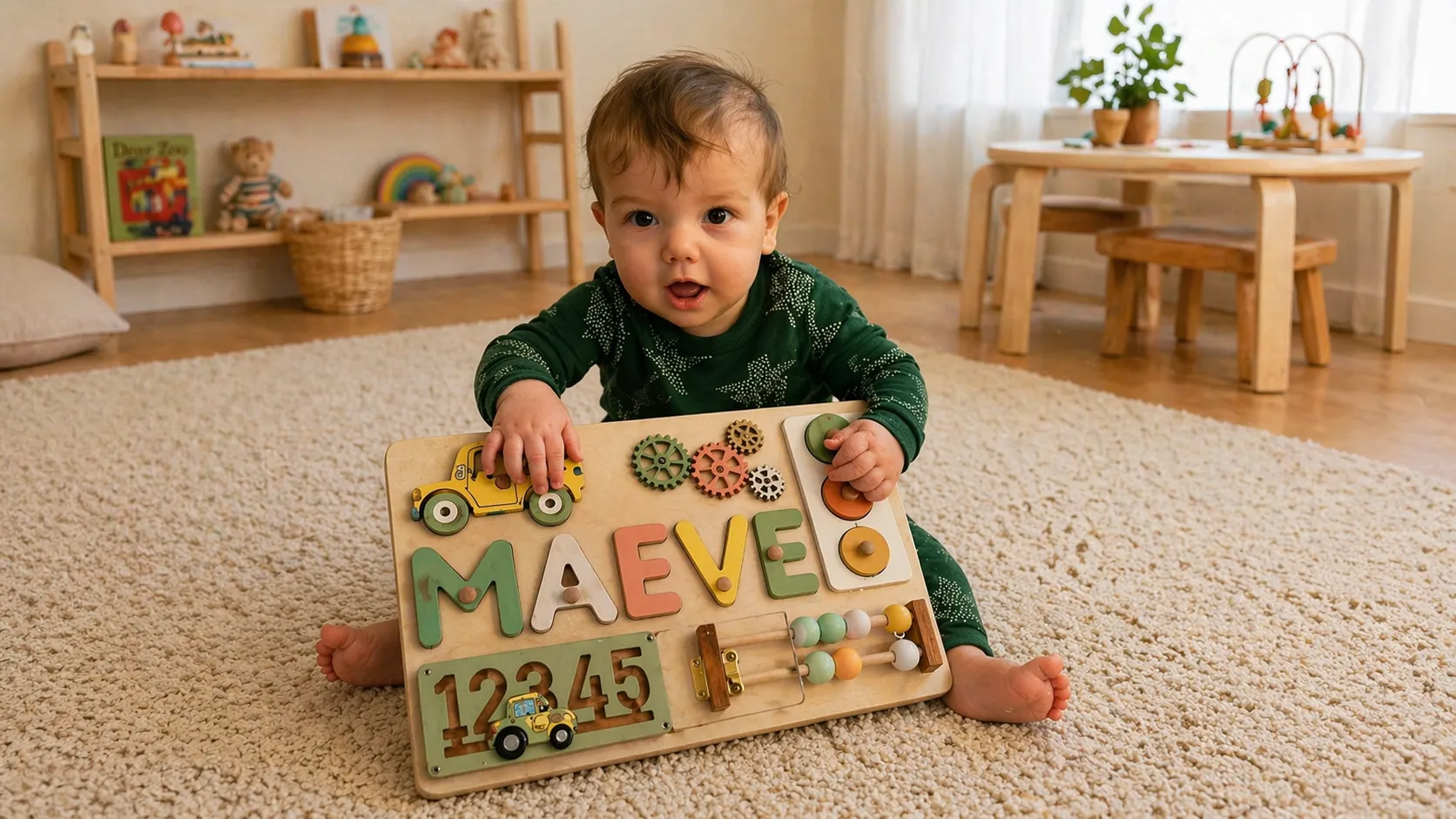
A busy board is one of the most searched toddler toys — and one of the most poorly explained. Most guides list benefits without telling you which specific movement develops which specific skill. This one does. It also covers the three types of busy boards, what a bad one looks like, whether they’re actually Montessori, and the one question nobody asks: how do you know when your child has outgrown it?
Your toddler is trying to open every door latch, unzip every bag, and undo every button they can find — while you chase behind them redirecting toward “appropriate” activities. What if the thing they’re compulsively trying to open was actually the activity?
A busy board is exactly that: a safe, purposeful outlet for the investigation drive that makes toddlers undo every fastener in your home. This guide covers what each element is actually teaching, the three types to choose from, what age makes sense, what to look for — and avoid — when choosing one.
What Is a Busy Board?
A busy board is a wooden activity panel featuring real-life mechanical elements — latches, zippers, buckles, bolts, gears, and maze sliders — that children manipulate independently to develop fine motor skills, hand-eye coordination, cause-and-effect understanding, and the practical dressing skills they will use daily. Unlike passive toys, every element on a busy board requires a specific hand movement and produces a specific mechanical result, making it one of the most skill-dense single toys available for children between 12 months and 4 years.
The child operates each element independently: no battery response, no automated feedback, no adult required. The board provides the challenge; the mechanism provides the self-correcting result.
| Mechanism | Hand Movement Required |
| Bolt latch | Push-slide with force calibration |
| Zipper | Pincer grip + directional pull |
| Side-release buckle | Press-release bilateral coordination |
| Spinning gear | Rotational push, continuous |
| Bead slider | Directional left-right slide |
| Elastic band lacing | Pinch + pull, bilateral stretch |
| Maze slider | Directional guidance, sustained control |
| Shoelace board | Loop, cross, bilateral fine motor sequencing |
The common thread: Every mechanism has a “done” state — the latch clicks open, the zipper reaches the end, the bead slides to position. That definitive completion state is the built-in feedback that makes the busy board work developmentally without adult confirmation.
| In my work with toddlers, the busy board is the activity that most consistently produces the sustained 10–15 minute concentration windows parents are trying to create. The reason isn’t that it keeps toddlers ‘occupied’ — it’s that every mechanism on a quality board is operating at exactly the developmental challenge level the child’s hands are currently seeking. – Zoe Paul — Infant & Toddler Expert (0-3) |
Types of Busy Boards
Not all busy boards serve the same purpose. Understanding the three main types helps you choose based on what your child needs right now. A busy board is one category within the broader Montessori toys by category framework — each category targets different developmental domains, and busy boards specifically serve the fine motor and practical life channels.
Type 1 — Skill-Focused Boards
Concentrate on specific mechanism categories — a board dedicated to dressing closures (zips, buckles, laces) or one focused on rotational and motion mechanisms (gears, maze slider, bead slider). AMI’s guidelines for Practical Life activities include dressing frames — boards isolating a single fastener type for repeated practice — as foundational Care of Self materials. A quality busy board extends this principle by combining multiple fastener types with a Montessori-consistent design: real mechanisms, self-correcting outcomes, child-directed use. A dressing-focused board like Kukoo’s Zips & Buckles busy board puts zipper, buckle, and latch on a single panel so every mechanism reinforces the same grip family. Best for: targeting a particular fine motor gap, or for a child in the early stages of a specific mechanism type.
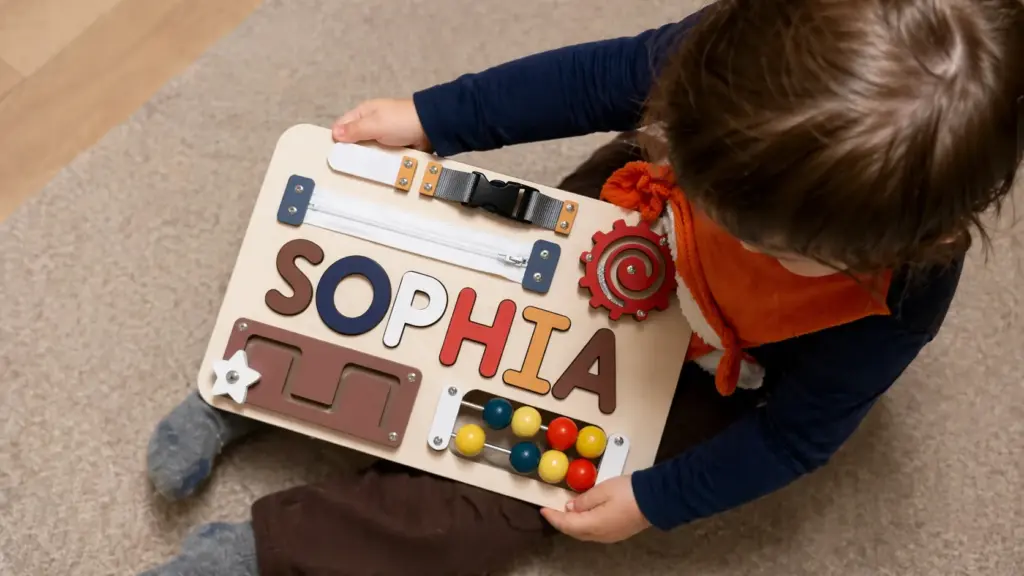
Zips & Buckles – Wooden Montessori Busy Board
Type 2 — Themed Boards
Combine mechanisms with a visual narrative — vehicles, animals, nature, transport. The theme gives your child a context for engagement: the gear is a wheel, the latch is a door, the bead slider is a road. The theme doesn’t change the developmental work of the mechanisms — but it significantly increases initial engagement and sustained interest for children who connect through story and imagination. Best for: children 18 months–3 years in the symbolic play window.
Type 3 — Personalized Boards
Include your child’s name or photo engraved or embedded into the board design. A board like Kukoo’s Photo & Name busy board combines both — the child sees their own face and letter shapes together, reinforcing self-recognition alongside early literacy through daily handling.
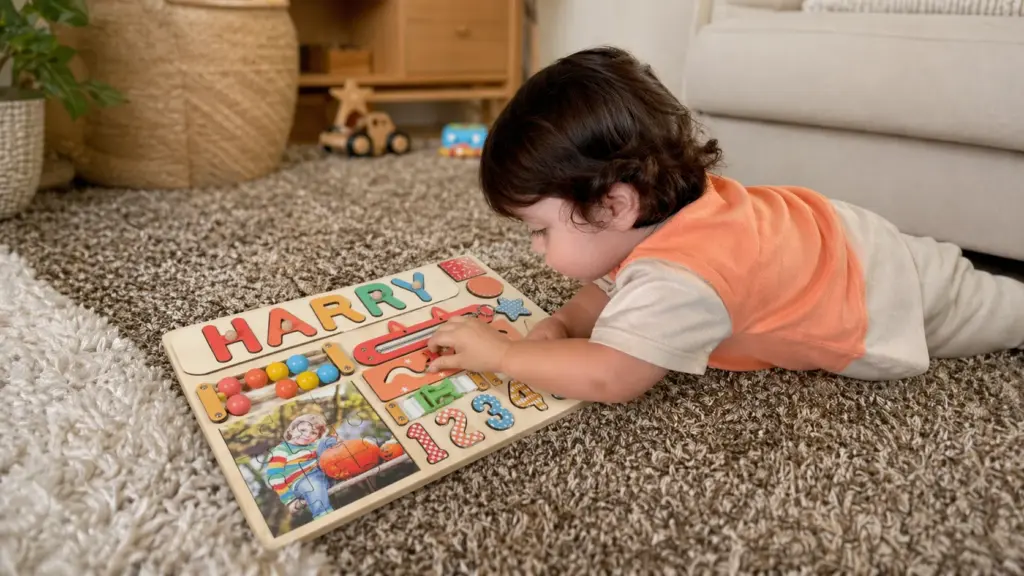
Photo & Name – Wooden Montessori Busy Board
Name recognition through daily handling adds an early literacy dimension — similar to what a personalized name puzzle provides, your child sees, touches, and begins identifying the letter shapes of their own name. A personalized board also creates stronger ownership and motivation: this board is explicitly mine. Best for: gifting, and specifically for children between 18 and 30 months in the vocabulary explosion window.
Busy Board Benefits: 6 Developmental Skills With Specifics
Every article about busy board benefits says “fine motor skills” and “problem-solving.” Here is what those actually mean — which specific muscles, which specific cognitive process, and which later skill each benefit directly prepares.
Benefit 1 — Fine Motor Precision
The mechanisms on a busy board require grip patterns that collectively develop every aspect of the tripod grip — the three-finger hold that fine motor skill development through purposeful hand work depends on. A zipper demands pincer grip with directional tracking. A maze slider requires sustained force control while guiding a knob through a path. A shoelace board requires bilateral looping and crossing — the most complex fine motor sequence available to a toddler. Each mechanism is a different fine motor drill disguised as a mechanical puzzle.
Benefit 2 — Bilateral Coordination
Most busy board mechanisms require both hands working simultaneously in different roles: one hand stabilizes the board, the other operates the mechanism. A side-release buckle requires one hand to hold the strap taut while the other presses the release. An elastic lacing board requires one hand to anchor while the other threads and pulls. This bilateral differentiation is the coordination pattern required for handwriting, scissors use, food preparation, and most complex real-world fine motor tasks. The CDC’s 18-month milestone checklist includes children helping with dressing by lifting a foot and copying adults doing chores — both actions requiring exactly this bilateral differentiation, which busy board practice directly builds from 12 months onward.
Benefit 3 — Cause-and-Effect Understanding
Every mechanism on a quality busy board produces a visible, satisfying result — not an automated electronic response, but a direct mechanical consequence of your child’s specific action. The latch opens because they pushed it correctly. The zipper travels because they applied the right direction and force. The result is 100% their doing.
Benefit 4 — Practical Life Preparation
Every mechanism corresponds to a real fastener your child will encounter in daily life — the same practical life skills that Montessori classrooms build through dressing frames and food preparation. The zipper on the board at 18 months becomes the jacket zipper at 3 years. The buckle on the board at 2 — when your child is ready for the bilateral coordination that Montessori toys for 2-year-olds are built around — becomes the car seat buckle at 3–4. Practical life skills transfer directly from board practice to real-world independence — the full self-dressing timeline is covered below.
Benefit 5 — Sustained Concentration
The American Academy of Pediatrics’ clinical report on play and early brain development confirms that hands-on, child-directed play builds exactly the executive function and self-regulation skills that sustained concentration depends on — and a correctly chosen busy board with 5–8 mechanisms at the right challenge level is one of the most reliable ways to produce those 10–15 minute concentration windows. Harvard’s research on executive function identifies inhibitory control — the ability to stay with a task and resist distraction — as one of three core executive capacities that develops through repeated practice in exactly the kind of sustained, self-directed work a busy board produces. Each mechanism is a micro-challenge at the appropriate difficulty level. The board never runs out of challenge in a single session.
Benefit 6 — Independence and Self-Efficacy
The busy board requires no adult facilitation after the initial presentation. Your child approaches, chooses a mechanism, works it, experiences success or continued challenge, moves to the next. The mechanism confirms success — not the adult. This is self-efficacy built through physical evidence rather than praise.
Best Age for a Busy Board: By Developmental Stage
Most busy board guides say “suitable from 12 months+” and leave it there. The right mechanisms depend on which hand development stage your child is in — and the difference between a 14-month-old and a 30-month-old is not gradual, it’s categorical — and at this age, a busy board is just one of several wooden Montessori toys for 1-year-olds that target the pincer grasp your child is consolidating.
| Age | Hand Stage | Best Mechanisms | Avoid |
| 12–18 months | Pincer consolidating | Spinning gear, bead slider, bolt latch (large) | Buckles, zippers, shoelace |
| 18m–2.5 years | Pincer refining; wrist rotation developing | Bolt latch, zipper pull, maze slider, beginning buckle | Complex shoelace, elastic lacing |
| 2.5–3.5 years | Radial digital grip; bilateral coordination | All mechanisms; side-release buckle; full zipper; elastic lacing | Very simple boards (mastered too fast) |
| 3.5–5 years | Tripod emerging | Shoelace board, complex sequencing boards | Single-mechanism boards (mastered in seconds) |
The readiness signal: When your child approaches the board, works one mechanism to completion, and moves to the next — they are in the productive developmental window. When they complete the entire board in under 30 seconds without sustained engagement on any mechanism — they have outgrown it.
| The most common age question I get is whether a specific board is ‘too hard’ for an 18-month-old. My answer is: look at one mechanism, not the whole board. If there is at least one element they can work with sustained effort — that’s the entry point. Everything harder is next week’s challenge.– Zoe Paul — Infant & Toddler Expert (0-3) |
How to Choose a Busy Board: 4 Quality Criteria
The busy board market ranges from genuinely developmental to genuinely misleading. Four criteria separate the ones worth buying from the ones that will be abandoned in a week.
- Criterion 1 — Material: Wood, Not Plastic. Wooden toys provide natural temperature variation, real weight, and texture that plastic cannot replicate — feeding the sensory discrimination system when it is most active. When your child handles a wooden latch versus a plastic one, they receive richer proprioceptive and tactile information. Natural materials feed the sensory discrimination system when it is most active.
- Criterion 2 — Mechanism Count: 5–8, Not 15+. A board with 15+ elements is a visual overstimulation problem — your child cannot identify where to start, and the “done” state is never clear. Five to eight carefully chosen mechanisms at mixed difficulty levels produce longer sustained engagement than 15 mechanisms that overwhelm before the child begins.
- Criterion 3 — Real Hardware, Not Toy Simulations. A real functional latch that opens a panel. A real zipper with a real pull. A real buckle that clicks and releases. Toy-grade simulations that produce no genuine mechanical consequence miss the developmental point entirely — cause-and-effect understanding requires real physical consequence.
- Criterion 4 — Safety Certification. ASTM F963 (US) and EN71 (EU) are the minimum standards. Check for: no detachable small parts, non-toxic finish on all surfaces, and secure hardware mounting. A real latch that can pull away from the board base is a safety issue, not a developmental tool.
Is a Busy Board Really Montessori? The Honest Answer
Some Montessori educators say yes. Some say no. The answer is: it depends entirely on the board and how it’s used.
- The case FOR — when a busy board IS Montessori-aligned: The core Montessori principles a quality board satisfies — as defined by the Association Montessori Internationale — include real-world object engagement (real latches, real zippers, not toy simulations), child-directed independent work (no adult facilitation required after the first presentation), control of error built into the mechanism (the latch either opens or it doesn’t — self-correction without adult feedback), practical life preparation (direct correspondence to real dressing skills), and natural material construction.
- The case AGAINST — when it’s NOT: A board with 20 mechanisms crammed onto a single surface, battery-operated lights and sounds, and no clear mechanical consequence is not Montessori regardless of packaging claims. It is a stimulation machine, not a purposeful activity. This is the design failure some Montessori educators are objecting to — not the busy board concept itself.
The practical test: Replace “busy board” with “practical life dressing frame.” If the specific board passes that substitution — real materials, real mechanisms, real skill preparation, self-correcting by design — it is Montessori-aligned. If it fails — lights, sounds, or too many elements to focus on any one — it isn’t.
Mechanism-by-Mechanism Skill Analysis
The busy board is only as good as its mechanisms — and each mechanism develops something specific. Here is what each one is actually doing for your child’s hands.
| Mechanism | Grip Pattern | Skill Developed | Real-Life Application |
| Bolt latch | Lateral pinch | Force regulation, directional movement | Door latches, cabinet clips |
| Zipper | Pincer + wrist rotation | Directional tracking, grip endurance | Jacket zip, backpack, pencil case |
| Side-release buckle | Full-hand + pincer dual | Bilateral hand differentiation | Shoe buckle, car seat, bag strap |
| Spinning gear | Palmar push → radial | Rotational coordination, wrist supination | Handles, dials, tap turning |
| Bead slider | Pincer + lateral tracking | L–R tracking, counting correspondence | Reading direction, abacus, ruler use |
| Elastic lacing | Bilateral pincer stretch | Bilateral coordination, lace threading | Elastic waistbands, cord threading |
| Maze slider | Index-finger lead, radial control | Visual-motor integration, path planning | Pencil tracking, cutting along a line |
| Shoelace board | Bilateral tripod in alternation | Most complex dressing sequence available | Shoelaces, bow-tying, gift ribbon |
The implication for parents: A board that includes zipper + buckle + bolt latch covers the three most important dressing mechanisms in sequence. A board with only gear and bead slider is primarily a motion and tracking toy, not a dressing preparation board. Use this table to evaluate what a specific board is actually building toward.
The Self-Dressing Timeline: Why Practice at 18 Months Matters at 3 Years

The self-dressing timeline below tracks the progression that organizations like Zero to Three document in their developmental guidelines: grip patterns practiced at 18 months become the real dressing skills your child uses independently at 3.
| Age | Board Practice | Real-Life Skill Unlocked |
| 12–18m | Bead slider + spinning gear | Manual tracking + rotation → tap use, dial turns |
| 18–24m | Bolt latch + zipper pull | Directional push + pincer → cabinet latches, starter zips |
| 2 yr | Side-release buckle repetition | Press-release bilateral → car seat buckle, shoe buckle |
| 2.5 yr | Elastic lacing + maze slider | Threading + visual-motor → elastic waistbands, pencil tracking |
| 3 yr | Full zipper + shoelace beginning | Complete dressing closures → jacket independence |
| 3.5–4 yr | Shoelace board mastery | Bilateral bow sequence → shoe independence |
The mechanism: The busy board provides indirect preparation — your child’s hand develops the grip pattern and muscle memory before the real-life demand arrives. When the real car seat buckle or jacket zipper comes, the movement sequence is not being learned for the first time. It is being transferred from a practice context to a performance context.
| I tell parents: every minute your child spends on a busy board between 18 months and 3 years is a minute of dressing battle they won’t have at 4. The board is not the activity — it’s the training for the daily life that comes next. – Zoe Paul — Infant & Toddler Expert (0-3) |
What Makes a Bad Busy Board
The busy board market has one serious problem: the most “impressive” boards are often the least developmental. Here is what to avoid.
1. More than 15 mechanisms on a single panel. Visual overload. Your child scans but cannot commit. The board becomes a stimulation surface rather than purposeful work.
2. Battery-operated lights and sounds. The moment the board responds automatically, cause-and-effect understanding is broken. Your child’s precision should produce the result — not the battery.
3. Toy-grade simulated hardware. A latch that looks like a latch but opens nothing. A zipper that slides but isn’t attached to a real closure. These provide the hand movement without the consequential feedback that makes the learning real.
4. Primarily plastic construction. Identical weight, identical temperature, identical texture across every mechanism. The sensory discrimination system at 12m–3yr needs material variation — wood’s natural properties provide it where plastic cannot.
5. No progressive difficulty. All mechanisms at the same level means your child finds it all overwhelming or all trivial within one session. Mixed difficulty is the feature that produces developmental longevity.
6. Loose or detachable parts. Any mechanism where components can separate creates a choking hazard. Real hardware securely mounted to solid wood is the safety standard.
Overstimulation: When “Busy” Becomes Too Busy
The name “busy board” contains its own risk. A board designed to keep a child “busy” can produce exactly the opposite of what a developmental activity should: overwhelm instead of concentration.
When your child approaches a surface with 20 simultaneous options, the brain must allocate attention across all of them before any single one can be selected. This scanning load is cognitively significant for a toddler. The result is rapid superficial touching of each mechanism without sustained engagement on any. Your child looks busy. They are not concentrating — they are browsing.
- The cognitive load test: A board with 5–8 mechanisms allows your child to visually survey all options in one second, select deliberately, and commit to the chosen mechanism. That deliberate selection is the beginning of the work cycle that concentration is built from.
- How to evaluate: Watch whether your child (a) moves through mechanisms quickly and randomly — overstimulated, wrong board, or (b) chooses one, works it repeatedly until satisfied, then moves to the next — engaged, right board. The behavior tells you whether the board is producing concentration or stimulation. Themed boards focused on 5–8 mechanisms with a coherent visual context — rather than “all-in-one” boards cramming 15+ elements — are typically the right choice for children under 3.
How to Present a Busy Board to Your Child
A busy board placed on the shelf without introduction will be ignored or misused. One presentation — done correctly — sets your child up for independent work that can last 10–15 minutes.
The 4-step presentation:
1. Choose one mechanism. The simplest one on the board. The one most likely to produce immediate success.
2. Demonstrate once, slowly. No narration. Show the movement: grip the mechanism, operate it completely, show the result. Return it to its starting position.
3. Step back immediately. Physically move away — not hovering nearby. Your child approaches on their own terms.
4. Do not demonstrate a second time. If they don’t engage immediately, the timing may be wrong. Leave the board on the shelf and observe when they return to it independently.
The adult’s role after the first presentation is zero. Do not show them how to operate each mechanism. Do not correct their approach. The mechanism self-corrects: if the latch opens, the grip was right; if it doesn’t, they try again.
When the Board Is Outgrown: 3 Mastery Signals
A busy board stays on the shelf until your child’s behavior signals it is no longer a developmental challenge. Three signals.
- Signal 1 — The sub-30-second scan. Every mechanism is operated in under 30 seconds total, without sustained engagement on any single one. The board has been mastered.
- Signal 2 — The non-return. The board has sat on the shelf untouched for 5+ consecutive days. Your child consistently chooses other activities. The board has lost its challenge.
- Signal 3 — Deliberate avoidance. Your child looks at the board and moves away to choose something else. This is accurate self-assessment — they know the board doesn’t challenge them anymore.
What to do: Rotate the board to storage. Introduce a board with 1–2 harder mechanisms than the ones mastered. The core mechanisms (zipper, buckle, latch) can be revisited in a new board configuration — this is not starting over, it is progressing.
Busy Board vs. Sensory Board: The Real Difference
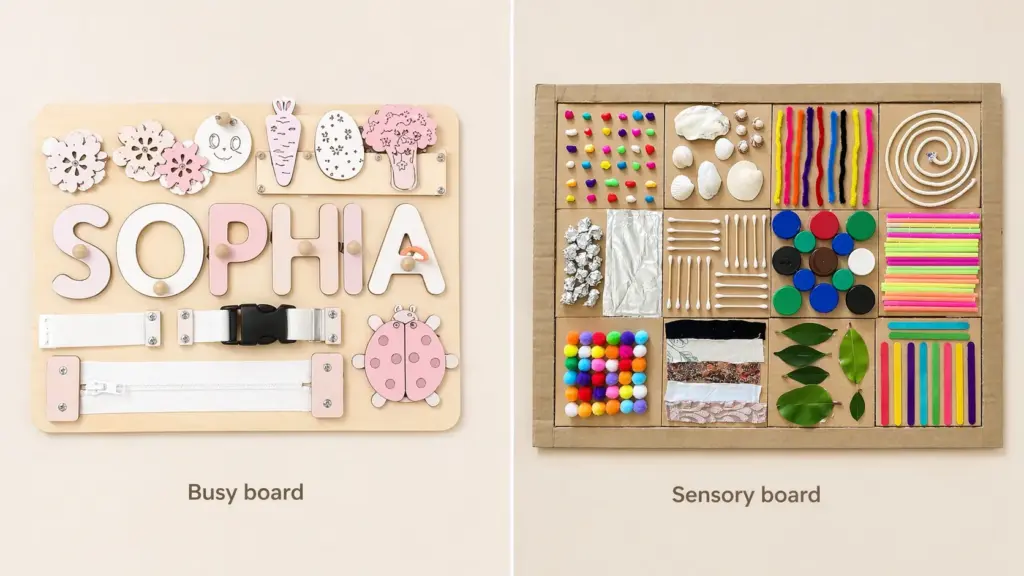
One commonly cited source says busy boards and sensory boards are the same thing. They are not — and the distinction matters for choosing the right one.
| Busy Board | Sensory Board | |
| Primary purpose | Fine motor + practical life skill development | Sensory system stimulation and regulation |
| Core elements | Functional mechanisms: latches, zippers, buckles, gears | Textures, sounds, visuals: sandpaper, mirrors, bells |
| Child action | Operate a mechanism to produce a mechanical result | Explore a texture or stimulus for sensory feedback |
| Developmental output | Specific grip patterns + real dressing skill preparation | Sensory discrimination + nervous system regulation |
| Best for | 18m–4yr practical life + fine motor preparation | 6m–3yr sensory exploration and regulation |
A child who needs sensory regulation needs a sensory board — one designed around sensory development goals like texture discrimination and nervous system calming. Many children benefit from both — at different times and for different developmental purposes. Some boards combine elements of both — a texture panel alongside a latch and a zipper. That hybrid can work; knowing which goal you’re targeting helps you evaluate whether it serves it.
Frequently Asked Questions
What is a busy board?
A busy board is a wooden activity panel featuring real-life mechanical elements — bolt latches, zippers, buckles, gears, bead sliders, elastic lacing, maze sliders, and shoelace boards — that children operate independently to develop fine motor skills, bilateral coordination, cause-and-effect understanding, and practical dressing skills. Every mechanism requires a specific hand movement and produces a specific mechanical result. Quality boards use real functional hardware on a natural wood base with 5–8 mechanisms at mixed difficulty levels, no batteries, and no electronic responses.
What are the different types of busy boards?
Three main categories. Skill-focused boards concentrate on a specific mechanism type — dressing closures or motion mechanics — developing one area in depth. Themed boards combine mechanisms with a visual narrative (vehicles, animals, nature) to increase engagement, particularly for children connecting through story. Personalized boards include the child’s name or photo, adding an early literacy dimension through daily name-recognition handling — especially suited for gifting and children between 18 and 30 months.
What age is best for a busy board?
Busy boards become developmentally productive from approximately 18 months, when the pincer grasp can operate zipper pulls and latch mechanisms. The productive range extends to 4–5 years — mechanisms challenging at 2 prepare real dressing skills at 3, and the shoelace board at 3 prepares shoe independence at 4–5. Match mechanism difficulty to the current grip stage: spinning gear and bead slider at 12–18 months; buckles, full zippers, and elastic lacing by 2.5–3 years. The mastery signal — completing the entire board in under 30 seconds — tells you when they’ve outgrown it.
Is a busy board Montessori?
A wooden busy board with real functional mechanisms — presented once and left for independent use — aligns fully with Montessori’s practical life curriculum. It functions as a portable dressing frame: real-world materials, self-correcting design, independence goal. The distinction from non-Montessori boards: no batteries or electronic sounds, no toy-grade simulations, and no more than 8–10 mechanisms per panel. Overcrowded boards with automated responses are the design the Montessori objection targets — not the busy board concept itself.
The Practice Board for Real-World Independence
A busy board is not a distraction device. At its best, it is a concentrated practical life curriculum in portable form — every mechanism a different hand skill, every operation a preparation for the real fastener your child will encounter in daily life. The child at 18 months who masters the zipper pull is the child at 3 who zips their own jacket. The child at 2 who works the buckle is the child at 3.5 who fastens their own car seat. The board is the practice; the independence is the outcome.
Every Kukoo wooden busy board is built with 5–8 real mechanisms at mixed difficulty levels on a solid hardwood base — the criteria described throughout this guide.. Present it once. Step back. Observe which mechanism produces the longest sustained engagement. That observation tells you where their hands are right now.
Explore our wooden busy board collection today!!