
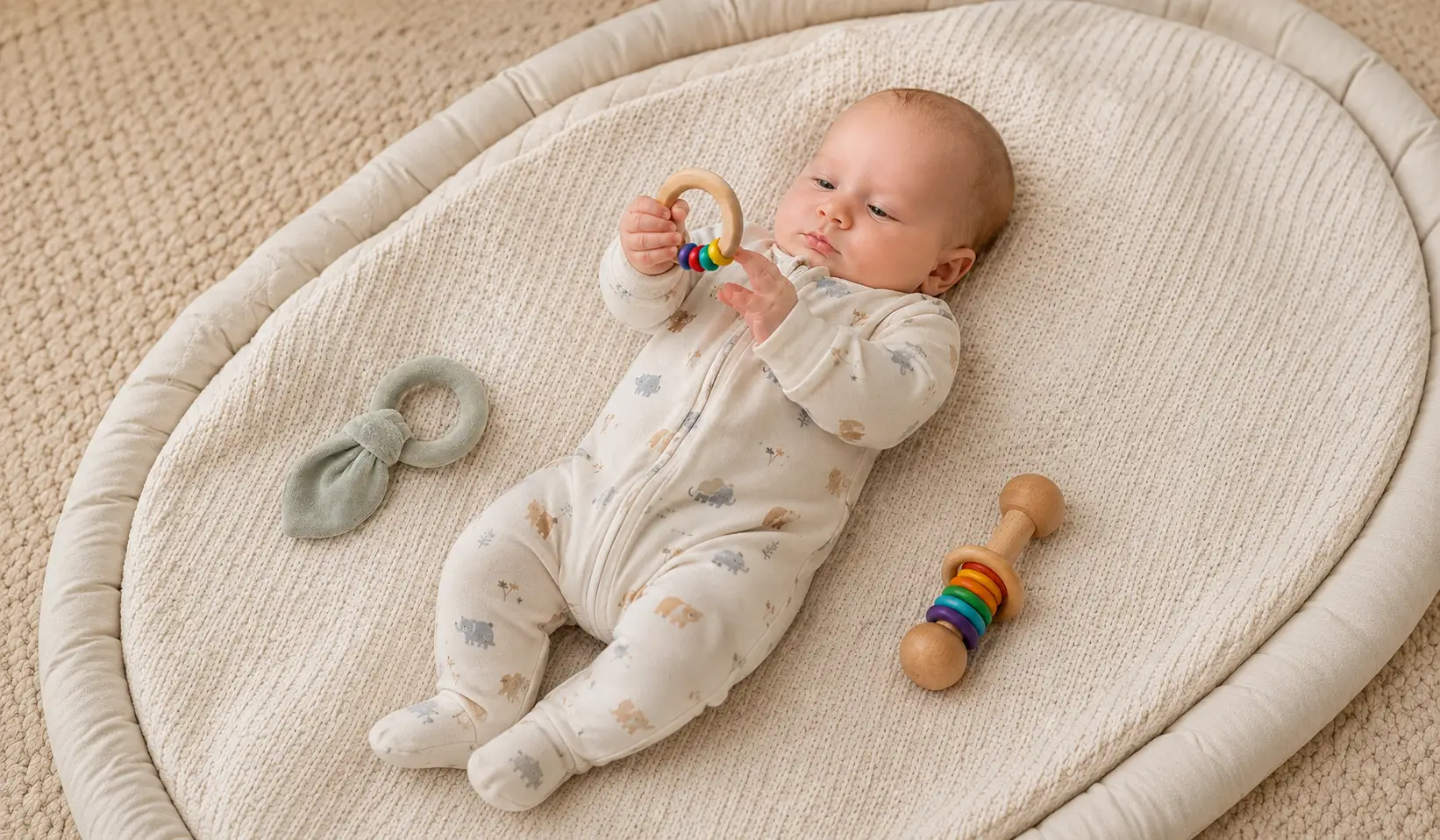
The 3–6 month period is not a continuation of the newborn stage. It is a fundamentally different developmental moment — the period when your baby’s movement transitions from reflex-driven to intentional, and the activities that serve that transition look completely different from what worked at 8 weeks.
Between these two ages, your baby undergoes one of the most significant motor transformations of the entire first year: the reflex grasp becomes intentional reaching, the arm bat becomes deliberate grasping, turning the head becomes rolling the whole body. What was developmentally perfect at 6 weeks is already behind at 4 months.
This guide is organized around what is actually developing during those three months — not around a product list.
What are Montessori activities for 3–6 month olds?
Montessori activities for 3–6 month olds focus on the most transformative motor development of the first year — the transition from reflex grasping to voluntary, intentional reaching and holding — through natural grasping materials, the treasure basket, tactile mobiles, floor-based movement freedom, and continued face-to-face language interaction. This period is fundamentally different from 0–3 months: the 3-month-old is still primarily a visual observer, while the 6-month-old is an active investigator who reaches, grasps, mouths, rolls, and begins to sit.
What Is Actually Developing — Why This Period Is Not “More Newborn”
The single most important developmental event of the 3–6 month period is the transition from reflex-driven to voluntary, intentional movement. This transition reorganizes everything — which activities are appropriate, which materials work, and what your baby’s behavior means.
The newborn’s grasp is a reflex — an automatic response to any object placed in the palm. Your baby doesn’t choose to grasp; the nervous system does it automatically. Between weeks 10 and 16, this reflex is replaced by voluntary reaching: your baby sees an object, decides to reach for it, and coordinates arm and hand to make contact. This is the first time your baby’s conscious intention organizes a physical action. Research on the onset of infant reaching confirms this as one of the most studied transitions in developmental psychology — the moment when movement stops being reflexive and begins to be intentionally organized around an external target.
What else changes between 3 and 6 months:
- Midline reaching (~week 12–14): Both hands meet at the body’s center for the first time, enabling hand-to-hand transfer.
- Visual-motor coordination: Your baby can now track an object and reach for it simultaneously.
- Rolling (~week 14–20): First front-to-back, then back-to-front — the first whole-body voluntary movement.
- Intentional mouthing: Every grasped object goes to the mouth deliberately — this is sensory investigation, not a problem to prevent.
- Babbling (~week 14–20): Single consonant-vowel combinations, responding to voice with voice.
The activity implication: Passive visual stimulation (hanging mobiles) served the 0–3 month newborn stage. Active grasping, mouthing, transferring, and multi-sensory exploration serves 3–6 months. These are different curricula for different developmental moments.
| Zoe Paul: “The 3–6 month window is one of my favorite periods to work with families, because the change visible from week to week is unlike any other. A baby who cannot yet reach at 10 weeks is deliberately placing objects in their mouth at 16 weeks. Understanding what drives that change — and what environment supports it — transforms how parents see and respond to their baby.” |
The Developmental Arc Within the Period
3 months and 6 months are not the same baby. Here is what changes within this window — and how activity selection responds.
[VISUAL 2: Developmental arc timeline — 3 months to 6 months with milestone markers and activity shifts.]
3–4 Months — First Intentional Reaching
- What’s happening: Reflex grasp fading; voluntary reach emerging; midline not yet established; rolling not present; alert windows now 1.5–2 hours. Color vision fully functional; babbling beginning. The CDC’s developmental milestones checklist by 4 months documents reaching toward objects and following moving things with eyes as the two primary motor milestones active in this window — both directly served by the tactile mobile and the first grasping materials.
- Activity emphasis: Tactile mobiles for batting and first intentional contact; lightweight grasping objects placed at midline; continued mirror engagement; floor time on back as primary position.
- Key signal: When your baby begins reaching for a hanging object with both arms rather than making accidental contact — intentional bilateral reach has arrived. Time for grasping materials in the hand.
4–5 Months — Intentional Grasping + First Transfer
- What’s happening: Voluntary grasp functional; hand-to-hand transfer emerging; deliberately putting objects to mouth; some babies rolling front-to-back; social engagement at peak — babbling loudly, responding to name.
- Activity emphasis: Wooden rattle and grasping ring now actively used; treasure basket introduced; tummy time with mirror highly engaging; sitting with support for brief periods.
- Key signal: When your baby moves a grasped object from one hand to the other — hand-to-hand transfer — bilateral coordination has arrived. Interlocking rings are the ideal material at this moment.
5–6 Months — Rolling + Sitting + Active Exploration
- What’s happening: Many babies rolling both directions; beginning to sit with support; reaching from seated position; mouthing everything; beginning to look for dropped objects (early object permanence).
- Activity emphasis: Full treasure basket engagement; interlocking rings; sitting-position activities; outdoor floor time; increased language interaction — naming objects as your baby reaches for them.
- Key signal: When your baby leans forward from a seated position to reach for an object — motivated locomotion has begun conceptually. The first steps toward crawling are intentional, not physical.
Grasping and Mouthing Activities — The Core Curriculum
The primary curriculum of the 3–6 month period is hand work — reaching, grasping, transferring, and mouthing. Every material offered should serve one or more of these capacities.
Tactile Mobile — Ribbons and Bells
Simple natural materials hung at reaching height — a ribbon, a bell, a small wooden ring — that your baby can bat, reach for, and eventually grasp. Develops the transition from batting (passive contact) to intentional grasping (active contact), cause-and-effect (bell rings when contacted), and visual-motor coordination (tracking + reaching simultaneously). A ribbon of natural silk behaves differently when contacted than a plastic attachment — it falls, wraps, responds variably. This variable response sustains attention longer than an object that simply bounces. Introduce from 3 months, positioned 20–25cm above your baby’s chest.
Wooden Grasping Ring
A smooth, appropriately weighted wooden ring — large enough to grasp around the full circumference, small enough to bring to the mouth. Develops voluntary grasp, grip strength, and wrist supination — the sequence of fine motor capacities this material specifically targets from week 12 onward. Wood provides thermal feedback (slightly cool, warms with handling), textural variation, and appropriate weight that plastic cannot replicate. Your baby’s mouth is their primary sensory organ at this age; the material quality of what’s mouthed is developmentally significant.
[PRODUCT PLACEHOLDER — Slot A: Kukoo wooden grasping ring. Natural unfinished wood, safe for mouthing, weighted for the 3–5 month grasp transition. Confirm product + URL. Not a publish blocker.]
Wooden Rattle
A lightweight wooden rattle your baby can hold independently while the rattling sound responds to their movement. Develops cause-and-effect understanding (I shake → sound happens), wrist rotation, bilateral coordination when transferred hand-to-hand, and visual-auditory integration. Introduce when your baby can hold a grasping ring for 5+ seconds without dropping — typically week 14–16. Too early = immediately dropped, no learning. Appropriately timed = sustained engagement and repetitive shaking.
[PRODUCT PLACEHOLDER — Slot B: Kukoo wooden rattle. Light enough to hold, substantial enough for satisfying cause-and-effect feedback. Confirm product + URL. Not a publish blocker.]
Interlocking Rings
Two or three wooden or natural material rings linked together — grabbable from multiple angles, transferable from hand to hand. Develops hand-to-hand transfer (the defining milestone of 4–5 months), bilateral coordination, visual tracking as objects move between hands, and problem-solving (the rings have different orientations). Introduce when your baby is actively transferring the grasping ring from hand to hand — typically month 4.5–5.
The Treasure Basket — A Complete Setup Protocol
The treasure basket was developed by early childhood pioneer Elinor Goldschmied — the Froebel Trust documents its origins and principles as a collection of natural and household objects that seated infants explore freely, with an adult present but not directing. Goldschmied observed that infants given varied sensory objects sustained focus and self-directed investigation for remarkably long periods without adult prompting. The treasure basket is the most powerful single activity for the 3–6 month period — and the most commonly set up incorrectly. “Fill a basket with objects” is not a protocol. Here is one.
What it is: A low, lightweight, open-top basket containing 6–8 natural objects of varied sensory properties — texture, weight, temperature, sound, flexibility — that your baby can reach into, grasp, mouth, and explore at will.. It is your baby’s first self-directed exploration activity: you present the basket, then completely withdraw.
Object Selection — The 6 Sensory Categories
| Category | Example Objects | Why Include |
| Hard + smooth | Wooden spoon, smooth stone | Tactile contrast, temperature feedback |
| Hard + textured | Wooden spool, pinecone, shell | Texture exploration, grip variation |
| Soft + flexible | Natural sponge, wool pompom, cotton cloth | Mouthing feedback, texture contrast |
| Metal | Small stainless spoon, safe bottle cap | Temperature (cold), sound, weight contrast |
| Sound-producing | Small bell, wooden rattle | Cause-and-effect, auditory exploration |
| Visual interest | Small baby-safe mirror, bright natural material | Visual engagement during exploration |
- Placement: Present the basket when your baby can sit with support or is positioned with both hands free. Place at midline, within easy reach. Sit nearby but do NOT demonstrate, point to objects, or praise. Your role is to observe.
- Rotation: Replace 2–3 objects every 7–10 days as engagement drops. Keep 2–3 firm favorites; introduce new materials offering similar sensory categories with different specific properties.
- What NOT to include: Plastic objects, battery-operated items, anything with detachable small parts, anything synthetic that flattens sensory feedback to a uniform experience.
[PRODUCT PLACEHOLDER — Slot C: Kukoo natural materials set / sensory wooden objects for treasure basket. Varied textures, safe for mouthing, sized for 3–6 month grasping. Confirm product + URL. Not a publish blocker.]
Movement Activities — Supporting the Body Learning to Move
Between 3 and 6 months, your baby’s body is figuring out how to move intentionally for the first time. Floor time — with specific positioning and visual anchors — is the most important activity available.
Mirror Tummy Time
Baby-safe floor mirror positioned horizontally, your baby in tummy time facing the mirror at arm’s length. Develops neck and shoulder extension (the postural muscles for sitting and crawling), visual self-recognition beginning around 5 months, and motivation to sustain tummy time beyond what they’d tolerate without visual engagement. Your baby’s face in the mirror is the most compelling visual stimulus available — no toy competes.
Back-Lying Free Movement
The movement area floor mat remains the most important physical space at this age. Your baby on their back is not passive — they’re practicing kicking, arm batting, body rolling, and beginning to move intentionally. The key adult behavior: do not position your baby in sitting or propped positions before their postural muscles are ready. Let rolling emerge from their own movement practice.
Outdoor Floor Time
A blanket outdoors — on grass, under a tree — provides the richest multi-sensory environment available: light filtering through leaves (visual tracking), wind sounds (auditory), grass texture through the blanket (tactile), fresh air (olfactory). This is not a break from real activities — it is the most complete sensory environment a 3–6 month old can inhabit.
Language and Social Activities — Caregiving as Curriculum
The sensitive period for language is at its peak during the first six months. Every caregiving interaction is a language activity — if the adult treats it as one.
Face-to-Face Proto-Conversation
By month 3–4, your baby responds to facial expressions with facial expressions, to voice with voice, to pauses with sounds. This is proto-conversation — the structural template of all future language. Talk at face level, then pause. Allow 5–10 seconds for their response. Respond to whatever they produce — a sound, an expression, a movement — as if it is a meaningful contribution. Because it is. The AAP’s guidance on language development and toy selection identifies back-and-forth turn-taking interaction as the highest-value language activity in the first year — more predictive of later vocabulary than any passive input like background speech or recorded audio.
Narrated Object Exploration
When your baby reaches for an object, name it. When they mouth it, describe it. “That’s the wooden ring. It’s smooth. It’s round.” Not baby talk — precise adult vocabulary. Your baby’s nervous system is specifically primed to extract phonological patterns from what it hears. Every correct naming interaction is language input during the highest-receptivity window.
Anticipation Games
A consistent verbal phrase followed by a predictable physical action (a gentle tickle, being lifted, a kiss) — repeated identically each time. Your baby begins to show anticipation before the action happens — increased movement, excited expression. This is the first proto-understanding of symbolic language: the sound predicts the event.
What Stays From the Newborn Period — And What to Retire
Not everything from 0–3 months still belongs in the 3–6 month environment.
- Continue: The full Montessori newborn activity framework for 0–3 months — Munari mobile, high-contrast cards, movement freedom — is the foundation this guide builds from. Floor mirror (now for tummy time engagement). Outdoor floor time (now more active). Face-to-face conversation and narrated caregiving (now more reciprocal). Movement freedom on the floor mat (now includes rolling practice).
- Retire: Munari mobile (visual system has developed beyond this contrast level). Passive hanging mobiles above the face (your baby now needs to reach and grasp, not just observe). Swaddling during alert periods (the emerging voluntary grasp requires free hands).
- The transition signal: When your baby begins actively attempting to grasp the mobile rather than tracking it visually — the mobile has done its developmental work. Time for grasping materials in the hands.
| Zoe Paul: “The most common underestimation I see at this age is parents who keep the passive mobiles going well past the point where the baby is ready for grasping materials. A 5-month-old reaching for a mobile that’s deliberately hung out of reach is being underestimated by the environment. The mobile’s job is done. The hands are ready.”[USER ACTION NEEDED: Confirm as authentic Zoe Paul observation] |
Frequently Asked Questions
What are the best Montessori activities for 3–6 month olds?
Activities that support the reflex-to-voluntary grasping transition: a tactile mobile for batting and first intentional reaching, a wooden grasping ring and lightweight rattle for grasp development and cause-and-effect, interlocking rings for hand-to-hand transfer (typically from month 4.5), and the treasure basket — a low basket with 6–8 natural objects of varied texture, weight, and sound — for self-directed exploration from month 4–5. Floor time with mirror, outdoor time, and face-to-face language interaction remain foundational throughout.
When should I introduce the treasure basket?
When your baby can hold a small object for several seconds — typically between weeks 16–20 (months 4–5). Before voluntary grasping is established, the basket’s objects are out of functional reach. The signal is clear: when your baby reaches for and holds the grasping ring, brings it to their mouth, and begins transferring between hands, the treasure basket is ready. Start with 5–6 objects; rotate 2–3 every 7–10 days as interest drops.
Why does Montessori for 3–6 months look different from 0–3 months?
The 0–3 period is primarily visual — the newborn observes but cannot voluntarily act on the environment. Activities (Munari mobile, high-contrast cards, face conversation) serve a baby whose hands are reflex-driven. The 3–6 period is the transition to intentional action: voluntary grasp emerges, midline reaching develops, rolling begins, mouthing becomes deliberate investigation. Activities shift from passive visual stimulation to active grasping, mouthing, batting, and multi-sensory exploration.
What should I look for in materials for a 3–6 month old?
Four criteria: appropriately sized for grasping (roughly 6–10cm — your baby’s hand must close around or contact it meaningfully), safe for mouthing (natural unfinished wood, natural fabric, smooth stainless steel — no paint, varnish, or synthetic coatings), appropriate weight (light enough to lift, substantial enough to provide feedback), and varied sensory properties (hard/soft, smooth/textured, warm/cool, sound-producing/silent).
The First Acts of Intentional Self-Construction
The 3–6 month period is not a continuation of the newborn stage — it is the first period in which your baby becomes an agent in their own development. The hand that grasps deliberately, the reach that crosses the midline, the roll that moves the whole body for the first time: these are the first acts of intentional self-construction. The activities that support them are not entertainment — they are the curriculum.
Start with one thing: put a wooden grasping ring in your baby’s palm during their next alert period, and step back. Watch what their hand does over the next three minutes. What you see is the developmental story of this entire period in miniature.
As your baby approaches 6 months, activities shift toward object permanence, sitting, and beginning practical life. Montessori toys for 1-year-olds covers what comes next in that window.. For the newborn period this guide builds from: Montessori newborn activities for 0–3 months.
Kukoo’s wooden materials are designed for exactly this developmental window — natural wood for mouthing, appropriate weight for emerging grip strength, real sensory feedback at every stage. Wooden infant toys for the 3–6 month grasping and mouthing window.