

When you walk into your child’s pediatrician’s office, you might notice something: the waiting room toys are often simple wooden blocks, chunky puzzles, and basic stacking rings. Not flashy. Not electronic. Just… present.
There’s a reason for that.
Pediatricians consistently recommend toys that are simple, safe, and encourage active engagement. Because many well-designed wooden toys are non-electronic, durable, and open-ended, they often align closely with these developmental principles. The preference is less about material alone and more about how a toy supports healthy brain development and parent-child interaction.
This article explores why pediatricians prefer wooden toys over plastic in many contexts—not because wood is magical, but because the way many wooden toys are designed naturally supports what pediatric experts know about child development.
Why Pediatricians Prefer Wooden Toys Over Plastic
1. Simplicity Supports Executive Function and Sustained Attention
Executive function—the brain’s ability to plan, focus, and solve problems—develops through active thinking, not passive watching.
Toys without automatic rewards require children to think, plan, and persist. A wooden block tower doesn’t build itself. Your toddler has to figure out how to balance each piece, adjust their approach when it falls, and try again. That’s executive function in action. This is the principle behind our stacking and building toys — minimal design, maximum cognitive work from the child.”
The Harvard Center on the Developing Child describes executive function as the mental processes that enable us to plan, focus attention, remember instructions, and juggle multiple tasks successfully. These skills develop most effectively through activities that require active problem-solving.
The AAP’s 2018 clinical report “The Power of Play” specifically emphasizes simple toys that promote imagination and problem-solving over those that provide immediate electronic feedback.
Many wooden toys are intentionally minimalist, aligning naturally with these recommendations. A set of wooden blocks offers endless possibilities but zero instructions. Your child’s brain does all the work.
2. More Parent–Child Interaction and Language Development
Here’s something that surprised many parents when the research came out: the type of toy affects how much you talk with your child.
A 2016 study published in JAMA Pediatrics found that electronic toys were associated with fewer adult words and fewer conversational turns compared to traditional toys like wooden blocks and puzzles. When babies played with electronic toys, adults spoke less. When they played with books and traditional toys, conversation flourished.
Why? Because electronic toys do the talking. The toy names colors. The toy sings the alphabet. The toy provides the entertainment.
Traditional, non-electronic toys—often including wooden toys—create conversational space. When your baby picks up a wooden animal, you can say, “That’s a cow! Cows say moo. Can you make a cow sound?” Back and forth. Question and response. The rhythm of real conversation.
Research shows that conversational turns—not just hearing words, but engaging in back-and-forth exchanges—predict language-related brain activation. Those interactions literally shape developing neural pathways.
3. Open-Ended Play Encourages Creativity and Cognitive Flexibility
Imaginative play builds problem-solving and abstract thinking—skills that extend far beyond childhood.
A 2007 randomized controlled trial found that providing blocks to families improved language outcomes in toddlers. Not electronic learning toys. Not apps. Blocks.
Simple stacking toys and building materials—frequently wooden—exemplify open-ended design. Today those blocks are a tower. Tomorrow they’re a train track. Next week they’re food for a pretend picnic. The same physical objects support infinite possibilities.
The AAP’s “Power of Play” report explicitly links imaginative play to healthy cognitive and social-emotional development. Cognitive flexibility—the ability to think about something in multiple ways—is a predictor of academic success and creative problem-solving throughout life.
Wooden toys don’t tell your child what to imagine. They wait for your child’s ideas.
4. Reduced Exposure Complexity Compared to Multi-Component Plastics
Let’s be clear: high-quality plastic toys that meet current safety standards are considered safe by regulatory bodies.
But historically, some plastics contained phthalates (plasticizers) and BPA, which raised health concerns. The U.S. Consumer Product Safety Improvement Act (CPSIA) now restricts specific phthalates in children’s toys, and the CPSC’s 2017 final rule tightened these regulations further.
Modern plastic toys from reputable manufacturers comply with these standards. The concern isn’t well-regulated plastic—it’s the chemical complexity involved in plastic production.
Solid wood finished with water-based paint involves fewer chemical components than multi-layered plastic with colorants, plasticizers, and stabilizers. For parents who prefer simplicity in material composition, understanding what makes wooden toys safe for babies can provide additional confidence in their choices.
This isn’t about fear. It’s about informed preference.
5. Lower Risk of Overstimulation From Electronic Features
Pediatricians increasingly caution against excessive electronic stimulation in early childhood.
The AAP’s clinical report on toy selection notes that electronic features in toys may detract from social engagement and imaginative play. Lights that flash rapidly, sounds that play automatically, and screens that demand attention can create sensory overload—especially for babies and toddlers whose nervous systems are still developing.
Many wooden toys are passive, requiring children—not electronics—to drive play. The toy doesn’t perform. Your child performs.
This doesn’t mean electronic toys are harmful in moderation. It means that a play environment dominated by constant stimulation misses opportunities for the kind of calm, focused engagement that builds sustained attention.
For children who are easily overstimulated or have sensory sensitivities, the natural sensory qualities that solid wood materials provide can create a more supportive play environment. The science of how wooden toys reduce overstimulation — from acoustic properties to tactile feedback — explains why this difference is neurological, not just aesthetic.
6. Greater Durability and Mechanical Safety
Breakage creates risks—sharp edges, small detachable parts, and potential choking hazards.
The ASTM F963 toy safety standard specifically addresses mechanical hazards in toys. The CPSC recall database includes numerous incidents involving brittle or broken plastic toys that cracked and created sharp edges or released small parts.
Solid hardwood toys often maintain structural integrity better than thin or hollow plastic. They’re less likely to shatter into dangerous fragments when dropped repeatedly—and toddlers drop things. This durability advantage is also a key factor in why quality wooden toys carry a higher upfront cost — and why that cost often works out lower over time.”
Additionally, wooden toys typically contain fewer detachable electronic components—batteries, circuit boards, small screws—that can become accessible if the toy breaks.
Quality matters more than material. But well-made wooden toys have an inherent durability advantage.
7. Alignment With Montessori and Child-Centered Education Models
Montessori education emphasizes natural materials, independence, and concentration—principles increasingly supported by developmental research.
Dr. Maria Montessori’s foundational work advocated for materials that provide accurate sensory feedback and support self-directed learning. Research published in Science found positive associations between Montessori education and executive function, creativity, and social skills among children at ages 5 and 12.
The AAP’s “Power of Play” report emphasizes child-led exploration—exactly what Montessori classrooms prioritize.
Wooden materials are commonly used in Montessori classrooms worldwide because they align with these principles: simplicity, natural sensory input, and durability that allows repeated practice.
This doesn’t mean only Montessori toys are developmentally appropriate. It means the educational philosophy behind many wooden toys happens to align with pediatric developmental recommendations. For parents curious about the science behind choosing wooden materials — from sensory feedback to brain development — the reasoning goes well beyond aesthetics.
When Plastic Toys May Still Be Recommended
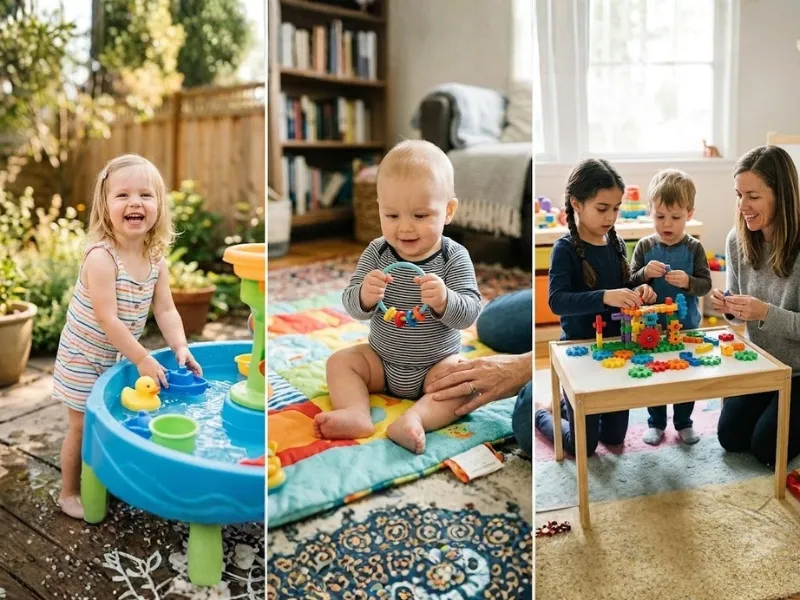
Pediatricians aren’t anti-plastic. They’re pro-development.
There are situations where plastic toys genuinely make sense:
- Outdoor water play: Wooden toys shouldn’t be repeatedly soaked. Plastic bath toys and water tables serve this purpose perfectly.
- Lightweight infant items: Very young babies benefit from toys they can actually lift and manipulate. Lightweight plastic rattles support early motor development.
- Specific STEM engineering kits: Many excellent building and construction toys use high-quality plastic components that snap together precisely, supporting spatial reasoning and engineering thinking.
- Budget accessibility: Not every family can afford premium wooden toys. A thoughtfully chosen plastic toy that meets safety standards and encourages engagement is far better than no toy at all.
Material alone does not determine developmental value. A well-designed plastic toy used with parent engagement beats an expensive wooden toy that sits unused. For a comprehensive look at how wooden and plastic toys compare across all developmental areas, including when each material excels, parents can explore both options thoroughly.
What Pediatricians Prioritize Above All
Before you buy any toy—wooden, plastic, or otherwise—consider these questions:
✓ Is it safety-tested? Look for ASTM F963, CPSIA, or EN71 compliance.
✓ Is it age-appropriate? Can your child actually use it successfully at their current stage?
✓ Does it promote interaction? Can you play together? Does it invite conversation?
✓ Does it encourage active thinking? Does your child have to problem-solve, or does the toy do all the work?
✓ Does it avoid unnecessary overstimulation? Some stimulation supports learning. Excessive stimulation can overwhelm.
Many well-designed wooden toys naturally meet these criteria—but thoughtful design matters more than material alone.
How to Choose Safe, Developmentally Appropriate Wooden Toys
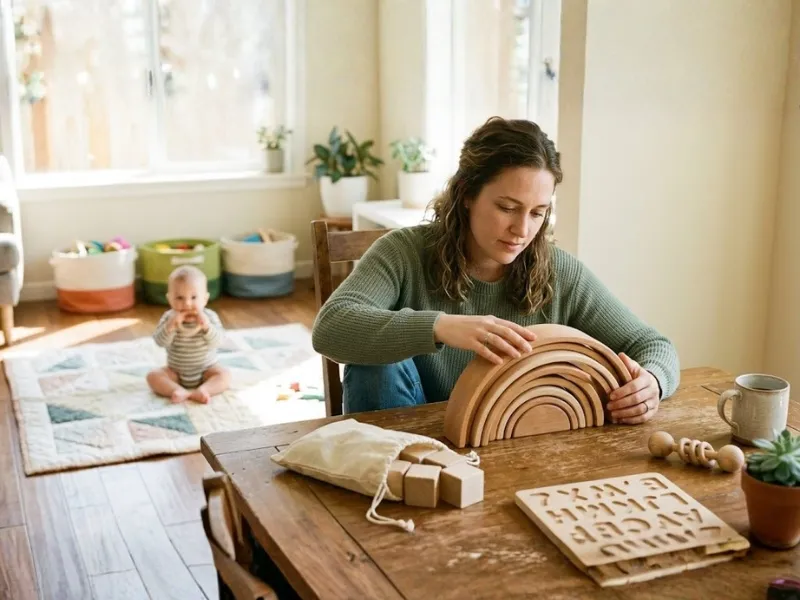
Look for Non-Toxic, Water-Based Finishes
Your baby will mouth these toys. The finish needs to be as safe as the food they eat.
Verify that paints and stains are water-based and explicitly labeled non-toxic. Avoid toys with strong chemical odors or vague “eco-friendly” claims without certification.
Choose Solid Hardwood Over MDF
Solid hardwoods like beech, maple, and rubberwood offer superior durability and contain no formaldehyde-based adhesives.
MDF (medium-density fiberboard) is compressed sawdust and glue. When it gets wet—from drool, spills, or cleaning—it can swell and crumble. For items that receive heavy mouthing and handling, solid wood is the safer choice.
Parents wanting a curated starting point will find our toys by age pages filter specifically for developmental stage and verified material safety.”
Verify ASTM / CPSIA / EN71 Compliance
These certifications aren’t just logos—they represent third-party testing for mechanical safety, flammability, and chemical composition.
If you can’t find safety certification information on the packaging or manufacturer’s website, consider it a red flag.
Avoid Fragile Decorative Components
Small painted details, glued-on eyes, or decorative beads can detach and become choking hazards.
Look for toys with minimal decorative elements, or choose designs where details are carved or burned into the wood rather than attached separately.
Conclusion: It’s About Developmental Principles—Not Just Material
Pediatricians prioritize safety, simplicity, and meaningful interaction in early childhood development. Their recommendations center on how toys support brain development, parent-child connection, and healthy play patterns.
While both wooden and plastic toys can meet these standards, many wooden toys naturally align with the principles pediatric experts emphasize: simplicity, durability, open-ended design, and reduced electronic stimulation.
The best choice is one that supports safe, engaged, child-led play—regardless of whether it’s made from wood, plastic, or any other material. Understanding what developmental qualities to look for empowers parents to choose confidently.
Frequently Asked Questions
- Do pediatricians officially recommend wooden toys over plastic?
Pediatricians recommend toys that are simple, safe, and encourage active engagement. Many wooden toys align with these principles, but the AAP doesn’t specifically endorse one material over another. The focus is on developmental appropriateness, not material type.
- Are plastic toys harmful to toddlers?
High-quality plastic toys that meet ASTM F963 or EN71 safety standards are not considered harmful. Modern regulations restrict concerning chemicals like phthalates and BPA. The concern is poorly made, unregulated plastic—not all plastic.
- What does the AAP say about electronic toys?
The AAP notes that electronic features may reduce parent-child interaction and imaginative play. They recommend prioritizing simple, non-electronic toys that encourage conversation and creativity, though electronic toys aren’t harmful in moderation.
- Are Montessori toys backed by research?
Research has found positive associations between Montessori education and executive function, creativity, and social skills. The AAP’s emphasis on child-led exploration aligns with Montessori principles, though not all wooden toys are authentically Montessori-aligned.
- Are light-up toys bad for child development?
Not inherently, but toys with excessive lights and sounds can contribute to overstimulation. Pediatricians recommend balancing electronic toys with simpler options that require children to drive the play themselves.
- Do wooden toys improve attention span?
Simple, open-ended toys—often wooden—can support sustained attention by requiring active problem-solving. Research links this type of play to executive function development, which includes attention control.
- Are wooden toys better for language development?
Research shows that traditional, non-electronic toys (including wooden blocks and puzzles) are associated with more parent-child conversation and conversational turns, which support language development. The material matters less than the interaction it enables.
Note: The information provided in this article is for educational purposes only and does not substitute for professional medical advice. Always consult with your pediatrician regarding your child’s health and development.