
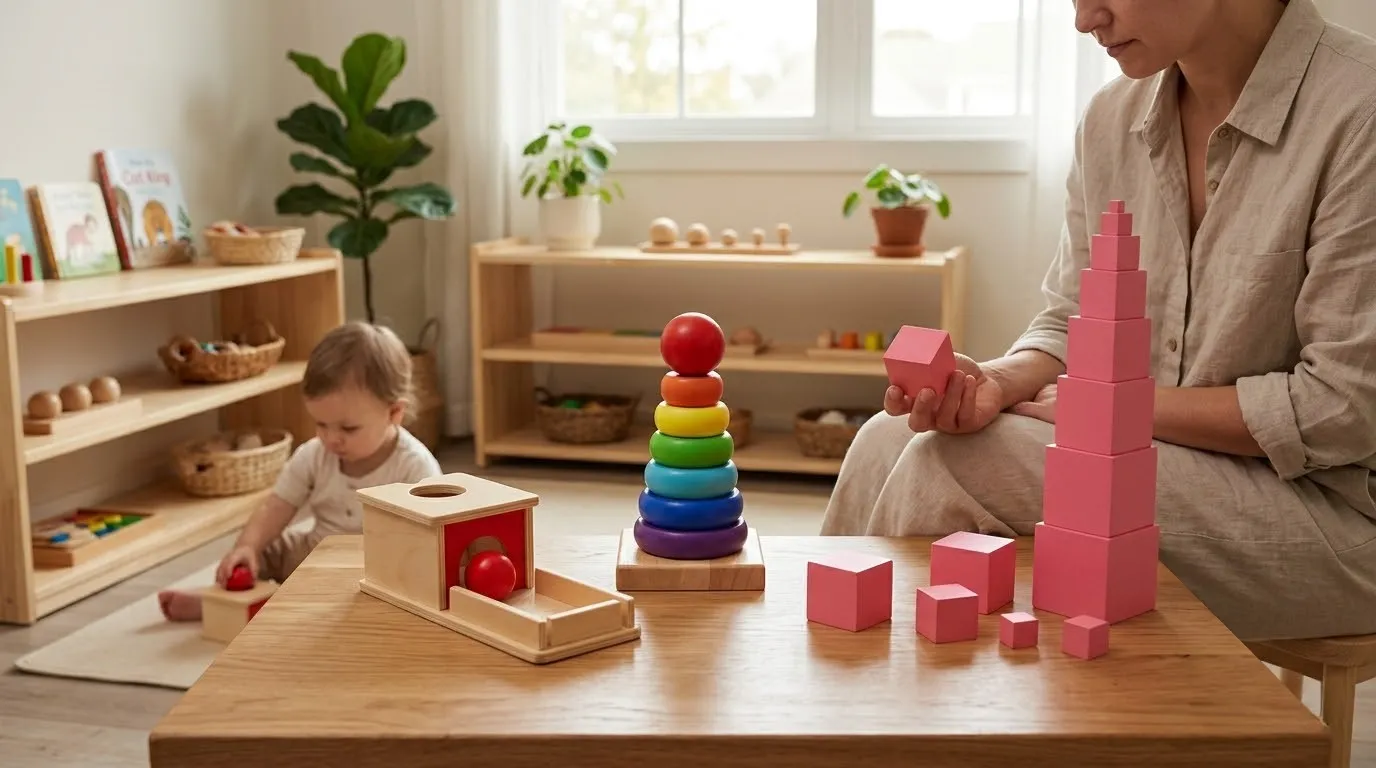
Search “Montessori toys” and you’ll find hundreds of results — most of them wooden, most of them expensive, and many of them using the word “Montessori” as a marketing term rather than a design description.
This guide gives you a practical system for cutting through the noise: what the real criteria are, how to spot red flags fast, which toy types matter at each age, and how to build a collection without overbuying.
What makes a toy authentically Montessori?
- Focuses on one clear skill or concept
- Keeps the child active — not passive
- Supports independent use
- Includes self-correction built into the design
- Is simple and not overstimulating
- Connects to real life or purposeful work
- Matches the child’s developmental stage
- Invites repetition and sustained concentration
If a toy fails several of these, it may be Montessori-inspired at best — or Montessori-washed marketing at worst.
The Three Types of “Montessori Toys” on the Market
Before evaluating anything, it helps to know what you’re actually looking at:
| Type | What it means | Worth buying? |
|---|---|---|
| Montessori-aligned | Closely reflects the 8 criteria above | Yes — the reliable choice |
| Montessori-inspired | Follows some principles but not all | Sometimes, depending on the gap |
| Montessori-washed | Uses the label as marketing only | Usually avoid |
The rest of this guide helps you tell the difference quickly.
These criteria are grounded in 4 core Montessori design principles — if you want the philosophy behind them before shopping, start there. This guide focuses on the buying decision.
The 8 Criteria of Montessori Toys
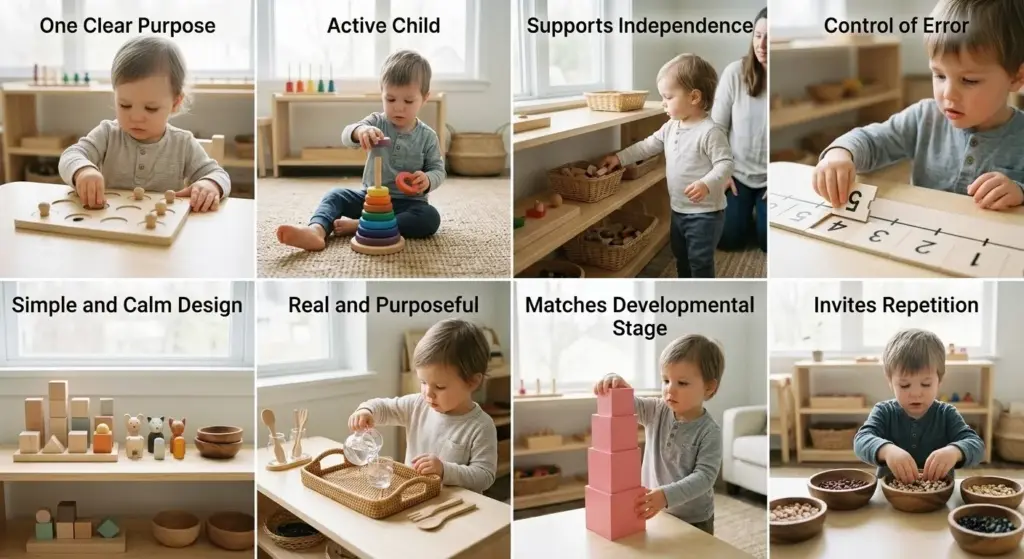
Apply these before buying anything. Each criterion below includes what to look for and the red flag to avoid.
1. One clear purpose (Isolation of Quality) The toy has one main developmental job. Red flag: “Teaches 15+ concepts with lights, sounds, and music!”
2. Child is active, not passive The child produces the result through their own action. Red flag: Pressing buttons to trigger rewards; toy performs while child watches.
3. Supports independent use Child can take it out, start, work through, and put it back without adult instruction at each step. Red flag: Too many parts, no clear entry point, constant adult setup required.
4. Control of error built in The material gives feedback without an adult saying “wrong.” A puzzle piece that doesn’t fit. A stacker that wobbles. Red flag: Adult must constantly correct — “not that one,” “try the other side.”
5. Simple and calm Clean design supports full attention on the task. Red flag: Too many competing colors, busy patterns, extraneous noise.
6. Connected to real life Especially important under age 6. Real images, real actions, real-world relevance. Red flag: Fantasy characters as the primary learning vehicle for under-3s.
7. Developmentally matched Right for your child’s current stage — not the box’s age range, which is often a sales range, not a developmental range. Red flag: “Ages 1–6” with no specific stage guidance.
8. Invites repetition The child returns to it across multiple sessions. Best sign: Used again the next day, willingly, without prompting.
The 8-criteria scoring guide
| Criterion | Pass / Partial / Fail |
|---|---|
| One clear purpose | |
| Child is active | |
| Supports independence | |
| Control of error | |
| Simple and calm | |
| Reality-based | |
| Developmentally matched | |
| Invites repetition |
7–8 passed: strong Montessori-aligned choice. 5–6: Montessori-inspired, may still be useful. 3–4: weak alignment. 0–2: label-driven, not Montessori in practice.
The 30-Second Pre-Purchase Test
Before checking out, ask these five questions:
- What one skill does this support? (If you can’t answer in one sentence, the toy is probably too scattered.)
- Can my child use this mostly independently?
- Does the child do the work, or does the toy?
- Will this likely invite repetition — not just novelty?
- Is this actually matched to what my child is working on right now?
If you can answer all five clearly, it’s a confident purchase. If you’re guessing on two or more, keep looking.
Red Flags: How to Spot Weak Montessori Toys Fast
- Toys that do too many things at once. When a product teaches everything simultaneously, it usually teaches nothing deeply. Multi-purpose is often no-purpose.
- Battery-powered, sound-heavy, light-flashing design. Electronic stimulation interrupts concentration and removes self-correction. This is structurally opposite to how Montessori materials work.
- “Montessori” is the entire marketing message. If a product page repeats the word but never explains the specific skill, age relevance, or design purpose — that’s a red flag. Authentic sellers describe exactly what developmental work a material supports.
- Vague age range “Ages 1–6.” Usually signals a product designed to sell broadly, not to serve a specific developmental window precisely.
- Beautiful but shallow. The shelf looks perfect; the child uses each item once and loses interest. Form is optimized, function is not. This is the most common social-media Montessori shopping trap.
- Constant adult correction required. A material that depends on an adult saying “wrong” at every turn isn’t building independence — it’s just supervised play with wooden props.
Summary: noisy, battery-powered, feature-heavy, vague in purpose, or adult-dependent = not authentically Montessori.
Montessori Toys by Age {#by-age}
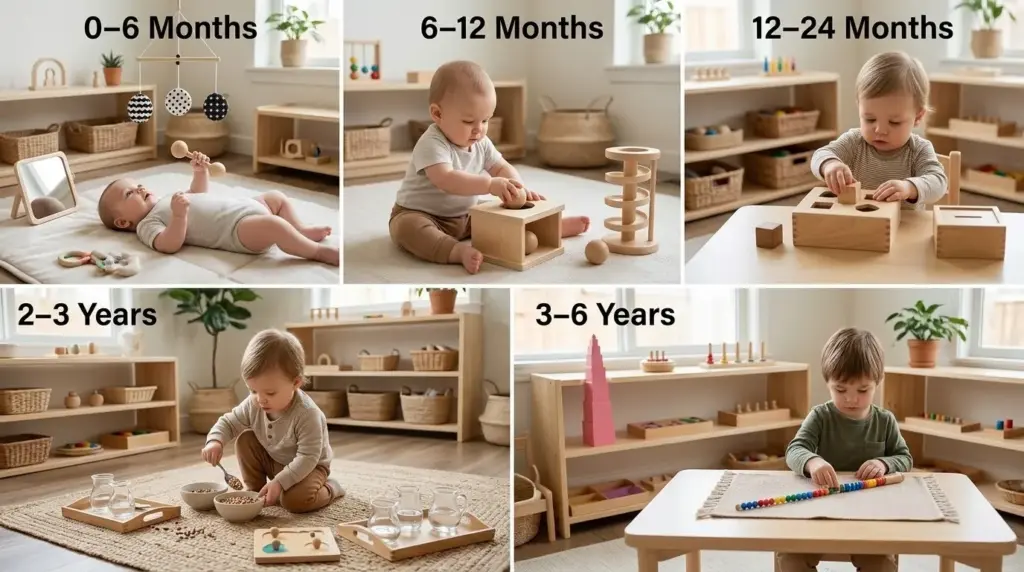
Babies: 0–6 months
What the child is developing: Visual tracking, early grasping readiness, sensory foundation, movement freedom, object permanence, cause and effect through direct action, hand transfer, posting and dropping.
Best toy types by stage:
0–6 months — sensory and movement foundation:
- High-contrast visual materials (black-and-white cards, simple mobiles)
- Lightweight rattles with real texture and weight
- Soft tactile balls
- A mirror placed at floor level for tummy time
6–12 months — cause and effect, hand control:
- Object permanence box — ball drops in, reappears; one of the clearest Montessori-aligned toys at this stage
- Simple ball drop or coin posting box — direct cause and effect, hand control
- Basic stacking rings or nesting cups — sequencing, size discrimination
- Treasure basket — varied real objects (wooden spoon, metal cup, fabric square, small brush) for sensory exploration
Who this is for: Infants in an environment focused on calm sensory input and movement freedom in the first half of the year; babies sitting independently and beginning intentional hand use in the second half. These are meant to be handled, mouthed, and used — not displayed.
What to skip: Overstimulating play gyms with too many hanging elements, electronic noise toys, anything battery-powered. A baby pressing buttons is reacting; a baby posting a ball is constructing. These are different developmental experiences.
Buying principle: Less is more at this stage. One or two well-chosen items per phase outperform a crowded activity center every time.
→ Shop Montessori toys for 0–12 months
Young toddlers: 12–24 months
What the child is developing: Fine motor control, early order, simple problem-solving, practical life imitation, vocabulary growth.
Best toy types:
- Shape sorters (3–6 shapes, no sounds) — shape matching, spatial reasoning, hand control
- Simple knobbed puzzles (3–5 pieces) — grip, placement, visual discrimination
- Coin/disc posting box — precision, hand control, object permanence reinforcement
- Stacking sets (graded, self-correcting when wrong order) — sequencing, cause and effect
- Push toys for walking — gross motor, purposeful movement
- Practical life tools — small pitcher, cloth, dustpan: real tasks, real competence
Who this is for: The child in the “me do it” phase — high drive for independence, learning from real repetition. These toys meet that drive directly.
What to skip: Electronic learning tablets, busy boards with 20 unrelated features, anything requiring adult-led use at every step.
→ Shop Montessori toys for 1-year-olds
Toddlers: 2–3 years
What the child is developing: Independence, fine motor precision, practical life skills, sorting and matching, early sequencing.
Best toy types:
- Pouring and transfer work — dry beans to start, then water; builds hand control and concentration
- Lacing and threading — fine motor precision, sequencing, pattern readiness
- Object-to-picture matching — vocabulary, classification, visual discrimination
- Dressing frames or practice materials — buttons, zippers, snaps; direct practical life preparation
- Simple sorting trays — grouping by color, shape, or size
- Realistic practical life tools — child-sized broom, mop, and dustpan for actual use
Who this is for: Children with an intense need to participate in real tasks. At this age, some of the best “toys” aren’t toys at all — they’re household setups. The guide to Montessori practical life activities covers this in depth.
What to skip: Educational tablets, alphabet/number apps designed for this age, “2-in-1 activity centers” that try to do everything.
→ Shop Montessori toys for 2-year-olds
Preschoolers: 3–6 years
What the child is developing: Sustained concentration, sensorial refinement, pre-writing hand control, early math and language readiness, purposeful independent work.
Best toy types:
- Sensorial grading and sorting — color gradation, size sequencing, texture comparison: builds perceptual precision and classification readiness
- Counting materials (physical objects with quantity) — not flashcards; tangible math
- Pre-writing hand control work — tracing, cutting, lacing, threading; indirect pencil preparation
- Advanced puzzles and sequencing activities — 10–20 pieces, realistic images
- Art tools with real purpose — watercolors, quality pencils, real paper; not toy craft kits
- Grace and courtesy practice materials — social practical life
Who this is for: Children ready for longer work cycles (20–40 minutes) and more nuanced challenge. Three materials used with genuine concentration are worth more than ten used briefly.
What to skip: Workbooks, flash drills, electronic learning systems positioned as “school readiness.” Preschoolers build readiness through hands, not screens.
→ Shop Montessori toys for 3–6 year olds
Shop by Skill {#by-skill}
If you know the specific developmental area your child is working on, these are the most reliable toy categories for each:
| Skill | Best toy types |
|---|---|
| Fine motor / hand control | Threading, lacing, tonging, pouring, posting, knob puzzles |
| Sensory exploration | Texture boards, sound cylinders, sensorial grading sets, treasure baskets |
| Language and vocabulary | Object baskets, picture-to-object matching, classified cards, realistic puzzles |
| Math foundations | Counting objects, sorting trays, sequencing materials, graded stackers |
| Practical life | Child-sized cleaning tools, dressing frames, pouring sets, food prep tools |
| Object permanence / cause-effect | Object permanence box, ball drop, posting box |
| Social-emotional | Cooperation games, grace and courtesy materials, emotion sorting |
→ Browse all toys by skill at Kukoo Montessori
Materials: What Actually Matters
Why wood is often preferred — but not essential
Natural materials (wood, metal, cotton, ceramic) offer richer tactile feedback, honest weight proportional to size, and durability that supports repeated use. The specific reason weight and material density shape toddler learning — not just feel — goes deeper than most parents expect.. A large wooden block feels heavier than a small one in a way that hollow plastic does not — which is real proprioceptive information for a developing child.
But wood is a material, not a quality guarantee. A poorly designed wooden toy is still a poorly designed toy. A simple purposeful plastic item is preferable to a decorative wooden object that invites no real work.
The material question that actually matters
Does this material’s weight, texture, and sensory feedback support the learning the toy is supposed to provide? If yes, the material is right — regardless of what it’s made of.
Safety basics
Look for: non-toxic finishes with transparent product information, smooth surfaces appropriate for mouthing (under-3s), no loose parts unsafe for children who still mouth objects. Safety certification (ASTM F963 in the US, EN71 in Europe) is a minimum, not a Montessori endorsement. Understanding what these two standards actually test — and how they differ — helps evaluate compliance claims beyond just checking for a logo.
How Many Montessori Toys Does a Child Need?
Less than most parents assume.
Research from the University of Toledo found that toddlers with fewer toys engaged in longer, more creative, more focused play. Visible choices beyond what a child can organize reduce concentration rather than enrich it.
Practical shelf guidelines:
| Age | Items on shelf at once |
|---|---|
| 0–12 months | 4–6 |
| 1–2 years | 5–7 |
| 2–3 years | 6–8 |
| 3–6 years | 6–10 |
The rotation system: buy less, get more
Store roughly three times what you display. Every 1–2 weeks — based on observation, not a calendar — swap out mastered or disengaged materials for something fresh from storage. The full shelf setup and rotation protocol covers what to do when a child loses interest, how many zones to create, and how to decide what comes off the shelf
This also gives you ongoing developmental data: what your child returns to tells you what they’re ready to deepen; what they ignore tells you the stage has passed or hasn’t arrived.
How to Build a Montessori Toy Collection Without Overbuying
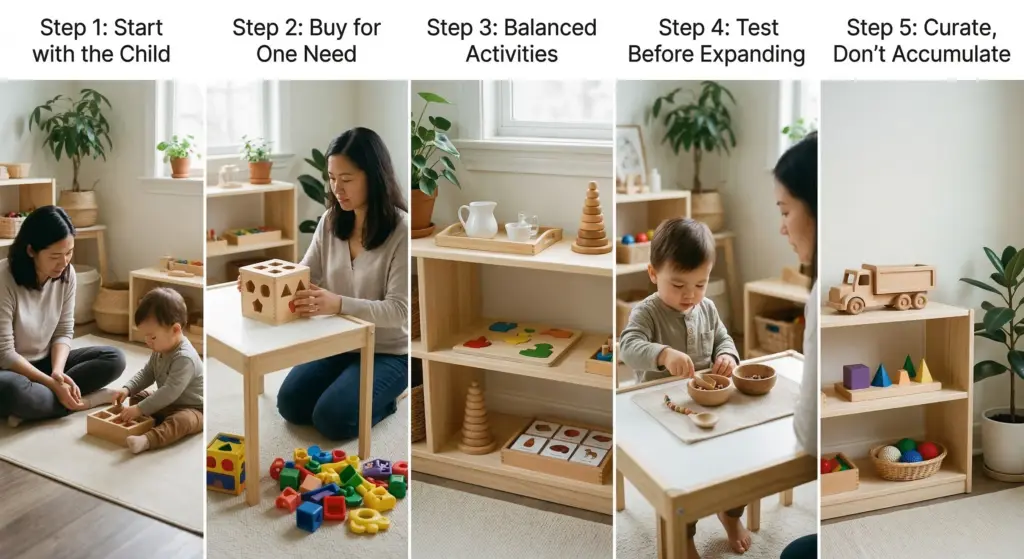
Step 1 — Observe before you shop
What is your child repeating this week? What frustrates them productively? What are they trying to do independently? Observation should drive purchases, not trends. If you can’t answer clearly, observe for three days first.
Step 2 — Identify one developmental need
Grasping. Posting. Sorting. Pouring. Dressing independence. Pre-writing hand control. One specific need leads to one better purchase. You don’t need a bundle.
Step 3 — Prioritize depth over variety
One toy used with genuine concentration fifteen times is more developmental than five toys used once each. When in doubt, buy less and rotate more.
Step 4 — Start with practical life before buying anything
Before purchasing any Montessori material, set up one practical life activity from existing household items. A small pitcher, a cloth, a low basket. If your child engages with that, you understand how Montessori-aligned activity actually works — and you’ll make better purchasing decisions from that point.
Step 5 — Build gradually
A well-chosen starting set for most ages: 2 practical life items, 2 fine motor items, 1 sensorial item. Add one new item every 2–4 weeks based on what you observe. Quality over accumulation, always.
Common Mistakes Parents Make When Choosing Montessori Toys
- Buying the aesthetic, not the design. The shelf looks Montessori; the toys aren’t. Neutrals and wood without the 8 criteria = decoration.
- Buying a bundle when a single item would serve better. Bundles create choice overload and dilute developmental focus. One well-chosen item beats five adequate ones.
- Choosing by age range on the box. “Ages 1–5” is a sales range. What matters is your specific child’s current developmental readiness — observable through their current interests and frustrations.
- Buying before observing. Shopping based on a list or a social media post rather than what your child is actually working on. The child’s behavior is the brief; no list replaces it.
- Setting up without demonstrating. A Montessori material put on the shelf without a slow, clear, one-time demonstration often goes unused — not because the child isn’t interested, but because they don’t know the entry point. Show it once, slowly, with minimal words. Then step back. The full model–invite–step back sequence — and why rushing it defeats the purpose — is at the heart of the Montessori parent role.
- Expecting immediate sustained engagement. Some materials take a few encounters before a child settles into focused use. Give a new item 3–5 separate exposures before concluding it’s wrong.
Frequently Asked Questions
- What is the difference between authentic Montessori toys and Montessori-inspired toys?
Authentic Montessori-aligned toys closely reflect all or most of the 8 design criteria: one clear purpose, child active, supports independence, control of error, simplicity, real-life connection, developmental match, and invitation to repetition. Montessori-inspired toys follow some of these principles but not all — they may have good design in some dimensions while missing others.
- Are wooden toys always Montessori?
No. Wood is a common material in authentic Montessori toys because of its tactile feedback and honest weight, but material alone doesn’t define Montessori alignment. A wooden toy that tries to teach twelve things simultaneously with electronic sounds fails the criteria regardless of what it’s made of.
- How do I know if a toy is right for my child’s age?
Ignore the box age range — it’s a sales range, not a developmental guide. Instead: what is your child currently attempting and repeating? What frustrates them productively? What do they return to voluntarily? Match the toy to those observations, not to a calendar age.
- How many Montessori toys do I need to start?
Two to three items is enough to begin. Focus: one practical life activity (often using household items), one fine motor challenge, one cause-and-effect toy matched to your child’s current stage. Add based on observation, not based on a “complete set.”
- What’s the best first Montessori toy for a toddler?
An object permanence box for 6–12 month olds, a simple shape sorter or knob puzzle for 12–18 months, or a basic pouring set for 18 months and up. In all cases, the best first toy is the one matched to what your specific child is currently trying to figure out.
- Can Montessori toys coexist with regular toys?
Yes. The goal is not to eliminate all non-Montessori toys, but to ensure that the materials getting the most shelf space — and the most uninterrupted work time — are genuinely aligned with your child’s developmental needs. Intentional curation matters more than purity.
- When should I rotate toys?
When you observe that a material has been mastered (the child completes it quickly and without engagement) or when it’s been ignored for two or more weeks. Rotation should be driven by observation, not by a fixed schedule.
The Best Montessori Toys Are the Ones That Help Children Work, Repeat, and Grow
A toy is not Montessori because it’s wooden, beige, expensive, or well-photographed. What makes it authentic is whether it’s designed to help a child focus, self-correct, learn through their hands, and connect to something meaningful.
The 8 criteria and the 30-second test give you that filter for any toy, anywhere.
Ready to shop with confidence? Shop Kukoo Montessori now!