
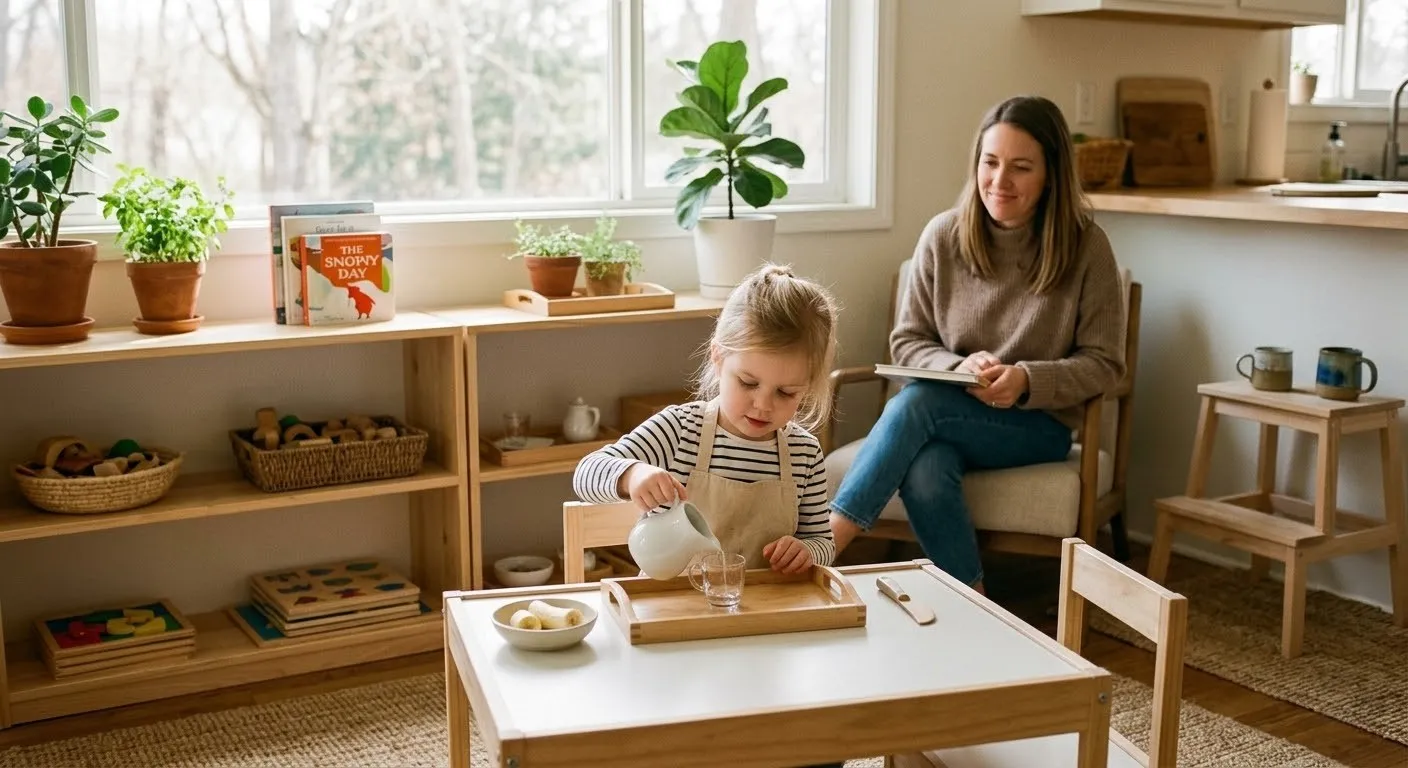
You just closed a “Montessori home tour” on YouTube — glowing wooden shelves, zero plastic toys, a two-year-old focused for twenty minutes with a small pitcher. You look at your own home: plastic toys, TV running, breakfast bowls unwashed. You close the tab.
That feeling isn’t Montessori failing you. It’s content marketing failing Montessori. The method was designed for low-income families in Rome in 1907. The aesthetic has nothing to do with whether it works in your house.
How to start Montessori at home (the honest version):
- Understand the philosophy first — it’s about independence and respect, not wooden toys
- Observe your child for 3 days without changing anything
- Declutter one space — less choice = more focus
- Lower one thing to child height (a hook, shelf, or snack area)
- Involve your child in one real daily task (cooking, cleaning, gardening)
- Change your language — invite instead of instruct
- Step back when your child is working — resist the urge to help
Total cost to start: $0. What it requires: a mindset shift, not a budget.
Before we start: This guide will not tell you Montessori at home is easy, transforms everything overnight, or requires throwing away plastic toys. It will tell you what genuinely works, what is overhyped, what takes time, and exactly where real families get stuck.
What Montessori at Home Actually Is (And What It Isn’t)
The strongest Montessori outcomes ever recorded — published in PNAS in 2025 by Lillard et al. — came from public schools serving low-income families. What Instagram doesn’t show: spilled water, activities the child ignored, a parent losing patience at 7am, and Montessori still working through all of it.
Montessori at home is not a curriculum, a checklist, or an aesthetic. It’s a way of seeing your child — as capable, internally motivated, and needing an environment that supports rather than constantly directs their development. Three things genuinely matter: how you interact with your child (language, pace, trust), what your environment enables (accessibility, order, real work), and how you observe before you react, plan, or buy anything. Everything else is optional.
One important distinction: Montessori at home means applying Montessori principles to daily family life regardless of where your child goes to school. Montessori homeschooling is an entirely different commitment. 95% of parents searching this topic want the first — and you don’t need to homeschool. A Montessori-aligned home combined with a traditional school still produces meaningful outcomes, because 16 hours of each day are at home.
The 3 Ideas You Must Understand Before Doing Anything Else
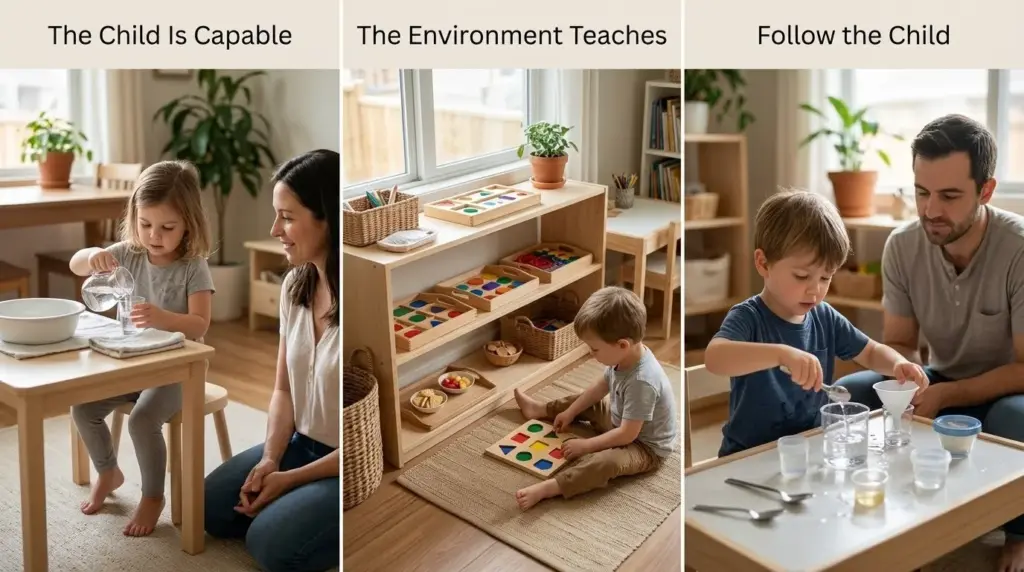
Idea 1 — The child is capable (more than you think)
The foundational belief in Montessori is simple and radical: children are not empty vessels waiting to be filled by adults. They are driven by an inner force toward growth, mastery, and contribution.
What this changes in practice: every time you do something for a child that they could attempt themselves, you send a subtle message — I don’t trust you to do this. And each repetition of that message has a cost.
Maria Montessori put it directly: “Every unnecessary help is an obstacle to development.”
Try this: make a list of five things you do for your child daily that they could attempt themselves. That list is your starting point — not a shelf, not a purchase.
Idea 2 — The environment teaches (more than you do)
Montessori’s most counterintuitive insight: the best teaching doesn’t come from the adult talking. It comes from the environment being set up correctly. A well-prepared space teaches 24 hours a day, without fatigue, without inconsistency, without raised voices.
Practically: 30 minutes setting up one accessible space correctly does more than 30 minutes verbally instructing your child.
The minimum viable environment isn’t expensive or elaborate. It’s: one low shelf, one accessible snack station, one spot where a child can work without being corrected or interrupted.
Idea 3 — “Follow the child” (not your curriculum)
This is the most misunderstood phrase in all of Montessori. It does not mean “child does whatever they want.” It means: observe what your child is naturally drawn to, ready for, or struggling with — then prepare conditions that support that specific thing.
The difference in practice: Traditional approach → “We’re doing arts and crafts because it’s Tuesday.” Following the child → “I noticed she’s been fascinated with water all week. I’ll set up a simple pouring station.”
The skill it requires is observation — the most underrated and most powerful tool available to a parent. This week’s practice: 20 minutes of watching your child, no phone, no intervention. Write down what you see.
Understanding these three ideas is foundational to the Montessori method as a whole. If you’re new to the philosophy, the complete method guide covers the science and principles behind all of this in depth.
Setting Up a Montessori Home Environment: What Actually Matters
The honest starting point
The biggest myth in Montessori content: you need to redesign your home. The reality: you need to modify it in small, purposeful ways — most of which cost nothing.
| Non-negotiable (free–low cost) | Nice to have (optional) | Marketing trap (skip) |
|---|---|---|
| Low hook for coat/bag | Specific Montessori shelf | Expensive wooden toy sets |
| Step stool at sink | Learning tower | Full bedroom overhaul |
| Accessible snack station | Child-sized table/chairs | “Montessori” branded materials |
| Work mat on floor | Minimalist décor | Separate Montessori room |
| Reduced clutter | Natural materials only | Instagram-ready aesthetic |
The 4-zone home Montessori framework
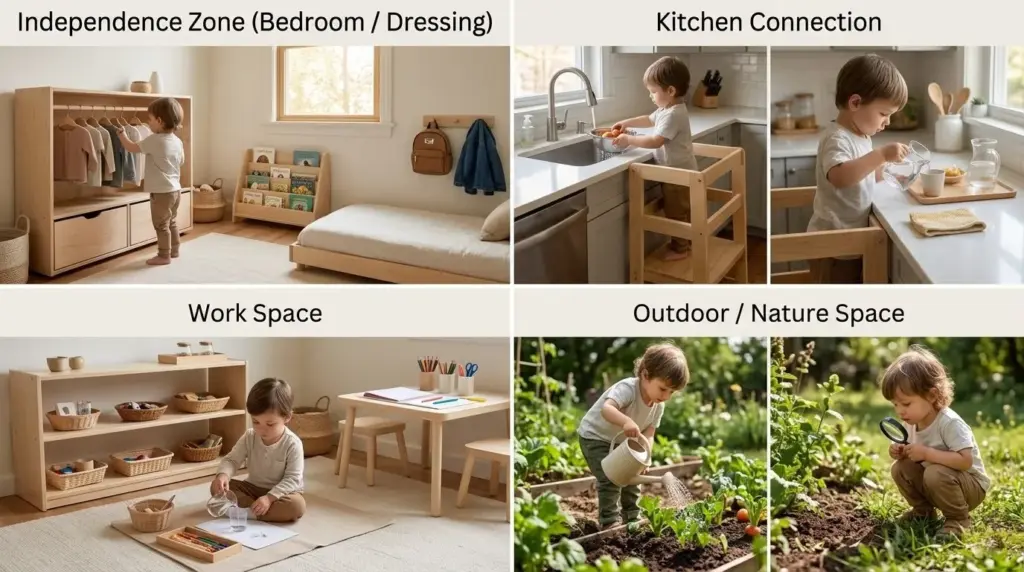
Zone 1 — The Independence Zone (Bedroom/Dressing)
- Goal: child manages their own body and belongings without asking.
- What matters: A low or accessible bed the child can get in and out of independently. An open shelf or low drawer with 2–3 visible clothing choices (not an overwhelming wardrobe). A hook at child height for their bag and jacket. Books displayed cover-out at eye level, max 6–8 rotated weekly.
- The 2-choices rule for clothing: not 20 options — two weather-appropriate choices. Child decides. Non-negotiable once chosen. A simple morning routine board with photos (not words) lets pre-readers self-manage the sequence: wake up → toilet → wash face → get dressed → breakfast → ready.
Zone 2 — The Kitchen Connection
- Goal: child participates in real food preparation and cleanup.
- What matters: A step stool or sturdy chair that gives counter access ($8 at a hardware store). A self-serve snack station at child height, accessible from 8am–4pm without asking permission — a small container of crackers or fruit, a small pitcher of water, their own cup. A real sponge and small cloth accessible for self-cleaning spills.
- The snack station alone changes mealtime conflict for many families. When children can access food independently, a significant portion of “I’m hungry” interruptions — and the negotiations that follow — simply stop.
Zone 3 — The Work Space
- Goal: a space where the child can self-select an activity, work without interruption, and clean up independently.
- What matters: One low shelf (an IKEA KALLAX costs $40–70 and does the job perfectly). Five to seven activities maximum on the shelf at any time — rotation is the mechanism, not accumulation. Work mats that define the workspace (rubber bath mats cost $3 and work fine). An accessible art station: paper, colored pencils, scissors, tape — organized, reachable, complete.
- The rotation principle: when an activity has been mastered, rotate it out. When an activity generates no interest after a week, it may not be the right developmental stage — swap it. Each activity should live in one basket or tray, completely set up and ready. Choosing which activities are worth that shelf space — and filtering out Montessori-washed decoration — is exactly what our complete buyer’s guide is built around. The child should not need to ask for anything to begin.
Zone 4 — The Outdoor/Nature Space
- Goal: connection to the real world, gross motor development, scientific observation.
- What matters: Daily outdoor time, even if it’s only 20 minutes at a park. One natural thing to care for — a plant, a patch of garden, a bird feeder. Space to move freely without being directed. For apartment families: one potted herb on a windowsill plus regular park time is valid and sufficient.
The declutter protocol — the single most impactful free change
- Research from the University of Toledo found that toddlers with fewer toys play longer, with more creativity and more focus. Knowing which toys are actually worth keeping — based on design criteria rather than aesthetics — makes the rotation system far more effective. The finding is consistent: less visible choice produces more sustained engagement.
- The 50% rule: remove half of all visible toys. Observe for one week. Nearly every parent who tries this reports their child plays more and better with less.
- What to keep: open-ended items the child currently uses. What to store: battery-operated toys, duplicates, anything the child hasn’t touched in two weeks. Store 3x what you display, rotate every 1–2 weeks. Toys feel new again without buying anything.
What a Montessori Day at Home Actually Looks Like
Rhythm over schedule
A rigid schedule is adult-controlled — children are always reactive to it. A predictable rhythm is different: the child knows what comes next, which creates security and independence without the child being managed.
The four rhythms that matter most: a morning rhythm where the child manages their own preparation; a work rhythm — one daily period of uninterrupted self-directed activity; a mealtime rhythm where the child participates in preparation and cleanup; and an evening rhythm with consistent elements the child leads.
The morning routine — where Montessori is won or lost daily
The morning sets the tone for independence or dependence for the whole day. A Montessori morning audit: Does your child know the sequence? Can they access everything they need without asking? Are you waiting for them — or rushing them?
| Instead of | Try |
|---|---|
| “Get dressed now!” | “What’s next in your morning?” |
| “Let me do it for you” | “Do you want to try?” |
| “Hurry up!” | Build in 10 extra minutes instead |
Create a morning visual board with photos of each step — made together with the child. Within a few weeks, the morning is theirs.
The uninterrupted work period — the most powerful thing most families aren’t doing
Montessori schools protect a 3-hour work period in the morning. At home, the realistic version is 30–45 minutes, daily. During this window: the child self-selects from the shelf or a practical activity, and the adult does not suggest, correct, praise mid-activity, or interrupt. The adult observes or does parallel work nearby.
Every interruption breaks the concentration cycle. Concentration builds like a muscle — protect it and it grows. The hardest part: watching your child struggle without jumping in. The struggle is the learning. If your child can’t sustain 30 minutes yet, start with 10 and build by 5 minutes each week.
Mealtime — the most underused Montessori opportunity
Three principles: child participates in preparation (age-appropriate), child serves themselves (self-regulation of portions), child is responsible for their cleanup.
By age:
- 18mo–2yr: Wipes own face, carries unbreakable bowl to sink, wipes spills
- 2–3yr: Pours own drink from small pitcher, scoops own food, places utensils
- 3–5yr: Peels, cuts soft foods, sets table, clears and stacks dishes
- 5yr+: Prepares simple dishes, manages own plate fully, helps with family cleanup
The “don’t serve them” shift: from parent plating food and placing it in front of the child → child serving themselves from family-style dishes at the center of the table. One of the easiest and highest-impact Montessori changes available.
How Montessori Parents Talk Differently
Language is the most accessible Montessori practice — no purchase required, and it changes how children feel about themselves and their capacity to learn.
The 5 highest-impact language shifts
Shift 1 — From praise to acknowledgment
| Instead of (praise) | Try (acknowledgment) |
|---|---|
| “You’re so smart!” | “You did it. How do you feel?” |
| “Amazing job!” | “I noticed you worked on that for a long time.” |
| “I’m so proud of you!” | “Are you proud of yourself?” |
Praise shifts focus to the adult’s approval. Acknowledgment builds the child’s internal compass. Carol Dweck’s research on fixed vs. growth mindset maps directly onto this distinction — children praised for intelligence seek to protect that image; children whose effort is acknowledged seek to grow.
Shift 2 — From commands to invitations
| Instead of (command) | Try (invitation) |
|---|---|
| “Put your toys away right now!” | “It’s time to clean up. Where do you want to start?” |
| “Don’t run!” | “We walk inside the house.” |
| “Come eat now.” | “Dinner is ready. Can you come to the table?” |
Shift 3 — From doing to enabling: Instead of putting on your child’s shoes, sit nearby while they try. Instead of pouring their drink, set up a small pitcher they can reach. Instead of answering “what’s that?” immediately, ask: “What do you think it is?”
Shift 4 — From “no” to information: “That’s hot — it could hurt your hand” instead of “Don’t touch.” “Chairs are for sitting” instead of “Stop climbing the chair.” When possible, let the environment solve it — a smaller container eliminates the spill argument entirely.
Shift 5 — From rescuing to witnessing struggle: The 30-second rule: before intervening, count silently to 30. In most cases, the child solves it. The message of non-rescue — “I trust you can do this” — is more powerful than any praise.
Discipline language — natural consequences over punishment
Natural consequences: the world provides feedback (no jacket → feels cold). Logical consequences: directly related to the action (made a mess → helps clean up). Punishment: disconnected from action, teaches compliance through fear rather than inner understanding.
Five quick scripts: Hitting — “I won’t let that happen. You can be angry — hurting someone is not okay.” Stay calm, stay present. Tantrum — no words during the storm; after: “You were really upset. How are you feeling now?” Refusing cleanup — “You chose this activity. The activity is finished when the materials are back in their place.” Sibling conflict — don’t referee immediately; “Can you two work this out together?” Intervene only if escalating. Lying — stay curious: “Tell me what happened.”
For a complete guide on practical scenarios including morning routines, tantrums, and screen time, the Montessori parent role in daily life covers Director vs. Guide mode in daily life.
Montessori at Home by Age
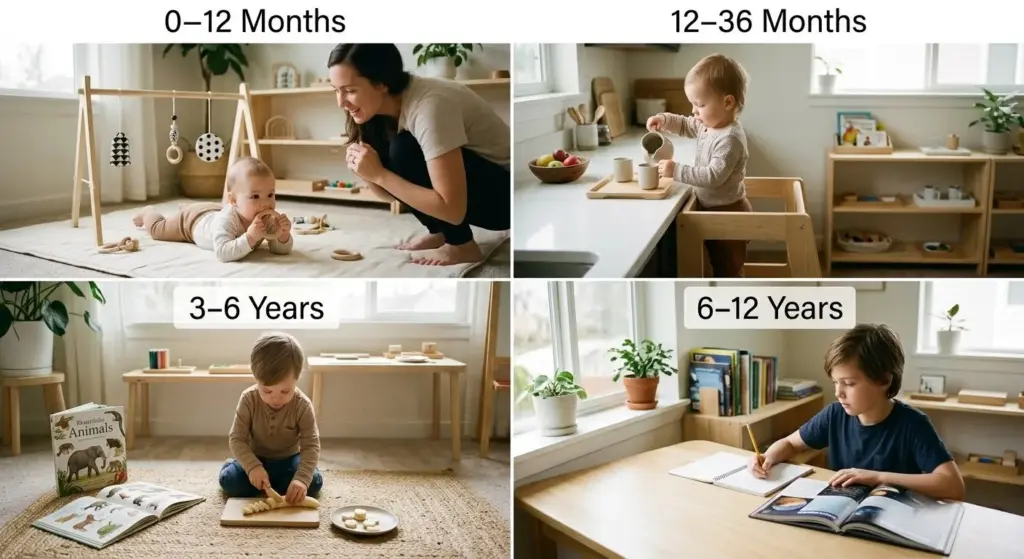
Newborns and infants (0–12 months)
Core focus: rich sensory environment, narrated daily life, floor freedom.
The biggest thing: floor time without restraint devices. No bouncy seats, no walkers, minimal restricted holding. Talk to your baby constantly — narrate everything. They are absorbing language from day one. Total Montessori-aligned setup for this age: a floor gym mat ($15), a simple black-and-white mobile, a basic natural rattle. Under $30. When choosing beyond those basics, toys for 0–12 months are curated specifically around movement freedom and sensory simplicity — not electronic stimulation
Toddlers (12–36 months)
Core focus: “Me do it” — independence in self-care, simple practical life, freedom of movement.
This is the most challenging and most impactful age for Montessori at home. The three non-negotiables: let them try before you help (even when it takes 10x longer), create access (step stool, low shelf, accessible clothing), and maintain consistent routines — the sensitive period for order peaks here, and predictability is security.
The tantrum reframe: toddler tantrums are often unsatisfied competence. When a toddler melts down insisting on doing something themselves, that is one of Montessori’s most important developmental drives at work. Let them try. Understanding what’s happening developmentally at this stage connects directly to the Montessori sensitive periods — particularly the sensitive periods for order, movement, and language that peak in the first three years.
Preschoolers (3–6 years)
Core focus: purposeful work, reading/writing preparation, social skills, real contribution.
Five highest-impact practices: full involvement in food preparation with real tools; a daily uninterrupted work period (30–45 minutes minimum); reading saturation — books everywhere, conversations about books, following interests; outdoor time daily; and one consistent real household responsibility.
Screen time at this age: Montessori is clear — minimize significantly. The reasons are neurological. Under 5, research is unambiguous about the relationship between screen time and executive function development. What builds executive function is the opposite of passive screen watching: self-directed, challenging, hands-on work.
The language shift for this age: introduce specific vocabulary for real things. Dandelion, not just “flower.” Chrysalis, not just “butterfly house.”
Elementary (6–12 years)
Core focus: intellectual curiosity, community contribution, real responsibility, self-direction.
The shift at this stage is less about physical environment setup and more about intellectual environment and genuine responsibility. Montessori at home here means: following their passionate questions and fueling them with books, documentaries, and experiences; giving them real household responsibilities that genuinely matter (cooking a whole meal, managing their own schedule); protecting long uninterrupted time for self-directed projects; and incrementally expanding their decision-making domain.
Montessori at Home in the Real World: Solving the Hard Situations
“I work full-time. Is Montessori at home even possible?”
Honest answer: a full Montessori all-day? No. Meaningful Montessori within a working family’s life? Absolutely.
The three high-impact windows: the morning routine (20 minutes of independent sequence sets the tone for the child’s whole day), evening meal involvement (30 minutes of real participation in prep and cleanup), and one weekend environment hour (rotate shelf, set up activities, reorganize accessible spaces).
Five quality Montessori interactions in a day outperform an hour of anxious “doing Montessori” badly.
“My partner/in-laws don’t agree with this approach”
Don’t argue philosophy — invite observation of outcomes. Ask your partner to simply watch without intervening for one week and notice changes.
The alignment minimum: identify three practices you both agree on. Start there. Build consensus from evidence, not argument.
Grandparent script: “We’re not doing anything radical. We’re just letting [child] try things before we help. Can you try that this weekend?”
The honest concession: 100% alignment is rare. Directional consistency from at least one primary caregiver produces meaningful outcomes.
“Montessori at home is too expensive”
| What costs money | Actual cost | Free/cheap alternative |
|---|---|---|
| Learning tower | $150–$300 | Sturdy step stool: $8–$15 |
| Montessori shelf | $100–$400 | IKEA KALLAX: $40–$70 |
| Montessori materials | $500+ for full sets | Household items: $0 |
| Dressing frames | $30–$60 each | Real clothing with varied fasteners: $0 |
| Wooden toy sets | $50–$200 | Thrift store wood items: $2–$10 |
Total minimum viable Montessori home setup: under $50.
The Montessori product market is not the Montessori method. When certain wooden materials are worth the investment, the true cost breakdown explains exactly what drives the price difference — and when the premium is real versus marketing. The method requires thoughtfulness, not purchases. As Lillard noted in 2025: “I see all these schools that claim to have Montessori when what they offer is just a shadow of it or ‘Montessori toys’ sold on the web” — and the same applies equally to home setups.
“I started and my child doesn’t seem to care”
Most common reasons: activities not matched to current developmental stage (too easy = bored, too hard = avoidance); activities set up incompletely or never demonstrated; the adult is hovering during work time instead of observing from a distance; or — the most overlooked — the transition period. Children who have been directed their whole lives often take 2–4 weeks to “wake up” to self-direction. This is normal.
The two-week protocol: make zero new purchases. Observe for two weeks. Identify specifically which activities the child gravitates toward when nothing is organized for them. That is your starting point.
Montessori at home and neurodiversity
Montessori is frequently considered highly compatible with neurodivergent profiles because of individual pacing, sensory-rich materials, freedom of movement, and the complete absence of shame culture. Specific adaptations:
- ADHD: Shorter work periods with movement breaks built in; outdoor time as a regulation tool; fewer items on shelf to reduce overwhelm.
- Autism spectrum: High predictability and routine consistency; visual schedules; sensory adaptations to materials (texture options, lighting).
- Anxiety: Extra emphasis on predictable routine and consistent environment; fewer sudden transitions; extensive advance notice before changes.
The core principle remains: observe, then respond to this child’s actual needs — not a hypothetical ideal Montessori child.
For a practical framework on how to apply these principles daily — including the prepared environment setup and practical life activities that support all of the above — the guide to Montessori practical life activities is the most direct next step.
Your 30-Day Montessori at Home Start Plan
Week 1 — Observe and stop (do nothing new yet)
- Days 1–3: 20 minutes daily, no phone, no intervention. Write down: What does your child choose when no one directs them? Where are they frustrated by their environment? What do they try to do independently that you usually do for them?
- Days 4–5: Language audit — track 10 things you say to your child today. How many are commands vs. invitations?
- Days 6–7: Environment walk — crouch to your child’s height in each room. What can they reach? Make a list of priority changes only.
Week 1 cost: $0. Time: 20 minutes daily.
Week 2 — Environment minimum viable changes
Pick the three highest-impact changes from Week 1. Almost always: a low hook, an accessible snack station, one decluttered shelf. Set up one practical life activity. Demonstrate it once — slowly, minimal words — then step back. Start the 30-second pause rule before every intervention.
Week 2 cost: $0–$20. Time: 2 hours setup, 15 minutes daily.
Week 3 — Routines and language
Create the morning visual board with the child. Replace three commands with invitations. Begin the 30-minute daily work period: child self-selects, adult does parallel work nearby without interfering. Introduce one mealtime independence element.
Week 3 cost: $0–$5. Time: 30-minute daily work period.
Week 4 — First rotation and reflection
Observe which activities were used and how often. Rotate out mastered activities, introduce one new practical life activity at the next level. Write a 5-minute reflection: What changed? What surprised you?
The long game: this is a 6-year gradual shift in who does what — with compound returns.
Why Montessori at Home Is Worth It: The Evidence
Three significant studies from 2025 make the case clearly. PNAS 2025 (Lillard et al.) — the first national randomized controlled trial of public Montessori, 588 children across 24 programs — found Montessori children significantly ahead in reading, executive function, short-term memory, and social understanding by end of kindergarten. Crucially, these gains sustained rather than fading, unlike most early education interventions. Scientific Reports 2025 (Le Diagon et al.) — a 5-year longitudinal RCT — found significant advantages in mathematical problem-solving at ages 8–9, attributed to sensory-motor foundations built in the early years. Frontiers in Developmental Psychology 2025 (Lillard et al.) found Montessori attendance during sensitive periods associated with higher adult wellbeing — engagement, social trust, and sense of purpose — across nearly 2,000 adults.
The home environment’s role is consistently confirmed in behavioral reviews: parental approach co-determines outcomes alongside school quality. You don’t need a Montessori school to benefit. But if you have one, the home environment determines whether the school’s investment compounds or dissipates.
The longer view: Moffitt et al. (PNAS, 2011) found self-control established in childhood predicted health, financial stability, and wellbeing at age 32 — more reliably than IQ or socioeconomic status. The five Montessori principles that build this self-control — and how each one translates to a daily home habit — give the theoretical backbone to everything in this guide.. Montessori at home builds self-control through uninterrupted work, real consequences, and independent problem-solving. You’re not building test scores at 6. You’re building autonomy and judgment at 32.
Montessori at Home: 14 Questions Real Parents Ask
- Can I do Montessori at home without a Montessori school?
Absolutely. The principles — prepared environment, following the child, respecting independence — are fully applicable at home and independent of school enrollment.
- How do I start with no money?
Observe for 3 days without intervening. Change your language from commands to invitations. Involve your child in one real daily task. Declutter one space. These four actions require no budget.
- What age should I start?
From birth. The absorbent mind begins at birth — narrated daily routines and floor freedom are Montessori for an infant.
- Is Montessori at home expensive?
Under $50 to begin meaningfully. The most expensive thing is the time investment — specifically, the patience to wait while your child does things slowly.
- What does a Montessori home look like?
Low hooks, an accessible snack station, a shelf with 5–7 activities in baskets, a child-height work area, and a kitchen that allows real participation. Not expensive wooden toys, not minimalism, not a separate room.
- How is Montessori parenting different from regular parenting?
The adult’s role shifts from directing, deciding, and rescuing to observing, preparing, and stepping back — trusting the child to direct their own learning within thoughtfully established boundaries.
- My toddler won’t stay with any activity — what am I doing wrong?
Usually one of three things: activities don’t match current interest or stage; you’re present in a way that invites interaction; or the transition to self-direction is new and needs 2–4 weeks to establish. Start with something you’ve directly observed the child drawn to.
- Can working parents meaningfully do Montessori at home?
Yes. Focus on high-impact windows: independent morning routine, evening mealtime participation, one weekend environment hour. Quality of Montessori moments matters more than quantity.
- What are the biggest mistakes parents make?
Buying materials before understanding the philosophy. Setting up activities without demonstrating them first. Hovering during the work period. Correcting mid-activity. Expecting immediate results.
Montessori at Home Is Not About Being a Perfect Parent. It’s About Being a Thoughtful One.
The perfectly curated Montessori home you saw on YouTube — that parent also has bad days, plastic toys in the storage room, and mornings where they did everything for their kid to get out the door on time.
Montessori at home is not a destination. It’s a direction.
Every day won’t be a Montessori day. Many days will be survival mode. That is parenthood, and Montessori does not require you to be superhuman. What it requires: the willingness, most days, to wait a few extra seconds before helping. To set up one thing at their level. To ask “what do you think?” before answering. To say “you can try” instead of “let me do it.”
Each of those micro-moments deposits into an account that pays out in independence, confidence, and self-regulation — at 6, 16, and 36.
“The child has a mind able to absorb knowledge. He has the power to teach himself.” — Maria Montessori
Your job is not to teach your child. Your job is to not get in the way of a child who is already, brilliantly, teaching themselves — if you give them the chance.