
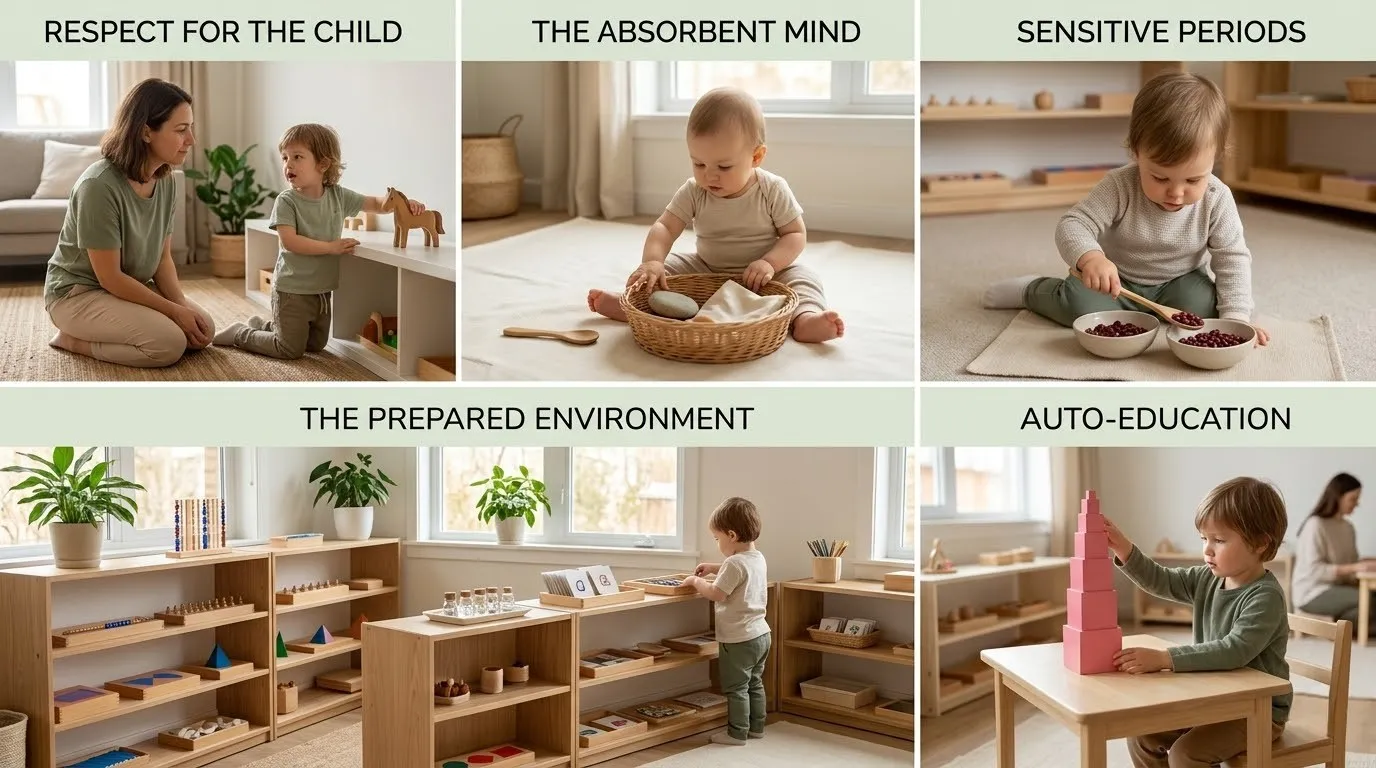
A four-year-old is trying to tie her shoes. She’s been at it for four minutes. In a traditional response, an adult steps in — here, let me do that — and it’s done in ten seconds. In a Montessori response, the adult pauses, watches, and only steps in if genuinely needed.
That difference isn’t a parenting preference. It’s what happens when five specific principles of the Montessori method are working together.
What are the five principles of the Montessori method?
- Respect for the Child
- The Absorbent Mind
- Sensitive Periods
- The Prepared Environment
- Auto-Education
What are Montessori principles? Montessori principles are the core ideas that explain how children learn, what they need from adults, and why environment matters so much in the Montessori approach. They are less about a curriculum checklist and more about a way of understanding child development in daily life.
This guide explains each principle clearly, shows what it looks like at home and in the classroom, addresses common misunderstandings, and connects the five principles to related terms you’ll often encounter — like freedom within limits, child-directed work, and uninterrupted work period.
Why Montessori Principles Can Feel Confusing Online
If you’ve searched this topic before, you’ve seen very different lists — 5 principles, 8, 10, or 12. None are wrong; they’re answering different questions. Some describe core philosophical beliefs. Others describe how those beliefs get implemented. Still others describe the broader worldview.
This guide uses the five-principle framework because it’s the clearest starting point for parents and educators, and because it matches what most people are actually searching for. Once you understand the five principles, the broader components — materials, work cycles, mixed-age groupings — all make more sense.
A quick distinction worth keeping in mind:
- Principles are core beliefs about how children learn.
- Components are how those beliefs are expressed in a real environment.
- Philosophy is the wider picture, including independence, intrinsic motivation, and whole-child development. The five principles live at the first level.
Where the 5 Montessori Principles Come From
Maria Montessori (1870–1952) didn’t develop these principles from educational theory. She developed them from observing children — thousands of them, across different backgrounds and decades. What she kept seeing contradicted the assumptions of her era: children were not passive recipients of teaching. They were active, driven, and capable when the environment supported them.
They’ve lasted because they describe things that remain true about child development: the power of intrinsic motivation, the role of environment in shaping behavior, the existence of developmental windows. A review of the Montessori evidence base published in npj Science of Learning confirms that the core elements Montessori observed — child-directed work, uninterrupted concentration, and self-correcting materials — show consistent measurable benefits for children’s learning and motivation.
The five principles are not five independent ideas. They form a system:
- Respect is the foundation.
- The Absorbent Mind and Sensitive Periods explain how children develop.
- The Prepared Environment is the adult’s response to that knowledge.
- And Auto-Education is what becomes possible when all four align. Remove one, and the others lose their grounding.
The 5 Core Principles at a Glance
Quick definitions
- Principle 1 — Respect for the Child: Treating the child as a whole person with dignity, a developmental pace of their own, and a real capacity for independent action.
- Principle 2 — The Absorbent Mind: The young child’s unique ability to absorb language, culture, movement, and environment deeply and almost unconsciously, especially from birth to age 6.
- Principle 3 — Sensitive Periods: Temporary windows of heightened receptivity when a child is especially ready to develop a specific skill — and learning in that window tends to be faster, deeper, and more joyful.
- Principle 4 — The Prepared Environment: A physical space intentionally arranged to support independence, order, concentration, and child-directed work — at home or at school.
- Principle 5 — Auto-Education: The child’s capacity to construct their own learning when the environment, materials, and adult support are right.
Summary table
| Principle | Core meaning | What it looks like daily |
|---|---|---|
| Respect for the Child | Child has dignity, pace, and capability | Waiting, listening, not over-helping |
| The Absorbent Mind | Early childhood is the most powerful learning window | Rich language, modeling, real-world routines |
| Sensitive Periods | Children have windows of heightened readiness | Observing interests, offering aligned activities |
| The Prepared Environment | Environment shapes behavior more than correction | Accessible shelves, real tools, ordered space |
| Auto-Education | Children can teach themselves when conditions are right | Stepping back, letting repetition happen |
Principle 1: Respect for the Child — The Foundation of Montessori
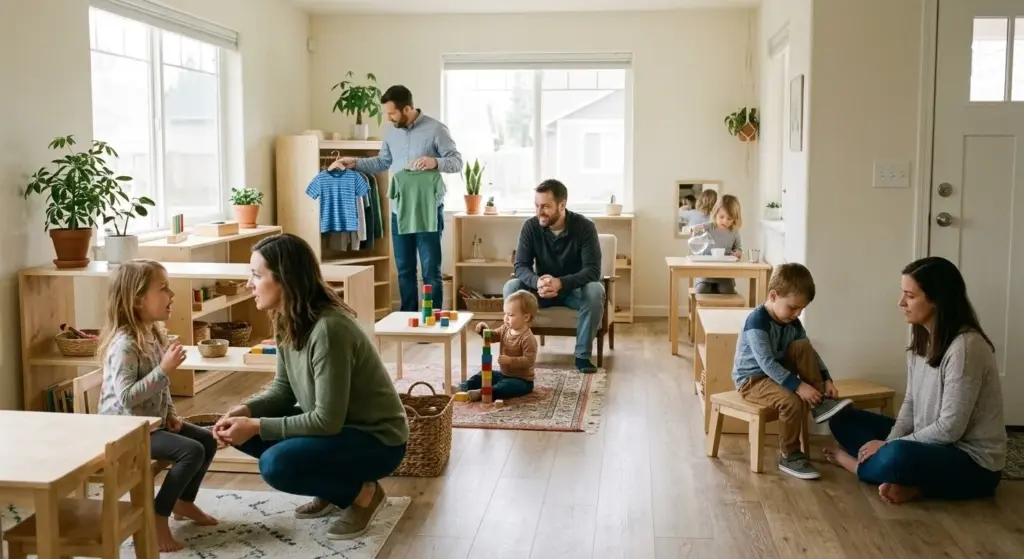
What “respect for the child” really means
Respect in Montessori doesn’t mean permissiveness. It doesn’t mean the child gets what they want. It means seeing the child as a complete human being — with their own developmental timeline, their own emerging will, and a real capacity to participate in daily life.
Most adults respect children’s emotions in theory but override them constantly in practice: we finish their sentences, grab things from their hands because we’re in a hurry, and decide when they’ve “had enough” of an activity. Montessori asks us to catch those moments and make a different choice.
The 4 dimensions of respect
- Respecting concentration: When a child is deeply focused, that focus deserves protection — not interruption, even with praise. Concentration is one of the most valuable things a child can develop — it underlies fine motor control, problem-solving, and self-regulation equally.
- Respecting pace: Not every child buttons a coat at the same speed, learns to read at the same month, or finishes a task in the time an adult considers “reasonable.” Respect means not imposing adult timelines on developmental processes.
- Respecting choice: Offering real choices — not fake ones — within a defined space. “Do you want to put on your shoes first or your jacket?” is respectful. “Do whatever you want” is not a choice; it’s a vacuum.
- Respecting capability: Defaulting to the assumption that the child can — and only stepping in when they genuinely cannot. Not because you don’t care, but because you believe in them. Materials that embody this principle give the same message: the child can do this themselves, without an adult stepping in to confirm every move. Busy boards and shape sorters are built around self-correction — the child discovers whether they’re right, not an adult telling them.
Respect vs. permissiveness
Respect does not remove limits. Limits exist in three clear areas: safety, respect for others, and care of the environment. Within those three, the child has real freedom. Outside them, the adult holds the line — calmly and consistently.
What respect looks like in daily practice
- Crouch or sit at child’s eye level when speaking
- Give advance notice before transitions: “In five minutes we’ll be leaving the park”
- Don’t grab objects from a child’s hands — ask
- Don’t finish their sentences or answer for them
- Give more time to respond than feels comfortable
- Explain rules in a calm, informational tone rather than a commanding one
Common mistakes
- Rushing physical tasks to save time
- Correcting constantly and loudly
- Using shame (“a big kid wouldn’t do that”)
- Conflating obedience with learning
- Talking at children rather than with them
Daily scenario
Situation: Child is slowly putting on shoes before school.
- Disrespectful adult response: “We’re late, just let me do it” — takes over.
- Montessori-respect response: Builds time into the morning, sits nearby, says “I’ll wait.” Lets the child work. Steps in only if the child asks or is genuinely stuck.
- Why the second one matters: The child experiences competence. Tomorrow, the shoes go on a little faster. Over months, they stop needing help at all.
Principle 2: The Absorbent Mind — Why Early Childhood Is So Powerful
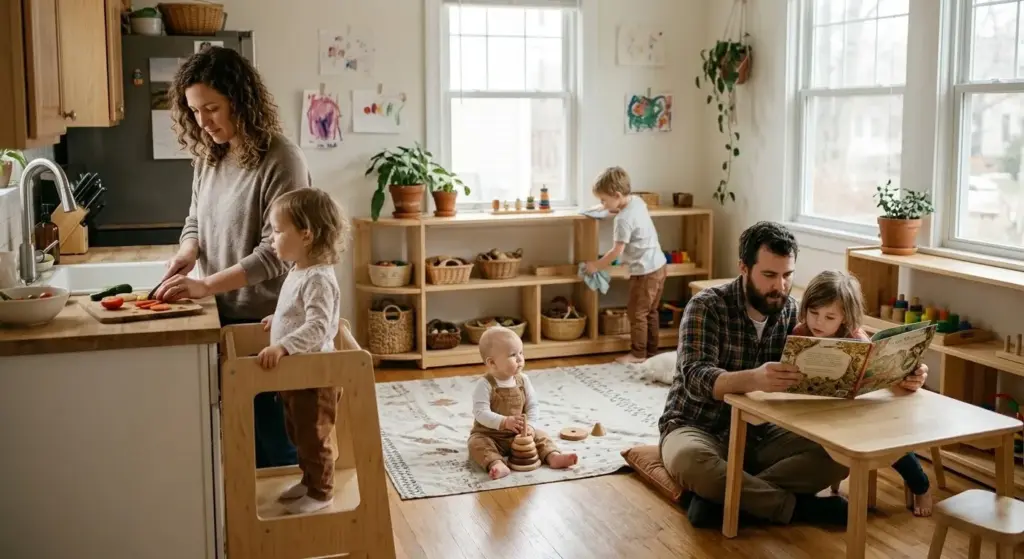
What the absorbent mind means in simple terms
Young children don’t learn the way adults do — through deliberate study, repetition, and effort. They absorb. Language, emotional tone, social patterns, routines, culture — all of it goes in deeply, almost without effort, from the environment around them.
Maria Montessori called this the absorbent mind: the young child’s unique capacity to take in and internalize the world. It’s why a two-year-old picks up an accent perfectly and a forty-year-old struggles for years with one. The capacity is genuinely different.
The two broad phases
- Birth to 3 — unconscious absorption: The child absorbs almost everything without awareness. The tone of your voice, the rhythm of the household, the emotional climate, the physical environment — all of it goes in. The foundations of language, order, movement, and attachment are laid here, before the child can tell you what they’re learning.
- 3 to 6 — more conscious absorption: The child is still absorbing powerfully, but with increasing intentionality. They want to do, to name, to classify, to repeat. They’re starting to understand the logic of what they’ve absorbed. This is the phase where Montessori materials, practical life work, and guided activities are particularly well-matched.
Why this changes the adult’s role
If the child is constantly absorbing the environment, then you are part of the curriculum. Your tone of voice when you’re stressed. How you handle a spill. How you greet people. Whether you follow through on what you say.
This is not a guilt statement — it’s a practical one. The most powerful Montessori intervention in the early years isn’t a material. It’s a calm, consistent adult who models what they want the child to absorb.
What the absorbent mind looks like in daily practice
- Rich, real conversation — narrating what you’re doing, using specific vocabulary
- Predictable daily rhythms (the child absorbs order from them)
- Real-world tasks over screen time — hands absorb differently than eyes. The richest input during this window is tactile and sensory — real materials with real weight, texture, and feedback. Sensory toys that offer contrast and variation feed this absorption directly.
- Calm emotional modeling — regulation is absorbed before it’s taught
- Reading aloud every day, even before the child seems to “get it”
Common misunderstanding
“They’re too little to understand.”
Montessori says the opposite: the youngest years are when the environment leaves the deepest imprint. The child isn’t understanding in the adult sense — they’re absorbing in a way that’s more powerful than understanding. What you model now doesn’t just teach behavior; it shapes the template for how the child sees and navigates the world.
Principle 3: Sensitive Periods — The Right Learning at the Right Time
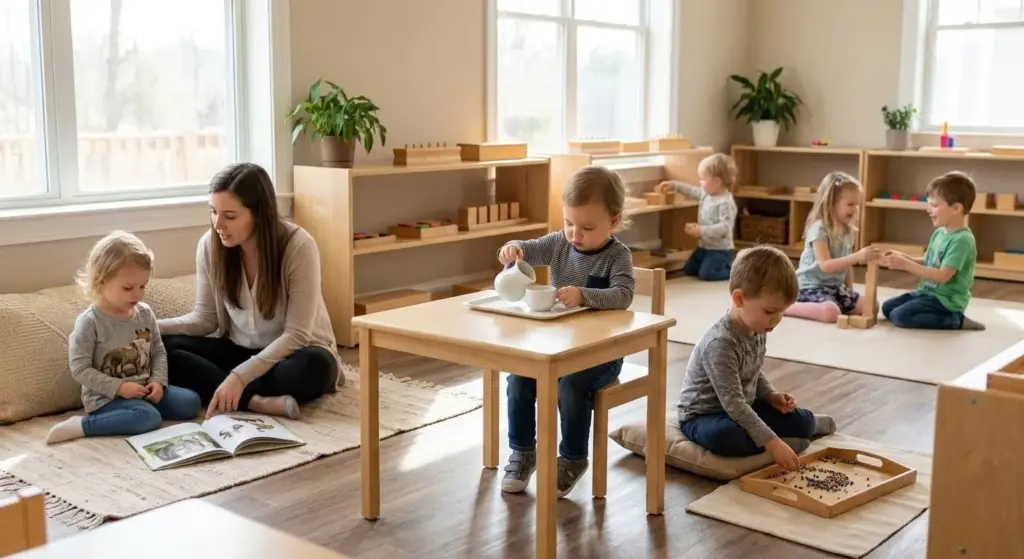
What sensitive periods are
Sensitive periods are temporary windows when a child is unusually receptive to a specific kind of learning. During these windows, the drive to practice a certain skill is intense and almost self-sustaining. The child seeks the activity, repeats it, and makes fast progress. After the window closes, the skill can still be learned — but it takes more conscious effort.
For a deeper breakdown of all six sensitive periods and how to recognize them at home, see our complete guide to Montessori sensitive periods.
Why observation matters more than pushing
The adult’s role isn’t to impose a curriculum on top of sensitive periods. It’s to observe closely enough to recognize which window is open right now — and then prepare the environment to meet the child there. You’re responding to development, not manufacturing it.
The most useful sensitive periods to know
- Language: From birth to around 6. The child is absorbed by sounds, names, stories, and eventually letters and written language — the full arc of language development from babble to literacy. This is why a toddler asks “what’s that?” about everything — they’re in peak vocabulary acquisition.
- Order: Strongest from birth to 3. The child needs consistency, predictable placement of objects, and stable routines. The meltdown over a moved cup isn’t drama — it’s this period working. Routine is security.
- Movement: Birth to around 4.5. First gross motor (walking, climbing, carrying), then refined coordination (pouring, threading, dressing). Movement is not separate from learning — it’s the vehicle for it. Pouring, threading, dressing: these are practical life skills being constructed through physical repetition.
- Small objects / fine detail: Peaking in toddlerhood. The child notices tiny things adults overlook: crumbs, insects, buttons, the small print on a label. This is visual discrimination and pincer grip development happening simultaneously.
- Social behavior: More visible from about 2.5 to 6. The child becomes interested in how people interact — turn-taking, greetings, fairness, belonging.
How to recognize a sensitive period
- Voluntary repetition of the same activity without losing interest
- Intense focus that looks almost adult-like
- Frustration when the activity is interrupted
- Unusually fast progress once the right materials are offered
- Strong, recurring attraction to one type of work
What adults get wrong
Calling a sensitive period an “obsession” and restricting access to it. Interrupting repetition because it looks like boredom. Trying to force skills before the window opens, then wondering why it’s a struggle. Or — the opposite — treating the sensitive period chart as a checklist that triggers anxiety when a child doesn’t match the timeline precisely.
Sensitive periods are an observation guide, not a performance schedule.
Sensitive periods vs. milestones
A milestone is a marker — something a child can now do. A sensitive period is the internal window of readiness that makes the milestone easier to reach. The same milestone can be reached outside the sensitive period; it just tends to require more deliberate effort. This distinction matters because it shifts the adult’s posture from tracking outcomes to tracking readiness.
Principle 4: The Prepared Environment — The Principle You Can Actually See
What a prepared environment is
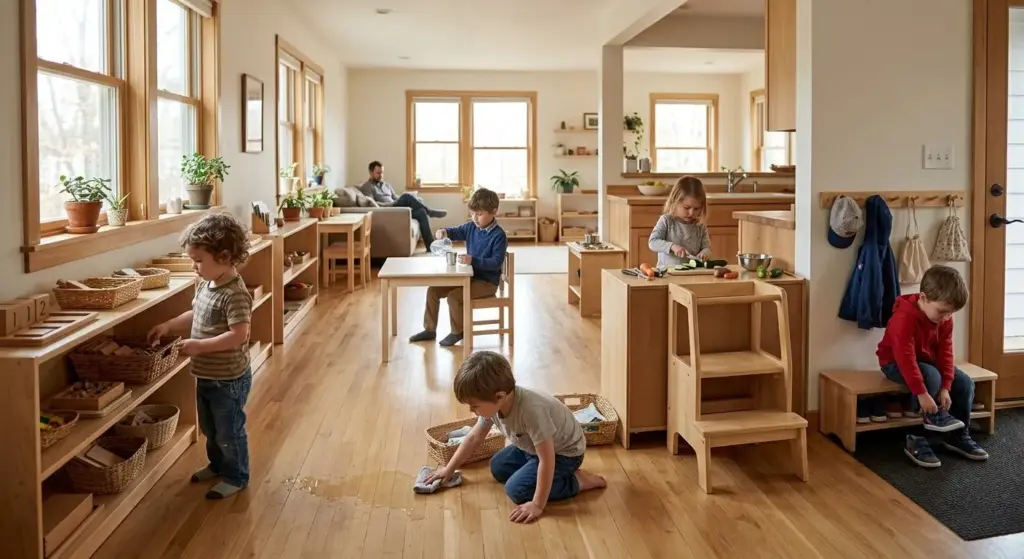
Not a Pinterest aesthetic. Not beige shelves and wooden toys. A prepared environment is a space intentionally arranged to support independence, order, concentration, and real choice — whether that’s a Montessori classroom or a corner of your kitchen.
The test is functional, not visual: Can my child access what they need without asking me? Can they make a real choice here? Can they clean up after themselves? If yes, you have a prepared environment regardless of what it looks like.
Why the environment matters so much
Behavior follows environment. When a child keeps climbing on the counter to reach their cup, the answer is not more reminders — it’s a lower shelf with their cup on it. The environment removes the friction, removes the need for the correction, and removes the power struggle. This is one of the most immediately actionable insights in all of Montessori, and it costs nothing.
The 5 pillars of a prepared environment
- Order: Everything has a consistent, predictable place. Children learn where things belong and can restore the environment independently. This external order supports internal calm — especially during the sensitive period for order.
- Accessibility: Materials are reachable without adult help. Low shelves, child-sized tools, open access where appropriate. If a child has to ask you to get something every time they need it, that’s a setup problem, not a behavior problem.
- Simplicity: Fewer visible choices, less sensory clutter. A shelf with 6–8 items, rotated based on interest and readiness, supports concentration better than a room full of toys. A low shelf with 6–8 items rotated by developmental stage — rather than a toybox full of everything — is the single most impactful change most families can make. Kukoo’s toys by age collections are organized exactly for this rotation: each age window has a curated starting point.
- Real and purposeful activity: Real cups over plastic ones, real cloths for wiping, a real small broom for sweeping. When a child uses real tools, they develop genuine competence and genuine respect for the environment.
- Freedom within limits: The space says “yes” to appropriate independence and “no” to unsafe or disruptive actions. The limits are consistent and clear, but within them the child has real freedom of choice and movement.
Room-by-room guide
- Bedroom: Low bed or floor mattress. 2–3 clothing choices visible and reachable. Books at child height. One basket or low shelf for current toys.
- Kitchen: A step stool at the counter. A low drawer with child-sized cups and spoons. A self-serve snack basket they can access independently. A sponge and small cloth at floor level for spills.
- Bathroom: Step stool, towel hook at child height, toothbrush and toothpaste accessible without asking.
- Entryway: Low hooks for their coat and bag. A small bench or step for putting on shoes independently.
- Work/play area: Low shelf with a limited rotation of materials. The complete room-by-room setup — with a budget breakdown and honest list of what’s actually necessary — is in our Montessori at home guide. A defined mat or small table as a workspace. One activity at a time out and in use.
Budget-friendly version
The most impactful change in most homes is not shopping — it’s removing. Clearing one shelf, lowering one hook, moving snacks to a reachable drawer. These changes often produce an immediate shift in a child’s behavior and in how often they ask for help.
Common mistakes
- Buying Montessori materials before decluttering the existing space
- Rotating toys randomly based on novelty rather than developmental readiness
- Focusing on aesthetics (beige, wooden, minimal) without checking usability
- Keeping the home arranged for adult convenience rather than child access
- Putting too many choices out at once
Principle 5: Auto-Education — Why Montessori Believes Children Can Teach Themselves
What auto-education means
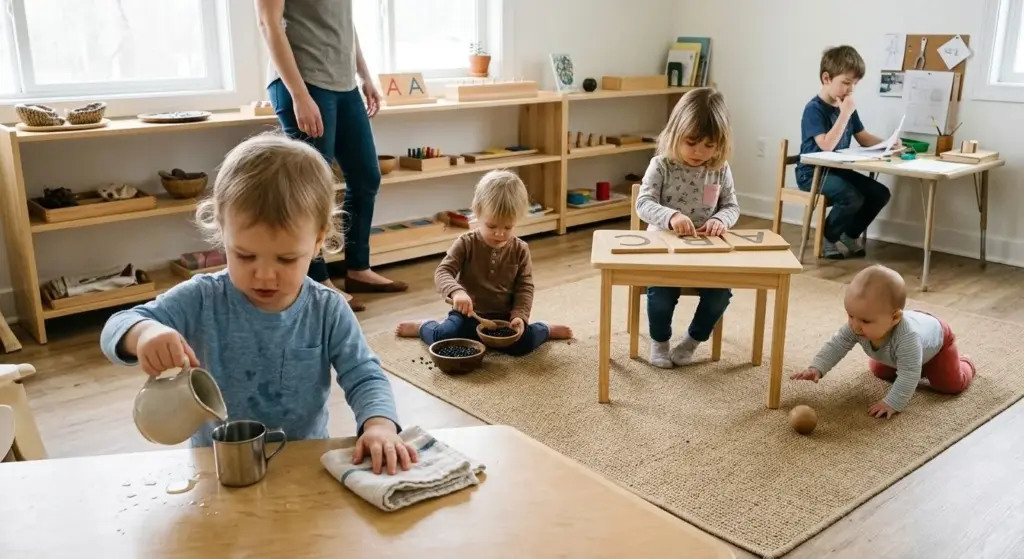
Auto-education is not neglect. It’s not “letting children figure everything out alone.” It’s the recognition that children have an innate capacity to construct their own learning — when the environment is right, the materials offer feedback, and the adult knows when to step back.
In Montessori classrooms, the materials themselves do a significant portion of the teaching. A puzzle piece that doesn’t fit tells the child they’ve made an error without an adult saying a word. Object permanence toys and stacking toys are built on exactly this mechanic — the piece either fits or it doesn’t, the tower stands or it falls. The material is the teacher. The adult doesn’t need to say anything. Water that spills shows the child that the pour was too fast. The environment corrects; the child adjusts.
Why auto-education is often misunderstood
People hear “children teach themselves” and imagine a room full of children doing whatever they want with no adult in sight. That’s not it.
Auto-education requires a carefully prepared environment. It requires materials with built-in feedback (what Montessori called “control of error”). It requires an adult who has observed carefully and offered the right activity at the right time. And it requires an adult who is present but not hovering — available without being directive.
Stepping back is an active choice, not an absence.
The 4 conditions that make auto-education possible
- A prepared environment — the space makes independent work possible
- Meaningful choice — the child selects their own activity based on genuine interest
- Time for repetition and concentration — uninterrupted work periods, however brief
- An adult who knows when to step back — and who intervenes only when genuinely needed
What auto-education looks like across ages
- Infancy: Reaching for an object that rolls away. Trying to turn over. Discovering that kicking makes the mobile move. The environment responds to the child’s action — learning happens.
- Toddlerhood: Pouring water, spilling, noticing the spill, getting the cloth, wiping it up. No lecture needed. The experience teaches the sequence. This is the work cycle practical life activities are designed around — real tasks with real consequences and real cleanup.
- 3 to 6: Working with a practical life activity — spooning beans from bowl to bowl — until they can do it without spilling. Tracing the sandpaper letters until the shape is in the fingers. The child repeats until the skill is truly owned. The toys that build this kind of sustained, self-directed concentration are collected in our cognitive skills guide.
- 6 to 12: Choosing a project, planning how to do it, running into obstacles, finding solutions. Research, problem-solving, and ownership of a process.
The scaffolding continuum
The adult’s role shifts based on the child’s current need:
- Full support — doing together, demonstrating slowly
- Partial support — holding part of the task while the child does the rest
- Verbal cue — “What do you notice?” or “What comes next?”
- Visual setup — the environment provides the prompt
- Observation only — the child is working; the adult watches
The goal is to spend as much time as possible at the bottom of that list — not because you don’t care, but because that’s where the child is building the most.
What to say instead of rescuing
- “Do you want to try again?”
- “What did you notice just happened?”
- “Which part is tricky?”
- Silence — sometimes the most powerful response is simply staying present without acting
The 5 Principles Are Connected, Not Separate
It’s worth stepping back before the practical sections to see how the five principles function as a system — because applying one without the others produces inconsistent results.
- Respect is what changes how you interpret a child’s behavior in the first place. Without it, everything else is technique without foundation.
- The absorbent mind explains why the environment and the adult’s modeling matter so much in the early years. The child isn’t just learning from what you teach — they’re absorbing the whole atmosphere.
- Sensitive periods give the adult the observational lens to recognize what the child is ready for right now — which is the most useful information you can have when deciding what to offer.
- The prepared environment is the adult’s concrete response to that knowledge — arranging space so that independence is not just allowed but supported.
- Auto-education is what becomes possible when the others are aligned. When the environment is right, the observation is ongoing, and the adult’s respect is genuine — children don’t need to be taught every step. They construct the learning themselves.
What Montessori Principles Mean in Real Daily Life
Morning routine
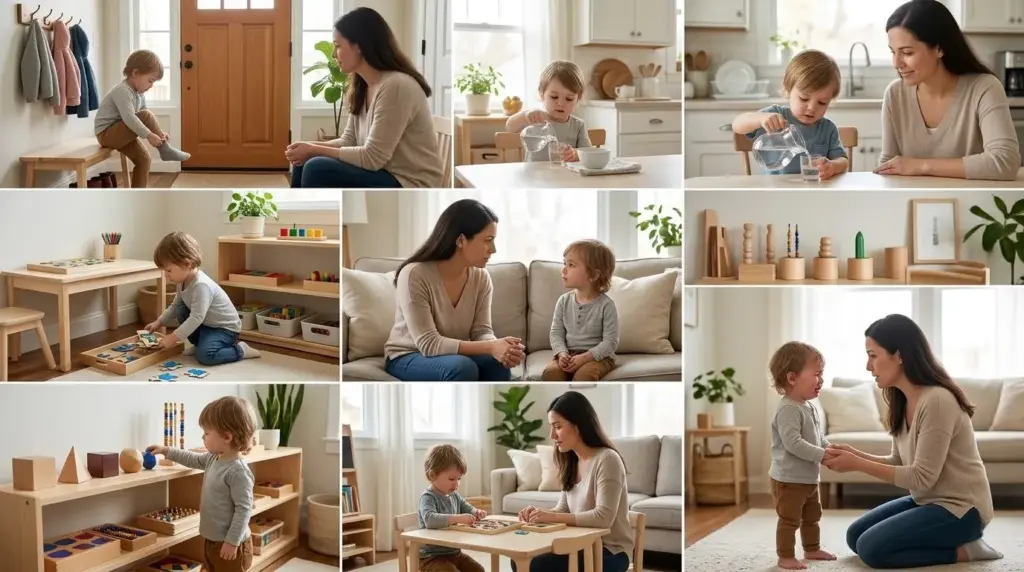
The morning is where Montessori principles either hold or collapse. Respect means building time for the child to dress, eat, and prepare themselves without being rushed. The prepared environment means clothing choices are accessible the night before, the breakfast setup is reachable, and the shoe basket is at the door. Auto-education means the child goes through the sequence — not because you directed each step, but because the routine and the environment make it navigable independently.
Mealtime
Real participation over observation. A child who helps set the table, pours their own water, and wipes their own spill is absorbing practical life, fine motor development, responsibility, and social ritual simultaneously. Spills are not failures; they’re part of the learning. The prepared environment means the cloth is already accessible. Respect means not rushing to correct technique.
Cleanup and care of environment
Cleanup is not a punishment or an adult demand — it’s part of the work cycle. A child who puts their puzzle back on the shelf before choosing another activity is practicing auto-education: the environment stays ready for the next person, including themselves. This requires preparation (accessible storage, clear places) and modeling (adults who return things too), not repeated instructions.
Language and conversation
Rich vocabulary, slow and clear speech, real listening. The absorbent mind principle reminds you that your language — the specificity of it, the respect in it, the emotional tone of it — is curriculum. Not just the words you teach deliberately, but all the ones your child absorbs while you’re doing other things.
Work and play choice
Freedom within limits: the child chooses from what’s on the shelf. The shelf is prepared by the adult based on observation. The choice is real. The limit is the space itself. This setup simultaneously honors auto-education (the child selects), the prepared environment (the options are intentional), and sensitive periods (the offerings match current readiness).
Conflict and discipline
Respect doesn’t remove limits — it changes how they’re held. The adult regulates first (you can’t co-regulate a child while you’re dysregulated). The limit is stated calmly, once. Natural or logical consequences follow. Then, when everyone is calm, problem-solving happens together. The goal is not obedience; it’s the child developing an internal sense of why limits exist.
For a detailed look at how this translates into daily Montessori parent role practice — including real scenarios and a 30-day shift plan — see the complete guide.
Related Montessori Terms You’ll Also Hear About
Freedom within limits
Not a separate principle — an expression of respect and the prepared environment working together. The child has genuine freedom of choice and movement, within boundaries defined by safety, respect for others, and care of the environment. It’s neither “do whatever you want” nor “do exactly what I say.”
Child-directed work
Connected directly to auto-education. In Montessori classrooms, children choose their own activities during the work period. This is not random — the adult has prepared the environment with appropriate materials and observes which ones the child selects. Child-directed work is what makes intrinsic motivation possible: the child works because they chose to, not because an adult assigned it.
Uninterrupted work period
The practical expression of concentration and auto-education. In classrooms, this is typically a 2–3 hour morning block with no forced transitions. At home, it’s any stretch of time where you protect your child’s focus from unnecessary interruption — even brief, even imperfect. The research consistently shows that concentration, once developed, transfers to academic skills, self-regulation, and long-term learning capacity.
Montessori materials
Materials are not principles — they’re tools that serve the principles. A sandpaper letter serves auto-education and sensitive periods by giving the child tactile feedback without adult correction. A pouring set serves movement and auto-education. The material supports the principle; the principle doesn’t depend on the material. You can practice Montessori principles without a single purchased material. When materials do serve the principles, four design criteria are the fastest way to separate genuinely aligned toys from the Montessori label used as marketing.
The guide’s role
The adult in a Montessori setting is an observer, preparer, presenter, and protector of concentration. Not a lecturer. Not a constant corrector. The teacher gives a lesson once — slowly, clearly, without unnecessary words — and then steps back. At home, the parent plays the same role. Understanding the Montessori method as a whole gives the deepest context for why the guide’s role is structured this way.
Common Misunderstandings About Montessori Principles
“Montessori is just an aesthetic.” Wood toys and beige shelves are not the method. A plastic toy that offers real challenge, feedback, and choice is more Montessori than a beautiful wooden toy that doesn’t. Function precedes form.
“Respect means no limits.” Limits exist. They’re just held calmly, explained honestly, and connected to real reasons — not imposed arbitrarily or enforced through fear.
“Auto-education means the adult disappears.” Stepping back is an active, intentional choice. The adult is observing, preparing, and available. They’re just not narrating, correcting, or directing every moment.
“The prepared environment requires money.” The most powerful changes are usually free: removing clutter, lowering a shelf, moving materials to child height. A minimal, functional space beats an expensive, beautiful one every time.
“Sensitive periods are a checklist to complete.” They’re an observation tool. The child who doesn’t match the chart isn’t behind — they’re on their own timeline. The purpose is to sharpen your watching, not trigger your anxiety.
“Montessori principles only work in Montessori schools.” The principles describe how children develop. That happens at home too — and arguably, the home environment has more influence during the 0–6 years than any school.
Montessori Principles at Home vs. in the Classroom
The core never changes: respect for the child’s pace, observation before intervention, an environment that supports independence, an adult who steps back more than they step in.
At home, practical life dominates — cooking, cleaning, dressing are the curriculum. Materials are simpler and fewer. Family rhythms replace formal work cycles.
At school, longer protected work cycles (2–3 hours), curated materials arranged by difficulty, multi-age groupings, and a trained guide who observes systematically.
Parents often feel their home “isn’t Montessori enough” because it doesn’t look like a classroom. It’s not supposed to. A kitchen where a three-year-old helps make breakfast is a prepared environment. A morning where a child gets dressed without help is auto-education in action. The principles apply — the expression is just domestic.
Montessori Principles vs. Traditional Education
| Aspect | Montessori | Traditional |
|---|---|---|
| Role of the adult | Observer and environment preparer; intervenes minimally | Primary instructor; delivers content directly |
| Source of motivation | Intrinsic — child chooses work based on genuine interest | Extrinsic — grades, praise, rewards, and correction |
| Error correction | Built into materials (control of error); child self-corrects | Adult identifies and corrects errors |
| Pace of learning | Child’s own developmental timeline | Standardized by grade level and curriculum schedule |
| Classroom structure | Mixed ages; 3-year cycles; uninterrupted work periods | Same-age groupings; teacher-led lessons; fixed timetable |
| Assessment | Observation-based; no grades in early years | Tests, grades, and formal evaluations |
| Environment | Prepared for child independence and real-world tasks | Arranged for group instruction and adult delivery |
| Movement | Integrated into learning; children move freely within limits | Largely sedentary; movement during designated breaks |
This comparison clarifies what makes Montessori philosophically distinct — not to argue superiority, but to make the principles legible by contrast. One note worth keeping: “Montessori-inspired” doesn’t always mean authentic Montessori. Implementation quality and genuine fidelity to the principles matter far more than labeling.
Montessori Principles Explained: FAQs
- What are the 5 principles of the Montessori method?
Respect for the Child, the Absorbent Mind, Sensitive Periods, the Prepared Environment, and Auto-Education. Together they describe how children develop, what they need from adults, and why environment matters more than instruction in early learning.
- Why do different websites list different Montessori principles?
Because they’re answering different questions. Some list philosophical beliefs; others list implementation components; others describe the broader Montessori worldview. The five-principle framework is the most common for parents and educators who want a clear, usable starting point.
- What is the most important Montessori principle?
Respect for the Child is the foundation — without it, the others become techniques without purpose. But the principles work as a system: each one supports and depends on the others.
- Are Montessori principles only for preschool children?
No. The five principles apply across all ages — the expression changes as the child grows, but the core ideas about respect, environment, intrinsic motivation, and the adult’s role remain relevant from infancy through adolescence.
- Can I apply Montessori principles at home without a Montessori school?
Yes. The principles describe child development, not a specific school program. A home with accessible materials, real routines, respectful communication, and an adult who observes before intervening is applying Montessori principles — regardless of school setting.
- What does auto-education mean in simple terms?
It means that when the environment is right and the adult steps back appropriately, children can construct their own learning — through doing, repeating, making mistakes, and correcting themselves. It’s not abandonment; it’s trust backed by preparation.
- Are Montessori principles the same as Montessori materials?
No. Materials are tools that serve the principles. They’re designed to allow auto-education and self-correction. But the principles — especially respect, observation, and prepared environment — can be practiced with no purchased materials at all.
- How do Montessori principles affect discipline?
Respect replaces shame; natural consequences replace arbitrary punishment; calm modeling replaces lectures. The goal is self-discipline — the child learning why a limit exists — rather than obedience driven by fear or reward.
A Simple 5-Principle Start Plan
Step 1 — Start with observation
Choose one daily routine. Watch it for three days without changing anything. Note where you step in before the child has really tried, and where the environment creates friction.
Step 2 — Change one part of the environment
Based on what you observed: lower one shelf, clear one surface, add one self-serve option. Don’t shop first — reorganize. Watch how behavior shifts without you saying a word.
Step 3 — Change one adult habit
Choose one: pause before helping (count to 10), speak more slowly when modeling, give one real choice per day, or stop interrupting deep concentration once per day.
Step 4 — Match one activity to one interest
Look at what your child repeats voluntarily. Offer one activity that meets that interest — practical life, movement, language, sensorial. Step back once they start.
Step 5 — Protect one short uninterrupted work window
20 minutes for a toddler, 45 for a preschooler. No interruptions — not for snacks, not for praise. Let the repetition happen.
Montessori Principles Are Not Rules — They’re a Way of Seeing the Child
The five principles — Respect, Absorbent Mind, Sensitive Periods, Prepared Environment, Auto-Education — are not a compliance checklist. They don’t tell you exactly what to do every morning. They give you a lens for interpreting what you’re seeing.
When you understand these principles, the child tying their shoe isn’t just a child taking too long — they’re building competence. The toddler pouring water for the twelfth time isn’t making a mess — they’re in the sensitive period for movement, doing exactly what their development needs. The child who melts down when their routine changes isn’t being difficult — they’re in the sensitive period for order, and their environment just got disrupted.
That shift in interpretation changes everything: what you set up, when you step in, what you say, what you leave alone.
Montessori doesn’t begin with a shopping list or a school enrollment. It begins with respect, observation, and a willingness to prepare the environment before you correct the child.
Start with one principle today. Pick the one that resonates most — and find one place in your day to let it work.