
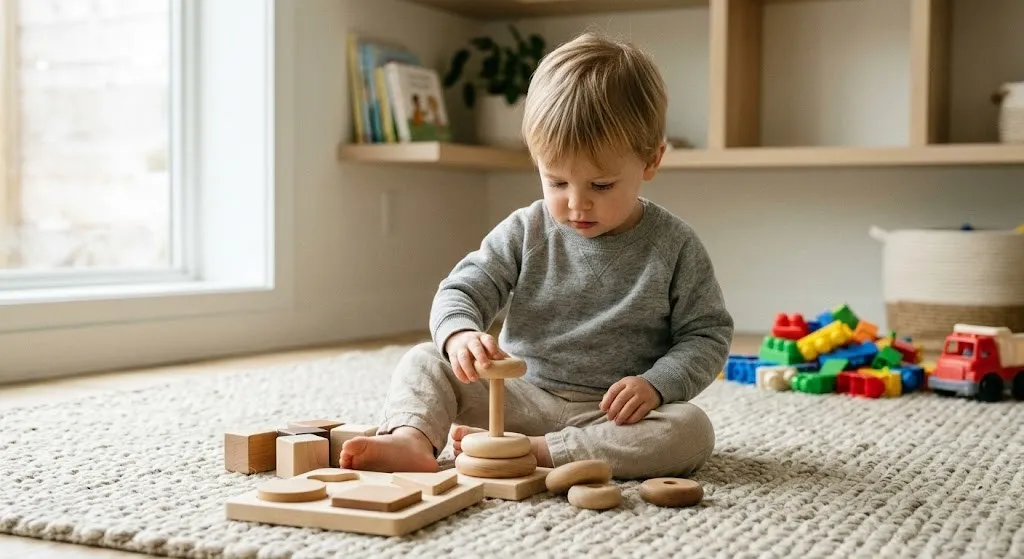
Wooden toys often feel calmer because they typically produce softer sounds, provide natural tactile feedback, and avoid electronic overstimulation. While calmness depends more on design than material alone, simpler, non-electronic toys can support better sensory regulation and sustained attention in early childhood.
If you’ve ever wondered why wooden toys feel calmer than many plastic alternatives, the answer lies in how young children’s developing nervous systems process sensory input. This article explores the science behind sound, texture, and visual simplicity—and how these factors shape your child’s ability to focus and regulate.
Why Do Some Toys Feel Overwhelming to Children?
You’ve probably experienced this: your toddler surrounded by toys, flitting from one to the next without really playing with anything. Fussy. Distracted. Unable to settle.
Sometimes it’s not the child. It’s the environment.
The Developing Nervous System in Early Childhood
Young children process sensory input differently than adults. Their brains are still learning how to filter, organize, and respond to the constant stream of sights, sounds, and textures around them.
Toddlers have limited self-regulation capacity. When adults feel overwhelmed, we can step away, close our eyes, or tune things out. Young children don’t have those skills yet. Their nervous systems are taking in everything at once, without the filtering mechanisms adults develop over time.
This creates high sensitivity to sound and visual intensity. What feels mildly stimulating to you might feel completely overwhelming to a two-year-old whose sensory processing systems are still under construction.
What Sensory Overload Really Means
Sensory overload happens when a child receives excessive auditory, visual, or tactile input that their nervous system can’t organize effectively.
Their brain struggles with filtering stimuli. Everything competes for attention at equal volume. The flashing toy. The background music. The bright colors. The textures. All at once, with no hierarchy.
Signs you might recognize:
- Irritability without clear cause
- Short attention spans, rapid toy switching
- Covering ears or eyes
- Meltdowns that seem to come from nowhere
- Difficulty calming down even after the stimulus is removed
Not every fussy moment is sensory overload. But when patterns emerge—especially in busy, stimulating environments—it’s worth considering what the child’s nervous system is trying to process.
The Role of Modern Toy Design
Many modern toys are designed to capture attention immediately. Flashing lights grab the eyes. Fast-paced sound effects demand response. Immediate reward cycles—press button, get song, get light—create rapid feedback loops.
These design choices aren’t accidental. They’re engineered to be engaging. And for many children, they are engaging—for about three minutes. Then the child moves on to the next thing, searching for the next quick hit of stimulation.
The American Academy of Pediatrics has noted that electronic features in toys may detract from social engagement and the type of sustained, imaginative play that supports healthy development.
Why Wooden Toys Feel Calmer: The Sound Science Explained
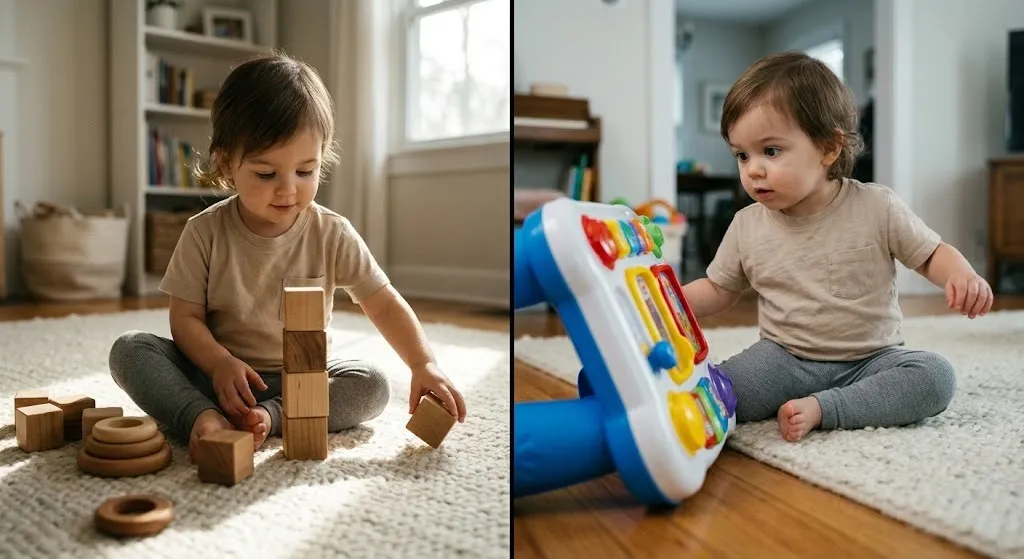
Close your eyes for a moment and imagine two sounds: a wooden block dropping on a floor, and a hard plastic toy crashing down.
The wooden block lands with a soft thud. The sound fades quickly. The plastic toy? A sharp crack that echoes, lingering in the air longer than you’d expect.
Acoustic Properties of Materials
Materials behave differently when they vibrate.
Plastic reflects and amplifies impact sounds. The smooth, hard surface bounces sound waves rather than absorbing them, creating sharper, higher-pitched noises.
Wood absorbs and softens vibrations. The cellular structure of wood—tiny air pockets within the material—dampens sound waves, producing lower, warmer tones that dissipate faster.
Electronics introduce entirely artificial noise layers. Beeps, melodies, recorded voices—all at volumes designed to be heard over household noise, which means they’re often louder than necessary for a child playing two feet away.
Startle Response and Stress Activation
Sudden loud noises can activate the body’s stress response—even in play contexts.
The startle reflex is automatic and involuntary. When a toy crashes loudly, a young child’s nervous system responds as if something might be wrong. Their body tenses. Their attention fragments. It’s subtle, but it’s real.
Repeated abrupt sounds throughout a play session create a pattern of micro-stresses. Each one individually is minor. Cumulatively, they make it harder for a child to settle into deep, focused play.
Why Softer Auditory Environments Support Calm Play
Predictable sound patterns allow the brain to relax into background awareness rather than constant alert monitoring.
Lower decibel exposure reduces the cumulative auditory load on a developing nervous system. It’s not just about whether sounds are “too loud”—it’s about the total volume of auditory input across an entire day.
Reduced sensory spikes mean fewer interruptions to sustained attention. When sounds are gentler and less jarring, children can maintain focus on their play without constant auditory distraction.
Many wooden toys rely on natural sound rather than electronic feedback—the soft click of a puzzle piece finding its spot, the gentle knock of stacking rings, the quiet roll of a wooden ball. These sounds provide feedback without demanding attention.
Texture and Weight: How Tactile Input Shapes Calmness
Your child’s hands are constantly gathering information. Every toy they touch sends data to their developing brain about the physical world.
Natural Surface Variation vs Uniform Plastic
Wood grain variation creates subtle tactile diversity. Run your fingers across a wooden toy and you’ll feel tiny ridges, variations in density, the history of the tree captured in texture.
Wood maintains temperature neutrality—it doesn’t feel cold like metal or sticky-warm like some plastics on a hot day. It feels… stable.
Less glossy reflection means less visual competition for attention. Matte or satin wood finishes don’t create bright spots of reflected light that pull the eye away from the toy itself.
Proprioceptive Feedback and Motor Control
Proprioception is your body’s sense of where it is in space and how much force it’s using. It’s developed through physical interaction with objects of varying weight and resistance.
Slightly heavier wooden objects require intentional grip and controlled manipulation — and that weight difference shapes motor learning in ways that go beyond what ‘heavy vs light’ implies. A wooden block has enough weight that your toddler’s hand has to work to hold it, providing clear feedback: “I’m holding something. This is how much effort it takes.”
This supports body awareness and motor planning. Light, hollow plastic doesn’t provide the same level of feedback. It’s not better or worse—it’s different information.
Sensory Integration Theory and Regulation
Sensory integration theory, developed by occupational therapist A. Jean Ayres in the 1970s, describes how the nervous system receives and organizes sensory input to produce adaptive responses.
Moderate tactile input—textures that are varied but not overwhelming—can support organization of the nervous system. The brain gets clear, consistent feedback that helps it calibrate and regulate.
Overly intense stimuli may overwhelm some children, particularly those with sensory processing differences. Too much at once creates disorganization rather than integration.
For children who are sensory-sensitive, understanding why natural wooden materials provide consistent tactile feedback can help parents make choices that support their child’s specific regulation needs. The full picture of how wood supports sensory development — from proprioception to acoustic quality to biophilia — is grounded in both Montessori theory and neuroscience.
The Biophilia Effect: Why Your Baby’s Body Recognizes Wood
There’s a deeper layer to why wood feels calming — one that goes beyond texture and weight into evolutionary biology. The biophilia hypothesis, developed by biologist E.O. Wilson, proposes that humans have an innate physiological affinity for natural materials because we evolved surrounded by them. Wood isn’t just familiar — it’s recognizable at a nervous system level.
Research from the University of British Columbia measured the stress response of participants exposed to wood versus non-wood environments. Those in rooms with wood showed lower skin conductance levels — a direct measure of sympathetic nervous system arousal — across all periods of the study. In plain terms: the body was less stressed in the presence of wood, even passively, without touching it.
For babies, this matters in a specific way. A developing nervous system that hasn’t yet learned to filter and regulate sensory input is more vulnerable to environmental arousal. A wooden toy sitting on a shelf, warm-toned and grain-textured, asks less of that nervous system than a brightly colored plastic one does. It signals, at a biological level, something safe and familiar.
This doesn’t mean every wooden toy is calming or every plastic toy is stressful. It means the material itself carries a baseline quality that — all else being equal — tends toward regulation rather than arousal.
Visual Simplicity and Sustained Attention
Attention is a limited resource, especially for young children still developing executive function.
The Attention Cost of High-Contrast and Light-Up Toys
Rapid color shifts grab attention reflexively. Your brain is wired to notice movement and change—it’s a survival mechanism. Toys that flash or change colors activate this automatic response repeatedly.
Flashing LED patterns create what researchers call “exogenous attention”—attention captured by external stimuli rather than directed intentionally. Every flash pulls focus away from whatever the child was doing.
Reward-driven attention switching teaches children to look for the next exciting thing rather than staying with sustained exploration. Press button. Light flashes. What’s next?
Executive Function and Focus
The Harvard Center on the Developing Child describes executive function as the mental processes that enable planning, focus, remembering instructions, and managing multiple tasks.
Research from Carnegie Mellon University puts concrete numbers on what Montessori educators have observed for decades. Kindergarteners in highly decorated classrooms spent 38.6% of instructional time off-task — compared to 28.4% in sparse classrooms. Their test scores reflected the difference too: 55% accuracy in simpler visual environments versus 42% in decorated ones. The researchers found that visual complexity doesn’t just distract children momentarily — it reduces how much they actually learn.
A wooden toy on a clean shelf operates on the same principle. Muted tones, simple grain patterns, no flashing elements — the visual environment around the toy allows your child’s attention to settle on what they’re doing, rather than constantly scanning for the next stimulus.
Sustained attention builds through uninterrupted engagement. When children can focus on one activity for extended periods—testing, exploring, discovering—they’re exercising the neural pathways that support executive function.
Minimal distractions support deeper concentration. This doesn’t mean children need complete silence or blank walls. It means the environment doesn’t constantly interrupt their focus with competing stimuli.
Why Many Wooden Toys Use Muted, Natural Tones
Reduced competing stimuli allow the child’s attention to rest on the toy itself and what they’re doing with it, rather than reacting to bright visual patterns.
Easier visual processing means less work for the brain. Soft, natural wood tones don’t create high visual contrast that demands constant processing.
Greater child-led pacing happens when the toy doesn’t dictate the speed of play. A wooden block waits. A light-up toy cycles through its programmed sequence whether your child is ready or not.
Passive Toys and Active Learners
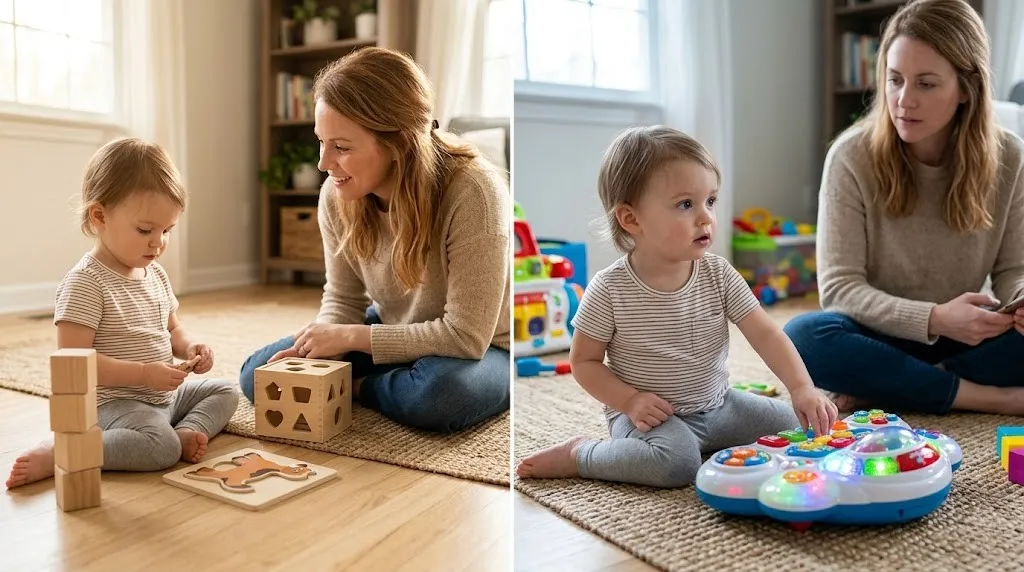
There’s a principle in child development that’s worth understanding: the more the toy does, the less the child does.
What Makes a Toy “Passive”
A passive toy is one that responds to the child’s actions rather than initiating its own.
No voice commands. No automatic sound loops. No embedded instructions telling the child what to do next.
The toy waits. Your child decides. The busy board is one of the cleaner examples of this — a single surface, multiple mechanisms, zero electronic feedback.”
Why Child-Controlled Play Feels Calmer
No external command to respond to. When a toy announces “Now press the blue button!” your child’s play is being directed by the toy. Their brain shifts from creator to follower.
Self-paced exploration allows children to move at the speed their nervous system can handle. Fast processors dive in quickly. Cautious observers take their time. Both are valid.
Less sensory interruption means fewer breaks in concentration. The play flows according to the child’s internal rhythm, not the toy’s programmed timing.
Research Comparing Traditional and Electronic Toys
The 2016 JAMA Pediatrics study by Sosa found that electronic toys were associated with fewer conversational turns between parents and children compared to traditional toys like books and blocks.
When researchers observed parent-infant pairs playing with different types of toys, traditional toys promoted more interaction, richer language use, and longer sustained engagement.
Many of the traditional toys studied were simple and non-electronic—blocks, shape sorters, simple wooden puzzles. The lack of built-in entertainment created space for human interaction to fill.
Calmness Depends on Design—Not Material Alone
Let’s be clear about something important: not all wooden toys are calm, and not all plastic toys are overstimulating.
Not All Wooden Toys Are Minimal
Some wooden toys feature bright paint in high-contrast colors. Some have busy designs with multiple moving parts and complex mechanisms. Some incorporate bells, whistles, or other sound-making features.
Excessive complexity in any material can overwhelm. A wooden toy with twenty different activities happening at once isn’t calmer just because it’s made from wood.
When Plastic Toys May Be Completely Appropriate
Outdoor water play benefits from waterproof plastic toys that won’t deteriorate. Bath time, pools, water tables—plastic serves these contexts well.
Lightweight infant items help very young babies who are still building grip strength. A 4-month-old benefits from toys they can actually lift and manipulate.
STEM engineering kits often use precise plastic components that snap together in specific ways, supporting spatial reasoning and problem-solving.
Material choice should serve the purpose and the child’s developmental stage. For a comprehensive look at the specific benefits and trade-offs of each material across cognitive, motor, and sensory development, the comparison goes well beyond calmness alone.
How to Choose Toys That Support Calm Play
Look for fewer electronic features. This doesn’t mean zero electronics forever—it means being selective and intentional rather than defaulting to electronic stimulation.
Choose age-appropriate complexity. A toy that’s too simple bores. A toy that’s too complex frustrates. Either extreme prevents calm engagement.
Consider balanced color palettes. Toys don’t need to be beige, but they also don’t need to be neon. Natural tones, soft pastels, or thoughtfully chosen primary colors all work.
Most importantly: observe your child’s individual sensory needs. Some children thrive with more sensory input. Others regulate better with less. Your child will show you what they need if you watch how they play.
Conclusion: Calm Comes From Simplicity and Sensory Balance
Wooden toys often feel calmer because they tend to be quieter, more tactile, and less electronically stimulating. The natural acoustic properties of wood create softer sounds. The weight and texture provide grounding sensory feedback. The typical absence of lights and electronic features removes layers of competing stimulation.
But calm play depends more on thoughtful design and sensory balance than on material alone. A simple plastic toy can support peaceful engagement. A complex wooden toy can overwhelm.
The key is understanding what creates calm for your specific child: predictable sounds, manageable visual input, age-appropriate complexity, and space for self-directed exploration.
Choosing toys that support regulated, child-led engagement—whatever material they’re made from—can help create a more peaceful play environment where your child’s attention can settle and deepen.
Frequently Asked Questions
Why do wooden toys feel less stimulating?
Wooden toys typically produce softer sounds due to wood’s sound-dampening properties, feature muted natural tones rather than bright colors, and generally lack electronic features that create constant sensory input. This combination often supports calmer sensory regulation.
Are wooden toys better for sensory processing?
For children who are sensory-sensitive or easily overstimulated, wooden toys may offer advantages through consistent tactile feedback, quieter sounds, and simpler visual presentation. However, sensory needs vary—some children benefit from more intense sensory input.
What are the best toys for an overstimulated toddler?
Look for toys with minimal electronic features, soft or natural sounds, muted color palettes, and open-ended designs that allow child-led pacing. Simple blocks, puzzles, stacking toys, and imaginative play items often support better regulation.
Do electronic toys cause overstimulation?
Electronic toys don’t automatically cause overstimulation, but when used excessively or as the primary play option, they can contribute to sensory overload in some children. Balance is key—occasional electronic toys within a varied play environment work well for most children.
How can I reduce toy overstimulation?
Rotate toys to reduce visual clutter, choose toys with fewer electronic features, create designated calm play spaces, observe which toys support longer engagement, and balance stimulating toys with simpler options that encourage focused play.