
You know the Instagram aesthetic: minimalist shelves and calm toddlers. But is that real Montessori, or just a look?
Most online content stops at the shopping list. This guide goes deeper, unpacking the philosophy, science, and practice behind the Montessori method,
By the end, you’ll have:
- A clear understanding of your child’s development.
- A practical roadmap for choosing authentic Montessori toys that truly support development—without overwhelm or overspending.
- The confidence to start and keep going.
Forget perfection and fancy playrooms. All you need is intention, observation, and trust.
Let’s begin.
Montessori Explained Simply
What is the Montessori Method? (The 30-Second Explanation)
The Montessori method is an educational approach that follows your child’s natural development. It nurtures independence, concentration, and a love for learning through purposeful, hands-on experiences.
It’s built on 4 foundational principles:
- Independence — “Help me do it myself.” Creating opportunities for children to practice real skills.
- Concentration — Protecting deep focus, which toddlers naturally develop when the environment supports it.
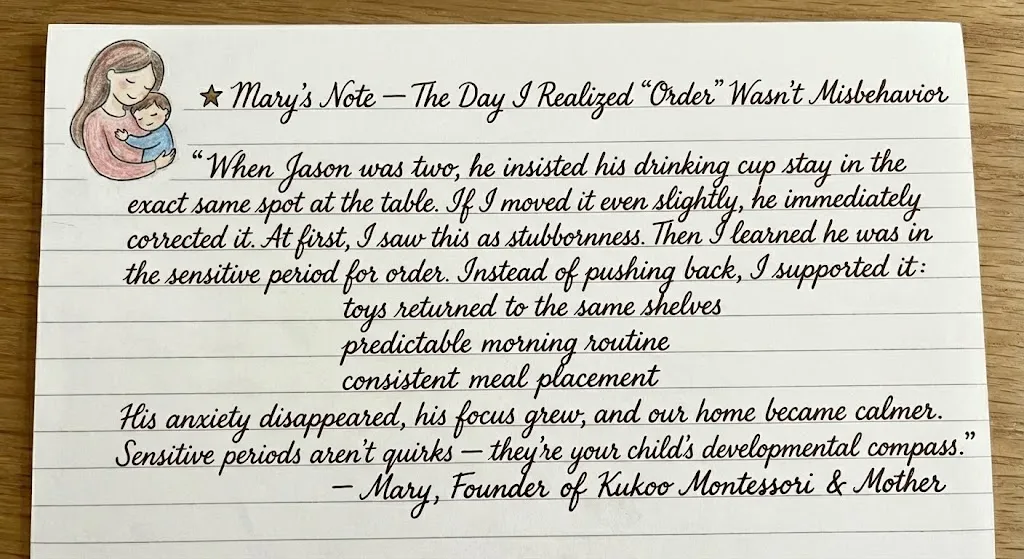
- Order — Honoring the child’s need for predictability (the hidden reason behind many meltdowns).
- Self-Discovery — Learning through doing. True learning happens when children make discoveries themselves.
A Method Rooted in Science, Not Trends
Developed over a century ago by Dr. Maria Montessori, this method recognizes that children aren’t empty vessels—they are active, motivated learners who absorb their world intentionally.
A Brief History: From Roman Slums to a Global Revolution
To truly understand the Montessori method, we must look at where it began. It wasn’t in a prestigious academy for the wealthy. It started in a slum.
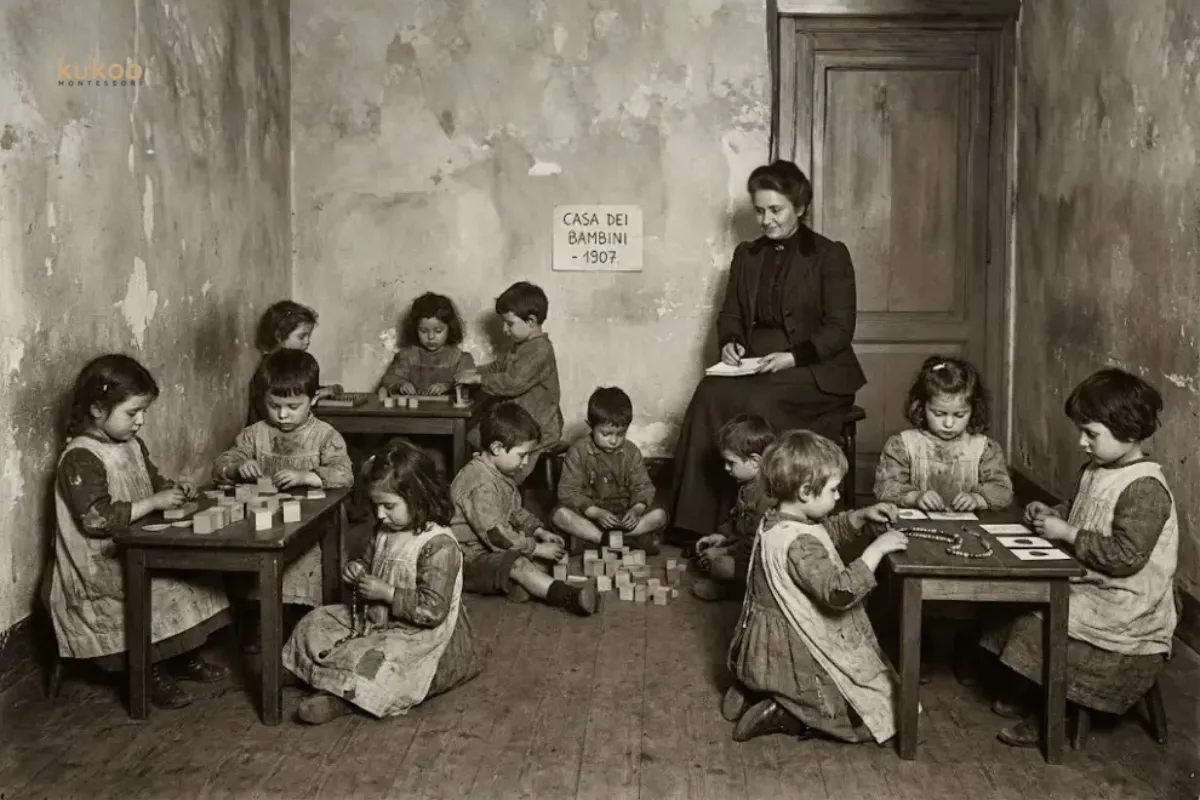
The Montessori Method began in 1907 when Dr. Maria Montessori, Italy’s first female physician, opened the Casa dei Bambini (Children’s House) in a low-income district of Rome.
Through scientific observation, she discovered that children are not “empty vessels” but have an innate drive to learn. The method spread to the US in 1911 but faded by 1920 due to criticism from educational theorists like William Kilpatrick.
It experienced a major American revival in 1960 led by Nancy McCormick Rambusch, who founded the American Montessori Society (AMS), adapting the method to American culture.
Why Parents Need This Guide
Researching Montessori often leads to overwhelm with terms like:
- Absorbent mind?
- Sensitive periods?
- Control of error?
- Prepared environment?
You buy a few wooden toys, lower a shelf, but still wonder:“Am I doing this wrong?”
This guide bridges the gap between the look of Montessori and the practice of the Montessori method. We will explore the Philosophy (the WHY) and the Practice (the HOW)
Montessori: A Method Proven by Time and Science
The Montessori method is not a Pinterest trend. It is a globally recognized approach with over 20,000 schools. Modern research validates what Dr. Montessori observed:
Neuroscience confirms sensitive periods exist.
Executive function studies show self-directed learning builds cognitive skills.
Environmental psychology proves natural materials support focus.
The Science Behind Montessori Method
Why does this approach work? Because it anchors parenting choices in developmental truth, not just aesthetics.
The Full Picture: The Four Planes of Development (0–24 Years)
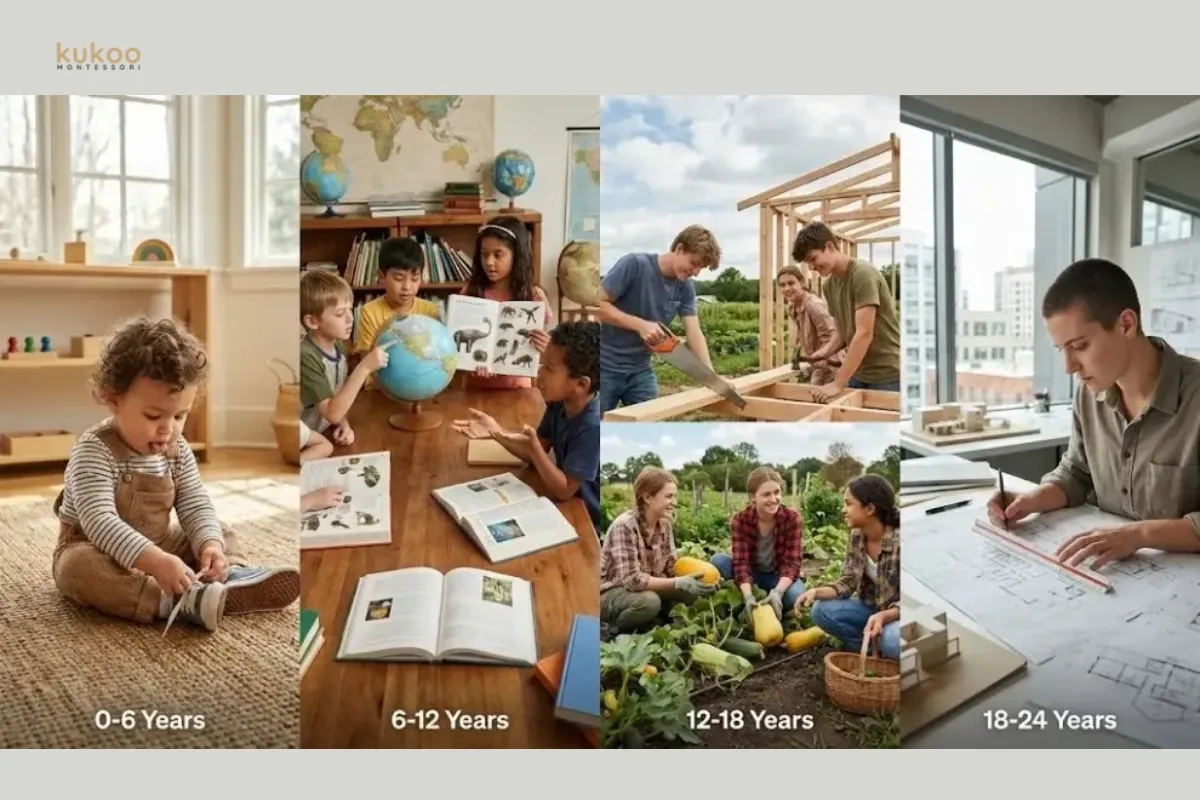
Dr. Montessori identified four distinct planes of development, each requiring a different educational approach:
First Plane (0–6 Years): The Absorbent Mind
Goal: Physical independence (“Help me do it myself”).
Focus: Concrete learning through senses and movement.
Second Plane (6–12 Years): The Reasoning Mind
Goal: Intellectual independence (“Help me think for myself”).
Focus: The age of “Why?” and “How?”. Children develop a moral compass, a sense of justice, and a hunger for culture and science.
Third Plane (12–18 Years): The Humanistic Mind
- Goal: Social and economic independence (“Help me find my place in society”).
Focus: Adolescence. Dr. Montessori suggested “Erdkinder” (farm schools) for this age, where teens learn real economic skills alongside academics.
Fourth Plane (18–24 Years): The Specialist Mind
Goal: Specialist knowledge and contribution.
Focus: Young adulthood. Finding a vocation and contributing to the world.
The Absorbent Mind (Ages 0–6): The Superpower Your Child Only Has Once
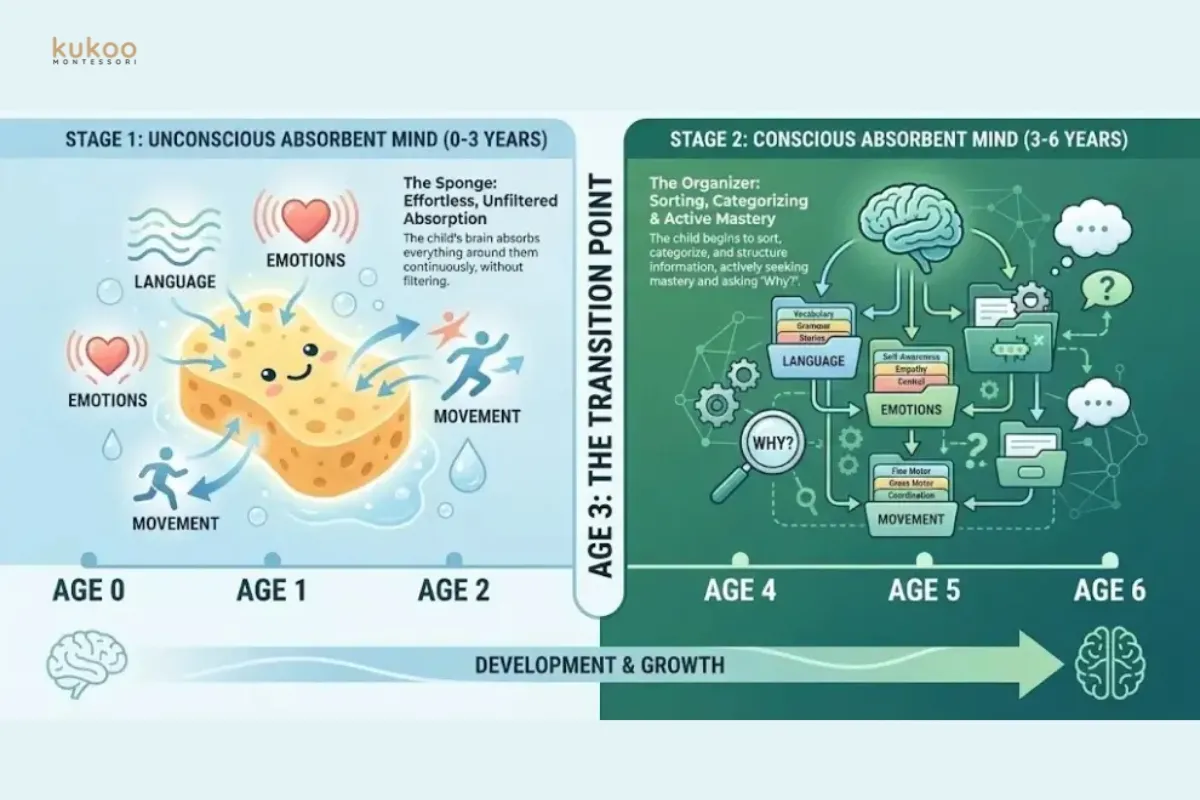
From birth to six, children learn in a way adults literally cannot. Dr. Montessori called this the Absorbent Mind.
Unconscious Absorption (0–3 years): The “Sponge” phase. Children absorb emotions, routines, and language effortlessly.
Conscious Absorption (3–6 years): The “Organizer” phase. Children become intentional, asking “why” and seeking mastery.
The environment is not décor. It’s curriculum.
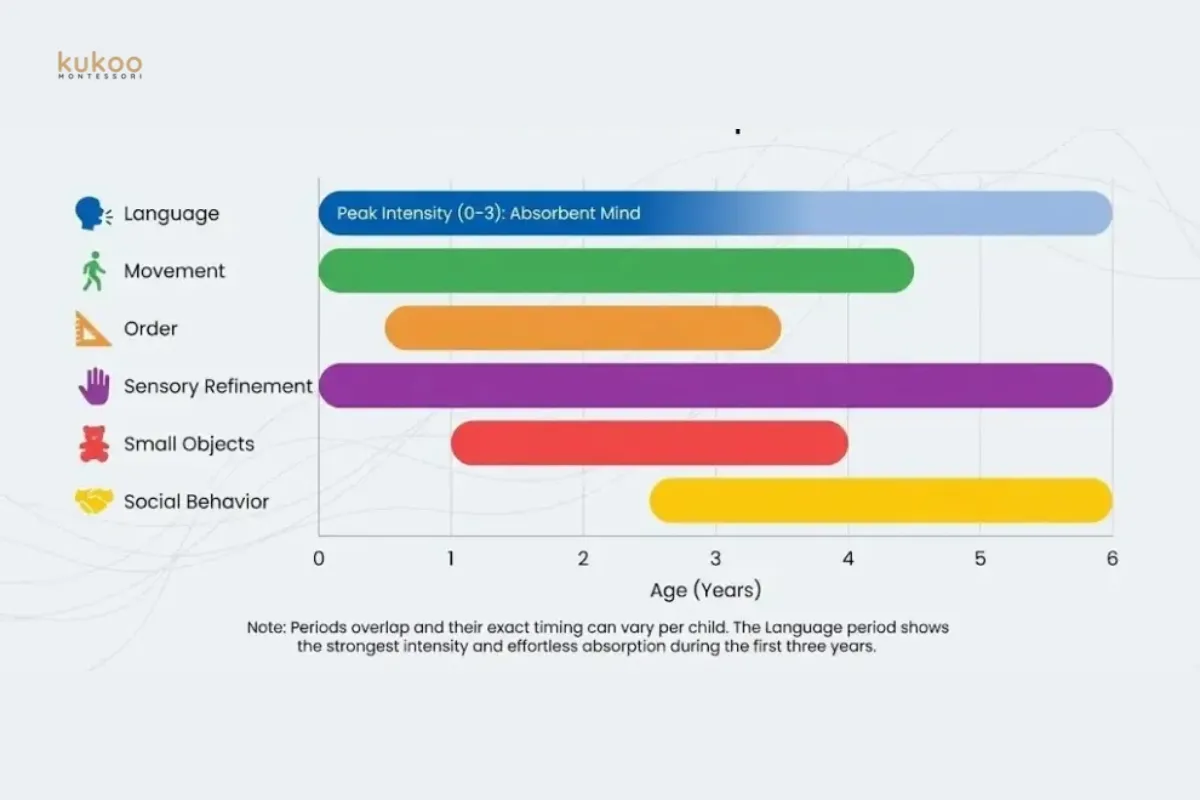
Sensitive Periods: Windows When Your Child Learns at Lightning Speed
Neuroscience confirms that children go through sensitive periods: temporary windows of heightened curiosity where learning is effortless.
Learning inside the window = natural, joyful, deep.
Learning outside the window = possible but harder.
Major Sensitive Periods Timeline (0–6 Years)
Order (6 mo – 3 yrs): A craving for consistency. Routine = safety.
Language (Birth – 6 yrs): Peak absorption of vocabulary.
Movement (Birth – 4.5 yrs): Refining gross and fine motor skills.
Small Objects (1 – 4 yrs): Fascination with tiny details and pincer grip.
Social Behavior (2.5 – 6 yrs): Grace, courtesy, and empathy.
Sensory Refinement (Birth – 6 yrs): Calibrating all five senses.
Why This Science Transforms Your Montessori Practice
Once you grasp the science, Montessori shifts from a style to a strategy. “Help me do it myself” becomes an invitation, not an inconvenience.
The Core Principles of Montessori Method (From Philosophy to Daily Practice)
Principle 1: “Follow the Child” — Observation Over Instruction
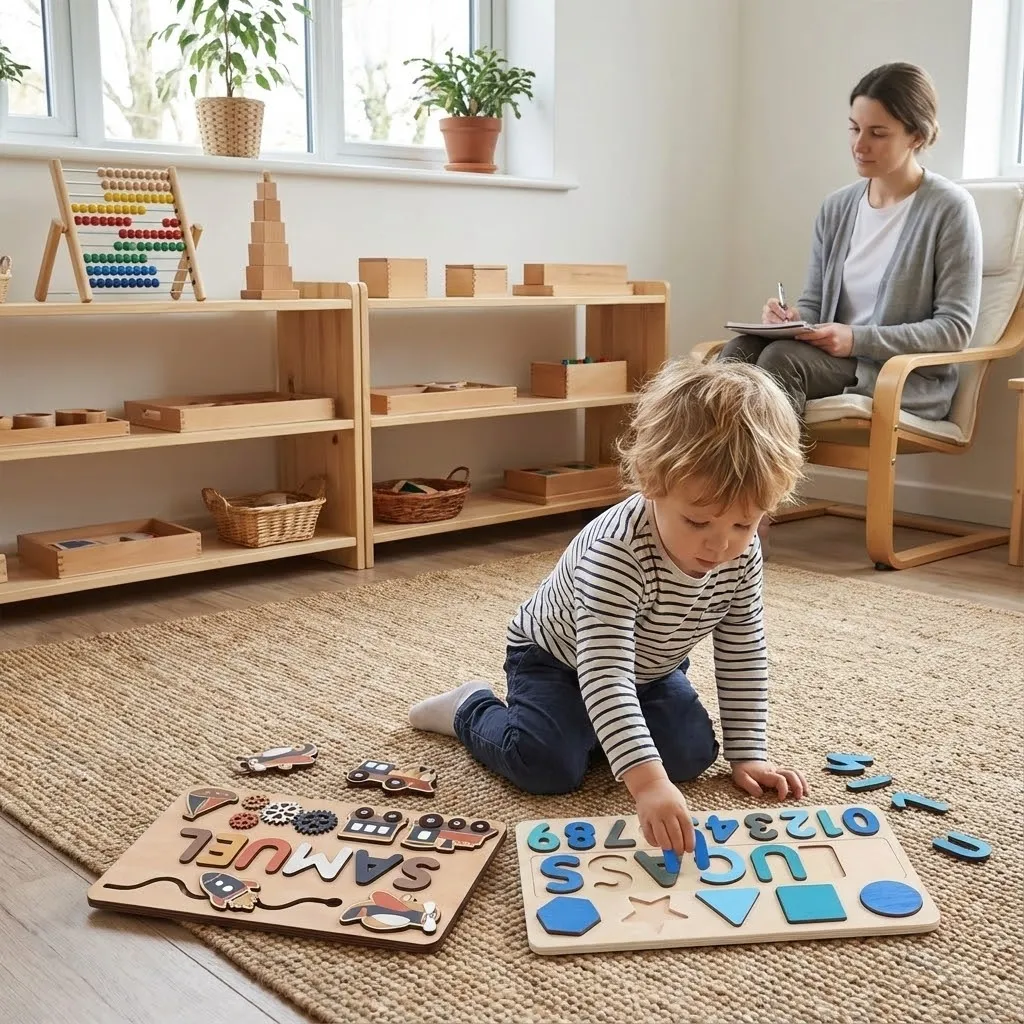
This doesn’t mean “let them do whatever they want.” It means observe what they are ready for, then prepare the environment to support it.
Observe: Notice interests and frustrations.
Prepare: Offer materials that match that interest.
Step Back: Allow them to struggle productively.
Common Trap: Thinking it means ‘no structure.’
Instead: Structure is what makes freedom possible.
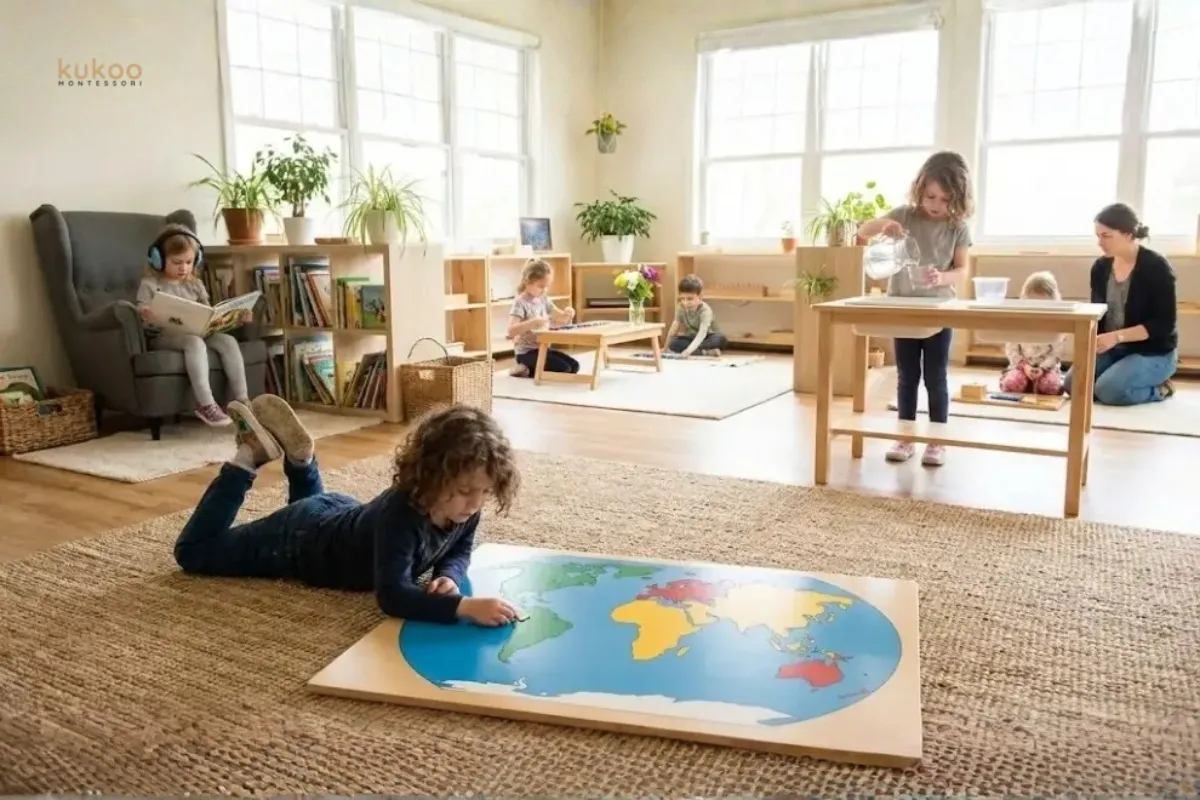
Principle 2: The Prepared Environment — Where Learning Happens Without You
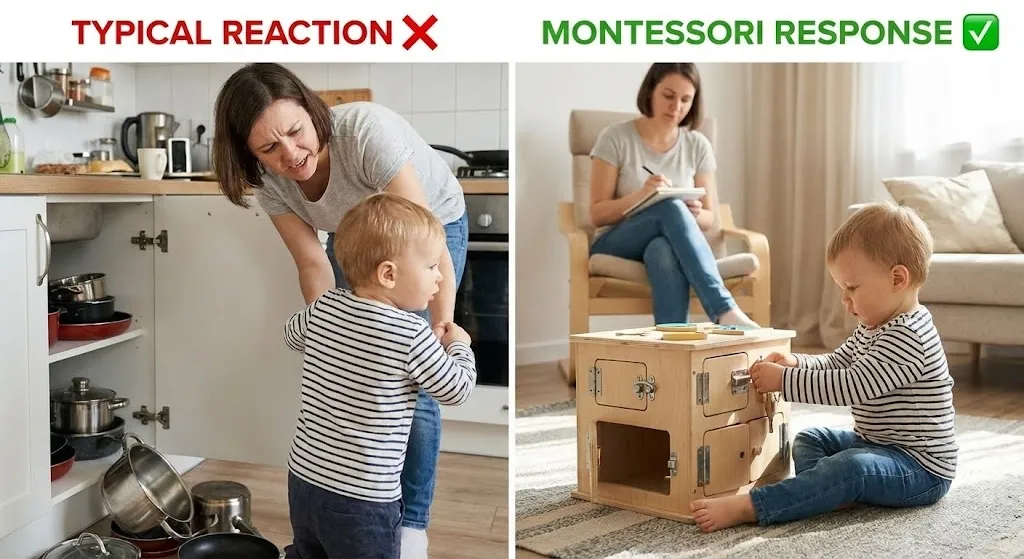
The environment is the “third teacher.” A prepared space has:
Order: Everything has a place.
Beauty: Intentional and inviting.
Accessibility: Low shelves and child-sized furniture.
Reality: Functional tools, not plastic pretend versions.
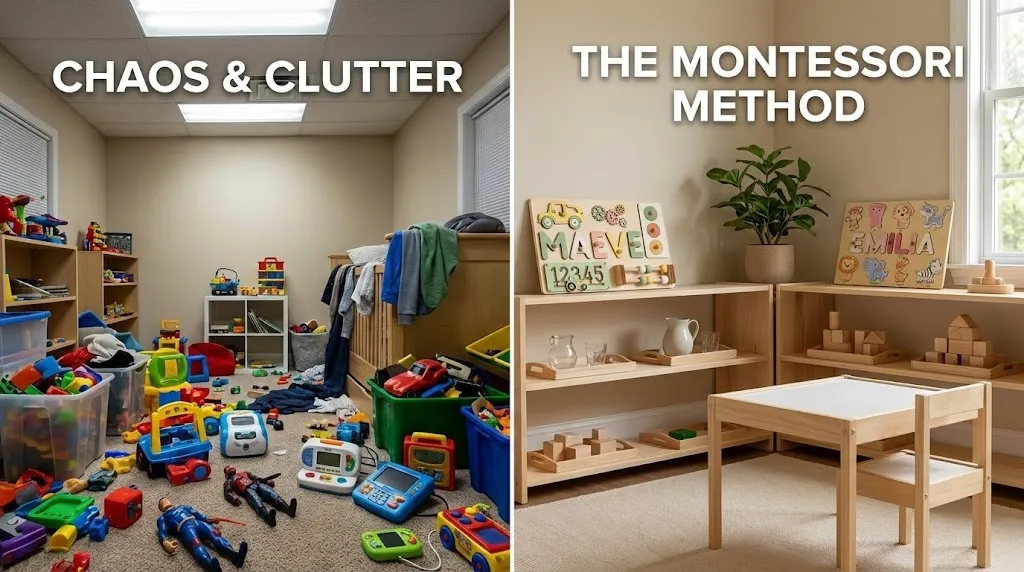
Common Trap: Overflowing toy bins and plastic clutter.
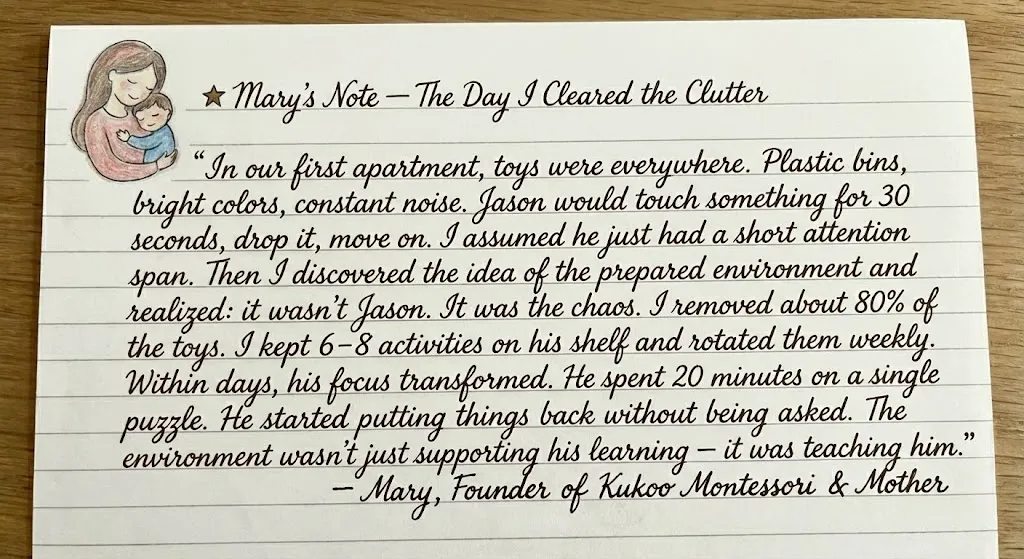
Instead: 6–8 purposeful materials on a low shelf, natural light, and real tools
Principle 3: Hands-On Learning — The Brain Learns Through the Hands
The brain learns through the hands. Movement + thought = deep learning. “The hands are the instruments of man’s intelligence.” Children learn by doing.
Common Trap: Screens, flashcards, and passive apps.
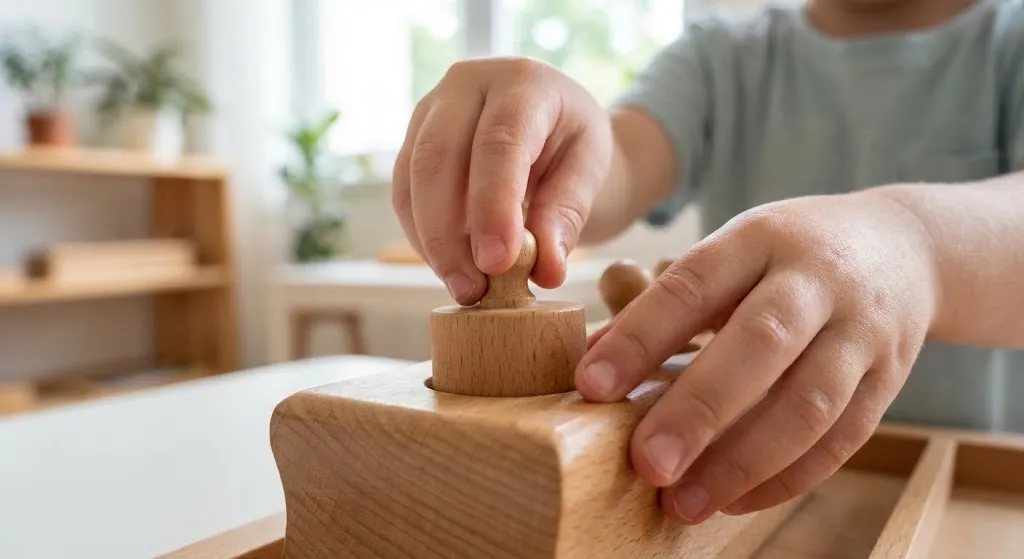
Instead: Tactile puzzles, pouring activities, and sorting games.
Principle 4: Freedom Within Limits — Structure That Feels Like Choice
This is the balance between chaos and control.
The Formula: Clear boundaries create safety; safety creates the confidence to explore.
Freedom: To choose an activity and work as long as they like.
Limit: They must respect the material and others.
Common Trap: Too much freedom (chaos) or too many limits (passivity)
Instead: You may choose any activity, but you must return it before starting a new one
Principle 5: Auto-Education (Self-Correction) — Letting Materials Do the Teaching
Good Montessori materials have a control of error. The child can see their own mistake (e.g., a puzzle piece doesn’t fit) and correct it without an adult saying, “No, that’s wrong.”
Common Trap: Constant correction, hovering, or fixing the work.
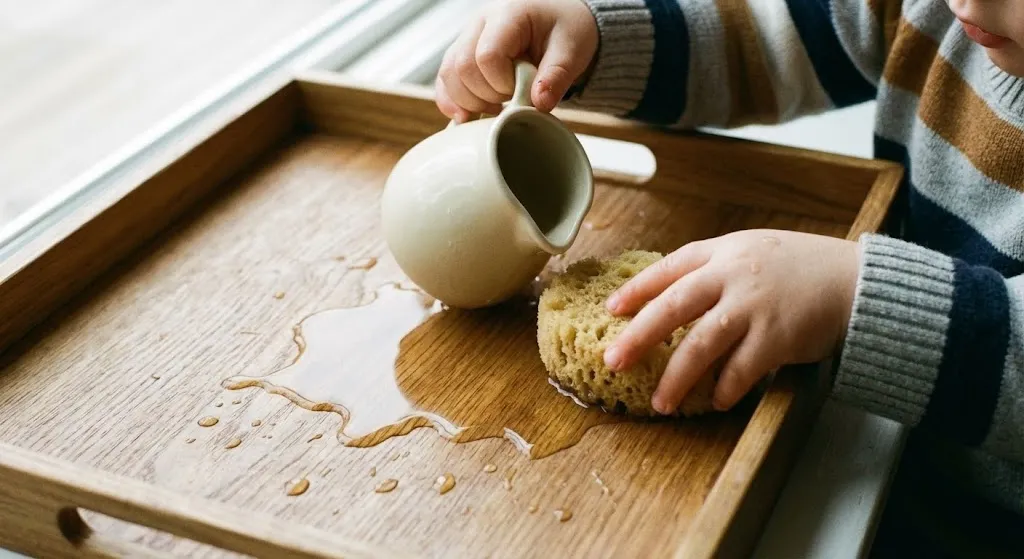
Instead: A puzzle piece that doesn’t fit, a tower that topples, water that spills — the consequence is visible and fixable by the child
Mastering these principles is the first step toward transforming your home into a space of discovery.
Why These 5 Principles Transform Your Home
When these principles of the Montessori method click, everything softens and sharpens at the same time:
- Follow the Child → You stop forcing timelines and start noticing readiness.
- Prepared Environment → You stop blaming “behavior” and start adjusting the space.
- Hands-On Learning → You stop chasing “educational” screens and start offering real-world tools.
- Freedom Within Limits → You stop constant power struggles and start offering clear, respectful choices.
- Auto-Education → You stop rescuing and start trusting your child’s ability to figure things out
How Montessori Works
You understand the principles. But how does a toddler move from random, chaotic play to deep, purposeful work through the Montessori method?
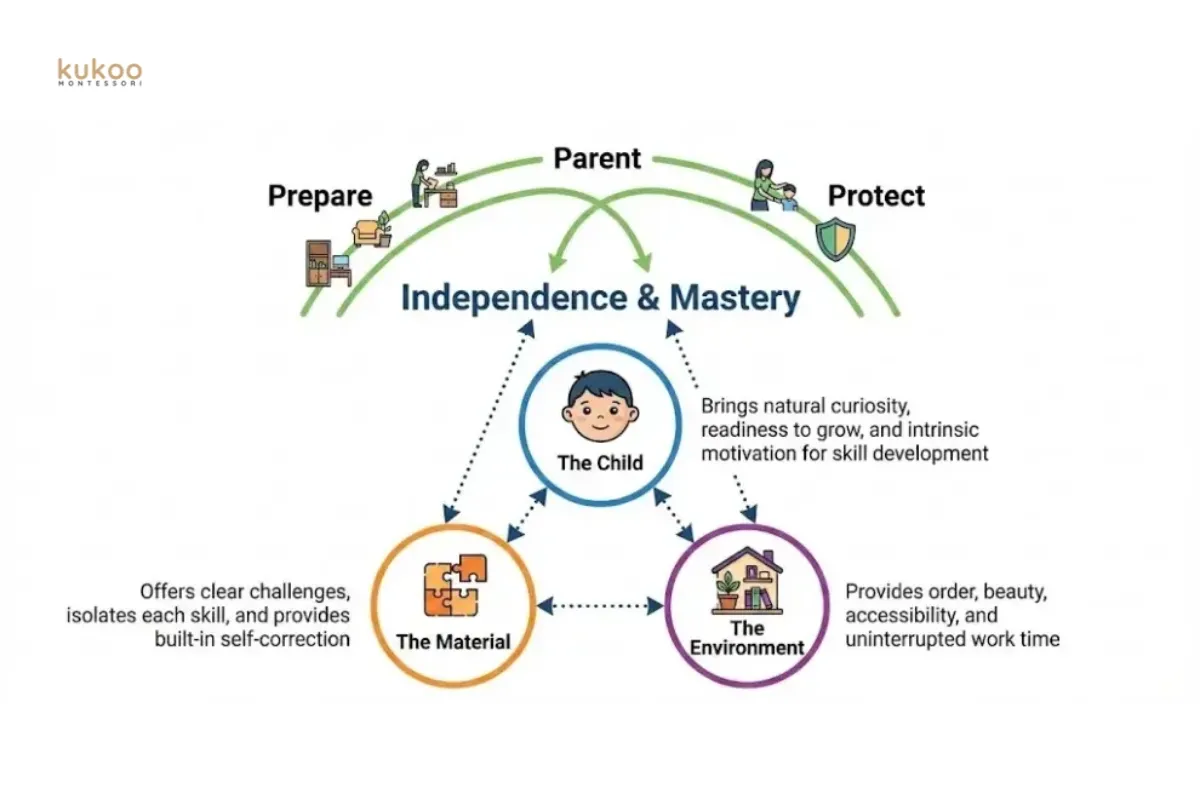
The Three-Part Interaction: Child – Material – Environment
Montessori learning isn’t teacher-led. It’s a living relationship between three elements:
- The Child – brings curiosity, developmental readiness, and a natural drive to master.
- The Material – offers a single, clear challenge with built-in feedback.
- The Environment – provides order, beauty, access, and uninterrupted time.
What This Looks Like at Home: Your child chooses a pouring activity, spills, notices the error, and tries again until they succeed. You watch without correcting or rushing in with praise. You simply protect their focus .
No lectures. No sticker charts. Just deep, satisfying work.
The Foundation of Focus: The Uninterrupted Work Cycle
In a classroom, children have a 3-hour work period. At home, you don’t need 3 hours, but you do need protected time. Interruptions—even well-meaning praise—break the flow of concentration.
Prepare: Set out 4–6 materials the night before.
Step Back: Once they engage, become an observer.
Protect the Bubble: No errands, no screens, no “come here for a second.” Let them dive deep.
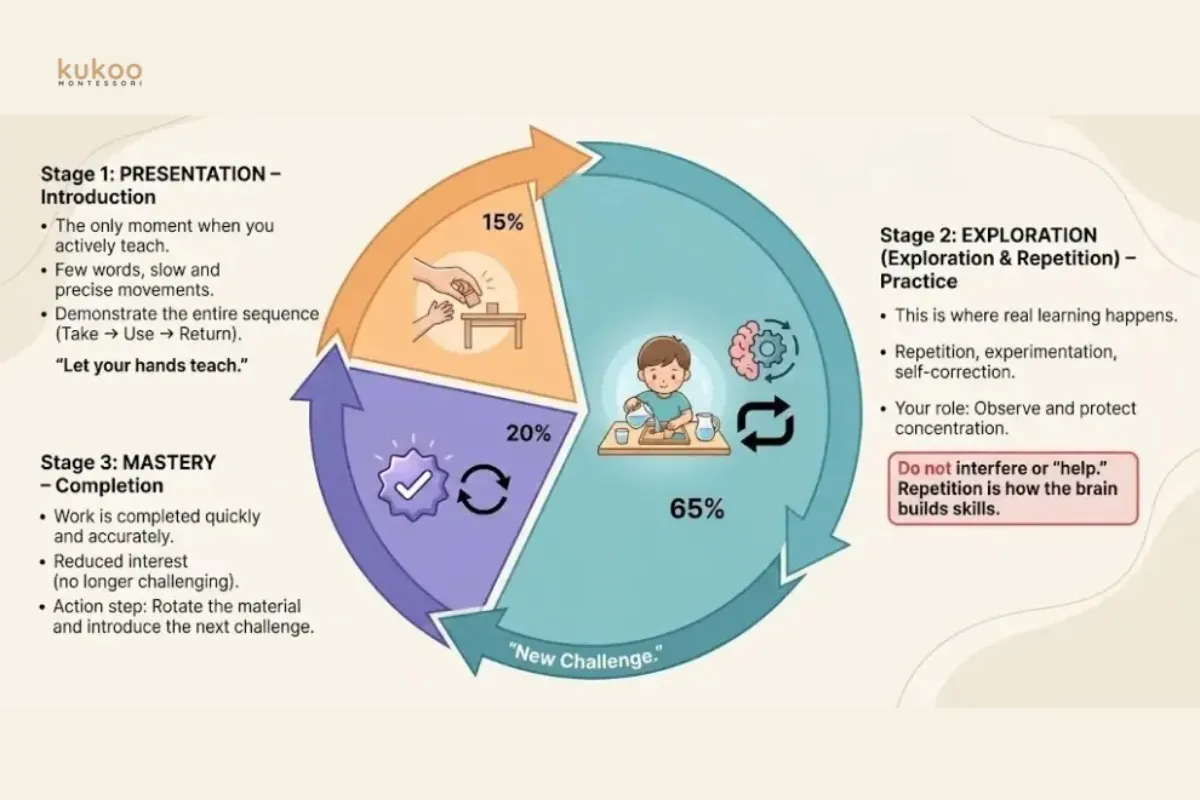
The Learning Cycle: Presentation → Exploration → Mastery
Understanding this rhythm tells you exactly when to step in and when to step back .
Phase 1: Presentation
This is the only moment you actively “teach.” The goal is clarity, not entertainment .
How to Present:
Sit Beside: Sit next to your child, not across.
Slow Movement: Move deliberately so they can see every detail. Children process movement slower than adults .
Minimal Words: Let your hands do the teaching. Silence keeps attention on the work, not your voice .
The Invitation: End with, “Would you like to try?” If they say no, simply return it to the shelf .
Handling Misuse: If they use materials destructively (throwing, banging):
Re-present once: “This is for pouring.”
Remove calmly: If it continues, put it away for another day. Be firm, kind, and consistent .
Phase 2: Exploration (The Practice)
Your child takes over. This is where the brain wires the new skill.
What You’ll See: Repetition (10–50 times), self-correction, and deep focus .
Your Role: Observe and protect their concentration.
Don’t: Interrupt to “help” or praise. Repetition is not boredom; it is deep work .
Phase 3: Mastery (The Completion)
Eventually, the challenge fades.
Signs of Mastery: They complete the task quickly, accurately, and show less interest .
What To Do: Rotate the material off the shelf and introduce a slightly more complex challenge
How Montessori Builds 8 Foundational Skills
1. Cognitive Skills
Problem-solving and executive function (focus, planning) develop through self-correction and choice—teaching children that mistakes are simply information, not failure.
2. Fine Motor Skills
Puzzles with knobs, pouring, and transferring build hand strength, pincer grip, and precision for writing and self-care.
3. Language Development
Vocabulary grows from concrete experiences, giving words like ‘heavy’ or ‘smooth’ real meaning through the hands.
4. The Mathematical Mind
Understanding pattern, order, and quantity through hands-on work like sorting, stacking, and one-to-one correspondence.
5. Practical Life Skills
Real, everyday tasks (pouring, wiping, dressing) that build independence, coordination, sustained effort, and confidence.
6. Social and Emotional Skills
Empathy and self-regulation grow through mixed-age collaboration, “Grace & Courtesy” lessons, and conflict resolution tools like the Peace Table.
7. Sensory Skills
Refining the senses by isolating specific qualities (like weight, texture, or sound) creates a concrete, physical foundation for later abstract thinking.
8. STEM and Creative Thinking Skills
Scientific inquiry and innovation begin with observation and mastery. Children learn logic, cause-and-effect, and structural design through hands-on experimentation.
Ready to explore materials organized by developmental skill? Browse our complete collection of Montessori toys by skill to find tools that support each area of growth.
Montessori Method at Home
The Parent’s Shift: From Director to Guide
In the Montessori method, you stop being the “Director” (instructing and correcting) and become the Guide. Understanding how to make this shift as a Montessori parent — in real daily situations — is one of the most practical things you can do at home.”
1. Your New Role
- Observer: Watch to understand what your child is ready for.
- Preparer: Set up the space to match their needs.
- Protector: Guard their focus from interruptions—including your own.
The Hardest Part: Doing less and trusting more. When you stop solving every problem, your child discovers their own capability .
2. The Inner Work (The Pause)
When your child struggles, your instinct screams “Help them!” But struggle is where learning happens.
The 10-Second Rule: Before intervening, count to 10 slowly. Most of the time, they figure it out .
- Self-Inquiry: Ask, “Am I stepping in because they need help, or because I am uncomfortable?” .
3. Social Learning
If you have multiple children, protect the older child’s focus (“Let’s give him space”) and invite—but don’t force—the older child to teach the younger one
Montessori Discipline: Boundaries, Tantrums, and Respect
One of the biggest questions is: “If Montessori is about freedom, what about discipline?”
1. Redefining Discipline
Discipline means “to teach,” not “to punish.” The goal isn’t blind obedience; it is self-discipline—the internal ability to make respectful choices .
2. Setting Boundaries (Kind AND Firm) “Freedom within limits” requires a respectful middle ground.
Kind: Acknowledge feelings (“You really want to keep playing”).
Firm: Hold the boundary clearly (“But it is time for bed now”).
3. Natural & Logical Consequences Instead of rewards or punishments, use consequences related to the action.
Natural: What happens naturally (e.g., forgetting a coat = feeling cold).
Logical: A necessary intervention (e.g., throwing a puzzle = the puzzle is put away) .
4. Handling Tantrums Tantrums are communication, not misbehavior.
Stay Calm: Your calm is contagious.
Connect Before Correct: Validate the feeling (“I know you are angry we have to leave”).
Hold the Boundary: Don’t give in (“We still have to go home”).
Offer Support: Sit nearby quietly until the storm passes
The Ultimate Goal: Peace Education
“Establishing lasting peace is the work of education.” — Dr. Maria Montessori Dr. Montessori was nominated for the Nobel Peace Prize three times. She believed that true peace begins with the child. In Montessori, peace isn’t just a concept; it’s a curriculum.
The Peace Table: A designated spot where children go to resolve conflicts. They use a “peace object” (like a flower or stone) to take turns speaking and listening until a solution is found—without an adult referee.
Inner Peace: Through concentration and independent work, children find an internal calm that naturally reduces aggression.
Preparing the Environment: Room by Room
You don’t need a Pinterest-perfect home. You need intention. Start small—focus on one shelf or room.
1. The Great Declutter (80/20 Rule) Remove about 80% of the toys to stop overstimulation. Keep only a few purposeful materials out; store the rest .
Note: If your child seems “bored” at first, wait. Boredom is where creativity begins .
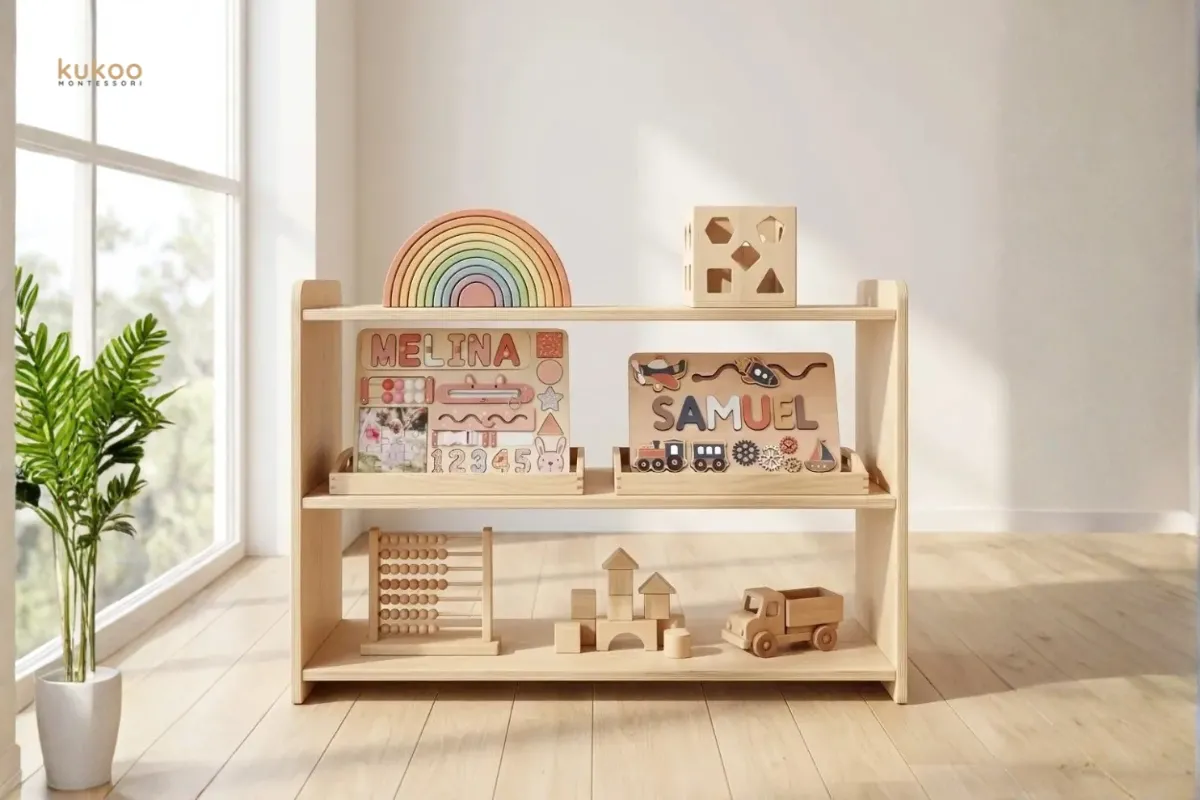
2. The Toy Shelf (Core Setup)
Setup: 1 low shelf with 6–8 materials, arranged left-to-right (simple to complex) .
Rotation: Swap 2–3 items every 1–2 weeks based on interest .
What NOT to Buy: You don’t need a full curriculum or branded “Montessori” boxes. Look for real materials (wood, metal) that isolate a single skill .
3. Practical Life Corner (Kitchen/Bath)
Kitchen: A low drawer with a child-sized pitcher, real glass/ceramic dishes (teach capability, not pretending), and a sponge for spills.
Bathroom: A step stool and towel at child-height .
4. Navigating Screens
Principle: Concrete before abstract. Brains under 3 wire themselves through hands-on sensory experience, which screens interrupt .
Guideline: Minimize 0–3. For 3–6, prioritize slow-paced, realistic content (nature documentaries) over fast-paced cartoons .
Boundaries: Keep screens out of bedrooms and mealtimes. You are the model—if you scroll while they talk, they learn screens come first .
Common Mistakes & How to Avoid Them
Even parents who understand the philosophy fall into these traps.
Buying Too Much: Trap: Ordering 20 materials at once. Fix: Start with 4–6 items and rotate slowly .
Intervening Too Quickly: Trap: “Helping” when they struggle. Fix: Pause. Let the material give the feedback .
Praising Everything: Trap: “Good job!” constantly. Fix: Describe effort instead (“You stacked all five rings”) .
Chasing Aesthetics: Trap: Buying beige/wooden toys that do nothing. Fix: Ask, “Does this isolate a skill?” .
Skipping Practical Life: Trap: Focusing only on puzzles. Fix: Let them pour, wipe, and sweep. This is the foundation of independence
The Essential Montessori Toys & Materials Starter Kit (0–3 Years)
Montessori marketing is expensive; Montessori philosophy is free. You do not need a $200 curriculum kit.
What You DON’T Need: A full curriculum, expensive furniture, or “aesthetic” toys that lack purpose.
The Essentials Roadmap (Starter Kit):
0–6 Months: High-contrast cards, wooden rattle, floor mat (for movement).
6–12 Months: Object permanence box, simple stacking rings, heavy balls.
12–18 Months: Knobbed puzzles (3 pieces), walking wagon, real water pitcher.
18–36 Months: Sorting trays, dressing frames (zippers/buttons), cleaning tools.
Guide to Authentic Montessori Toys & Materials
Montessori materials — and truly Montessori toys — aren’t “toys” in the usual sense. They’re tools, designed with a very specific job:
- Isolate one skill at a time
- Offer control of error (self-correction)
- Invite repetition and mastery
- Use natural materials wherever possible
The “Authentic” Checklist: How to Spot the Real Deal
Before buying anything—whether from a high-end shop or a thrift store—run it through this 4-point test. If it fails one, it’s likely entertainment, not education.
Isolation of Difficulty: Does it teach one thing at a time?
The Goal: A wooden puzzle with knobs teaches grip and shape.
The Trap: A plastic toy that sings, flashes lights, and counts to 10 simultaneously. This is overstimulation, which breaks concentration.
Control of Error: Can the child see their own mistake?
The Rule: The material itself should be the teacher. If a puzzle piece doesn’t fit or water spills, the child knows immediately without you saying, “No, that’s wrong.” This builds self-correction.
Active Child vs. Passive Toy: Does the child do the work?
The Rule: Avoid battery-operated toys. If the toy performs (lights, sounds, movement), the child becomes a passive observer. In Montessori, the child’s hands must be active for the brain to learn.
Real & Natural: Is it grounded in reality?
The Rule: Choose wood, metal, glass, and real photos over plastic and cartoons. Wood offers sensory feedback (weight/texture) that plastic lacks, and real images connect the child to the actual world
The Five Categories of a Balanced Shelf
Don’t buy random toys. Build a balanced environment across these developmental areas:
Practical Life (The Foundation): Real tools for real independence. Small pitchers, brooms, or button frames.
Purpose: Developing coordination and the belief “I can do it myself.”
Sensorial: Refining the senses. Stacking towers, sound cylinders, or texture boards.
Purpose: Preparing the brain for abstract concepts by isolating senses (heavy/light, rough/smooth).
Language: Vocabulary rooted in experience. Realistic objects, picture cards (no cartoons), and books.
Purpose: Connecting words to the real world.
Math: Quantity you can hold. Number rods or bead chains.
Purpose: Feeling that “10” is heavier/longer than “1,” making math concrete before it becomes abstract on paper.
Culture: The world beyond. Globes, puzzle maps, leaves, or animals.
Purpose: Fostering curiosity about nature and geography.
Building Your Collection (The Anti-Overwhelm Strategy)
You do not need the full curriculum. Having too much slows development.
Start Small: Aim for 5–8 items total on a low shelf (e.g., 2 practical life, 2 sensorial, 1 language).
Rotate, Don’t Accumulate: Keep 80% of toys in storage. Rotate items every 1–2 weeks based on your child’s interest.
Follow the Progression: Start simple (3-piece puzzle) and only move to complex (10-piece puzzle) when the skill is mastered.
Montessori isn’t about buying the most expensive wooden toy. It’s about offering the right tool, at the right time, that invites your child to say, “I did it myself.”
Why Wood Matters: The Science of Natural Material
Most parents choose wood for the aesthetic. We choose it for the neuroscience.
Your child learns through touch. The material they hold sends direct signals to their developing brain. Plastic sends one kind of signal; wood sends another. Here is why that difference is at the heart of everything Kukoo creates.
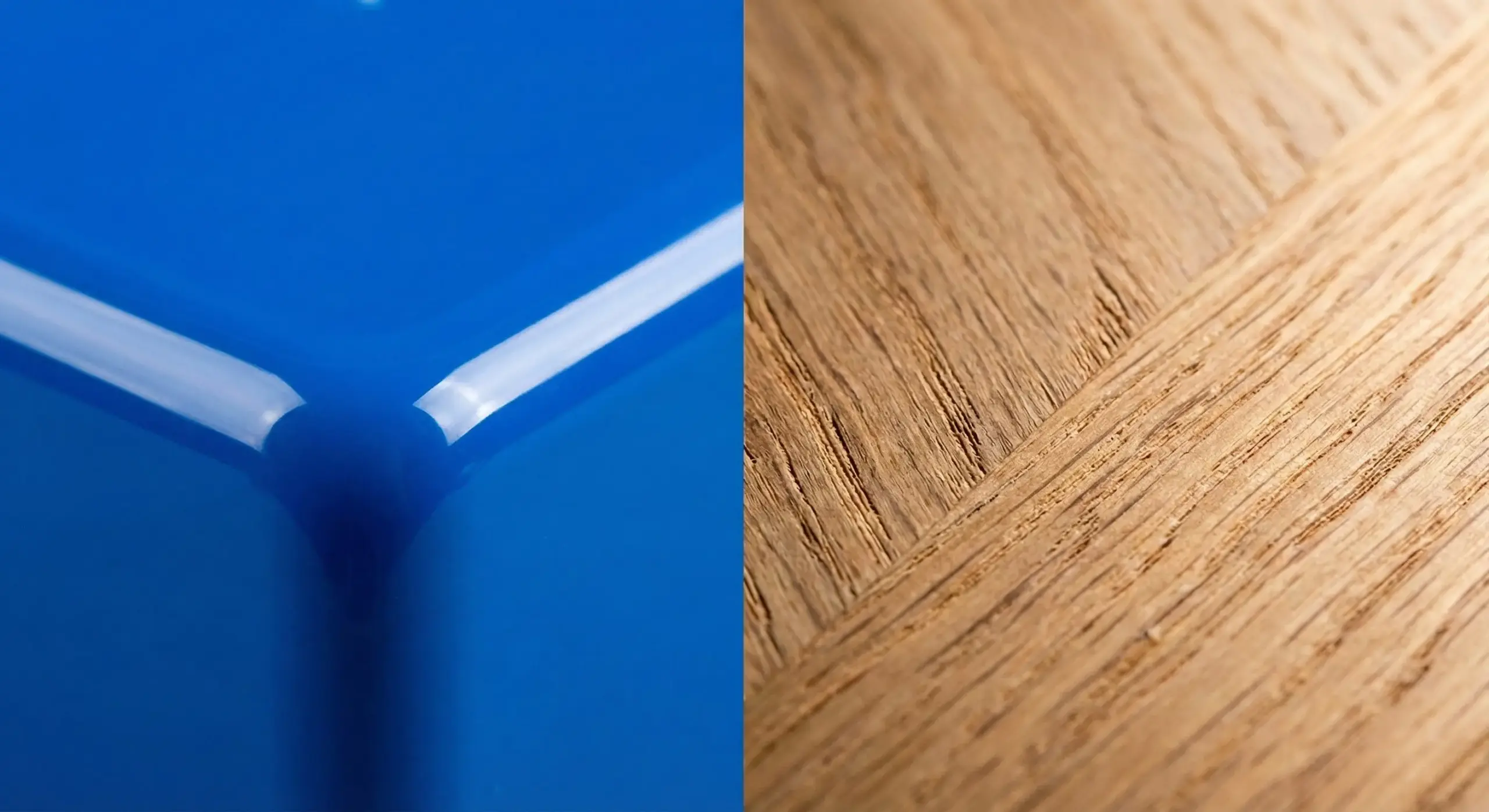
1. Sensory Richness: Feeding the Tactile Sense
Touch is the first language your child speaks.
- Plastic: Sensory-uniform—smooth, cool, feels the same regardless of shape. Gives the brain a “flat map” with less detail to process.
- Wood: Alive with texture—visible grain to trace, subtle variations in every piece, natural warmth. Gives the brain a “topographical map” full of detail and nuance.
Research shows natural textures activate more nerve receptors in fingertips. Richer sensory input builds better fine motor control and spatial awareness.
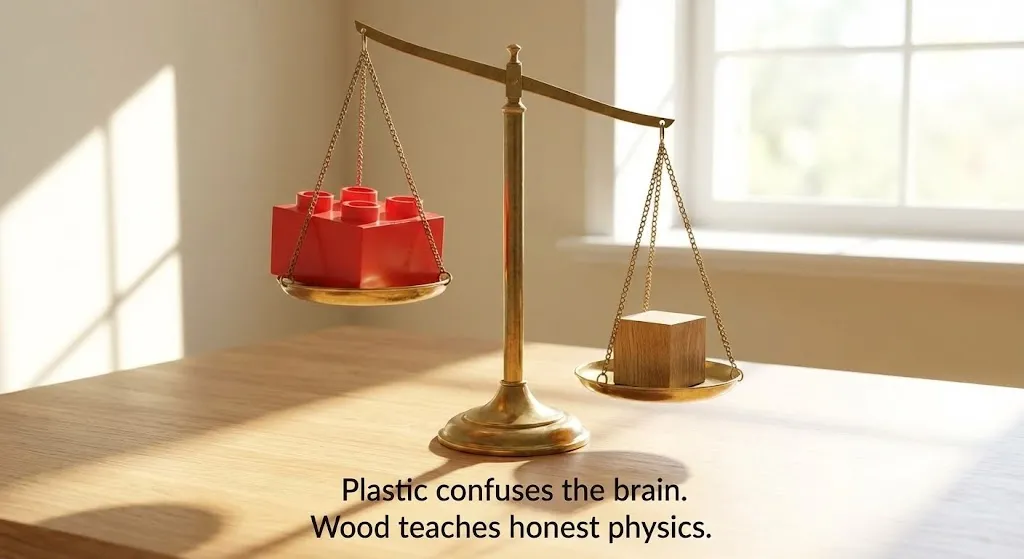
2. The Baric Sense: Why Weight Matters
Your child is a physicist, constantly experimenting with gravity and balance. To learn effectively, they need materials that tell the truth.
- Plastic is “dishonest”: A large hollow block can weigh less than a small solid one, sending inconsistent signals that confuse the brain.
- Wood is “honest”: Large pieces feel heavy; small pieces feel light. This consistency builds proprioception—the ability to judge how much muscle force is needed to grip and lift.
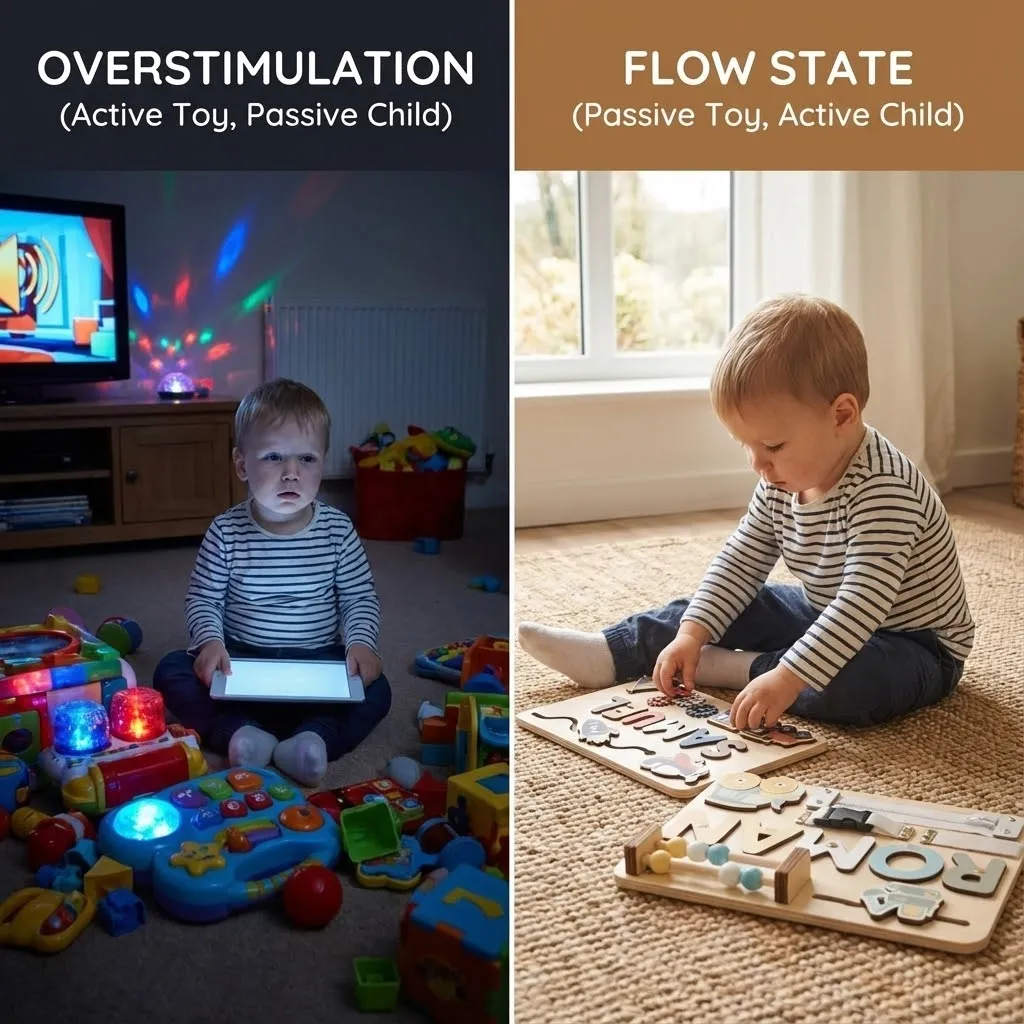
3. The Calmness Factor: Active Child, Passive Toy
The truth: The more a toy does, the less your child learns.
- Electronic toys: Flashing lights and sounds cause overstimulation. The child becomes a passive observer.
- Montessori principle: “The toy should be passive so the child can be active.” Wooden materials sit quietly, waiting for your child to act, explore, and imagine.
The science: Electronic noise increases cortisol (stress). Passive natural materials support the “flow state”—deep, quiet engagement where real learning happens.
4. Safety & Connection to Nature (Biophilia)
Humans have an innate biological need to connect with nature. Studies show touching natural materials lowers heart rates and increases feelings of safety.
Kukoo’s Commitment: “Sustainably sourced wood, non-toxic finishes, fully tested to meet ASTM (U.S.) and EN 71 (European) safety standards. Your child will mouth, carry, and sleep next to these materials—they deserve safety you don’t have to question.”

Why Natural Materials Are Foundational
You can practice Montessori with plastic toys, but you will miss something crucial. Montessori isn’t just about what your child does; it’s about what their senses experience while doing it .
When you choose wood, you provide:
Richer tactile input for fine motor development.
Honest weight feedback for spatial reasoning.
A calm, passive tool for deeper concentration.
At Kukoo, wood isn’t a style choice. It’s a developmental one .
Understanding why we choose natural wooden materials reveals the science behind this commitment.
Montessori vs. Other Educational Approaches
Many parents confuse the Montessori method with Waldorf or Reggio Emilia. Understanding the distinct differences helps you commit fully and stop mixing conflicting methods.
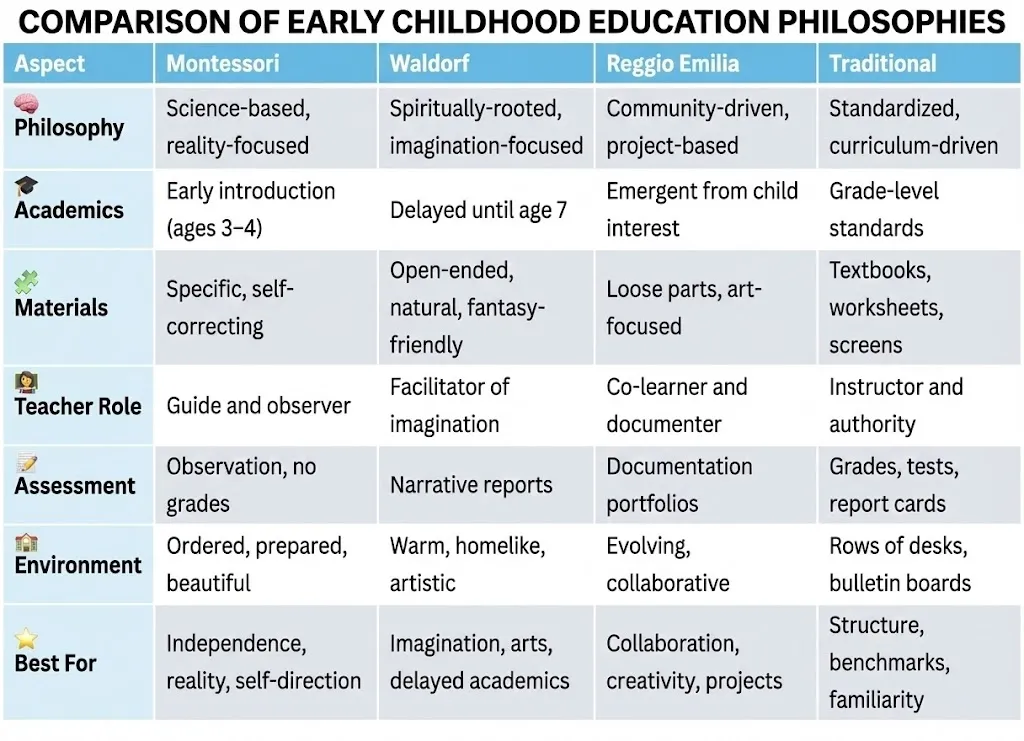
Which Method Fits Your Family?
There is no single “best” method, but there is a best fit for your values.
Choose Montessori if: You value early independence, logic, real-world skills, and self-directed learning.
Choose Waldorf if: You want to protect childhood from academics and technology, prioritizing imagination and arts.
Choose Reggio if: You love artistic collaboration, group projects, and community involvement.
Choose Traditional if: You value clear benchmarks, standardized testing, and familiar structure.
Montessori by Age (0–6 Years)
Most guides treat 0–6 as a single block. We don’t. We break down the developmental windows so you know exactly whya material matters at a specific moment.
0–12 Months – Sensory Foundation & Trust
- Developmental Focus: Explosive growth, “Help me do it myself,” sensitive period for order (consistency is key), pincer grip development.
- Your Role: Step back and let them try; offer real tasks (practical life), not pretend versions; prepare the environment for success.
- Key Principles: Practical life is central. Respect their need for order—meltdowns are developmental, not defiance.
- Suggested Materials: Small pitcher/cups, stacking rings, transferring tools (spoons), simple knobbed puzzles (3–5 pieces).
1–2 Years – Independence And “Me Do It”
- Developmental Focus
Sensitive period for order (need for predictability), language explosion, mastery of multi-step practical tasks.
- Your Role
Maintain routines and offer more complex versions of familiar tasks. Validate big emotions instead of fixing them immediately.
- Key Principles
Order equals safety. Begin modeling grace and courtesy (kindness, patience).
- Suggested Materials
Dressing frames (buttons/zippers), complex puzzles (6–10 pieces), food prep tools (peeling/cutting), busy boards with real latches, sorting trays.
3-6 Years – Mathematical Mind & Executive Function
- Developmental Focus
Abstract thinking, executive function, mastery of complex practical life, reading/writing readiness, deep focus (30–60 minutes).
- Your Role
Protect long, uninterrupted work periods and encourage collaboration; step back even further.
- Key Principles
Move from concrete to abstract (math in the hands, not on paper). Cosmic Education begins.
- Suggested Materials
12+ piece interlocking puzzles, math manipulatives (bead chains, number rods), Sandpaper Letters, real art supplies, small tools for real contribution (meal prep).
Why Age-Appropriate Materials Matter
The right material at the right time is the heart of the method.
- Too simple → Boredom.
- Too complex → Frustration.
- Just right → Deep concentration (Flow).
Explore our complete collection of Montessori toys by age to find developmentally appropriate materials for your child’s current stage.
Is Montessori Right for Your Child?
Every child is unique, and while we believe in the power of Montessori, it’s not a magic wand. Choosing an educational path is a big decision. This section offers an honest look at the realities, helps you spot authentic programs, and explores how this method supports diverse learners.
The Honest Truth: Pros and Cons
To help you decide with eyes wide open, here is an objective look at the trade-offs.
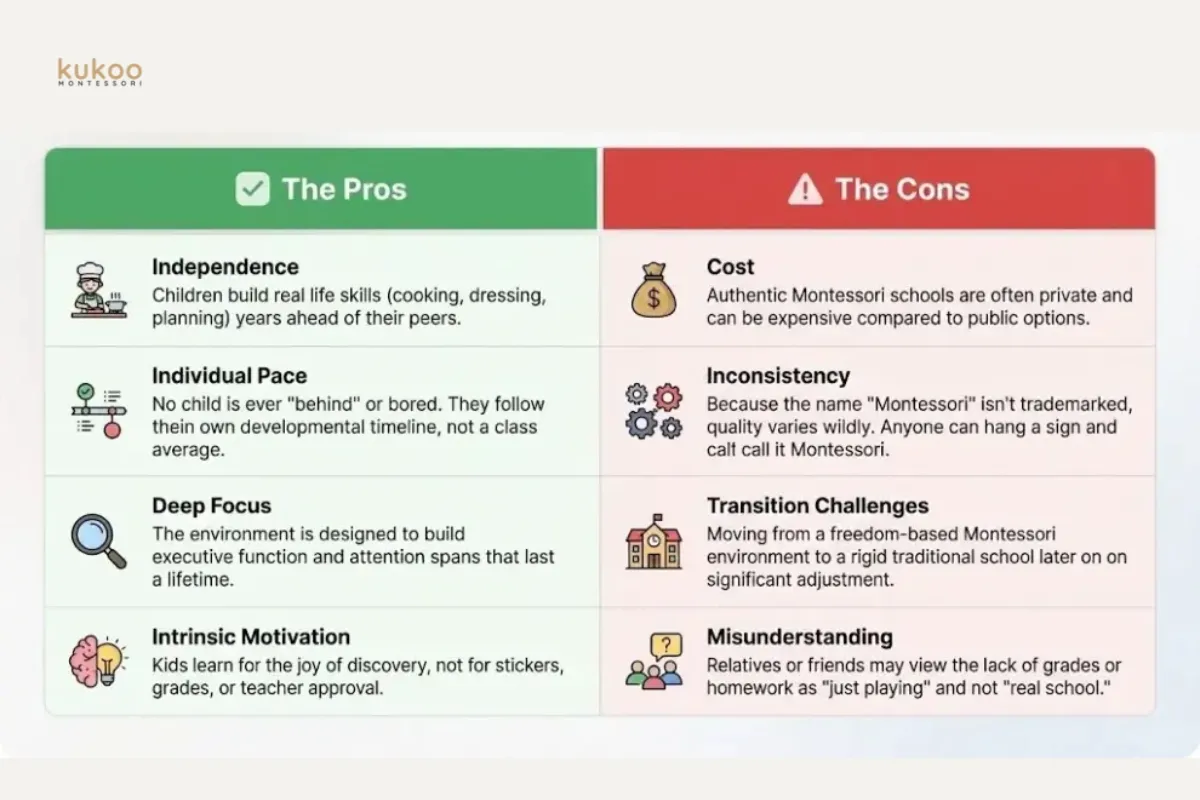
The “Fake” Montessori Problem: How to Spot a Real School
Did you know the name “Montessori” is not trademarked? Any daycare can use it. This leads to many “Montessori-inspired” programs that miss the core philosophy.
Use this checklist to ensure a school is authentic:
Mixed-Age Classrooms: Are children aged 3, 4, and 5 together? This is non-negotiable. It allows younger children to learn from older peers and older children to reinforce mastery by teaching. If they are separated by age (e.g., a “3-year-old room”), it’s not authentic.
The 3-Hour Work Cycle: Does the schedule allow for long, uninterrupted blocks of work (2–3 hours)? Or is the day chopped up by mandatory circle times, snack times, and transitions every 30 minutes?
The Materials: Are the shelves stocked with authentic materials (Pink Tower, Moveable Alphabet) arranged in order? Or is the room filled with bright plastic toys and fantasy play sets?
- Certified Guides: Ask about teacher training. Look for certifications from AMI (Association Montessori Internationale) or AMS (American Montessori Society).
AMI vs. AMS: What’s the Difference?
In the US, you will often see schools accredited by either AMI or AMS. Both indicate high quality, but they have distinct flavors.
AMI (Association Montessori Internationale): Founded by Dr. Maria Montessori herself.
The Vibe: “Pure” or “Classical.”
The Approach: Strictly adheres to the original method, materials, and training exactly as Dr. Montessori prescribed. Less likely to include supplementary materials or modern adaptations.
AMS (American Montessori Society): Founded by Nancy McCormick Rambusch. It is the largest organization in the US.
The Vibe: “Flexible” or “Modern.”
The Approach: Adapts the method to American culture. You might see more integration of technology, supplementary materials, or slight variations in curriculum to align with state standards.
Which is better? Neither. It depends on what fits your family. AMI offers a rigorous, traditional experience. AMS offers a high-quality experience that may feel more familiar to American parents.
Montessori for Neurodiversity
Many parents worry if Montessori will work for a child with ADHD, Autism, or learning differences.
The truth? The method didn’t start with “typical” children. It originated from Dr. Montessori’s work with children with developmental disabilities in the Orthophrenic School. It is inherently inclusive.
Why it works for neurodivergent minds:
Self-Paced: It removes the anxiety of “keeping up.” A child who needs more time on a concept gets it without shame. A child who needs to move faster isn’t held back.
Multi-Sensory: Abstract concepts (like math) are taught through concrete, tactile materials. This is a game-changer for children who struggle with auditory processing or traditional lectures.
Order & Routine: The prepared environment is predictable. Everything has a place. This external order provides the safety and structure that many neurodivergent children crave to regulate their internal chaos.
Freedom of Movement: Children aren’t forced to sit still at a desk. They can stand, move, and work on the floor, which helps regulate energy levels (especially for ADHD).
A Note of Caution: While the method is ideal, not every school has the resources for every child. Always observe a classroom to ensure the specific environment supports your child’s unique needs.
Common Montessori Myths & Misconceptions
Myth 1: “It’s unstructured. Kids do whatever they want.”
The Reality: Montessori is highly structured—just not by the adult controlling every minute.
The Structure: It lives in the environment (everything has a place), the materials (clear purpose), and the ground rules (respect for others’ work) .
Real Life: A child freely chooses a puzzle but must return it to the shelf when done. This is “freedom within limits,” not chaos .
Myth 2: “It’s too rigid. It kills creativity.”
The Reality: Montessori builds the skills creativity relies on.
The Principle: Creativity = Skills + Freedom. A child who has mastered scissors can create art; a child who hasn’t just shreds paper .
The Sequence: Structure → Mastery → Freedom → Creativity. We provide the skills first so the imagination can soar later.
Myth 3: “It’s only for wealthy families.”
The Reality: Montessori is about intention, not money. You don’t need a showroom; you need a few purposeful items.
The Math: Buying 50 cheap plastic toys costs far more over time than buying 6–8 high-quality wooden materials that last for years and multiple children .
Smart Investment: When you do spend, choose items like Kukoo wooden puzzles—built to last, repairable, and safety-certified .
Myth 4: “Montessori kids don’t learn discipline.”
- The Reality: They learn self-discipline—doing the right thing because they understand why, not because they fear punishment .
The Method: We use logical consequences (“If you throw the puzzle, it goes away”) rather than random punishments.
The Result: Research shows Montessori children often have better self-control and social skills because they practice regulation daily .
Scientific Research & Evidence: Why It Works
Dr. Maria Montessori didn’t guess. She developed the Montessori method through scientific observation over 100 years ago, testing and refining every material. . Modern research now backs up what she observed, confirming that the calm, focus, and independence you see are not accidents.
The Cognitive Advantage: Executive Function & Academics
Executive Function (focus, impulse control, planning) is the brain’s “CEO”—often predicting life success better than IQ.
The Evidence: A landmark study published in Science (2006) found that Montessori 5-year-olds scored significantly higher on executive function and social problem-solving than peers in traditional schools.
Long-Term Impact: Longitudinal studies show these benefits persist. Montessori alumni adapt well to traditional high schools, often outperforming peers in math and science.
Why It Works: They learn through deep conceptual understanding, not rote memorization. Uninterrupted work cycles train the brain to focus, while “freedom within limits” builds self-discipline.
Developing the Whole Child: Creativity & Social Skills
The Creativity Myth: “Montessori is too rigid.”
The Reality: Structure builds competence, which fuels creativity. Research shows Montessori children display equal or higher levels of original thinking. By mastering tools first, they gain the freedom to create with confidence.
Intrinsic Motivation: Without gold stars or timeouts, children develop intrinsic motivation—learning for curiosity, not for a reward.
Social Intelligence: Mixed-age environments allow older children to practice leadership and younger children to learn by observing, fostering conflict resolution skills without the need for adult punishment
The Verdict: Addressing the Critics
“Is the research biased?”
No. Key studies are conducted by independent university psychologists and neuroscientists, not just Montessori advocates.
“Is it only for the wealthy?”
No. Research in diverse communities indicates that when implemented well, the core principles—respect, independence, and order—provide strong developmental gains for children across all economic backgrounds.
You don’t need a science degree to love your child, but knowing the evidence confirms that the calm, focus, and independence you are cultivating is not an accident—it is scientifically sound.
The “Montessori Mafia”: Proof of Success
Critics often ask if Montessori prepares children for the “real world.” The answer lies in its alumni.
Many of the world’s most creative innovators credit their success to the method’s emphasis on self-direction and “thinking outside the box.”
Notable alumni include:
Tech Pioneers: Larry Page and Sergey Brin (Founders of Google), Jeff Bezos (Founder of Amazon), Jimmy Wales (Founder of Wikipedia), Will Wright (Creator of The Sims).
(Larry Page and Sergey Brin famously credited Montessori for their success, stating that the method taught them to be self-motivated and to question the world, leading directly to the creation of Google.)
Arts & Culture: Gabriel García Márquez (Nobel Prize Author), Julia Child (Chef), Taylor Swift (Singer), Joshua Bell (Violinist).
Leadership: Anne Frank (Diarist), Princes William and Harry.

An Investment in Your Child’s Future
You’ve reached the end of this guide. But this isn’t an ending. It’s a beginning.
From Confusion to Clarity
You started with questions; you leave with a roadmap. You now understand the science, the principles, and the practical steps to bring the Montessori method home. You know not just what to do, but why it works .
The Shift: From Control to Trust
When you apply this, your parenting changes:
You stop buying random toys → you choose materials that serve development.
You stop comparing to Instagram → you create a space that is real and functional.
You stop managing → you start seeing your child as someone who is already capable .
Progress, Not Perfection
Montessori at home will never look like a classroom. You will have messy shelves and hard days. That is real life . It isn’t about perfect execution; it is about consistent intention. Small choices—stepping back, observing, trusting—compound over time .
The Result
One day, you will look at your child and see them concentrate deeply, solve problems independently, and move with confidence. That is when you know: It’s working.
Now, it’s time to explore Authentic Wooden Montessori Toys by Kukoo Montessori!
FAQ
How is Montessori different from traditional education?
Unlike the teacher-led, textbook-driven model of traditional schools, Montessori is child-centered and self-paced .
The Classroom: Mixed-age groups work uninterrupted, choosing their own activities from a prepared environment .
The Method: Hands-on materials replace lectures and standardized tests .
The Goal: Fosters independence and internal motivation rather than working for grades
Why are Montessori schools so expensive?
It comes down to operational costs, not just branding. Authentic Montessori requires:
Specialized Training: Teachers need 1–2 years of rigorous graduate-level certification.
High-Quality Materials: Classrooms are stocked with expensive, durable wooden learning tools, not cheap consumables.
Low Ratios: Schools maintain specific student-teacher ratios to ensure individual observation.
Is Montessori religious?
No. The Montessori Method is secular. While Dr. Maria Montessori was Catholic, her method is based on the scientific observation of human development, not religious doctrine. It is used worldwide in public, private, and religious schools of all faiths.
How do Montessori children transition to “traditional” schools?
Surprisingly well. This is the #1 concern for parents. Research suggests Montessori children adapt quickly because they possess strong adaptability, social skills, and self-discipline. They are used to managing their own time and asking questions, which helps them navigate new rules and systems effectively.
Q: Is Montessori good for children with ADHD?
Yes. The method is naturally supportive of neurodivergence because it allows for freedom of movement (no forced sitting) and individualized pacing (no pressure to keep up with a group). The emphasis on hands-on learning and a quiet, ordered environment helps active children focus without the frustration of traditional desk-based learning.
References & Citations
This guide is built on research from peer-reviewed journals, official Montessori organizations, and expert sources. Below is the full list of references cited throughout this article.
- Association Montessori Internationale. (n.d.). Montessori education.
- American Montessori Society. (n.d.). About Montessori.
- Montessori, M. (1912). The Montessori Method (A. E. George, Trans.). New York, NY: Frederick A. Stokes Company.
- Montessori, M. (1995). The Absorbent Mind (Rev. ed.). New York, NY: Henry Holt and Company. (Original work published 1949)
- Dohrmann, K. R., Nishida, T. K., Gartner, A., Lipsky, D. K., & Grimm, K. J. (2007). High school outcomes for students in a public Montessori program. Journal of Research in Childhood Education, 22(2), 205–217
- Fjørtoft, I. (2004). Landscape as playscape: The effects of natural environments on children’s play and motor development. Children, Youth and Environments, 14(2), 21–44.
- Fjørtoft, I., & Sageie, J. (2000). The natural environment as a playground for children: Landscape description and analyses of a natural playscape. Landscape and Urban Planning, 48(1–2), 83–97.
- Largo-Wight, E., Guardino, C., Wludyka, P. S., Hall, K. W., Wight, J. T., & Merten, J. W. (2018). Nature contact at school: The impact of an outdoor classroom on children’s well-being. International Journal of Environmental Health Research, 28(6), 653–666.
- Lillard, A. S. (2012). Preschool children’s development in classic Montessori, supplemented Montessori, and conventional programs. Journal of School Psychology, 50(3), 379–401.
- Lillard, A., & Else-Quest, N. (2006). Evaluating Montessori education. Science, 313(5795), 1893–1894.
- Lillard, A. S., Heise, M. J., Richey, E. M., Tong, X., Hart, A., & Bray, P. M. (2017). Montessori preschool elevates and equalizes child outcomes: A longitudinal study. Frontiers in Psychology, 8, 1783.
- Rathunde, K., & Csikszentmihalyi, M. (2005). Middle school students’ motivation and quality of experience: A comparison of Montessori and traditional school environments. American Journal of Education, 111(3), 341–371.
- Shankland, R., Genolini, C., Riou França, L., Guelfi, J.-D., & Ionescu, S. (2010). Student adjustment to higher education: The role of alternative educational pathways in coping with the demands of student life. Higher Education, 59, 353–366.
- Diamond, A., & Lee, K. (2011). Interventions shown to aid executive function development in children 4 to 12 years old. Science, 333(6045), 959–964.
- Galinsky, E. (2010). Mind in the Making: The Seven Essential Life Skills Every Child Needs. New York, NY: HarperCollins.
- Randolph, J. J., et al. (2023). Montessori education’s impact on academic and nonacademic outcomes: A systematic review. Campbell Systematic Reviews.
- Ikei, H., Song, C., & Miyazaki, Y. (2017). Physiological Effects of Touching Wood. Int. J. Environ. Res. Public Health.
- Sosa, A. V. (2016). Association of the Type of Toy Used During Play With the Quantity and Quality of Parent-Infant Communication. JAMA Pediatrics.
- Takahashi, I., et al. (2023). Screen Time at Age 1 Year and Communication and Problem-Solving Developmental Delay at 2 and 4 Years. JAMA Pediatrics.
- Bensmaia, S. J., et al. (2013). Spatial and temporal codes mediate the tactile perception of natural textures. PNAS
Meet the Founder & Our Philosophy
- Mary Carey — Founder, Kukoo Montessori
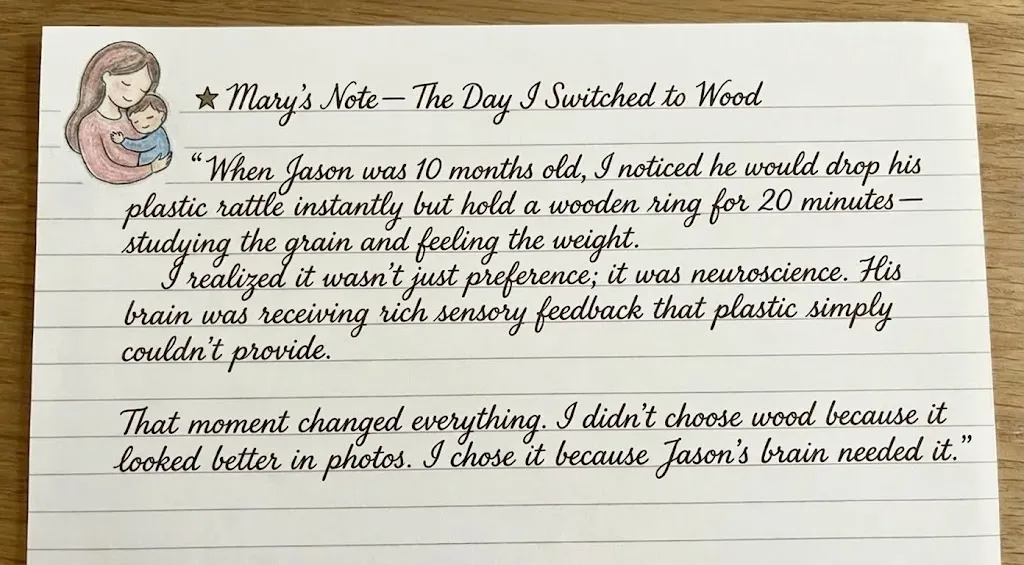
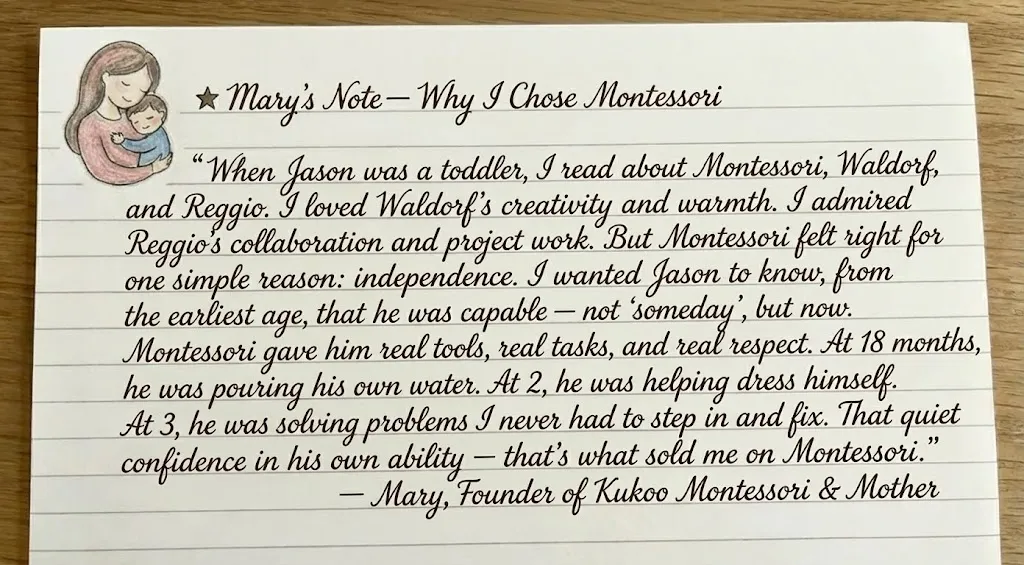
I didn’t come to Montessori as an expert. I came as a first-time mom who was lost.
When Jason was born in 2020, I spent months researching every method — Waldorf, Reggio Emilia, RIE, Traditional. When I found Montessori, something finally clicked. Not because of the aesthetics. Because of the why: children are not empty vessels. They are born ready to learn — if we give them the right environment and get out of their way.
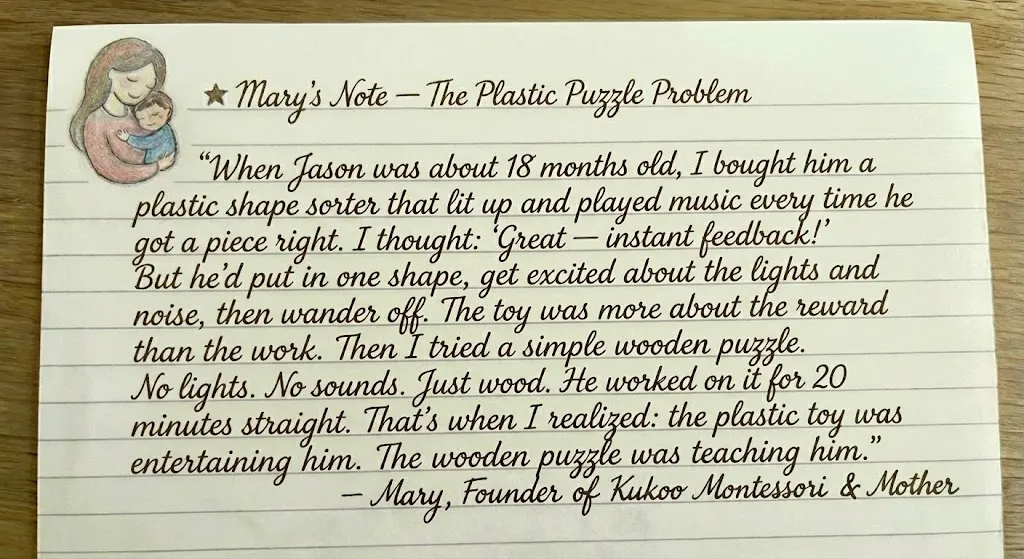
What I couldn’t find were toys that honored that philosophy honestly. The market was full of plastic stamped with the word “Montessori” — loud, reactive, and completely missing the point.
So I built Kukoo. Not to sell toys. To give parents the tools the method actually calls for. From the plastic trap to finding the soul of wood — here’s how it happened.
Everything on this page is what I wish someone had told me in those early, overwhelming months.

- Sarah Chen — Montessori Educational Advisor, M.Ed
AMI Assistants to Infancy (0–3) · Montessori Institute of San Diego
Mary brings the parent’s perspective. Sarah brings the classroom.
With 12 years working directly with infants and toddlers, and AMI Assistants to Infancy certification from the Montessori Institute of San Diego — one of the most rigorous AMI training centers in the United States — Sarah ensures that everything Kukoo builds is grounded in how children aged 0–3 actually develop, not just how Montessori looks on a shelf.
Her role at Kukoo is specific: to review every product against real developmental criteria before it reaches your home. If a toy doesn’t give a child genuine control of error, it doesn’t pass. If the challenge doesn’t match the sensitive period, it goes back to the drawing board.
“The first three years are when the brain builds its foundation. What a child touches, holds, and manipulates during this window shapes everything that comes after. Material choice isn’t aesthetic — it’s neurological.” — Sarah Chen

Our Philosophy, In One Sentence
Kukoo exists because the Montessori method deserves materials that take it seriously.
Commitment to Accuracy and Editorial Process
At Kukoo Montessori, we understand the importance of providing reliable information regarding child development. Our editorial process includes:
1. In-depth Research
We prioritize referencing highly authoritative sources, including international Montessori associations (such as AMI/AMS) and peer-reviewed scientific studies.
2. Expert Consultation
Before publication, in-depth content regarding educational methods or developmental milestones is consulted on or reviewed by certified Montessori teachers and early childhood education experts. This ensures the knowledge is not only theoretically correct but also pedagogically practical.
3. Practicality and Feasibility
We understand that every child is a unique individual and every family’s conditions are different. Therefore, the editorial team always strives to translate complex theories into simple, understandable, and easy-to-apply home practices, avoiding dogmatic advice that is removed from reality.
4. Regular Updates and Review
Scientific and educational knowledge is constantly innovating. We commit to performing periodic reviews of older articles to ensure information remains up-to-date, accurate, and relevant to the modern context.
5. Transparency and Listening
We value all feedback from the parent community and readers. If any errors are detected or information needs clarification, we commit to reviewing and implementing necessary corrections quickly and transparently.
Important Note While we strive to provide accurate information, the content on the Kukoo Montessori website is for reference and educational purposes only. For issues related to a child’s physical health or deep psychological conditions, we always recommend parents seek direct advice from doctors or authorized medical professionals.
Our Mission
Our mission is to become a trusted companion, helping parents feel more confident on the journey of raising happy, independent, and loving children.