
A 3-year-old counts five beads onto a tray. Moves them off. Counts them back on. Does it again. Not because an adult asked — because something clicked, and they need to confirm it is real.
That moment is Montessori math working as designed: the child discovering a mathematical truth through their hands, on their own terms, before any symbol is involved. This guide covers what Montessori math skills actually are, how the full curriculum sequence unfolds from birth to age 6, and which activities support each stage.
What Are Montessori Math Skills?
Montessori math skills are the ability to perceive, reason about, and operate on quantities — built from concrete physical experience upward through abstraction. They are not the same as numeracy (recognizing written numbers) or arithmetic (performing calculations). They are the underlying mathematical intelligence that makes numeracy and arithmetic meaningful rather than mechanical.
In Montessori education, math skills develop across five interconnected areas, introduced in a specific sequence that mirrors how mathematical understanding actually forms in the developing brain. Each area must be established concretely before the next is introduced abstractly.
The five areas, in sequence:
– Sensorial preparation (birth–3 years) — quantity, comparison, order, pattern
– Number concept 1–10 (3–4 years) — one-to-one correspondence, numeral-quantity connection
– Decimal system and place value (4–5 years) — units, tens, hundreds, thousands as physical realities
– Arithmetic operations (4.5–6 years) — addition, subtraction, multiplication, division with materials
– Fractions and geometry (5–6 years) — part-whole relationships, shape and spatial reasoning
This sequence is not a curriculum to be “completed.” It is a map of how children naturally develop mathematical understanding when given the right materials and enough time. The same child may be working in area 2 and area 4 simultaneously if different concepts have developed at different rates — which is normal.
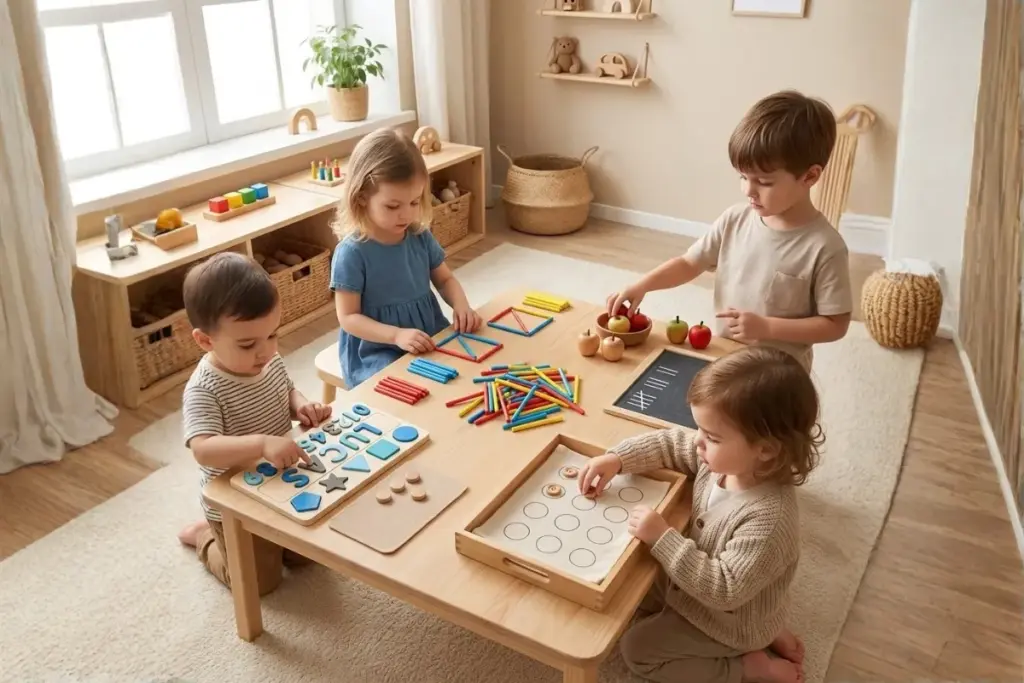
The Science: Why Concrete-First Works
- Number sense is not the same as counting. Rote counting — reciting “one, two, three” in sequence — and number sense — understanding that “three” means exactly three things, every time — are two separate cognitive skills. Children can develop the first without the second. Montessori math builds number sense first, because a child who genuinely understands quantity learns arithmetic in a fraction of the time compared to a child who has only memorized sequences.
- The concrete-pictorial-abstract sequence. Mathematics education research consistently supports what Montessori established a century ago. Lasting understanding develops in three stages: first, physical manipulation (three beads moved by hand); second, pictorial representation (a picture of three beads); third, abstract symbol (the numeral “3”). Skipping the concrete stage produces children who can recite but not reason — who write “3 + 2 = 5” without understanding what it means.
- Math thinking is built on cognitive foundations. Counting, classifying, comparing quantities, and recognizing patterns are not arithmetic procedures — they are cognitive operations that mathematics uses as its vocabulary. Classification (sorting by attribute), seriation (ordering by size or quantity), and conservation (understanding that quantity doesn’t change when rearranged) are the cognitive prerequisites for all formal arithmetic. A child who cannot yet sort objects reliably by two attributes is not ready for addition — not because they’re behind, but because the cognitive scaffolding isn’t yet in place.
- Spatial reasoning predicts mathematical ability. Of all early skills that correlate with later mathematics performance, spatial reasoning is among the strongest. Children who can mentally rotate objects, visualize structures, and understand spatial relationships score significantly higher in mathematics across the school years. This is why building, stacking, and fitting activities in the early years are a direct investment in mathematical ability — not a detour from it.
- The math-STEM bridge. Mathematical thinking is the language that STEM disciplines share. Every science experiment requires measurement and comparison. Every engineering challenge involves quantitative reasoning. Every technology problem involves systematic logic. A child who can think mathematically — who understands why operations work, not just how to perform them — enters STEM learning with a foundational advantage that procedural arithmetic training cannot provide.
The 5 Areas of Montessori Math: A Full Guide
Area 1 — Sensorial Preparation (Birth to 3 Years)
Before numbers, there is quantity. Before addition, there is comparison. The sensorial preparation area doesn’t look like math to most parents — it looks like play. But every activity in it is building the neural architecture that formal math will later run on.
- Key concepts: more/less, same/different, big/small/bigger/biggest, ordered sequences, one-to-one correspondence, early pattern recognition.
- What development looks like: A child who consistently places the largest ring first on a stacking tower is demonstrating seriation. A child who lines up cars in a row and gives one toy to each car is practicing one-to-one correspondence. A child who notices that their plate has fewer crackers than their sibling’s is perceiving quantity difference. These are all pre-mathematical operations happening in the context of play.
- Montessori activities: Nesting cups (size seriation), graduated stacking towers (visual discrimination of quantity difference), sorting objects by single attributes (color, shape, size), simple pattern-making with blocks or beads.
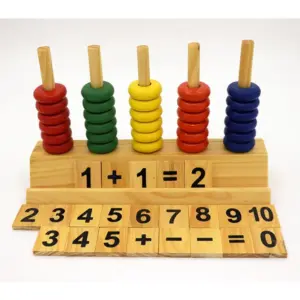
Area 2 — Number Concept 1–10 (3–4 Years)
This is where the numeral system enters — but only after quantity understanding is established. In Montessori math, the number “5” is introduced as a physical quantity (five objects, handled and counted) before it is introduced as a written symbol. The connection between quantity and numeral is built deliberately, through materials designed specifically to hold both simultaneously.
- Key concepts: one-to-one correspondence, cardinality (the last number counted is the total), numeral recognition 1–10, matching quantities to written numerals, comparison operators (more than, fewer than, equal to).
- What development looks like: The child counts five objects into a tray, touching each one, then places the numeral card “5” next to the set. The physical quantity and the abstract symbol sit side by side — the child holds both in view at once until the connection is internalized.
- Core Montessori materials at this stage: Number rods (wooden rods of graduated length representing 1–10), spindle box (placing exactly the right number of spindles in each numeral compartment), sandpaper numerals (tracing digit shapes with fingers while naming them).
Area 3 — Decimal System and Place Value (4–5 Years)
Place value is one of the most conceptually demanding ideas in early mathematics — and one of the most frequently taught too abstractly, too fast. In Montessori, it is introduced through the Golden Bead material: individual unit beads, ten-bead bars, hundred-bead squares, and thousand-bead cubes that children handle physically. A child who has carried a thousand-cube understands, in their body, that a thousand is much heavier than a hundred — before they encounter “1,000” as a written symbol.
- Key concepts: units, tens, hundreds, thousands as distinct categories; the principle that ten of any category makes one of the next; reading and writing four-digit numbers; exchanging (ten units = one ten).
- What development looks like: A child builds the number 2,345 using Golden Beads — two thousand-cubes, three hundred-squares, four ten-bars, five unit-beads — then writes the numeral. They can see, hold, and count the physical referent for every digit in the number before they write it.
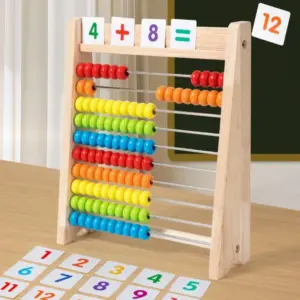
Area 4 — Arithmetic Operations (4.5–6 Years)
With concrete quantity understanding, numeral recognition, and place value established, children in the 3–6 year window are ready for the four operations — but introduced as extensions of what they already understand, not as new procedures to memorize.
Addition is combining two quantities and finding the total. Subtraction is removing a quantity and finding what remains. Multiplication begins as “the same group repeated” — not as a times table, but as a physical pattern noticed with real objects. Division begins as “sharing equally” — distributing objects into equal groups until none remain.
- Key concepts: dynamic and static addition and subtraction, early multiplication as repeated addition, division as equal sharing, fact families (the relationship between addition and subtraction), skip counting as preparation for multiplication.
- What development looks like: A child rolls two dice, takes out the corresponding quantities of beads, combines them in a tray, and writes the equation. They are not performing a procedure — they are recording a physical act. The equation describes something real they just did with their hands.
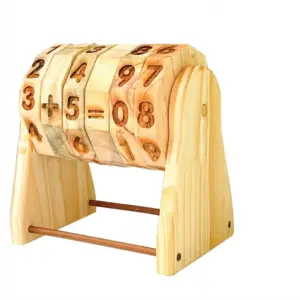


For the full range of toys supporting this development arc, visit our wooden Montessori math toys collection.
Area 5 — Fractions and Geometry (5–6 Years)
Fractions are introduced in Montessori long before they appear in conventional curricula — and always concretely. Fraction circles (physical pieces representing halves, thirds, quarters, and so on) allow children to see and feel part-whole relationships before they encounter fraction notation. A child who has held a quarter-piece and placed four of them together to make a whole has a physical understanding of “one quarter” that the numeral ¼ alone cannot give.
Geometric concepts — shape, angle, symmetry, perimeter, area — follow the same concrete-first pattern. Children trace geometric shapes, sort them, build them, and explore their properties with their hands long before they are defined in formal terms. Geometry and fractions round out the full Montessori math arc — and connect naturally to the other Montessori skill areas that develop in parallel during the same 5–6 year window: spatial reasoning through sensory work, measurement through practical life, and logical sequencing through cognitive development.
Key concepts: equal and unequal parts, halves/thirds/fourths, fraction notation as a description of physical division, basic geometric shapes and their properties, symmetry.
Montessori Math vs. Conventional Pre-K Math: Key Differences
| Montessori approach | Conventional approach | |
|---|---|---|
| Starting point | Quantity and comparison | Numeral recognition |
| Sequence | Concrete → pictorial → abstract | Abstract introduced early |
| Operations | Derived from quantity understanding | Memorized as procedures |
| Place value | Held physically before written | Introduced as written notation |
| Error correction | Built into materials | Adult correction |
| Pace | Child-determined | Group-paced |
Common Mistakes in Early Math Development
- Introducing numerals before quantity understanding. A child who recognizes the shape “3” without understanding that three is a consistent, specific amount has learned a visual symbol with no mathematical content behind it.
- Rushing to written arithmetic. Written equations are abstract representations of operations children should first experience with objects. Build the physical understanding first; the notation follows naturally.
- Prioritizing counting sequence over number sense. Counting to 20 fluently is far less mathematically valuable than genuinely understanding the quantity “seven” — what it looks like, how it compares to six and eight, how it can be decomposed into parts.
- Stopping at number recognition. Recognizing numerals 1–10 is the beginning of math literacy, not the goal. Composition, decomposition, place value, and pattern recognition are all more foundational for arithmetic ability than numeral recognition alone.
- Treating math as a separate subject. Mathematical thinking is embedded in daily life: setting the table (one plate per person = one-to-one correspondence), dividing snacks equally, measuring with simple tools. Children who encounter mathematical ideas in natural contexts develop more durable understanding than those who encounter them only in designated practice.
Red Flags and When to Seek Support
- By ~36 months: Not sorting objects by any single attribute. No awareness of obvious quantity differences between very different amounts.
- By ~48 months: Not counting 1–5 objects reliably with one-to-one correspondence. Not understanding “more” and “less” with small quantities.
- By ~5 years: Significant difficulty with one-to-one correspondence after sustained practice. Unable to recognize any written numerals. No interest in or spontaneous engagement with quantity comparisons in play.
A pattern across multiple areas, or significant difficulty with foundational concepts despite consistent exposure, is worth discussing with your child’s teacher or pediatrician.
FAQ
- What are Montessori math skills?
The ability to perceive, reason about, and operate on quantities — developed through five sequential areas: sensorial preparation, number concept 1–10, decimal system and place value, arithmetic operations, and fractions and geometry. Each area is built concretely before being represented abstractly.
- What age do Montessori math skills start?
Sensorial math preparation begins from birth through sorting, comparing, and ordering activities. Formal number work (numeral-quantity connection) typically begins around 3 years. The decimal system and operations develop between 4 and 6 years. The starting point is always the child’s readiness, not their chronological age.
- What is the difference between number sense and counting?
Counting is producing number words in sequence. Number sense is understanding what those words represent — that “five” means a specific, consistent quantity that can be compared, split, and combined. A child can count to 20 without meaningful number sense. Montessori math builds number sense first.
- What are the best Montessori math materials for home?
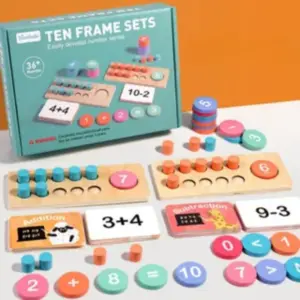
For 2–3 years: counting objects, graduated stacking sets, simple sorting trays. For 3–4 years: ten frames, numeral-quantity matching cards, sandpaper numerals. For 4–5 years: abacus, bead bars, simple equation work with objects. For 5–6 years: fraction circles, arithmetic materials, skip counting chains.
- Why does Montessori introduce fractions so early?
Because fractions introduced concretely — as physical pieces that combine to make a whole — are not difficult. They become difficult when introduced abstractly as notation (¼, ½) without physical reference. A 5-year-old who has held fraction circles for a year understands part-whole relationships intuitively; the notation is just a label for what they already know.
- How does Montessori math connect to school readiness?
Children who enter formal schooling with strong number sense — genuine understanding of quantity, not just numeral recognition — develop arithmetic fluency faster and more reliably. The Montessori concrete-first sequence builds exactly the foundation that formal math education presupposes but rarely teaches.
- Do wooden math toys make a difference compared to worksheets?
For the 2–6 age range, significantly. Mathematical concepts at this stage are three-dimensional before they are symbolic. Physical materials allow children to hold concepts in their hands until their minds are ready to hold them without support. Worksheets require abstract reasoning that most children in this range haven’t yet developed.