
A 3-year-old grabs a toy from their friend. The friend cries. The 3-year-old looks genuinely puzzled — not defiant, not cruel. Puzzled. They don’t yet fully understand that their action caused that feeling in another person.
That moment is not a behavioral problem. It is the normal developmental state of a child who hasn’t yet developed theory of mind — the understanding that other people have inner experiences different from their own. Developing that understanding, and everything that comes with it, is what social and emotional learning is actually about.
What Are Montessori Social & Emotional Skills?
Five interconnected capacities, developed in sequence:
- Emotional awareness — recognizing and naming emotions in oneself and others. Knowing what anger feels like in the body. Understanding that emotions have names, and that naming them gives you some control over them.
- Emotional regulation — managing the intensity and duration of emotional responses. Not suppression — the ability to feel anger without being controlled by it.
- Empathy and perspective-taking — understanding that other people have feelings and viewpoints that may differ from your own. The social application of theory of mind.
- Social competence — taking turns, sharing, resolving conflicts, reading social cues, maintaining friendships.
- Self-concept and confidence — a stable sense of one’s own capabilities, formed through genuine independent achievement rather than external praise.
The Science: What’s Actually Developing
- Emotional regulation develops before self-regulation. Young children cannot self-regulate — they co-regulate, borrowing a calm adult’s nervous system to manage their own arousal. This is why the adult’s response to a tantrum matters more than the child’s behavior during it.
- Theory of mind arrives, it doesn’t develop gradually. The understanding that other people have beliefs and feelings different from your own typically emerges between ages 3 and 5, most commonly around age 4. Before it arrives, children cannot genuinely take another person’s perspective. After it arrives, the full range of social competence becomes accessible.
- Naming an emotion changes the experience of it. One of the most robust findings in affective neuroscience: labeling an emotional state — ‘I am angry’ — reduces its physiological intensity. The prefrontal cortex becomes more active; the amygdala becomes less so. This is why emotional vocabulary is not a soft skill — it is a direct neurological regulation tool. This is the deepest connection between language development and emotional regulation: language is not just how children communicate emotions, it is how they manage them.
- Empathy and perspective-taking are cognitive processes. To understand that another person feels sad right now requires attributing an internal state to that person, reasoning about its cause, and differentiating it from your own current state. This is demanding abstract reasoning — which is why genuine empathy only emerges once the cognitive prerequisites are in place, typically not before age 3.
- The environment shapes development. A predictable, ordered environment with consistent routines reduces the cognitive and emotional load children carry — freeing capacity for social engagement. Chaos is not just uncomfortable; it actively constrains social-emotional development.
What Makes Montessori SEL Different
Conventional SEL typically uses circle time lessons, reward systems, and adult-directed scripts. The Montessori philosophy uses none of these as primary tools.
- Modeling over instruction. Adults demonstrate the behaviors they want to develop — not by explaining them, but by embodying them consistently. A calm, respectful adult response to conflict teaches more than any lesson plan.
- Freedom with natural consequences. If a child grabs a toy, the natural consequence is that the other child is upset and doesn’t want to play. No adult mediation required — the social reality is the feedback.
- Emotional vocabulary as curriculum. Naming emotions is treated as a specific teachable skill, not a byproduct of growing up. Emotion vocabulary materials and facial expression activities are part of the formal curriculum for 3–6 year olds.
Core Montessori Mechanisms That Build SEL
1. The Prepared Environment as Emotional Regulator
A predictable environment — consistent placement of materials, clear daily rhythm, child-height access — reduces ambient anxiety. A child who always knows where things are and what comes next carries less emotional load, freeing capacity for social engagement and risk-taking.
2. Freedom Within Limits and Natural Consequences
Children choose their own work within defined parameters. If a child is unkind to a peer, the peer doesn’t want to work with them. Adults don’t engineer these outcomes — the social reality produces them. Children who experience genuine consequences develop real social understanding; children whose consequences are always adult-mediated develop compliance, not comprehension.
3. Mixed-Age Groupings
The three-year age span in Montessori classrooms is one of the most effective SEL mechanisms in the model. Younger children observe older ones navigating conflict, disappointment, and collaboration before they’re called to perform it themselves. Older children develop patience and leadership by working alongside younger ones. An older child who teaches a younger one to use the Peace Rose is simultaneously consolidating their own understanding of conflict resolution.
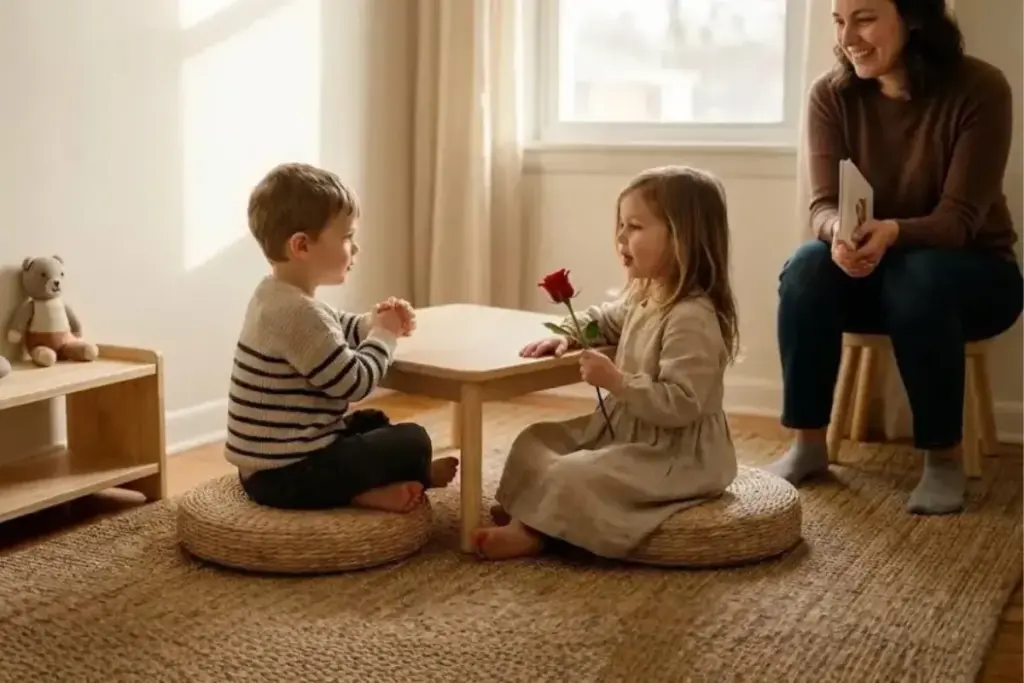
4. The Peace Rose
When conflict arises, either child retrieves the Peace Rose. The child holding it speaks — what happened, how they feel — while the other listens without interrupting. Then they exchange. The physical object makes an abstract social rule concrete and holdable. Children as young as 3 use it with adult scaffolding; by 4–5, many initiate it independently. What it teaches isn’t just technique — it teaches that both perspectives are worth hearing and that repair between people is possible.
5. Grace and Courtesy Lessons
Grace and Courtesy is one of the four areas of Montessori practical life. Brief, specific demonstrations of social behavior: how to greet someone, how to interrupt politely, how to offer or decline gracefully. Presented as practical skills, not moral obligations. Children who learn social behaviors as useful tools are more likely to use them than children who learn them as compliance requirements.
6. The Uninterrupted Work Cycle
The three-hour work cycle is a social-emotional structure as much as an academic one. A child who enters deep concentration, completes work to their own satisfaction, and experiences genuine competence develops the intrinsic confidence that healthy social relationships require. A child who feels capable does not need to dominate others to feel powerful.
Social & Emotional Skills by Age
18 Months – 2 Years: Emotion Recognition and Co-Regulation
- What’s happening: Toddlers experience emotions intensely but have almost no capacity to regulate them. Language is just beginning — most emotional expression is behavioral. The developmental work is emotion recognition: identifying distinct emotional states in faces and voices.
- Key milestones: Showing basic empathy responses (patting someone who is crying), recognizing a few facial expressions, beginning to use one or two emotion words.
- What supports development: Consistent adult co-regulation. Simple emotion vocabulary in context. Picture books with clear facial expressions. Face-matching activities.
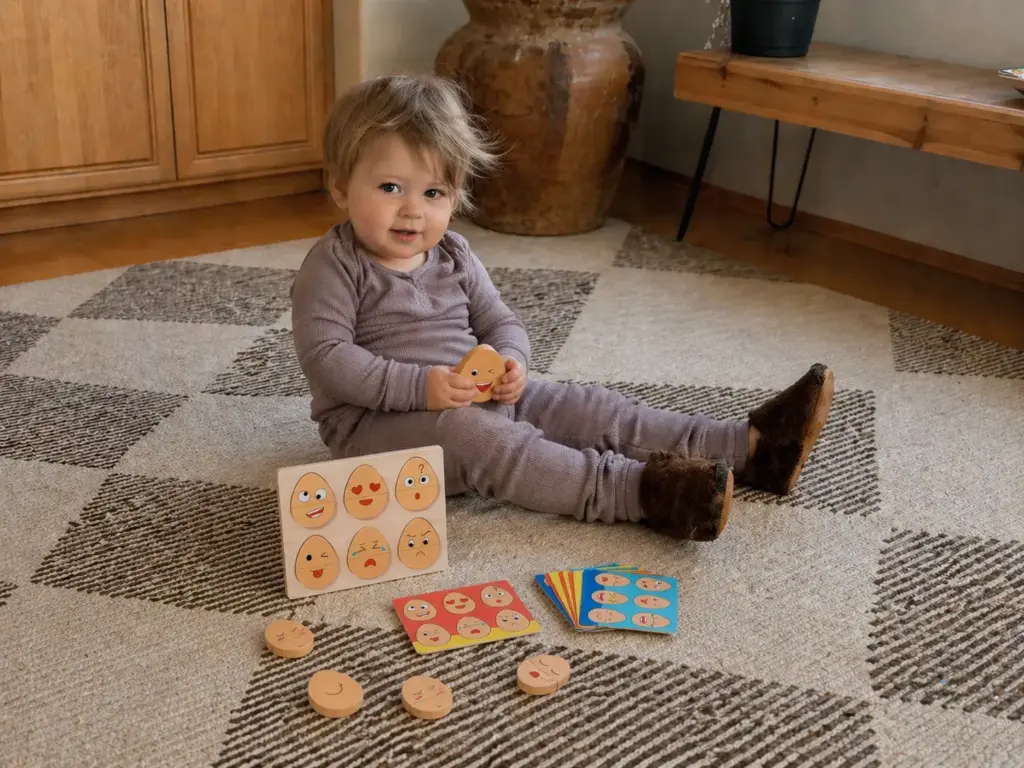
Facial Expressions Eggs
- Red flags: No empathy responses whatsoever. No recognition of any basic facial expressions.
2–3 Years: Emotion Vocabulary and Self-Awareness
- What’s happening: Language is expanding rapidly, and with it, the capacity for emotional self-awareness. Children begin labeling their own emotional states. Parallel play is primary, with brief cooperative moments emerging toward age 3.
- Key milestones: Using 4–6 emotion words accurately, reporting their own emotional state when asked, showing increasing empathy responses, beginning to recognize that their behavior affects others.
Children who have richer emotional vocabularies show measurably better regulation and fewer behavioral incidents — not because they are more verbally intelligent, but because words give them tools to process emotion internally before it becomes action externally.
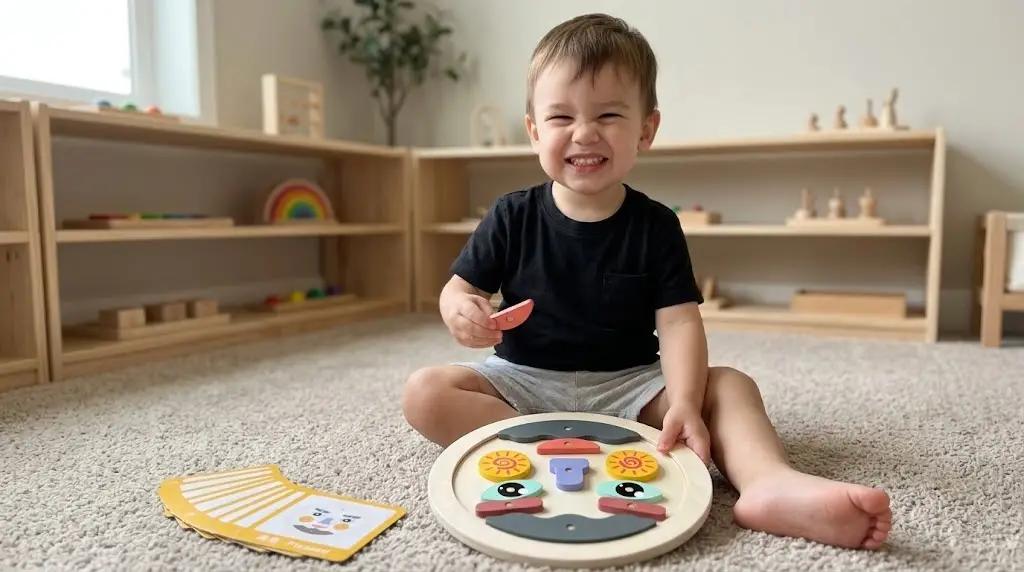
Emotion Matching Face Puzzle
Pairs emotion labels with facial expressions in a self-correcting matching format. The pieces only fit when the word and expression correspond — building vocabulary and face-reading simultaneously. Appropriate from around 2 years.
- Red flags: No emotion words at all by 2.5 years.
3–4 Years: Theory of Mind and Perspective-Taking
- What’s happening: Theory of mind emerges. With it comes genuine empathy, basic perspective-taking, and the beginning of self-regulation. This is the most significant developmental window in social-emotional development — and the period when well-designed materials make the most impact, because the cognitive infrastructure is now in place.
- Key milestones: Understanding that someone can believe something wrong, showing genuine concern for others’ emotional states, beginning to modify behavior based on others’ reactions, using emotion vocabulary spontaneously.
Children in the 3–6 year window are in peak growth for social-emotional skills. What children encounter, practice, and observe during this period has outsized influence on the social competence they bring to formal schooling — what Maria Montessori identified as a sensitive period for social development.
The wheel format organizes emotions across dimensions — basic to complex, positive to negative — giving children a structured framework for exploring the full range of human emotional experience. More sophisticated than simple face-matching: it invites children to think about relationships between emotions, which is genuine perspective-taking practice.
- Red flags: No evidence of theory of mind by age 4.5. Persistent physical aggression as the only conflict response.
4–6 Years: Emotional Complexity and Social Navigation
- What’s happening: Children begin understanding that a person can feel two emotions at once. Conflicts begin to be resolved verbally in some situations. Friendships become intentional — children seek specific peers and maintain relationships over time.
- Key milestones: Understanding mixed emotions, negotiating rather than physical conflict with increasing frequency, demonstrating genuine self-regulation in some situations, maintaining preferred friendships.
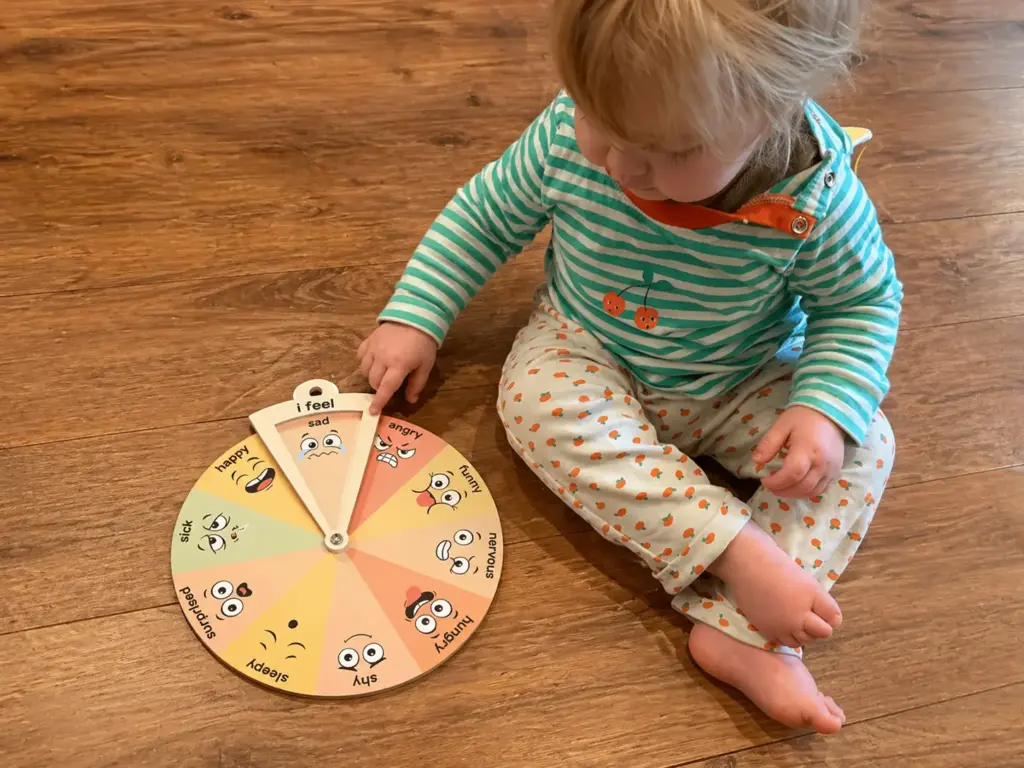
Emotion Wheel for Kids
Covers a broader range of emotional states than basic face-matching — including complex emotions (proud, embarrassed, jealous, disappointed) that 4–6 year olds are beginning to experience and need vocabulary for. Can be used for self-identification, discussion, and group sharing.
For the full range of materials supporting emotional development, visit our wooden social-emotional toy collection.
Emotional Regulation: The Core Skill
- What it is: The ability to experience an emotion and choose how to respond — not the ability to suppress it. A regulated child still feels anger; they simply have more options when they feel it.
- The co-regulation bridge. Self-regulation is not neurologically possible before around age 4. Before then, children regulate by borrowing a calm adult’s nervous system. Every calm adult response to dysregulation teaches regulation. Every escalated response models dysregulation
By age:
- 2–3 years: Remove from stimulus, offer physical comfort, name the emotion. “You are so angry right now.” Wait.
- 3–4 years: Name emotion and cause. Offer a choice within a limit. Give something physical to do.
- 4–6 years: Reflect after the event. “What could you do next time you feel that angry?” Build a repertoire children generate themselves.
Practical Strategies at Home
- Name emotions in real time, without judgment. “You look frustrated.” “I can see you’re really excited.” No evaluation, no instruction — just accurate reflection.
- Model your own regulation visibly. “I’m feeling frustrated right now. I’m going to take a breath before I respond.” Children learn regulation by watching regulated adults.
- Acknowledge feeling before addressing behavior. The sequence matters. Problem-solving while a child is still dysregulated is functionally ineffective — the reasoning brain is not accessible until the emotional brain settles.
- Allow natural social consequences. If a child grabs a toy, let the other child’s response be the feedback. Children who navigate social consequences with minimal adult intervention develop more genuine social competence.
- Read books with emotional content regularly. Picture books allow children to explore difficult emotions at a safe distance, discuss perspectives without personal stakes, and build vocabulary in a narrative context.
The broader Montessori skill framework places social-emotional development alongside cognitive, language, sensory, fine motor, and practical life as interconnected tracks — not a standalone subject.
Common Mistakes
- Treating dysregulation as defiance. A dysregulated child is not choosing to misbehave — they are neurologically overwhelmed. Punishment during dysregulation increases arousal and makes regulation harder.
- Bypassing co-regulation. “Calm down” is instruction without support. Co-regulation means being physically present and calm while the child regulates — it is active, demanding work for the adult.
- Forcing apologies. A forced apology teaches a child to perform remorse. Genuine remorse emerges when a child has been supported to understand the impact of their action — a process that cannot be scripted.
- Praising emotional suppression. “You were so good — you didn’t cry at all” reinforces suppression as the correct response to difficult emotion. All emotions are acceptable; behavior is what has limits.
Red Flags and When to Seek Support
- By ~2 years: No empathy responses. No recognition of any basic facial expressions.
- By ~3 years: No emotion words. Consistently extreme dysregulation with no recovery regardless of adult support.
- By ~4 years: No evidence of theory of mind. Persistent physical aggression as the only conflict response.
- By ~5 years: No genuine peer interactions. Extreme emotional volatility with no self-regulation emerging in any context.
A pattern across multiple areas, persistent over several months, is worth discussing with your pediatrician. Ask specifically about a developmental pediatrician or child psychologist evaluation. Early support is significantly more effective than later intervention.
FAQ
- When does emotional regulation develop?
True self-regulation is not reliably available until around age 4, and continues developing through adolescence. Before then, co-regulation — borrowing a calm adult’s nervous system — is how children manage emotional states.
- What is theory of mind and why does it matter?
The understanding that other people have beliefs, desires, and knowledge that differ from your own. It typically emerges around age 4. Before it develops, children cannot genuinely take another person’s perspective. After it develops, the full range of social competence becomes accessible.
- How do emotion toys actually help?
They serve a specific function: externalizing internal states, building emotional vocabulary, and developing face-reading accuracy. They are not a substitute for adult modeling and co-regulation, which are the primary drivers of development. Used well, they accelerate vocabulary development and give children a concrete reference point for abstract concepts.
- How does Montessori approach conflict between children?
By allowing natural social consequences where possible and mediating minimally when necessary. The goal is not conflict prevention but conflict navigation — children developing the capacity to recognize, address, and repair social ruptures themselves. An adult who resolves every conflict is inadvertently preventing that development.
- Why does emotional vocabulary matter so much?
Because naming an emotion reduces its physiological intensity — a neurological mechanism, not a metaphor. Children with richer emotional vocabularies regulate more effectively, have fewer behavioral incidents, and resolve conflicts more successfully. Building emotional language is one of the highest-impact investments in social-emotional development.