
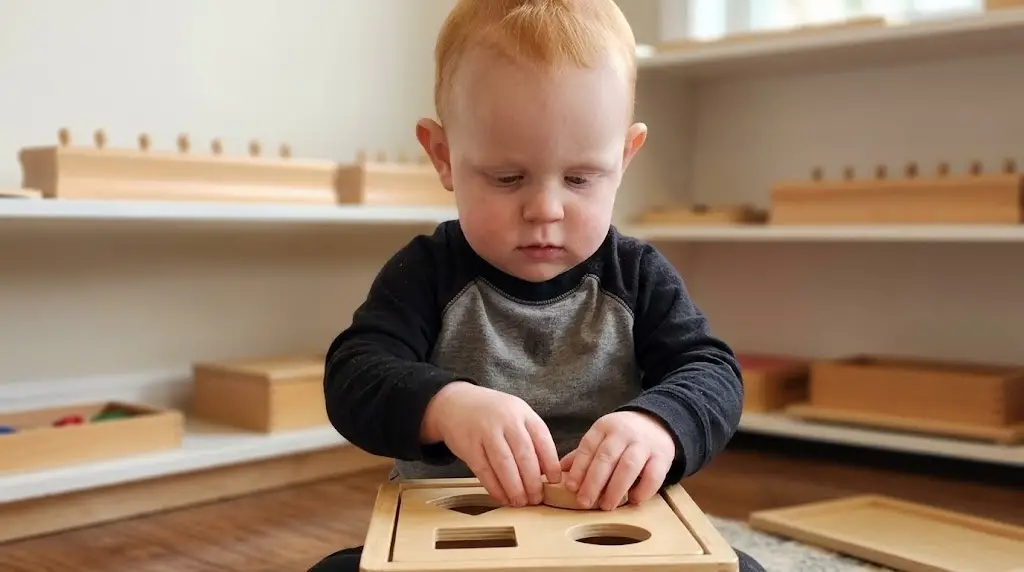
You’re at a parent information night at a Montessori school. The guide uses words like “prepared environment,” “normalization,” and “the absorbent mind.” Everyone around you is nodding. You nod too — but honestly, you leave with the same vague sense of “child-led, wooden toys, no grades” that you arrived with.
If that sounds familiar, you’re not alone. Most parents drawn to Montessori are responding to something real — a feeling that conventional education misses something important about how children actually develop. But the philosophy that explains WHY Montessori works is almost never communicated clearly.
This guide covers the actual philosophy behind the Montessori method: the theory of development Montessori derived from scientific observation, the principles that flow from it, the 2025 research that validates it, and what it means in practice for families with children ages 0–6
📖 What Is the Montessori Philosophy?
The Montessori philosophy is a scientific theory of human development that holds that children actively construct themselves through interaction with their environment — rather than being shaped by adult instruction. Developed by Dr. Maria Montessori from direct clinical observation of children (beginning 1907), it proposes that children pass through predictable developmental windows, that a carefully prepared environment is the primary teacher, and that the adult’s role is to observe and support — not to direct. The result is a child who learns through intrinsic motivation, self-correction, and genuine choice within clear limits.
Maria Montessori: The Scientist Who Changed How We Understand Children
Maria Montessori (1870–1952) was Italy’s first female physician. What makes her work unusual is not just what she believed about children — it’s how she arrived at those beliefs.
Why It Matters That She Was a Doctor, Not a Teacher
Montessori trained in psychiatry and pediatrics. She began by observing children with developmental disabilities in Rome — children written off as unteachable — and noticed that when given appropriate materials and real work, they learned. Her question: what if the environment was the problem, not the child?
In 1907, she opened the first Casa dei Bambini — Children’s House — in a working-class housing project in Rome. Not a wealthy private school: a public experiment with children expected to fail. She gave them a prepared environment, freedom within structure, and real materials. They taught themselves to read, write, and calculate. They did so joyfully. They did so with sustained concentration that surprised even Montessori herself.
What followed was not ideology. It was iteration: observe, form hypothesis, test, revise. She changed her method when evidence required it. This is what separates Montessori from educational philosophy in the conventional sense — it was developed as science, not doctrine. The Stanford Encyclopedia of Philosophy (2025) recognizes her work as spanning pedagogy, developmental theory, ethics, and political theory: not just an educator, but a philosopher whose thinking has proven more durable than almost any contemporary.
What She Saw That Others Missed
Early 20th-century education was built around the teacher: children sat in rows, received information passively, were corrected when wrong and rewarded when right. No consideration of developmental stage. No recognition that children had an internal developmental drive.
Montessori observed something different: children who chose difficult tasks over easy ones; who repeated activities not because they were told to but because something in them needed to; who helped each other voluntarily; who preferred real activities to fantasy play; who, when genuinely concentrating, became calm, ordered, and deeply satisfied. These were not observations about gifted children. These were observations about what all children do when given appropriate conditions.
Her foundational insight: conventional schools were designed for the teacher’s convenience. Montessori designed the environment around what children actually needed at each developmental stage.
The Foundation of Montessori Philosophy: How Children Actually Develop
Before the principles, before the materials, before the classroom design — there is a theory of how human beings develop. Understanding this theory is what separates parents who understand Montessori from those who have Montessori aesthetics.
The Child as Self-Constructor
The foundational Montessori claim is deceptively simple: children are not empty vessels to be filled with knowledge. They actively construct the adults they will become through their own activity and experience. This single idea overturns conventional teaching completely.
Montessori described an innate developmental drive — the “horme” — that pushes children toward self-development. It’s observable everywhere: the infant’s relentless drive to walk despite falling; the toddler’s insistence on doing it themselves; the 4-year-old who repeats an activity 20 times; the 5-year-old who is genuinely furious when help is forced on them. These are not personality quirks. They are the child’s developmental intelligence expressing itself.
If you’ve ever tried to help a child complete a task they were managing on their own — and watched them fall apart — you’ve witnessed the horme being interrupted. The help was the problem, not the solution.
The Absorbent Mind (Birth to 6 Years)
Montessori’s most widely cited concept: from birth to approximately age 6, children possess a qualitatively different form of intelligence she called the “absorbent mind.” During this period, children take in everything from their environment — language, movement, culture, social norms, emotional patterns — unconsciously, without effort, and without the ability to filter.
- Phase 1 (birth–3 years): Entirely unconscious absorption. The child is not learning in the sense adults mean — they are being shaped by what surrounds them. Language heard, emotions observed, routines experienced, relationships modeled: all of this is being permanently absorbed without the child having any choice about it.
- Phase 2 (3–6 years): The conscious absorbent mind begins. The child continues to absorb but now does so with increasing intentionality — categorizing, refining, making conscious what was unconscious.
The parenting implication is significant: in the first three years, you are not teaching your child. You are being the environment they absorb. What they hear, see, touch, feel, and observe in the adults around them is being written into the permanent architecture of who they are. Modern neuroscience calls this experience-dependent neural plasticity — the brain’s maximum sensitivity window for building fundamental neural architecture. Montessori described it 100 years before the neuroscience arrived.
The 4 Planes of Development
Montessori identified four broad developmental stages, each with its own characteristics and appropriate environment. For families with children 0–6, the First Plane is the primary focus — but understanding the full arc explains why Montessori education is designed the way it is.
| Plane | Age | Driving Question | Primary Need |
| First Plane | 0–6 years | “What is the world?” | Sensory exploration, order, language, movement |
| Second Plane | 6–12 years | “How does the world work?” | Reason, imagination, moral development |
| Third Plane | 12–18 years | “Who am I?” | Identity, dignity, real-world contribution |
| Fourth Plane | 18–24 years | “What is my place?” | Independence, vocation, social responsibility |
The First Plane child is an explorer of physical reality. Their primary work is sensory, motor, and linguistic — they are building the embodied foundation upon which all later abstract thinking will rest. Everything else in Montessori philosophy for early childhood flows from this.
Sensitive Periods
Montessori’s second most important developmental concept: children pass through windows of heightened receptivity for specific skills. During a sensitive period, a particular type of learning is effortless, natural, and deeply satisfying. After the window closes, the same learning is still possible — but it requires significantly more effort.
| Sensitive Period | Approximate Age Range | What It Looks Like |
| Language | Birth–6 years | Absorbs vocabulary, grammar, accent without instruction |
| Order | 1–3 years | Distress when routines change; insistence on sequences |
| Movement | Birth–4.5 years | Compulsive drive to walk, run, climb, carry |
| Small Objects / Fine Motor | ~18 months–3 years | Fascination with tiny things; precise manipulation |
| Sensory Refinement | Birth–4.5 years | Intense interest in textures, sounds, tastes, smells |
| Social Behavior | 2.5–6 years | Learning manners, collaboration, social norms naturally |
Knowing the windows exist is the first step. Knowing how to recognize which sensitive period is active in your child right now — and matching it to specific materials — is what makes the philosophy practical.
A sensitive period looks like obsession from the outside: the toddler who must put every object through every hole; the 2-year-old who screams if their routine is interrupted; the 3-year-old who wants to pour their own water at every meal for six months. These are not phases to manage. They are windows to use.
Lillard, Jiang, and Tong (Frontiers in Developmental Psychology, 2025) found that children who experienced authentic Montessori education during their sensitive periods showed lasting wellbeing benefits extending into adulthood — confirming Montessori’s observation that these windows have permanent developmental consequences.
The 5 Core Principles of Montessori Philosophy
Every principle below is a direct logical consequence of the developmental theory above. They are not arbitrary rules — each one exists because of what we know about how children construct themselves. Understanding the WHY makes it possible to apply them intelligently, not just imitate them. Each principle below is summarized within this guide — and how each one translates into specific daily family practices goes deeper into the behavioral shifts parents actually make, from language to shelf setup to when to step back.
Principle 1: The Prepared Environment
The Montessori classroom — and Montessori home — is not just a room with wooden toys on a shelf. It is a carefully designed environment where the physical space, the social atmosphere, and the available materials are all calibrated to what children at this specific developmental stage actually need.
The three dimensions: physical (child-sized furniture, accessible shelving, natural light, beauty, and order — everything has a place); social (a mixed-age community where respectful interaction is modeled, not lectured); and intellectual (materials matched to current sensitive periods, graduated in challenge, available for self-directed use).
At home, this doesn’t require expensive renovation. It means: one low shelf with 5–7 activities accessible at your child’s height; a step stool at the sink so they can wash their own hands; real child-sized tools in the kitchen. The principle is intentional design for the child, not the adult. The environment is the teacher — which means the quality of what your child is surrounded by shapes the quality of what they develop.
“The prepared environment” is not Pinterest perfection. It’s asking one question: can my child access what they need independently? If the answer is mostly no — there is room to prepare.
Principle 2: Freedom Within Limits
“Montessori has no rules” is the most persistent misconception — and it misreads freedom within limits as freedom without limits.. Montessori has very clear limits: children cannot disturb others’ work, cannot damage materials, cannot be physically unsafe. Within those limits, they have genuine freedom — to choose which activity to work on, at what pace, for how long, in which order.
| In my work with families of 1- and 2-year-olds, the most common misconception I encounter is that Montessori freedom means the child decides everything. One family I trained had a 2-year-old whose parents followed her lead on everything — including bedtime, meals, and whether they left the playground. Three months of chaos later, we finally clarified what Montessori actually means by freedom: the freedom to choose which activity to work on, in which order, for how long. Not freedom from structure, not freedom from limits. The child chooses the work; the adult maintains the environment. Those are not the same thing. When that distinction clicked, everything changed — for her concentration, for her behavior, and for the parents’ own stress levels. — Zoe Paul, AMI Teacher Trainer (0-3) |
The neurological reason this matters: children who make genuine choices develop executive function — planning, decision-making, impulse control — through the act of choosing itself. You cannot develop self-direction if every choice is made for you. The executive function outcomes that Montessori research consistently reports are not a curriculum outcome. They are the direct result of children having practiced real decision-making for years.
Principle 3: The Adult as Guide, Not Teacher
The Montessori adult’s role is: observe carefully, prepare the environment, offer materials at the right developmental moment, then step back. Not direct. Not correct constantly. Not praise every minor thing.
Montessori wrote extensively that the adult must undergo an inner transformation — moving from the conviction that the child needs to be shaped by adult will, to the understanding that the child needs conditions that support self-development. This is, in practice, the hardest part of Montessori. The instinct to help, correct, and approve is deeply wired in most adults.
On praise specifically: Montessori’s position is that both external reward and external punishment undermine intrinsic motivation. A child who works to hear “good job” is developing a dependence on external validation. A child who works because the work itself is satisfying is developing something more durable and more useful. The goal is a child who does things because they are worth doing.
The PNAS 2025 (Lillard et al.) research confirms this mechanism: authentic Montessori environments produce significantly better executive function, reading, and social understanding outcomes.
Principle 4: Auto-Education
Children have an innate capacity to teach themselves — given appropriate materials, appropriate freedom, and a prepared environment. This is not a hopeful belief. It is Montessori’s foundational empirical observation, confirmed by the children of Casa dei Bambini and replicated across 100+ years and dozens of research contexts.
The mechanism is the control of error: every authentic Montessori material is designed so the child can tell from the material itself whether they have done it correctly, without adult input. The puzzle piece that only fits its matching letter. The stacking tower that falls when built in the wrong sequence. The pouring set where a spill tells the child exactly what to adjust.
A child who discovers and corrects their own error develops metacognition, problem-solving, and genuine persistence. A child who is told by an adult that they’re wrong develops dependence on external validation. These are not the same developmental outcomes, and the difference accumulates dramatically over years.
Principle 5: Respect for the Child
This is the principle from which all others flow, and the most radical. Montessori demands that children be treated as full human beings deserving of genuine respect — their pace, their interests, their dignity, their developmental needs.
In practice: not forcing a hug from a child who doesn’t want to give one; not interrupting deep concentration even for something pleasant; getting physically to the child’s level to speak with them; not talking about the child as if they’re not present; acknowledging that their work is real work, not play. These are not trivial courtesies. They are the behavioral expression of what the philosophy actually believes about children.
Montessori developed her philosophy during two World Wars and believed deeply that education for peace required raising children who had been treated with respect — who knew from experience that their inner lives mattered, that they were capable of directing themselves, and that the world could be navigated with genuine competence. The PNAS 2025 research confirms that children in authentic Montessori environments show significantly better social understanding and emotional development than peers — which is precisely what you would expect from years of being treated as capable, respected human beings.
Key Montessori Concepts Every Parent Should Know
Several terms appear frequently in Montessori contexts but are rarely explained clearly. Understanding these unlocks the ‘why’ behind what Montessori environments actually look like.
Normalization — Not What Most People Think
Normalization is one of the most misunderstood words in Montessori education. It does not mean making children conform or suppressing individuality. It refers to a specific developmental state: the child who has reconnected with their natural developmental drives through appropriate purposeful activity. A normalized child is deeply concentrating, self-directed, calm from within rather than controlled from without — and, notably, more creative and individuated than children who have not had their developmental needs met.
The opposite state — what Montessori called “deviations” — is also familiar to most parents: the child who bounces between activities without settling, the child prone to tantrums and aggression, the child chronically bored. Montessori’s observation was that these are often environmental problems, not character problems. When the environment consistently fails to meet a child’s developmental needs, the behavior follows. When the environment is appropriately prepared, the behavior changes”: “Part of that preparation is understanding how the balance between open-ended and close-ended materials shifts as your child develops — from predominantly close-ended at 12 months to predominantly open-ended by age 5.
| In my years working with preschool and elementary-age children, the word “normalized” used to sound clinical to me — like producing a compliant child. Then I watched a 4-year-old in a classroom spend 35 minutes on a single bead chain without looking up once. Not because anyone told her to. Not because there was a reward. Because she was inside something. When she finished, she set the chain aside carefully, looked around with what I can only describe as deep satisfaction, and chose her next activity. That’s normalization. Not obedience. A child who has found her developmental rhythm. Once you’ve seen it, you recognize the absence of it immediately. — Katy Lenoir — Preschool & Elementary Expert ( 3–12) |
Practical Life: Why Sweeping Is More Educational Than Flashcards
Practical life refers to activities drawn directly from real adult life — pouring, sweeping, folding, washing, preparing food, caring for plants — performed by children with real, child-sized tools. It is not supplementary in Montessori; it is the foundation of the early childhood curriculum.
The developmental dimensions go deeper than they appear. Practical life activities develop fine motor coordination (the precise movements of pouring without spilling; of folding along a line); executive function (activities have a clear beginning, middle, and end — recipe following is sequential thinking made physical); mathematical concepts (measurement, one-to-one correspondence, sequencing); and perhaps most importantly, the experience of genuine competence. A 3-year-old who can set a table, prepare a snack, and clean up a spill independently has a relationship with their own capability that no flashcard program produces.
At home: The most impactful Montessori change most families make is to the kitchen. An accessible snack station the child can manage independently, a step stool at the counter, real child-sized tools. This one change typically produces more concentrated independent activity than any set of toys — because it connects the child to the real adult world they observe and want to be part of. If you want to explore practical life materials for your child’s current stage, Kukoo organizes practical life activities by age and developmental readiness — from first pouring at 12 months through full food preparation at 5.
Sensorial Materials: Education of the Senses
The systematic development of sensory discrimination — the ability to perceive fine differences in dimension, color, texture, weight, sound — is the bridge between the child’s physical experience of the world and their later abstract thinking. Montessori’s position, confirmed by embodied cognition research, is that mathematics emerges from tactile experience with quantity; reading from auditory discrimination of sound; geometry from hands-on experience with shape.
Each sensorial material is designed around the principle of isolation of quality: it varies in exactly one property. The Pink Tower varies only in three-dimensional size, with everything else constant. The Color Tablets vary only in color. This isolation allows the child to perceive and categorize a single quality with precision — building the discriminative intelligence that underlies all academic learning.
The research connection: The PNAS 2025 Lillard et al. study found that children from authentic Montessori programs showed better reading and mathematical outcomes. The sensorial foundation is the mechanism — the brain built to discriminate fine differences in physical experience is the brain that later discriminates fine differences in symbol, sound, and number.
Mixed-Age Classrooms
Montessori classrooms group children in 3-year spans (0–3, 3–6, 6–9, 9–12) rather than single-year cohorts. This is not an administrative convenience — it is a core philosophical and developmental decision.
Younger children are inspired by and learn from older ones without direct instruction. Older children solidify their own learning by helping younger ones — explaining something to a less experienced peer requires a depth of understanding that listening to a teacher never produces. No child is always the youngest or always the oldest. The social curriculum is built directly into the structure of the community.
Randolph et al. (2023) meta-analysis found that Montessori education produces significantly better outcomes in creativity, executive function, and social skills — attributing part of this effect specifically to the mixed-age social environment, which creates forms of peer learning unavailable in same-age classrooms.
The Uninterrupted Work Block
Authentic Montessori classrooms protect a minimum 3-hour uninterrupted work period each morning — no bells, no subject switches, no adult-directed interruptions. This is not aesthetic preference. It is developmental engineering.
Deep learning has phases: the child begins, goes through a period of warm-up, and eventually reaches a state of genuine concentrated engagement — what Csikszentmihalyi later described as “flow.” Reaching the third phase requires time. Twenty-minute subject blocks interrupt the process before it can complete. Over years, this produces a child who is expert at surface-level engagement and unable to sustain deep concentration — because they have never been allowed to practice it.
At home, the equivalent is protecting a block of uninterrupted play. Not redirecting a deeply concentrated child. Not rescuing a child from a challenging activity before they’ve worked through it. The AAP (reaffirmed 2025) confirms that this kind of self-directed, uninterrupted play builds executive function and brain structure most rapidly during the 0–6 window. The concentration window is the developmental moment.
Montessori vs. Traditional Education: What the Research Actually Shows
The differences between Montessori philosophy and traditional educational approaches are not stylistic. They are grounded in fundamentally different theories of how children develop.
The Core Philosophical Difference
| Dimension | Traditional Education | Montessori Philosophy |
| Who directs learning | Teacher (curriculum-driven) | Child (interest + developmental readiness) |
| Purpose of education | Knowledge transmission | Self-construction of the whole person |
| Role of error | To be corrected by teacher | Self-correction through material design |
| Motivation | External (grades, praise) | Internal (intrinsic drive, mastery) |
| Assessment | Standardized testing | Observation, portfolio, development |
| Classroom structure | Same-age, desks, bells | Mixed-age, open workspace, 3-hr work block |
| Materials | Textbooks, worksheets | Self-correcting, hands-on, graduated |
These philosophical differences are abstract until you see how these philosophical differences play out in the specific toys children use every day — who does the work, what feedback the child receives, and how long engagement lasts.
What the 2025 Research Shows
The evidence base for Montessori has reached a new level of rigor with two randomized controlled trials published in 2025.
PNAS 2025 (Lillard et al.): The first national RCT of public Montessori in the US — 588 children, 24 public schools, gold-standard random lottery design. Children in authentic Montessori programs showed significantly better outcomes at end of kindergarten in reading, short-term memory, executive function, and social understanding. Cost $13,127 less per child than traditional programs due to higher child-to-teacher ratios in early years. Important nuance: effects appeared at the end of kindergarten, not PK3 or PK4 — a delayed benefit pattern, consistent with the cumulative nature of developmental foundations.
Scientific Reports 2025 (Le Diagon, Van der Henst & Prado): A 5-year longitudinal RCT in France. Children randomized to Montessori vs. conventional kindergarten, then followed through elementary school. Finding: Montessori early education produced delayed benefits in mathematical problem-solving at ages 8–9 — the gains grew larger over time rather than fading, even after all children had returned to conventional French elementary curriculum. The advantage persisted because the foundations were built differently, not because Montessori instruction continued.
Lillard’s own important caveat: “I see all these schools that claim to have Montessori when what they offer is just a shadow of it.” Both studies show effects are strongest in programs with high fidelity to authentic Montessori principles. “Montessori-inspired” programs with lower fidelity consistently show weaker results.
The Criticisms — Addressed Honestly
“Only for certain types of children”: The PNAS 2025 research found Montessori benefits were particularly strong for children from lower-income families. The perception of Montessori as elite is historical and economic, not developmental.
“Children won’t learn structured skills”: Montessori reading and mathematics are highly structured — the structure is in the materials and the developmental sequence, not in adult direction. Children in authentic programs consistently outperform on academic measures.
“The word ‘Montessori’ is unprotected”: True, and important. Since 1967, anyone in the US can call a school or a toy “Montessori.” The honest assessment of both what the research supports and where genuine concerns remain matters more than advocacy from either side — and the 2025 PNAS data has shifted the conversation significantly.
.This is precisely why understanding the actual philosophy matters more than the label — and why AMI (Association Montessori Internationale) certification remains the most reliable external indicator of authentic implementation.
Montessori Philosophy at Home: How to Apply It Without a Classroom
The Montessori philosophy is not a school curriculum. It is a philosophy of how children develop — and it is fully applicable in any home, with any budget, starting today.
The Most Important Shift: From Director to Observer
The hardest part of implementing Montessori at home is not choosing the right materials. It is changing the adult’s instinct to direct, correct, rescue, and praise constantly.
| I see this pattern constantly with families who come to Montessori through the aesthetic first — the beautiful wooden shelf, the carefully curated toys — and find that nothing changes developmentally. The shelf looks right but the child is still bouncing off walls, still having the same tantrums, still unable to concentrate.The shelf isn’t the intervention. The adult is.One family I worked with had a 4-year-old and what looked like a perfect Montessori environment. But the parents were interrupting his concentration to show him the “right” way to use materials. They praised every minor thing he did. They jumped in the moment something got hard. The shelf was Montessori. The adult behavior wasn’t. The week they stopped doing those three things — stopped interrupting, stopped praising reflexively, stopped rescuing — he started spending 40-minute stretches in deep independent work. Same shelf. Completely different outcome. — Katy Lenoir — Preschool & Elementary Expert ( 3–12) |
Observation is the practical alternative: watch what your child is drawn to repeatedly, what produces deep concentration, what produces frustration or boredom. These observations tell you which sensitive periods are active and what the environment needs. The child is always communicating. Most adults are not yet listening with this specific attention.
The Prepared Home Environment — Practical Starting Points
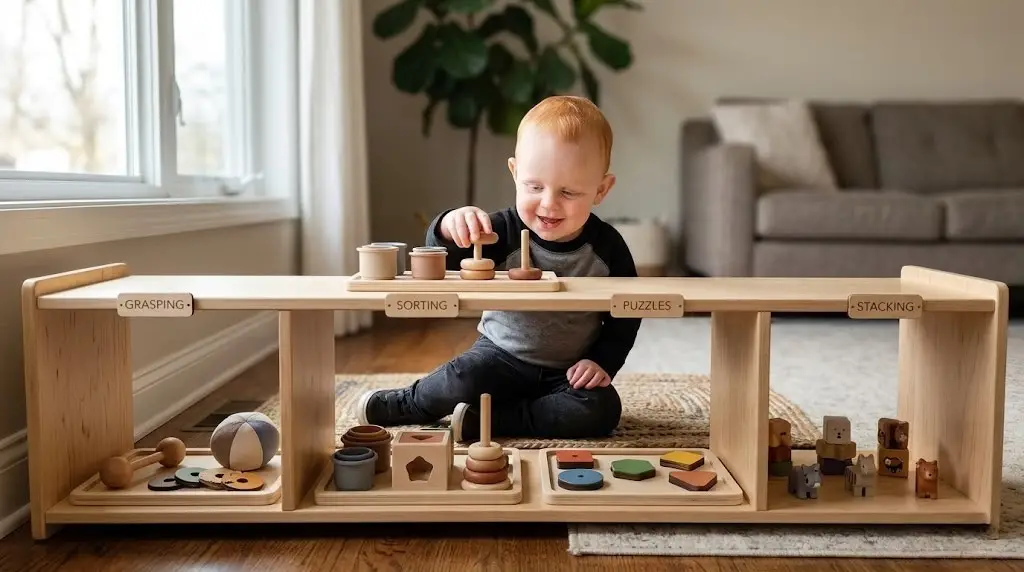
One low shelf in the main living area, 5–7 activities accessible at child height, changed when mastered. That’s the core. Everything else extends from there.
What goes on the shelf: activities matched to current sensitive periods, presented in trays or baskets, complete and ready. 5–7 items maximum — less is reliably more. Research from Dauch et al., 2018, University of Toledo confirms that toddlers with fewer toys played longer, more creatively, and with greater focus than those with 16 options available.
The kitchen as Montessori environment: accessible snack station the child can manage independently; step stool at the counter; real child-sized tools for food preparation. Participation in cooking, setting the table, watering plants. These practical life activities develop more in a 30-minute morning routine than most structured toy-based learning.
On natural materials: Wood has properties that plastic structurally cannot replicate — real weight, natural texture, tactile warmth, the grain visible under a child’s fingers. These properties are not aesthetic preferences. They are sensory data the child’s nervous system uses. Wood has properties that plastic structurally cannot replicate — real weight, natural texture, tactile warmth, the grain visible under a child’s fingers. These material properties serve specific sensory and proprioceptive functions in early development.
The Most Common Montessori Home Mistakes
- Buying materials without understanding the philosophy. A shelf full of wooden toys with an adult who constantly directs, corrects, and praises is not a Montessori environment. The aesthetic is the least important component.
- Interrupting concentration. When a child is deeply concentrated, interrupting them — even for something positive — breaks the work cycle. Learn to recognize deep concentration and protect it. The uninterrupted concentration window is the developmental moment.
- Helping too much. Montessori: “Never help a child with a task at which he feels he can succeed.” Struggle is the developmental mechanism. A child working through difficulty is not suffering — they are building.
- Skipping practical life because it’s messy. The mess is the learning. A child who wipes up their own spill develops more than a child who watches an adult do it.
Choosing Materials That Embody the Philosophy
Understanding Montessori philosophy changes how you evaluate every material in your child’s environment. The question shifts from “does this look Montessori?” to “does this embody the principles?”
Since ‘Montessori’ is legally unprotected, the reliable test is the four design principles that distinguish genuine Montessori materials from label-only marketing — isolation of quality, control of error, purposeful reality, and embodied learning. The reliable test is four principles: Does the material isolate one quality for the child to perceive? Does it have a built-in control of error so the child can self-correct? Is it connected to real-world purposeful activity? Does it require the child to do the actual cognitive and physical work — rather than doing it for them?
Kukoo Montessori’s collections are organized by the developmental stages and sensitive periods this article describes. If you’re ready to translate the philosophy into practice:
- Birth–3 years: Your child absorbs everything from the environment without effort. Materials should have genuine weight, varied textures, and honest cause-and-effect. The capacities emerging shift fast — from early grasping and sensory exploration in the first year to the independence drive accelerating at 12–18 months to the fine motor precision and autonomy peak approaching age 2–3.
- Sensorial (2.5–5 years): Your child is driven to perceive, compare, and classify. Materials that isolate a single sensory quality — size only, color only, texture only — let them discriminate with precision rather than juggling competing variables.
- Practical life (peak 1–3 years): The window most parents underestimate. Real tools, real consequences — pouring that spills, sweeping that cleans. Practical life materials organized by age channel this drive into genuine competence.
- Language (birth–6 years): Precision matters — vocabulary anchored in real objects and exact names, not cartoon abstractions. Materials designed around how vocabulary is acquired through physical handling make naming multisensory rather than passive.
- Fine motor (0–6 years): The full progression from palmar grasp through pincer to dynamic tripod determines which materials serve which stage. Getting the sequence right matters more than the number of activities.
- The 3–6 primary window: The conscious mind is fully active — your child seeks to understand, classify, and name. A balanced shelf crosses all five curriculum areas, and materials for this cognitively active stage should reflect that breadth.
Montessori Philosophy: The Questions Parents Ask Most
Q: What is the Montessori philosophy in simple terms?
The Montessori philosophy holds that children are naturally driven to develop themselves, and that education’s job is to create the right conditions for this — not to transmit information to passive recipients. It is grounded in Dr. Montessori’s direct scientific observation of children from 1907 onward. The core practices that follow: a carefully prepared environment, genuine freedom within clear limits, an adult who observes and guides rather than directs, and materials designed for self-correction. The child teaches themselves; the environment and the adult provide the conditions.
Q: What are the main principles of the Montessori method?
Five core principles, each flowing from the theory of child development: (1) The Prepared Environment — the environment is the primary teacher; (2) Freedom Within Limits — real choice within clear structure develops self-direction and executive function; (3) The Adult as Guide — observe and support, don’t direct or correct constantly; (4) Auto-Education — children have an innate drive and capacity to teach themselves, given appropriate materials; (5) Respect for the Child — children are full human beings whose pace, interests, and dignity deserve genuine respect. These are not independent rules — they form an interconnected system.
Q: What is the difference between Montessori and traditional education?
Traditional education is teacher-directed, curriculum-driven, and uses external rewards and punishments to motivate. Montessori is child-directed, development-and-interest-driven, and relies on intrinsic motivation and self-correction. The foundational philosophical difference: traditional education assumes children need to be shaped by adult will; Montessori assumes children need conditions that support self-construction. The PNAS 2025 RCT (Lillard et al.) found that authentic Montessori produces significantly better reading, executive function, and social understanding at end of kindergarten — at $13,127 less per child.
Q: What is the absorbent mind in Montessori?
The absorbent mind is Montessori’s term for the qualitatively different intelligence children possess from birth to approximately age 6. During this window, children unconsciously absorb everything from their environment — language, movement, culture, emotional patterns, social norms — without effort and without the ability to filter what they take in. Phase 1 (birth–3): entirely unconscious absorption. Phase 2 (3–6): conscious and intentional absorption begins. The practical implication: what surrounds a child in these years is being permanently absorbed. The quality of the environment matters more at this stage than at any other period in development.
Q: What are sensitive periods in Montessori?
Sensitive periods are windows of heightened receptivity for specific types of learning that Montessori observed in all children’s development. During a sensitive period, a child acquires a particular skill — language, order, fine motor precision — with remarkable ease and natural joy. After the window closes, the same skill can still be learned but requires significantly more effort. Key sensitive periods in 0–6: Language (birth–6), Order (1–3), Movement (birth–4.5), Small Objects/Fine Motor (~18 months–3 years), Sensory Refinement (birth–4.5), Social Behavior (2.5–6). Frontiers in Developmental Psychology (Lillard et al., 2025) found that children who experienced their sensitive periods in authentic Montessori environments showed lasting wellbeing benefits into adulthood.
Q: Can Montessori philosophy be used at home?
Fully, yes. Montessori philosophy is not a school curriculum — it is a theory of how children develop, and its core practices apply in any home. The most impactful changes parents report: creating a prepared environment (accessible shelf, child-sized tools, order); following the child’s lead rather than directing play; stepping back when a child is concentrating rather than intervening; involving the child in real household work. None of these require expensive materials. They require understanding the philosophy and making the shift in the adult’s approach.
Q: Does Montessori philosophy work? What does the research show?
The evidence base is now strong. PNAS 2025 (Lillard et al.) — the first national RCT of public Montessori in the US, 588 children, 24 schools — found significantly better outcomes in reading, short-term memory, executive function, and social understanding at end of kindergarten, at lower cost. Scientific Reports 2025 (Le Diagon et al.) found a “sleeper effect” for mathematics: children who had Montessori early education outperformed conventionally educated peers at ages 8–9, after years in standard French elementary school. Randolph et al. (2023) meta-analysis found Montessori more effective across academic, social, and creative outcomes. Critical caveat: effects are strongest in programs with high fidelity to authentic Montessori principles.
The Philosophy That Trusts the Child
You came in with a vague sense of “child-led, wooden toys, no grades.” The philosophy is more than that — and less complicated than it might have seemed on the way in.
Montessori rests on one foundational idea: children are not empty vessels. They are human beings actively constructing themselves. Everything else — the prepared environment, the freedom within limits, the adult who steps back, the three-hour work block, the materials with built-in control of error — is a logical consequence of that one idea.
After more than 100 years, the science is catching up with what Montessori observed in a Rome housing project in 1907. The 2025 research — randomized controlled trials, not correlational studies — shows measurable, lasting benefits in reading, executive function, mathematical problem-solving, and social understanding. These are not soft outcomes. They are the foundations of everything.
And you don’t need a Montessori school to give your child these conditions. You need a prepared environment — accessible, ordered, intentionally designed for the child. You need freedom within clear limits. You need an adult willing to observe before directing. And you need materials that embody the principles, not just the aesthetic.
The materials you choose are the environment your child absorbs. That is not a trivial choice.