
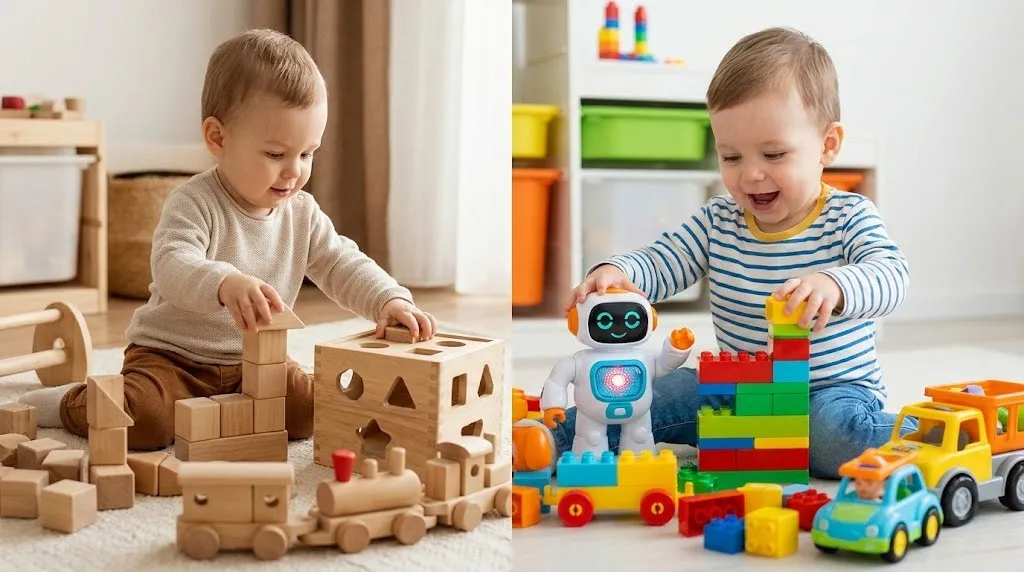
Walk into any toy store and you face an immediate choice: the warm, natural appeal of wood or the vibrant colors of plastic. But which material actually helps your child learn better? This guide compares wooden and plastic as materials — their physical properties, chemistry, durability, and sensory profiles.
Which is better — wooden vs plastic toys?
Both materials can support healthy development. However, wood and plastic deliver fundamentally different sensory inputs — in weight (proprioception), texture (tactile discrimination), temperature response (thermal feedback), sound (acoustic dampening), and chemical composition (safety profile). These material differences affect how a child’s sensory system processes the toy, how their grip strength develops, and what chemical exposures they encounter — independent of how the toy is designed.
| A note on scope: This guide compares materials — the physical and chemical properties of wood vs plastic. Design philosophy (self-correcting vs high-output, isolation of quality, who does the work) is a separate question covered in our comparison of Montessori vs regular toy design. A wooden toy can violate every design principle; a plastic toy can follow them all. |
Material Properties: The Physical Comparison
Before evaluating developmental impact, understand what wood and plastic actually are as materials — their measurable physical properties.
| Property | Solid Wood (Beech/Maple) | Standard Toy Plastic (ABS/PE) |
| Density | 0.6–0.75 g/cm³ | 1.0–1.1 g/cm³ (ABS) / 0.91–0.96 (PE) |
| Weight feel | Heavy relative to size — consistent | Light relative to size — often hollow |
| Thermal conductivity | Low (0.12–0.17 W/mK) — feels warm | Higher (0.17–0.25 W/mK) — feels cooler |
| Surface texture | Variable — grain, knots, natural variation | Uniform — smooth, consistent, molded |
| Acoustic properties | Dampened, resonant, warm tone | Sharper, higher-pitched, less resonant |
| Chemical complexity | Minimal — cellulose + finish only | High — monomers, plasticizers, stabilizers, colorants |
| Biodegradability | Yes — fully biodegradable | No — persists 400–500 years |
| Mouthability safety | Depends on finish quality | Depends on plastic type + additives |
These are physical facts, not design judgments. A toy made from either material can be well-designed or poorly designed. But the material itself delivers different sensory, chemical, and environmental properties regardless of design.
How Material Affects Sensory Processing
Your child’s sensory system doesn’t process “a toy.” It processes weight, texture, temperature, sound, and visual pattern. Wood and plastic deliver different inputs across every sensory channel.
Tactile: Grain vs. Uniformity
Wood grain provides natural surface variation — subtle differences in texture across the same object. Your child’s fingertips encounter ridges, smooth areas, and micro-variations that activate discriminative touch pathways. Plastic surfaces are injection-molded to uniformity — tactile discrimination skills that later support handwriting and object manipulation. This isn’t inherently bad, but it provides less tactile information per touch. For children developing fine tactile discrimination (the same skill that later supports handwriting), material texture variety matters.
Thermal: Warm vs. Cool
Wood’s low thermal conductivity means it absorbs body heat slowly and doesn’t feel cold at first contact. Plastic conducts heat faster, creating an initial cool sensation. This difference is subtle but measurable — and for young children, the warm-neutral feel of wood can reduce sensory startle, particularly for infants during first object exploration.
Acoustic: Dampened vs. Sharp
When a wooden block hits another wooden block, it produces a low-frequency, dampened sound. When plastic hits plastic, the sound is sharper, higher-pitched, and more reverberant. In a playroom with 10 toys being manipulated simultaneously, wood produces a significantly calmer acoustic environment than plastic. For children who are sensitive to auditory input, this difference compounds across hours of play — the acoustic science behind why wooden toys produce calmer environments explains the frequency and dampening differences in detail.
Proprioception: Real Weight vs. Hollow Weight
Solid wood has consistent density — a larger piece genuinely weighs more. Your child’s proprioceptive system (the sense that tells the brain where the body is in space and how much force to apply) calibrates grip force to actual mass. When a small object is unexpectedly heavy (solid wood) vs. unexpectedly light (hollow plastic), the grip calibration challenge is different. Wood’s consistent weight-to-size relationship provides more reliable proprioceptive information — a principle that drives why real weight matters in early childhood toys.
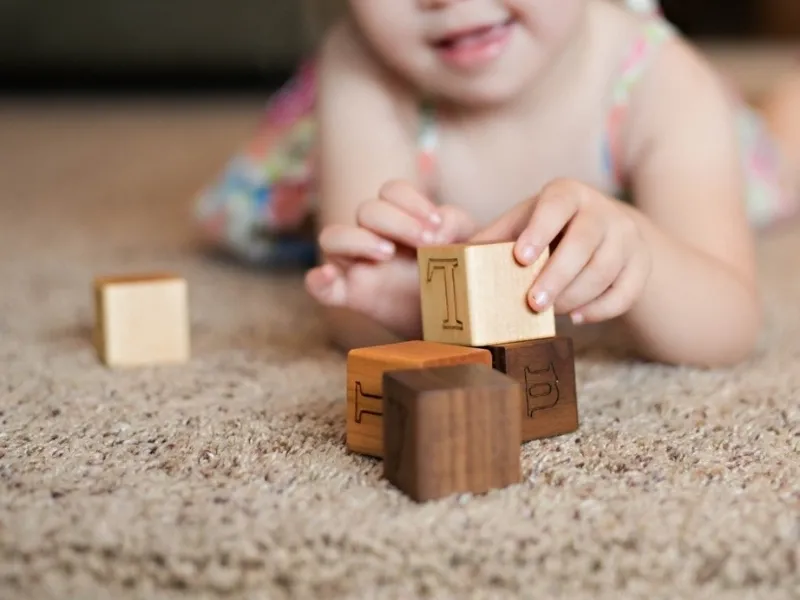
| The sensory difference I notice most consistently across my work with preschool and elementary children is weight. When a 3-year-old picks up a solid hardwood block for the first time after months with lightweight toys, they almost always pause — their hand recalibrates. That moment of grip adjustment is proprioception being activated in a way the lighter material never demanded. It’s subtle, but it compounds: the children I see who handle weighted materials regularly develop noticeably more deliberate, controlled hand movements over time. – Zoe Paul, AMI Teacher Trainer (0 to 3) |
The Chemistry of Toy Safety
This is a material-science question, not a design question. The chemical composition of wood and plastic are fundamentally different — and the safety implications are worth understanding.
Plastic: What’s Inside the Material
Aurisano et al. (2021, Environment International — Technical University of Denmark and University of Michigan) analyzed 419 chemicals used in plastic toy materials and found that 126 can potentially harm children’s health via cancer or non-cancer effects. These include plasticizers (phthalates), flame retardants, UV stabilizers, colorants, and fragrances. Children under 6 explore orally — mouthing is a primary sensory investigation method at this age. The chemical simplicity of solid hardwood is one of several reasons why pediatricians consistently recommend simpler, natural-material toys for the 0–6 age range
Safety standards help: ASTM F963 (US) and EN71 (EU) regulate maximum levels of heavy metals and certain chemical migrants. Toys from reputable manufacturers that meet these standards are substantially safer. But the underlying chemistry of plastic — multiple synthetic compounds in every piece — creates a baseline chemical complexity that solid wood simply doesn’t have.
Wood: What’s on the Surface
Solid wood (beech, maple, birch) is chemically simple: cellulose, hemicellulose, and lignin. The safety question for wood is the finish. Water-based, non-toxic paints and natural finishes (beeswax, linseed oil) are the safest options. Formaldehyde can be a concern in MDF (medium-density fiberboard) and certain plywood products — solid hardwood avoids this entirely. The key distinction: with wood, the safety concern is what’s applied to the surface. With plastic, the concern is what’s in the material itself.
How Material Affects Motor Skill Development
Fine Motor: Weight and Grip
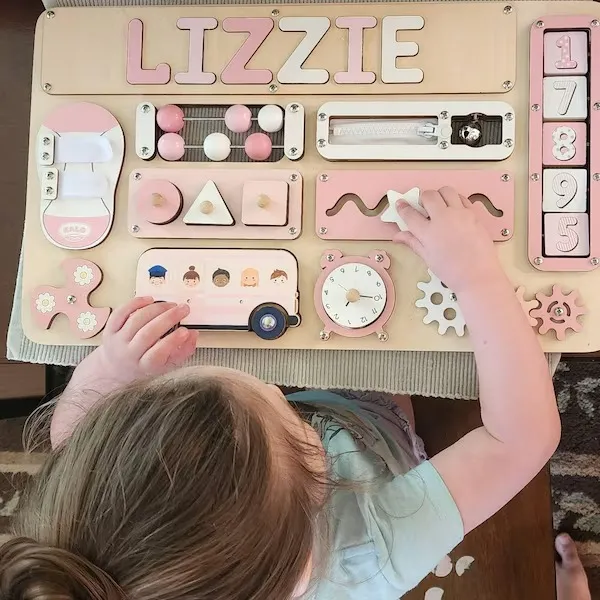
- Wood: The slight heft of solid wood supports grip strength development. When your baby picks up a chunky wooden ring, their hand works harder than with a lightweight plastic version. This resistance — subtle as it is — builds the small muscles in fingers and hands, which is why stacking activities that use real weight for grip development are particularly effective during the pincer grip stage. For children developing the pincer grip (8–12 months) and later the three-jaw chuck and tripod grip, material weight adds a proprioceptive challenge that supports fine motor progression.
- Plastic: Plastic’s lighter weight makes it easier for younger infants to manipulate. A 4-month-old learning to grasp benefits from a toy they can actually lift and hold. From around 6 months, once grip strength develops enough for wood’s weight to be accessible rather than difficult, the 0–12 month wooden toy collection is the right transition point. For very young babies still developing their first grasp, this lower barrier to entry matters. Lightweight plastic is the right material choice for the earliest motor stages.
Gross Motor: Material Is Less Relevant
For larger movements — pushing, riding, climbing, throwing — both materials perform well. Motor development at gross motor scale depends primarily on size and design, not material. A well-built push toy supports walking whether it’s made from beech or durable plastic.
| The acoustic difference between materials is the one parents notice last but children respond to first. I’ve worked in rooms where the entire toy collection was switched from mixed plastic-and-wood to predominantly solid wood over a single weekend. The volume of the room dropped noticeably — not because the children were quieter, but because every collision, drop, and stacking event produced a lower-frequency, dampened sound instead of a sharp plastic crack. Within the first week, concentration episodes lengthened. The material didn’t change the children. It changed the acoustic environment the children were concentrating inside.– Zoe Paul, AMI Teacher Trainer (0 to 3) |
How Material Properties Affect Cognitive Engagement
Material doesn’t determine whether a toy is “cognitive.” But material properties affect the quality of cognitive engagement through three channels:
1. Weight affects concentration. Heavier objects require more deliberate handling. A child stacking solid wood blocks must calibrate force more precisely than with featherweight plastic, producing more focused, intentional movements — which correlates with longer concentration episodes, a pattern consistent with how the Harvard Center on the Developing Child describes the building of executive function through active physical engagement.
2. Acoustic properties affect attention. A calmer acoustic environment (dampened wood sounds vs. sharp plastic sounds) supports sustained voluntary attention. Children in quieter play environments show longer uninterrupted concentration windows.
3. Tactile variance affects sensory processing depth. Natural grain variation provides richer tactile data per manipulation than uniform plastic surfaces, activating more sensory processing pathways per interaction.
AMI’s framework for Montessori materials draws on exactly these material properties — weight, texture, and acoustic simplicity — as the physical basis for why natural materials belong in a prepared environment.
Note: These are material effects on engagement quality. Whether a toy is open-ended or single-function, self-correcting or externally validated — those are design questions, not material questions.
Durability and Longevity — The Material Lifespan
- Wood: Well-crafted solid hardwood maintains structural integrity over years and multiple children. The wood doesn’t degrade. The joinery stays tight. Many families pass down wooden blocks across generations. Finish may need refreshing over decades but the material itself is essentially permanent in human-use timescale.
- Plastic: Durability varies enormously by quality. High-end ABS construction sets last for years. Cheap injection-molded toys can crack within weeks. UV exposure degrades plastic over time — outdoor plastic toys become brittle. High-quality plastic can be very durable; low-quality plastic is almost disposable.
The practical difference: solid wood has a higher minimum durability floor. Even inexpensive solid wood rarely shatters or becomes dangerous through normal wear. Plastic’s durability range is wider — from excellent to fragile — making quality assessment more important.
Environmental Impact — The Material Lifecycle
- Wood: Renewable when responsibly sourced from managed forests. FSC (Forest Stewardship Council) certification indicates sustainable forestry. Fully biodegradable at end of life. Carbon-neutral or carbon-negative depending on forestry practices.
- Plastic: Production is energy-intensive and petroleum-based. Not biodegradable — persists 400–500 years. Microplastic shedding during use is an emerging concern. Recyclability is limited in practice (most toy plastic is not recycled).
The honest nuance: longevity reduces environmental impact regardless of material. A durable toy that lasts 10 years has less impact than 10 cheap toys lasting 1 year each. The most sustainable toy is the one you don’t need to replace.
When Each Material Is the Better Choice
When Plastic Makes More Sense
- Water play: Wood shouldn’t be soaked repeatedly. Plastic bath toys and water tables are the right material for this context.
- Earliest infant grasp (0–4 months): Lightweight plastic removes a barrier to first grasping. Super-light rattles serve this motor stage where strength hasn’t developed yet.
- Precision-engineered construction kits: Some of the best snap-together building sets require the dimensional precision that injection-molded plastic delivers better than wood.
- Budget constraints: Not every family can afford premium hardwood. A thoughtfully chosen plastic toy your child actually plays with beats an expensive wooden toy that sits unused.
When Wood Makes More Sense
- Sensory-rich manipulation (6mo+): Once grip strength is developing, wood’s weight, texture, and thermal properties provide richer sensory input — toys designed for sensory-rich manipulation use these material properties intentionally.
- Calm play environments: Wood’s acoustic dampening creates a quieter playroom — measurably less auditory stress for children sensitive to sound. Wooden stacking toys are the category where this acoustic difference is most noticeable in daily play — block-on-block produces a sound profile measurably softer than plastic equivalents.
- Chemical-conscious families: Solid hardwood with non-toxic finishes has a simpler chemical profile than any plastic. Our guide to what makes wooden toys safe for babies walks through finish types, certification requirements, and the specific checklist to use before buying For families prioritizing minimal chemical exposure during the oral exploration stage, wood is the safer material baseline.
- Multi-child durability: If you want toys that serve 2–3 siblings across a decade, solid hardwood’s minimum durability floor is higher than plastic’s.
Environmental priority: Biodegradable, renewable, carbon-neutral when FSC-sourced. No microplastic shedding.
Side-by-Side: The Material Comparison
| Dimension | Solid Wood | Plastic |
| Sensory richness | High — grain, weight, warmth, resonance | Lower — uniform texture, light, cool |
| Proprioceptive input | Consistent weight-to-size | Inconsistent (often hollow) |
| Acoustic environment | Dampened, calm | Sharper, more reverberant |
| Chemical simplicity | High — cellulose + finish only | Low — multiple synthetic compounds |
| Earliest infant suitability | Heavier — better from ~6mo | Lighter — better for 0–4mo first grasp |
| Durability floor | High — rarely shatters | Variable — quality-dependent |
| Environmental impact | Renewable, biodegradable | Petroleum-based, persistent |
| Water resistance | Poor — not for bath/water play | Excellent |
| Cost | Higher per unit | Lower per unit |
What Matters More Than Material
Material is one factor among several. Before choosing any toy, also consider:
- Is it age-appropriate? Can your child use it safely at their current stage? The AAP guidance on selecting age-appropriate toys emphasizes matching toy complexity to developmental readiness.
- Is it safety-tested? CPSC toy safety guidelines cover compliance verification for both materials — check ASTM F963, EN71, or equivalent before purchasing.
- Does it serve a current developmental need? Match the toy to what your child is working on right now. How to choose Montessori toys by developmental stage gives a practical framework for that decision — eight criteria that work regardless of whether the toy is wood or plastic.
Frequently Asked Questions
- Are wooden toys safer chemically than plastic?
In terms of baseline chemical complexity, yes. Solid hardwood (beech, maple) is cellulose + finish only. Aurisano et al. (2021) identified 126 potentially harmful chemicals among 419 used in plastic toy production. However, high-quality plastic toys meeting ASTM F963 or EN71 standards regulate the most concerning chemicals. And wooden toy safety depends entirely on finish quality — solid wood with non-toxic, water-based finishes is the safest baseline available.
- Do wooden toys feel different in a child’s hand? Why?
Yes, measurably. Wood has lower thermal conductivity (feels warmer at first contact), natural grain texture (activates discriminative touch), and consistent weight-to-size density (provides reliable proprioceptive input). Plastic feels cooler, smoother, and often lighter-than-expected due to hollow construction. These differences affect sensory processing quality — the same toy design in different materials delivers different sensory data to your child’s brain.
- Is plastic toy durability worse than wood?
Not universally. High-quality ABS plastic (like premium construction sets) is extremely durable. But plastic’s durability range is wider than wood’s: cheap plastic can crack into sharp fragments, while even inexpensive solid wood rarely shatters dangerously. Wood has a higher minimum durability floor. Plastic’s durability depends more heavily on manufacturing quality.
- Are all plastic toys equally bad for the environment?
No. High-quality, durable plastic toys used for years have lower environmental impact than cheap ones replaced frequently. But the material itself is petroleum-based, non-biodegradable, and persists for centuries. Even the best plastic toy eventually becomes permanent waste. Wood — when FSC-sourced — is renewable, biodegradable, and carbon-neutral. The most sustainable choice overall is any toy durable enough that you don’t need to replace it.
- Is it okay to mix wooden and plastic toys?
Absolutely. Most children benefit from variety. Lightweight plastic serves early infant grasp (0–4 months) and water play. Wood serves sensory-rich manipulation, calm acoustic environments, and multi-child durability. Choose each toy based on which material properties serve the specific developmental context — not adherence to one material.
The Material Matters — But It’s Not Everything
Wood and plastic deliver genuinely different sensory inputs, chemical profiles, durability characteristics, and environmental footprints. These differences are physical facts, not marketing claims. For sensory richness, chemical simplicity, acoustic calm, and multi-generational durability, solid wood has measurable advantages. For earliest infant manipulation, water play, precision engineering, and budget accessibility, plastic has genuine strengths.
The best toy collection uses both materials intentionally — choosing each for the specific developmental context it serves. Material is one dimension. Design is another. Both matter, and they’re separate questions.
Kukoo’s toys are crafted from solid hardwood with non-toxic, water-based finishes — chosen for their sensory properties, chemical simplicity, and multi-child durability. Shop Kukoo Montessori toys now!