
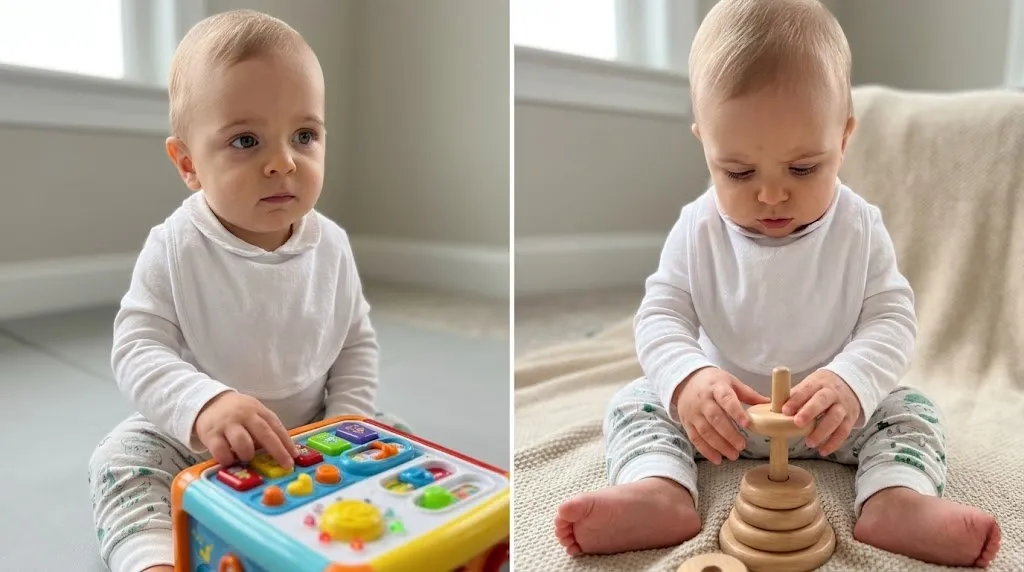
Before we start: “regular toys” is not a synonym for “bad toys.” Many conventional toys are genuinely developmental. And many toys labeled “Montessori” do not apply the design principles at all. This article compares design philosophies, not brand names — and acknowledges what each approach does well.
What Is the Difference Between Montessori Toys and Regular Toys?
The core difference is who does the developmental work. Regular toys — especially high-output ones — are designed to entertain: they produce lights, sounds, and responses that command attention. Montessori toys are designed so the child does the work: they require physical manipulation, self-correction, and active problem-solving. This distinction drives every other difference — in complexity (one concept vs. many features), feedback (self-correction vs. external validation), attention type (voluntary concentration vs. orienting reflex), and developmental outcome.
| A note on scope: This guide is about toy DESIGN — who does the developmental work. It’s not a comparison of materials. A plastic toy can be Montessori-principled; a wooden toy can violate every principle. If you want the material-science comparison — chemistry, weight, durability, environmental impact — see the material comparison guide. Both questions matter, but they’re separate. |
The One Question That Reveals Everything About Any Toy
Before comparing any two toys, ask: when my child plays with this, who does the majority of the work — the child or the toy?
| Toy | Who Does the Work? | Developmental Outcome |
| Electronic toy: plays sound when button pressed | The toy | Child entertained; no skill built |
| Wooden shape sorter (self-correcting, no sounds) | The child | Visual discrimination, fine motor, problem-solving |
| Plastic talking alphabet toy announcing letters | The toy | Child hears letters passively; no motor connection |
| Sandpaper letter: child traces + says sound | The child | Motor + auditory + tactile encoding simultaneously |
| Character playset with pre-set story | Toy + script | Child acts out existing story; minimal narrative creation |
| Wooden figurines with no features | The child | Child invents characters, story, world entirely |
As AAP-cited research by Dr. Kathy Hirsh-Pasek (Temple University) on how toys support child development puts it: “The best toys are 90% child and 10% toy.” A toy that does 90% of the work leaves 10% for the child. A toy that does 10% of the work leaves 90% — roughly 9 times more development per play hour. This is the entire Montessori vs. regular toys debate in one sentence.
Why This Matters in the 0–6 Window Specifically
The 0–6 year window is the period of maximum experience-dependent neural plasticity. A toy that demands active contribution builds sensory pathways, attentional capacities, fine motor networks, and language circuits. A toy that entertains passively does not. PNAS 2025 (Lillard et al.) found that children in authentic Montessori environments — using materials designed to maximize child contribution — showed significantly better reading, memory, executive function, and social understanding by the end of kindergarten.

The 4 Real Differences Between Montessori and Regular Toys
Most comparisons list surface differences: wood vs. plastic, colors, batteries. The real differences are in design philosophy — and they have measurable developmental consequences.
1. Self-Correcting vs. Externally Validated
Every authentic Montessori material has control of error built in — the toy itself tells your child whether they’ve done it correctly. A puzzle piece fits or it doesn’t. A stacking ring sequence falls if built out of order. No adult needed. No electronic celebration. Most conventional toys rely on external validation — an adult says “well done,” or an electronic sound plays. This trains your child to seek outside confirmation rather than develop internal standards.
The practical test: If you removed the adult and removed any electronic feedback — could your child still tell whether they succeeded? Yes = control of error present. No = the toy depends on external validation. This test works regardless of what the toy is made from.
2. One Concept vs. Multiple Simultaneous Features
Isolation of quality: each Montessori material varies in exactly one property. A stacking ring set that varies only in size (same color, same finish) is principled. The same set in six colors violates isolation of quality — it teaches neither size nor color clearly. Most “educational” toys combine many features simultaneously: colors, sounds, shapes, numbers, characters, lights. The alphabet toy with 26 buttons, 26 sounds, 26 pictures, and music is teaching all of them less precisely.
The honest caveat: some regular toys do isolate one concept well — a simple puzzle, nesting cups (size only), plain building blocks. These perform similarly to Montessori materials regardless of label, branding, or material.
3. High-Output Toys and Language — The Research Most Parents Haven’t Seen
JAMA Pediatrics (Sosa, 2016): 26 parent-infant pairs (ages 10–16 months) were audio-recorded during play with three conditions — electronic toys, traditional wooden toys, and books. Electronic toys produced significantly fewer adult words, fewer conversational turns, fewer parental responses, and less vocabulary-specific speech than both traditional toys and books.
The mechanism: electronic toys command children’s attention through the orienting reflex — the brain’s involuntary response to novel sound and light. When the toy is doing the communicating, the parent becomes a bystander. Traditional wooden toys create a silence that parent and child fill together. Those conversational turns — back-and-forth exchanges — are the primary driver of language brain development (Romeo et al., MIT fMRI study). A toy that reduces them is not neutral.
AAP Pediatrics (reaffirmed January 2025) confirmed: play with traditional toys was associated with increased quality and quantity of language compared with electronic toys. This isn’t about what the toy is made of. It’s about whether the toy talks — or whether your child does.
Developmental Longevity vs. Novelty Lifespan
High-output toys work through novelty: engagement peaks in the first days, declines as fixed functions are exhausted, and fades within 1–4 weeks. A material matched to a sensitive period produces returning, deepening engagement across months. Your child uses the same name puzzle at 12 months (grasping), 15 months (shape recognition), 18 months (placing letters), and 24 months (connecting letters to sounds). Each return is at a different developmental level. The design — not the material — determines whether a toy grows with your child.
Design, Not Material — The Proof That It’s Not About What Toys Are Made Of
If Montessori were simply about material choice, then any wooden toy would be Montessori and no plastic toy could be. Neither is true. The four design principles — self-correcting, isolation of quality, embodied learning, purposeful reality — can exist in any material. Here’s the proof:
Toys That ARE Montessori-Principled (Regardless of Material)
| Toy | Why It’s Principled |
| Plastic nesting cups (same color, graduated sizes) | Single variable (size only). Self-correcting (wrong order = won’t nest). Child does the work. |
| Simple shape sorter (no sounds, no lights) | Self-correcting (fits or doesn’t). Isolation of quality. Physical manipulation required. |
| Stacking rings (uniform color, size-only variation) | Single variable. Falls if wrong order = built-in control of error. |
Toys That Are NOT Montessori-Principled (Regardless of Material)
| Toy | Why It Violates the Principles |
| Busy board with 20+ activities | Violates isolation of quality — 20 features, no single concept isolated. Child samples without depth. |
| Electronic music cube | The electronics do the work. Press button = hear sound. No self-correction. No child contribution. |
| Shape sorter with colors + shapes + numbers simultaneously | Three variables at once. Teaches none precisely. |
| Character train with preset storyline | Narrative is pre-set. Child acts out given story rather than creating their own. |
This section makes one point unmistakable: design principles determine developmental value, not material. A plastic nesting cup set is more “Montessori” than a busy board with 20 activities. What matters is who does the work, how many concepts are isolated, and whether the child can self-correct.
| The Simple Test That’s Not About Material One question decides everything: “If I remove the adult and remove any electronic feedback, can my child still tell whether they succeeded?” Yes = principled design (regardless of material). No = not principled. |
Where Regular Toys Have Genuine Value — The Honest Part

Regular toys have genuine developmental value in specific contexts — including regular toys made from any material.
- Gross motor development: Bikes, balls, ride-ons, climbing structures. These don’t need to follow isolation-of-quality principles to work.
- Social rule-based games (age 4+): Board games, card games, collaborative play. Valuable school-readiness skills not targeted by open-ended Montessori materials.
- Books: The most impactful language development tool. Cheap, available everywhere, not branded.
- Nature: Free outdoor time with natural loose parts is more open-ended than most purchased toys, Montessori-labeled or not.
- Imaginative play with reference (age 4+): Character-based play scaffolds narrative complexity. A train set with a preset character storyline is a “regular” toy that’s fine for social-narrative play — it’s just not Montessori-principled concentration work, which is where open-ended materials produce the deeper engagement.
Montessori Toys vs. Regular Toys: The Complete Side-by-Side
Montessori vs. High-Output Toys:
| Dimension | Montessori-Principled | High-Output / Feature-Heavy |
| Who does the work | Child (90%) | Toy (90%) |
| Feedback mechanism | Self-correcting (built in) | External (sound / light / adult) |
| Concept focus | One (isolation of quality) | Multiple simultaneously |
| Language effect | Increases parent-child conversation | Reduces conversation (JAMA 2016) |
| Engagement duration | Months — developmental match | Days to weeks — novelty-driven |
| Attention type | Builds voluntary concentration | Commands involuntary attention |
Montessori vs. Simple Conventional Toys:
| Dimension | Montessori-Principled | Simple Conventional |
| Self-correcting design | Yes — by principle | Variable — depends on specific toy |
| Isolation of quality | Yes — by principle | Sometimes yes / sometimes no |
| Developmental longevity | High — sensitive period match | Moderate — depends on design |
| Performance difference | Consistent | Often comparable when design aligns |
A simple set of plain blocks with no branding can outperform a $45 “Montessori” toy that violates the design principles. The philosophy matters, not the label.
The “Montessori” Label: Why It Doesn’t Guarantee Anything
The word “Montessori” has been in the public domain since a 1967 US court ruling. No trademark. No certification body. No legal definition. Multi-feature shape-sorters, battery-operated talking boards, and low-quality toys are all currently sold as “Montessori” on major retail platforms. Common marketing tactics: “Montessori-inspired” (means nothing legally), pastel color palette as design signaling (aesthetics ≠ principles), and “educational” + “Montessori” double branding (neither guarantees design quality).
The 4 Questions That Actually Matter
- Can the child discover their own mistake without adult help? (Control of error)
- Does this toy teach exactly one concept? (Isolation of quality)
- Does the child have to physically handle it to learn from it? (Embodied learning)
- Does it connect to a real-world skill or object? (Purposeful reality)
All 4 yes = genuine Montessori design regardless of label or material. Fewer than 2 = marketing. Understanding what actually makes a toy Montessori — beyond the label on the box — is the single most useful filter for any toy purchase you’ll make.
What the Comparison Looks Like in Real Life
Scenario 1: Two Shape Sorters — Same Category, Different Design
- Shape sorter A: 4 shapes, 4 matching holes, no sounds, no lights. Child picks up shape, attempts each hole, discovers fit. Wrong hole = doesn’t go through. Self-correcting. One concept.
- Shape sorter B: 8 shapes in 4 colors with numbers, electronic sound on correct fit, lights flash on success. Three variables (shape + color + number). Electronic feedback replaces self-discovery. Child learns to wait for the sound instead of evaluating fit.
Both can be the same material. Shape sorter A builds visual discrimination and problem-solving. Shape sorter B builds button-pressing and waiting for confirmation. The developmental gap is entirely about design.

Scenario 2: Two Stacking Sets — Same Category, Different Principles
- Set A: 5 rings graduated by size only. Same color. Wrong sequence = visible instability. Child sees the error. Self-correcting. Single variable.
- Set B: 5 rings in 5 colors, different textures, character face on top that plays music when complete. Multiple variables. Electronic reward signals success. The music, not the child’s judgment, signals completion.
Same category. Completely different outcomes. Set A develops visual discrimination, size ordering, and concentration. Set B entertains.
Scenario 3: The 3-Year-Old and Imaginative Play
Licensed character playset with preset scenario, voice recordings, character accessories. Child acts out the movie’s story. Creative latitude constrained. Engagement: 15 minutes once scene is known.
Versus: collection of realistic figurines + loose blocks. Child invents characters, story, setting, conflict. Engagement: hours per week across months. The figurine collection builds executive function, narrative construction, symbolic thinking, and sustained voluntary attention.
Are Montessori Toys Worth the Price? The Honest Answer
| Toy | Cost | Engagement Window | Hours of Quality Play | Cost / Hour |
| Electronic toy (typical) | $15 | 2–4 weeks | ~20 hours | ~$0.75/hr |
| Plastic battery toy (mid-range) | $25 | 4–8 weeks | ~35 hours | ~$0.70/hr |
| Quality wooden stacking set | $35 | 18 months | ~200 hours | ~$0.18/hr |
| Knobbed name puzzle | $45 | 3–4 years | ~300 hours | ~$0.15/hr |

A principled material costs more per item and dramatically less per hour. The driver of longevity is design — a toy matched to a sensitive period produces returning engagement because the child’s relationship with it deepens at each stage. A novelty toy exhausts its functions in weeks regardless of build quality.
When NOT worth the premium: gross motor equipment (durability > philosophy); books (highest-impact, cheap); free outdoor time (unbeatable, costs nothing).
How to Mix Both Types Well — What Actually Works
The goal isn’t to replace every regular toy. It’s to ensure materials with highest daily access demand the most from your child.
- The shelf rule: Whatever’s on the low accessible shelf should be predominantly principled (self-correcting, single concept, demands child contribution). Entertainment toys can exist but require adult involvement to access.
- The 80/20 principle: 80% principled, 20% entertaining = development without deprivation.
- Existing toys: Apply the 4-question test. Move entertainment-only toys to “occasionally with adult.” Keep what’s principled regardless of label or material.
Before you buy checklist:
- Who does the work — the child or the toy?
- Can the child discover their own mistake without me?
- Does this teach one thing at a time?
- Does it require physical handling — or does it work with buttons and watching?
- Will this still be developmentally relevant in 6 months?
| The most reliable indicator that a shelf is working isn’t what the child picks up first — it’s how long they stay. A pouring tray that gets ignored in a crowded playroom will often sustain 30–40 minutes of focused repetition on a shelf with four activities. The toy didn’t change. The environment did. — Katy Lenoir, AMI Primary (3–6) & Elementary (6–12) |
Montessori Toys vs. Regular Toys: Questions Parents Ask Most
- What is the difference between Montessori toys and regular toys?
Montessori toys are designed so the child does the work — through self-correction, physical manipulation, and single-concept focus. Regular toys, especially high-output ones, do the work for the child through lights, sounds, and predetermined responses. The distinction is about design philosophy, not material.
- Is a plastic toy ever truly Montessori-principled?
Yes. Plastic nesting cups that vary only in size are Montessori-principled — single variable, self-correcting, requires physical manipulation. A plastic shape sorter without sounds that self-corrects through fit is principled. The four design tests (self-correcting, isolation of quality, embodied learning, purposeful reality) apply regardless of material. If all four pass, the toy is principled.
- Is a wooden toy always Montessori?
No. A busy board with 20 activities violates isolation of quality. An electronic music cube relies on the toy doing the work. A shape sorter with shapes + colors + numbers teaches none precisely. Material does not determine design philosophy.
- Are Montessori toys really better for child development?
For concentration, language, executive function, and fine motor: yes, with strong research support. Sosa (2016, JAMA Pediatrics) found traditional toys produced more parent-child language than electronic toys. PNAS 2025 (Lillard et al.) found better reading, memory, and social understanding at kindergarten entry. For gross motor and rule-based social games: conventional options are equally effective.
- Are Montessori toys worth the extra cost?
By cost-per-developmental-hour: yes. A principled material with an 18-month engagement window costs far less per hour than a $15 high-output toy abandoned in 3 weeks. Design principles matter more than label or material.
- What makes a toy Montessori vs. regular?
Four design principles: self-correcting, isolation of quality, embodied learning, purposeful reality. These can exist in any material regardless of label.
The Question Is Never ‘Montessori or Regular’ — It’s ‘Who Does the Work?’
Both children were playing. But in one case, the toy was doing the work — and in the other, the child was. That’s the entire comparison.
Montessori materials aren’t magic. They’re well-designed — and they ask more of the child. Simple conventional toys that follow the same principles perform just as well. A plastic nesting cup that isolates one variable outperforms a busy board that isolates none. The philosophy matters, not the label. Not the material.
You don’t need to replace every regular toy. Just make sure what’s within easiest reach demands the most from your child — self-correcting, single-concept, hands-on, real-world connected.
Kukoo Montessori’s materials are designed against exactly these four principles — matched to your child’s current developmental stage.