
You’re at the playground. Your 4-year-old hangs back at the edge of the climbing frame while the other kids scramble up — not scared, exactly, just uncertain. You’ve noticed this before: they trip more than their friends, avoid the balance beam, drift to the sidelines when games get physical.
You file it away as “just their personality.” Maybe it is. But here’s something most parenting content skips over: gross motor skills and social development are far more connected than parents realize. The child who can run, jump, climb, and catch isn’t just physically capable — they’re able to participate in the social world of childhood. And participation is where friendships happen.
This guide covers everything you need: what gross motor skills are, what’s typical at every age, how to support them at home, and when to pay closer attention.
What Are Gross Motor Skills?
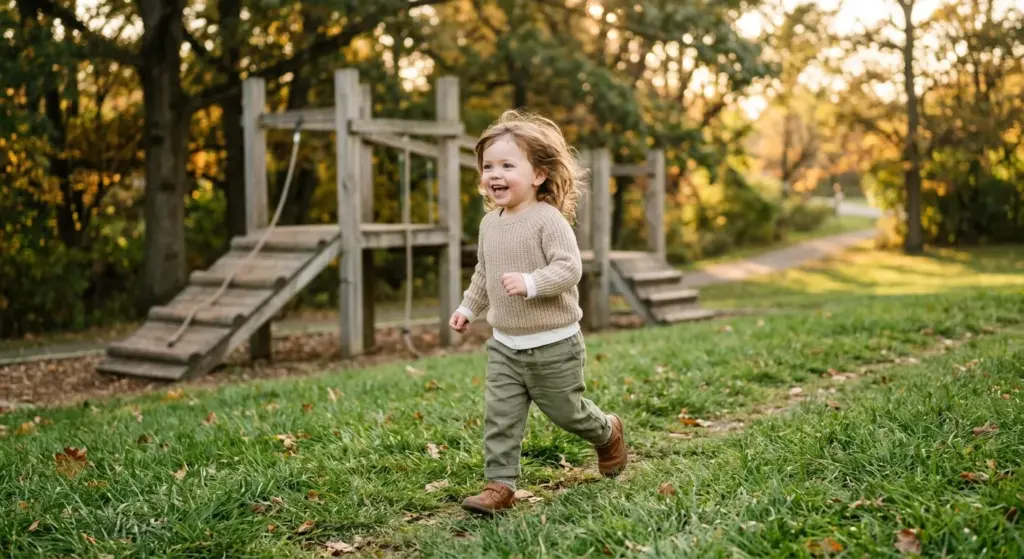
Gross motor skills are the physical abilities that use large muscle groups — in the legs, arms, and core — to produce whole-body movements. They fall into three categories: locomotor skills (moving through space: crawling, walking, running, jumping, climbing), stationary skills (controlled movement in place: balancing, bending, reaching, pushing), and object control skills (interacting with objects: throwing, catching, kicking, rolling). They develop from head to toe (cephalocaudal) and from the core outward (proximodistal), forming the foundation for fine motor skills, cognitive development, and social participation.
The 3 Types of Gross Motor Skills
| Type | Definition | Examples |
| Locomotor | Moving the body through space | Crawling, walking, running, jumping, hopping, skipping, climbing |
| Stationary | Controlled movement in place | Balance, bending, twisting, pushing, pulling, sitting upright |
| Object Control | Using the whole body with objects | Throwing, catching, kicking, rolling, batting a ball |
Why Gross Motor Skills Matter More Than You Think
Most parents think of gross motor development as “physical” — separate from social and academic growth. Recent research says otherwise.
A 2025 study in Frontiers in Psychology (Zhang et al.) tracked children across three age groups and found that gross motor proficiency directly predicts social behavior — and the specific skill type that matters most shifts by age:
| Age | Most Predictive Skill | Why It Matters |
|---|---|---|
| 3–5 years | Locomotor (running, jumping, climbing) | Peer play at this age is built around physical chasing and climbing — exclusion is structural, not unkind |
| 6–8 years | Both locomotor AND object control equally | Group games require both movement and ball skills |
| 9–10 years | Object control (throwing, catching) | Team sports and organized games dominate social life — participation requires these skills |
A second 2025 study (Scientific Reports, Vagnetti et al.) identified running and two-hand catching as the most central gross motor skills — most connected to all other motor abilities in the developmental network.
The bottom line: When your child’s gross motor skills lag, the ripple effects reach their social confidence and classroom readiness — not just their physical fitness. And the good news: these skills are entirely buildable with the right environment.
A child who can run, jump, and climb confidently can participate in the physical world of childhood. That’s where friendship happens, where confidence grows — and it starts with the opportunities you create today.
The Science Behind Gross Motor Development
Cephalocaudal (head to toe): Development proceeds downward — head control first, then trunk, then legs. You cannot skip this sequence. Tummy time builds the head and neck control that makes everything else possible.
Proximodistal (core outward): Development moves from the center out — core stability before shoulder control, shoulder before arm, arm before hand. This is why a child with poor handwriting may not have a hand problem — they may have insufficient core stability.
3 Body Systems Driving Gross Motor Control
- The vestibular system (balance & spatial orientation) — built by swinging, rolling, spinning, rocking, and walking on uneven surfaces. Underdeveloped vestibular processing shows up as poor balance and difficulty with sustained sitting at school.
- The proprioceptive system (body awareness) — built by climbing, carrying heavy objects, jumping, and digging. When this system is under-stimulated, children may appear “clumsy” or crash into things — not from clumsiness, but from seeking the input their nervous system needs.
- The visual-motor system (eye-body coordination) — built by catching, obstacle navigation, and throwing at targets. This same system drives reading and writing: tracking a line of text is visual-motor work.
Every time your child climbs, runs, catches, and carries, they’re simultaneously building the neural infrastructure for attention, memory, and learning. Movement IS cognitive development — not a break from it.
Gross Motor Milestones by Age (Birth–6 Years)
These milestones describe the range of typical development. A few weeks either side is almost always normal — if you’re concerned, your pediatrician is your best first call.
Birth–12 Months: Building the Foundation
| Age | Key Milestone | Best Activity |
|---|---|---|
| 1–3 months | Lifts head during tummy time; kicks symmetrically | Daily tummy time — start 30 sec on your chest, build to 15–30 min total across the day |
| 4–6 months | Rolls both directions; sits with support; bears weight on legs | Toys just out of reach; varied floor textures (carpet, grass, blanket) |
| 7–9 months | Crawls (hands + knees); pulls to stand; cruises furniture | Safe crawling obstacles; continuous furniture path for cruising |
| 10–12 months | Stands briefly alone; walks with hand held; first steps | Sturdy wooden push walker; outdoor grass time; climbing over low cushions |
The most common pattern we see in Kukoo families who reach out about toddler motor concerns: their child spent significant time in infant containers — bouncers, swings, car seats — as a primary resting position. This isn’t a parenting failure; it’s an invisible side effect of modern baby gear. The fix is simple: more floor time, less container time. Families often see meaningful changes in 4–6 weeks.
12 Months–3 Years: The Movement Explosion
| Age | Key Milestone | Best Activity |
|---|---|---|
| 12–18 months | Walks independently; squats; kicks a ball; carries objects while walking | Outdoor uneven terrain daily; large soft ball kicking; carrying a small watering can |
| 18–24 months | Jumps with both feet; runs more steadily; throws overhand | Obstacle courses with household cushions; animal walks (bear, frog, crab); swinging |
| 2–3 years | Jumps from height; gallops; stands on one foot; pedals tricycle | Target throwing; digging in garden; pushing a loaded wagon; jumping on cushions |
At this stage, proprioceptive seeking peaks — the crashing, the jumping off everything, the carrying of heavy objects. This is not misbehavior. This is the nervous system requesting the developmental input it needs.
3–6 Years: Coordinating and Integrating
| Age | Key Milestone | Best Activity |
|---|---|---|
| 3–4 years | Hops; skips; gallops; catches medium ball; pumps on swing | Playground monkey bars + swings; graduated ball sizes; tape balance beam on floor |
| 4–5 years | Skips smoothly; hops 10+ times each foot; catches small ball | Bike riding with stabilizers; hopscotch; tree climbing (supervised); running games (tag, freeze) |
| 5–6 years | Rides two-wheeled bike; skips rope; one-foot balance 15+ sec | Jump rope; nature hikes on varied terrain; skipping rope; target kicking for accuracy |
The Montessori Approach: Movement as Learning, Not Exercise
In Montessori environments, gross motor development isn’t a “PE period” — it’s woven into everything. This is not a philosophical nicety. It’s neuroscience.
Embodied cognition research confirms that learning grounded in physical interaction with the environment means motor development and cognitive development are the same system viewed from different angles. Maria Montessori wrote about this decades before the research caught up: “Movement, or physical activity, is thus an essential factor in intellectual growth” — a principle now supported by a growing body of developmental science.
The Montessori Sensitive Period for Movement
From birth to around 2.5 years, your child has a heightened biological drive to gain command over their large muscle system — crawling, walking, climbing, carrying — what Maria Montessori identified as the sensitive period for movement. From roughly 2.5 to 4.5 years, the drive shifts to refining those movements: making them precise, graceful, and purposeful.
Montessori environments honor this by removing obstacles to movement and offering purposeful physical challenges — not exercise drills.
3 Montessori Gross Motor Practices Worth Borrowing
- Freedom of movement: Children choose where to work — floor, mat, low table. This constant postural variation builds core strength, vestibular balance, and body awareness without a single structured “exercise.”
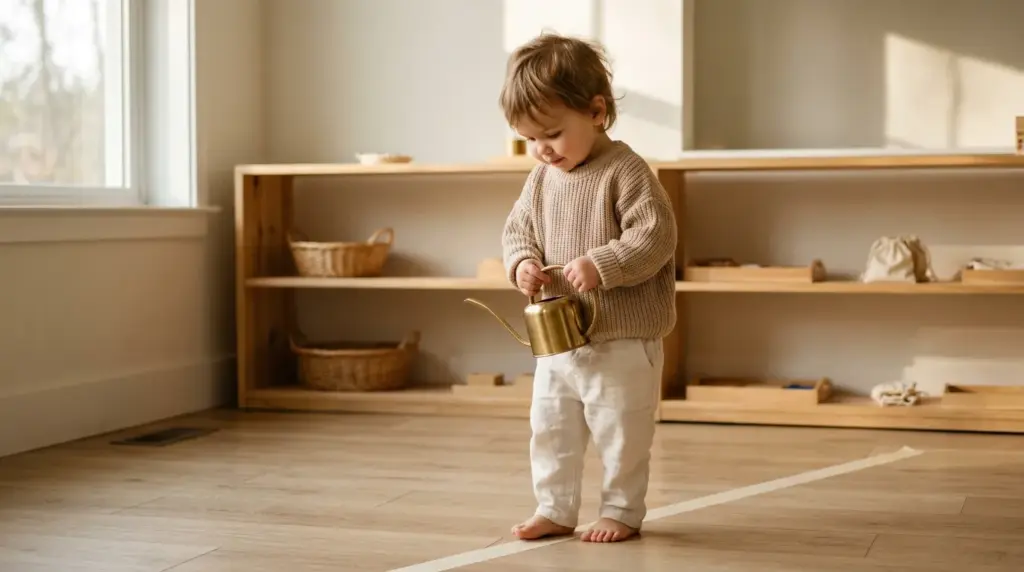
- Walking on the Line: An ellipse of tape on the floor. Your child walks heel-to-toe, arms relaxed, eyes forward. It looks simple — the neural demand is equivalent to walking a narrow balance beam. Advanced versions add carrying a glass of water (force modulation) or bells on a tray (vibration + balance). Begins around 2.5 years; deepens significantly at 3–4.
- Practical life as heavy work: Sweeping (bilateral coordination), mopping (core rotation), carrying filled watering cans (proprioceptive loading), digging in the garden (whole-body engagement). Practical work develops gross motor skills more deeply than exercise because intrinsic motivation sustains the physical effort far longer. These are also the foundations of the practical life skills that run through every area of the Montessori curriculum.
Building Gross Motor Skills at Home: What Actually Works
3 Principles That Matter More Than Any Specific Activity
- Unstructured over structured — child-chosen outdoor play builds gross motor skills more efficiently than the same time in adult-directed exercise. Create the environment; let your child lead.
- Real terrain over flat surfaces — grass, gravel, sand, bark, and uneven ground challenge the vestibular and proprioceptive systems in ways no indoor floor can replicate.
- Real weight over plastic — wooden materials with genuine weight provide real proprioceptive feedback. A plastic watering can weighs almost nothing; a real one filled with water teaches force modulation and body awareness.
The same principle applies to striking tools. A hollow plastic hammer bounces off without resistance; a solid wooden shape sorter hammer toy requires your child’s arm to calibrate real force against real weight — exactly the proprioceptive feedback the nervous system needs to refine whole-arm coordination. The shape-sorting element adds a cognitive layer without interrupting the gross motor work: your child is simultaneously learning force modulation, shape recognition, and cause-and-effect in a single activity.
Quick Activity Bank by Age
0–12 months: Daily tummy time progressions; varied holding positions; rolling facilitation (toy at 90° during tummy time); outdoor air time in arms.
12–24 months: Cushion mountain (climb over and tumble on); carrying a small weighted basket; push-along wooden walker; large ball rolling; outdoor barefoot walking on grass and gravel. For whole-arm striking practice, a wooden musical hammer and xylophone channels the natural banging drive into purposeful gross motor work — your child calibrates swing force against real acoustic feedback, building shoulder stability and bilateral arm coordination while making sounds they find intrinsically motivating.
2–3 years: Household obstacle courses (cushions, low plank, tunnel under table); digging in garden; heavy work (push loaded wagon, carry backpack of books before transitions); animal walks; swinging.
3–6 years: Playground time (monkey bars, swings, climbing frame — a complete gross motor environment); graduated catching (balloon → beach ball → small ball); tape balance beam; bike riding; nature hikes on varied terrain; hopscotch.
Gross Motor Delay: Signs to Watch and When to Reach Out
This is educational guidance, not medical diagnosis. Every child develops at their own pace. If you’re concerned, your pediatrician is always the right first call — and earlier is always better than waiting.
| Age | Talk to your pediatrician if your child… |
|---|---|
| 2 months | Doesn’t lift head during tummy time; kicks only one side |
| 6 months | Not sitting with any support; not rolling in both directions |
| 12 months | Not standing independently even briefly; not cruising along furniture |
| 15–18 months | Not walking independently |
| 24 months | Not jumping with both feet; not kicking a ball |
| 3 years | Can’t stand on one foot briefly; not running smoothly |
| 4 years | Can’t hop; can’t catch a large ball; very frequent falling |
| Any age | Regression — losing motor skills previously mastered; using only one side consistently |
If your child is at the later end of the typical range: provide movement opportunities and observe over 4–8 weeks. If concerns persist, your pediatrician will screen and refer. A pediatric physical therapist (PT) is the primary specialist for gross motor delays — and intervention is play-based, not clinical.
Gross Motor Skills: 6 Questions Parents Ask Most
Q1: Do gross motor skills really affect my child’s social life?
Yes — and the research is specific about how. Frontiers in Psychology 2025 found locomotor skills (running, jumping) most predict social engagement at ages 3–5; both locomotor and object control predict social competence at 6–8; and object control (throwing, catching) most predicts social behavior at 9–10. The mechanism is simple: the social world of childhood is physically structured. Gross motor competence enables participation.
Q2: What’s the most important thing I can do for gross motor development?
Floor time from birth and outdoor time on varied terrain every day. These two things — floor freedom for infants, unstructured outdoor play for toddlers and preschoolers — are the highest-leverage interventions available, cost nothing, and are supported by all major developmental research.
Q3: Does crawling really matter if my baby wants to skip it?
Crawling is not a required milestone — some children walk without crawling and develop typically. However, crawling develops bilateral coordination (both brain hemispheres), shoulder girdle strength (fine motor prerequisite), and cross-body motor patterns (reading prerequisite). It’s worth offering crawling opportunities and gentle encouragement even if your child seems inclined to skip it.
Q4: When should a child walk independently?
Between 9 and 15 months, with the average around 12 months. Walking up to 18 months is within the normal range. If your child is not walking independently by 18 months, discuss with your pediatrician.
Q5: How does the Montessori approach support gross motor development differently?
Rather than scheduling physical activity separately, Montessori integrates movement into every part of the child’s day — through freedom of movement, walking on the line, and practical life work. Children build core strength, vestibular balance, and proprioceptive awareness continuously, not in discrete exercise blocks. Each of these areas — from fine motor and sensory skills to language and math — has its own developmental arc worth understanding.
Q6: My toddler crashes into everything and seems unusually rough. Should I be worried?
Usually no — this is proprioceptive seeking. The nervous system is requesting the heavy sensory input it needs to feel regulated. Try introducing “heavy work” before transitions: carrying a small backpack of books, digging in the garden, pushing a wagon. Many families see the crashing reduce significantly within 2 weeks.
Gross Motor Skills Are Built in Everyday Moments — Starting Today
Here’s what gets buried under all the milestone charts: gross motor development is exceptionally responsive to opportunity. You don’t need expensive equipment, structured programs, or special expertise.
You need floor time from birth. Outdoor time every day. Terrain that challenges balance. Objects with real weight to carry. The freedom to climb, fall safely, and try again.
Let your child carry the heavy bag even when it slows you down. Let them climb the tree even when it raises your heart rate. Let them dig in the mud, run down the hill, roll in the grass.
These moments — the ones that look like nothing in particular — are the gross motor brain being built. One proprioceptive loading, one vestibular challenge, one catch-and-throw at a time. And the social world they’ll need at age 4, 8, and 12 starts here, now, with the quality of movement experience you offer today.
“Movement, or physical activity, is thus an essential factor in intellectual growth.” — Maria Montessori