
Your 3-year-old tears through the playroom — forty seconds with the stacking rings, forty seconds with the shape sorter, genuinely playing with nothing. It isn’t boredom and it isn’t a problem with your child. It’s a signal: those toys match a 2-year-old’s brain, not the 3-year-old standing in front of you.
Three is a turning point. Your child is now ready for narrative, causation, emotion, and early number — and most “3–6” toy lists miss this because they lump three years of development together. Here are the 7 Kukoo Montessori materials matched specifically to the developmental window that opens at 3.
| Best Montessori toys for 3-year-olds (summary): 1. Toy Car Parking Garage — multi-level spatial engineering + narrative (premium anchor) 2. Wooden Cooking Toy Set — practical life + pretend play 3. Emotions Feelings Chart Wheel — emotional vocabulary + self-regulation 4. Wooden People Balance Stacking Set — physics intuition + patience 5. 100 Creative Wooden Building Blocks — open-ended building + creative thinking 6. Wooden Musical Hammer & Xylophone Toy — auditory development + cause-and-effect 7. Teddy Bear Wooden Busy Board — fine motor + practical independence Each pick targets the specific developmental window opening at 3 — symbolic thinking, emotional language, cause-and-effect reasoning, and sustained voluntary attention. |
The 7 Best Montessori Toys for 3-Year-Olds, Reviewed
1. Toy Car Parking Garage — Best for Spatial Reasoning and Sustained Play

Toy Car Parking Garage
⭐ 4.99 | 717 Reviews
BEST FOR
Three-year-olds ready for sustained narrative play who need a primary anchor material for their rotation shelf.
WHY IT WORKS
Multi-level wooden garage with ramps, parking levels, and vehicles — no electronics, fully child-directed. Your child releases the car, watches it descend, and sees the result: cause-and-effect through physics, not buttons. Multiple levels build spatial reasoning through real decisions. At 3, the garage becomes a city your child narrates into existence — symbolic play arriving right when the sensitive period for language is at its peak. Parents consistently report 30–45 minute sessions — the kind of self-directed concentration the AAP links directly to executive function development.
GOOD TO KNOW
At $266.99, this is the premium pick. Families report 45-minute sessions across 12+ months of daily use — roughly $0.60 per hour of developmental engagement, comparable to the cheapest toys in this list. It earns its place because of developmental longevity, not despite the price.
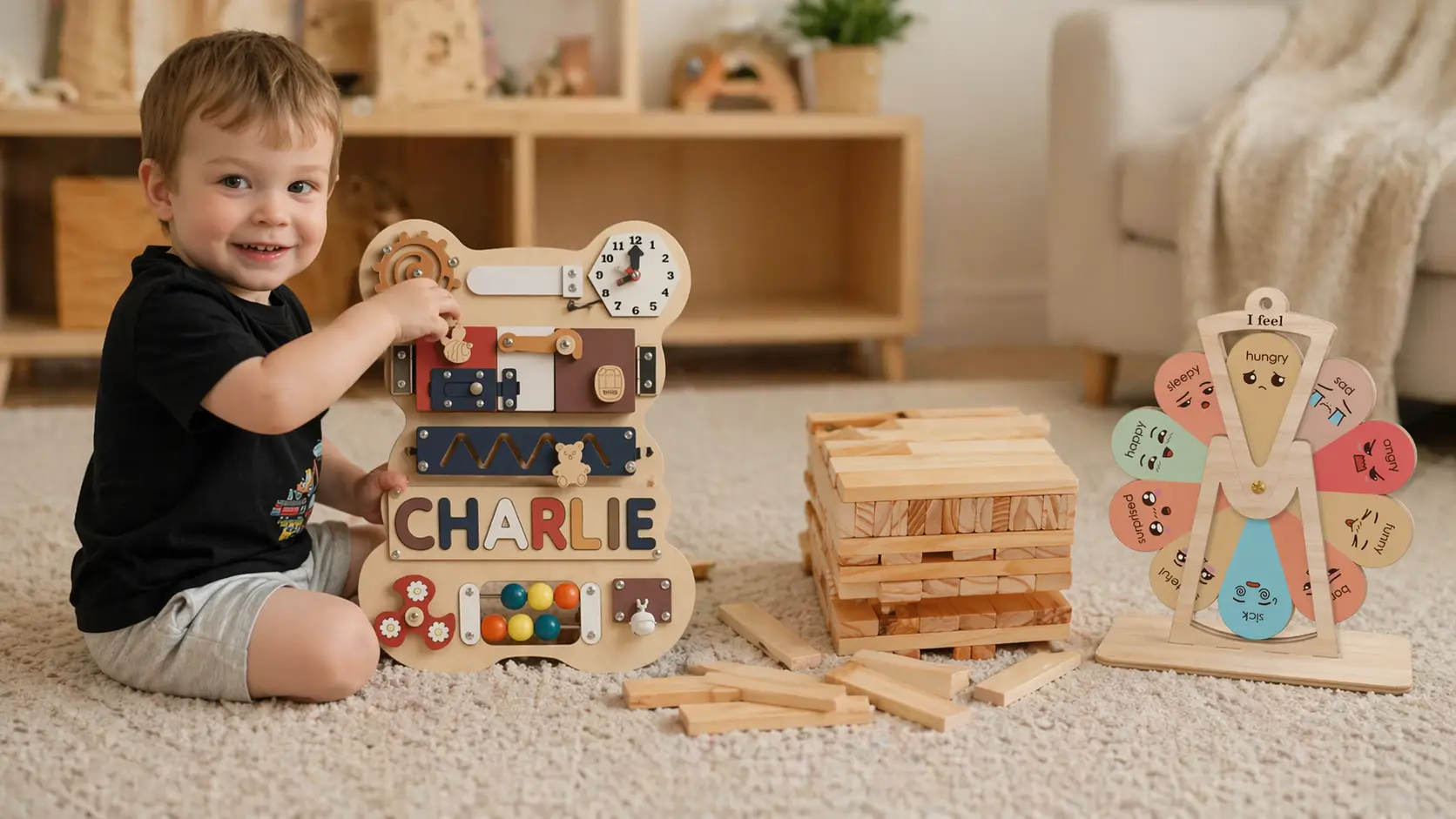
2. . Teddy Bear Wooden Busy Board — Best for Practical Independence and Fine Motor Mastery

Teddy Bear Busy Board
⭐ 5.00 | 882 Reviews
BEST FOR
Three-year-olds who insist on dressing themselves but don’t yet have the fine motor precision to succeed during the actual morning rush.
WHY IT WORKS
Wooden board with buttons, zippers, buckles, laces, and snaps embedded in a Teddy Bear design. Age 3 is within the active Sensitive Period for Fine Motor Precision, and this board channels that drive without morning time pressure. Every mechanism is a real-world dressing skill practiced at your child’s pace.The pincer grip for buttons is the same grip for holding a pencil — these fine motor skills that transfer directly from board to clothing to pencil are being built during an active sensitive period at 3.. Zipping, lacing, and buckling build sequential thinking — multi-step sequences the 3-year-old brain is ready to execute independently. The Teddy Bear design is Montessori-appropriate: realistic, not fantasy-based.
GOOD TO KNOW
Perfect 5.00 rating. Parents note children transfer board skills to their own clothes within weeks. All busy boards in the Kukoo collection are personalized, making them a meaningful gift.
3. Montessori Emotions Feelings Chart Wheel — Best for Emotional Intelligence
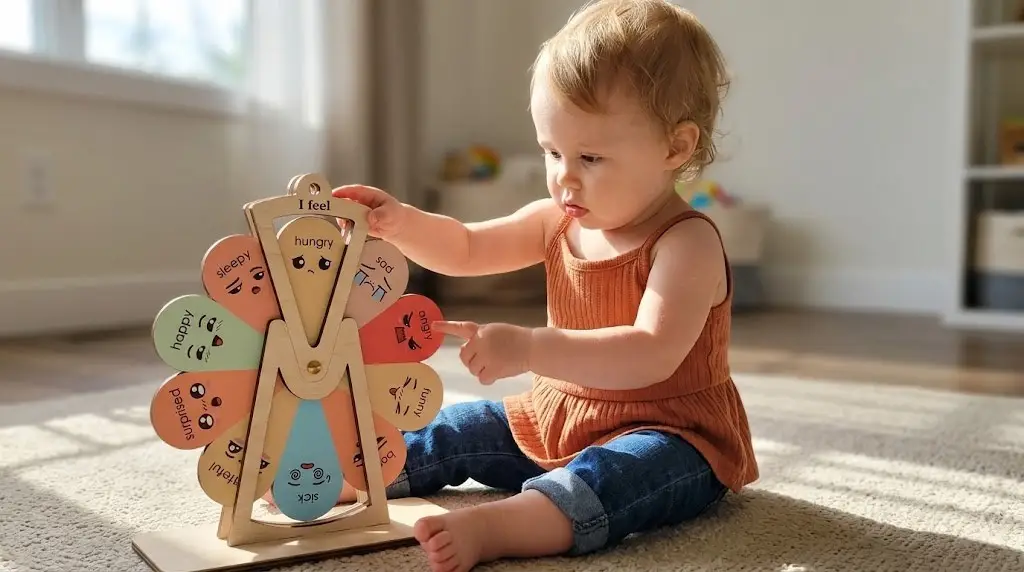
Emotions Feelings Chart Wheel
⭐ 4.95 | 541 Reviews
BEST FOR
Three-year-olds who feel everything intensely but can’t yet name what they’re feeling — the ones whose big emotions become big behaviors.
WHY IT WORKS
Wooden spinning wheel with illustrated emotion faces and vocabulary — your child points to, names, and discusses feelings independently or with you. Age 3 is when emotional intensity outpaces emotional vocabulary, and giving your child accurate words for what they feel (“frustrated,” not just “angry”) is one of the most effective paths toward self-regulation. The social understanding that PNAS 2025 (Lillard et al.) found significantly stronger in Montessori children starts here — with a 3-year-old who can say what they feel instead of showing it through behavior.
GOOD TO KNOW
At 3, the CDC identifies showing concern for friends and noticing when others are upset as active social-emotional milestones — the feelings wheel directly supports this transition from feeling emotions to recognizing and naming them in context. Use it for morning check-ins, after hard moments, before bed. These micro-interactions build emotional intelligence that compounds over time.
| I introduced the feelings wheel in our toddler community because I kept seeing 2-year-olds who could describe what a friend was doing — ‘she’s crying’ — but couldn’t name what that friend was feeling. The vocabulary gap is real. A structured tool like the feelings wheel closes it faster than waiting for the words to appear on their own.” — Zoe Paul, AMI Teacher Trainer (0-3) |
4. Wooden People Balance Stacking Set — Best for Physics Intuition and Patience

People Balance Stacking Set
⭐ 4.89 | 645 Reviews
BEST FOR
Three-year-olds learning to handle frustration and try again — the emerging executive function skill that predicts everything from school readiness to long-term self-regulation.
WHY IT WORKS
Wooden weighted people pieces balanced on a base — different sizes require problem-solving to stack without toppling. Balance play introduces real physics (weight distribution, center of mass) through pure intuition. No explanation needed. The productive failure element is key: the stack falls, and a 3-year-old is now developmentally ready to try again with a modified approach. Building a tall stable stack requires slowing down and tolerating “it might fall” — voluntary inhibitory control trained through play. The people figures add narrative: they become characters, embedding physics in symbolic play. Montessori’s control of error is built right in — incorrect placement is immediate and visible.
GOOD TO KNOW
At $30.99, the most accessible entry point in this guide — and one of the most consistently returned-to materials.
5. 100 Creative Wooden Building Blocks — Best for Open-Ended Creative Building

100 Creative Building Blocks
⭐ 4.97 | 498 Reviews
BEST FOR
Three-year-olds whose symbolic thinking is exploding — the ones who look at blocks and see a castle, a city, a farm.
WHY IT WORKS
One hundred solid wooden pieces in multiple geometric shapes — no paint, no script, no correct outcome. The Sensitive Period for Small Objects transitions into fine motor precision at 3, and these pieces are exactly the right size. Symbolic thinking means blocks become stories. Multiple domains activate simultaneously: geometry (shape vocabulary), fine motor (precise placement), spatial (structural planning), and math skills (counting, grouping, patterns). One hundred pieces provides enough variety for complex narratives without overwhelm.
GOOD TO KNOW
The only rating below 4.8 (4.57) — reviews are positive on quality, the lower score reflects storage notes. Pair with a labeled wooden tray or open basket. The age shelf setup guide shows how to organize open-ended materials on a rotation shelf.
6. Wooden Musical Hammer & Xylophone Toy — Best for Auditory Development and Cause-and-Effect

Musical Hammer & Xylophone Toy
⭐ 5.00 | 376 Reviews
BEST FOR
Three-year-olds in the “what happens if?” phase who learn best through immediate sensory feedback.
WHY IT WORKS
Dual-function: hammer pegs that produce sound when struck, plus a xylophone with a graduated scale — solid wood, real acoustic resonance, no batteries. The hammer-peg component delivers immediate auditory cause-and-effect. The xylophone’s graduated scale (higher note for shorter bar) creates a spatial-auditory connection that activates multiple sensory systems during active Sensitive Periods. Fine motor develops through precision striking. And 3-year-olds are beginning to understand they can communicate beyond words — music play is one of the first non-verbal expressive outlets available to them.
GOOD TO KNOW
The key differentiator: electronic toys play preset songs when buttons are pressed. This toy produces sound only from your child’s precise physical action.
7. Wooden Cooking Toy Set — Best for Practical Life and Pretend Play

Cooking Toy Set
⭐ 5.00 | 413 Reviews
BEST FOR
Three-year-olds deep in the Sensitive Period for Practical Life — the ones who watch you cook and want to do it themselves.
WHY IT WORKS
Complete wooden cooking set with pots, utensils, cutting boards, and play food — real weight, no electronics. Age 3 is the peak of practical life interest — practical life activities that build independence through real household work are precisely what your child is driven toward. The role play that follows — cooking for someone, serving, sharing — requires perspective-taking, the same social understanding PNAS 2025 (Lillard et al.) found significantly stronger in children from authentic Montessori environments. Utensil handling builds the grip patterns that become pencil grip at 4 — genuine pre-writing practice disguised as play. Parents report 20–40 minute daily sessions, not because it entertains, but because it mirrors the real adult work your child is driven to join.
GOOD TO KNOW
Pairs naturally with the Car Garage — one is physical/cause-effect, one is social/narrative. Together they cover complementary developmental domains on the same shelf.
Why 3-Year-Old Toy Choices Are Different From Any Other Age
Three is not “2 plus one more year.” It’s a qualitative developmental shift. Maria Montessori identified Sensitive Periods — windows when the brain absorbs specific types of learning with an ease that won’t be replicated later. At 3, multiple Sensitive Periods are simultaneously active, which is why toy selection at this age matters more than at almost any other.
| After 15 years of training teachers in 0–3 environments, the shift I watch for is unmistakable: children who were pure explorers at 18 months become planners by 2.5 — they stack with intention, narrate quietly, and return to the same material the next morning. The deepest concentration always happens when you’ve matched the right material to an active sensitive period. Choose what fits the windows open right now, not the ones that closed six months ago.” — Zoe Paul, AMI Teacher Trainer (0-3) |
- Symbolic thinking arrives. A wooden block genuinely IS a car, a house, food for a figurine — the engine behind pretend play and narrative construction.
- Emotional vocabulary becomes learnable. Your child has huge feelings but limited language for them. This window builds the self-regulation foundation for school readiness.
- Cause-and-effect reasoning emerges. “What happens if…” becomes the dominant question — the foundation of scientific and mathematical thinking.
- Concentration windows lengthen. A 2-year-old focuses 5–8 minutes. A matched 3-year-old can sustain 20–30 minutes of deep work. The right material produces this.
- Early numeracy readiness. Concrete-to-abstract math begins. Handling real objects while counting builds genuine number sense — the kind of cognitive skills that form through physical experience, not flashcards.
The mismatch problem: Stacking rings and simple shape sorters are perfect at 2 — at 3, they’ve been mastered. A child who looks bored isn’t bored with play; they’re bored with the developmental level the toy represents. Meanwhile, materials for 4–6 years produce frustration, not productive challenge. The sweet spot at 3: symbolic play with realistic anchors, emotional vocabulary, cause-and-effect with visible consequences, and open-ended building with narrative depth. That’s what this list targets.
How to Set Up Your 3-Year-Old’s Montessori Shelf
These 7 products are a rotation system, not a shelf setup. Three to four materials accessible at a time, the rest stored.
| 📊 Why fewer is better Dauch et al. (2018, University of Toledo) observed 36 toddlers in two conditions: 4 toys vs. 16 toys. With 4 toys, children played twice as long and demonstrated more sophisticated, creative play. For 3-year-olds with 20–30 minute attention spans, limited choice lets Sensitive Period concentration actually emerge. |
- Rotation A — Spatial/Physical: Car Garage (anchor) + Balance Stacking Set + Xylophone
- Rotation B — Creative/Expressive: Building Blocks (anchor) + Cooking Set + Busy Board
- Rotation C — Emotional/Social: Emotions Wheel (anchor) + Cooking Set + Balance Stacking Set
- Rotation trigger: When your child stops choosing a material for 4–5 consecutive days, swap it. Observe — don’t follow a calendar.
These 7 products are a rotation system, not a shelf setup. Three to four materials accessible at a time, the rest stored — the observation-driven rotation system that determines when to swap makes each change serve development, not a calendar.
| “Before we tried toy rotation, my daughter would walk past everything in under three minutes and say she was bored. In the first week, I placed just the car garage and a balance set on the shelf—and she played for 35 minutes straight. By week three, I realized the playroom wasn’t the issue. It was simply too many visible choices.” — Eva D. Clinard, Kukoo customer |
What NOT to Buy a 3-Year-Old (Even If It Says “Ages 3+”)
- Electronic toys with preset responses: Sosa (2016, JAMA Pediatrics) confirmed these reduce parent-child conversational turns. At 3, language is in an active Sensitive Period — the worst time to crowd out dialogue.
- Activities mastered at 2: Basic stacking rings, 2-piece puzzles. The Sensitive Period has closed. The “bored” flitting behavior is a mismatch signal, not an attention problem.
- Abstract teaching tools without concrete foundation: The Montessori method sequence at 3 is concrete-to-abstract. Physical objects first, abstract concepts second.
- One honest nuance: “Ages 3+” is a safety standard (ASTM small parts), not a developmental recommendation. It tells you a toy is physically safe — not that it matches where your child’s brain is. When selecting materials, the material itself carries weight, texture, and sensory information plastic cannot replicate — a separate dimension from design philosophy.
Your Questions Answered
Q: What Montessori toys are good for 3-year-olds?
The best Montessori toys for 3-year-olds match the Sensitive Periods active at this age: symbolic play, emotional vocabulary, cause-and-effect, and practical life. Top categories: multi-level construction (car garages, blocks) for spatial reasoning, practical life sets (cooking, dressing) for independence, emotional tools (feelings wheels) for self-regulation, and musical instruments for auditory development. The key differentiator from younger toys: complexity and narrative depth.
Q: What are the best educational toys for 3-year-olds?
Genuinely educational at 3 means matched to active Sensitive Periods and research-backed. PNAS 2025 (Lillard et al., 588 children) confirmed Montessori materials build executive function and social understanding better than conventional alternatives. Look for: high child contribution, no electronic output, and materials that grow with your child through their Sensitive Periods.
Q: How many toys should a 3-year-old have?
Far fewer visible at once than most parents assume. Dauch et al. (2018) found children played twice as long with 4 toys versus 16. For 3-year-olds, the ideal shelf holds 3–4 materials, with the rest stored and rotated based on observation. You can own a broader collection while keeping the shelf spare.
Q: Are Montessori toys worth it for 3-year-olds?
Yes — because this is the age when Sensitive Periods are most actively open. A well-chosen material at 3 isn’t just a toy; it’s fuel for development that’s actively happening. Longevity matters too: quality wooden materials at 3 remain developmentally relevant at 4 and 5, used in progressively sophisticated ways. Dr. Kathy Hirsh-Pasek’s principle — “90% child, 10% toy” — describes exactly how Montessori materials work.
Q: What do 3-year-olds need for development?
Materials matched to active Sensitive Periods: symbolic play opportunities, emotional vocabulary tools, practical life engagement (cooking, dressing, pouring), cause-and-effect exploration with immediate consequences, and sustained concentration practice with limited visible choices. These five needs are exactly what this guide’s picks are designed to serve.
Q: What are the most popular Montessori toys for preschoolers?
Wooden blocks, practical life sets, balance toys, musical instruments, and emotional literacy tools. In Kukoo’s 3–6 collection, the Toy Car Garage is the bestseller (4.99 stars, most-reviewed product). Emotional literacy tools are the fastest-growing category — reflecting awareness that social-emotional skills matter as much as academics, confirmed by PNAS 2025.
Q: What is a good gift for a 3-year-old who has everything?
The “has everything” child almost never has materials matched to their current Sensitive Periods. Best bets: an emotions wheel (almost no child has emotional literacy tools — the most underserved category at 3), a multi-level car garage (genuinely new spatial experience even in a toy-full home), or open-ended blocks to replace plastic alternatives. Match an active Sensitive Period and watch the concentration that follows.
The Right Toys at the Right Sensitive Period
That 3-year-old flitting from toy to toy wasn’t bored — they were in active Sensitive Periods with nothing on the shelf that matched. The right materials produce something completely different: quiet focus, voluntary return, genuine satisfaction.
Start with 1 or 2 of these materials, put everything else away, and observe what happens in the first week. You’re already doing more than you think.
Your child will grow through these materials faster than you expect — and when they do, the next stage is already waiting in the same Montessori toys for 3–6 year olds collection, with complexity that scales up alongside them.
Happy Shopping,