
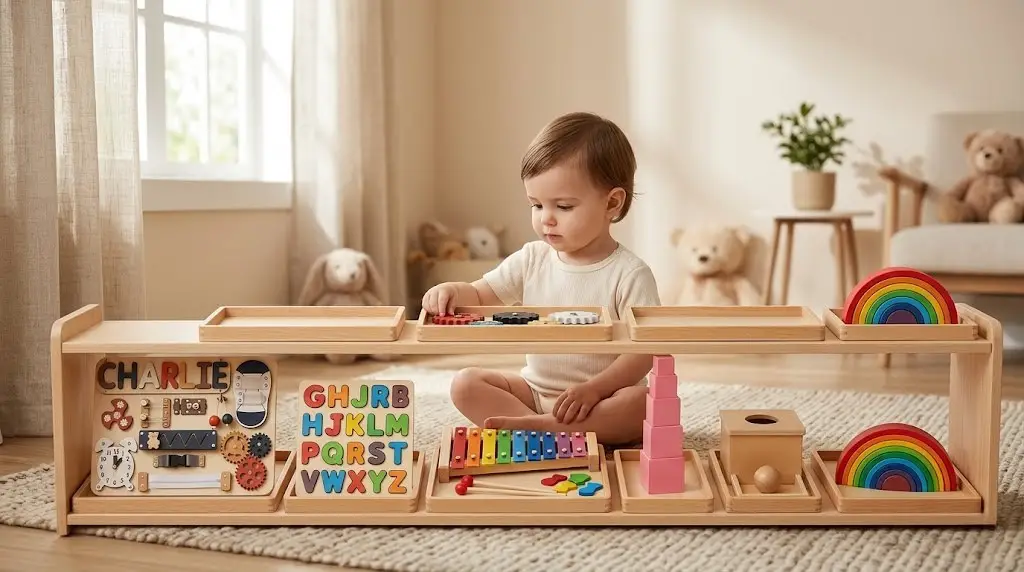
Saturday morning. The living room floor is a toy explosion — 40+ items, half with missing pieces, many untouched since Christmas. Your toddler walks past all of them, picks up an empty cup from the kitchen, and spends 25 minutes pouring water from it into another cup.
Your toddler isn’t bored. They’re overwhelmed. When there are 40 options, none of them are interesting enough to settle into. The kitchen cup is compelling precisely because it appeared unexpectedly in their play space — an unexpected invitation rather than one more option in an already crowded field.
That’s the principle behind toy rotation. Not fewer toys permanently. Fewer visible choices at any one time, changed thoughtfully as your child develops.
What Is Montessori Toy Rotation?
Montessori toy rotation is the practice of keeping only a small number of materials — typically 5–8 — visible and accessible on a low shelf at any time, while storing the rest out of sight. When a child has mastered a material or lost genuine interest in it, it’s swapped out for something new or more challenging. The goal is not to minimize toys permanently. It’s to maximize the depth of engagement with whatever is currently available. Rotation is driven by observing your child’s play, not by a fixed calendar schedule.
The Science Behind Fewer Toys (Why This Works)
Toy rotation isn’t a parenting trend — it’s a practice grounded in research showing that the number of toys in an environment directly affects the quality of play.
The University of Toledo Study
The most important research parents should know: Dauch et al. (2018) at the University of Toledo observed 36 toddlers aged 18–30 months in two free-play conditions — 4 toys available versus 16 toys available.
- With 4 toys: toddlers had longer play durations with each toy, played in more varied and sophisticated ways, and showed greater creativity and focus.
- With 16 toys: toddlers had more frequent but shorter play episodes — bouncing rapidly between toys without settling into any.
The University of Toledo research team’s recommendation is direct “Save some for later and swap them out. If they have a chance to explore a few toys at a time, they might have a richer experience.”
The key insight is not that fewer toys entertain better. It’s that fewer choices eliminate the distraction that prevents children from entering deep play. Deep, creative engagement requires a child to exhaust the obvious uses of a material and begin inventing new ones. With 16 toys available, they move to the next toy instead.
What Happens in a Child’s Brain With Too Many Choices
Adults experience decision fatigue — quality of decision-making degrades after too many choices. Young children experience a more acute version: with too many visible options, they cannot settle on any one thing. Montessori observed this directly: “everything about the child should not only be in order but that it should be proportioned to the child’s use — and that interest and concentration arise specifically from the elimination of what is confusing and superfluous.” (The Secret of Childhood)
A child bouncing between toys every 3–5 minutes is not choosing freely. They are unable to choose deeply. The solution is not more interesting toys. It’s fewer visible options — which is exactly what toy rotation creates.
The Neurodevelopment Dimension
Deep, focused play develops attentional control — the capacity to maintain focus on a chosen activity despite distractions. Research summarizing the Dauch findings notes that “playing in an environment with fewer toys helps eliminate disruptions and may positively affect the neurodevelopment of attention skills, which are important to cognition, problem-solving, sequencing, and communication.”
The AAP (reaffirmed January 2025) found that active, self-directed play “enhances brain structure and function and promotes executive function” — specifically attentional inhibition and cognitive flexibility. These capacities are being built most rapidly during the 0–6 window. The play environment during this period isn’t just providing entertainment. It’s constructing the neural architecture for focus.
What Montessori Toy Rotation Is — and What It Isn’t
What It Is
Keep a small, curated selection of materials on a low, accessible shelf. Store the rest out of sight. When a child has mastered a material, lost interest, or needs more challenge, swap it out. Observe → Set shelf → Observe → Adjust 1–2 materials → Observe → Adjust. The rotation is always in service of following your child’s development, not following a calendar.
In Montessori, what’s on the shelf at any moment is not random — it reflects your observation of where your child is developmentally and what they’re currently working on. The shelf is a considered offering.
What It Isn’t
- Not a fixed weekly chore. Most parents who “fail” at rotation schedule it every Monday regardless of engagement. This creates unnecessary disruption. Timing is observation-driven.
- Not getting rid of toys. Rotation requires having most toys stored with a few accessible at any time. The same toys can and often should cycle back — children frequently re-engage with materials at a new developmental level months later.
- Not for every toy. Some materials stay on the shelf for weeks or months — “anchor materials” that consistently produce deep engagement. These should not be rotated out just because time has passed.
- Not exclusively Montessori. The Global Montessori Network notes that “the concept of toy rotation is not officially derived from Maria Montessori’s research, but it does complement her findings” about order and the elimination of the superfluous.
The Observation Cycle: Why Rotation Should Follow Your Child, Not the Calendar
The most common mistake in toy rotation is treating it as a scheduling task. Real Montessori rotation is observation-driven — the shelf changes when your child’s play behavior tells you it should.
5 Play Behaviors to Watch For
| What You Observe | What It Signals | What to Do |
| Child reaches for the same activity daily, concentrates fully, returns voluntarily | Developmentally matched — deep work happening | Leave it. This is an anchor material. |
| Child ignores an activity for 5+ consecutive days | Too easy, too hard, or not matching current interest | Rotate out; replace with new challenge or different category |
| Child completes activity quickly, little focus, moves on immediately | Mastered — too easy now | Rotate out; introduce more complex version of same skill |
| Child becomes frustrated quickly and abandons | Too advanced for current stage | Remove; store 4–6 weeks; reintroduce later |
| Child uses material in novel, unexpected ways | Creative extension — excellent sign | Keep it; this is developmental imagination at work |
Before rotating, observe for at least 2–3 consecutive days. A single disinterested day doesn’t signal readiness to rotate — children have tired days, sick days, days when they’re processing something emotionally. Patterns matter, not single observations.

The Sensitive Period Signal
Obsessive repetition of a specific type of movement or activity — compulsively pouring, lining up objects, carrying things from room to room — often signals a sensitive period actively opening. Introduce one material that channels this drive directly. When the sensitive period closes, the obsessive interest naturally fades. That’s your rotation signal.
Involving Your Child (Age 3+)
From approximately age 3, your child can begin participating in rotation. Show them what’s going into storage — briefly, without fanfare. Let them choose 1–2 items from the storage bin to include. Involve them in setting up the new shelf arrangement. What they choose from storage is valuable data about their current interests.
Important: don’t ask your child to decide which favorite toys to put away. The adult curates; the child participates within that structure. Offer limited choices within the framework you’ve already decided on.
How Many Toys Should Be on a Montessori Shelf?
The right number scales with age, attention span, and developing capacity for choice — and how many Montessori toys a child actually needs is consistently lower than most parents expect. Fewer is almost always better — these numbers are maximums, not targets, and the research behind each range explains why adding one more item often reduces rather than increases engagement.
| Age | Materials on Shelf | Notes |
| 0–6 months | 2–4 | Very young infants are overwhelmed quickly; 2–3 sensory items maximum |
| 6–12 months | 4–5 | Beginning deliberate reaching and grasping; slightly more variety, still minimal |
| 12–18 months | 5–6 | Object exploration intensifies; each material needs its own clear space |
| 18–36 months | 6–8 | Peak distraction-sensitivity (Dauch study age range) — this age needs the fewest options |
| 3–4 years | 8–10 | Attention span lengthening; can manage slightly more choice |
| 4–6 years | 10–12 | Can exercise genuine choice from wider selection; involve in choosing |
The age-organized collections are already filtered by developmental stage — so every item in the rotation pool is pre-matched to what your child is actively building, which eliminates the most common audit result: toys that are simply wrong for the current window. The space test: Leave visible breathing room between each toy on the shelf. If items are touching or crowded, there are too many. Each material should be clearly visible, clearly separated, and clearly reachable without adult help.
What Categories Should Be Represented?
A well-curated shelf doesn’t just have fewer items — it has varied developmental invitations. A balanced shelf for a 2-year-old might include:
- 1 fine motor activity — pouring, threading, knobbed puzzle. Choosing fine motor activities that match your child’s current grip stage is what makes the rotation developmentally productive rather than arbitrary.
- 1 sensory/exploratory material — object basket, nature tray, texture activity
- 1 practical life activity — small broom + dustpan; watering can + plant. Rotation within this category follows the same observation logic: swap when mastered, choosing practical life activities appropriate for your child’s current stage.
- 1 language/vocabulary material — object basket with named items, figurines + picture matching
- 1 open-ended material — wooden figurines, stacking set, loose parts. The balance between open-ended and close-ended on the shelf is important because how open-ended and close-ended materials serve different developmental appetites determines whether your child gets both mastery and imagination practice.
- 1 music/auditory material — small wooden instrument
Rotate within each category when a material is mastered — replace the fine motor activity with a new fine motor challenge, not with a second open-ended activity. The balance across categories is what makes the shelf developmentally complete, and it follows the same criteria behind choosing Montessori toys in the first place.
How Often Should You Rotate? The Honest Answer
Most parenting articles answer: “rotate weekly.” This is the most common toy rotation mistake. Rotation frequency is determined by observation, not a calendar — and it varies significantly by age and material.
| Situation | What to Do |
| Child consistently ignores a material for 5+ days | Rotate this material now |
| Child has mastered an activity — completes it quickly without concentration | Rotate now; introduce next challenge level |
| Child is still deeply engaged with most shelf materials | Don’t rotate — observe another week |
| Material has been on shelf for 3+ months with consistent engagement | It’s an anchor — consider keeping it permanently |
| Child is ill, routine disrupted, or experiencing a big life change | Don’t rotate — maintain consistency for stability |
The practical outcome: some weeks you change 2–3 materials; some weeks you change nothing. Weeks with no rotation are not failures — they are evidence the shelf is working.
Age-Specific Rotation Rhythm
- 0–18 months: Rotate less frequently. Familiar materials provide security and comfort — the foundation for confident exploration. Weekly rotation is often too disruptive at this age.
- 18 months–3 years: Weekly rotation is reasonable IF observation supports it. But keep anchor materials even here. Focus rotation on what’s clearly been mastered or ignored.
- 3–6 years: Biweekly rotation is appropriate. Your child now has the attention span to return to the same shelf setup across multiple sessions. Rotate less, not more, as they develop deeper play capacity.
The most important rule: never rotate a material your child is currently using. If they’re in the middle of something, let them finish. If they’ve been using the same activity daily for three weeks, that is NOT a reason to remove it — that is deep, sustained developmental work. Leave it alone.
Signs It’s Time to Rotate
The observation table earlier in this article gives you the framework. This section gives you the real-world moments — what rotation signals actually look like at the kitchen table, on the floor, and during the morning play window.
- The “speed run” signal. Your child picks up the material, completes it in under a minute with no visible effort, sets it down, and moves on. No repetition, no variation, no return later that day. This isn’t engagement — it’s a victory lap. The skill is mastered. The material has done its job. Rotate it out and introduce the next level of the same skill: simpler threading becomes smaller beads, a 4-piece puzzle becomes an 8-piece.
- The “invisible toy” signal. A material has been on the shelf for 7–10 days and your child’s eyes pass over it as if it isn’t there. They don’t pick it up, don’t mention it, don’t point to it. This is the clearest rotation signal — not because the toy is bad, but because the developmental moment it serves has either passed or hasn’t arrived yet. Remove it without comment. Reintroduce in 3–4 weeks. You’ll often find a child re-engages enthusiastically after a break — the pause resets novelty and the child may have developed new capacities in the interim.
- The “wrong time of day” false alarm. Before rotating, check whether the disengagement is consistent across the day. A child who ignores the shelf at 8am but engages deeply at 10am isn’t signaling rotation — they’re signaling that their concentration window opens later in the morning. Observe at different times for 2–3 days before deciding. The material might be perfectly matched; the timing of your observation might not be.
- The “emotional season” pause. New sibling, illness, house move, disrupted sleep, travel recovery — any major change in your child’s world can produce temporary shelf disengagement that looks like rotation signals but isn’t. During transitions, the opposite of rotation applies: keep the shelf stable and familiar. Consistency is the anchor your child needs while everything else is shifting. Resume observation-driven rotation once the child has visibly settled — typically 1–2 weeks after the disruption resolves.
- The “outgrown category” signal. Sometimes it isn’t one toy — it’s an entire category. A child who has spent three months on pouring and spooning activities and suddenly ignores all of them may have completed the practical life fine motor sequence at their current level. The response isn’t rotating one pouring set for another — it’s shifting the category entirely. Replace the practical life tray with a more complex sequence: food preparation with a child-safe knife, or folding cloths along a line. The practical life progression from simple transfer to multi-step real tasks follows a predictable arc that observation reveals in real time.
Anchor Materials: The Toys That Should Never Get Rotated
An anchor material is one your child consistently returns to across weeks or months, using it in increasingly sophisticated ways. The stacking tower first used at 12 months for simple stacking — then at 18 months for size sequencing — then at 24 months as imaginary vehicles in a story. Same material. Three different developmental uses.
How to identify an anchor: the material appears 4–5 times per week without prompting; your child uses it in different ways on different days; it produces the deepest concentration you observe; removing it causes genuine distress or repeated asking for it.
| In my AMI training, control of error was described as the most structurally important feature of any Montessori material — because it shifts the locus of correction from the adult to the child. The adult stops being the judge of right and wrong; the material is. In 12 years of observation, this is also the criterion most consistently absent from toys marketed as Montessori. A wooden toy where I have to say “no, try the other way” at every turn isn’t a Montessori material — it’s a supervised activity with wooden props. — Katy Lenoir — Preschool & Elementary Expert (Ages 3–12) |
Why anchors matter: developmental mastery isn’t achieved in one encounter with a material. Fine motor precision, spatial reasoning, and sequential thinking require months of repeated practice. Rotating out an anchor prematurely interrupts a developmental sequence that was working.
Classic anchor materials: a good stacking set stays relevant from 9 months through 3 years. A name puzzle that stays relevant from 12 months through 4 years — first as a grasping activity, then shape matching, then letter recognition, then sound connection.
What If Your Child Ignores a Toy?
A toy sitting untouched on the shelf is not a failure — not of the toy, not of your child, and not of your rotation system. It is information. The question is what kind.
- Scenario 1: Developmental mismatch — too advanced. Your 18-month-old ignores the lacing board completely. They pick it up, can’t get the lace through the hole, put it down, and never return. The prerequisite fine motor skill — sustained pincer grip with a thin object — isn’t consolidated yet. Remove the lacing board. Add a large-bead threading activity or a knobbed puzzle that builds the grip strength the lacing board requires. Reintroduce in 6–8 weeks. A material your child ignores today may become their favorite in two months — if you let the prerequisite develop first.
- Scenario 2: Developmental mismatch — too easy. Your 3-year-old used the stacking rings enthusiastically at 20 months. Now they sit untouched. The child has mastered the concept so thoroughly that the material provides zero cognitive resistance. This is graduation, not rejection. Move it to storage — or to a younger sibling’s shelf. Introduce a material that applies the same spatial reasoning at a higher level: nesting cubes that require size discrimination, or a balance set where weight distribution becomes the variable the child must solve.
- Scenario 3: Shelf overcrowding. The toy isn’t wrong — it’s invisible. When 12 items compete for attention, several will be overlooked regardless of quality. Reduce the shelf to 6 items. The “ignored” toy often reappears as a first choice once the visual noise is cleared.
- Scenario 4: Presentation gap. Your child has never seen this material used. It sits on the shelf looking like an object, not an invitation. The fix is a single, slow, wordless demonstration: pick up the material, use it once through with deliberate movements, return it to the shelf, and walk away. That 30-second presentation is often the only difference between a toy that sits untouched and one that produces 20 minutes of concentration.
- Scenario 5: Genuine disinterest — and that’s fine. Not every material resonates with every child. A child who never engages with sound cylinders despite multiple reintroductions and correct developmental timing is simply not drawn to auditory discrimination work through that specific material. This isn’t a gap — it’s individuality. Respect it. Offer the same sensory domain through a different material (a xylophone instead of cylinders, for example), and observe whether the response changes.
The one thing never to do: Don’t ask your child “why don’t you play with this?” or direct them to the ignored material. The moment you assign the toy, you’ve replaced intrinsic motivation with compliance. If observation tells you the toy isn’t working, act on the observation. Remove, store, reintroduce later, or retire. The shelf speaks for itself.
How to Start Montessori Toy Rotation: Step-by-Step
This section turns the philosophy into a 90-minute Saturday project. Here’s exactly how to get started.

Step 1 — The Full Audit (30 minutes)
Gather every toy and material your child can access into one space. Sort into 4 piles:
- Keep — active rotation: age-appropriate, good quality, likely to produce engagement
- Store — later rotation: too advanced right now; reintroduce in 2–4 months
- Donate or pass on: genuinely outgrown or wrong developmental fit
- Repair or complete: good material but missing pieces — complete it before it returns to the shelf
Honest note: most families discover 60–70% of their toys fall into “donate” or “store later” when genuinely assessed for developmental fit. This is normal. It’s a calibration, not a judgment on previous choices. The evaluation criteria for what earns shelf space — isolation of one skill, self-correcting design, natural materials, age-appropriate complexity — are the same criteria that make rotation decisions systematic rather than guesswork.
Step 2 — The Shelf Setup (20 minutes)
Choose a low shelf at your child’s eye level when seated on the floor — open front, placed in the main living area or primary play space, not hidden in a bedroom. Your child must be able to see and reach everything without adult help.
Set the number of materials based on your child’s age (see the table in Section 4). One material per spot on the shelf — each activity on its own tray or in its own basket, complete and ready to use. Nothing loose. Nothing missing pieces.
- Left-to-right orientation: matches the direction of reading and natural visual scanning
- Leave visible space: breathing room between each material signals order and accessibility
- The tray principle: every activity should be contained — on a tray, in a basket, in a small bin. This makes independent use and cleanup possible for your child without adult help
Step 3 — The Storage System (30 minutes)

Everything not on the shelf lives in storage out of your child’s sight and reach — a closet, storage room, or under the bed. Categorize storage bins by skill type: fine motor, sensory, language, practical life, music, open-ended. Label clearly — rotation should take 10–15 minutes, not a 30-minute hunt.
Keep a “next up” rotation bin near the storage area: 3–5 materials you’ve pre-identified as likely next rotations based on recent observation. When a shelf material needs replacing, this is your first source. It makes the rotation decision fast and intentional rather than rushed.
| The first time I set up the rotation shelf, I put 7 materials out and stored everything else. The hardest part was explaining to my own mother why I was ‘hiding’ toys. She thought I was being mean. By the end of the first week, my son was spending 25–30 minutes on single activities — activities he’d been ignoring for months when they were competing with 40 other options. Grandma came back the following Sunday and commented that he seemed ‘so calm.’ Nothing had changed except the number of visible choices — Katy Lenoir, Preschool & Elementary Expert (Ages 3–12) |
Step 4 — The First Rotation (10 minutes, 1 week later)
After one week of observation, identify which materials were used deeply and repeatedly (potential anchors — keep them) and which were consistently ignored (candidates for replacement). Swap only 1–3 materials at a time, not the whole shelf. Drastic changes disrupt the sense of order children depend on.
Do the rotation when your child is not present — during nap, after bedtime, or during an outing. This prevents anxiety about favorites disappearing.
When introducing new materials: show your child once, slowly, without words. Set it back on the shelf. That brief, silent demonstration is an invitation — not a lesson. Then step back completely.
Montessori Toy Rotation by Age
0–12 Months: Sensory Richness + Low Volume
2–4 materials on the shelf. Primary focus: varied textures, real weights, acoustic materials, visual variety. For 0–6 months, 2–3 items changing monthly is sufficient. At 6–12 months, more frequent change as physical capacities expand rapidly — transitions from grasping to mouthing to transferring to early object permanence understanding.
Montessori mobiles follow a predetermined sequence in the first 5 months (Munari → Octahedron → Gobbi → Dancers), changing approximately every 3–4 weeks based on the visual development sequence — this is the one case where rotation follows a predetermined developmental progression rather than pure observation. The Munari-to-Dancers sequence — and the sensory materials that follow — are what our 0–12 month toy collection is built around.
12–24 Months: The Most Sensitive Age for Toy Overload

5–7 materials. This is the Dauch study age range — the research was conducted specifically on this group because 18–30 month olds are the most sensitive to choice overload. Keep the shelf as spare as possible. If in doubt, remove.
What to prioritize: self-correcting materials (puzzle, object permanence box, stacking ring); real-weight practical life tools; object baskets with 3–5 named items. Materials that rotate most naturally at this age: those that have been mastered (completed quickly without concentration) and those ignored for 5+ days. Self-correcting activities like object permanence boxes and stacking rings — the kind that tell your child when they’ve succeeded without adult feedback — make up the core of our 1-year-old collection.
2–3 Years: Fine Motor + Practical Life Peak
6–9 materials. Rotation loosely weekly — but observation-driven. Some materials at this age stay for 2–4 months: a busy board element being slowly mastered; a stacking precision activity; any open-ended material that’s generating new play scenarios.
What signals rotation readiness at this age: your child offering the activity to you in a “you do it” way (mastery + loss of personal challenge); not chosen for 5+ consecutive days. Open-ended imaginative materials — wooden figurines, loose parts — often become anchors at this age and stay on the shelf for months; they’re also among the most-returned-to materials in our toys for 2-year-old collection.
3–6 Years: Biweekly Rotation + Child Involvement
9–12 materials. At 4–5 years, your child can return to the same shelf across multiple days, building increasingly complex play. Frequent rotation disrupts developing narrative continuity — a child mid-story with their figurines shouldn’t have the figurines swapped out. Rotate less, not more.
From age 3, invite your child to choose 1–2 materials from the storage bin for the next rotation. Their choices tell you about current sensitive period interests. Art and making materials can be rotated within their category (new clay color, new craft material, different paint type) without removing the category itself — and they sit alongside the construction sets and wooden figurines that anchor our materials for 3–6 year olds.
6 Common Toy Rotation Mistakes — and What to Do Instead
1. Rotating too frequently. Disrupts deep mastery cycles; creates anxiety in children who rely on the shelf for order. Fix: rotate based on observation signals only, not the calendar.
2. Rotating engaged materials. The most common and most damaging mistake. A child deeply engaged with a material is doing exactly what the system is designed to produce. Fix: if they’re using it, leave it.
3. Keeping broken or incomplete materials on the shelf. An incomplete puzzle is not a material — it’s a frustration device. Fix: before each rotation, verify every activity is complete and ready.
4. Introducing too many new materials at once. Novelty overload recreates the decision-fatigue problem rotation was meant to solve. Fix: swap 1–2 materials maximum per rotation; keep the majority of the shelf familiar.
5. Storing everything in a chaotic pile. A 30-minute storage hunt means rotation won’t happen consistently. Fix: organize by skill category; label clearly; keep trays complete.
6. Rotating in front of the child. Can create anxiety about favorites disappearing, especially 18 months–3 years. Fix: rotate during nap, after bedtime, or while on an outing.
Montessori Toy Rotation: Questions Parents Ask Most
Q: How often should you rotate Montessori toys?
Rotate based on observation, not a fixed schedule. The clearest signals: swap a material when your child ignores it for 5+ days, or completes it quickly without concentration. In practice, most families change 1–3 materials per week — but some weeks, nothing needs to change. Older children (3–4 years) sustain engagement longer than toddlers, so rotate less as your child grows.
Q: How many toys should be on a Montessori shelf?
Research shows toddlers play twice as long with 4 toys versus 16 (Dauch et al., University of Toledo, 2018). In practice: 2–4 materials for babies under 12 months; 5–7 for toddlers 12–36 months; 8–10 for children 3–6 years. The simplest test: if materials are touching each other on the shelf, there are too many.
Q: How does Montessori toy rotation work?
Keep 5–7 age-appropriate materials on a low shelf; store the rest out of sight. Observe how your child engages — then swap out anything mastered or ignored, and keep anything still producing focused play. Introduce new materials with a brief, wordless demonstration. The cycle is always: observe, adjust, observe again.
Q: When should I rotate toys to keep my baby interested?
For babies under 12 months, rotate when your child stops reaching for a material with active interest. At the youngest ages this can happen within 2–3 weeks, as motor and sensory abilities develop quickly. Rotate one material at a time — large shelf changes can be disorienting for babies. Let emerging interests (grasping, object permanence, cause-and-effect) guide what you introduce next.
Q: What is the best toy rotation system?
Four elements make it work: a sparse shelf with 5–8 materials, each on its own tray; organized out-of-sight storage by skill type; a “next up” bin of 3–5 pre-selected materials ready to rotate in; and a brief weekly observation check. The rule that holds it together: rotation serves your child’s development, not a calendar.
Q: What are good Montessori shelf rotation ideas?
A balanced shelf covers five categories: fine motor (pouring, threading, knobbed puzzle); sensory/exploratory (nature basket, texture tray); practical life (child-sized real tools); language (object basket, figurine matching); open-ended (wooden blocks, loose parts). When a material is mastered, replace it within the same category — a more advanced fine motor challenge, not a second open-ended activity. Seasonal additions work well too: autumn leaves in fall, shells in summer.
Q: How do I know when to change toys on the Montessori shelf?
Five clear signals: not chosen for 5+ consecutive days; completed quickly without concentration; used with consistent frustration (store it, reintroduce later); unchanged for 3–4 weeks with no engagement shift; or your child’s focus has visibly moved on (was pouring, now sorting — adjust the shelf to match). When none of these apply, don’t rotate. Deep engagement with familiar materials beats shallow engagement with new ones.
The Shelf That Changes Your Child’s Play
That toddler with the kitchen cup — ignoring 40 toys to pour water — was telling you something. Not “give me more interesting toys.” Give me fewer things to compete for my attention so I can actually concentrate on one.
Toy rotation is not about owning fewer toys. It’s about making fewer visible at any given time, and changing what’s visible based on what your child is actually working on developmentally. One low shelf. 6–8 materials. Organized storage. And the practice of watching your child closely enough to know when to change what’s out.
One low shelf. 6–8 materials. Organized storage. And the practice of watching your child closely enough to know when to change what’s out. Kukoo’s wooden toy collections by age and stage are organized around the same developmental categories this rotation system is built on.