
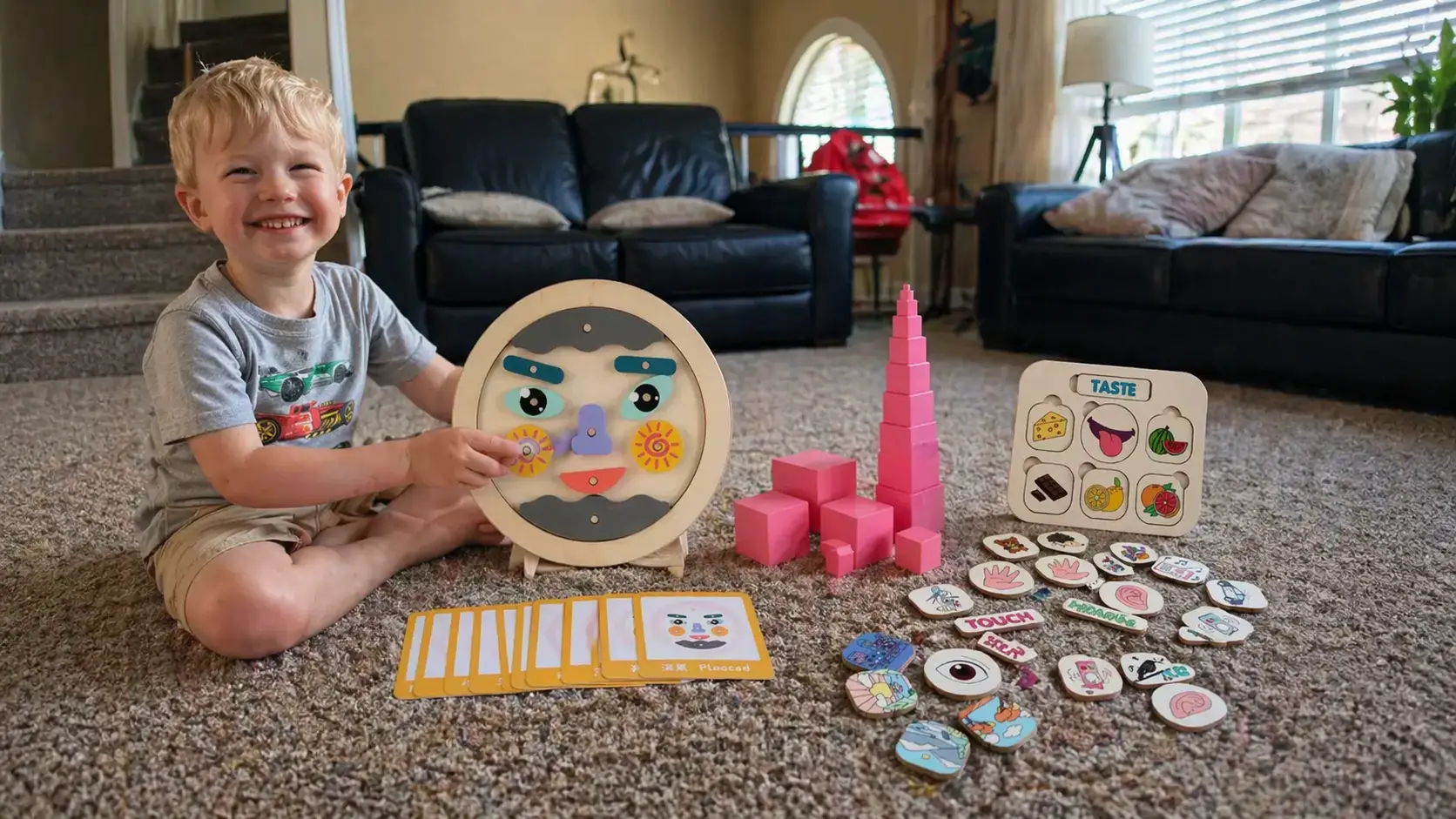
Most toy roundups for this age lump three years of development together and call it ‘3–6 years.’ This one doesn’t. At 4, specific developmental capacities are active — logical reasoning, pre-literacy investigation, tripod grip formation, structured rule-following play — and every pick in this guide responds to one of them. Organized by developmental domain, not by popularity.
| Best Montessori toys for 4-year-olds (summary): The best Montessori toys for 4-year-olds respond to the developmental priorities active at this specific age: the logical mind that arrived at 4 (why questions, cause-and-effect investigation, rule-following), the tripod grip forming in the hands (direct writing preparation), pre-literacy investigation of letters and symbols, and the emotional sophistication that can now handle perspective-taking and feeling-matching. 1. Montessori Toy Car Garage — spatial reasoning + narrative play (premium anchor) 2. Wooden Bead Threading Tray Set — tripod grip + fine motor endurance 3. Montessori Pink Tower — mathematical gradation + sensorial precision 4. Emotion Matching Face Puzzle — advanced emotional recognition 5. Wooden Montessori Music Percussion Set — auditory discrimination + ensemble play 6. Wooden Shape Sorter & Hammer Toy — dual-demand spatial + motor precision 7. Wooden Five Senses Learning Board — scientific classification + “why” exploration |
Your 4-year-old just asked you why the sky is blue, why the fish in the tank has to eat, and why it’s called a hammer when it doesn’t make ham. In the same ten minutes. This is not random curiosity — it is the logical mind arriving. At 4, the “why” question is the developmental headline, and the right toy feeds that investigation drive rather than just entertaining it.
Four is also the year when the three-finger grip that pencil-holding requires is forming in the hands — which means certain activities are doing writing preparation right now, whether or not they look academic. And it’s the year when emotional sophistication moves from naming feelings to reading them in others. All seven picks sit within the 3–6 developmental range — you can browse the full wooden Montessori toys for 3–6 year olds collection to see what else fits alongside these choices on your child’s shelf.
The 7 Best Montessori Toys for 4-Year-Olds
Seven picks covering seven developmental domains. Each assessed with the same framework: who it’s best for, why it works, and what to know before buying.
1. Montessori Toy Car Garage — Best for Structured STEM Play

Montessori Toy Car Garage
⭐ 4.99 | Best Seller | $266.99
BEST FOR: Four-year-olds who’ve graduated from open-ended vehicle play and now want rules, systems, and the satisfaction of making something work correctly.
WHY IT WORKS: Multi-level wooden garage with ramps, parking levels, and vehicle routing — fully child-directed, zero electronics. The ramp system introduces real physics: the same car released from different heights travels different distances. Multiple levels require spatial planning: “this car needs to go to the top floor, which means I use the ramp, which means I need to clear this space first.” That three-step planning sequence is executive function in action. Harvard’s research on executive function identifies planning, working memory, and cognitive flexibility as the three core capacities — all three are active in the car garage scenario at 4 in a way they are not at 3. The open-ended narrative layer — the garage becomes a city, a hospital, a space station — serves the symbolic thinking at full capacity at 4.
GOOD TO KNOW: At $266.99, the premium pick. Parents consistently report 30–45 minute daily sessions sustained over 12+ months. At that engagement level, cost per hour of developmental play is comparable to any item in this list. If budget is a constraint, this is the one to save for — the mismatch between its price and developmental depth is significant.
2. Wooden Bead Threading Tray Set — Best for Tripod Grip + Writing Preparation

Wooden Bead Threading Tray Set
⭐ 5.00 | $35.99
BEST FOR: Four-year-olds whose hands need the specific fine motor work tripod grip development requires — children showing interest in writing or drawing but whose grip is still inconsistent.
WHY IT WORKS: Wooden beads of varied sizes and colors with lacing cord. The motion of pushing the lace through a bead hole — repeated across a full threading session — develops the three-finger grip in a rotation neurologically close to pencil handling. At 4, this bridges the gap between grasping (well-established) and tripod precision (in formation). The pattern-making dimension — threading by color sequence, size sequence, alternating pattern — adds a mathematical mind challenge that makes the activity genuinely engaging.
GOOD TO KNOW: At $35.99, the highest value-per-developmental-impact pick in this guide. Perfect 5.00 rating.
3. Montessori Pink Tower — Best for Mathematical Gradation

Montessori Pink Tower
⭐ 5.00 | $35.99
BEST FOR: Four-year-olds in whom the mathematical mind is active — the child who spontaneously orders objects by size, lines things up by height, or becomes genuinely bothered when a sequence is wrong.
WHY IT WORKS: Ten solid wooden cubes from 1cm³ to 10cm³ graduated by a constant increment — the foundational Montessori sensorial material. Sensorially: the hand distinguishes the cubes by touch and weight before the eye confirms — building the sensorial discrimination that underpins handwriting. Mathematically: the constant increment introduces proportional thinking through physical handling before abstract numbers are required. Control of error: the tower falls if incorrectly sequenced — no adult feedback needed. The most authentically Montessori material in this guide — it appears in every AMI-certified primary classroom globally.
GOOD TO KNOW: At $35.99, one of the most accessible. Children return differently at 4 than at 3 — not just stacking, but measuring, comparing, building architectural combinations.
4. Emotion Matching Face Puzzle — Best for Advanced Emotional Recognition
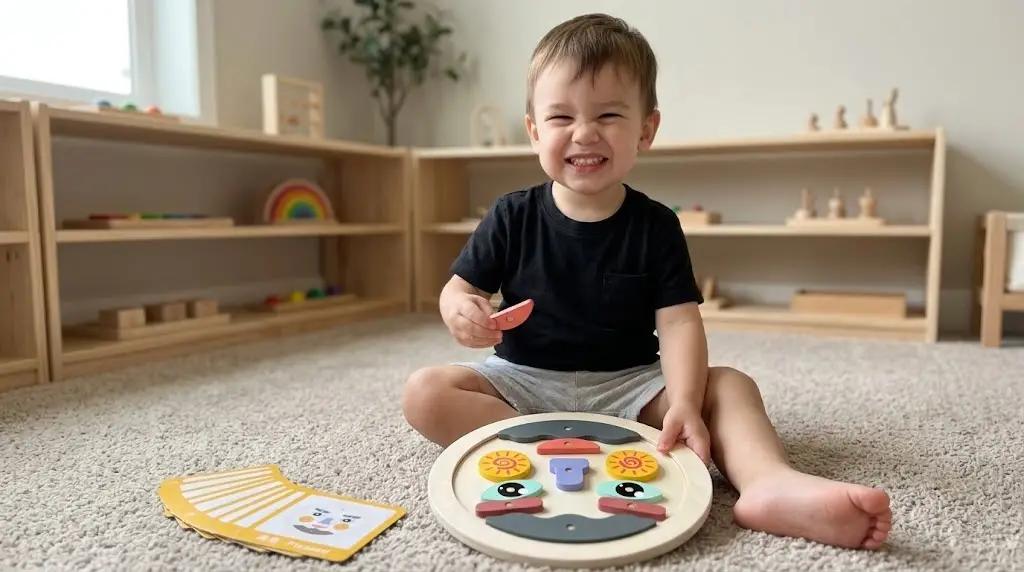
Emotion Matching Face Puzzle
⭐ 5.00 | $45.99
BEST FOR: Four-year-olds who can already name common emotions and are ready for the next layer: reading emotions in others, matching feeling to cause, understanding that the same event can produce different feelings in different people.
WHY IT WORKS: Wooden puzzle matching facial expression pieces to corresponding emotion states. The matching format requires holding two pieces of information simultaneously — the face AND the match — which requires working memory and perspective-taking, not just labeling. The social understanding that PNAS 2025 (Lillard et al.) found significantly stronger in Montessori children is built through exactly this kind of structured emotional recognition work. Puzzle format means control of error is physical: pieces only fit correctly.
GOOD TO KNOW: The right material for a 4-year-old who has graduated from a feelings wheel — for the child who knows what “frustrated” is and is now ready to understand what frustration looks like on someone else’s face.
5. Wooden Montessori Music Percussion Set — Best for Auditory Discrimination

Montessori Music Percussion Set
⭐ 5.00 | $50.99
BEST FOR: Four-year-olds who learn through sound — the child who taps rhythms on the table, notices when music changes tempo, hums while working. Also ideal for the first introduction to ensemble music: playing with someone else, listening, and responding.
WHY IT WORKS: Complete wooden percussion set — multiple instruments with varied timbres, no batteries, no preset sounds. The sound is produced entirely by the child’s precise physical action — active learning through the auditory modality. Each instrument requires a different playing technique (striking, shaking, scraping) — developing varied fine motor patterns simultaneously. The ensemble layer (playing with a parent or sibling) introduces social music: listening as an active skill.
GOOD TO KNOW: A full percussion set provides more developmental breadth than any single instrument. The varied timbres — wood vs. metal vs. membrane — give the auditory discrimination system the contrast it needs. At $50.99, the most complete music offering in the range.
6. Wooden Shape Sorter & Hammer Toy — Best for Dual-Task Development

Shape Sorter & Hammer Toy
⭐ 5.00 | $45.99
BEST FOR: Four-year-olds who have mastered basic shape sorting and need the next level: spatial problem-solving that simultaneously requires motor precision.
WHY IT WORKS: Wooden board where shapes must be identified, oriented correctly, AND hammered through matching holes — the spatial and motor demands happen at the same time. This dual-task structure develops between 3.5 and 5 years. Simple shape sorters are 2-year-old work. This version adds the hammering demand: identify shape, determine orientation, AND calibrate force. That three-step cognitive sequence develops the executive function that underlies later learning. The hammer element develops bilateral coordination (one hand holds steady; one strikes) and controlled force application.
GOOD TO KNOW: What makes this specifically right for 4 is the hammering demand — elevating it above the toddler version. Perfect 5.00 rating. At $45.99, strong value for multi-domain coverage.
7. Wooden Five Senses Learning Board — Best for Scientific Classification

Five Senses Learning Board
⭐ 5.00 | $35.99
BEST FOR: Four-year-olds in the full height of the “why” question phase — the child who asks how they know something is hot, why the dog can smell things they can’t, what “tasting” actually is.
WHY IT WORKS: A wooden learning board introducing the five senses with matching activities and classification challenges. The logical mind needs organizing frameworks — ways of categorizing the world that answer “why” questions systematically. The five senses provide exactly this: a classification system your child can immediately verify through their own body. Develops vocabulary precision (“smell” vs. “taste” is a meaningful distinction at 4), scientific observation habits, and the beginning of systematic thinking. Connects to the Cultural curriculum area of Montessori’s primary program.
GOOD TO KNOW: A category uniquely its own in this guide — zero overlap with any other pick. Perfect 5.00. At $35.99, the most accessible specialist pick. Pairs naturally with outdoor observation walks: “What do you sense right now? Can you use all five?”
Buying Guide — 4 Criteria for This Age
The word “Montessori” on a toy box doesn’t make it appropriate for a 4-year-old. Four criteria narrow the field.
1. Does it respond to what a 4-year-old is actively building? Tripod grip, logical causation, pre-literacy investigation, structured rule-following. If the toy doesn’t serve one of these, it may be right for a different age.
2. Does it have control of error built in? Can the child self-correct without adult feedback? A Pink Tower that falls when incorrectly sequenced is self-correcting. A toy that requires “good job!” to feel complete is not.
3. Is the child the agent, not the audience? If the toy can play itself — preset songs, automatic responses — the child is watching, not working. Montessori materials require the child’s action to produce any result.
4. Does it invite sustained work cycles? A 4-year-old with a correctly matched material stays with it for 15–20 minutes. Abandoned in under 3 minutes consistently = either mastered (too easy) or above current readiness (too hard).
What Makes 4 Different — The Developmental Portrait
Four is not 3-with-more-vocabulary. It is a qualitatively different developmental moment. Six capacities are opening simultaneously:
- The logical mind arrives. “Why” questions peak at 4 because logical causation — one thing causes another — is being actively constructed. Toys that make cause-and-effect visible feed this directly.
- Tripod grip is forming. The three-finger grip that pencil-holding requires develops between 3.5 and 5 years. Activities that develop this grip are doing writing preparation whether they look academic or not.
- Pre-literacy investigation begins. The sensitive period for language, active since birth, now reaches the symbolic layer — written symbols represent sounds. Letter-shape exploration becomes genuinely motivating.
- Structured play with rules emerges. A 3-year-old makes up rules mid-game. A 4-year-old wants rules to be consistent and honored — the beginning of game logic and social rule-following.
- Concentration extends. Correctly matched materials at 4 produce 20–30 minute sustained work cycles — the longest naturally occurring concentration window before formal schooling.
Scientific curiosity becomes systematic. A 4-year-old who asks why the heavier block falls faster is doing proto-science. The “why” question isn’t random — it’s the beginning of hypothesis-testing.
The buying implication: A toy responding to one or more of these six capacities produces sustained, self-directed engagement. A toy that doesn’t respond to any of them receives ten seconds of attention. These toys are the materials — the activities that activate them across all five curriculum areas at 4 show how each capacity translates into daily practice, from metal insets to the moveable alphabet.
| At 4, the shift I watch for is from mastery-seeking to rule-seeking — a child who was satisfied completing a puzzle at 3 now wants to invent rules for how the puzzle is done. That’s the logical mind, and it’s the signal that more structured, multi-step materials are ready. The wrong toy at this stage isn’t just boring — it genuinely can’t hold the concentration that becomes available at 4. – Katy Lenoir, Preschool & Elementary Expert (Ages 3–12) |
What NOT to Buy a 4-Year-Old
Every toy list tells you what to buy. Here is what the 4-year-old developmental stage specifically doesn’t need.
- Electronic learning tablets. The tripod grip develops through resistance-based physical manipulation. Screen tapping provides no resistance, no weight, no texture. At precisely the age when writing preparation is most active, screens cannot contribute.
- Coloring books with pre-drawn lines. A 4-year-old’s symbolic thinking and creative expression are both at capacity. Pre-drawn lines tell them their ideas are secondary. Blank paper and open-ended art materials serve this moment; coloring books don’t.
- Simple shape sorters and basic stacking toys. These serve the 2-year-old’s work. At 4, they’re mastered within seconds. The engagement signal: 10 seconds, not 20 minutes. Mastered = outgrown.
- Toys with only one outcome. The logical mind is testing rules and variations. A toy with a single correct answer and no variation stops being interesting after one correct completion.
Frequently Asked Questions
- What are the best Montessori toys for a 4-year-old?
Toys responding to the specific developmental capacities active at 4. For STEM and spatial reasoning: the Montessori Toy Car Garage. For tripod grip preparation: the Wooden Bead Threading Tray Set. For mathematical gradation: the Montessori Pink Tower. For advanced social-emotional development: the Emotion Matching Face Puzzle. For auditory discrimination: the Music Percussion Set. For dual-task cognitive-motor development: the Shape Sorter & Hammer Toy. For scientific classification: the Five Senses Learning Board.
- How is 4 different from 3 developmentally for toy selection?
Three-year-olds are in the symbolic thinking phase — blocks become cars, cooking sets become restaurants. Four-year-olds have moved into the logical mind phase — they want cause-and-effect to be consistent, rules to be followed, systems to make sense. At 3, open-ended narrative toys with minimal structure produce deepest concentration. At 4, materials with more steps, complexity, and structured challenge — ramp systems, matching puzzles, graduated towers — match what the brain is actively seeking. A 4-year-old given only 3-year-old materials will consistently appear bored or restless. The age-organized collections are filtered by developmental stage — so the shelf is pre-matched to what a 4-year-old’s brain is actively building rather than a broad “3–6” range.
- What Montessori materials are introduced at 4 in a classroom?
In AMI-certified primary classrooms (3–6), 4-year-olds typically engage with: the Pink Tower and Brown Stair (sensorial gradation and mathematical preparation), threading and lacing for tripod grip development, emotion matching for social-emotional work, the beginning of sandpaper letter exploration for pre-literacy, practical life sequences with real tools at increasing complexity, and structured sensorial classification including sound discrimination and texture matching. The home equivalents are exactly the materials in this guide.
- What is the Montessori Pink Tower for?
The Pink Tower is one of the foundational sensorial materials in the Montessori primary curriculum (ages 3–6). Ten solid wooden cubes graduated by a constant increment from 1cm³ to 10cm³. Its purposes: sensorial discrimination (the hand distinguishes size through touch and weight), mathematical gradation (the constant increment introduces proportional thinking through physical experience), and control of error (the tower falls if incorrectly sequenced — self-correction without adult feedback). At 4, the mathematical mind finds genuine challenge in the precision the tower requires.
Your 4-Year-Old Is Telling You What They Need
That child who won’t stop asking “why” isn’t being difficult — they’re showing you exactly where their brain is headed. The one lining up every object in the house by size? That’s the mathematical mind at work. The one whose drawings suddenly look intentional? Their hands are ready for more.
You don’t need all seven picks on the shelf at once. Start with the one that matches what your child is already doing — the investigation they’re already running without any adult direction. Put it on the shelf, step back, and watch what happens over the next few days. The concentration that shows up when a material meets a developmental moment in progress is unmistakable. You’ll know it when you see it.
Happy Shopping,