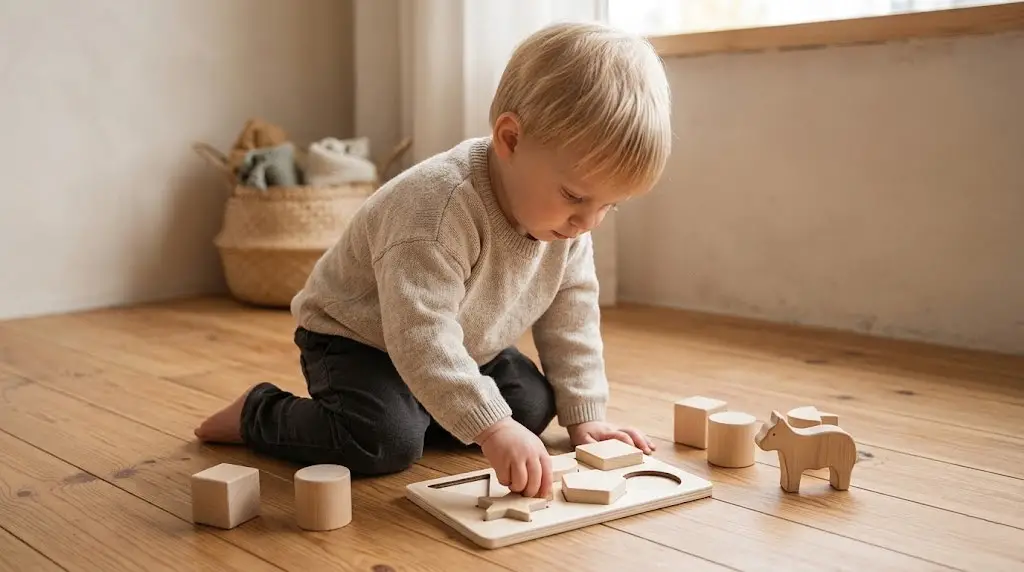
Your 2-year-old has been given a box of wooden blocks. No instructions, no right answer. Within two minutes they’ve built a tower, knocked it over, lined the blocks up like cars, and now they’re using one as a phone. You didn’t tell them to do any of this. The toy asked nothing — and they did everything. That’s open-ended play.
Understanding how it actually fits into the Montessori approach — which most guides get wrong — will change how you think about every toy you buy from Kukoo Montessori or anywhere else.
What are Montessori open-ended toys?
Materials with no predetermined correct use — the child decides what they become and how they’re used. Wooden blocks can be a building, a vehicle, food, or a road. Unlike closed-ended Montessori materials (puzzles, shape sorters) which have one correct use, open-ended materials develop imagination, symbolic thinking, and divergent problem-solving. Both types belong in a Montessori home. The balance between them is what this guide is about.
What Makes a Toy Open-Ended?
The simplest test: hand it to your child without instructions. If they can use it in at least 3 completely different ways — it’s open-ended. But open-endedness is a spectrum, not a switch:
| Toy Type | Open-Endedness | Child Contribution |
| Electronic toy with preset sounds | Minimal | Child reacts |
| Puzzle (close-ended Montessori) | Low | Child solves |
| Wooden stacking rings | Medium | Child decides approach |
| Unit blocks | High | Child creates |
| Loose parts (stones, shells) | Maximum | Child invents everything |
Montessori-aligned open-ended materials share 4 characteristics:
1. Natural materials — wood, metal, stone, fabric. Real weight, real texture. Natural toys provide richer sensory feedback — the material properties of wood vs plastic explain why weight and texture matter for hands-on manipulation.
2. Child-directed — no adult scripting needed. Temple University research on what makes toys developmentally effective, led by Dr. Kathy Hirsh-Pasek, offers a simple benchmark: “The best toys are 90% child and 10% toy.” Open-ended materials embody this.
3. Reality-anchored (for under 6) — realistic wooden animals over fantasy characters. Natural loose parts over plastic abstractions. Real-world anchors let children build authentic knowledge while imagining.
4. Calm aesthetics — no character branding, no sensory overwhelm. A generic wooden cylinder can be anything; a licensed character can only be that character.
What Open-Ended Toys Actually Develop

- Symbolic thinking: When a block becomes a car, your child holds the block’s real identity AND its imagined identity simultaneously. This dual representation is one of the most important cognitive capacities that underpin later mathematical and literacy skills — it emerges around 18 months and deepens significantly at 2.5–3.
- Divergent thinking and executive function: The same block becomes 20 different things in one session — that’s divergent thinking practice. AAP Pediatrics (2025) confirmed play that is “intrinsically motivated and entails active engagement” directly builds executive function: planning, working memory, cognitive flexibility. PNAS 2025 (Lillard et al.) found Montessori environments — which include both close-ended and open-ended materials — produced better cognitive skills and executive function at kindergarten entry. Open-ended materials naturally create the back-and-forth exchanges that drive language brain development — because when the toy is silent, the parent and child fill the space together
- Deep, sustained attention: Dauch et al. (2018): toddlers with 4 toys played twice as long and more creatively than those with 16. Open-ended materials don’t have a finite completion state, so children set their own challenge level continuously. The “deep play” state — when your child doesn’t notice you entering the room — is almost always happening with open-ended materials or mastery-stage close-ended work.
The Biggest Misconception About Montessori and Open-Ended Toys
Most content claims Montessori is about open-ended play. It isn’t.
- Authentic Montessori classroom materials are predominantly close-ended — each has a specific purpose, a correct use, and a built-in self-correcting mechanism — the core Montessori design question is always whether the child or the toy does the developmental work, and close-ended materials answer it by demanding precision from the child. A knobbed cylinder fits one hole. A Pink Tower arranges in one correct sequence. This precision is Montessori’s isolation of quality principle: one concept at a time, no distracting variables. AMI-trained sources confirm this consistently — as one trained Montessorian puts it: “Montessori classrooms and homes are primarily comprised of close-ended materials.”
- So where do open-ended materials fit? The Montessori home is more flexible than the classroom. Close-ended materials build specific skills through mastery. Open-ended materials build imagination and divergent thinking through freedom. Neither alone is sufficient. The distinction between open-ended and close-ended is central to understanding what actually defines a Montessori toy — four design principles separate genuine Montessori materials from toys that just carry the label, and both close-ended and open-ended materials can satisfy all four. A child with only close-ended materials masters tasks but may not develop rich imaginative capacities. A child with only open-ended materials gets creativity but misses the satisfaction of purposeful mastery. The developmental logic follows the Montessori method: both, in balance.
- The timing matters: Open-ended materials become most valuable from roughly 2.5 years onward, when symbolic play activates. Under 18–24 months, close-ended sensorial materials are typically more developmentally matched.
| In the toddler communities I’ve supervised, I always set up shelves with both types side by side — a three-piece inset puzzle next to a small basket of wooden rings and silk scarves. What I see over and over is a child completing the puzzle twice, setting it back on the shelf, then immediately pulling the basket down and draping the scarf over the rings to make ‘a family sleeping.’ It’s the same 20-minute work cycle, but two completely different kinds of concentration. When I train new teachers, I tell them: watch for the switch. The child isn’t losing focus — they’re choosing what their brain needs next. — Zoe Paul, AMI Teacher Trainer (Birth to 3) |
Open-Ended Toys by Age — What’s Right When
0–18 Months: Sensorial Open-Endedness
Close-ended materials dominate. Open-ended contribution here is sensorial variety through different weights, textures, and shapes to grasp, mouth, and explore. The symbolic capacity for imaginative open-ended play hasn’t activated yet. Pure imaginative play with figurines is developmentally premature at this age.
18 Months–3 Years: Symbolic Play Begins
The switch: your child can now look at a wooden cylinder and decide it’s a person, a car, or a tower. Open-ended materials become genuinely powerful.
Best picks: Wooden People Balance Stacking Set ($30.99) — balance challenge + character narrative. Multicolor Balancing Stones ($39.99) — sorting, stacking, color patterns. 100 Creative Wooden Building Blocks ($45.99) — the foundational open-ended building material. Browse the full stacking toys and balance toys collections for more options. Shelf balance at this age: ~60% close-ended, ~40% open-ended.
3–6 Years: Peak Open-Ended Play

Symbolic thinking fully active. Children sustain complex narratives, assign roles, use materials symbolically across extended sessions.
Best picks: Wooden Rainbow Stacking Stones ($45.99) — maximum open-endedness for sorting, art, and narrative. Building blocks — the richest open-ended material for 3–6. Car toys used narratively — wooden vehicles as characters in child-invented city scenarios. Shelf balance: ~50/50, shifting toward more open-ended by age 5. Browse our 3–6 year-old toy collection for the full range
| Parents on my courses often say, ‘She just messes around with the blocks.’ I ask them to describe it. Usually it’s something like: she stacked three, knocked them down, then lined them up and whispered to each one. That’s not messing around — that child assigned identity to an object and sustained a private narrative. The deepest cognitive work in a toddler room doesn’t always look productive to adults. It looks like ‘just playing.’ — Zoe Paul, AMI Teacher Trainer (0 – 3) |
How to Balance Open-Ended and Close-Ended on Your Shelf
| Age | Close-Ended | Open-Ended | Example |
| 0–18 months | ~70–80% | ~20–30% | Sensorial baskets (OE) + puzzle work (CE) |
| 18 months–3 years | ~60% | ~40% | Blocks + figurines (OE) + matching/sorting (CE) |
| 3–5 years | ~50% | ~50% | Building + animals (OE) + Pink Tower + math (CE) |
| 5–6 years | ~40% | ~60% | Loose parts + building (OE) + writing prep (CE) |

The anchor rule: Keep 1–2 materials producing deep engagement on the shelf — either type. Rotate everything else. Dauch et al. (2018): 4 toys produced twice the play quality of 16. Fewer options, deeper engagement. Shelf setups change significantly across each age bracket from 0 to 6 — fewer items, rotated more intentionally.
Red flags when buying “Montessori open-ended” toys: Electronic components (toy does the work, not the child). Character branding (constrains narrative). Cheap plastic (no sensory richness). “40 activities in one” (overwhelming choice negates focus). Fantasy-based without real-world anchor for under 6.
Your Questions Answered
- What are Montessori open-ended toys?
Materials with no predetermined correct use — the child decides what they become. Wooden blocks, figurines, natural loose parts. They develop imagination, symbolic thinking, and divergent problem-solving. Both open-ended and close-ended materials belong in a Montessori home.
- Are Montessori toys open-ended or closed-ended?
Authentic Montessori classroom materials are primarily close-ended — one correct use, self-correcting. A Montessori home appropriately includes both. The ratio of open-ended increases from ~20% under 18 months to ~60% by age 6.
- What are examples of Montessori open-ended toys?
Wooden unit blocks, realistic figurines (animals, people, vehicles), natural loose parts (stones, shells, rings), stacking stones, rainbow stackers, art materials (clay, paint). All share: natural materials, no electronics, no predetermined story.
- What’s the difference between open-ended and closed-ended Montessori toys?
Close-ended: one correct use, self-correcting, builds specific skills (puzzles, Pink Tower). Open-ended: no correct use, child decides everything, builds imagination and creativity (blocks, figurines). Both are valuable. Close-ended is the classroom core; open-ended is most powerful in the home from 18 months onward.
- At what age should I introduce open-ended toys?
Simple sensorial exploration from birth. Genuinely imaginative open-ended play from 18–24 months, when symbolic thinking emerges. Ages 3–6 are the peak window. Balance shifts naturally toward more open-ended as your child’s imagination develops.
- Are wooden blocks Montessori open-ended toys?
Yes — one of the most validated open-ended materials. They serve a 12-month-old (stacking), a 2-year-old (buildings), a 4-year-old (complex narrative architecture), and a 5-year-old (geometric exploration). Exceptional developmental longevity.
- How many open-ended toys does a child need?
Fewer than you think. One to two anchor materials on the shelf at a time, rotated every 2–3 weeks. Fewer options = deeper engagement.
Not Open-Ended OR Montessori — Both
Those blocks your child turned into a phone and a road — that was open-ended play at its most productive. Montessori is not synonymous with open-ended. Most Montessori classroom materials are deliberately close-ended. But a complete Montessori home needs both — close-ended for mastery, open-ended for imagination. The balance shifts as your child develops, tilting toward open-ended through ages 2–6.
The test that cuts through all the marketing: “Who does the work — my child, or the toy?” If your child does the work and can use the material in at least three genuinely different ways, it’s open-ended. That’s the test.
Start with one basket of blocks and one close-ended puzzle — and watch which one your child returns to first. That answer will tell you everything about where they are right now.