
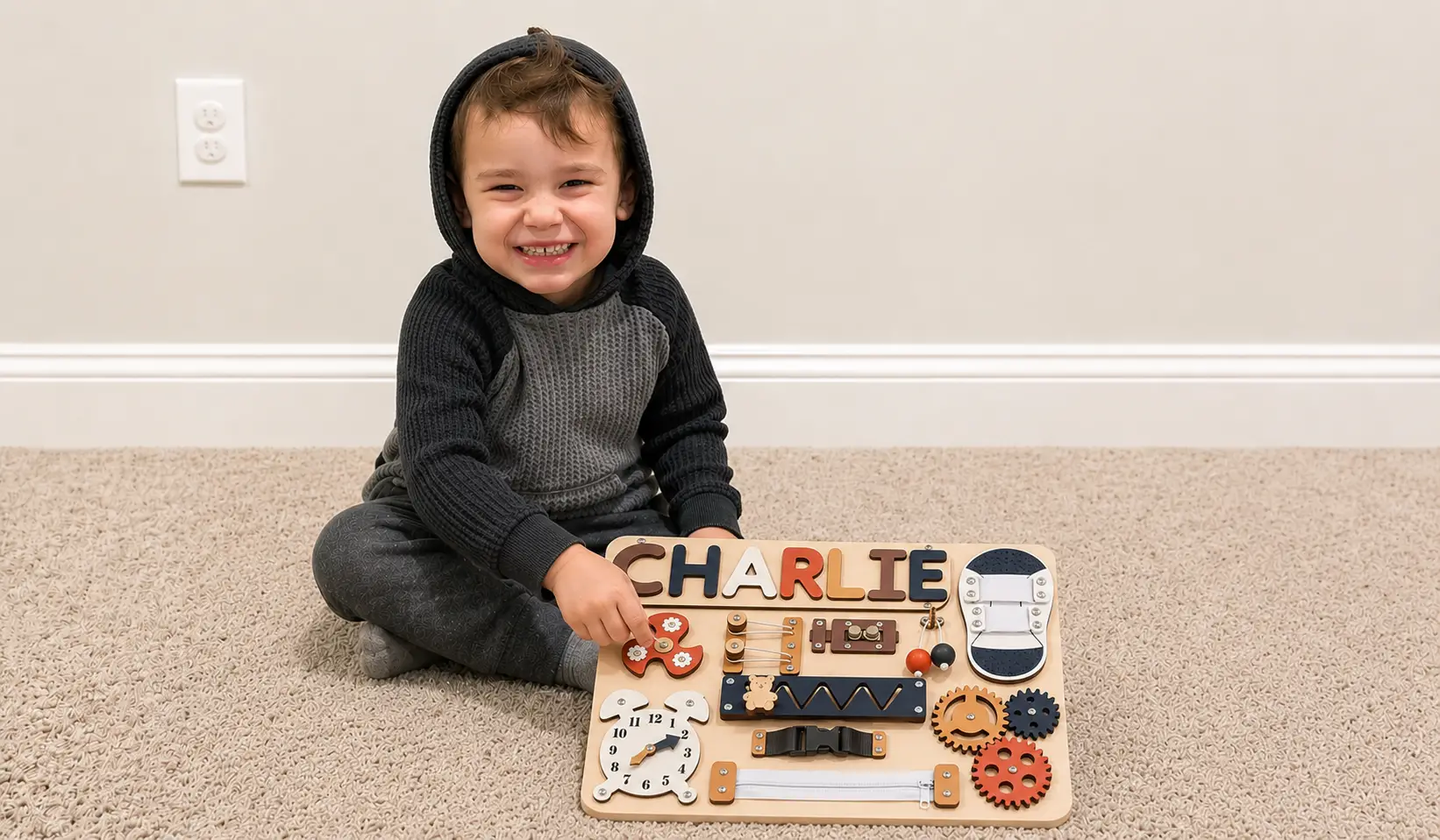
Most busy boards say “ages 1–3” on the box. That’s a three-year window. A 12-month-old and a 35-month-old are in completely different developmental worlds — the board that frustrates a 10-month-old will bore a 3-year-old, and the one that’s perfect at 18 months gets abandoned by 30.
Age isn’t just a safety recommendation. It determines which mechanisms your child can actually use, which ones build the right skills right now, and which ones are simply not ready to be touched yet.
This guide maps busy board by age — not the box range, but the real developmental windows: what each stage is ready for, what it gets from each mechanism, and when it’s time to rotate the board off the shelf.
Busy Board by Age Guide
| Age | Ready? | Best Features | Avoid |
| 6–12 mo | Yes (supervised) | Soft textures, bead rails, large fabric tabs | Small parts, multiple stimuli at once |
| 12–18 mo | Peak introduction | Large zippers, chunky latches, velcro | Electronic lights/sounds, tiny buttons |
| 18–24 mo | Peak use | Full zippers, snaps, slide bolts | Flimsy construction, unclear objectives |
| 2–3 yr | High engagement | Buckles, padlocks, shape-matching, gears | Tasks too simple → boredom |
| 3–4 yr | Advanced stage | Shoelaces, small buttons, gear systems | Overly electronic versions |
| 4+ yr | Transitioning out | Real clothing fastenings replace the board | Holding on past developmental need |
| The most common mistake I see: giving a 14-month-old a board designed for a 3-year-old. The result isn’t learning — it’s shutdown. The sections below are organized by behavioral readiness, not just birthday candles. — Zoe Paul, AMI Teacher Trainer (0-3) |
Is a Busy Board Right for Your Child’s Age?
A busy board is a hands-on activity panel with latches, zippers, buttons, and textures designed to build practical life skills and fine motor development in children ages 6 months to 4 years. In Montessori terms, it’s a home-friendly practical life environment — real mechanisms, self-correcting outcomes, child-directed exploration.
Not all busy boards are equal. A board matched to your child’s current stage produces deep, returning engagement. A mismatched one gets ignored. Use the sections below as a buying and readiness checklist.
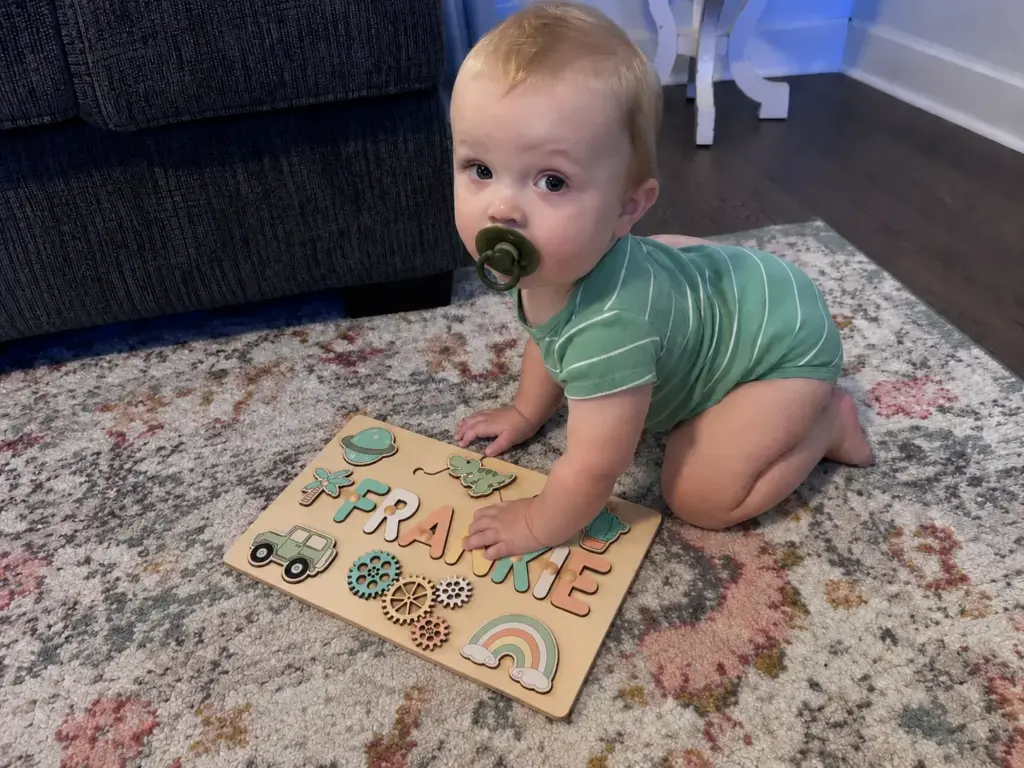
Infant Busy Board for 6–12 Month Olds
When Your Baby Is Ready
Watch for behavioral cues, not calendar dates: reaches for objects with intent (not reflex), transfers objects hand-to-hand, mouths less and manipulates more (usually 8–10 months), sits supported with both hands free.
What to Look For
Soft fabric panels with varied textures (cotton, felt, crinkle). Large bead rails or ring-pull tabs — no loose beads. High-contrast colors or natural wood tones. Zero small detachable parts (choking threshold: under 1.75 inch diameter). Wipeable or washable fabric elements. Bonus: mirror element for self-recognition (emerges ~8–9 months).
What to Avoid
Electronic lights and sounds — overstimulation interrupts self-directed focus. Too many features at once — sensory overload signals include looking away, arching back, fussiness. Plastic construction — the sensory difference from wood matters more at this stage than at any other developmental window.
Engagement Time
Realistic expectation: 3–8 minutes independent exploration, up to 12–15 minutes with light parallel engagement from you. Start with 2–3 elements visible and cover the rest — the Montessori toys for 0–12 months that match this window follow the same ‘less is more’ principle across all materials at this stage
Busy Board for 1 Year Old: 12–18 Months
Why This Is the Sweet Spot
The pincer grip refines between 12–14 months (AAP milestone). Object permanence consolidates. Cause-and-effect schema is hungry for input. This is the age where a busy board stops being a texture toy and starts being a problem to solve. Your child moves from mouthing to intentional manipulation — and the Montessori toys for 1-year-olds that match this shift extend the same problem-solving principle beyond the busy board.
Readiness Signals
Deliberately pulls at clothing fasteners. Opens and closes containers repeatedly. Points with index finger (precision digit engagement active). Tolerates sitting for 5+ minutes with a chosen object.
What to Look For
Large-pull zippers (D-ring or fabric tab, not metal sliders). Chunky latch mechanisms (~3-inch clearance). Velcro tabs (satisfying tactile + auditory feedback). Knobs and dials at least 1 inch diameter. Bead wire/abacus element (lateral push, not threading). Solid wood construction, rounded edges, non-toxic finish — EN71 or ASTM F963 certified.
What to Avoid
Shoelaces, small buttons, key-lock systems — developmentally ahead, produces frustration not challenge. Boards designed for 3+ years marketed as “12 months+” — check actual feature complexity. Multiple elements with no visual separation — choose boards where each activity has clear visual boundary.
Engagement Time
Expected: 8–15 minutes focused independent play. This is the age parents often describe as the board finally “clicking” — you leave the room and come back to find your child still on the same latch.
Busy Board for Toddlers: 18–24 Months
Why This Is Peak Busy Board Age
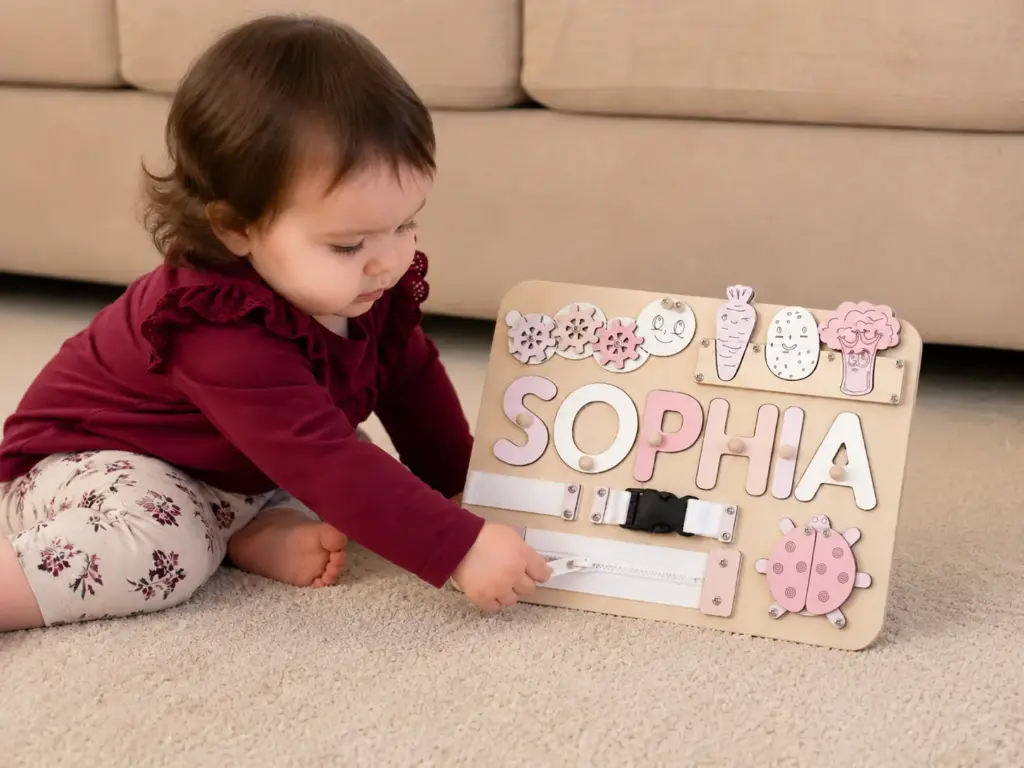
Pincer grip now refined. Wrist rotation emerging. Bilateral coordination developing. The Sensitive Period for Practical Life is at full intensity — Maria Montessori described 18–36 months as the sensitive period for order and practical life. The autonomy drive peaks (‘me do it’) — a busy board channels this without power struggle, and the Montessori toys for 2-year-olds at this stage are built around exactly that same drive.
Readiness Signals
Actively attempts to dress/undress. Frustrated by tasks they can’t complete (reaching for real zippers, adult keys). Sustained attention 10+ minutes on self-chosen activity. Uses two hands cooperatively.
What to Look For
Standard metal zippers (pull tab accessible). Snap systems (press-and-release). Slide bolts and barrel bolts. Toggle buttons (large, 1+ inch). Simple D-ring buckle (no tongue-and-hole yet). Board size minimum 12”×12” for two-hand operations. Natural wood + metal construction for tactile realism.
What to Avoid
Shoelace elements — finger strength and bilateral sequencing not ready. Gear systems with multiple interlocking parts — cognitive load too high at 18 months (fine by 24). Boards that light up or make sounds — the external reward interrupts intrinsic satisfaction of task completion.
Engagement Time
Expected: 12–20 minutes, can reach 30+ during sensitive periods. Tip: rotate visible activities (cover half the board) to reset novelty — extends engagement by weeks, not days.
| I watched a 19-month-old work the same zipper 14 times in a row — not because anyone encouraged her, but because it hadn’t fully submitted to her yet. That’s the Sensitive Period in its clearest form. The board provides the problem. The child provides the persistence. The adult’s job is to not interrupt either. — Zoe Paul, AMI Teacher Trainer (0-3) |
Busy Board for 2 Year Old
What Changes at 2
Finger strength consolidates — stiffer mechanisms are now accessible. Language intersects: your child names parts, describes actions — the board becomes a conversation anchor. Frustration tolerance increases — multi-step tasks become possible.
What to Look For
Belt-style buckles (tongue-and-slot). Padlock with oversized key. Latch-and-hook systems. Basic gear wheel pairs (2–3 interlocking). Number dial elements (1–5 range). Still defer: shoelaces, combination locks, fine-needle elements.
The “Too Easy” Problem
Red flag: your child completes all elements in under 2 minutes and walks away. The board should have at least 2 activities requiring multiple attempts. If introduced at 12 months, 2 years is often time to evaluate upgrading.
Busy Board for 3–4 Year Olds

What’s Different at This Stage
Pre-writing fine motor skills active: three-jaw chuck grip, isolated finger movements. Self-care motivation: your child wants to dress independently — the board becomes rehearsal space. Mastery play: some children time themselves, repeat to “beat their record.”
What to Look For
Shoelace board (loop stage only, not full bow). Small buttons (½ inch diameter). Multi-gear systems (3–5 interlocking). Combination-style dial (shape or color matching). Zipper with fine metal slider (no pull tab). Clock face with moveable hands. Smaller board format acceptable — fine motor precision is higher now.
Is a Busy Board Still Worth It?
Yes, for: children still mastering self-care tasks, travel/waiting contexts, children who benefit from sensory regulation. Less necessary when: your child can button their own shirt and zip their own jacket. At that point, real clothing IS the busy board.
When Your Child Outgrows the Busy Board
Signs They’ve Moved On
Completes entire board in under 60 seconds without interest in repetition. Reaches for real objects instead — velcro shoes, actual cabinet latches. Ignores the board for 3+ weeks consistently. Real clothing self-dressing is competent (all buttons, all zippers).
What Happens to the Skills
The board doesn’t end learning — it graduates it. Skills transfer to: getting dressed independently, opening school lunch containers, managing bag closures, helping with younger siblings. The Montessori principle: busy board is a bridge to real practical life.
Transition Strategies
Don’t abruptly remove — let your child naturally disengage. Swap into car/travel rotation as novelty extends interest. If gifting onward: boards at this stage are ideal for younger cousins or siblings — full lifecycle value.
Busy Board by Age: Safety Tips
- Choking hazard threshold: Any part passing through a 1.75-inch (44mm) circle is a choking hazard for under 3. Check fabric loops, beads, key fobs, small dial spinners. Look for ASTM F963 (US) or EN71 (EU/UK) certification.
- Age-specific notes: 6–12 months: always supervised, no detachable elements, no string over 7 inches. 12–24 months: check bead rail security monthly (wood screws loosen with heavy use). 2+ years: supervise padlock key elements (swallowable if separated).
- The overstimulation risk: Boards with 20+ features simultaneously visible can cause sensory overload in children under 18 months. Signs: fussiness, looking away, pushing the board. Solution: cover unused sections with a cloth panel until your child is ready.
Your Questions Answered
What age should I introduce a busy board?
Six months is possible with supervision. 12–15 months is the developmental sweet spot — pincer grip refining, cause-and-effect schema active, Sensitive Period for Practical Life opening. The best signal is behavioral readiness (intentional reaching, hand-to-hand transfer), not the calendar.
Is a busy board too young for a 6-month-old?
Not necessarily — with supervision and a board limited to soft textures and large bead rails. Keep sessions short (5–10 minutes) and watch for fatigue cues. The risk is overstimulation, not danger, when the board is age-appropriate and certified.
What’s the difference between a busy board for 1 year old vs 2 year old?
At 1: large, chunky, simple mechanisms (bead rails, velcro, single-pull zippers). At 2: add stiffer latches, buckles, padlocks. Feature complexity and mechanism resistance should increase with finger strength.
How long should a toddler play with a busy board?
No target time — the goal is uninterrupted, self-directed engagement. Most toddlers 14–24 months sustain 10–20 minutes on a well-matched board. Dauch et al. (2018) found children with focused play materials engage significantly longer per session.
Can I use the same busy board from 1 through 3 years?
Yes — if the board has a range of mechanism complexity. Easier elements (velcro, large zippers) for a 1-year-old, harder elements (buckles, padlocks) that become relevant at 2–3. The key signal: if your child completes everything in under 60 seconds, they’ve outgrown it. At least 2–3 mechanisms should still challenge them.
The Right Board for Right Now
The right busy board for your child isn’t the one with the widest age range on the box — it’s the one matched to where their hands and attention actually are right now.
That match looks different at every stage. At 12 months, it’s a board with one or two mechanisms your child can partially figure out. At 24 months, it’s a board complex enough to hold 20 minutes of independent focus. At 3 years, it’s something that still offers a challenge — or it’s time to move it off the shelf entirely.
Every child’s timeline is different, and behavioral readiness will always matter more than the number of birthday candles. Trust what you observe over what the box says.
When you’re ready to choose, Kukoo’s wooden busy board collection is organized around exactly this principle — each board matched to the developmental stage it’s actually built for.