
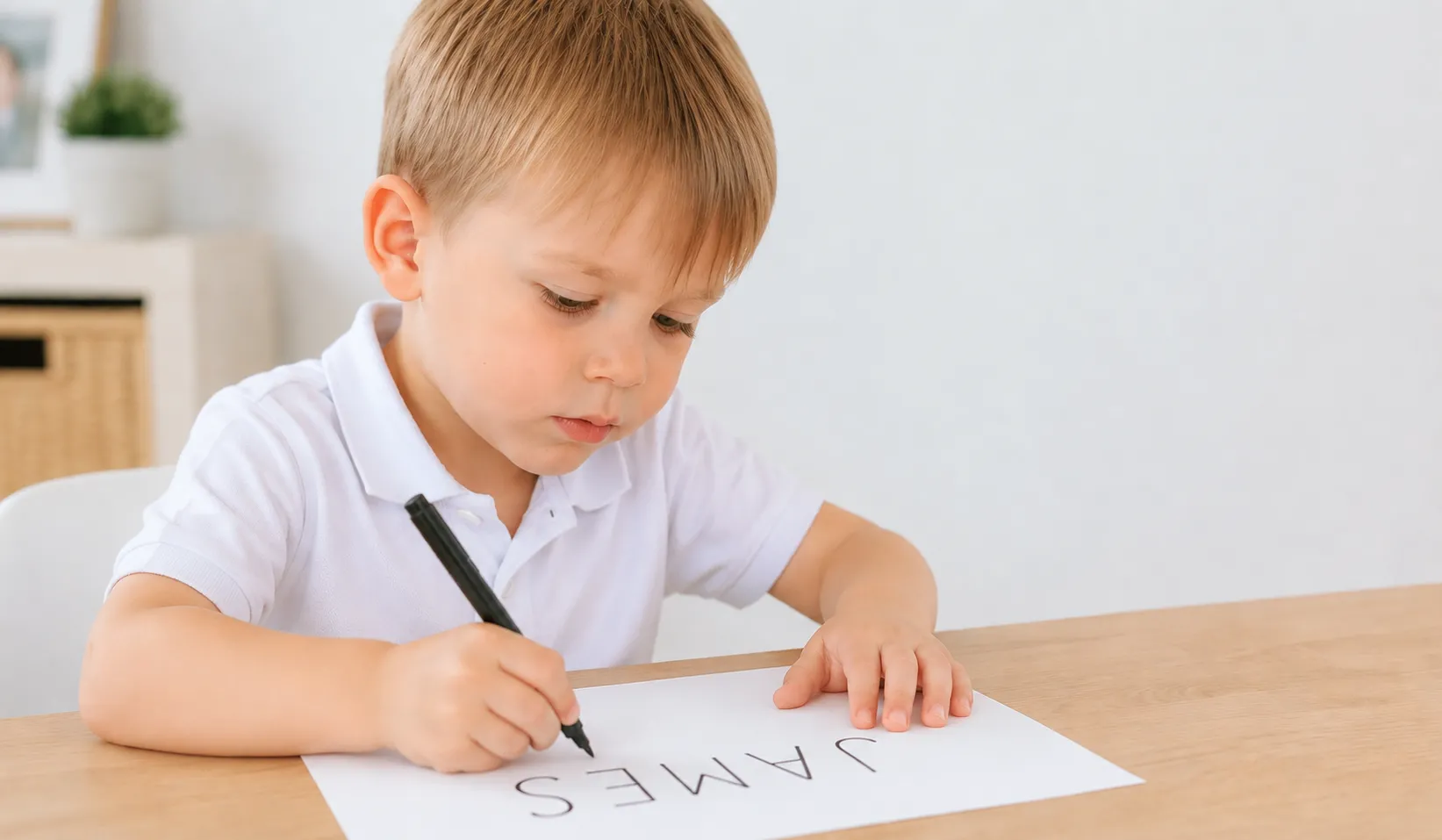
Your 4-year-old picked up a pen and wrote their name. You didn’t teach them. You didn’t drill them. You’ve been doing sandpaper letters and the moveable alphabet for six months — and one morning, they just wrote it. That’s not a coincidence. That’s the sensitive period for writing doing exactly what Maria Montessori described: preparation accumulates invisibly, then surfaces as something that looks like a gift.
Age 4 is when Montessori activities shift from building foundations to activating them. The sensitive period for writing peaks here. Children who’ve done the right preparation often begin writing spontaneously — not because they were taught, but because their hand finally caught up with what their mind has been ready for. This guide maps every activity to where it sits in that preparation sequence, so you know what to offer, and when.
| Montessori activities for 4-year-olds are organized across five curriculum areas — Practical Life, Language, Math, Sensorial, and Cultural — with particular emphasis on writing readiness, because age 3.5–4.5 marks the peak of the sensitive period for writing, during which children who have received adequate preparation often begin to write spontaneously without formal instruction. |
The Sensitive Period for Writing — Age 4’s Most Important Window
Maria Montessori documented what she called the ‘explosion into writing’ — the moment when children who have completed the preparation suddenly begin to write spontaneously, with evident joy and without instruction. This typically occurs between 3.5 and 4.5 years, and it is the result of systematic indirect preparation, not direct writing instruction.
The Four-Stage Preparation Sequence
| Stage | Activity | What It Builds | Age Window |
| 1 | Sandpaper letters (sounds + letter forms) | Phonological awareness + muscle memory of letter shapes | 3–4 yr |
| 2 | Metal insets / shape stencils | Dynamic tripod grip + controlled pencil movement | 3.5–4.5 yr |
| 3 | Moveable alphabet (composing words without writing) | Phonetic encoding — child spells before hand is ready | 3.5–4.5 yr |
| 4 | First spontaneous writing | Integration of sound, symbol, and motor — explosion | 4–5 yr |
Why Skipping the Preparation Backfires
Children given pencils and worksheets before completing Stages 1–3 learn to write their name by copying — visual memory, not phonetic understanding. They may write “correctly” but cannot read back what they wrote because the symbol-sound connection was never made. The Montessori sequence builds writing from the inside out: sound → symbol → muscle movement. Worksheet practice builds it from the outside in: copy → memorize → (sometimes) understand later.
| In my experience working with children across the 3–12 age range, the year that surprises parents most is always the fourth. A child who spent age 3 doing practical life and sensorial work arrives at 4 ready for the moveable alphabet, the golden beads, and real sewing — because the foundation is already there. The activities in this guide assume that foundation. – Katy Lenoir, Preschool & Elementary Expert (3–12) |
Language Activities — The Writing Readiness Curriculum
Language activities at 4 are not separate from writing activities — they ARE writing activities. Each one prepares a different component of the act. The sequence builds from phonological awareness to first word composition.”
Metal Insets — Controlled Pencil Movement (HowTo)
- What it develops: Dynamic tripod grip, controlled pencil movement along edges, visual-motor integration at writing scale.
1. Choose one simple shape (square or circle for first introduction).
2. Place frame on paper; trace around interior edge with pencil — hold frame steady with non-dominant hand.
3. Lift frame; remove insert; place insert within traced outline.
4. Trace around insert’s edge — this produces a second, slightly smaller outline.
5. Fill interior with parallel pencil lines — slow, deliberate strokes.
6. Slide toward child; step back. No corrections to pencil grip — the task demands precision, and the grip will self-correct.

- Why this is the critical activity at 4: The metal inset builds the exact muscle coordination for writing without requiring letter formation. The hand trains before the symbol is introduced to it.
Moveable Alphabet — First Word Composition (HowTo)
- What it develops: Phonetic encoding, symbol-sound connection, pre-reading, spelling without motor demand.
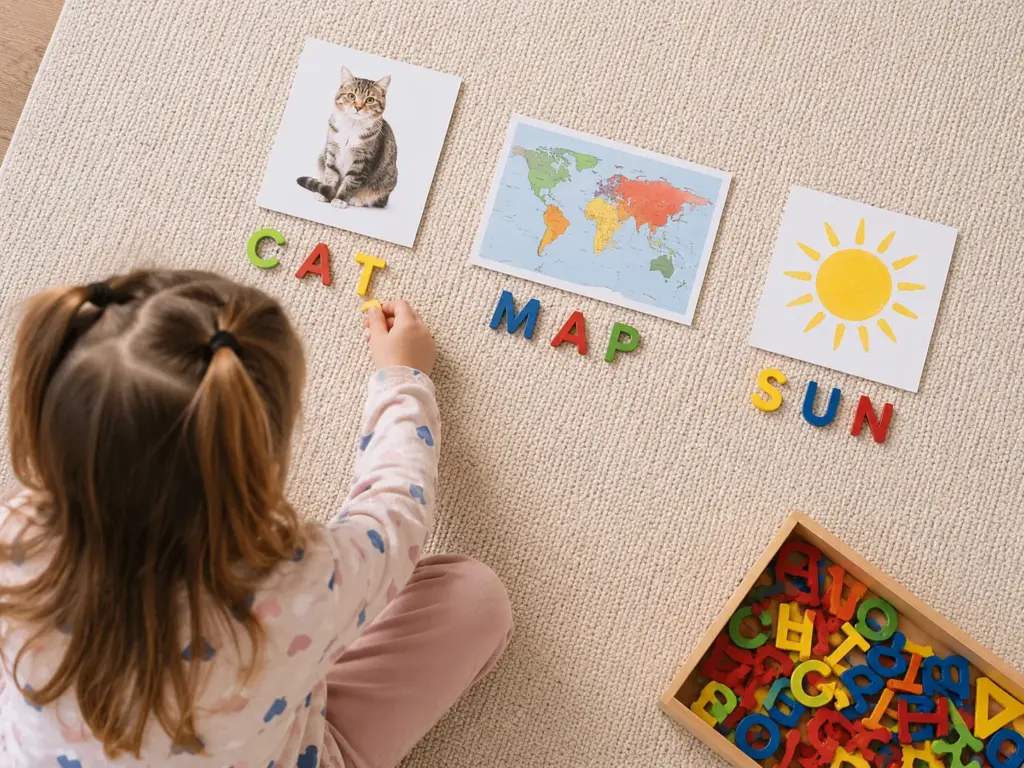
1. Place 3 objects on mat: “cat,” “map,” “sun” (CVC phonetic words only).
2. Pick up “cat”; say slowly, isolating first sound: “cccc-at — what sound do you hear first?”
3. Child says “c” or “/k/” — find the letter c together; place it.
4. Continue: “ca-t — what comes next?” Guide if needed; don’t rush.
5. Complete word; run finger under letters: “c-a-t. Cat.” Show the object.
6. Offer second object; child attempts independently. Step back once they begin.
- Critical: The moveable alphabet comes BEFORE pencil writing. The child composes words when their hand cannot yet write them. This is Montessori’s genius — the mind learns to encode while the hand continues preparing separately.
Advanced I Spy — Middle Sounds and Blending
- What it develops: Phonological awareness deepening. From 3yr: was beginning sounds only. Now: ending sounds (“I spy something ending in /n/”), then medial vowels. Blending introduction at 4–4.5yr: blend 3 sounds “/k/ /a/ /t/ — what word?” Child synthesizes: “cat.” This is the phonics foundation. Ready for blending when child reliably identifies all three sound positions in known words.
Name Puzzle — Entry Point for Late Starters
Two scenarios at 4: child used pegged version at 2–3 → upgrade to no-peg, edge-pinch version and integrate with moveable alphabet (find own name letters, compose new words starting with same sounds). Child didn’t use name puzzle at 3 → age 4 is still effective — the edge-pinch grip and letter discrimination work directly into the moveable alphabet sequence at exactly the right moment. Age 4 is still effective — the edge-pinch grip and letter discrimination work directly into the moveable alphabet sequence at exactly the right moment. The developmental arc of a name puzzle follows the child from first motor grip at 18 months to letter-sound integration here
| The child who has used the moveable alphabet for three months doesn’t need to be taught to write. They need to be given a pencil and left alone. I’ve seen this transition happen dozens of times — the preparation does the work, and the child simply begins. – Katy Lenoir, Preschool & Elementary Expert (3–12) |
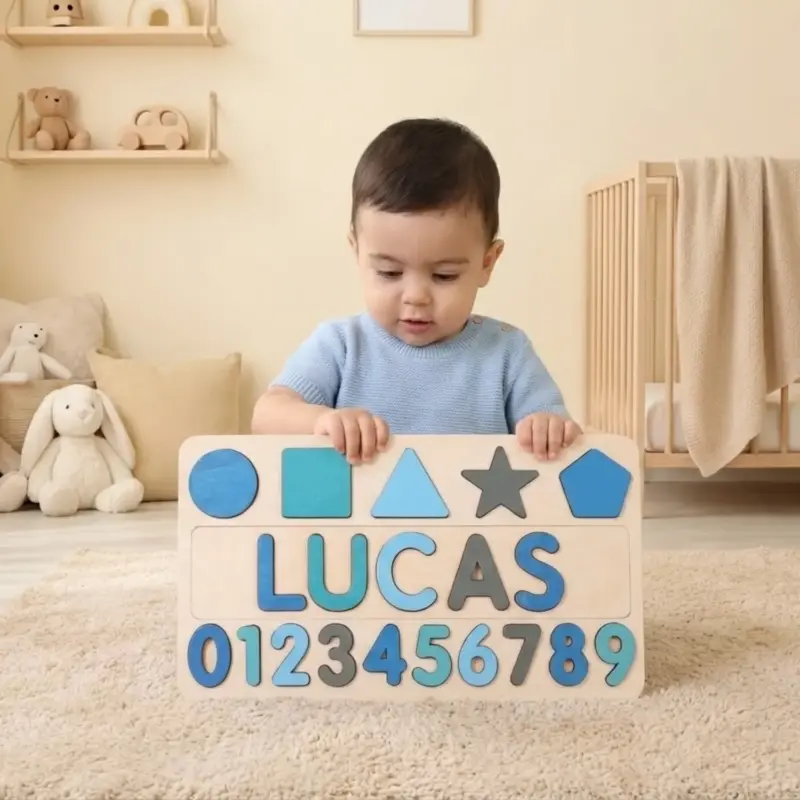
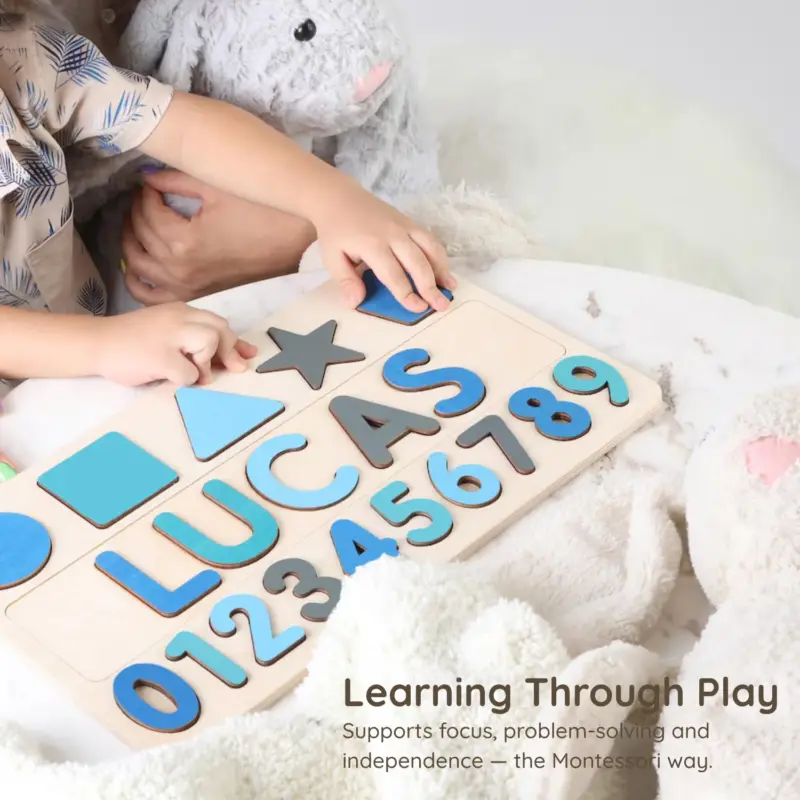
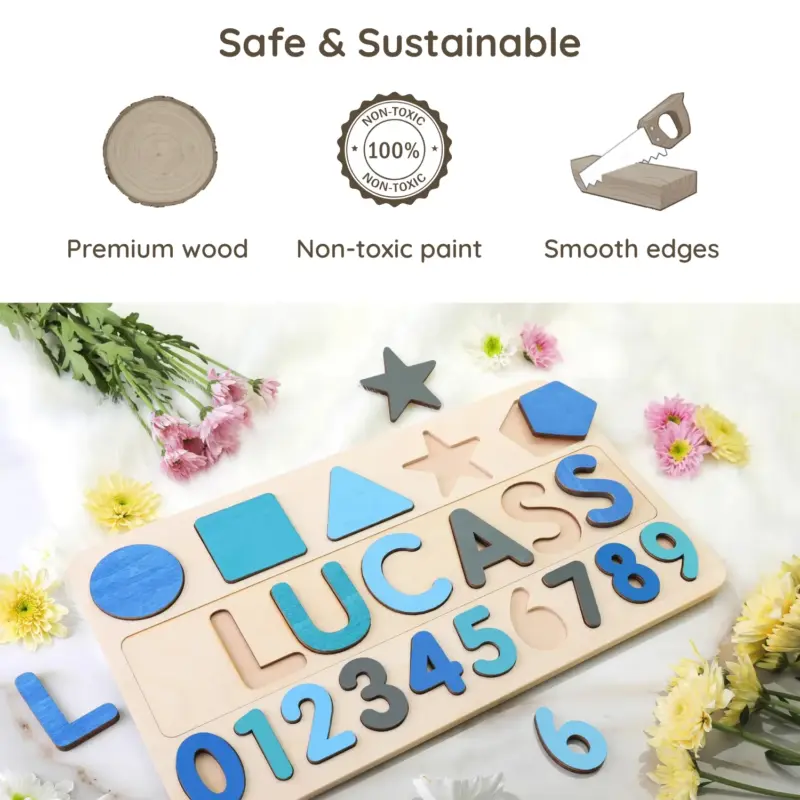

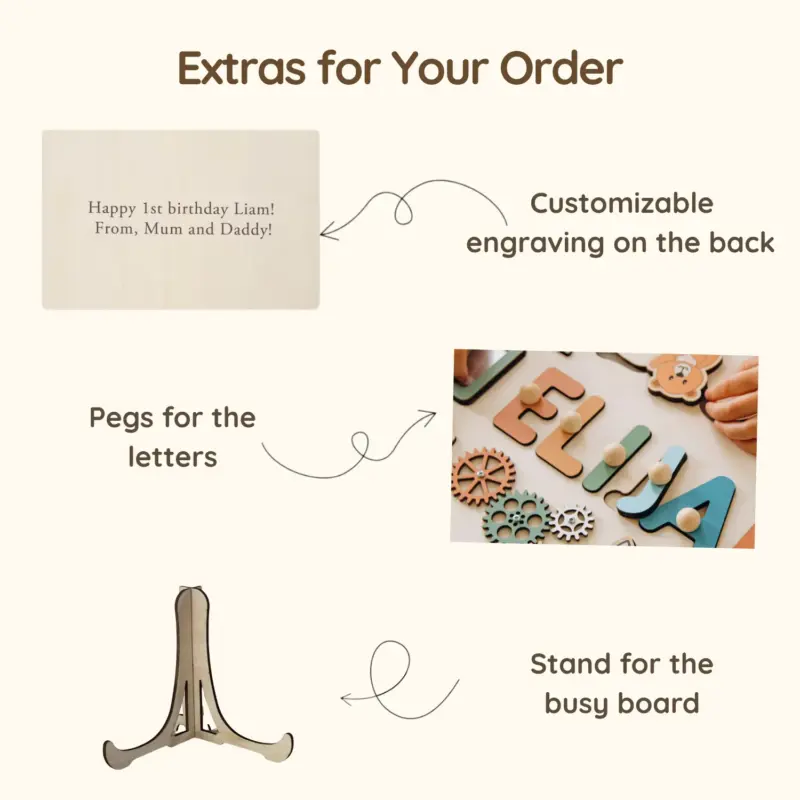
Blue Theme – Wooden Montessori Name Puzzle
Practical Life Activities — Advanced Sequences
At 4, practical life matures from single sequences into multi-day projects and real craft skills. The concentration window (now 25–30 minutes) supports longer, more complex work — and protecting it without interruption is the single most important thing a parent can do at this age.
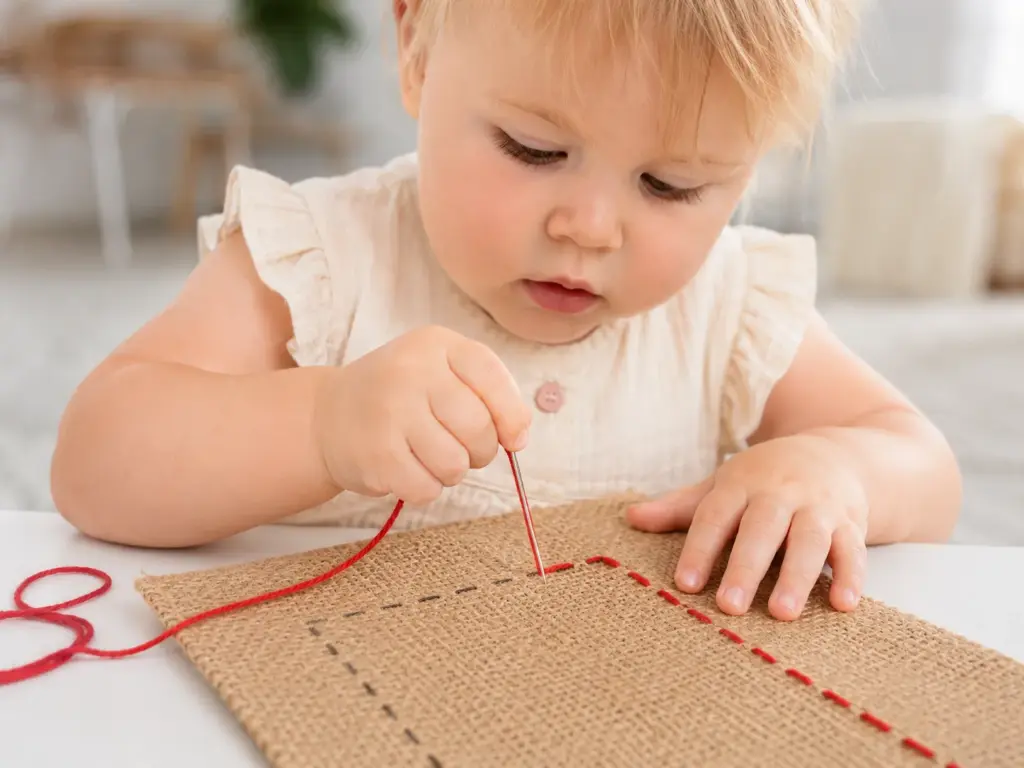
Sewing — Running Stitch to Stitching Patterns
- What it develops: Pre-writing fine motor endurance (sustained grip over 20+ minutes), bilateral coordination, care of materials, aesthetic sense. From 3yr: was running stitch on burlap. Now: stitching along a drawn line, simple shapes, free-form on felt. The child holds the needle with a dynamic tripod — the same grip as a pencil. Sewing IS writing preparation in tactile form.
Advanced Food Preparation — Peeling and Grating (HowTo)
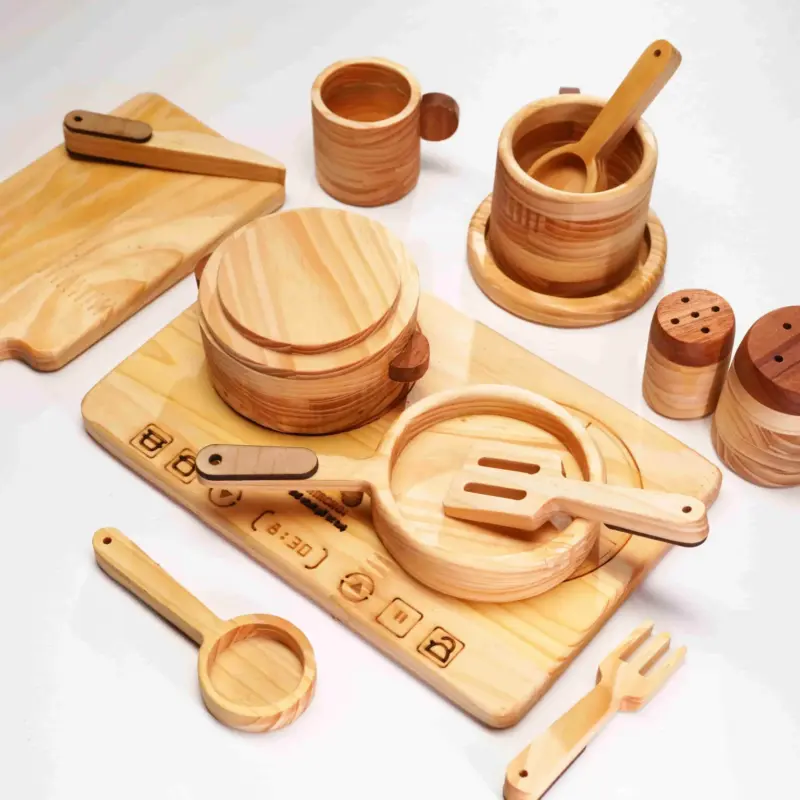
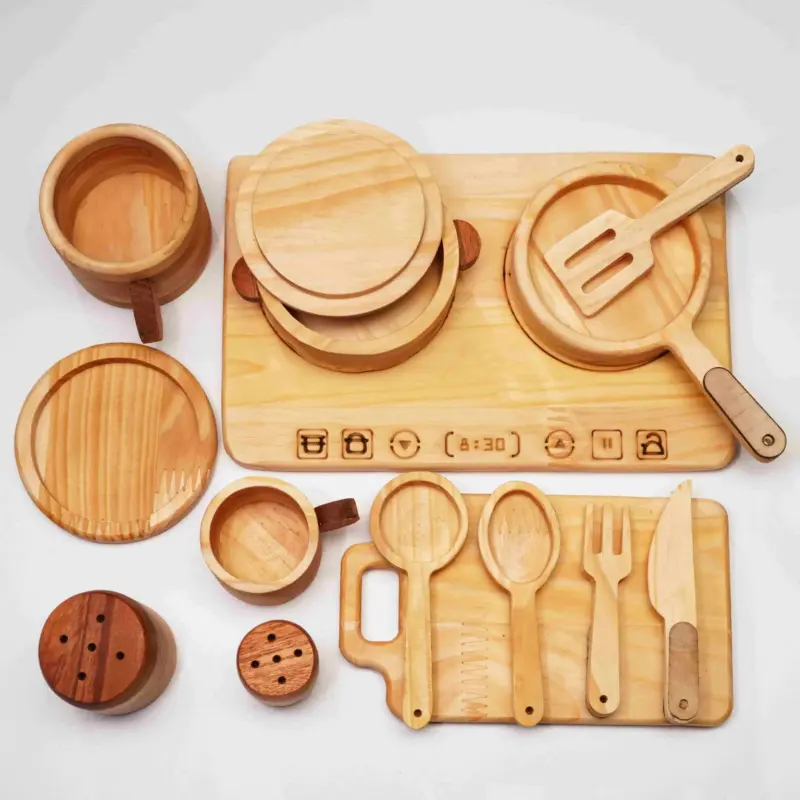
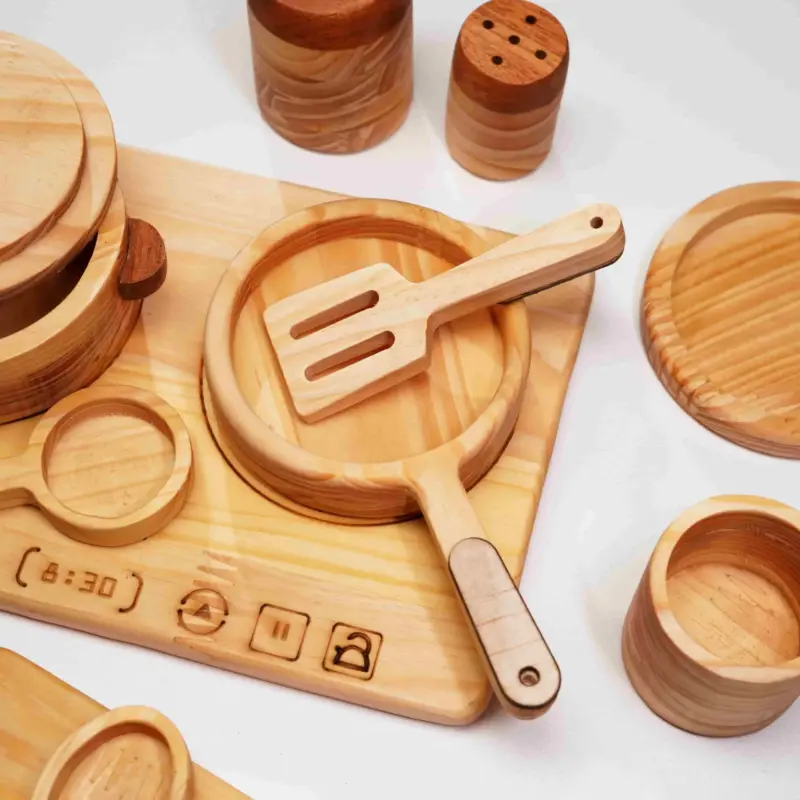
- What it develops: Full food prep cycle, bilateral precision, real-world contribution, independence. Montessori kitchen tools sized for 4-year-old hands make the peeling-to-serving sequence completable without adult assistance., bilateral precision, real-world contribution, independence.
1. Place vegetable, peeler, and bowl on cutting board.
2. Hold vegetable with non-dominant hand; demonstrate peeler stroke away from body — slow, deliberate.
3. Complete 3–4 strokes; collect peelings in bowl.
4. Offer to child; stand beside for safety on first attempt only.
5. When safe technique is established: step back fully.
6. Grating: demonstrate on one side of grater; same hand positioning principle.
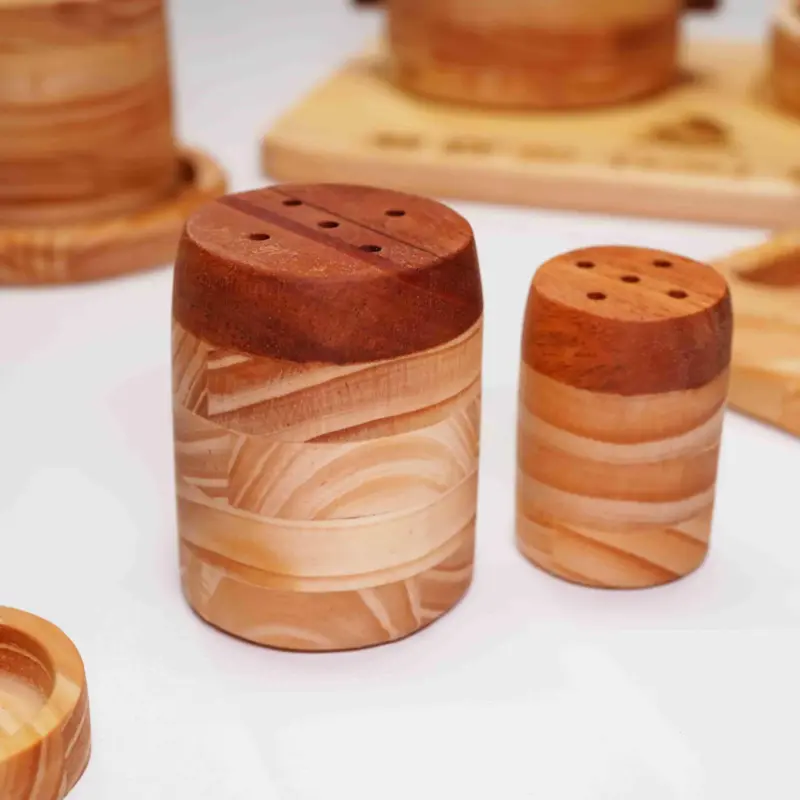
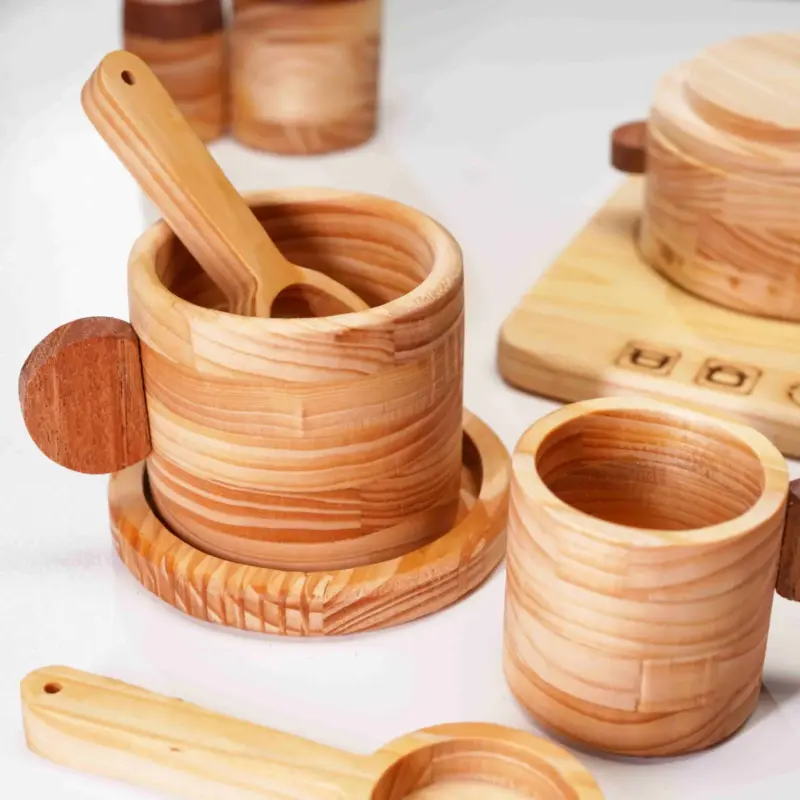
The full sequence — peeling, cutting, spreading, serving — is easier to establish when the child has already practiced it with wooden kitchen tools sized for small hands. The Wooden Cooking Toy Set builds the workflow memory that makes real food prep both safer and more confident.
Real Gardening — Planting to Harvest
- What it develops: Scientific observation (change over time), care of living things, responsibility, patience. The child tends their own plant from seed — planting, watering, tracking growth, harvesting. The 4-year-old’s extended time horizon (can track a plant over weeks) makes the full cycle meaningful. At 2–3, the wait was too abstract.
Math Activities — From Counting to Early Operations
The 4-year-old’s mathematical mind is ready for first formal operations — addition as combining groups — through the same concrete-to-abstract progression that has defined every Montessori math step.
Teen Board — Numbers 11–19 and Place Value
- What it develops: Place value (teen numbers contain a ten and some units), counting past 10, numeral recognition to 19. Wooden board with “10” fixed; loose tiles 1–9 slid alongside to form 11–19. Montessori introduces teen numbers BEFORE single addition — because understanding that “11” means “ten and one more” is more fundamental than knowing 5+6=11. Concrete first, always.
Addition Strip Board — First Written Operation
- What it develops: Addition as combining quantities, reading written equations, number facts 1–10 + 1–10. Wooden board with colored strips in two sets; child places strips to form equations, reads result. Introduce when cards and counters are fully mastered and child recognizes numerals 1–18 reliably.
Golden Bead Material — Introduction to Decimal System
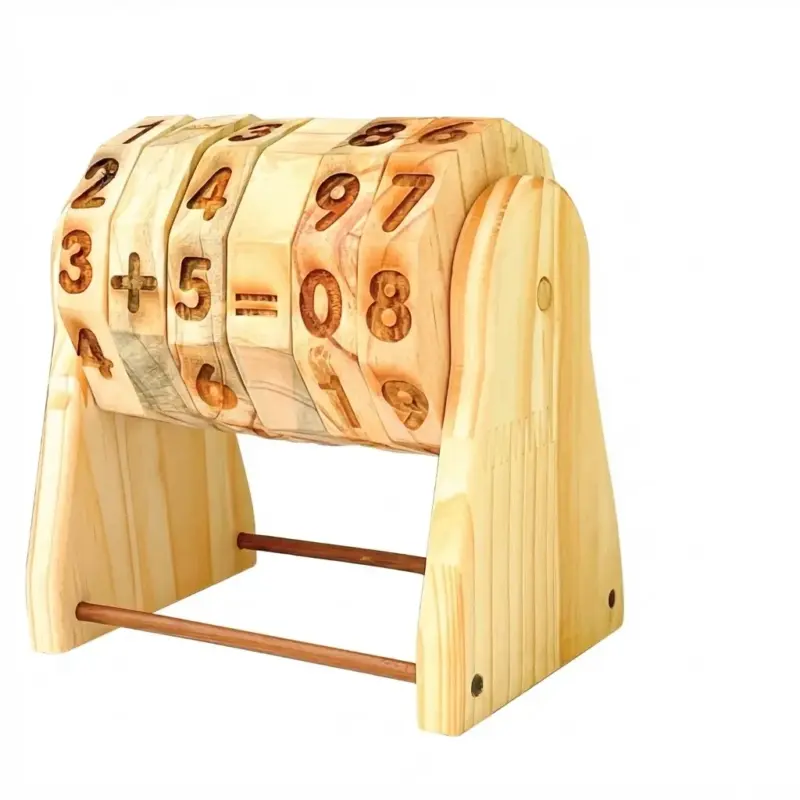
- What it develops: Decimal system (each category is ten times the previous), place value concretely, very large number concepts. Four denominations: unit bead (1), ten-bar (10), hundred-square (100), thousand-cube (1,000). A 4-year-old who holds a thousand-cube and a unit bead simultaneously understands what 1,000 means in a way no worksheet can produce. Montessori’s most elegant material. All three materials — teen board, strip board, and golden beads — follow the same concrete-to-abstract progression that defines every Montessori math step at this age. The Montessori Arithmetic Wheels extend this into self-correcting operations work: child rotates wheels to build and verify equations independently, with the answer built into the mechanism as control of error.
Sensorial and Cultural — Deepening Classification
At 4, sensorial work shifts from grading and matching to abstract three-dimensional reasoning. Cultural work expands from classification to full-scale scientific exploration.
Binomial Cube
- What it develops: Three-dimensional spatial reasoning, pattern recognition, logical problem-solving. 8 wooden blocks in specific colors that assemble into a cube — the same arrangement regardless of starting position. Indirect preparation for algebraic thinking (a+b)³ — not because a 4yr old needs algebra, but because the pattern recognition and systematic reasoning it builds is the same cognitive muscle.
Knobless Cylinders — Creative Construction
- What it develops: Creative spatial reasoning with no prescribed outcome. Extension of knobbed cylinders — now used in pairs and all-four combinations for free construction work. The child who has mastered individual grading now explores relationships between sets.
Continent Globe and Puzzle Maps
- What it develops: Geographic classification, global awareness, cultural vocabulary, spatial reasoning. Sandpaper globe (rough = land, smooth = water) → continent puzzle map (each continent a separate piece) → continent cards with capital cities. Three-Period Lesson with puzzle map: child names and places each continent piece independently.
Parts of a Plant / Plant Cycle
- What it develops: Scientific naming, observation, life cycle understanding. Real plants + nomenclature cards for plant parts (root, stem, leaf, flower, seed) + life cycle cards. Connects directly to the gardening activity above — the child who grows a plant can label its parts and track its cycle with genuine prior experience.
What Kindergarten Readiness Actually Looks Like — The Montessori Answer
The most common question from parents of 4-year-olds: “Will my child be ready for kindergarten?” The honest Montessori answer: yes — but not because they practiced letter worksheets. The CDC’s developmental milestones for 4-year-olds confirm that pencil grip, sustained focus, and independent task completion are exactly what kindergarten readiness looks like — and every item on that list is built through the activities in this guide.
| What Kindergarten Needs | What Montessori Builds It Through |
| Can hold pencil correctly | Metal insets + sewing + daily drawing = dynamic tripod through use |
| Recognizes letters and sounds | Sandpaper letters + moveable alphabet = sound-symbol in both directions |
| Can concentrate 20–30 min | Normalization through long work cycles protected at home |
| Can follow multi-step instructions | Work cycle (present → work → put away) practiced daily for 2+ years |
| Can manage personal needs | Practical life independence (dressing, self-care, food prep) since 18 months |
| Basic number sense 1–10+ | Concrete sequence: quantity → counting → cards and counters → strip board |
| Can work independently | Prepared environment + adult stepping back since 12 months |
A child who has done genuine Montessori work since age 1 or 2 arrives at kindergarten not needing to catch up — needing to wait for the curriculum to reach them.
Your Questions Answered
What Are the Best Montessori Activities for 4-Year-Olds?
The most developmentally powerful activities address the peak of the sensitive period for writing: metal insets (controlled pencil movement), moveable alphabet (phonetic word composition), and advanced sandpaper letters (blending sounds). For math: teen board and golden beads build the decimal foundation. For practical life: sewing and advanced food prep build the fine motor endurance writing requires. A balanced shelf includes all five curriculum areas, with Language weighted most heavily at this age.
When should a 4-year-old start writing?
In Montessori, writing is not “started” — it emerges from preparation. The sequence: sandpaper letters (sound-symbol) → metal insets (controlled pencil movement) → moveable alphabet (encoding words without motor demand) → spontaneous writing. Most prepared children begin writing words spontaneously between 4 and 4.5 years without being taught. Rushing to pencil-and-paper before the preparation is complete produces copying, not genuine literacy.
Is Montessori appropriate for 4-year-olds also in preschool?
Yes — with one principle: practical life at home, academic depth following the child’s interests. Reserve classroom materials (metal insets, golden beads, moveable alphabet) for school to maintain novelty. Home Montessori at 4 is most powerful in advanced practical life (sewing, cooking, gardening), cultural exploration following current interests, and protected concentration time without screens or adult direction.
My 4-year-old isn’t interested in letters. Should I be worried?
Not yet — but observe carefully. Some children aren’t in the sensitive period for writing until 4.5–5, which is within normal range. Signs the period is active: spontaneous interest in environmental letters (signs, books, packaging), tracing letters on surfaces, asking what words say. If none appear by 4.5–5, review the preparation: is phonological awareness established? Are sandpaper letters familiar? Often the sensitive period is waiting for one preparation step that hasn’t been completed.
The Activation Year
Age 4 is when everything built at 1, 2, and 3 — the practical life foundation, the sensory vocabulary, the phonological awareness, the mathematical mind — converges. The explosion into writing is not magic. It’s the result of three years of invisible preparation finally becoming visible.
Offer the metal insets. Offer the moveable alphabet. Let the sewing progress. Introduce the golden beads. Then stand back — because what is about to happen does not require your help. It requires your trust.
When you’re ready to build the shelf, wooden toys designed for 4-year-olds — name puzzles, natural material sets, and sensorial materials — are built around exactly the preparation this year depends on. And if your child is already moving ahead, the Montessori activities for 5-year-olds guide covers what comes next.