
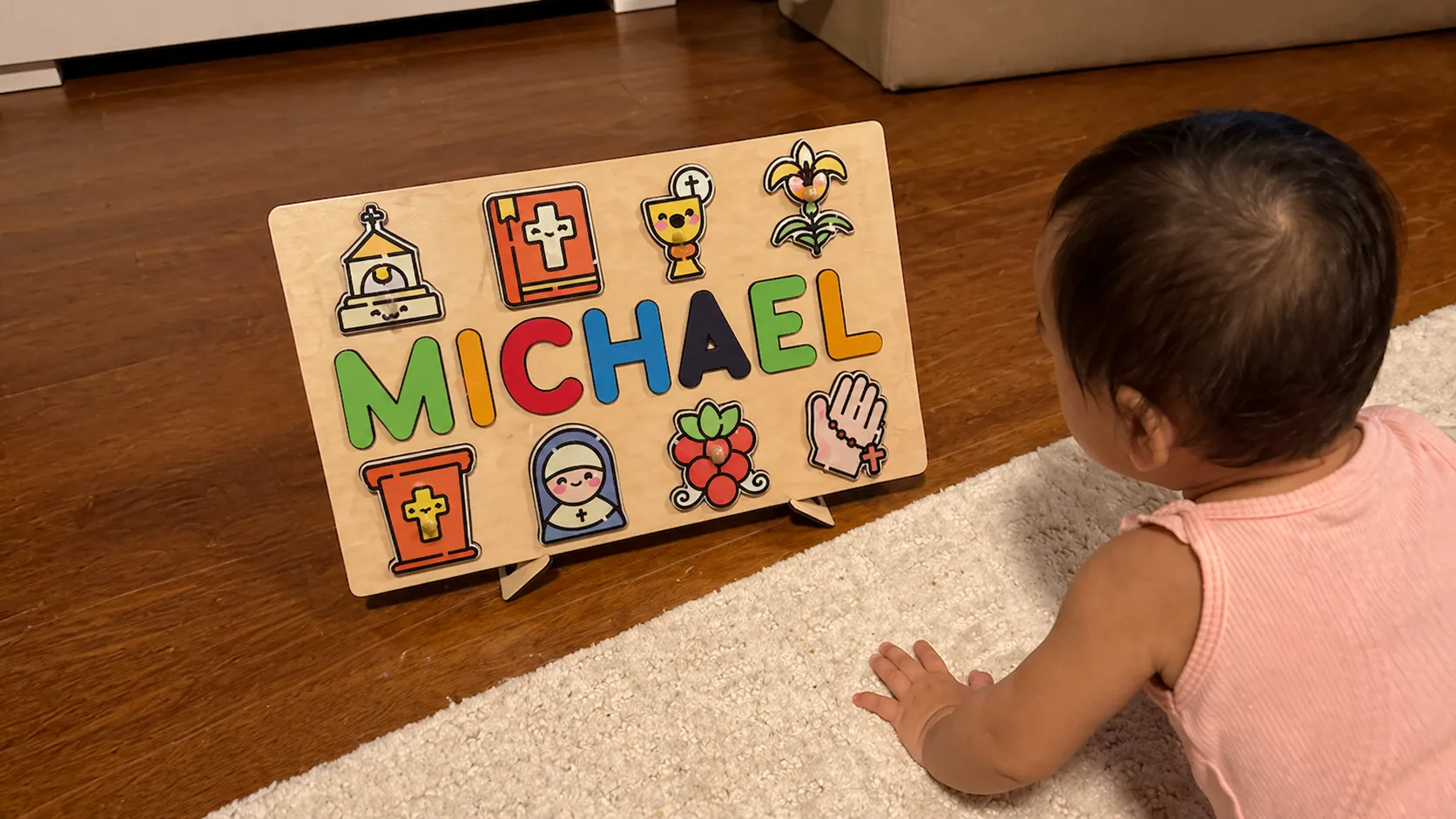
Most toddler toys develop one thing. A name puzzle develops three simultaneously: the hand muscles that will hold a pencil, the letter-recognition that is the first step in reading, and the identity — “this is MY name, MY letters” — that makes a child return to it again and again with the concentrated engagement real learning requires.
This guide explains what a name puzzle actually is, what it’s developing at each age, which type is right for your child right now, and the specific Montessori presentation method that activates all three benefits at once.
| What are name puzzle benefits? A name puzzle — a personalized wooden board with each letter of a child’s name as a separate removable piece — develops six skills simultaneously: letter recognition through physical handling, fine motor precision that directly prepares the writing grip, sequential ordering that feeds the sensitive period for order, pre-literacy symbol-sound connection, identity-driven sustained concentration, and independent self-correction without adult feedback. The personalization is the mechanism that makes these benefits more powerful than any generic alphabet toy: the child’s own name is the word they attend to most deeply and return to most consistently, making it the optimal entry point for every benefit the material produces. |
What Is a Name Puzzle?
A name puzzle is a wooden board with each letter of a child’s name cut as an individual removable piece — personalized, tactile, and designed for a specific developmental purpose. Each letter fits into a corresponding cutout in the base board. Your child removes each letter, handles it individually, and replaces it in its correct position. Unlike a jigsaw puzzle, there is only one correct arrangement — each letter has one home — giving your child an immediate, self-correcting result with no adult feedback needed. A name puzzle sits within the Montessori toys by category framework as both a practical life material and a language development tool — the only category that serves both domains simultaneously through a single personalized object.
- What makes it Montessori: Four alignment criteria: natural material (wood), control of error (each letter fits only in its correct position), child-directed use after initial presentation, and direct preparation for a real-world skill (reading and writing their own name). The name puzzle is used in AMI-certified primary classrooms globally as a language material, not merely a toy.
- What makes it personalized: Your child’s own name. Not a random word. Not the alphabet. The single word that has the highest emotional salience, the highest recognition, and the highest sustained engagement for any specific child.
Name Puzzle Benefits: 6 Developmental Skills With Specifics
Every guide to name puzzle benefits says “letter recognition” and “fine motor.” Here is what those mean in practice — which specific mechanism each benefit engages, and which later skill it prepares.
Benefit 1 — Letter Recognition Through Physical Handling
Your child learns the shape of the letter “A” by handling an “A” — turning it, orienting it correctly, feeling its angles — far more effectively than by seeing it on a screen or in a book. The tactile-visual connection created by physically handling a letter engraves its shape in both motor memory and visual memory simultaneously. This is the difference between recognizing “A” in print (visual only) and knowing “A” in the body — which is faster, more durable, and directly prepares for writing.
Benefit 2 — Fine Motor Precision (The Writing Grip Precursor)
Lifting each letter piece requires a specific grip: for pegged puzzles, a pincer grip on the peg; for edge-pinch puzzles, a three-finger grasp of the letter’s edge. The edge-pinch grip is the direct precursor to the tripod pencil hold. A child who has handled letter pieces by their edges for months before touching a pencil has been practicing the physical relationship between fingers and a held object in a writing-adjacent grip — without a pencil, without pressure, without the cognitive load of forming letters.
Benefit 3 — Sequential Ordering
Each letter has a fixed position in the name — the correct sequence produces the complete word, the familiar name, the satisfying result. This sequential ordering feeds the sensitive period for order (active 12m–3yr) at its most personally meaningful: the order that produces their own name. The child who insists on letters being replaced in exactly the correct sequence isn’t being rigid — they are expressing the sensitive period through the activity they find most significant.
Benefit 4 — Pre-Literacy Symbol-Sound Connection
Each letter is both a shape and a sound. The name puzzle is your child’s first encounter with the principle underlying all of reading: that abstract symbols represent specific sounds — the same symbol-to-sound foundation that formal phonics instruction will build on years later. Long before any explicit instruction, the child handling the letters of their own name is building the intuition that “this shape” and “this sound” belong together — the foundational insight of phonics.
Benefit 5 — Identity and Self-Recognition
Children recognize their own name before any other word — infants as young as 4.5 months already show measurable preference for the sound pattern of their own name (Mandel, Jusczyk & Pisoni, 1995). That early recognition deepens throughout toddlerhood, making the name puzzle the motivation-maximizing entry point for letter work.This emotional engagement isn’t incidental — it is the mechanism that sustains the concentration making the other developmental benefits possible.
Benefit 6 — Independent Work
The control of error in a name puzzle is built into the design: each letter fits only in its correct position. Wrong placement is immediately evident without adult commentary. Your child self-corrects, replaces the letter, achieves completion. This self-directed correction builds both executive function — monitoring one’s own accuracy — and the self-efficacy that independent problem-solving produces: I fixed it myself.
| The name puzzle is the material I recommend most consistently to families in the 18–30 month window — not because it’s the most impressive toy on the shelf, but because it hits three active developmental targets simultaneously at exactly the moment when the brain is primed for all three. I’ve seen toddlers return to their name puzzle for 15–20 minutes without prompting. That level of concentration at 18 months isn’t entertainment. It’s the sensitive period for language responding to exactly the right material. – Zoe Paul — Infant & Toddler Expert (0-3) |
Best Age for a Name Puzzle
Name puzzles are often marketed as suitable from “12 months+.” The developmental picture is more nuanced than the label suggests.
[VISUAL 1: Age-stage table — 3 rows showing what the child does, developmental value, and puzzle type at each stage.]
| Age | What the Child Does | Developmental Value | Puzzle Type |
| 12–18 months | Removes letters, mouths them, attempts to replace | Shape-in-hole spatial exploration; own-name visual imprinting | Pegged (large peg, safe for mouthing) |
| 18–30 months | Names letters when adult names them; attempts to place by sound | Letter recognition building; sensitive period for language peak | Pegged transitioning to edge-pinch |
| 2.5–4 years | Identifies letters by name and sound; spells own name while placing | Symbol-sound correspondence; tripod grip development | Edge-pinch (no peg) |
The optimal introduction window: Between 16 and 20 months — when the vocabulary explosion is active, the sensitive period for order is building, and your child is beginning to notice that written symbols mean something. The CDC’s 18-month milestone checklist confirms this window: at 18 months, children are expected to say at least 3 words and point to things to show interest — the same attentional and communicative drive that makes a name puzzle’s personal-name context so effective at this exact stage. Before 16 months: primarily mouthing and exploration (still valuable, but not peak return). After 30 months: letter-recognition deepens but the basic introduction window has passed.
How to Choose a Name Puzzle
Not all name puzzles serve the same developmental purpose. Five criteria determine whether a specific puzzle is worth the investment.
1. Letter sizing appropriate for toddler grip. Each letter piece should be 6–7cm tall minimum — large enough to grasp comfortably. Letters too small for a developing grip become frustration, not development.
2. Pegged or edge-pinch depending on age. Under 24 months: pegged letters for safer mouthing and easier grip. 24+ months: edge-pinch (no peg) is preferable — it develops the tripod precursor grip that pegged versions don’t.
3. UV-engraved or laser-cut letters, not painted-on. The letter shapes should be cut into or through the wood — not painted. Your child needs to feel the letter’s shape as a three-dimensional form. UV engraving into the wood produces tactile depth that painted letters cannot replicate.
4. Safe-for-mouthing finish. Non-toxic, water-based finishes without heavy metal pigments. Look for ASTM F963 (US) or EN71 (EU) certification specifically on the finish materials, not just the board.
5. Themed design that matches your child’s current interest. The theme doesn’t change the developmental function — but it significantly affects initial engagement. A child interested in vehicles will spend more time on a vehicle-themed puzzle than on a plain letter board.

Vehicle Theme – Wooden Montessori Name Puzzle
Types of Name Puzzles
Name puzzles come in three format variations — each appropriate for a different developmental stage and grip level.
- Type 1 — Pegged name puzzle. Each letter has a small wooden peg on top. Your child grasps the peg (pincer grip on the knob) to remove and replace each letter. Best for: 12–24 months. Safe for mouthing. Easier grip. The peg itself develops the pincer grasp — the same grip mechanism that busy board latches and zipper pulls challenge from a different angle.
- Type 2 — Edge-pinch name puzzle (no peg). Each letter must be grasped by its edge using a three-finger or pincer hold. More challenging — your child must develop the grip precision to lift and place each letter without a handle. Best for: 24+ months. The edge-pinch grip directly develops the tripod precursor grip.
- Type 3 — Themed name puzzle. The same pegged or edge-pinch format with a visual theme surrounding the name letters — animals, construction vehicles, geometric shapes, numbers. The theme provides visual narrative that increases sustained engagement without changing the developmental function.

Animals Kingdom – Wooden Montessori Name Puzzle
Which to choose: Match puzzle type to current grip stage, not calendar age. When your child can reliably hold a small object between thumb and index finger and place it precisely — they are ready for edge-pinch.
Why Their OWN Name — The Identity Psychology
The name puzzle is not an alphabet puzzle with personalization added on. The personalization IS the developmental mechanism.
Research by Rebecca Treiman at Washington University found that preschoolers show significantly stronger recognition of letters from their own name — especially the first letter — compared to other letters of the alphabet (Treiman & Broderick, 1998). The name isn’t just one word among many; it is the word that bootstraps letter knowledge.
A child working with their name puzzle is not working with “letters in general.” They are working with the specific letter sequence that produces the most emotionally resonant word they know. That emotional resonance is not a nice add-on — it is the mechanism producing sustained concentration. The child returns not because letters are interesting, but because THEIR letters are interesting.
| I tell parents: your child knows their name is special before they know anything is written. When you show them that those sounds they already love are made of specific letter shapes they can hold — the name puzzle turns abstract literacy into something that has been personal to them since birth. – Zoe Paul — Infant & Toddler Expert (0-3) |
The Grip Progression: From Pegged to Writing-Ready
The name puzzle is not one activity — it is a three-stage fine motor progression that, followed correctly, ends with the hand ready to hold a pencil.

Stage 1 — Pincer on Peg (12–24 Months)
Thumb and index finger grasp the wooden peg knob. Develops pincer grasp establishment and strengthening — the basic two-finger grip that all later fine motor precision builds from.
Stage 2 — Edge-Pinch Three-Finger (24–36 Months)
Thumb, index, and middle finger grasp the letter by its edge — no handle. Develops the radial digital grip: three-finger coordination and force calibration to hold without dropping. This is the tripod precursor grip — the same three-finger configuration pencil holding requires, applied to an object close to pencil size and weight.
Stage 3 — Dynamic Edge-Grip (36–48+ Months)
Same three-finger edge hold with increasing speed, precision, and reduced visual attention — your child knows the feel of each letter. Develops automaticity in the tripod grip: the hand begins to move to the pencil-ready position without thinking about it. The pencil grip at 4–5 years arrives with the physical pattern already established through thousands of repetitions of letter-edge handling.
The transition signal: When your child consistently picks up each letter piece with three fingers rather than the full hand, and places it precisely without dropping — they are ready to transition from pegged to edge-pinch.
The Three-Period Lesson: The Montessori Presentation Method
The Three-Period Lesson is the Montessori method for introducing any new material that involves naming. For the name puzzle, it transforms the activity from “child plays with letters” to “child learns letter names with guaranteed success at each stage.”
- Period 1 — Naming (“This is…”). Remove one letter slowly. Hold it at your child’s eye level. Say the letter name clearly: “This is A.” Return it to its place. Repeat with 2–3 letters maximum per session.
- Period 2 — Recognition (“Show me…”). With the same 2–3 letters visible, ask: “Show me the A.” Wait. Your child points or picks up the correct letter. If correct: quiet acknowledgment (a nod, a smile — not effusive praise). If incorrect: return to Period 1 for that letter.
- Period 3 — Recall (“What is this?”). Pick up a letter. Ask: “What is this?” Your child names it. This is the hardest period — spontaneous recall. If your child cannot name it, return to Period 1. Never force recall. The progression moves at the child’s pace.
Why this method matters: The Three-Period Lesson guarantees that your child only ever says “I don’t know” when the adult hasn’t yet completed Period 1 and 2 adequately. It makes letter-learning inherently successful rather than test-like.
How to Present a Name Puzzle to Your Child
A name puzzle placed on the shelf without presentation will be explored randomly. A name puzzle presented once correctly produces deliberate, concentrated letter work.
- Step 1. Remove the first letter slowly. Hold it at eye level. Say its name once: “A.” Place it back in its position. Do not continue until your child is watching.
- Step 2. Remove the second letter. Name it. Replace it. Repeat with 3 letters maximum in the first presentation.
- Step 3. Remove all letters, place them in a line beside the board. Hand the board to your child: “Now you try.” Step back immediately.
- Step 4. Do not intervene. If your child places a letter incorrectly, it won’t fit — the puzzle self-corrects. Do not redirect. Do not correct verbally.
After the first presentation: the puzzle goes on the shelf for independent use. Present additional letters only after your child has independently mastered placing the current ones. The adult’s role after presentation is zero.
The Vocabulary Explosion Connection
The name puzzle introduced at 18–24 months isn’t coincidentally well-timed — it arrives at exactly the developmental moment when the brain is most primed to receive it.
The American Academy of Pediatrics’ clinical report on the developmental role of play (Yogman et al., 2018, reaffirmed 2025) confirms that child-directed, hands-on activities — exactly the kind the name puzzle provides — build executive function and self-regulation more effectively than adult-directed instruction.
Between 18 and 24 months, most children undergo a vocabulary explosion — from approximately 20–50 words to 200+ in a matter of weeks. The brain during this window is specifically primed for word-object connections. The name puzzle harnesses this precisely: each letter is a new word-object connection — this shape (the letter) maps to this sound. Introducing the name puzzle during the vocabulary explosion means each letter-name association is acquired during the brain’s highest-sensitivity period for exactly this type of learning. The sensitive period for language is doing the heavy lifting — the puzzle is providing the material.
Connection to Writing Readiness

The name puzzle’s connection to writing readiness is not metaphorical — it is physical and direct.
1. Grip preparation. The edge-pinch grip on letter pieces is the physical precursor to the tripod pencil hold — the same grip progression that practical life activities like pouring, threading, and buttoning develop from different angles. By 3.5–4 years, a child who has handled name puzzle letters by their edges for 12–18 months has practiced the pencil grip in a stress-free, intrinsically motivated context hundreds of times.
2. Letter-shape encoding. The child who has physically turned the letter “A” in their hands knows its angles in motor memory — not just visually. When they attempt to write “A,” the shape is available in both visual and kinesthetic memory simultaneously.
3. Directionality. The name puzzle is read and assembled left to right — the same direction as written language. Every session reinforces the left-to-right tracking that reading and writing require.
What Comes After: The Literacy Progression
The name puzzle is the beginning of a literacy progression, not the destination.
- Stage 1 — Name Puzzle (16m–3yr). Letter recognition through own-name context. Fine motor grip development. Symbol-sound intuition building.
- Stage 2 — Sandpaper Letters (3–4yr). Each letter’s shape traced with two fingers on textured card. The tactile-kinesthetic encoding that name puzzle handling begins is completed here. Letter sounds (phonics) explicitly introduced.
- Stage 3 — Moveable Alphabet (3.5–5yr). Individual letter pieces selected and arranged to form words. Your child composes words before writing them — using hands to build language.
- Stage 4 — Metal Insets + Writing (4–5yr). The pencil grip developed through letter-edge handling is applied to controlled mark-making. The first writing is not laborious — the hand is already prepared.
Frequently Asked Questions
What is a name puzzle?
A personalized wooden puzzle where each letter of a child’s name is a separate removable piece fitting into a corresponding cutout. Your child removes each letter, handles it individually, and replaces it — with the puzzle self-correcting since each letter fits only in its own space. In Montessori, the name puzzle is used as a primary language material because the child’s own name produces the deepest sustained concentration of any early literacy material. It simultaneously develops fine motor precision, letter recognition, sequential ordering, and the symbol-to-sound understanding foundational to reading.
What are the benefits of a name puzzle?
Benefits work across three simultaneous developmental domains. Fine motor: handling each letter develops the pincer grasp (pegged) or the three-finger edge-pinch grip that is the direct precursor to pencil holding (no-peg). Language and pre-literacy: letter shapes learned through physical handling, and the symbol-to-sound connection acquired through the most personally significant word. Identity and concentration: children recognize their own name in print before any other word, making the name puzzle the motivation-maximizing entry point for letter work.
What age is a name puzzle best for?
The optimal introduction window is between 16 and 20 months — when the vocabulary explosion is active and the sensitive period for order is building. The pegged version is appropriate from 12 months; the edge-pinch version becomes productive from approximately 24 months. Name puzzles remain valuable through age 4–5 as the grip work and letter-recognition practice stay relevant until writing begins. The developmental purpose shifts across this range: at 18 months, primarily tactile letter exploration; at 3–4 years, direct writing preparation.
What is the Montessori method for introducing a name puzzle?
The Three-Period Lesson: Period 1 (naming) — remove one letter, name it, replace it. Period 2 (recognition) — ask “show me the A” and let the child identify it. Period 3 (recall) — pick up a letter and ask “what is this?” Introduce only 2–3 letters per session, never all at once. After the presentation, the puzzle goes on the shelf for independent use — the puzzle self-corrects, and independent placement produces the learning without adult direction.
What makes a good name puzzle?
Five criteria: letter sizing appropriate for toddler grip (6–7cm tall minimum); format matched to grip stage (pegged for under 24 months, edge-pinch for 24+); UV-engraved or laser-cut letters so the child feels three-dimensional form; non-toxic water-based finish certified to ASTM F963 or EN71; and a themed design matching current interests (animals, construction, shapes) to maximize sustained engagement.
The Preparation Is the Puzzle — The Reading Is the Outcome
The name puzzle is the only Montessori material simultaneously serving language development, fine motor preparation for writing, and the child’s sense of their own identity as a learner. The child who handles the letters of their own name at 18 months is building the same neural pathways that reading and writing will activate at 5 — long before any formal instruction, entirely through independent, intrinsically motivated work.
Introduce it during the vocabulary explosion (16–24 months) with a pegged version. Transition to edge-pinch at 24 months. Use the Three-Period Lesson for 2–3 letters at a time. Place it on the shelf and step back. The concentrated letter work that follows is the preparation — the reading is the outcome.
For the complete literacy progression that follows the name puzzle: the Montessori language development guide. For how to present any new Montessori material: the role of the adult guide.
This collection is made from natural wood and UV-engraved for durability. Each letter is carefully sized and weighted for easy toddler grip, and the puzzles come in themed designs like Wild Animals, Construction, and Shapes & Numbers. All products are certified to ASTM F963 and EN71 safety standards. Explore the full Kukoo’s wooden name puzzle collection today!