
You have a newborn. You haven’t slept in four days. Someone has told you to “do Montessori” and you’re staring at your baby wondering: do what, exactly?
The answer is simpler than the Pinterest boards suggest. Montessori for a newborn isn’t a toy list or a room setup — it’s a way of being present during the things you’re already doing. Diaper changes, bath time, the moment you pick them up from their mat. The developmental work happens inside those interactions, not alongside them.
This guide covers what that actually looks like — what to do, why it matters, and what genuinely belongs in those first three months.
What are Montessori newborn activities?
Montessori activities for newborns (0–3 months) fall into two categories: respectful caregiving interactions — narrating your actions before touching the baby’s body, slowing down during diaper changes and bathing, maintaining eye contact during feeding — and developmentally matched visual, tactile, and movement activities including the mobile progression, floor-based tummy time, and simple grasping objects introduced at 6–8 weeks. The Montessori approach prioritizes the quality of adult-infant interaction over any material, because the newborn’s primary work is building security, orienting to the world, and beginning voluntary movement — all supported more by a responsive caregiver than by any toy.
| Domain | Activity | What It Develops | When |
| Visual | Munari mobile | Contrast discrimination, first tracking | Week 1–4 |
| Visual | High-contrast cards | Focal range calibration | Week 1–6 |
| Visual | Floor mirror | Self-observation, face interest | Week 2+ |
| Movement | Floor time (on back) | Vestibular awareness, body mapping | From birth |
| Movement | Tummy time | Neck/shoulder strength | Week 1–2 supervised |
| Touch | Natural texture exploration | Tactile discrimination | Week 4+ |
| Touch | Grasping ring / wooden rattle | Voluntary grasp development | Week 6–8 |
| Caregiving | Narrated diaper change | Language absorption, bodily trust | From birth |
| Caregiving | Face-to-face conversation | Social development, proto-conversation | From birth |
| Caregiving | Skin-to-skin | Nervous system regulation | From birth |
The Minimum Viable Montessori — If You Can Only Do One Thing
Before covering everything, here is the one thing. If you’re surviving on 2-hour sleep increments and have capacity for exactly one change, this is it:
Narrate before you touch: Before picking up your baby, before unsnapping the onesie, before beginning the diaper change — say out loud what you’re about to do. “I’m going to pick you up now.” “I’m going to change your diaper.” “I’m going to put you on the mat.”
Your newborn’s nervous system is calibrating the world — building a map of what is predictable, safe, and responsive. A caregiver who narrates before acting builds the neurological foundation for trust in the environment. The baby who is consistently prepared for what’s about to happen develops a fundamentally different relationship to their body and to caregiving than the baby who is picked up and moved without warning.
This requires no materials, no setup, no energy beyond the 3 seconds to say what you’re doing. Start here.
| The single most transformative shift I see in new parents is not the moment they buy the right mobile. It is the moment they understand that the diaper change, the bath, the feeding — done with narration, eye contact, and respect for the baby’s body — is the Montessori curriculum for the first three months. Everything else supports that foundation. Nothing replaces it. — Zoe Paul, AMI Teacher Trainer (0-3) |
Understanding the Newborn — Why This Period Is Different
To understand what a newborn needs, you need to understand what a newborn can do — and what they’re in the process of constructing.
Montessori called the newborn period the continuation of gestation — a “fourth trimester” in which the baby is completing preparation for independent life. This period sits at the opening of what Montessori mapped as the sensitive periods — windows of heightened developmental receptivity that govern the first six years, with the order sensitive period and the movement sensitive period both active from birth. The primary developmental work: orienting to the external world, calibrating the nervous system to its new sensory environment, and beginning the transition from reflexive to voluntary movement.
What the newborn’s sensory system can do:
- Vision: 20–30cm focal range — approximately the distance between a feeding baby and their caregiver’s face. This is not coincidence; it is design. Your newborn sees your face clearly and almost nothing else.
- Contrast: High contrast (black/white) is the only visual information the newborn’s visual cortex can fully process. Color discrimination develops from approximately week 4–6, beginning with red.
- Sound: Fully functional at birth. Your baby distinguishes your voice from others and will orient toward familiar sounds.
- Touch: Extremely high sensitivity. Your baby feels temperature, pressure, texture, and the quality of being held with or without preparation.
Activities designed for a newborn’s actual capacities — not a 6-month-old’s — look very different from what most guides suggest.
The Montessori Nursery — 4 Zones, Nothing Extra

Before any activity begins, the room itself needs to be prepared. A Montessori nursery is not a decorated baby room — it is 4 functional zones, each serving one developmental purpose, with nothing extra.
1. Sleep Zone. A firm, flat CPSC-approved bassinet or crib — not a floor mat. The floor mat is for supervised awake time only. Dark, quiet, no toys, no mobiles, no stimulation. Dark, quiet, no toys, no mobiles, no stimulation. Sleep zone = sleep only. The AAP’s 2022 updated safe sleep guidelines specify a firm, flat, non-inclined surface; baby placed on back for every sleep; room-sharing without bed-sharing for at least the first 6 months; and no soft objects, blankets, pillows, or bumpers in the sleep space.
2. Movement Zone. This is the floor mat area — for supervised awake time only, never for sleep. This is where the activities in this article happen — the floor mat, the mobile, the mirror, the grasping materials. The full movement area setup is covered in detail below.
3. Care Zone. Diaper changing area with everything within reach. 2–3 clothing items visible (order begins before your baby can choose). This zone is where respectful caregiving-as-curriculum happens — the narrated diaper change, the eye contact, the slow preparation that builds bodily trust.
4. Feeding Zone. One consistent location — the same chair or cushion every time. Calm, dim, not stimulating. The consistency supports your newborn’s developing sense of predictability and order.
What the nursery does NOT contain: Crib with overhead entertainment mobile. Baby containers (bouncer, swing) as permanent fixtures. Multiple stimulation sources in one zone. Screen in any zone. Important: The floor mat in the movement zone is for supervised tummy time and awake floor time only — it is not a sleep surface. All infant sleep must occur on a CPSC-approved firm, flat surface per AAP 2022 guidelines. Each zone serves one purpose — mixing purposes produces the sensory overwhelm that turns up as fussiness.
Respectful Caregiving as the Primary Curriculum
Montessori for newborns is not primarily about adding activities to the day. It is about how every caregiving interaction is done. Three daily activities — the diaper change, the bath, and the feeding — are the three most important developmental interactions in the first three months. This caregiving-as-curriculum approach is the foundation of Montessori practical life work across all ages — in newborns it begins through narrated handling; by 18 months it expands into self-care, food preparation, and care of environment.
The Montessori Diaper Change
Most diaper changes are done to the baby efficiently. The Montessori diaper change is done with the baby slowly. Bring baby to the changing area. Say: “I’m going to change your diaper now.” Narrate each step as you do it — “I’m opening your onesie. Now I’m removing your diaper.” Make eye contact throughout — not at the task, at the baby. Pause before each action. When finished: “All done. You have a clean, dry diaper.”
- Why this works: Your baby is receiving language input during their highest-attention moments — awake, alert, and in close physical contact. This is the most potent language exposure available in the first three months. The narration also builds the beginnings of bodily consent: your baby’s nervous system learns that their body is handled with preparation and respect.
Face-to-Face Conversation
Newborns are specifically primed for face recognition and social response from birth. Hold your baby at face distance (20–30cm). Talk. Then stop and wait. Your baby will often produce an expression, a sound, or a movement in the pause. Respond to it. This is a conversation — and it’s building the turn-taking structure of all future communication. Mirror neurons are activating; facial expression is being processed as social data; the pauses build the first proto-conversational turn structure that language development depends on. Research on early face-to-face interaction and turn-taking in infancy documents that the pause-and-respond structure present in newborn interactions from the first weeks is a direct precursor to conversational competence — the same neural circuitry activated in turn-taking dialogue is being built during these early exchanges.
Skin-to-Skin as Nervous System Regulation
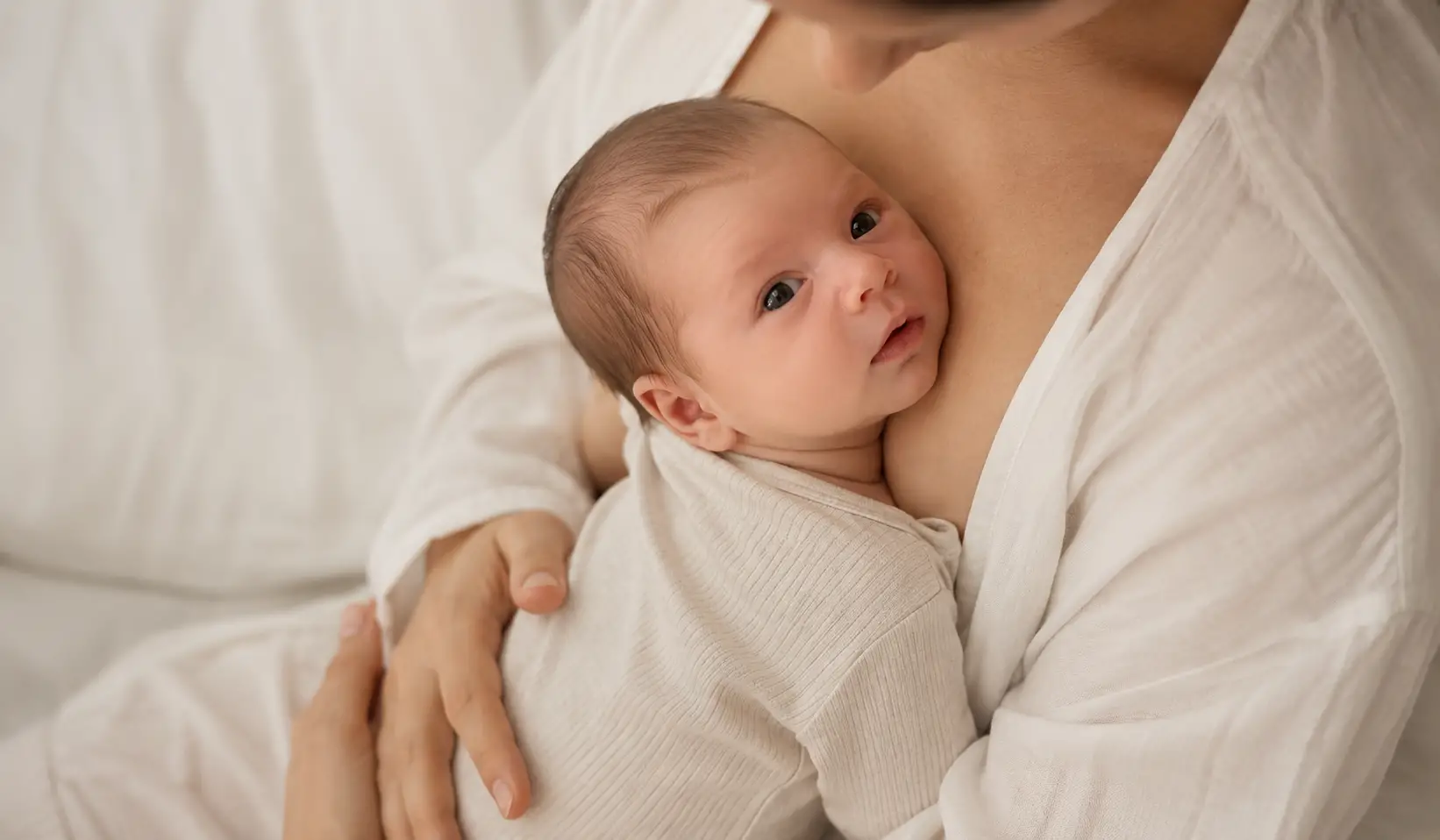
Skin-to-skin contact (baby’s chest against your bare chest) is not only emotional bonding — it is physiological regulation. Your newborn’s nervous system is immature; it uses your heartbeat, warmth, and breath rhythm as an external regulator. This is the Montessori principle of the prepared environment applied at its most fundamental level: the caregiver’s behavior is the first environment the newborn experiences before any room, shelf, or material. A systematic review of 22 studies on parent-infant skin-to-skin contact found consistent regulation of stress biomarkers — including heart rate variability, cortisol, and autonomic nervous system indicators — confirming that the physiological benefits of skin-to-skin contact go beyond comfort and operate at a neurological level.. The prepared environment for the newborn begins with the parent’s body — the world enters the baby through this regulatory contact before any other channel.
The Visual Activities — The Mobile Progression Explained
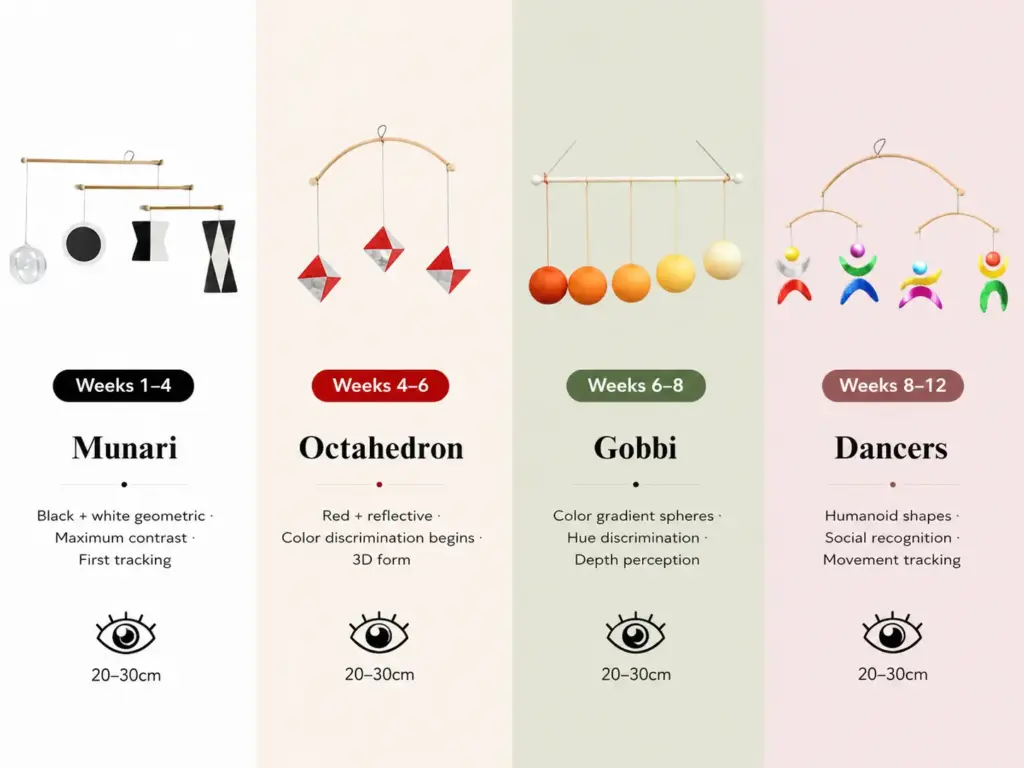
The Montessori mobile series is the most recognized newborn activity — but almost always described without the developmental logic that makes it work. Each mobile corresponds to a specific stage of visual cortex development.
Why high contrast first: At birth, the visual cortex hasn’t completed myelination. The only signal that produces sufficient neural firing for tracking is high contrast — black on white. Your newborn cannot see color with useful clarity because the cone cells haven’t yet differentiated. High contrast is not an aesthetic choice. It is the only visual information the newborn’s brain can process clearly.
| Mobile | Visual Input | Developmental Target | Introduce |
| Munari | Black/white geometric shapes | Maximum contrast; first tracking | Week 1–4 |
| Octahedron | Red/reflective mylar (3 shapes) | Color discrimination begins; 3D form | Week 4–6 |
| Gobbi | 5 color-gradient spheres | Hue discrimination; depth perception | Week 6–8 |
| Dancers | Humanoid shapes in color | Social recognition; movement tracking | Week 8–12 |
Placement: Mobiles hang 20–30cm above the baby’s eye line — the focal range. Not higher. A mobile at 60cm is invisible to the developmental purpose. High-contrast cards placed within focal range (propped against a cushion on the floor mat) serve the same visual cortex function between mobile sessions.
The Movement Area — Setting It Up Correctly
The Montessori movement area is not a playmat with attached toys. It is a defined floor space where your baby experiences free movement without containment — and where the visual activities happen.
What it needs:
- Floor mat: 90–120cm × 90–120cm minimum — firm surface, not soft. Your baby needs resistance to push against.
- Wall-mounted mirror: At floor level, 45–60cm from the mat. Baby-safe acrylic. Your baby’s fascination with their own face and movement provides extended engagement without adult involvement.
- Mobile hanging point: Directly above the mat at 20–30cm height. A ceiling hook with ribbon works; commercial stands work equally well.
- Natural light: Near a window but not in direct sunlight. Overhead fluorescent light is disorienting for a newborn.
- Separate from sleep space: Keeping the movement area distinct from where the baby sleeps begins building the sleep-wake environmental distinction from the earliest weeks.
- What it does NOT contain: Toys hanging overhead (other than the single current mobile), musical components, flashing or electronic elements, or more than one mobile at a time.
- Topponcino note: The topponcino — a thin oval pillow designed by Montessori — allows the baby to be moved between arms, between caregivers, without disruption. The continuous surface maintains postural orientation, making the transition from arms to floor mat feel continuous rather than abrupt.
Touch and Grasping Activities — From Reflex to Voluntary
Your newborn’s hands contain a reflex grasp — any object placed in the palm will be gripped automatically. Between weeks 6 and 10, this reflex transitions to voluntary, intentional grasping. The activities that support this transition are simple.
Natural Texture Exploration (Weeks 4+)
Lay a small piece of wool, silk, cotton, or linen near your baby’s hand during floor time. They’ll encounter these textures incidentally through movement. The tactile discrimination system is active from birth; natural materials — each with distinct texture, temperature, and weight — provide richer sensory input than uniform synthetic surfaces.
Grasping Ring (Weeks 6–8+)
A smooth wooden ring placed at your baby’s eye line during floor time, or gently placed in the palm during alert periods. Light enough to lift; smooth enough for mouthing (which is appropriate and developmental, not a problem to prevent). The baby who accidentally grasps, then discovers the grasp, then deliberately grasps is working through one of the most important motor transitions of the first year.
Bell on Ribbon (Weeks 8–10+)
A small bell hung from a ribbon that your baby’s fist can contact during floor time. Arm movement produces sound — the first cause-and-effect discovery, with no intentionality required. Appropriate once arm movement becomes more deliberate.
The Developmental Progression — What Changes Week by Week
The newborn period contains more rapid developmental change than almost any equivalent period in childhood. What is appropriate at week 1 is genuinely different from what’s appropriate at week 6.
| Window | What’s Changing | Activity Emphasis | Add / Remove |
| Birth–2 weeks | Orienting to world; sleep 18–20hr/day | Skin-to-skin; narrated caregiving; face conversation during alert windows only | Munari mobile; nothing else needed |
| Weeks 2–4 | First social smiles; beginning to track movement; alert windows extending | Face conversation; visual tracking with mobile and cards; floor time on back | Floor mirror; high-contrast cards |
| Weeks 4–6 | Color discrimination beginning (red first); neck strengthening | Tummy time increasing; outdoor visual experience (trees, clouds) | Replace Munari with Octahedron |
| Weeks 6–8 | Voluntary grasp emerging; batting at objects with arms | Introduce grasping ring; increase floor time duration | Gobbi mobile; grasping ring |
| Weeks 8–12 | Hands discovering each other; midline reaching; social responsiveness high | Bell on ribbon; mirror engagement; tummy time pressing up on arms | Dancers mobile; bell on ribbon |
The consistent rule: Alert windows are short, especially in weeks 1–3 (often 20–40 minutes). One focused activity per alert window is sufficient. Stacking multiple activities into one wakeful period is overstimulation.
What Not to Do — The Montessori Perspective on Common Newborn Practices
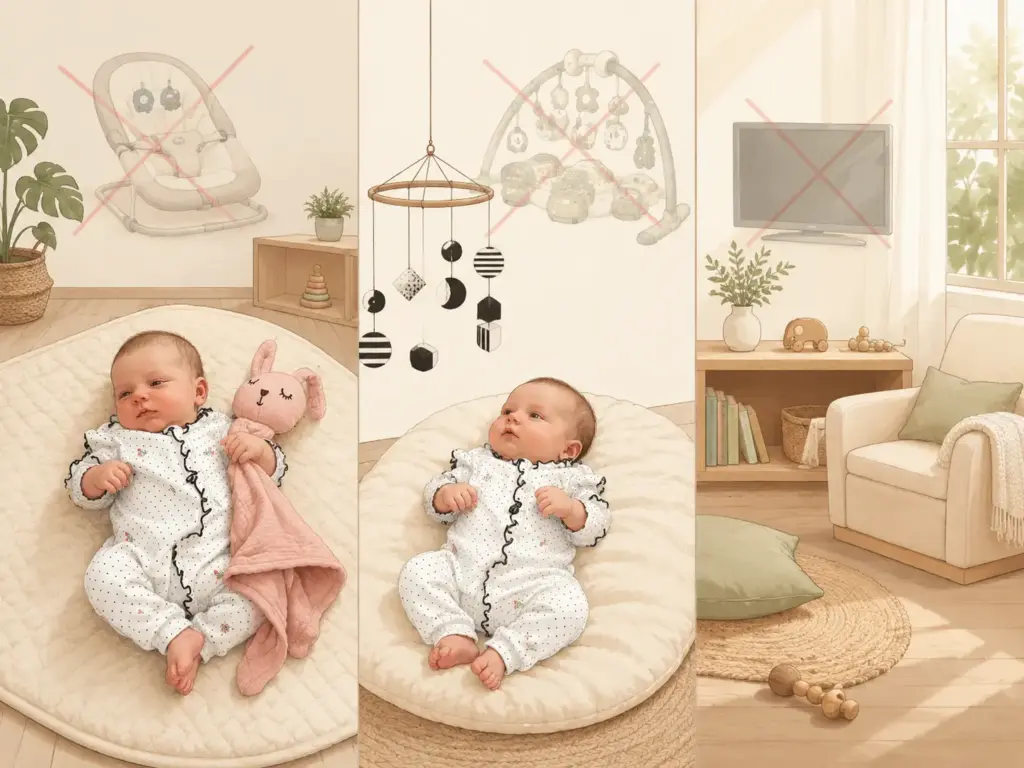
Montessori’s approach to the newborn period is partly defined by what it avoids.
Baby Containers — Bouncers, Swings, Bumbo Seats
Baby containers hold your baby in a position they can’t achieve independently and can’t exit independently. From a Montessori movement perspective, this removes your baby from their developmental work: the movement area is where they practice free movement, discover their body in space, and build the postural muscles that rolling, sitting, and standing depend on. Occasional use for caregiver necessity is different from routine use as entertainment. The issue is not safety — it is developmental opportunity cost. Every hour in a bouncer is an hour not spent on the floor building postural control.
Overstimulation — Activity Gyms With Multiple Features
A play gym with lights, music, hanging toys, and a mirror provides four simultaneous sensory channels to a nervous system that cannot yet integrate them. The newborn brain doesn’t experience this as enrichment — it experiences it as noise. A single mobile, a single card, a single mirror: isolation of one stimulus is the Montessori principle applied directly to infant sensory development.
Screen Proximity
Screens — including TV on in the background — produce visual and auditory stimulation at a pace the newborn’s nervous system cannot track. Background television is not background noise to a newborn; it is a stream of unpatterned sensory events. Keeping screens out of the movement area during wakeful periods costs nothing and removes an overstimulation source.
| The most common thing I see in home visits with newborns is an infant in a bouncer in front of a TV with a mobile above them and a music player on — all at once. Every single one of those things, individually, is fine. All at once, they produce sensory overwhelm that looks like fussiness and gets interpreted as needing more stimulation. Usually the answer is less, not more. — Zoe Paul, AMI Teacher Trainer (0-3) |
Frequently Asked Questions
What are the best Montessori activities for newborns?
The most significant activities are caregiving interactions done respectfully: narrating before touching, face-to-face eye contact during alert periods, and skin-to-skin contact. For visual activities, the Montessori mobile progression begins with the Munari (black and white, weeks 1–4) followed by Octahedron, Gobbi, and Dancers as color discrimination develops. A floor mirror, high-contrast cards, and from week 6–8 a wooden grasping ring complete the material set.
When do you start Montessori with a newborn?
From birth. The newborn’s first prepared environment is the quality of caregiving: narrated diaper changes, face-to-face conversation, skin-to-skin contact. The Munari mobile can be introduced in the first week. A floor mat for movement freedom can be set up from day one. No special materials are required to start — your attentiveness, narration, and physical presence are the complete curriculum for the first four weeks.
How long should Montessori activities last for a newborn?
In weeks 1–3, alert windows are 20–40 minutes with genuine attention capacity of 5–10 minutes. One activity per alert window is sufficient — a mobile session, a face conversation, or tummy time, but not all three consecutively. By 2–3 months, alert windows extend to 60–90 minutes and engagement may last 10–15 minutes. The signal is always the baby: turning the head away, arching the back, increasing fussiness — the session has been long enough.
Do I need special Montessori toys for a newborn?
The first four weeks require essentially nothing purchased. Face-to-face interaction, narrated caregiving, skin-to-skin, and a firm floor mat for supervised awake time are the complete setup. From week 1–4, a Munari mobile or high-contrast cards adds the first visual activity. From week 4–6, a floor mirror adds sustained engagement. From week 6–8, a natural wood grasping ring supports the reflex-to-voluntary grasp transition. The total material investment for 0–3 months is minimal; the developmental investment — the quality of adult presence and patience to do caregiving slowly — costs nothing.
When should I start Montessori with my baby?
From birth. Montessori principles apply from the first day — not through toys or materials, but through how you handle, speak to, and create an environment for your newborn. The respectful caregiving practices in this guide (narrating before touching, face-to-face conversation, prepared movement area) are the complete Montessori starting point. No purchases required. If your baby is already older, start with the activities matched to their current developmental stage — it is never too late to begin.
The Curriculum Is You
The Montessori curriculum for the newborn period is not a collection of materials. It is a way of being with your baby during the interactions that are already happening — the diaper changes, the feeding, the carrying. Slow those down. Narrate them. Make eye contact during them. Everything else — the mobiles, the mirror, the grasping ring — supports and extends what those interactions build.
If you’re in survival mode: do one thing. Say out loud what you’re about to do before you do it. That is Montessori for newborns, distilled to its most essential practice. The rest builds from there, when you have capacity for it.
As your baby moves into the next stage, the activities change significantly — Montessori toys and activities for 1-year-olds covers the materials and interactions matched to the 6–12 month window. For the full nido environment: the prepared environment guide.
Kukoo’s wooden materials are designed for the natural grasp reflex transition and beyond — unfinished natural wood, safe for mouthing, appropriate weight for small hands. Shop wooden Montessori toys for newborns and infants.