
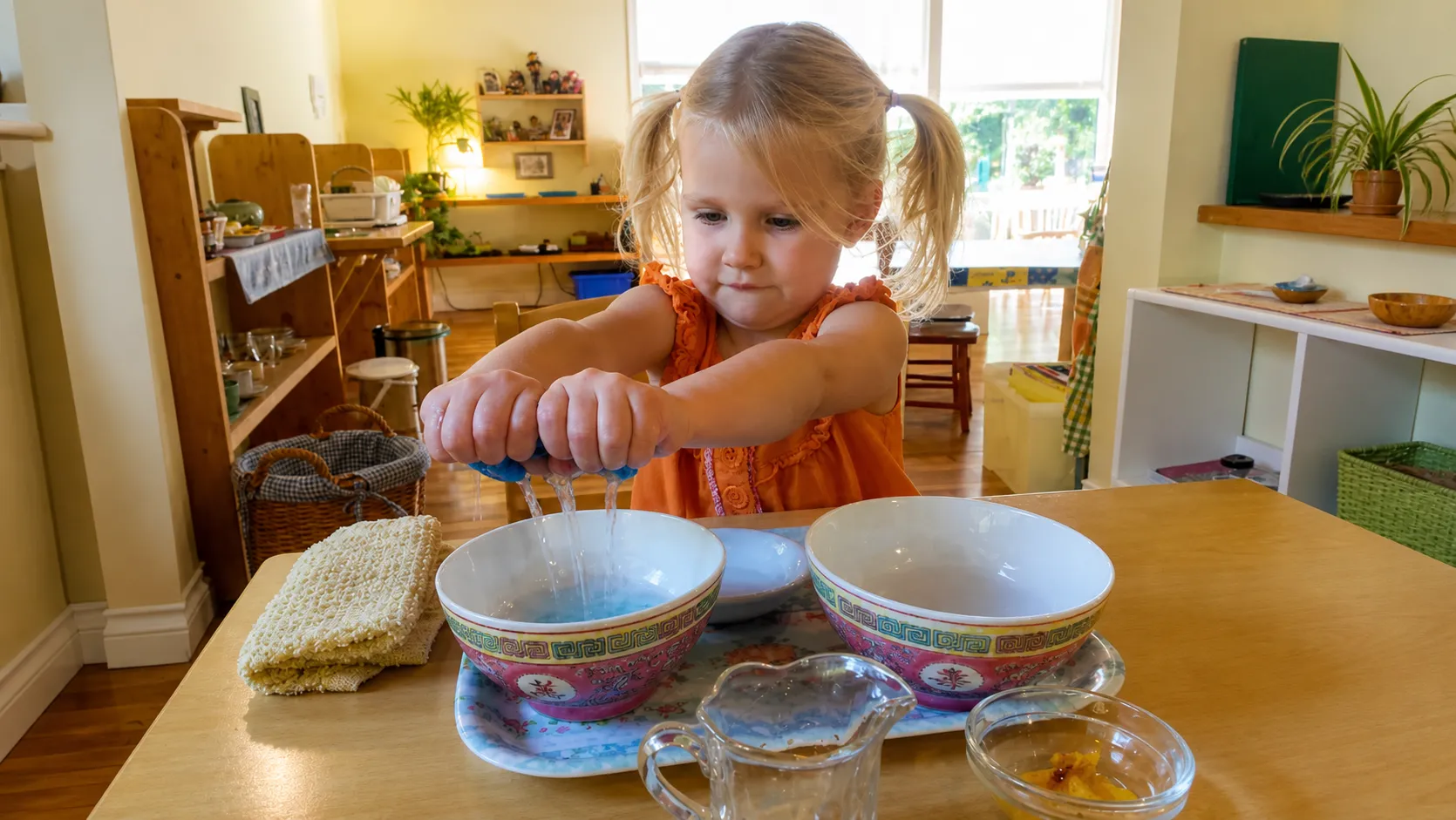
Your 2-year-old watches you sweep the kitchen floor. They reach for the broom. You hand them a toy broom instead. They drop it immediately and walk away. That wasn’t disinterest. That was a message. Children between 0 and 6 are in what Maria Montessori called a sensitive period for real work — and a toy broom is not real work.
Montessori Practical Life activities are the real, purposeful tasks of daily life given to children in child-sized form so they can do them independently. They are the first area of Montessori, the most important, and the most consistently misunderstood. Most guides give you a list. This guide gives you the system — organized by both age and category — so you know exactly which activity to introduce next.
What Are Montessori Practical Life Activities — and Why Do They Come First?
Montessori Practical Life activities are purposeful, real-world tasks that children perform independently — washing hands, pouring water, sweeping, arranging flowers — designed to develop concentration, coordination, independence, and a sense of order simultaneously. They fall into five categories established by AMI: Preliminary Exercises, Care of Self, Care of the Environment, Grace and Courtesy, and Control of Movement.
The Four Foundational Outcomes (O-C-I-D)
AMI educators describe four qualities every Practical Life activity develops simultaneously — what we can think of as the O-C-I-D foundation: Order (knowing every object has a place and every process has a sequence), Concentration (focusing on a task from beginning to satisfying completion), Independence (completing the full work cycle without adult intervention), and Development of coordinated movement (gross and fine motor control through purposeful, repeated action), through purposeful, repeated action — the same hand skills the CDC tracks as key milestones between 18 months and 3 years, from grasping and releasing objects to turning pages and using utensils. These don’t come from academic instruction — they come from doing.
A child who pours water three times isn’t being repetitive; they’re building the neural pathways that will later sustain reading, writing, and mathematics. Research from the Harvard Center on the Developing Child confirms that the executive function skills built through self-directed, purposeful activity — focus, working memory, and mental flexibility — are among the strongest predictors of academic and life success. Practical Life is, in developmental terms, executive function training disguised as housework.cs.
Practical Life isn’t the warm-up for Montessori. It IS Montessori — the developmental foundation every other curriculum area depends on.
Why Practical Life Comes Before Everything Else
AMI curriculum sequence: practical life skills before Sensorial, Language, and Math — because concentration, order, and coordinated movement must be established first (AMS, “Incorporating Practical Life at Home,” 2024). Children who haven’t built a complete work cycle (choose → complete → return) struggle with every subsequent material. The sequence isn’t arbitrary. The American Academy of Pediatrics’ clinical report on play specifically highlights child-directed, active engagement with real materials as the gold standard for developing concentration and self-regulation — which is precisely what Practical Life delivers when presented correctly.
| In my AMI training and years working directly with families, I’ve watched the same moment happen hundreds of times: a parent sets up a beautiful tray and the child doesn’t touch it. Not because practical life doesn’t work — but because one small detail of the setup wasn’t right. We’ll cover exactly what that detail is. – Katy Lenoir — Preschool & Elementary Expert (Ages 3–12) |
The 5 Categories of Montessori Practical Life Activities
Every activity belongs to one of five categories. Understanding the framework is more useful than any list — because once you know it, you can create activities from anything already in your home.
1. Preliminary Exercises — The Foundation Layer
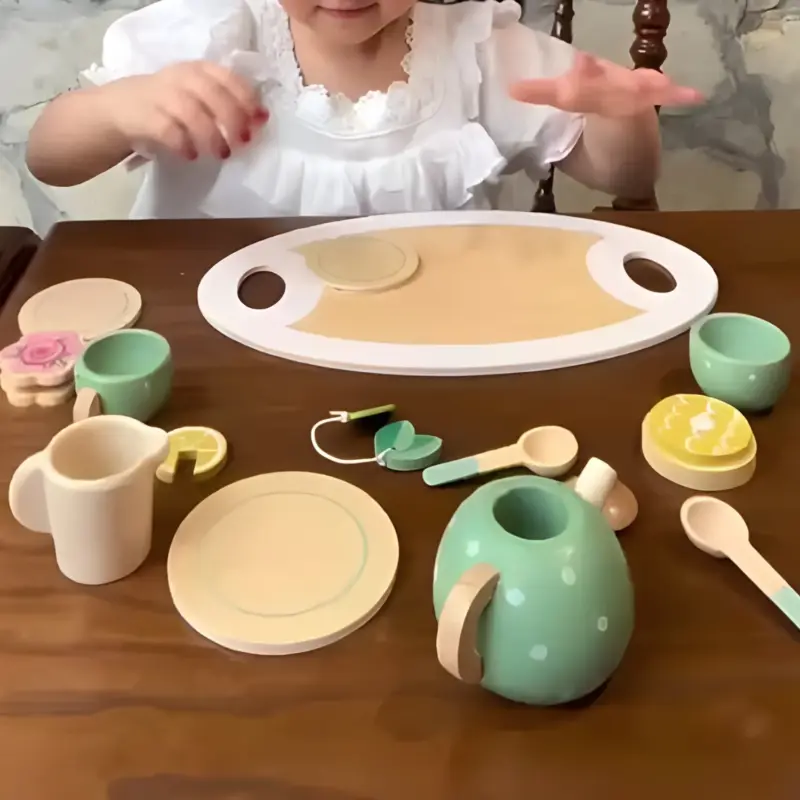
Pouring, carrying, folding, opening and closing, rolling a work mat. A child who cannot pour without spilling or carry a tray without dropping it cannot access the rest of Practical Life with confidence. Introduce at 12–18 months (dry material first, then water). Home version: two small pitchers + tray with a cloth; child pours dried lentils from one to the other.
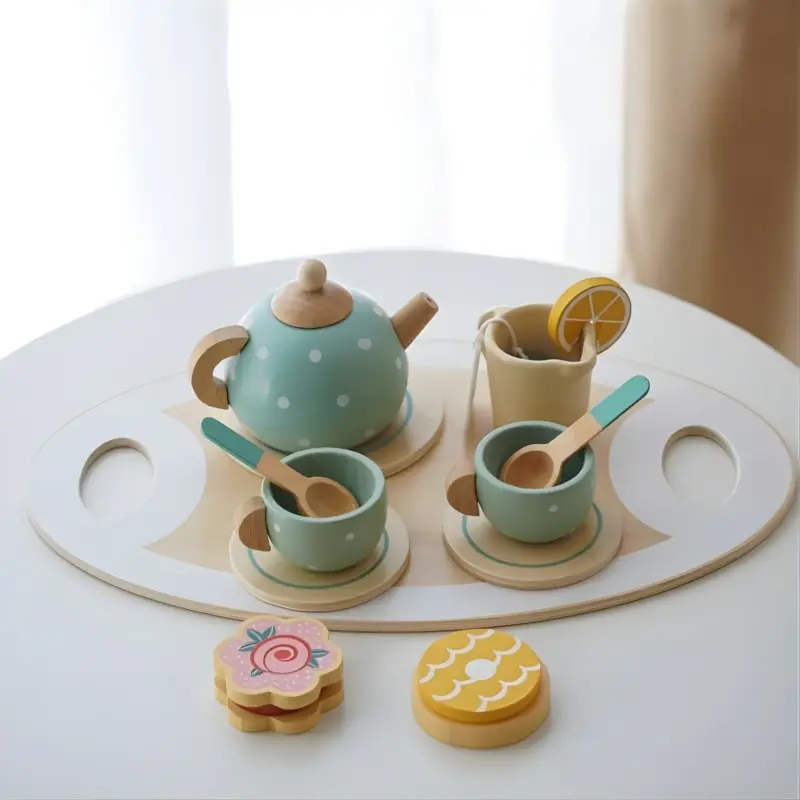
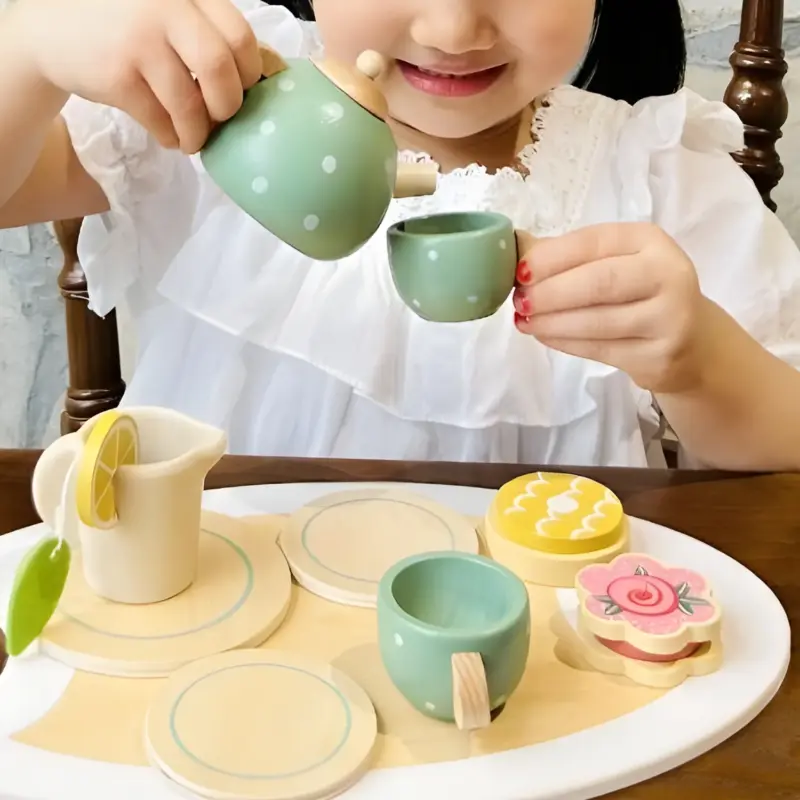
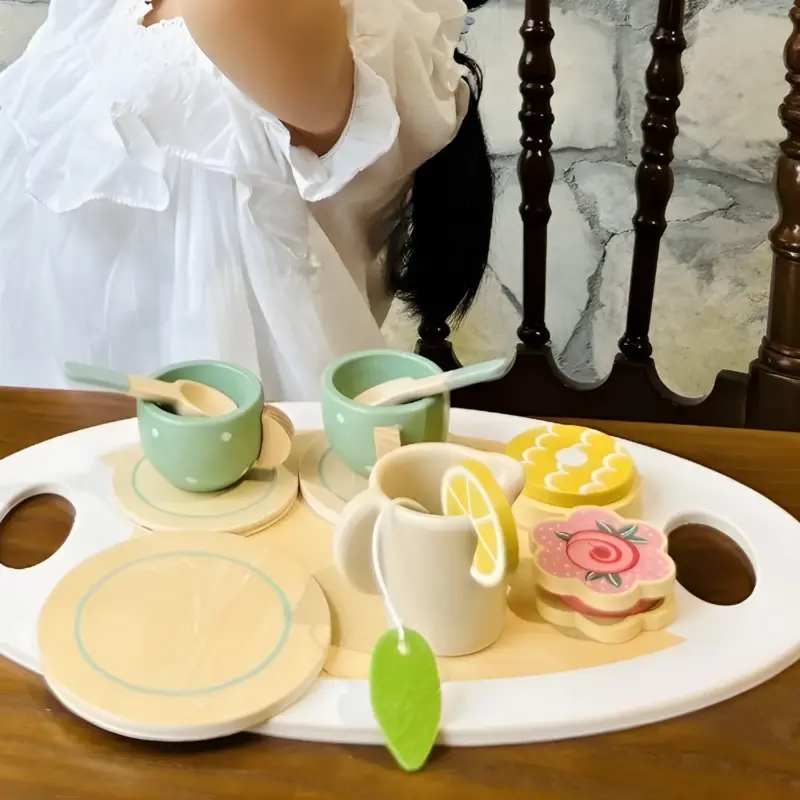
Once your child has mastered dry pouring, a wooden tea party set gives the same pouring motion a real social context — small pitcher, small cups, a tray to carry without spilling. The physical skill is identical; what changes is the purpose your child assigns to it.
2. Care of Self — Personal Independence
Handwashing, dressing/undressing, tooth brushing, hair brushing, blowing nose, putting on a coat. Your child experiences their body as something they are responsible for — not managed by adults. The sensitive period for order (18 months–3 years) makes this category particularly compelling. Home: low hook for coat, step stool at sink with soap and towel accessible.
3. Care of Environment — Contributing to the Home
Sweeping, mopping, wiping tables, watering plants, flower arranging, polishing. Core principle: real tools, real consequences — a child-sized broom that actually sweeps, not a toy that pushes crumbs around. Your child learns the environment belongs to them and they are responsible for maintaining it.
4. Grace and Courtesy — The Most Underrated Category
Greeting others, waiting for someone to finish speaking, saying excuse me, polite interruption, passing objects safely. This looks like “politeness lessons” but is actually the foundation of social-emotional intelligence and conflict resolution — practiced through role-play until internalized. Not rules imposed from outside; skills rehearsed until natural.
5. Control of Movement — Body Mastery
Walking the line, the silence game, carrying a tray without spilling, rolling a mat with precision. Body awareness, proprioception, and voluntary impulse control — qualities that translate directly to sustained focus in later academic work. Home: strip of tape on the floor; child walks heel-to-toe carrying a small cup of water.
Montessori Practical Life Activities by Age and Category
What Practical Life looks like shifts significantly at each stage. Use behavioral readiness, not just the calendar.
Birth–12 Months — Observation as Active Participation
| Category | Activities | Notes |
| Preliminary | Smelling herbs, feeling textures (bumpy lemon, smooth apple) | Narrate every action aloud |
| Care of Self | Involvement in diaper routine, pulling off socks | Child participates, not observes passively |
| Care of Environment | Washing fruit in shallow basin (from 6mo) | More sensory play than task mastery |
| Grace & Courtesy | Hearing “thank you,” “excuse me” naturally | Absorption stage only |
Readiness signal: sustained watching of an adult completing a task; reaching for real objects while ignoring toys. Biggest mistake: removing your child from the environment “so they don’t get in the way” — observation IS the learning.
12–18 Months — First Independent Tasks
| Category | Activities | Setup Tip |
| Preliminary | Pouring dry lentils pitcher-to-pitcher; carrying small tray | Tray with cloth for spills; one activity only |
| Care of Self | Removing socks, hat; handwashing sequence at step stool | Full sequence accessible independently |
| Care of Environment | Wiping own highchair tray with cloth | Small damp cloth in reachable basket |
| Grace & Courtesy | Waving goodbye; receiving an object with “thank you” modelled | Model, don’t demand |
Readiness signals: attempts to use spoon independently; reaches for cloth when they spill; removes own socks without prompting.
18–30 Months — The Peak Practical Life Window
| Category | Activities | Notes |
| Preliminary | Pouring water; food prep — spreading, peeling banana, tearing lettuce | Start with small water amounts |
| Care of Self | Dressing: large buttons, velcro, elastic waist; dressing-focused activity board (zippers, buckles, snaps isolated) | Zippers/snaps next; shoelaces at 4+ |
| Care of Environment | Sweeping; washing fruit; wiping table; watering “their” plant; flower arranging | Real child-sized tools, not toy versions |
| Grace & Courtesy | Simple greeting role-play; how to hand an object | Short 2–3 minute scenarios |
| Control of Movement | First line walking; carrying tray point-to-point | Tape line on floor; small cup with water |
This is the window of maximum return. The sensitive period for order is at peak intensity. The autonomy drive is intense (“me do it”). The drive to sweep, pour, and button peaks during the sensitive period for movement and order between 18 months and 3 years — which is why a 2-year-old who watches you cook wants to cook, not watch. A dressing-focused activity board with real fastener mechanics — zippers, buckles, snaps, latches isolated for repeated practice — is a Care of Self tool that directly corresponds to AMI dressing frames. Before your child can zip their own jacket, they need hundreds of repetitions with the mechanism in isolation.
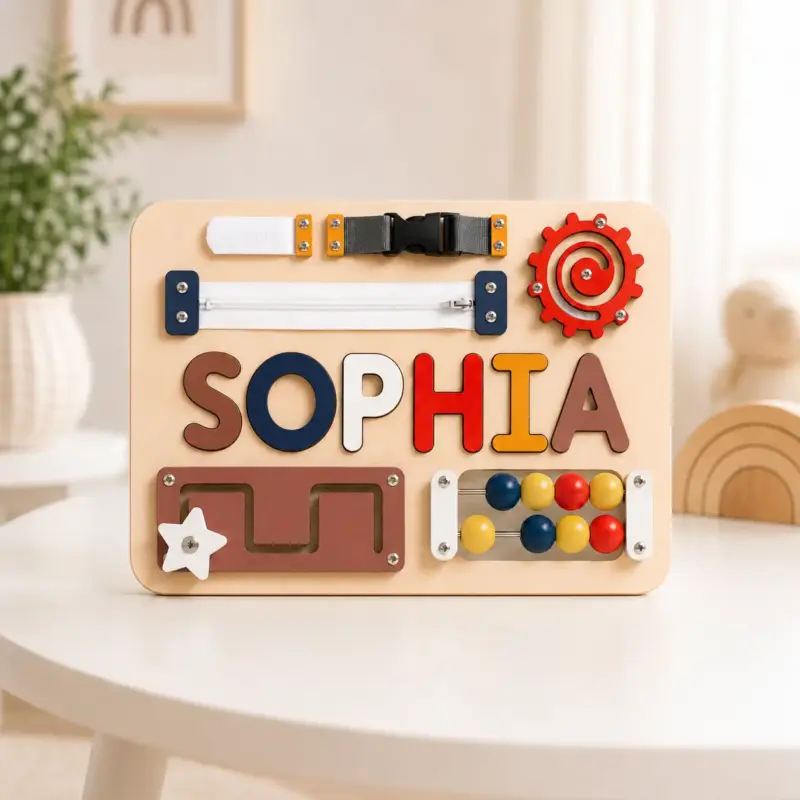
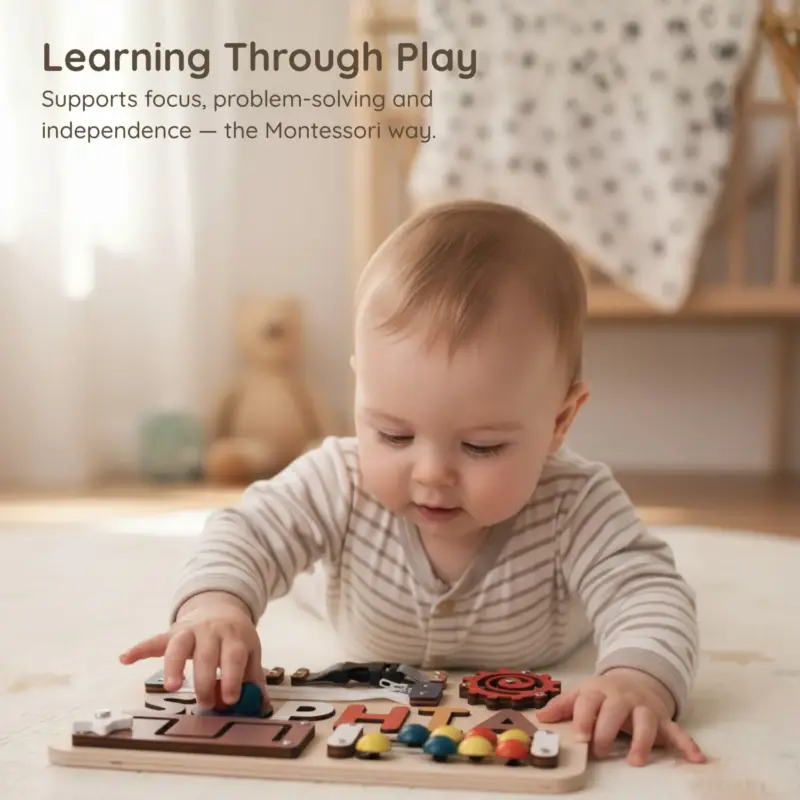
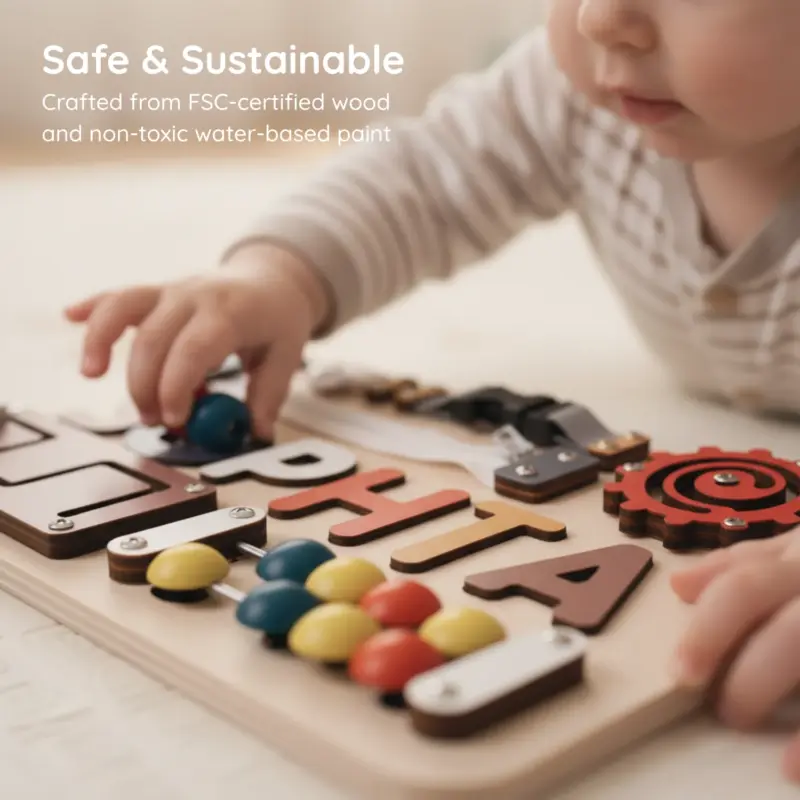

Zips & Buckles – Wooden Montessori Busy Board
2.5–4 Years — Expanding Complexity
| Category | Activities | Notes |
| Preliminary | Full table washing sequence (tray + sponge + soap + cloth); simple folding | Pictorial sequence card alongside tray |
| Care of Self | Standard buttons, snaps, zippers; dressing frames | Shoelaces at 4+ years |
| Care of Environment | Laundry sorting by color; sweeping with dustpan; full plant care | Child initiates without prompting |
| Food Preparation | Crinkle cutter for soft foods; grating cheese; cracking eggs | Real tools, real outcomes |
| Grace & Courtesy | How to interrupt politely; setting table; greeting visitors | Role-play → real application |
| Control of Movement | Walking the line carrying object; silence game; rolling mat precisely | Silence game: 1–3 minutes |
4–6 Years — Mastery and Pre-Academic Bridge
| Category | Activities | Academic Connection |
| Food Preparation | Visual recipe cards; measuring with cups/spoons | Math: 1:1 correspondence, sequencing |
| Care of Self | Independent dressing including shoelaces; full hygiene routine | Executive function, routine management |
| Care of Environment | Full bathroom wipe-down; mirror polishing; making snack for sibling | Language: describing steps; social-emotional |
| Craft / Sewing | Running stitch on fabric; stitching board | Pre-writing: precise hand movements |
| Grace & Courtesy | Hosting a guest; resolving conflict verbally | Social-emotional intelligence |
Children with strong Practical Life exposure at 0–4 consistently show longer concentration spans and better work-cycle establishment when beginning academic materials — the OCID foundation expressing itself.
How to Set Up Montessori Practical Life at Home

The 6-Part Tray Rule
Every effective tray has six qualities: Complete (every needed item present). Real (functional child-sized tools). Beautiful (natural, undamaged materials). Accessible (low shelf, child’s eye level). One activity only (isolation of activity). Correctly sized (pitcher matches grip; cloth fits one hand). Miss one, lose the activity.
Start Here — Three Priority Setups
Priority 1: Handwashing station — step stool + small soap + nail brush + towel at child height. Runs daily. Builds routine foundation.
Priority 2: Table-care tray — small spray bottle (water) + cloth + tray. After every meal. 45 seconds; teaches Care of Environment daily.
Priority 3: One pouring tray — dry lentils for under 18mo; small water for 18mo+. On low shelf; child accesses independently. The kitchen, the bedroom, and the entryway are where practical life happens most naturally — and setting up each zone so your child can access real work doesn’t require a full room redesign.
The Work Cycle — Why Return-to-Shelf Is Not Optional
Choose activity → complete → return all materials exactly as found. The return step closes the concentration loop, reinforces order, and prepares for next use. What to say: “Your work is complete — let’s put it back so it’s ready for next time.” What NOT to say: “Good job!” — evaluation from adults interrupts the child’s intrinsic satisfaction.
Why Your Child Is Refusing Practical Life Activities
If you’ve set up the tray and your child walked past it for the third day — here’s what’s actually happening.
Wrong Developmental Level
Too advanced: multiple steps before work cycle is established. Too simple: mastered weeks ago, not rotated. Fix: observe what your child attempts in daily life — what they reach for, what they watch you do. That’s the next activity.
Presentation Missing or Rushed
Every material needs a presentation: demonstrated once, slowly, without words, then left for the child. Most parents either skip the demo or hover and correct during use — both undermine ownership. Fix: demonstrate silently, invite with a gesture, leave entirely for 10 minutes.
Environment Not Ready
Hungry, tired, overstimulated, or transitioning from a screen = executive function depleted. Practical Life works best mid-morning after breakfast, after a nap, during calm transitions.
Adult Correction Broke the Loop
Your child sweeps in the wrong direction, uses too much soap, pours unevenly — and you step in. This signals: “this is my work, not yours.” Fix: observe only. Resist correction until the work cycle is complete. Model correctly next time, silently, before the child begins.
| I have genuinely never seen a child refuse an activity they were ready for, in a calm environment, with a beautiful accessible tray. Refusal is almost always information about one of those three conditions — not about the child or the method.– Katy Lenoir — Preschool & Elementary Expert (Ages 3–12) |
Which Practical Life Activities Build Which Skills?
You now know when to introduce each activity. This view answers a different question: what exactly does each category build — so you can choose deliberately, not by guesswork.
| Category | Signature Activity | Fine Motor | Concentration | Independence | Order | Social-Emotional |
| Preliminary | Pouring (dry → water) | ✅ Wrist, grip | ✅ Task loop | ✅ Self-start/finish | ✅ Pour→wipe→return | — |
| Care of Self | Handwashing | ✅ Bilateral | ✅ Multi-step | ✅ Self-initiation | ✅ Fixed order | — |
| Care of Env. | Table wiping | ✅ L-to-R motion | ✅ Full surface | ✅ Owns cleanup | ✅ Work cycle | — |
| Care of Env. | Sweeping + dustpan | ✅ Grip, pressure | ✅ Completion | ✅ Real contribution | ✅ Spatial order | — |
| Care of Self | Dressing (buttons, zips) | ✅ Pincer, isolation | ✅ Frustration tolerance | ✅ Body autonomy | ✅ Dress sequence | — |
| Grace & Courtesy | Polite greeting | — | — | — | — | ✅ Empathy, scripts |
| Control of Movement | Walking the line | ✅ Balance | ✅ Impulse hold | — | — | ✅ Body awareness |
| Food Prep | Spreading / cutting | ✅ Force, wrist | ✅ Multi-step | ✅ Real result | ✅ Recipe sequence | — |
| Grace & Courtesy | Table setting | ✅ Placement | ✅ Spatial completion | ✅ Family contribution | ✅ 1:1 correspondence | ✅ Serving others |
The pattern: Preliminary Exercises and Care of Environment hit the most developmental targets simultaneously — which is why AMI introduces them first. Grace and Courtesy is the only category building social-emotional skills directly — and the one most parents underweight. If your child’s shelf has nothing from this category, that’s the gap to fill next. The specific toys and materials that support practical life at each age are organized in the practical life skills collection — matched to the same developmental windows this guide describes.
Your Questions Answered
At what age do you start Montessori Practical Life?
Birth through participatory observation. First independent activities (pouring, wiping) from 12 months. The richest window is 18 months to 3 years, when the sensitive period for order and the drive for independence are both at peak.
What are the 5 categories of Montessori Practical Life?
Preliminary Exercises (pouring, carrying, folding), Care of Self (dressing, handwashing), Care of the Environment (sweeping, plant care), Grace and Courtesy (greetings, polite interrupting), and Control of Movement (walking the line, silence game).
How is Practical Life different from regular chores?
Chores are tasks adults assign for household management. Practical Life activities are designed from the child’s developmental perspective — matched to their current motor and cognitive stage, presented for independent completion, focused entirely on the process rather than the outcome. The imperfect sweep IS the point.
Do I need to recreate a Montessori classroom at home?
No. AMI explicitly states these activities should be culturally specific to the child’s own home. You don’t need special materials — you need one accessible hook at child height, one step stool, and the willingness to let your child participate in tasks already happening around them. One well-set-up tray per week is more effective than 20 trays the child can’t access independently.
Is a busy board a Montessori Practical Life activity?
A wooden activity board that isolates real dressing fasteners — zippers, buckles, snaps, latches — corresponds directly to Montessori dressing frames, a core Care of Self material in AMI classrooms. The key distinction: choose boards built around real fastener mechanics over those with electronic lights or sounds, which interrupt the intrinsic concentration the activity is designed to build.
Start with One Tray. Watch What Your Child Reaches For.
Practical Life is not a list of things to teach your child. It’s a way of seeing your home differently — as an environment where a small person can do real work, make real contributions, and build real skills without a single formal lesson.
You don’t need a Pinterest-perfect setup. You need one step stool, one accessible hook, and the willingness to move a little slower so your child can participate. The work they are desperate to do is already happening around them, every day.
→ Shop Kukoo’s practical life collection now!