
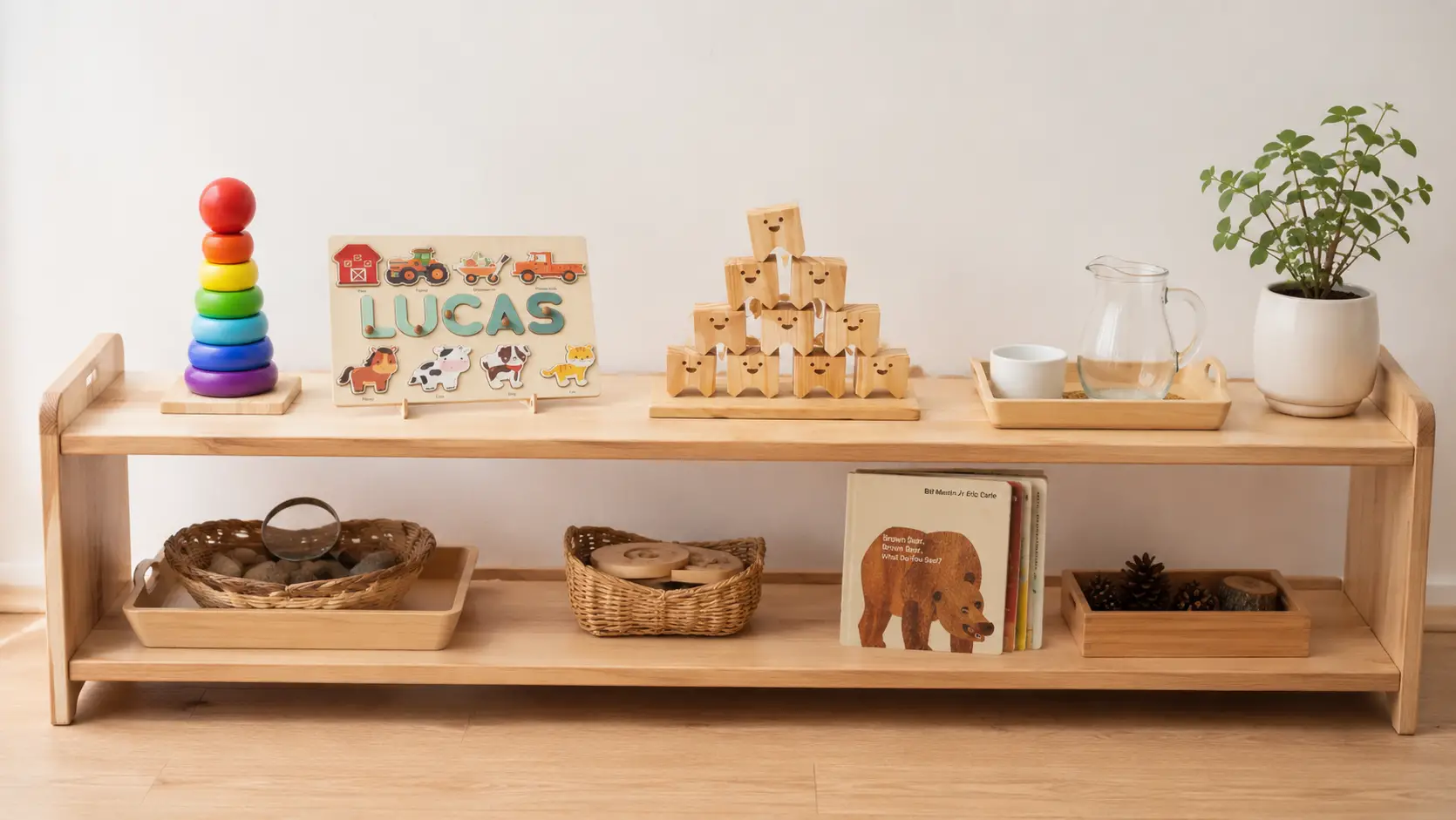
You’ve read that fewer toys is better. You’ve seen the minimalist Montessori playroom photos. You know the principle — you just don’t know the number. And more importantly: when you look at your child’s 47 toys and know you need to get to 6–8, you don’t know which 6–8 to keep.
This is the question that “fewer is better” never answers. How many, exactly? And which ones? The answer isn’t the same for a 6-month-old and a 4-year-old. It isn’t the same for a child in the pincer grasp stage and a child approaching the writing explosion. This guide gives you the number — and the framework for making it actually useful.
| How many Montessori toys does a child need? In Montessori, the recommended number of toys on the shelf at any one time is 6–8 items — not because of an arbitrary rule, but because this number allows the child to see all available choices clearly, make a deliberate selection, and engage in sustained concentration without being overwhelmed. Total collection (toys in rotation storage) can be larger — typically 15–25 items — but only 6–8 should be accessible and visible at once. The specific 6–8 should cover the child’s active developmental domains rather than duplicating the same type of activity. |
The 3-Tier Distinction — Shelf, Collection, and Owned
Before the number, the distinction — because “how many toys does a child need” is actually three different questions.
- Tier 1 — The Shelf (what’s accessible right now): 6–8 items. These are the only toys your child can see and access independently. Everything else is in storage. The shelf count is the number that matters most for concentration. AMI’s framework for the prepared environment establishes this principle directly: the environment is arranged not to display everything available, but to present a considered selection that invites concentration rather than overwhelm.
- Tier 2 — The Rotation Collection (what’s in storage): 15–25 items total across all developmental domains, organized by domain. These rotate onto the shelf when items are mastered or lose engagement. The rotation collection should be organized well enough that you can pull from any domain on rotation day.
- Tier 3 — Total Owned (everything the child has ever received): This number is flexible and personal. What matters is not how many you own but how many you display. A 200-toy household with 8 on the shelf is Montessori in practice. A 20-toy household with all 20 visible is not. The broader home setup — zones, furniture height, rotation storage logistics — is covered in the honest Montessori at home guide for families working with real constraints.
The practical implication: When someone says “your child needs 6–10 toys,” they mean Tier 1. Not Tier 3. This distinction alone resolves most parents’ confusion.
| The most common environment problem I see is not too few toys — it’s too many of the wrong kind displayed simultaneously. A child with 8 fine motor trays and nothing in the language or sensorial domain is experiencing a prepared environment with a gap, regardless of how many items are on the shelf. — Katy Lenoir — Preschool & Elementary Expert ( 3–12) |
The Developmental Domain Framework — Which 6–8 to Choose
The number 6–8 is meaningless without a framework for which 6–8. The rationale for limiting shelf choices is grounded in research: Dauch et al.’s study published in Infant Behavior and Development found that toddlers aged 18–30 months engaged in longer, more varied, and more sophisticated play when given 4 toys compared to 16 — the quality of engagement, not the quantity of options, is what drives development. A shelf of 8 stacking activities is a fine motor shelf — not a prepared environment. Here is the framework.

| Slot | Domain | Why It Belongs | Example |
| 1 | Practical life | Independence, fine motor, real-world mastery | Spooning tray, pouring set, dressing board |
| 2 | Fine motor / Sensorial | Hand precision, sensory discrimination, concentration | Stacking toy, threading, puzzle |
| 3 | Language | Feeds the sensitive period for language (active birth–6yr) | Name puzzle, picture cards, books |
| 4 | Sensorial | Discrimination, classification, mathematical mind | Sensory basket, sorting activity, texture exploration |
| 5 | Gross motor / Movement | Supports the movement sensitive period | Balance board, ball activity, push toy |
| 6–8 | Current interest | Follows the child — what they’re currently investigating | Animal figurines, blocks, nature objects |
The 1-item-per-domain minimum rule: At any shelf configuration, ensure at least one item from each of the first 4 domains. Domain balance follows the child’s active Montessori sensitive periods — understanding which periods are open at your child’s current age tells you which domains need the most presence on the shelf right now. Slots 5–8 are flexible and can weight toward current interest or repeat a needed domain. Never allow 3+ items from the same domain — this signals you’re following adult preference rather than the child’s developmental breadth.
| When a parent says ‘we have Montessori toys but my child isn’t concentrating,’ the first thing I do is look at the shelf. In most cases, the count is fine — but 5 of the 7 items are the same type of activity. The child has no variety across domains. The concentration isn’t missing — the developmental invitation isn’t there.” — Katy Lenoir — Preschool & Elementary Expert ( 3–12) |
Age-Specific Guidance — The Number Changes by Stage
Six to eight applies across ages as a principle — but the specific number within that range and the domain balance shift significantly by developmental stage.

6–18 Months — 4–5 Items
The infant’s concentration window is shorter; fewer items produce longer engagement per item. Shelf count: 4–5 maximum. Domain balance: movement (1) + sensory/tactile (1) + visual/auditory (1) + beginning practical life (1). Rotation: every 5–7 days or when engagement drops to 0. Materials that support the specific capacities emerging in the first year belong here — nothing more.
18 Months–3 Years — 6–8 Items
The toddler’s concentration window is extending; the sensitive period for order is at peak. The shelf must be consistent in placement even as items rotate. Shelf count: 6–8. Domain balance: practical life (1–2) + fine motor (1) + language (1) + sensorial (1) + movement (1) + current interest (1). Rotation: every 7–10 days; observe which items are untouched for 5+ days.
3–5 Years — 8–10 Items
The primary child can sustain longer work cycles and navigate a richer shelf. The domain balance expands to include the five Montessori curriculum areas. Shelf count: 8–10. Domain balance: practical life (1–2) + fine motor/sensorial (1–2) + language (1–2) + math (1) + cultural (1) + current interest (1). Rotation: every 10–14 days; follow mastery signals, not calendar.
The universal rule across all ages: The shelf should never contain more items than your child can independently choose between in under 30 seconds. If it takes them longer to scan the shelf than to begin working, there are too many items.
How to Know When to Rotate — Observation-Based Triggers

Most rotation advice says “rotate every week.” That’s a calendar-based system. Montessori rotation is observation-based: you rotate when your child’s behavior tells you to, not when 7 days have elapsed.
- Trigger 1 — The Mastery Signal. Your child completes the activity cleanly in one or two attempts and moves on without returning. The material has done its work. Rotate to storage; replace with the next difficulty level within the same domain.
- Trigger 2 — The Abandonment Signal. The item hasn’t been touched in 5+ consecutive days. Sometimes the timing is wrong, not the material. Move to storage; try again in 3–4 weeks. Engaged on return = timing issue. Ignored again = permanently outgrown.
- Trigger 3 — The “Everything in 5 Minutes” Signal. Your child moves through every shelf item rapidly without sustained engagement. The shelf as a whole is mismatched — either all items are mastered, or the domain balance is wrong. The AAP’s clinical report on play and child development notes that sustained, self-directed play — not rapid sampling of options — is the condition that produces benefits to executive function and social-emotional development. When rotation signals appear, they are signals to restore that condition.
Perform a full shelf reset: remove everything, reassess by domain, rebuild with 1 item per domain matched to current readiness.
What to Do With the Rest — The Declutter Protocol
You’ve read: 6–8 on the shelf. You have 47 toys. Here is what to actually do with the other 39–41.
| Category | Criteria | Action |
| Shelf now | Domain match + current readiness + recent engagement | Goes on the shelf, 1 per domain |
| Rotation storage | Still appropriate, good quality, not currently needed | Labeled bins by domain — accessible for rotation |
| Future | Currently too advanced; will serve in 3–6 months | Dated storage — label “open at [month/year]” |
| Exit | Below developmental level, no longer engaged, battery-operated entertainment | Donate, gift, or remove from home |
The honest truth: Most households with toy overwhelm don’t need to buy fewer toys in future. They need to remove the toys doing nothing — neither engaging the child nor serving a domain — from visibility. A toy in a labeled storage bin that gets rotated back in 6 weeks is not excess. A toy sitting untouched on a shelf for 4 months IS excess, regardless of cost. For the criteria that determine whether a toy earns a slot in rotation storage versus exit, the Montessori toy selection guide walks through the 8 design criteria that distinguish developmentally effective materials from those that merely look Montessori.
Frequently Asked Questions
How many Montessori toys does a child really need?
The shelf count — the number visible and accessible at once — is 6–8 items. This allows your child to survey choices, select deliberately, and engage without being overwhelmed. The total rotation collection can be 15–25 items organized by domain. The specific 6–8 should cover multiple developmental domains: at least one practical life, one fine motor or sensorial, one language, and one item following your child’s current interest.
How many toys should be on a Montessori shelf by age?
For 6–18 months: 4–5 items covering movement, sensory, and beginning practical life. For 18 months–3 years: 6–8 items across practical life, fine motor, language, sensorial, and movement. For 3–5 years: 8–10 items covering all five Montessori curriculum areas. The rule across all ages: never more items than your child can scan and choose between in under 30 seconds.
How often should I rotate Montessori toys?
Rotation is triggered by observation, not a fixed schedule. The three triggers: mastery (completes cleanly, doesn’t return — rotate to harder version), abandonment (untouched 5+ days — move to storage, retry in 3–4 weeks), and full-shelf stagnation (everything scanned in 5 minutes — perform a complete shelf reset). Typical rotation frequency that emerges from observation is every 7–14 days, but some items stay for months.
What should I do with all the toys that don’t belong on the shelf?
Sort into three categories: rotation storage (developmentally appropriate, organized by domain in labeled bins for future rotation), future storage (currently too advanced — labeled with the month they become appropriate), and exit (below developmental level, no longer engaged with, or battery-operated entertainment — donate or remove). A toy in organized rotation storage is a prepared environment resource. A toy untouched for four months is excess regardless of cost.
The Number Without the Framework Is Just Minimalism

The question “how many Montessori toys does a child need” has a quick answer: 6–8 on the shelf. The more useful answer — the one that actually changes how your child engages — is: 6–8 items that together cover the developmental domains your child is actively working on right now. The number without the framework is just minimalism. The framework without the observation-based rotation is just a one-time setup. All three together is a prepared environment. The observation system behind these triggers is covered in depth in the complete Montessori toy rotation guide — including how to read your child’s play signals and build a rotation schedule that follows development rather than the calendar.
One thing to do today: count the items on your child’s current shelf. If it’s more than 8, remove items from the most overrepresented domain first. If it’s under 6, check whether any domain is missing entirely. That assessment will tell you whether to add or subtract.
For which specific toys serve each domain at your child’s age, browse Kukoo’s toys by age and domain — organized by the same developmental framework described in this guide.. For the complete observation framework for rotation decisions: the Montessori observation guide. Shop now!