
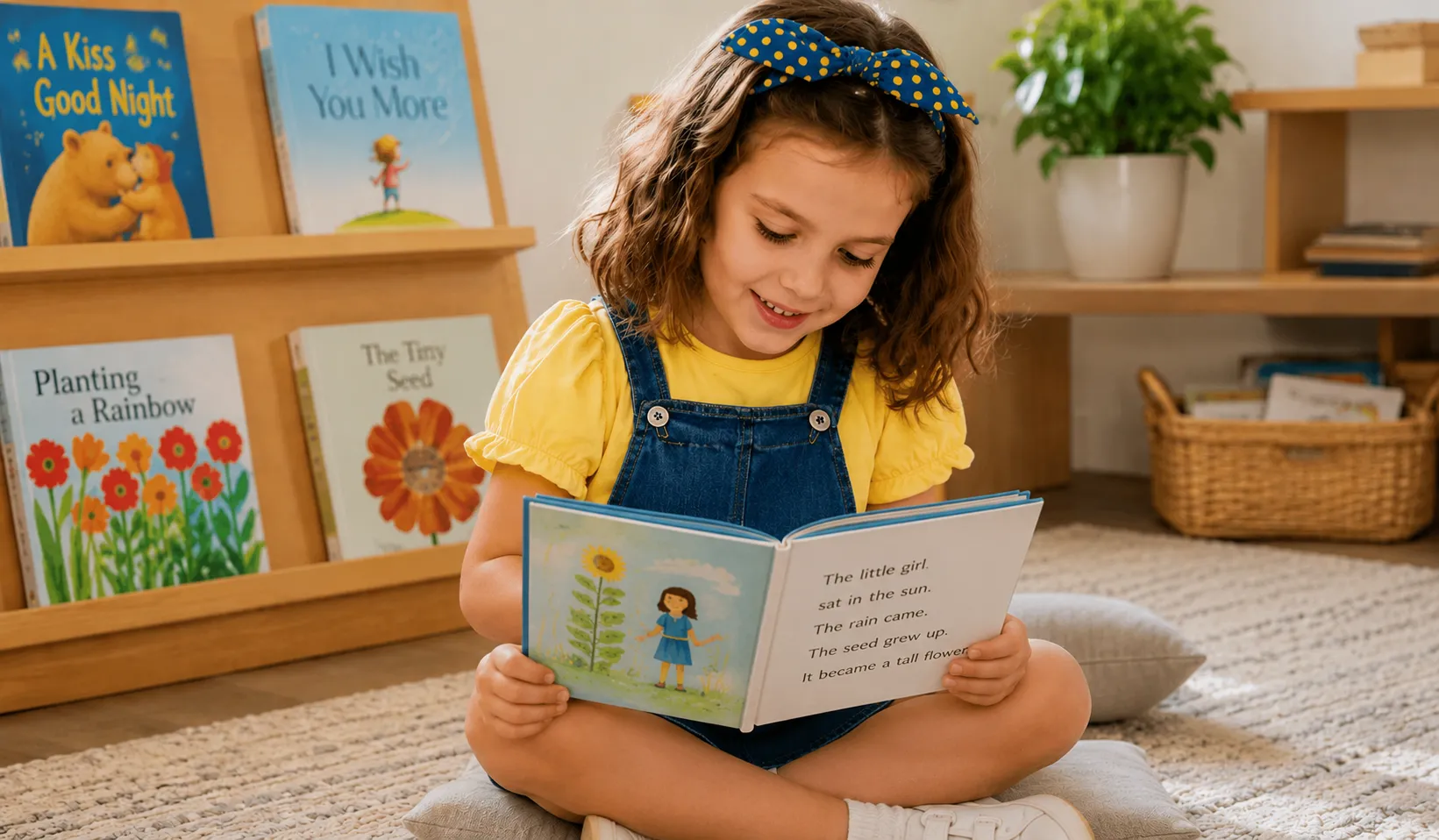
One morning your 5-year-old picks up a book — not to look at the pictures, but to read. Word by word, sounding out letters they’ve traced on sandpaper hundreds of times. They look up, slightly surprised. So are you. This is the explosion into reading, and it happens exactly like the explosion into writing at 4: not when you push, but when the preparation is complete.
Age 5 is the final year of Montessori’s primary period — and the Montessori toys for 5-year-olds that matter most now aren’t new introductions. They’re deepening what’s already there. This guide explains what to offer, and when.
| Montessori activities for 5-year-olds focus on the passage to abstraction — deepening concrete foundations built at 3 and 4 into increasingly independent, self-directed work — and on the sensitive period for reading, which often peaks at 5–5.5 years as children begin to decode phonetic texts spontaneously. Age 5 is the final year of Montessori’s primary period (3–6): the consolidation year. The year to deepen, not multiply. |
The Explosion Into Reading — Age 5’s Most Important Phenomenon
Just as the explosion into writing typically arrives between 3.5 and 4.5 years, the explosion into reading — the spontaneous ability to decode and read phonetic text — typically emerges between 4.5 and 5.5 years in children who have completed the reading preparation sequence. It is not taught. It arrives.
The Reading Preparation Sequence
| Stage | Activity | What It Builds | Age |
| 1 | Sandpaper letters + I Spy | Sound-symbol in both directions | 3–4 yr |
| 2 | Moveable alphabet | Encoding (spelling by sound) | 3.5–4.5 yr |
| 3 | Word analysis (segmenting all positions) | Phonemic awareness — all positions | 4–4.5 yr |
| 4 | First phonetic reading books | Decoding (reversing encoding) | 4.5–5.5 yr |
| 5 | Spontaneous reading explosion | Integration of all preparation | 5–5.5 yr |
Signs the Reading Explosion Is Imminent
These behaviors align closely with the developmental milestones for 5-year-olds — the language comprehension and early literacy markers that signal your child’s readiness to decode real text. Your child independently reads back words they composed with the moveable alphabet. They attempt to decode written words on signs, packaging, and labels. They ask “what does that say?” about written text — not pictures. When you see these signals converging, the phonetic books should already be on the shelf.
What to Do When It Arrives
Offer simple, decodable phonetic books — CVC words only at first. No sight-word-heavy books: your child needs to practice the decoding process, not memorize exceptions. Stay in the zone where phonetic decoding produces consistent success. Confidence at CVC words leads naturally to blends, digraphs, and longer words. Your only job when it arrives is to not interrupt it. Get out of the way and keep the phonetic books stocked. 🌟
| Across my work with children from the first practical life trays at 3 to the abstract reasoning of upper elementary, the 5-year-old window is the most pivotal I’ve seen. The preparation of the previous 24 months converges into academic readiness that can either be channeled into genuine literacy and numeracy — or missed. At 5, you don’t build the house. You move into the one you’ve been building for three years. And having worked with children all the way through to 12, I can tell you: what happens at 5 echoes forward for a very long time. – Katy Lenoir, Preschool & Elementary Expert (3–12) |
Language Activities — From Encoding to Reading and Writing
At 5, language activities shift from preparation to activation — the point at which phonemic awareness and encoding work become visible as real reading and writing on paper. The moveable alphabet work that built encoding capacity now becomes the bridge to real reading and real writing — on paper, with meaning.
First Phonetic Reading Book — The Presentation (HowTo)

- What it develops: Decoding, word recognition, phonetic confidence, first reading fluency.
1. Sit beside your child; place simple CVC phonetic reader on table between you.
2. Open to first page; say nothing — let them see the text and illustration.
3. If they begin reading independently: observe quietly for 30 seconds without intervening.
4. If stuck on a word: point to the first letter; make its sound without naming it: “ccc.”
5. Move finger to next letter: “aaa”; then: “ttt.”
6. Run finger smoothly under all three: “ccc-aaa-ttt — cat.” Point to illustration confirming meaning.
7. After completing the first page: step back; let them continue independently.
- The rule: Never say “sound it out” as a command — demonstrate the process instead. There’s a world of difference between being told to do something and watching it modeled.
Writing on Paper — Dictation and Independent Composition
- What it develops: Fine motor endurance, encoding-to-writing bridge, narrative language, confidence.. From 4yr: metal insets built motor control; moveable alphabet built encoding. Now: pencil on paper for first real writing. Dictation: say a CVC word slowly; your child writes it. Independent composition: child composes 1–3 sentences about a picture or experience and writes them independently. Don’t correct spelling at this stage — the goal is the joyful act of written self-expression.
Reading Analysis — Grammar Introduction
- What it develops: First grammar awareness, word classification, reading comprehension. Child sorts word cards into categories: nouns (black symbol), verbs (red), adjectives (blue) — Montessori’s concrete grammar introduction. Introduce at 5–5.5yr when the child is reading simple sentences confidently. The grammar symbols make language structure concrete — same principle as everything in the Montessori method.
Advanced Nomenclature — Self-Directed Three-Part Cards
- What it develops: Independent research skills, vocabulary precision, self-correction. From 3yr: was single-theme, 5-card sets with adult involvement. Now: multi-subject, 10+ card sets; child works the full Three-Period Lesson independently. Topics at 5: parts of the human body, types of clouds, geographic landforms, musical instruments. The child manages the entire sequence — picture matching, label reading, self-correction — without an adult in the room.
Math Activities — The Passage to Abstraction
The passage to abstraction is Montessori’s term for the moment when concrete math foundations — quantity, counting, and operational understanding — become internalized enough that the physical bead is no longer needed.
Stamp Game — First Abstract Operation (HowTo)

- What it develops: Four operations (addition first), place value in operation context, abstract arithmetic foundation.
1. Place operation card face up: 234 + 152 (start with static — no carrying).
2. “Build the first number” — child places 2 hundred-tiles, 3 ten-tiles, 4 unit-tiles.
3. “Build the second number” directly below — 1 hundred, 5 tens, 2 units.
4. “Combine the units” — child moves all unit tiles to one side; counts aloud: 6.
5. “Combine the tens” — counts: 8. “Combine the hundreds” — counts: 3.
6. “Read the answer: 3 hundreds, 8 tens, 6 units — that’s 386.”
7. Child records on paper: 234 + 152 = 386.
- Why this is the key transition material: The stamps are all the same physical size regardless of value — unlike golden beads, where the thousand-cube is much larger than the unit bead. This semi-abstraction gently bridges the gap between concrete bead work and fully symbolic arithmetic.
Skip Counting with Bead Chains
- What it develops: Counting beyond 10 in patterns, multiplication foundation (seeing 5 groups of 5 = 25), mathematical sequence. Long bead chain of 100 (10 bars of 10); child lays it out and places numbered arrows at each 10. Extension at 5: counting by 2s, 5s, and 10s — concrete skip counting is the foundation for multiplication tables the 6–9yr elementary curriculum builds on. The Montessori math materials for this transition — bead chains, addition boards — all follow the same concrete-first principle.
Addition Memorization Board — First Math Facts
- What it develops: Transition from concrete operation to fact memorization — Montessori’s way, derived from visual pattern rather than rote drill. Wooden addition board with grid; child places tiles to visually build all facts from 1+1 through 9+9. The passage to abstraction means beginning to internalize facts — and Montessori’s memorization is always earned through concrete experience first.
Practical Life — From Sequences to Real Independence
At 5, practical life is no longer about learning tasks — it’s about owning them. The 5-year-old who has been doing practical life work since 18 months now contributes to the household as a genuine partner.
Full Recipe Cooking — Independent Multi-Step Sequence (HowTo)
- What it develops: Multi-step sequencing (6–10 steps), reading (recipe cards), measurement, genuine family contribution, sustained concentration. Montessori kitchen tools sized for real food prep — not simulation — support the full cycle independently.
1. Place recipe card flat at child’s eye level — pictorial + written.
2. Point to the first step without reading it aloud; let them read or interpret it.
3. If they can’t decode the step yet: read it once and point to the illustration.
4. Child completes each step independently; moves to the next when ready.
5. Stay nearby for safety (knife work, heat) but don’t assist unless asked.
6. Child serves the finished result to the family — the work cycle completing at its highest level.
- Why this is different at 5: At 3, food prep was one or two steps. At 5, a full 8-step recipe sits within concentration range. Your child isn’t just preparing food — they’re managing a project from start to finish. The pride on their face when they serve it is worth every crumb on the counter. 🙂
Community Contribution — Going Out
- What it develops: Real-world independence, social skills beyond home, purposeful navigation, genuine confidence. Age 5+ can take purposeful trips: library visits, purchasing one item at a local shop, planting in a community garden — with appropriate supervision but real agency. The “going out” isn’t an outing — it’s a real errand with real responsibility.
Cultural — Cosmic Education and the Big Picture
Cosmic Education is Montessori’s answer to the 5-year-old’s deepest ‘why’ questions — not just ‘why does the sky turn orange?’ but ‘why am I here?’ and ‘where do I fit in?
Story of the Universe — First Cosmic Impression

- What it is: A dramatic telling of the universe’s origins — from the Big Bang to the formation of Earth to the emergence of first life — told as a story with visual materials (a black ribbon timeline, simple materials representing states of matter). Not a science lecture — a story told with wonder. The goal is awe and curiosity, not fact recall. The child who has spent two years classifying animals and growing plants is now intellectually ready for the framework that ties it all together.
Timeline of Life
- What it develops: Deep-time understanding (humans are very recent arrivals), scientific classification context, genuine humility and wonder. A long illustrated timeline showing the sequence of life on Earth that the child can touch, move along, and read.
Advanced Zoology/Botany Classification
- What it develops: Full biological classification. From 4yr: was habitat-based (land/sea/air). Now: vertebrates vs. invertebrates; then fish, amphibian, reptile, bird, mammal — each with nomenclature cards and realistic figurines. Begin with the vertebrate/invertebrate distinction; build from there following your child’s curiosity.
Preparing for the Transition — When Your 5-Year-Old Is Heading to Traditional School
Many 5-year-olds will leave Montessori — or home Montessori — and enter a traditional kindergarten or 1st grade. This transition is far smoother than most parents expect — in large part because the executive function built through years of Montessori work cycles gives children exactly what traditional classrooms require: sustained attention, self-direction, and the ability to follow multi-step instructions.
| Traditional School Expects | What Montessori Has Built Since Age 1–4 |
| Sit and concentrate 20–30 min | Daily work cycles for 3–4 years — normalization |
| Follow multi-step instructions | Work cycle (begin → do → finish → put away) as daily habit |
| Letter sounds and phonics | Sandpaper letters + moveable alphabet since age 3 |
| Number sense and basic counting | Concrete math from quantity sense to stamp game |
| Self-care and independence | Practical life since 18 months |
| Fine motor for writing | Metal insets + sewing + food prep since ages 3–4 |
| Working without constant direction | Prepared environment: present once, step back |
If a traditional school transition is coming, focus the 5th year on: Ensure name-writing is fluent and confident. Ensure number recognition to 20. Practice transitioning between activities on an external signal — Montessori children self-pace; school bells and group transitions are a genuinely new skill.
| One thing I’ve observed across years working with children on both sides of this transition: the Montessori child entering kindergarten is not behind. They’re typically far ahead in concentration, vocabulary, fine motor, and self-direction — the very capacities that make formal schooling stick. The single real adjustment is learning to follow external transitions rather than internal ones. Every well-normalized Montessori child I’ve seen make this move has adapted in weeks, not months — because the underlying skills were already there. The scaffolding just changes shape. – Katy Lenoir, Preschool & Elementary Expert (3–12) |
Your Questions Answered
What are the best Montessori activities for 5-year-olds?
Focus on the passage to abstraction across all five areas. Language: first phonetic books, writing on paper, reading analysis. Math: stamp game, skip counting, addition memorization. Practical Life: full recipe cooking and real community contribution. Cultural: cosmic education, timeline of life, advanced classification. Sensorial: trinomial and binomial cubes with extensions. A balanced shelf at 5 goes deeper than wider — mastery over novelty.
When do Montessori children start reading?
The explosion into reading typically occurs between 4.5 and 5.5 years in children who have completed the preparation: sandpaper letters, I Spy, moveable alphabet, and word analysis. Some read as early as 3.5–4; others not until 5.5–6 — both within normal range. The preparation is a far more reliable predictor than calendar age. The preparation is a far more reliable predictor than calendar age — a pattern explained by the absorbent mind framework: the 0–6 capacity that makes early Montessori preparation so durable.
How is Montessori for 5 different from 3 or 4?
The fundamental difference is the organizing principle. Age 3: discovery — building foundations. Age 4: activation — the writing preparation pays off. Age 5: consolidation and passage to abstraction — moving from concrete to first symbolic work, from word composition to actual reading and writing on paper, from mathematical manipulation to first arithmetic. At 5, activities go deeper on what is already known rather than introducing fundamentally new areas.
Can a Montessori-educated 5-year-old succeed in traditional kindergarten?
Typically yes — and usually more easily than expected. The Montessori child arrives with strong concentration, self-direction, fine motor preparation, and vocabulary depth. The primary adjustment: learning to follow external transitions (bells, teacher direction, group pacing) rather than self-paced internal ones. This typically takes well-normalized children 2–6 weeks. In the 5th year specifically, ensure name-writing is fluent, number recognition to 20 is secure, and your child has practiced transitioning on an external cue.
The Harvest Year
Age 5 is not where Montessori ends. It’s where everything planted since 12 months begins to bear fruit that’s visible to the outside world — the reading, the writing, the arithmetic, the independence that non-Montessori families notice and can’t quite explain. That fruit doesn’t come from what happened at 5. It comes from what happened at 1, and 2, and 3, and 4. Age 5 is the harvest. That sequence — from sensory exploration at birth through the full developmental arc to age 6 — is cumulative by design, and skipping stages doesn’t accelerate the harvest, it creates gaps in it.
Offer the phonetic books. Start the stamp game. Tell the Story of the Universe. And let the 5-year-old you’ve prepared do what prepared 5-year-olds do: surprise you.
When you’re ready to complete the shelf for this final primary year, wooden materials designed for the 3–6 window support every stage of what’s described in this guide. And if your child is already moving past 5 — the transition into the Second Plane at 6 is where the reasoning mind replaces the absorbent mind entirely.