
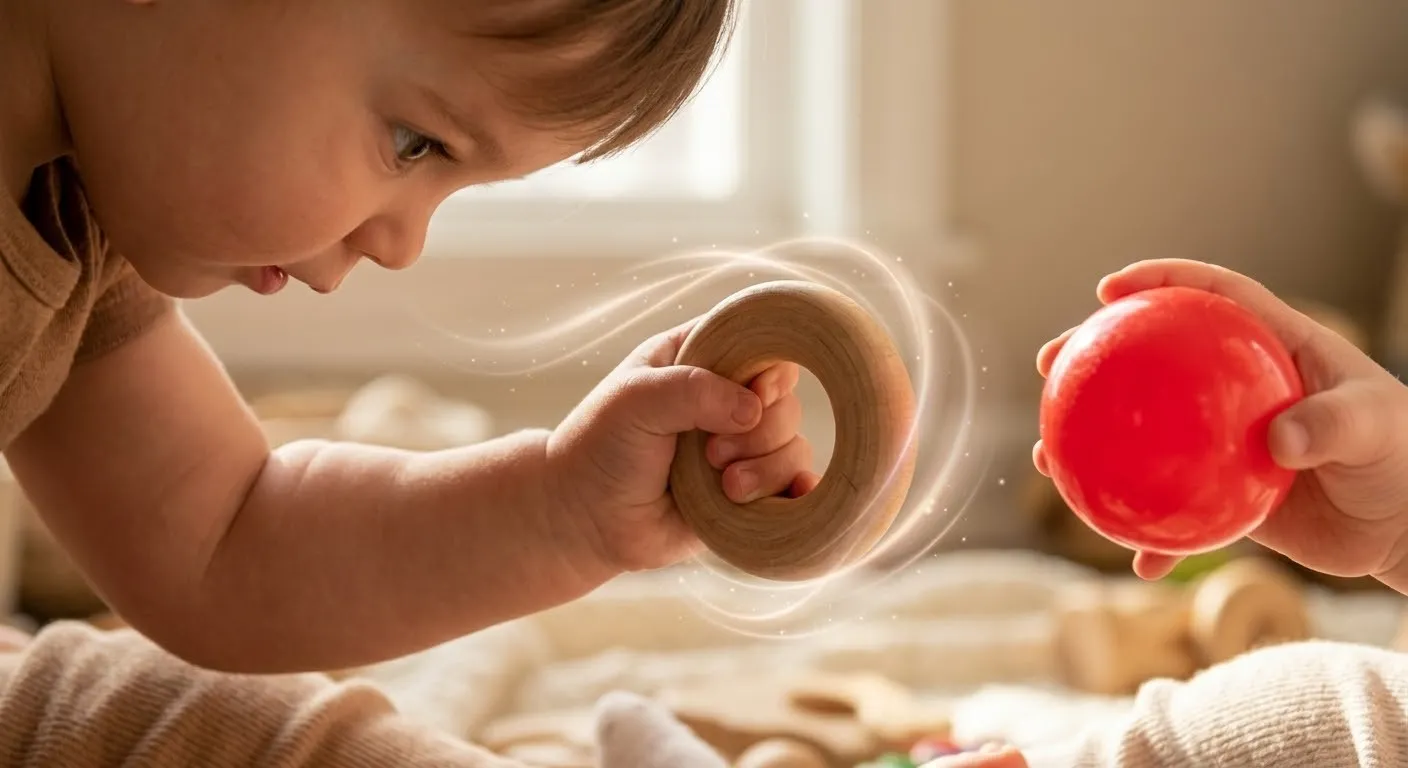
Many parents notice that wooden toys often feel heavier, denser, and more substantial than plastic toys. At first glance, that might seem like a small detail.
But for toddlers, toy weight is not just about feel—it’s part of the learning experience.
Toy weight matters for toddlers because they learn through physical handling. Wooden toys provide realistic weight and resistance that improve sensory feedback, teach cause and effect, support fine motor control, and encourage slower, more purposeful play—helping toddlers understand how real objects behave.
When a child lifts, stacks, or carries a toy, their brain learns from weight, balance, and resistance. In this article, you’ll discover why the “size-weight truth” supports development—and how to choose wooden toys that are right for your child.
What Is the “Size-Weight Truth” in Wooden Toys?
The “size-weight truth” means that the size and weight of a toy affect how a toddler experiences, controls, and learns from it. Wooden toys often provide more realistic weight and resistance than lightweight plastic toys, which can improve sensory feedback and motor learning.
Toddlers don’t learn only by looking. They learn by physically handling objects—gripping, lifting, balancing, dropping, stacking. When a toy has realistic weight relative to its size, it gives the child more meaningful feedback about their own movement and the object’s properties.
A lightweight toy may be easy to pick up, but it may not teach the same lessons about:
- Balance and stability
- Controlled force
- Spatial relationships
- Body awareness
Why Weight Matters in Wooden Toys for Toddlers in Everyday Play
Weight matters because toddlers learn through movement. The weight of a toy influences how they grasp, lift, balance, carry, stack, and place it—all of which shape motor skills and sensory understanding.
Weight Teaches Cause and Effect
Heavier objects fall differently. They require more effort to move. They change how toddlers plan their movement.
When a toddler lifts a wooden ring to place it on a stacker, the weight tells them: This needs two hands. This needs careful lowering. This will make a solid sound when it lands.
Examples where weight creates learning moments:
- Stacking blocks without toppling the tower
- Carrying a shape sorter piece across the room
- Placing a wooden puzzle piece into its slot
Each of these actions teaches your toddler about force, balance, and control.
Weight Improves Body Awareness
Here’s a concept that sounds technical but matters enormously: proprioception. In parent-friendly terms, it’s your body’s sense of effort, pressure, and movement.
When toddlers handle toys with meaningful weight, they receive clearer information through their muscles and joints. Their brain registers: How hard did I grip? How much force did I use? Where is my hand in space?
This helps them understand their own movement better—building the foundation for more complex skills like writing, using utensils, and manipulating small objects.
Weight Builds More Controlled Movement
Lighter toys can be tossed around without much control. The toddler doesn’t need to think about their movement because there’s no resistance.
Slightly heavier toys encourage slower, more deliberate action. Your toddler has to:
- Adjust their grip
- Plan their movement
- Control the release
This supports coordination, accuracy, and concentration—skills that transfer far beyond playtime.
Why Wooden Toys Feel Different From Plastic Toys
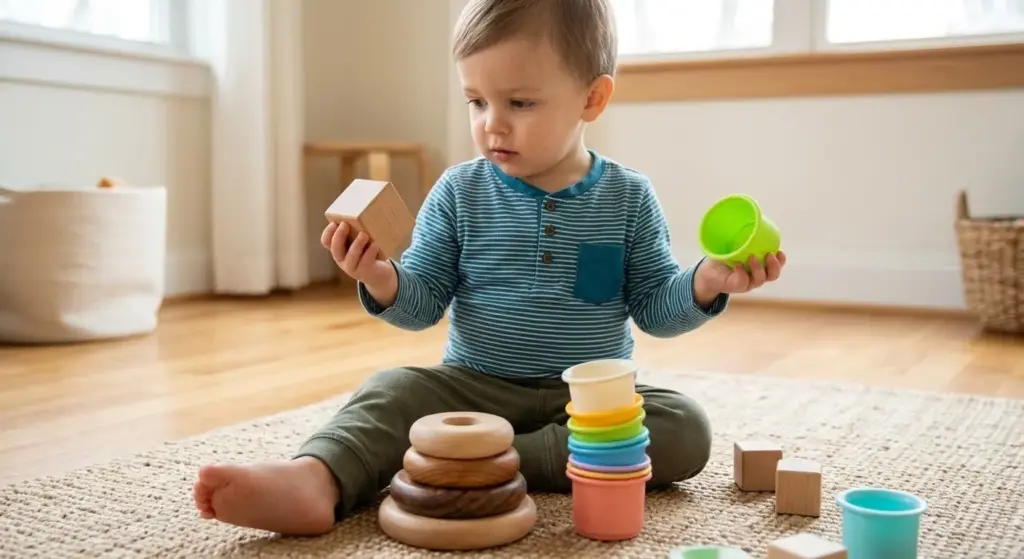
Wooden toys usually feel heavier than plastic toys because wood is denser and less hollow. That difference changes how toddlers touch, lift, carry, and use the toy.
Material Density Changes the Experience
Plastic toys are often hollow, ultra-light, and sometimes oversized for their actual weight. A large plastic block might weigh just a few ounces.
Wooden toys tend to have more true substance. A smaller wooden block may feel solid and grounded in your toddler’s hand.
Think of it this way: a large plastic block may feel almost empty, while a smaller wooden block feels present and real.
Wooden Toys Offer More Natural Resistance
Resistance teaches control. When a toy has some weight, the child has to adjust their grip and movement to handle it successfully.
This can support:
- Fine motor planning (thinking ahead about how to move)
- Wrist control and rotation
- Bilateral coordination (using both hands together)
Weight Plus Texture Creates Richer Sensory Input
Wood doesn’t just weigh more. It also provides:
- Natural grain texture that varies subtly
- Temperature difference (wood feels warmer than plastic)
- Distinct sound when placed down or knocked together
- Varied density depending on the wood species
Plastic often gives a flatter sensory experience—smooth, uniform, lightweight.
Wood engages more of your toddler’s sensory system simultaneously. This combination of weight, texture, and natural sound is one reason many parents notice wooden toys create calmer, less overstimulating play environments.
The Montessori Perspective: Why Real Materials Matter
Montessori education values real, natural materials because they give children more truthful information about the world. Weight is part of that truth.
Real Objects Give Real Feedback
Dr. Maria Montessori designed materials to help children learn through reality, not overstimulation or fantasy. She believed children needed to experience how real materials actually behave.
A child learns more from a toy that behaves like a real object—with authentic weight, texture, and resistance. The object permanence toys are a strong example — simple mechanism, meaningful weight, direct sensory consequence
Natural materials and their developmental properties teach effort, balance, care, and coordination in ways that ultra-light synthetic materials simply can’t replicate.
Weight Supports Focused, Intentional Play
Heavier toys often slow the child down just enough to encourage:
- Deeper focus on the task
- Deliberate, purposeful movement
- Repetition until mastery
This aligns beautifully with Montessori principles of concentration and the work cycle—the idea that children need sustained, uninterrupted time to fully engage with an activity.
Natural Materials Feel More Grounding
Wood doesn’t only look different—it feels different in the hand. The warmth, the weight, the subtle texture variations create a sensory experience that many parents and educators describe as “grounding.”
This can support:
- Calmer engagement with the toy
- Clearer sensory clarity without overwhelming stimulation
- More meaningful interaction over time
How Weight Supports Toddler Development
1. Fine Motor Development
Fine motor skills involve the small muscles in the hands and fingers—gripping, rotating, placing, adjusting hand pressure.
Heavier toys can encourage stronger and more precise hand use. When a toddler picks up a wooden knob puzzle piece, the weight provides resistance that builds grip strength.
Examples:
- Stacking rings onto a post
- Wooden knob puzzles
- Solid wooden blocks
- Peg toys
Each of these requires your toddler to control their fingers and hands with intention.
2. Hand-Eye Coordination
When a toy has real weight, toddlers must align their movement more carefully. They can’t just drop a piece in place—they have to watch, adjust, and control.
Examples:
- Placing one wooden block precisely on top of another
- Fitting shaped pieces into corresponding openings
- Balancing wooden animals on a wobble board
The weight creates a natural feedback loop: attempt, adjust, try again, succeed.
3. Bilateral Coordination
Many wooden toys encourage both hands to work together—one hand stabilizes while the other hand places or turns.
This bilateral coordination is foundational for later skills like:
- Tying shoes
- Using scissors
- Writing
- Playing instruments
Simple activities like holding a shape sorter steady with one hand while inserting a piece with the other build this coordination naturally.
4. Spatial Awareness and Judgment
Toddlers learn how much space an object takes up, how much effort it needs to move, and how it moves through space.
Weight improves this understanding. A heavier block teaches your toddler that they need to clear more space, use more force, and plan their movement differently than with a lighter object.
5. Concentration and Slower, More Purposeful Play
Because wooden toys often require more controlled movement, they can support:
- Deeper focus without distraction
- Less chaotic, more intentional play
- Natural repetition as the child masters the skill
Are Heavier Toys Always Better for Toddlers?
No. Heavier is not always better. The right toy should have developmentally appropriate weight for the child’s age, strength, and stage of coordination.
Too-heavy toys can:
- Frustrate toddlers who can’t lift them independently
- Reduce confidence and willingness to try
- Increase dropping risk if the child loses grip
- Make independent play harder rather than easier
The Goal Is “Meaningful Weight,” Not Maximum Weight
A good toy should feel substantial enough to give feedback, but not so heavy that it becomes difficult or unsafe.
Think of it as Goldilocks weight—not too light, not too heavy, but just right for your child’s current abilities.
Age and Skill Matter
Younger toddlers (12-18 months) need:
- Easier lifting with both hands
- Simpler grasping requirements
- Lighter objects with good stability
Older toddlers (24-36 months) can handle:
- Denser wooden blocks
- Heavier stacking toys
- More complex carrying and balancing work
The same toy that’s perfect for a 2.5-year-old might be too heavy for a 14-month-old.
The Right Balance: Size, Weight, and Toddler-Safe Design
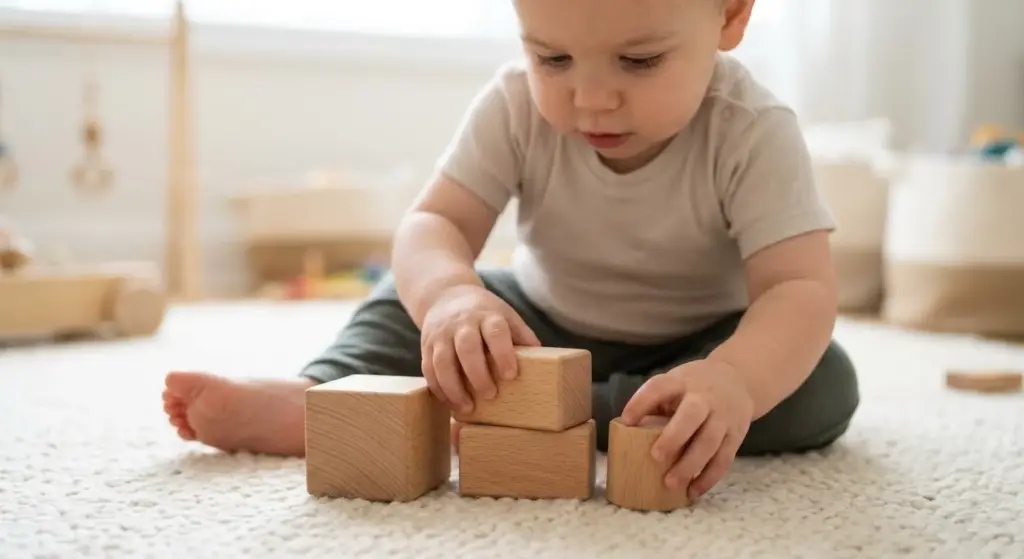
The best toddler toys aren’t only well-weighted—they also match the child’s hand size, grip ability, and stage of development.
Size and Weight Must Work Together
A toy may be small but too heavy, or large but too light. Neither provides the optimal learning experience.
The best design has:
- Easy-to-hold proportions relative to toddler hands
- Stable balance that doesn’t tip unexpectedly
- Manageable resistance that challenges without frustrating
Why Oversized Lightweight Toys Can Be Misleading
Large but hollow toys may look substantial but provide limited sensory feedback. Your toddler picks them up expecting weight and encounters almost nothing.
This can reduce the realism of the play experience. The toy looks like it should behave a certain way but doesn’t—creating a disconnect between expectation and reality.
Why Small Dense Toys Need Caution
If a toy is very dense and compact, size safety and age appropriateness matter even more.
Check for:
- Toddler-safe sizing (nothing that fits inside a toilet paper roll for children under 3)
- Rounded edges to prevent injury if dropped
- Supervised use where needed for younger toddlers
Beyond weight, the full safety checklist for wooden toys — finish type, construction integrity, and certification — applies regardless of material density.”
Wooden Toys vs Plastic Toys: A Size-Weight Comparison
| Feature | Wooden Toys | Plastic Toys |
|---|---|---|
| Weight | More substantial | Often very light |
| Material density | High and solid | Often hollow or low-density |
| Sensory feedback | Richer resistance and texture | Lighter, less tactile information |
| Grip and control | Encourages slower, deliberate handling | Easier to fling or toss |
| Real-world feel | Closer to actual objects | Often less realistic |
| Durability under dropping | Maintains integrity | Can crack or break |
This doesn’t mean all plastic toys are bad for development—but it shows why many parents and Montessori educators prefer wooden toys for early hands-on learning. For a broader comparison of how materials affect child development, including cognitive growth and language skills, see our full material guide.
How to Know if a Wooden Toy Has the Right Weight for Your Toddler
Check How Your Child Lifts It
Signs the weight is appropriate:
- Child can lift it independently (even if using both hands)
- Movement looks controlled, not strained
- Child repeats the action willingly
- No signs of struggle or dropping immediately
Signs it might be too heavy:
- Child tries but can’t lift it
- Drops it frequently despite effort
- Shows frustration or avoids the toy
Watch for Purposeful Play, Not Frustration
Appropriate weight usually leads to:
- Visible concentration
- Repeated use over time
- Careful, intentional handling
- Pride when they succeed
Too much weight may lead to:
- Frequent dropping
- Avoiding the toy entirely
- Visible frustration or giving up quickly
Look at How the Toy Balances in the Hand
A well-designed toy feels:
- Stable in your toddler’s grip
- Easy to grasp with small hands
- Predictable when moved or rotated
If a toy tips unexpectedly or feels awkward despite appropriate weight, the design may need better balance.
Choose Open-Ended Toys With Meaningful Resistance
Examples of toys where weight enhances learning:
- Wooden blocks for stacking and building
- Ring stackers with solid wooden rings
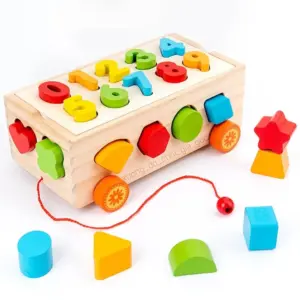
- Shape sorters with substantial pieces
- Knob puzzles with weighted pieces: Our name puzzle collection uses solid wood with raised knobs specifically sized for the pincer grip development stage.”
- Pull toys with real substance
- Simple practical life tools sized for toddlers
Examples of Toddler Toys Where Weight Makes a Big Difference
Wooden Blocks
Weight improves stacking stability and teaches careful placement. Your toddler learns that if they place the block too carelessly, the tower falls. The weight makes that consequence immediate and clear.
Shape Sorters
Pieces with real weight feel more intentional when handled and inserted. Your toddler has to control their grip, rotation, and release—building fine motor precision.
Ring Stackers
Weight affects lifting, aligning, and releasing onto the peg. A wooden ring requires your toddler to use both hands, line up carefully, and lower with control.
Knob Puzzles
Small weighted knobs support pincer grip development and wrist control. The resistance helps build the exact muscles needed for later skills like holding a pencil.
Push and Pull Toys
A toy with some real substance moves differently and gives stronger movement feedback. Your toddler learns how much force creates how much movement—a physics lesson disguised as play.


Common Mistakes Parents Make When Choosing Toys by Size Alone
Many parents judge toddler toys by color, size, age label, and appearance. But they forget to consider weight, density, balance, and grip fit.
“Big” Does Not Mean Better
Large lightweight toys may not offer meaningful sensory learning. In fact, the mismatch between size and weight can create confusing feedback for your toddler’s developing proprioception.
“Wooden” Does Not Automatically Mean Well-Designed
Not all wooden toys are equally well-balanced or appropriately weighted. Quality matters enormously.
Look for:
- Good proportion relative to toddler hands
- Smooth, child-safe finish
- Appropriate shape for the intended skill
- Thoughtful weight distribution
This is why we emphasize not just using solid wood over engineered materials, but ensuring every aspect of the toy serves your child’s development.
Why We Prioritize Weight and Material Truth in Wooden Toys
At Kukoo Montessori, we focus on natural materials, toddler-appropriate design, meaningful sensory input, and durable construction.
Every toy we offer is evaluated for how it feels in a child’s hand—not just how it looks on a shelf. We choose solid hardwoods because they provide authentic learning through real-world feedback.
Weight isn’t about making toys heavy. It’s about making them real—giving your toddler honest information about how objects behave, what effort feels like, and how control develops through practice.
Frequently Asked Questions
- Why does weight matter in toys for toddlers?
Weight matters because it affects how toddlers grasp, lift, balance, and control objects. Toys with appropriate weight provide better sensory feedback and can support motor development by creating resistance that builds grip strength, hand-eye coordination, and body awareness.
- Are wooden toys too heavy for toddlers?
Not when properly designed. Good wooden toys are created with age-appropriate size and weight in mind. The goal isn’t heaviness for its own sake, but meaningful, manageable weight that provides realistic sensory feedback without frustrating the child.
- Why do wooden toys feel better than plastic toys?
Wooden toys often feel denser, more textured, and more stable in the hand. This creates richer sensory input—combining weight, texture, temperature, and sound—that helps toddlers build more accurate understanding of how real objects behave.
- Do heavier toys help fine motor skills?
They can, when the weight is appropriate for the child’s age and strength. Slightly heavier toys may encourage more controlled grip, deliberate movement, and careful placement—all of which support fine motor development.
- Are lightweight toys bad for toddlers?
No, but extremely light toys may provide less sensory feedback and may not support the same level of controlled movement as more substantial toys. The best choice depends on the specific skill being developed and your child’s current abilities.
Conclusion: The Right Weight Helps Toddlers Learn More From Play
Size and weight aren’t minor details in toy design—they’re fundamental to how toddlers learn through physical interaction.
Wooden toys often provide more truthful sensory feedback because real materials have real properties. Appropriate weight supports coordination, concentration, and purposeful play. It helps your toddler understand effort, balance, and control in ways that ultra-light toys simply can’t replicate.
This doesn’t mean every toy needs to be wooden or heavy. It means choosing toys thoughtfully—considering not just appearance or age label, but how the toy will actually feel and function in your child’s hands.
The right weight, combined with safe design and natural materials, creates toys that don’t just entertain—they teach.
Explore thoughtfully designed wooden toys with developmentally appropriate weight at Kukoo Montessori.