
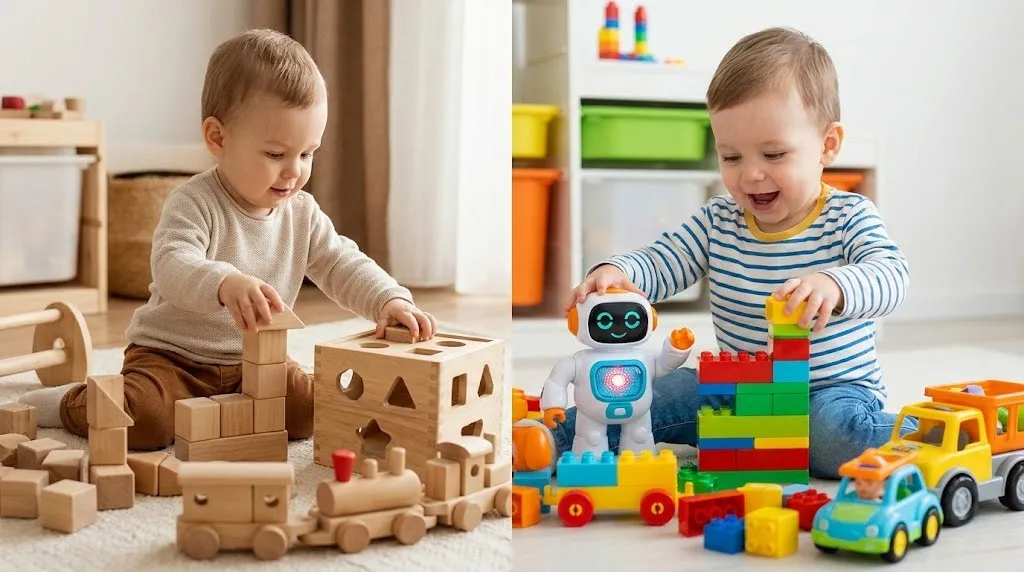
Walk into any toy store and you’ll face an immediate choice: the warm, natural appeal of wooden toys or the vibrant colors of plastic ones.
But here’s what most parents really want to know: Which one actually helps my child learn better ?
The short answer: Both wooden and plastic toys can support healthy development when thoughtfully designed. However, toys that are simple, open-ended, and encourage active engagement—characteristics often found in well-crafted wooden toys—tend to promote deeper concentration, creativity, and parent-child interaction.
This guide compares wooden vs plastic toys across cognitive growth, language development, motor skills, sensory processing, and safety. The truth? Development depends more on design and interaction than on material itself.
How Toy Design Influences Child Development
Before we dive into wood versus plastic, we need to establish what actually drives developmental benefits in any toy.
- Open-ended vs single-function play: A set of blocks can become a tower, a train, a fence for farm animals, or a bridge. A toy that plays one song when you press a button? That’s pretty much all it does.
- Active engagement vs passive stimulation: Does the toy respond to your child’s actions, or does your child respond to the toy’s preprogrammed features?
- Simplicity vs overstimulation: Some toys offer just enough to spark imagination. Others flash, beep, and sing all at once.
- Adult interaction vs independent entertainment: The best learning happens when you’re part of the play. Does this toy invite you in, or is it designed to keep your child occupied while you do something else?
Here’s where we need to be honest: a well-designed plastic toy—like a high-quality building set or a thoughtfully crafted puzzle—can be highly developmental. And a poorly designed wooden toy that’s too advanced, too simple, or just not engaging? That may offer little value.
Material matters, but it’s not everything.
Cognitive Development: Focus, Creativity & Problem-Solving
Wooden Toys and Open-Ended Thinking
Many wooden toys share a common trait: they don’t tell your child what to do with them.
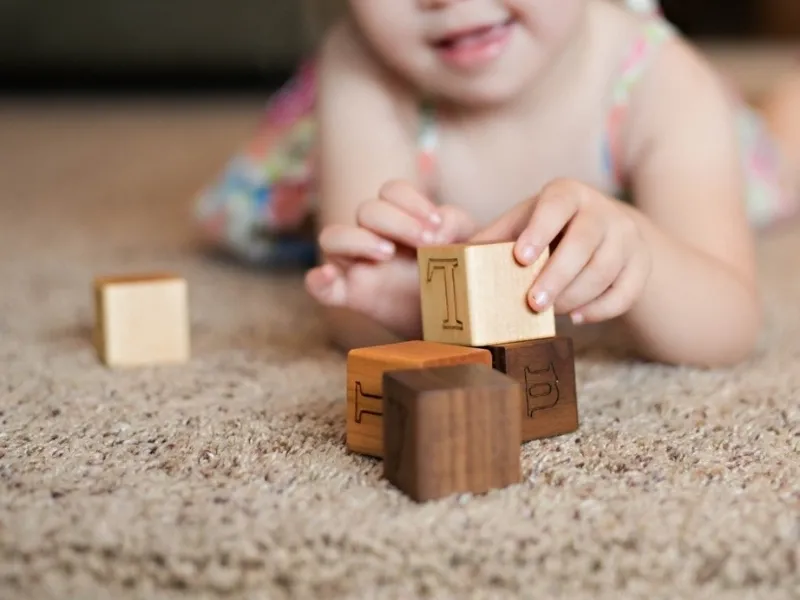
A set of wooden blocks doesn’t have instructions. A simple wooden peg doll doesn’t come with a backstory. This lack of preset direction means your child has to figure out the play themselves. What can I build? Who is this character? How do these pieces fit together?
This type of play—often called open-ended—encourages building, stacking, sorting, and pretend scenarios that your child creates entirely from their imagination. There’s no “right way” to play, which means there’s also no ceiling on creativity.
Because many wooden toys lack built-in entertainment features, children often stay engaged through their own problem-solving rather than reacting to lights or sounds. The toy becomes a tool for their ideas, not the source of the entertainment itself.
Plastic Toys and Structured Play
Plastic toys often grab attention immediately. Bright colors catch your baby’s eye. Interesting shapes invite exploration. Some plastic STEM kits brilliantly build spatial reasoning and engineering thinking.
The structure these toys provide can absolutely support learning—especially when it introduces concepts like cause and effect, sequencing, or early physics.
But there’s a consideration worth thinking about: when play becomes primarily button-driven, children may rely more on the toy’s response than their own creativity. The toy does the work. Your child watches, or presses, or waits for the next light to flash.
Not all plastic toys work this way, of course. But it’s a pattern worth noticing.
Language Development & Parent Interaction
Toys That Invite Conversation
Language development happens through conversation, not vocabulary lists. Your toddler learns words by hearing them in context, using them in play, and receiving your response.
Pretend play naturally encourages storytelling. When your child picks up a wooden figure and says “baby sleeping,” you can respond: “Oh, the baby is tired? Should we find a blanket?” That’s language learning in action—back and forth, building on each other’s ideas.
Symbolic play—using one object to represent another—builds vocabulary in surprising ways. That wooden block becomes a phone. That bowl becomes a hat. Your child is learning that objects and words can be flexible, contextual, and imaginative.
Shared play builds conversational turn-taking, which is a foundational social skill. You say something. Your child responds. You build on their response. This rhythm mirrors real conversation.
Electronic Features and Passive Listening
A 2016 study published in JAMA Pediatrics (Sosa, Northern Arizona University) measured this directly. Researchers recorded 26 parent-infant pairs — babies aged 10–16 months — playing at home with three different toy sets: electronic toys, traditional toys, and books. Play sessions with electronic toys produced significantly fewer adult words, fewer child vocalizations, and fewer conversational turns than sessions with traditional toys or books. The lead researcher noted that electronic toys appeared to put parents “on the sidelines” — the toy was doing the talking, so parents talked less.
The American Academy of Pediatrics reinforces this: interaction — not sound output — is what drives language development. Your voice, responding to your child, is the mechanism. A toy that fills that space with pre-recorded words reduces the room for that exchange.
Interaction—not sound output—drives language growth.
Motor Skill Development
Fine Motor Skills
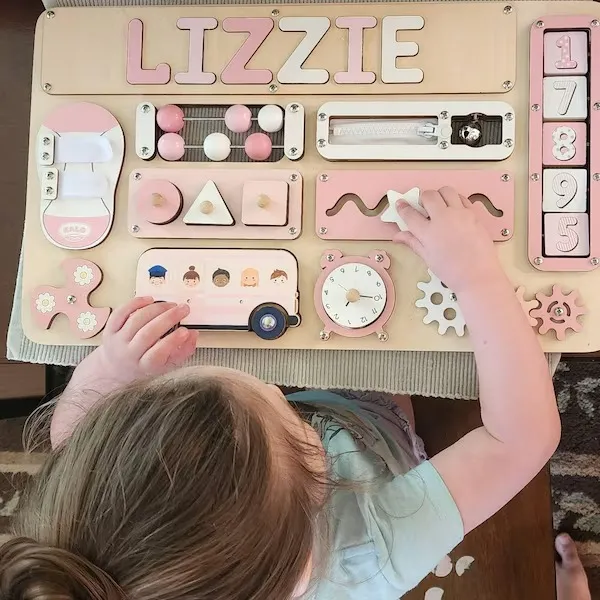
- Wooden toys: The slight weight of solid wood can actually support grip strength development. When your baby picks up a wooden rattle or a chunky wooden ring, their hand has to work a bit harder than with a lightweight plastic version. This resistance—subtle as it is—builds the small muscles in their fingers and hands. Many wooden toys also require controlled hand movements. Stacking rings on a post. Fitting shapes into corresponding holes. Threading large wooden beads. These are precisely the activities in our stacking toy collection — sized and weighted for the grip strength of specific age ranges.”
- Plastic toys: Plastic toys are often lightweight, which makes them easier for younger infants to manipulate. A 4-month-old learning to grasp benefits from a toy they can actually lift and hold. Plastic’s lighter weight removes one barrier to exploration. For very young babies still developing their grip, this advantage matters.
Gross Motor Skills
When it comes to larger movements—crawling after a rolling ball, pushing a walker, climbing on a ride-on toy—both materials perform well.
Both wooden and plastic toys can support:
- Push toys that encourage first steps
- Ride-on vehicles that build balance
- Balance-based activities like wobble boards
Motor development depends primarily on design and size, not material alone. A well-designed push toy supports walking whether it’s made from beech wood or durable plastic.
Sensory Processing & Regulation
Natural Sensory Input
Wood provides a specific type of sensory experience. The texture varies subtly depending on the grain. The weight feels substantial in your child’s hand. The visual tones tend to be warm and muted—creams, light browns, natural honey colors.
For some children, especially those who are easily overwhelmed by intense stimulation, these qualities create a calming play environment. The sensory feedback is present but not overwhelming.
High-Stimulation Design
Plastic toys often lean into bold sensory experiences:
- Bright primary colors and high-contrast patterns
- Glossy, smooth surfaces that reflect light
- Electronic lights and musical sounds
- Moving parts and spinning elements
For children who seek out sensory input—who love brightness, movement, and sound—these features can be genuinely engaging and developmentally appropriate.
Some children thrive on stimulation, while others benefit from calmer environments. Neither is “better” universally. It depends on your child’s sensory processing style and current developmental needs. For children who regulate better with less input, understanding how wooden toys support sensory regulation — through sound, texture, and visual simplicity — offers a practical starting point.
Safety Considerations
Chemical Exposure
Safety isn’t determined by material—it’s determined by manufacturing standards and testing compliance.
- Wood: The safety of a wooden toy depends entirely on its finish. Untreated solid beech? Generally safe. That same beech coated in unknown varnish? Potentially problematic. Always verify that paints and finishes are non-toxic and compliant with safety standards.
- Plastic: Modern plastic toys from reputable manufacturers typically avoid harmful chemicals like BPA and phthalates. But composition matters. Understanding which specific chemicals and conditions raise concern helps narrow the evaluation beyond just checking for a safety logo. And check for ASTM F963 or EN71 compliance, which ensures the plastic used meets safety requirements.
Safety depends more on compliance standards than material alone.
Breakage & Durability
- Wood: High-quality wooden toys are less likely to shatter into sharp fragments when dropped. They might dent or show wear, but they generally maintain their structural integrity.
- Plastic: Plastic can crack depending on quality and impact force. Cheaper plastics may split, creating sharp edges. Higher-quality plastics withstand repeated drops quite well.
Choking Hazards
Both materials pose risk if parts are too small or pieces detach easily.
A wooden toy with a loose peg? Choking hazard.
A plastic toy with small removable buttons? Choking hazard.
Construction quality and age-appropriate design matter most. Always use the toilet paper roll test: if a part fits through, it’s too small for children under three.
Durability & Longevity
Long-Term Use
Well-crafted wooden toys often maintain structural integrity over years and multiple children. The solid hardwood doesn’t degrade. The joinery stays tight. The finish, if properly maintained, continues protecting the wood underneath.
Everyday Practicality
Plastic toys are often lightweight and affordable, which makes them practical for everyday use. They’re easy to clean, simple to transport, and budget-friendly when you need multiples.
Durability varies by quality. A high-end plastic construction set can last for years. A cheap plastic toy from a bargain bin might break within weeks.
Both materials can be durable. Both can be fragile. Quality and craftsmanship make the difference.
Environmental Considerations
This matters to many parents, so let’s address it clearly.
Wood can be renewable when responsibly sourced from managed forests. Look for certifications like FSC (Forest Stewardship Council), which indicate sustainable forestry practices.
Plastic production is energy-intensive and typically relies on petroleum-based materials. Most plastic toys are not biodegradable and contribute to long-term waste.
That said, longevity reduces replacement frequency. A durable toy—whether wooden or plastic—that lasts ten years has less environmental impact than ten cheaper toys that each last one year.
The most sustainable toy is often the one you don’t need to replace.
Side-by-Side Comparison
| Dimension | Wooden Toys | Plastic Toys |
|---|---|---|
| Cognitive Depth | Often open-ended | Often single-function |
| Language Interaction | High in pretend play | Depends on design |
| Sensory Input | Subtle and natural | Often high stimulation |
| Durability | Generally high | Varies by quality |
| Chemical Concerns | Finish-dependent | Material-dependent |
| Sustainability | Often renewable | Less biodegradable |
This comparison isn’t about declaring a winner—it’s about understanding trade-offs so you can choose intentionally.
When Plastic May Be the Better Choice
Let’s be practical. There are situations where plastic toys genuinely make more sense:
- Outdoor water play: Wooden toys shouldn’t be soaked repeatedly. Plastic bath toys and water tables? Perfect for splashing.
- Lightweight infant toys: A 3-month-old building grip strength benefits from toys they can actually lift. Super-light plastic rattles serve this stage well.
- Certain STEM engineering kits: Some of the best building and construction toys are made from high-quality plastic components that snap together precisely.
- Budget constraints: Not every family can afford premium wooden toys. A thoughtfully chosen plastic toy that your child actually plays with beats an expensive wooden toy that sits unused.
Good parenting isn’t about buying the “right” material—it’s about choosing toys that serve your child’s current needs and your family’s circumstances.
When Wooden Toys May Be the Better Choice
Wooden toys tend to shine in specific contexts:
- Open-ended imaginative play: Wooden blocks, simple figures, and stacking toys invite creativity without imposing a storyline.
- Montessori-style environments: If you’re drawn to Montessori principles—simplicity, natural materials, child-led discovery—wooden toys align naturally with this approach.
- Toy rotation systems: Because wooden toys are durable, they work beautifully in rotation. Store half your toys away, bring them back out in a few weeks, and they feel “new” again.
- Focus-building activities: The quiet, simple nature of many wooden toys supports sustained concentration without competing for attention through lights or sounds.
- Long-term durability priorities: If you want toys that last through multiple children or can be passed to friends, well-crafted wooden toys often deliver.
These aren’t rules—they’re observations based on how children typically interact with different materials and designs.
Montessori Perspective
Why Natural Materials Are Common in Montessori Classrooms
Montessori education emphasizes a few core principles that influence material choices:
Simplicity supports concentration. When a toy does one thing well rather than many things adequately, children can focus deeply on mastering that skill.
Child-led discovery. Materials are designed to reveal concepts through exploration, not instruction. A set of nesting bowls teaches size relationships through direct experience.
Minimal overstimulation. The environment is calm, ordered, and intentional. Each material has a purpose. Nothing competes for attention through unnecessary noise or visual chaos.
For these reasons, wooden materials are commonly used in Montessori classrooms worldwide because they align with these principles: simplicity, natural sensory input, and durability that allows repeated practice. The science behind wooden materials and their sensory qualities — from proprioceptive feedback to acoustic properties — explains why this isn’t just tradition.
What Matters More Than Material
The framework below aligns closely with why pediatricians prefer simpler toys in early childhood — not because of material, but because of what the design demands from the child.
- Is it age-appropriate?
Can your child actually use it safely and successfully at their current developmental stage?
- Does it encourage active thinking?
Does your child have to problem-solve, imagine, or create—or does the toy do all the work?
- Does it promote interaction?
Can you play together? Does it invite conversation?
- Is it safety-tested?
Look for ASTM F963, EN71, or equivalent compliance. Verify finishes and construction quality.
- Does it avoid unnecessary overstimulation?
Some stimulation supports learning. Excessive stimulation can overwhelm and fragment attention.
This reframes the entire debate. Material is one factor among many. Design, safety, and how the toy invites engagement matter more.
Frequently Asked Questions
- Are wooden toys better for brain development?
Wooden toys that are open-ended and encourage active problem-solving can support cognitive development effectively. However, well-designed toys of any material can be developmentally beneficial. Focus on design characteristics—simplicity, open-endedness, appropriate challenge—rather than material alone. - Are plastic toys harmful?
High-quality plastic toys that meet safety standards (ASTM F963, EN71) are not inherently harmful. The key is choosing toys from reputable manufacturers that use non-toxic materials and avoid harmful chemicals like BPA or phthalates. - Do wooden toys last longer?
Generally, yes—well-crafted wooden toys made from solid hardwood maintain structural integrity over years and multiple children. However, quality plastic toys can also be highly durable. Longevity depends more on craftsmanship than material. - Are electronic toys bad for children?
Electronic toys aren’t universally “bad,” but they can reduce parent-child interaction if they become the primary source of entertainment. The concern is when electronic features replace conversation and imaginative play. Used occasionally and intentionally, they can complement a balanced toy collection. - Is it okay to mix wooden and plastic toys?
Absolutely. Most children benefit from variety. A mix allows you to choose each toy based on its specific developmental purpose rather than adhering rigidly to one material. The goal is thoughtful curation, not material purity.
Conclusion
Both wooden and plastic toys can support healthy development when thoughtfully designed. The material itself doesn’t drive learning—design, interaction, and engagement do.
That said, toys that are simple, durable, and open-ended—qualities often found in well-crafted wooden toys—tend to promote deeper concentration and creativity. The best toy collection isn’t about choosing one material over another. It’s about choosing intentionally based on purpose.