
Wooden Montessori Balance Toys
Wooden Montessori balance toys develop coordination, spatial reasoning, and physics intuition through hands-on stacking and stability challenges. Sustainable FSC-certified wood with non-toxic, water-based finishes meeting ASTM F963/EN71 safety standards.
Showing all 12 results



Showing all 12 results
Loved by 5,000+ Montessori families ·
Quick Buying Guide by Skill Level
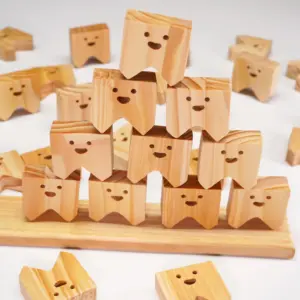
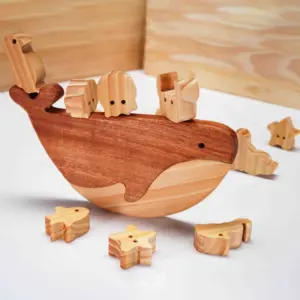
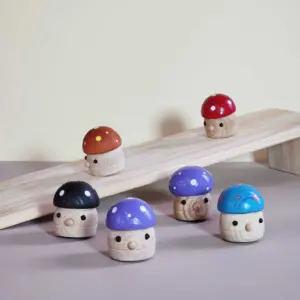
- Beginner — 18 months to 2 years — cause and effect: Smiling Teeth Balancing Toy, Wooden Balancing Fish Stacking Toy, Fun Slide Toy, Wooden Mushroom Walking Slide Set.
At this stage children are still learning the basic rule: pieces fall when unbalanced. Smiling Teeth and Balancing Fish introduce that concept through simple, low-stakes play — lightweight pieces, stable bases, quick feedback. The slide sets build coordination through guided movement and release-and-watch sequences.
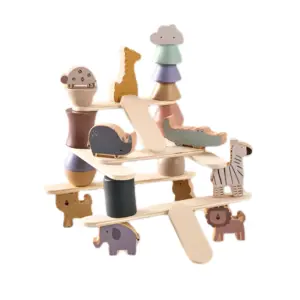
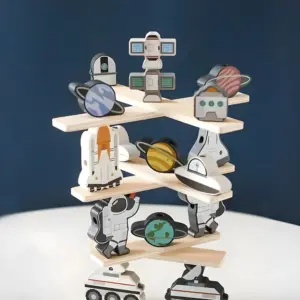
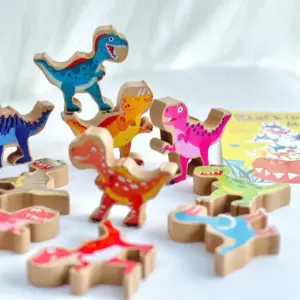
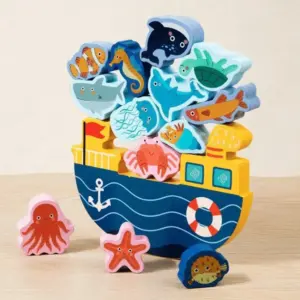
- Building — 2 to 3 years — intentional placement: Animal Balance Stacking Toy, Cat Balance Stacking Toy, Dinosaur Balance Stacking Toy, Ocean Balance Stacking Toy, Astronaut Wooden Stacking Toy.
Children at this stage begin placing pieces with intention — not just stacking, but thinking about where a piece goes before placing it. Themed character sets add motivation: children want their astronaut or dinosaur tower to stand. That emotional investment drives persistence through repeated attempts.
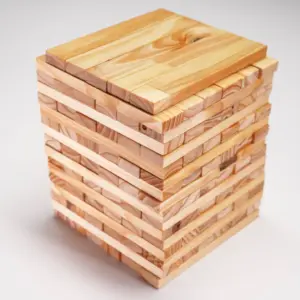
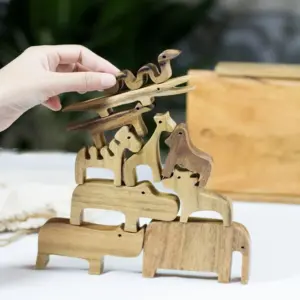
- Advanced — 3 years and up — structural thinking: Wooden Animal Balancing Set, Wooden Seesaw Blocks Set, 100 Creative Wooden Building Blocks.
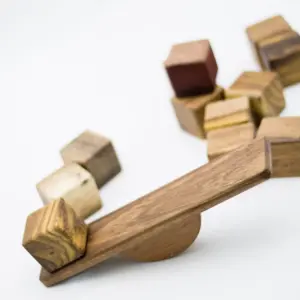
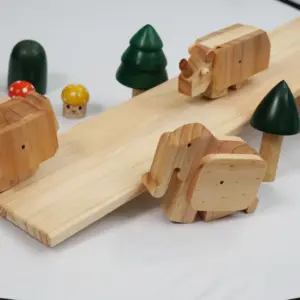
The Seesaw Blocks Set introduces leverage and weight distribution in a way younger children can’t yet process. The Animal Balancing Set raises the stakes: each added piece shifts the whole structure’s center of gravity. The 100-piece building set opens fully open-ended construction for children in the 3–6 year window ready to design their own challenges.
Always supervise play and check each product page for recommended age details.
🌿 Sustainable wood · 🎨 Water-based paint · ✅ Screen-free play · 🔄 30-day returns
Inside the Kukoo Balance Toys Collection
All 12 products share one core mechanism: children encounter instability, observe the result, and try again. That loop — attempt, fail, adjust — is where the real development happens.
- Simple balance games — Smiling Teeth Balancing Toy, Wooden Balancing Fish Stacking Toy. Rule-based play with clear win/lose feedback. Builds frustration tolerance and turn-taking alongside basic physics intuition.
- Themed stacking sets — Animal, Cat, Dinosaur, Ocean, and Astronaut Balance Stacking Toys. Interest-based motivation meets progressive difficulty. Children create their own challenges and define their own success — a key Montessori principle of self-directed learning.
- Physics exploration — Wooden Seesaw Blocks Set, Wooden Animal Balancing Set. These introduce equilibrium, leverage, and weight distribution through genuine experimentation. Every piece added changes the whole structure — children begin thinking about the system, not just the next move.
- Open-ended construction — 100 Creative Wooden Building Blocks. No rules, no defined outcome. Children design, build, test, and rebuild. Divergent thinking at its most hands-on.
- Movement and coordination — Fun Slide Toy, Wooden Mushroom Walking Slide Set. Timing, tracking, and hand-eye coordination through guided physical play. These also build the hand control and fine motor precision needed for later writing and detailed manual work.
Why Kukoo Montessori Is the Best Choice
- Physics through play — gravity, equilibrium, and center-of-mass are discovered through hands, not explanations
- Failure is built in — structures will topple; that’s the point; each fall is a data point, not a mistake
- Clear skill progression — beginner, building, and advanced levels matched to developmental readiness
- Pairs naturally with engineering play — balance toys develop the structural thinking that extends into car ramp and garage construction play for older children
- FSC-certified wood, non-toxic finishes, ASTM & EN71 certified
- 30-day returns
Not ready for balance toys yet? See the complete Montessori range and find what your child is ready for right now.
FAQ
- When should I introduce balance toys?
From around 18 months, once stable independent stacking is established. Start with Smiling Teeth or Balancing Fish — both offer immediate visual feedback and quick wins that build confidence before introducing more complex structural challenges.
- What’s the difference between a balance game and a stacking toy?
Stacking toys focus on vertical sequencing — ring stackers, nesting cups, size-order towers. Balance toys introduce lateral instability: children must consider not just which piece goes next, but where to place it to avoid tipping. That spatial dimension adds significant cognitive complexity and is what makes balance play so developmentally rich.
- How do I use these toys without turning play into a lesson?
Use short observation prompts: “I wonder what happens if you put the heavy one on top.” “What do you notice when it starts to lean?” “Can you rebuild it taller?” If your child is exploring freely, let them. The learning is already happening.
- Are balance toys appropriate for group play?
Yes — and they’re particularly good for it. Turn-taking games teach impulse control and strategic thinking. Collaborative building develops shared attention and negotiation. When a structure falls, everyone rebuilds together, which naturally models healthy attitudes toward failure and persistence.
- Do balance toys actually prepare children for math and science?
Consistently, yes. Spatial reasoning — the ability to mentally rotate objects and visualize structural relationships — is one of the strongest early predictors of mathematics performance. Hands-on balance play is one of the most effective ways to develop it before formal schooling begins.