
Wooden Montessori Car Toys
Wooden Montessori car garage spark imaginative play and early physics understanding through pushing, rolling, and storytelling. Sustainable FSC-certified wood with non-toxic, water-based finishes meeting ASTM F963/EN71 safety standards.
Showing all 15 results
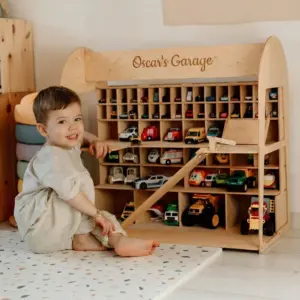
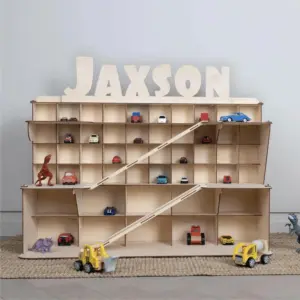
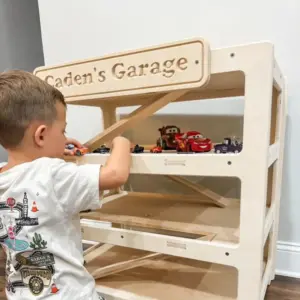
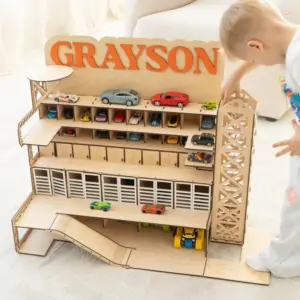



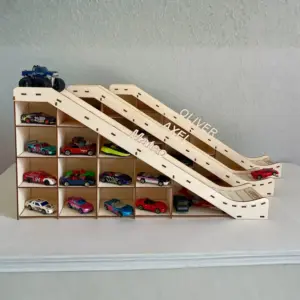
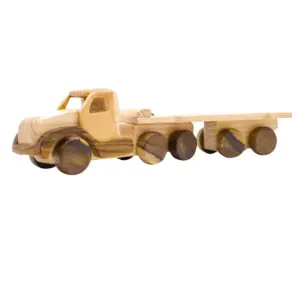
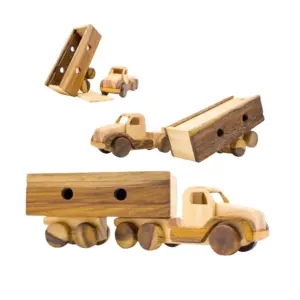
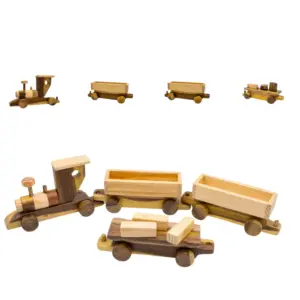


Showing all 15 results
Enjoyed by 5,000+ Montessori families · Designed around schema play and narrative development
Quick Buying Guide by Play Type:
- Ramp and gravity play: Wooden Car Garage with Ramp, Ramp for Playing & Storage, Montessori Toy Car Garage, Toy Car Parking Garage.
Children release a car at the top and watch what happens. Simple. But within that single action, they’re building intuition about gravity, speed, and distance. Ramp garages are the right starting point for children in the 3–6 year range — complex enough to hold attention, open enough to allow endless self-directed experimentation.
- Parking and organisation play: Garage Toy Car Display.
Children sort, assign, and retrieve vehicles from designated spots. This develops spatial organisation, sequential thinking, and the early executive function skills that underpin classroom learning.
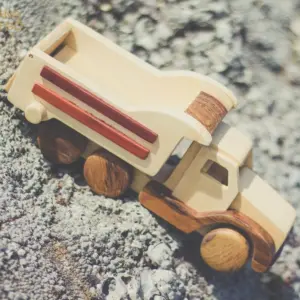
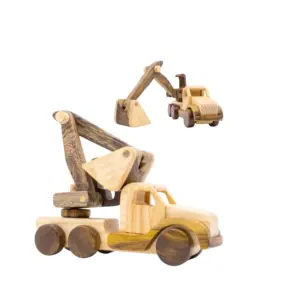
- Construction and work vehicles: Wooden Dump Truck Toy, Wooden Crane Truck Toy, Wooden Excavator Toy, Wooden Container Truck Toy, Wooden Tractor Truck Toy.
Load, lift, dump, transport. Each vehicle has a function children can observe and re-enact. Functional vehicle play builds occupational vocabulary, process sequencing, and the understanding that machines do specific jobs — an early engineering concept.
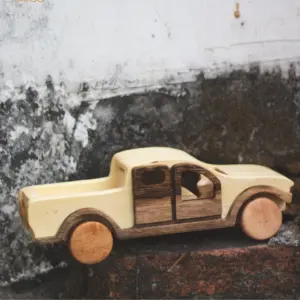
- Classic push-and-roll vehicles: Wooden Pickup Trucks Toy, Wooden Racing Cars Toy, Wooden Tank Toy, Wooden Train Toy.
Push, track, aim, race. The simplest format — and a surprisingly deep one. Children experiment with force (push harder, goes farther), direction, and collision. These are first physics experiments, not just toy play.
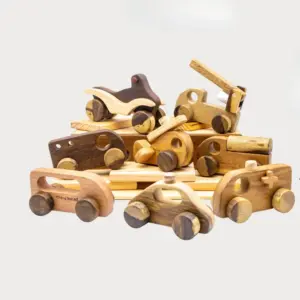
- Traffic world play: 8-Vehicle Traffic Kit Toy.
Route planning, traffic rules, character roles, collaborative storytelling. The kit format invites children to build small worlds — and the narratives that go with them.
Always supervise play and check each product page for recommended age details.
🌿 Sustainable wood · 🎨 Water-based paint · ✅ Screen-free play · 🔄 30-day returns
Inside the Kukoo Car Toy Collection
All 15 products share one quality: children direct the play. No batteries, no sounds, no instructions telling them what to do next. Just vehicles, structures, and open floor space.
- Garage and ramp sets — Montessori Toy Car Garage, Toy Car Parking Garage, Wooden Car Garage with Ramp, Garage Toy Car Display, Ramp for Playing & Storage. These are the centrepiece toys — the sets children build whole play sessions around. Ramp mechanics teach gravity and acceleration through self-directed experimentation. Parking structures add sorting, spatial reasoning, and routine. The physics intuition children develop through extended ramp play directly supports the early STEM reasoning and structural thinking that matter in formal education.
- Work vehicles — Dump Truck, Crane Truck, Excavator, Container Truck, Tractor Truck. Children imitate real-world processes: excavators scoop, cranes lift, dump trucks tip and empty. This functional play builds cause-effect understanding, mechanical vocabulary, and the capacity for multi-step sequential thinking.
- Classic vehicles — Pickup Trucks, Racing Cars, Tank, Train. Push-and-roll play develops bilateral coordination, force awareness, and spatial tracking. These are also the easiest toys to incorporate into imaginative narratives — characters, destinations, problems to solve.
- Traffic kit — 8-Vehicle Traffic Kit. Multi-vehicle play introduces collaborative storytelling, turn-taking, and rule structures children create themselves. At its most developed, this kind of play is a full social-cognitive workout.
For children who also enjoy structural challenge alongside vehicle play, our wooden balance and construction toys develop the same spatial reasoning through a different format.
Why Parents Choose Kukoo Montessori
- Physics through motion — ramp, roll, and collision play builds genuine intuition about force, gravity, and momentum before any formal instruction
- Open-ended by design — no defined outcome, no electronic prompts; children write their own play scripts
- Scales with age — the same garage that teaches gravity at 2 years supports complex narrative city-building at 5
- Built to last — solid wood construction survives years of crashing, pushing, and outdoor use; made for siblings, not one season
- FSC-certified wood, non-toxic finishes, ASTM & EN71 certified
- 30-day returns
Looking for something different? Explore the full Montessori collection to find what matches your child’s current stage.
FAQ
- What age should I introduce a car garage?
From around 18 months for simple push-and-roll vehicles. Garages with ramps are best introduced from 2.5 to 3 years, once children can manage the ramp mechanism and sustain interest in structured play. Multi-vehicle traffic kits are most engaging from 3 years onward.
- What’s the developmental value of ramp play specifically?
Ramp play is applied physics. Children discover that steeper angles mean faster speed, that heavier vehicles roll farther, and that surfaces affect how far a car travels. These are genuine scientific observations children make themselves — through repetition, variation, and comparison. The spatial prediction skills developed through ramp play consistently correlate with stronger mathematical reasoning in formal schooling.
- How do I extend car play without directing it?
Use short observation prompts: “I wonder which car will go fastest.” “What happens if you release it from higher up?” “Can you make it stop before the wall?” These invite experimentation without taking over. Follow their hypothesis, not yours.
- Are these suitable for group play?
Very well suited. Vehicle play naturally generates social scenarios — traffic rules, taking turns on the ramp, negotiating who drives which car. The 8-Vehicle Traffic Kit is particularly good for two to three children playing together, since it includes enough vehicles to give everyone a role.
- How do wooden vehicles compare to plastic ones?
Wooden vehicles are heavier, which makes ramp physics more intuitive — children can feel the weight difference between a dump truck and a racing car. They’re also more durable for floor play and outdoor use, and don’t have electronic sounds that override the child’s own narrative voice.