
Wooden Montessori Math Toys
Wooden math toys build number sense through hands-on counting, sorting, and pattern play—screen-free learning at their own pace. Sustainable wood with non-toxic finishes meeting ASTM F963/EN71 standards.
Showing all 11 results


Showing all 11 results
Chosen by 5,000+ families · Grounded in Montessori principles and child development science
Quick Buying Guide by Skill Level:
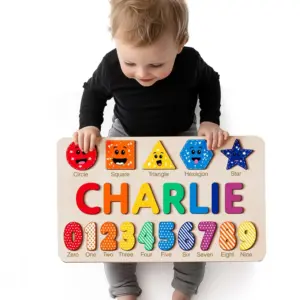
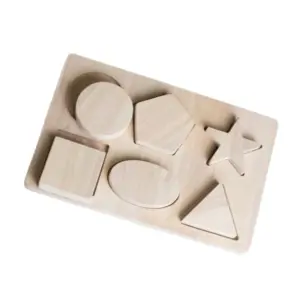
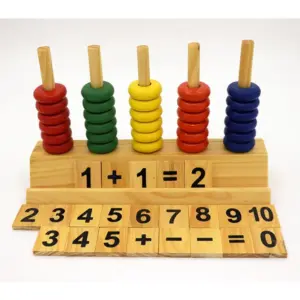
- Foundation — 2 to 3 years — quantity and counting: Wooden Counting Rings Math Toy, Wooden Ten Frame Math Set, Shapes Educational Toy, Colorful Shape Puzzle.
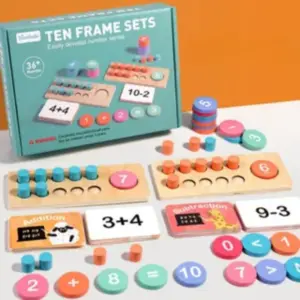
Before children can do math, they need to understand quantity — that three means three things, not just a symbol. Counting rings and ten frames make this tangible: children move objects, fill frames, and begin to see numbers as amounts. Shape toys introduce geometric classification alongside early number work.
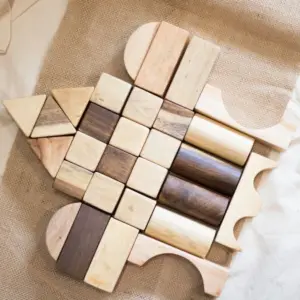
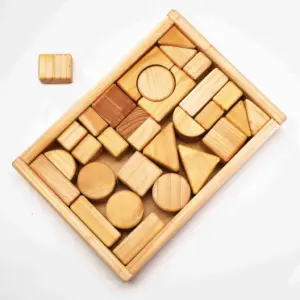
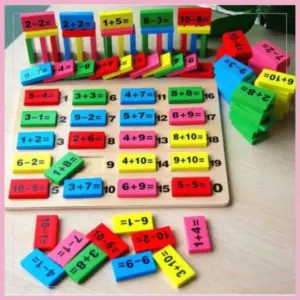
- Building — 3 to 4 years — pattern, sequence and structure: 29-Piece Wooden Building Block Set, Wooden Geometric Block Toys, 100-Piece Wooden Domino Set, Wooden Math Alphabet Clock Board.
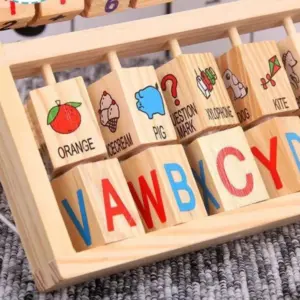
Dominoes build sequencing and matching. Building and geometric block sets develop spatial reasoning and three-dimensional thinking. The Math Alphabet Clock Board introduces time-reading and number positioning alongside letter recognition.
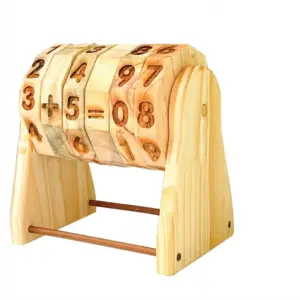
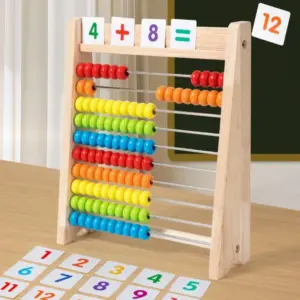
- Operations — 4 to 6 years — early arithmetic and problem solving: Wooden Abacus with Number Cards, Wooden Smart Math Box, Montessori Arithmetic Wheels.
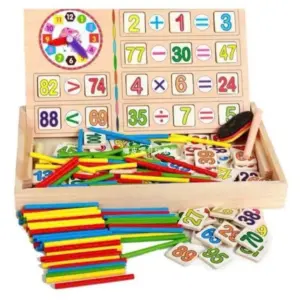
The abacus connects written numerals to physical quantities. The Smart Math Box presents arithmetic challenges children can solve independently. Arithmetic Wheels introduce multiplication structure through a self-checking rotating format. These are the right tools for children in the 3–6 year range approaching school readiness in mathematics.
Always supervise play and check each product page for recommended age details.
🌿 Sustainable wood · 🎨 Water-based paint · ✅ Screen-free play · 🔄 30-day returns
Inside the Kukoo Math Toys Collection
All 11 products share the Montessori principle of concrete-first mathematics: every concept is introduced through physical manipulation before any abstract representation.
- Counting and quantity — Counting Rings, Ten Frame Set. The most fundamental mathematical understanding: numbers represent real amounts that can be compared, combined, and broken apart.
- Shape and spatial reasoning — Shapes Educational Toy, Geometric Block Toys, 29-Piece Building Block Set, Colorful Shape Puzzle. Spatial thinking is as foundational to mathematics as number sense — children who understand shape relationships think more flexibly about all mathematical problems.
- Pattern and sequencing — 100-Piece Domino Set, Math Alphabet Clock Board. Pattern recognition is the cognitive engine of mathematics. Dominoes build matching and sequencing logic; the Clock Board introduces the circular pattern of time.
- Early operations — Abacus with Number Cards, Smart Math Box, Arithmetic Wheels. These tools build early mathematical reasoning through self-directed problem solving — children manipulate materials and verify their own answers without needing adult direction.
For children also building spatial awareness through construction, our wooden stacking and building toys develop the same three-dimensional reasoning through a different format.
Why Kukoo Montessori Is the Best Choice
- Concrete before abstract — every product makes mathematical concepts physically handleable before asking children to represent them symbolically
- Self-correcting where possible — the Smart Math Box and Arithmetic Wheels let children check their own answers without adult feedback, building independence and confidence
- Clear skill progression — foundation, building, and operations levels matched to your child’s current mathematical readiness
- FSC-certified wood, non-toxic finishes, ASTM & EN71 certified
- 30-day returns
Not quite the right moment for math? Browse all Montessori collections and find what clicks for your child today.
FAQ
- When should I start introducing math toys?
From around 2 years, once basic sorting and matching are established. Counting Rings and the Ten Frame Set are the right starting points — introducing quantity and comparison through physical manipulation before any numeral recognition is required.
- What’s the difference between a ten frame and an abacus?
A ten frame builds number sense to 10: children fill frames and begin to see numbers as visual patterns. An abacus introduces place value through sliding beads. Ten frames come first — typically from 2.5 to 3 years. Abacus work is most productive from 4 years onward, once stable counting to 10 is established.
- How do I use these tools without turning play into a lesson?
Keep prompts open and short: “Can you find three?” “Which row has more?” “What comes next?” If your child is moving pieces and exploring freely, let them. The discovery is the learning.
- At what age are Arithmetic Wheels appropriate?
From around 4 years, once counting to 20 is stable and your child has explored basic addition with concrete objects. They’re a bridge between concrete counting and the more abstract relationships of multiplication — best used alongside the abacus, not instead of it.
- Do these toys actually prepare children for school mathematics?
Consistently, yes. Children who enter formal education with strong concrete number sense — who understand what five means and have explored simple addition physically — develop mathematical fluency significantly faster than children who encounter numbers only as abstract symbols.