
Wooden Montessori Object Permanence Toys
Wooden balance & coordination toys build control, focus, and confidence—through shape sorting, ball drops, and “try again” problem-solving. Sustainable wood with non-toxic finishes meeting ASTM F963/EN71 standards.
Showing all 9 results


Showing all 9 results
Chosen by 5,000+ families · Grounded in Montessori principles and child development science
Quick Buying Guide by Skill Level
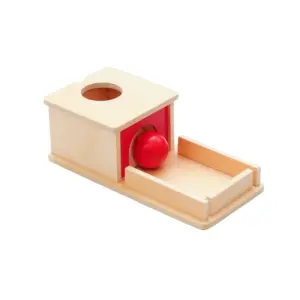
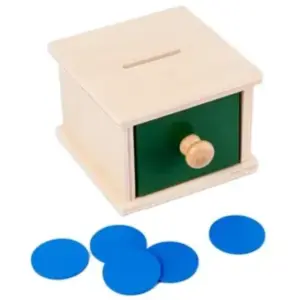
- Foundation — 6 to 12 months — cause and effect: Montessori Object Permanence Box, Wooden Montessori Coin Box.
The purest object permanence format: an object goes in, disappears, and can be retrieved. At this stage children are still forming the mental model that hidden things still exist. Both boxes offer immediate, self-confirming feedback — drop it, find it, repeat — which is exactly what this developmental stage needs. Ideal first toys for babies under 12 months once sitting with support is established.
- Building — 9 to 18 months — tracking and control: Wooden Ball Drop Toy, Montessori Wooden Spinning Disc Tower, Wooden Shape Sorter & Hammer Toy.
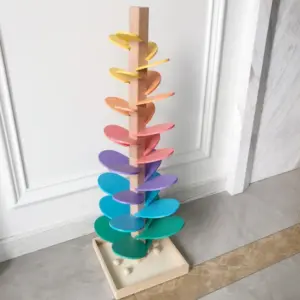
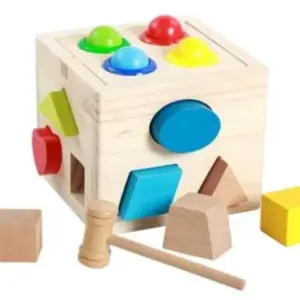
Children at this stage begin combining visual tracking with intentional hand movement. The Ball Drop Toy introduces trajectory — the ball travels a path before disappearing. The Spinning Disc Tower adds rotational control. The Shape Sorter & Hammer introduces force and direction: children must aim, strike, and watch the result. All three extend the drop-and-find mechanism into more complex physical action.
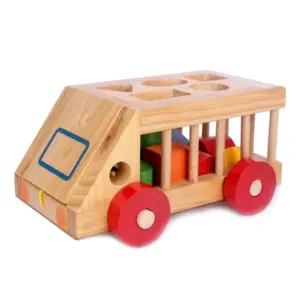
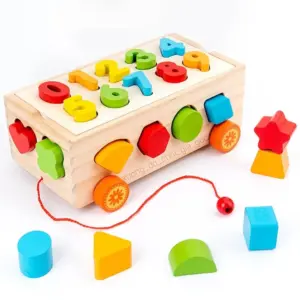
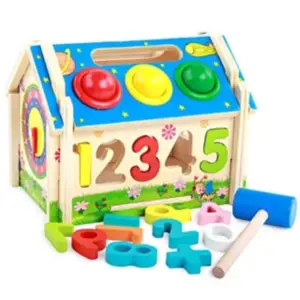
- Expanding — 12 to 24 months — shape recognition and independence: Geometric Shape Sorting Box, Montessori Wooden Activity House, Montessori Wooden Shape Sorting Truck, Montessori Pull-Along Shape Sorter Toy.
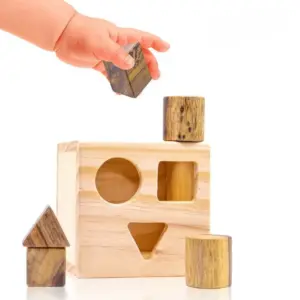
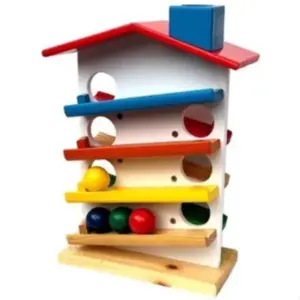
Once object permanence is established, children are ready for shape discrimination — matching a form to its corresponding hole. These toys layer geometric classification onto the familiar “post and retrieve” mechanic. The Activity House introduces numbers and letters alongside shapes. The Pull-Along and Truck add movement, making sorting a full-body experience for toddlers around 1 year old and beyond.
Always supervise play and check each product page for recommended age details.
🌿 Sustainable wood · 🎨 Water-based paint · ✅ Screen-free play · 🔄 30-day returns
Inside the Kukoo Object Permanence Toys Collection
All 9 products share one developmental principle: children learn by doing a short action, observing the result, and repeating. That loop — post, track, retrieve, repeat — is where focus, hand control, and early reasoning are built.
- “In and out” play — Object Permanence Box, Coin Box. The simplest and earliest format. Children drop an object, watch it vanish, then find it again. This confirms the mental model: things still exist when hidden. Repetition is the whole point — children will do this dozens of times in a single session.
- Tracking and trajectory — Ball Drop Toy, Spinning Disc Tower. These extend the basic mechanic: the object travels before disappearing, requiring children to track movement and predict where it goes. Visual tracking combined with motor control is foundational to early problem-solving and cognitive development.
- Shape sorting — Geometric Shape Sorting Box, Shape Sorter & Hammer Toy, Activity House. Children must identify a shape, orient it correctly, and insert it into the matching hole. This is more demanding than simple posting — it requires shape discrimination, spatial rotation, and persistence through failed attempts. The Hammer Toy adds percussive cause-and-effect that many toddlers find deeply satisfying.
- Mobile sorting — Shape Sorting Truck, Pull-Along Shape Sorter. Sorting mechanics combined with movement. Children pull the toy, stop, sort a shape, continue. This integrates gross motor coordination with fine motor precision and introduces sequenced, multi-step play.
For children ready to build on this foundation, our wooden stacking and ring toys extend the same hand-control and spatial reasoning through vertical construction challenges.
Why Kukoo Montessori Is the Best Choice
- Developmentally sequenced — products span 6 months to 2 years, matched to where object permanence and shape sorting actually develop
- Repeat-play design — every toy rewards repetition; children return to these dozens of times because the loop never gets old
- Self-correcting — shapes either fit or they don’t; children know immediately without needing adult feedback, which builds genuine independence
- No overstimulation — no lights, sounds, or electronic feedback; just the child, the toy, and the result
- FSC-certified wood, non-toxic finishes, ASTM & EN71 certified
- 30-day returns
Still figuring out what your child needs? Browse the full Montessori toy collection to build a play environment that fits your child right now.
FAQ
- What age is best for an object permanence box?
From around 6 months, once a baby can sit with support and reach intentionally. The Object Permanence Box and Coin Box are the right starting points — both offer the simplest version of the concept before shape sorting is introduced.
- What’s the difference between an object permanence box and a shape sorter?
An object permanence box has a single opening — any object goes in, then comes back out. The focus is entirely on the “things still exist when hidden” concept. A shape sorter adds discrimination: the child must match form to hole. Shape sorting is developmentally more complex and typically introduced from around 12 months, once basic object permanence is well established.
- How long should a baby play with these toys at one session?
Follow the child’s lead. Many babies will repeat the drop-and-retrieve cycle 20 or 30 times in a single sitting — that repetition is intentional, not mindless. As soon as they lose interest, the session is done. Five minutes of focused engagement is more valuable than twenty minutes of distracted play.
- How do I introduce a shape sorter without frustrating my toddler?
Start with a box that has only two or three shapes. Demonstrate slowly and without commentary — let the child watch the shape go in. Then hand them the same shape and wait. If they’re struggling, rotate the piece to the correct orientation without taking over. The goal is the child inserting it themselves, not the fastest route to success.
- Do these toys work alongside stacking toys?
Very well. Object permanence and stacking toys develop overlapping skills — hand-eye coordination, spatial reasoning, and grip control — through complementary mechanics. Many families use both types in the same play session, alternating between vertical stacking and posting/sorting challenges.