
“The senses are the gateways to intelligence.” — Maria Montessori
Before a child can read, count, or reason, they need to make sense of the world through their body. Touch a rough surface. Drop a ball and watch it roll. Shake a rattle and hear the sound change. These aren’t just play — they’re how the brain builds its input system, one sensory experience at a time.
Sensory skills are the ability to receive, process, and make meaning from information coming through the senses. They’re the foundation for focus, coordination, language, and learning. Ages 0–6 are the highest-growth window for sensory neural connections — what happens here matters more than most parents realize.
The Science: How Sensory Development Works
- There are seven senses, not five. Beyond the familiar five, the vestibular sense (balance and movement) and proprioception (body position and effort) profoundly affect behavior and learning. Children who are fidgety, easily overwhelmed, or struggling to focus often have underdeveloped vestibular or proprioceptive systems — not attention problems.
- Discrimination develops through contrast. Babies don’t learn “rough” and “smooth” abstractly. They learn by touching rough bark, then a smooth stone, back and forth, until the brain builds a reliable category for each. The same applies to every sense: pitch, weight, color, temperature. The brain learns through comparison, not single exposures.
- Sensory processing is the foundation of thinking. Before a child can classify, compare, or reason, they need clean, reliable sensory input. A child who can’t feel the difference between heavy and light, or hear the difference between similar sounds, will struggle with the cognitive operations that depend on those distinctions. Sensory discrimination and early cognitive development aren’t separate tracks — one feeds directly into the other. The child grading five shades of blue from light to dark is doing the same mental operation as ordering numbers from smallest to largest. The sense is the entry point; the reasoning follows.
- Overstimulation doesn’t build sensory skills — it defeats them. Pathways that receive clear, predictable input strengthen. Pathways flooded with chaotic stimulation habituate — the brain learns to tune out what it can’t make sense of. This is why Montessori sensory materials are simple, not stimulating.
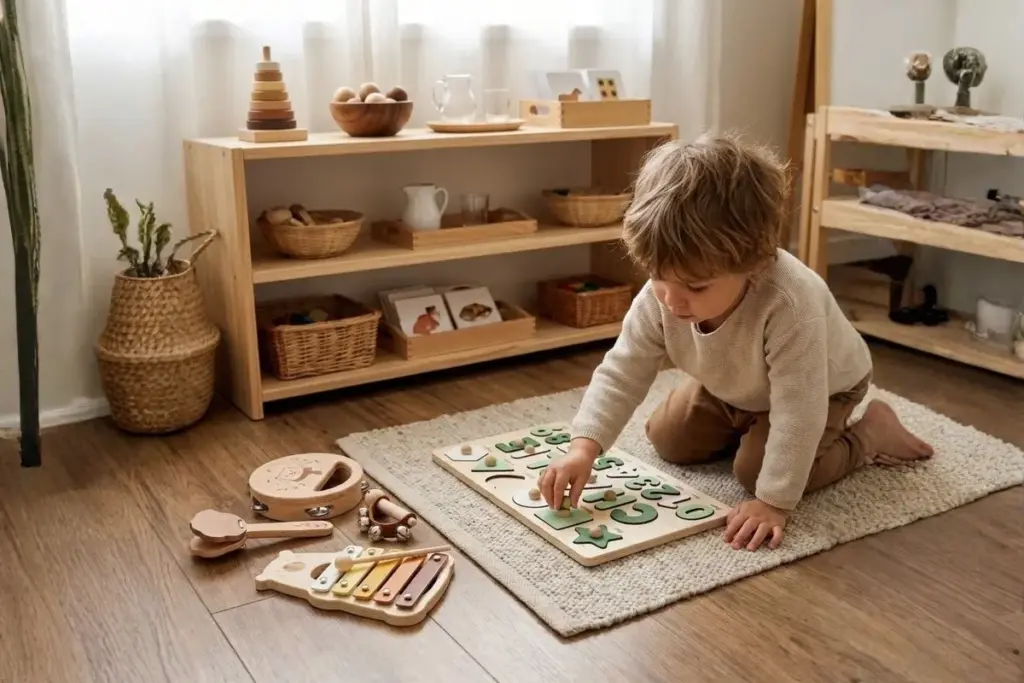
What Makes Montessori Sensory Training Different
- Isolation of quality: one variable at a time. Not size AND color AND sound simultaneously. Just size. Or just color. A toy that does five things at once teaches five things poorly. One clear sensory focus gives the brain something it can actually work with.
- Control of error: the material tells the child whether it worked. The cylinder either fits the socket or it doesn’t. No adult correction needed. The child learns to trust their own perception — which is the beginning of genuine sensory confidence.
- Concrete to abstract: a child who has held and traced wooden triangles has a concrete reference for “triangle” long before encountering the word. Sensory experience is how abstract concepts get anchored in reality.
This is also why natural materials support sensory development more effectively than plastic. Wood has real grain, authentic weight, and subtle warmth that varies across pieces. Those real differences are exactly what the brain needs to build accurate sensory categories.
Sensory Milestones & Activities by Age
0–6 Months: Visual and Auditory Foundations
- What’s happening: Vision is the least developed sense at birth — newborns see clearly at 20–30cm, in high contrast, with limited color. Over the first six months, visual acuity, color perception, and movement tracking develop rapidly. Hearing is more advanced from birth; babies already distinguish familiar from unfamiliar voices.
- Key milestones: Tracking moving objects smoothly, turning toward sounds, responding differently to familiar versus unfamiliar voices.
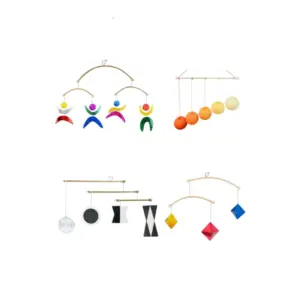
- Montessori activities: High-contrast mobiles, simple rattles with predictable sound, slow movement tracking.
The most important sensory input at this stage is visual contrast and controlled movement. Tracking a moving object requires the visual and motor systems to coordinate — and that coordination is foundational to everything that follows. Good for babies under 12 months from birth.
Red flags: Not tracking moving objects by 3 months. Not responding to familiar sounds.
6–12 Months: Cause and Effect + Auditory Processing
- What’s happening: Babies begin understanding they can produce sensory outcomes — shake the rattle, hear the sound; drop the ball, watch it roll. This cause-effect loop is sensory learning at its most fundamental.
- Key milestones: Turning accurately toward sound sources, intentionally repeating actions that produce interesting results, reacting differently to different sound qualities.
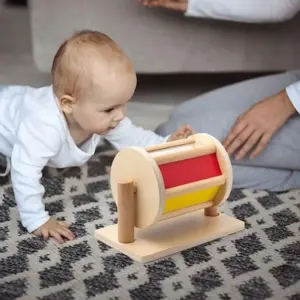
- Montessori activities: Simple percussion, cause-effect sound toys, rattles with varied tones.
Auditory discrimination at this stage directly predicts later phonemic awareness — the perceptual precision that makes reading possible. The right toy produces a clear, consistent auditory result every time the same action is performed. No randomness, no electronic variation.
Red flags: Not turning toward sounds by 9 months. Not intentionally repeating actions that produced an interesting result.
12–24 Months: Tactile, Proprioceptive + Multi-Sensory Integration
- What’s happening: As children become mobile, the proprioceptive and vestibular systems take center stage. Toddlers are constantly calibrating: how much force to pick something up, how to shift weight when reaching, what “heavy” feels like versus “light.”
- Key milestones: Grading objects by size, noticing texture differences, adjusting grip for different weights, maintaining balance during movement.
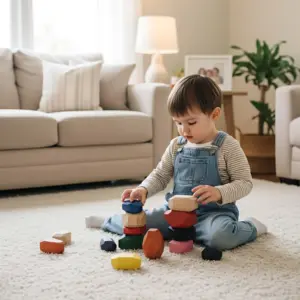
- Montessori activities: Graded stacking sets, objects with distinct weights, texture exploration, balance activities, spooning and pouring.
The key development here is proprioceptive calibration — feeling differences in weight and adjusting accordingly. A child who can feel heavy versus light is building the same neural pathway that later regulates pencil pressure, gentle object handling, and all manual effort control. Multi-sensory toys that combine weight, color, and spatial challenge give the brain more than one input channel to integrate — which produces deeper learning than single-channel activities.
Red flags: Strong aversion to textures with significant distress. Not adjusting grip force between heavy and light objects by 18 months.
2–3 Years: Tactile Refinement + First Classifications
- What’s happening: Finger sensitivity sharpens significantly. Children begin noticing and naming sensory differences spontaneously — “this is scratchy,” “that one is heavier.” Vocabulary and sensory perception develop together; the word helps the brain hold the distinction in memory.
- Key milestones: Grading 3 objects by size or weight, matching texture pairs, naming basic sensory qualities, sustained focus on a single sensory activity for 10–15 minutes.
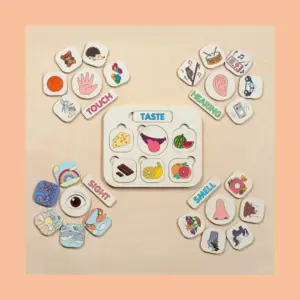
- Montessori activities: Texture matching pairs, simple weight grading (heavy/light/medium), mystery bag with 3–5 familiar objects, sound matching shakers, simple color sorting.
At this stage children are building their first sensory categories through contrast. The right material isolates one quality — just texture, just weight, just sound — and gives the child two or three clear examples to compare. More than that overwhelms; fewer than that doesn’t give the brain enough contrast to form a reliable category.
Red flags: Not noticing obvious differences between rough and smooth, or loud and quiet, by age 2.5. Strong consistent aversion to specific textures that disrupts daily routines.
3–6 Years: Refined Discrimination + Sensory Vocabulary
- What’s happening: Children move from noticing differences to grading them — not just “rough versus smooth” but five levels of texture from coarsest to finest. Sustained concentration lengthens. Language becomes precise: “lighter,” “darker,” “higher pitched.”
- Key milestones: Grading 5+ objects by a single quality, matching sensory pairs by memory, naming and describing sensory properties accurately, transferring sensory knowledge to new contexts.
- Montessori activities: Color gradation (lightest to darkest across multiple shades), refined texture grading, sound discrimination activities, weight sequencing, shape classification with geometric solids.
At this stage the bridge between sensory processing and cognitive classification becomes fully visible. Arranging stones from lightest to darkest blue isn’t just seeing — it’s comparing, ordering, and reasoning about gradation. The sensory act is a cognitive act. Materials that explicitly name the senses add the metacognitive layer children need to transfer these skills to reading, math, and careful work of all kinds.


Red flags: Significant inability to distinguish obvious sensory differences by age 3. Persistent sensory-seeking that interferes with daily functioning.
Activities by Sensory Channel
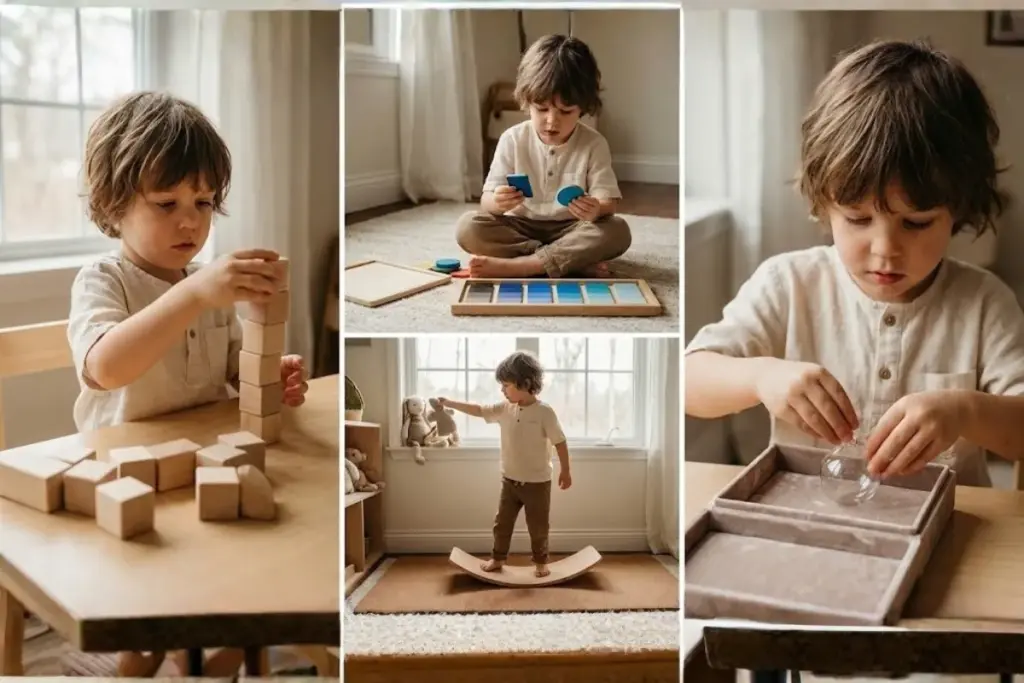
- Visual: Size grading, color gradation, shape matching, high-contrast pattern work.
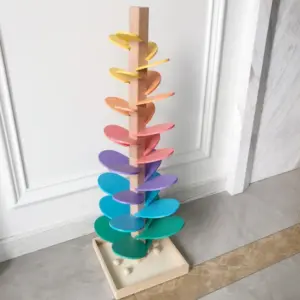
- Auditory: Sound matching pairs, rhythm repetition, pitch exploration on simple instruments, listening walks.
- Tactile: Texture matching, mystery bag identification, playdough and clay, water play with varied temperatures.
- Proprioceptive: Carrying objects of different weights, heavy work (sweeping, scrubbing, kneading dough), large block building.
- Vestibular: Balance beams, slow walking on a line, rocking, carrying objects while moving.
Browse the full wooden sensory toy collection for tools covering each channel across the 0–4 year range.
Sensory Toy Rotation
Display 2–3 sensory materials at a time. Rotate on observation, not schedule: a child returning to the same action 15–20 times in a session is still processing — don’t rotate the toy out. That repetition is the work.
Progression rule: increase difficulty by one variable at a time. From 3 sizes to 5. From matching sounds to grading them. From rough versus smooth to five texture gradations. The brain needs a challenge it can almost meet.
Common Mistakes
- Overstimulating toys. Lights, sounds, and five simultaneous activities don’t develop discrimination — they overwhelm it. The nervous system habituates rather than building precise categories.
- Rotating too fast. Mastery looks like boredom. If a child is still returning to a toy repeatedly, the processing isn’t finished.
- Skipping body senses. Vestibular and proprioceptive development are the most underserved in home environments. Dysregulated, fidgety children often need more movement and heavy work, not more visual stimulation.
- Correcting instead of observing. Let the material give feedback. Adult correction short-circuits the discovery.
Red Flags and When to Seek Support
- By ~6 months: Not tracking moving objects. Not responding to familiar voices.
- By ~12 months: Not turning toward sounds. Not repeating actions that produced interesting results.
- By ~2 years: Strong aversion to textures or sounds that disrupts daily life. Not noticing obvious differences between large and small.
- By ~3 years: Unable to complete basic sensory matching. Persistent sensory-seeking that’s difficult to redirect.
A pattern across several weeks is worth discussing with your pediatrician. Ask about an occupational therapy referral. Early support makes a significant difference.
FAQ
- What are sensory skills in Montessori?
The ability to receive, distinguish, and make meaning from sensory information across all seven senses, developed through materials that isolate one quality at a time.
- Why does the 0–12 month window matter most?
Neural connectivity is faster in the first year than at any other point in life. Sensory pathways that receive consistent, clear input during this window are strengthened and stabilized in ways that support all later learning.
- How is wooden sensory play different from plastic?
Wood provides genuine sensory variation — natural grain, authentic weight, subtle warmth — that plastic can’t replicate. Those real differences between pieces are what teach discrimination.
- Do sensory toys help with focus and self-regulation?
Consistently, yes — particularly vestibular and proprioceptive activities. The vestibular and proprioceptive systems are directly connected to arousal regulation in the brain. Heavy work and movement are among the most reliably calming activities available for dysregulated children.
- When should I worry about sensory processing?
When a pattern — not a single sensitivity — significantly affects daily life: extreme distress at ordinary sensory experiences, persistent sensory-seeking that can’t be redirected, or difficulty regulating after sensory input. Speak to your pediatrician and ask about an OT referral.
Explore every stage of your child’s growth — from fine motor and language to STEM, math, social-emotional, and practical life — in our complete Montessori skill guide library.