
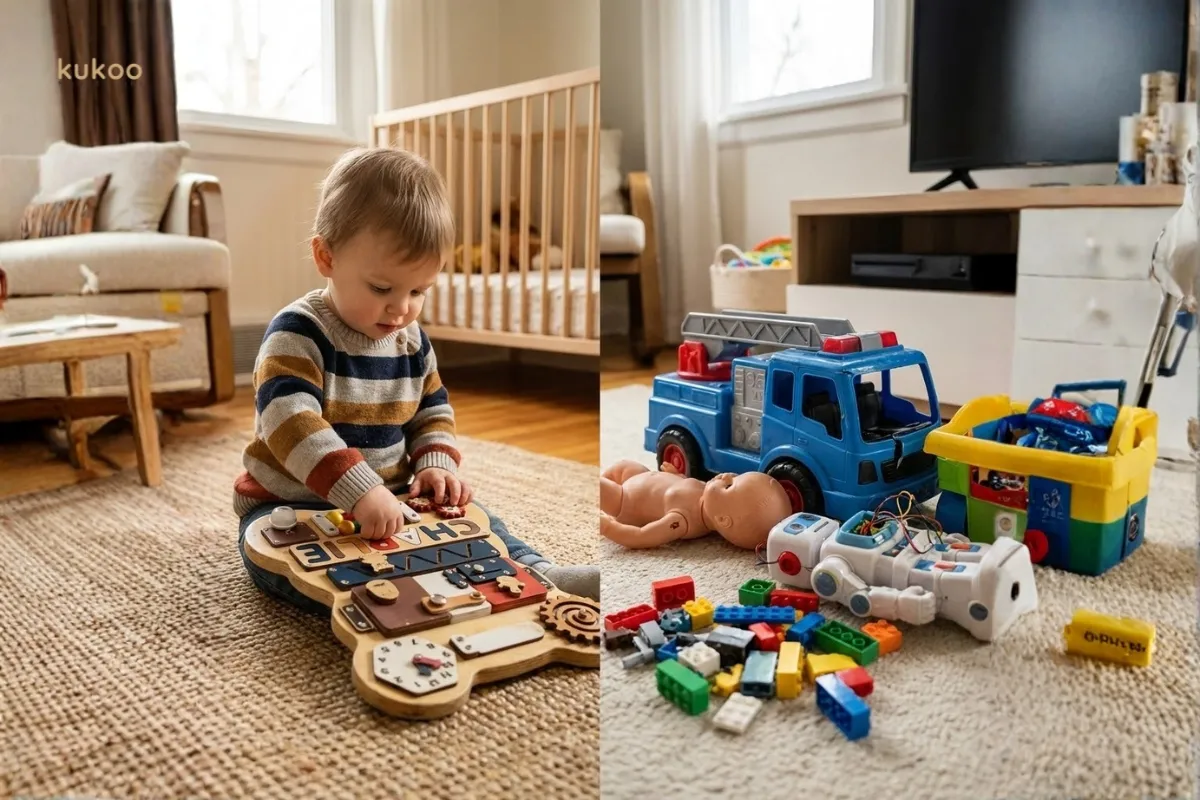
Overflowing plastic toys—lights flashing, music looping, your toddler flitting between them. Now picture a simple wooden rattle. Your baby picks it up, shakes it, listens. Ten minutes pass. Completely absorbed.
“Is wood just an aesthetic choice… or does it actually change how a child learns?”
Both. And that’s exactly why choose wooden toys is the first question every informed parent should ask. The real benefits of wooden toys go beyond aesthetics—it’s a neurological decision that shapes focus, sensory development, and how your child relates to the physical world.
At Kukoo, every design asks: “What does the child’s developing brain need?” The answer: natural learning materials, honest feedback, no gimmicks.
Montessori Foundations: For the Child’s Hands, Brain, and Heart
The Child as a Sensorial Explorer
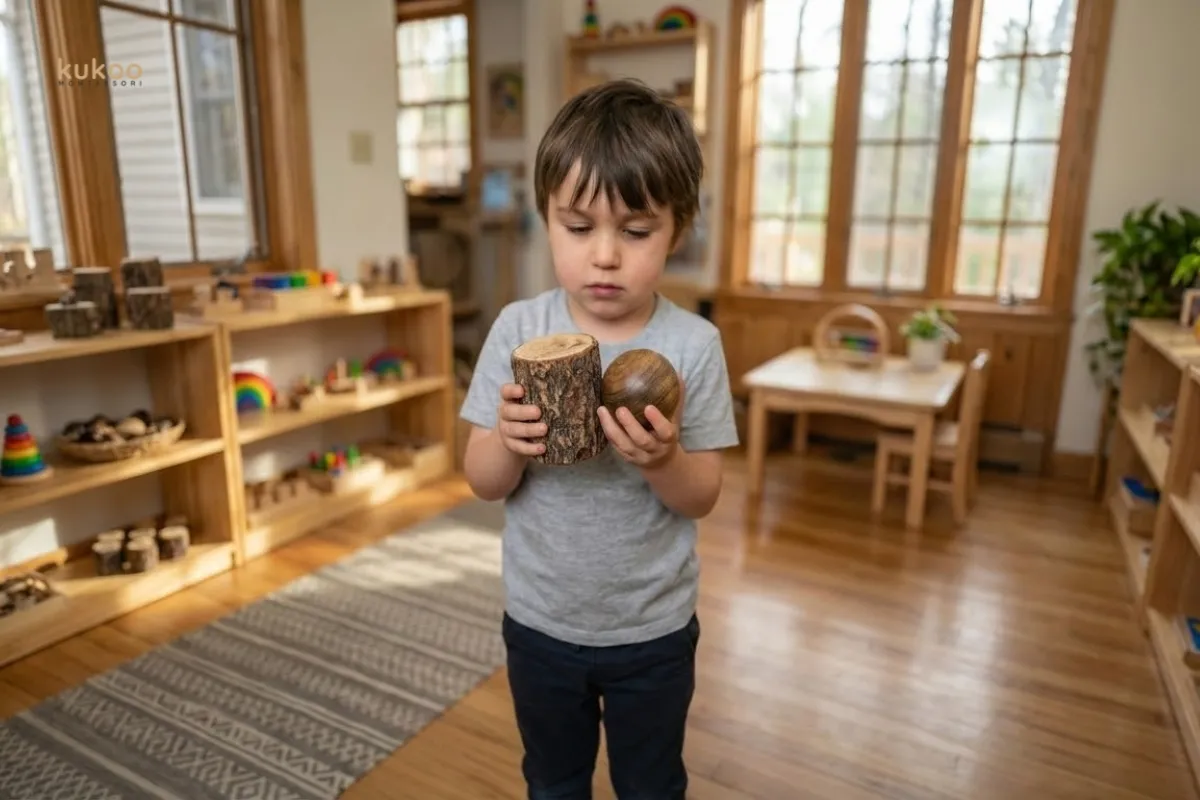
Babies and toddlers learn through their hands. A wooden block teaches weight, texture, temperature, resistance—sensory data points that help your child’s brain construct an accurate map of the physical world.
Why Dr. Maria Montessori Chose Natural Materials
Dr. Montessori chose wood, metal, and glass because they tell the truth. A wooden cylinder is heavy because it’s solid. A metal bell rings because of its material properties. These materials offer authentic feedback—the world responds predictably to a child’s actions.
When a toddler picks up a hollow plastic toy that looks big but weighs almost nothing, there’s a sensory mismatch. It’s not “wrong,” but for young children building their understanding of how the world works, real matters.
“Not for Instagram. For the child’s hands, brain, and heart.”
We follow Montessori’s original blueprint: real materials, honest feedback, no gimmicks. The Montessori Method puts the child’s senses at the center of learning—and this is precisely why authentic Montessori toys are made of wood. Natural materials give children accurate information about the physical world: real weight, real texture, real consequences. Every toy we design asks one question: Does this tell the truth? If yes, we build it from wood.
The Sensory Science of Wood (vs. Plastic)
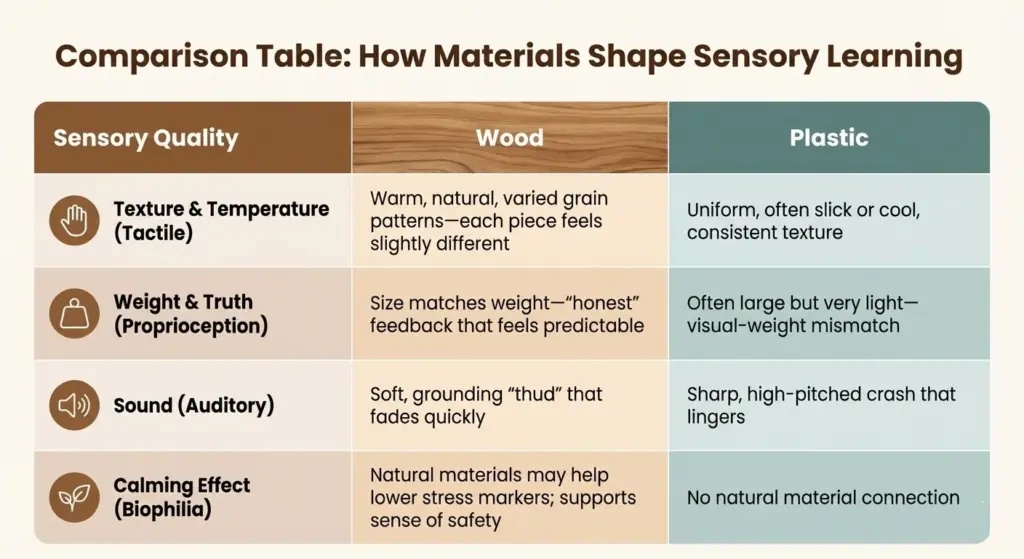
Texture & Temperature (Tactile Sense)
So what actually happens when a child picks up a wooden toy instead of a plastic one? The differences are measurable — across texture, temperature, weight, and sound. Here’s what the research shows.
- Wood: Warm, with varied grain patterns—micro-textures that keep fingers curious.
- Plastic: Uniform, often slick or cool—less sensory information for the brain.
Your toddler’s fingertips gather data with every touch, building neural pathways for fine motor control and sensory discrimination. Research published in JAMA Pediatrics found that traditional toys—compared to electronic ones—generated significantly more language interaction between parent and child
Weight & “Truth” (Proprioception)
- Proprioception is how the body knows where it is in space and how much force to use.
- Solid wood: Size matches weight. A large block feels heavy; a small one feels light. This “honest” feedback helps children calibrate grip strength.
- Hollow plastic: Often large but very light—creating a sensory mismatch. Not harmful, but less informative for a developing sensory system.
Acoustic Quality (Auditory Sense)
- Plastic: Sharp, high-pitched crashes that add to household noise.
- Wood: Soft, grounding “thud” that fades quickly.
A calmer soundscape supports concentration for both children and adults — and the science behind why wooden toys feel calmer goes deeper than just sound.
The Calming Effect of Natural Materials (Biophilia)
Research suggests contact with wood may help lower stress markers. For young children, this can support a sense of safety and calm—especially important where overstimulation is common.
This isn’t about demonizing plastic. Different materials create different sensory environments. For developing brains—where every touch, sound, and weight teaches something—those differences matter. For a detailed look at how wooden and plastic toys compare across developmental areas, the trade-offs are worth understanding.
The Key Insight
This isn’t about demonizing plastic. Different materials create different sensory environments. For developing brains—where every touch, sound, and weight teaches something—those differences matter.
Wood offers richer sensory input, authentic feedback, and a calmer atmosphere. It’s not aesthetic. It’s neurological. And for children in the earliest years of sensory development, that difference compounds every single day.
For parents navigating the plastic question specifically, understanding the hidden risks in certain plastics helps frame why material composition matters.
Focus, Calm, and Deep Play: Why Low-Tech Wins
What the Experts Say
The American Academy of Pediatrics recommends simple, non-electronic toys that promote language, creativity, and caregiver interaction—and pediatricians cite several specific reasons why wooden toys align with these principles.
Passive Toy, Active Child
- Electronic toys: The toy performs—lights flash, songs play. The child watches and reacts.
- Wooden Montessori toys: The toy waits. The child must act, imagine, problem-solve, and explore.
One entertains. The other educates. That’s the difference between a toy that does the thinking and a toy that invites your child to think.
“The more the toy does, the less the child does.”
When a toy requires the child to make it work—stack it, balance it, fit pieces together—the child’s brain is fully engaged in cause-and-effect learning, spatial reasoning, and motor planning.
Kukoo’s Play Philosophy
“Our wooden toys are 90% child, 10% toy. They wait quietly until your child’s imagination wakes them up.”
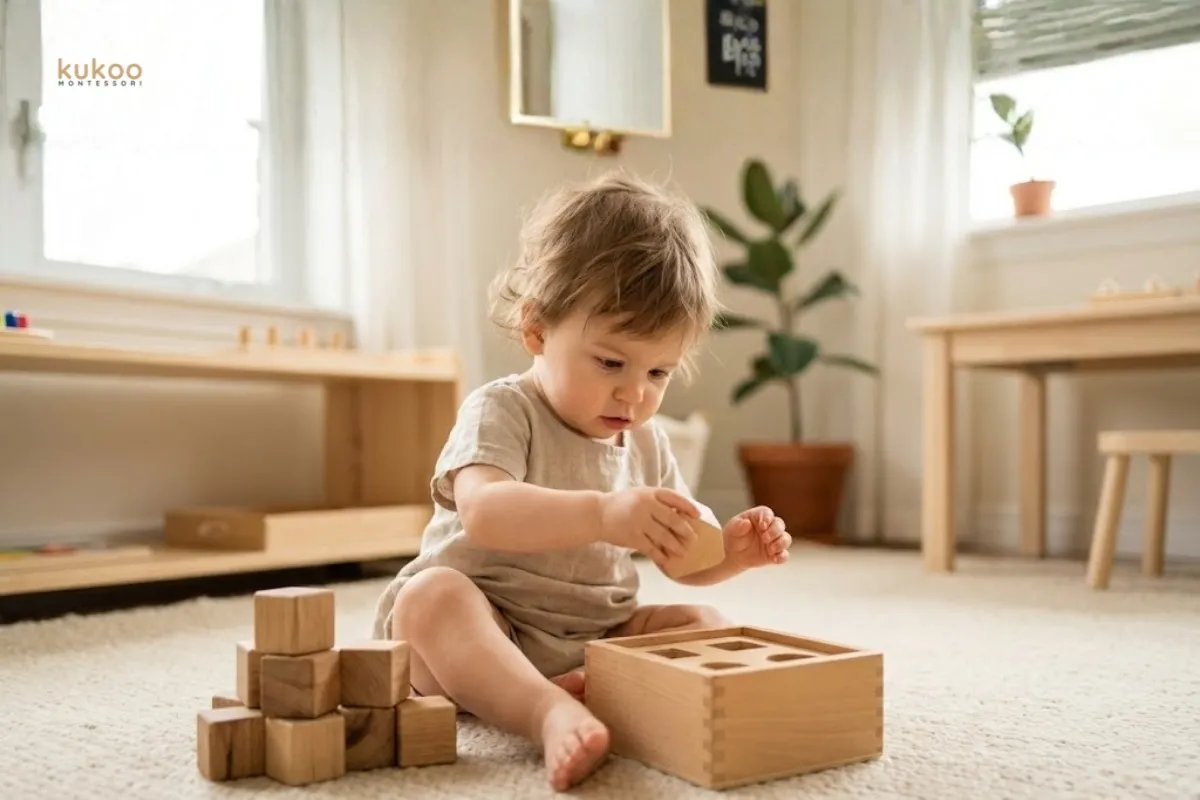
A wooden block doesn’t “do” anything on its own. But in your toddler’s hands, it becomes a car, a phone, a tower. This open-ended quality allows deep, sustained play where children enter focused concentration—what Montessori educators call “normalization.”
Brain Development: From Tiny Hands to Big Thinking
Cognition & Problem Solving
Without pre-programmed responses, wooden toys require children to discover rules themselves. How does gravity work? How do I fit this shape into that slot? Every puzzle solved is an exercise in cause-and-effect thinking and spatial reasoning — the cognitive foundations for math, logic, and executive function later in life.
Fine Motor Skills & Hand Strength
The natural resistance and weight of wood build grip strength and finger control. Grasping knobs, stacking blocks, threading beads — these hands-on actions strengthen the small muscles needed for holding pencils, using scissors, buttoning shirts, and feeding themselves. It’s the kind of physical learning that no screen can replicate.
Creativity & Imagination
Open-ended wooden toys are blank canvases. Today a block is a car. Tomorrow a phone. Next week a stepping stone. This flexible, self-directed play encourages divergent thinking—seeing multiple possibilities and creating original solutions. It’s the cognitive skill that supports innovation throughout life.
Wood is just the medium. What matters is what’s happening inside your child’s hands and mind — the fine motor control strengthening with every grasp, the problem-solving sharpening with every puzzle, the creativity expanding with every open-ended session. These skills compound quietly, and they add up faster than most parents expect.
Non-Toxic Toy Safety: The Kukoo Standard & Certifications
For parents of babies and toddlers, safety isn’t a feature — it’s the starting point. When your child explores everything with their hands and mouth, the materials they touch matter as much as the design. Here’s how we ensure every Kukoo toy meets that standard.
Gold Standards in Toy Safety
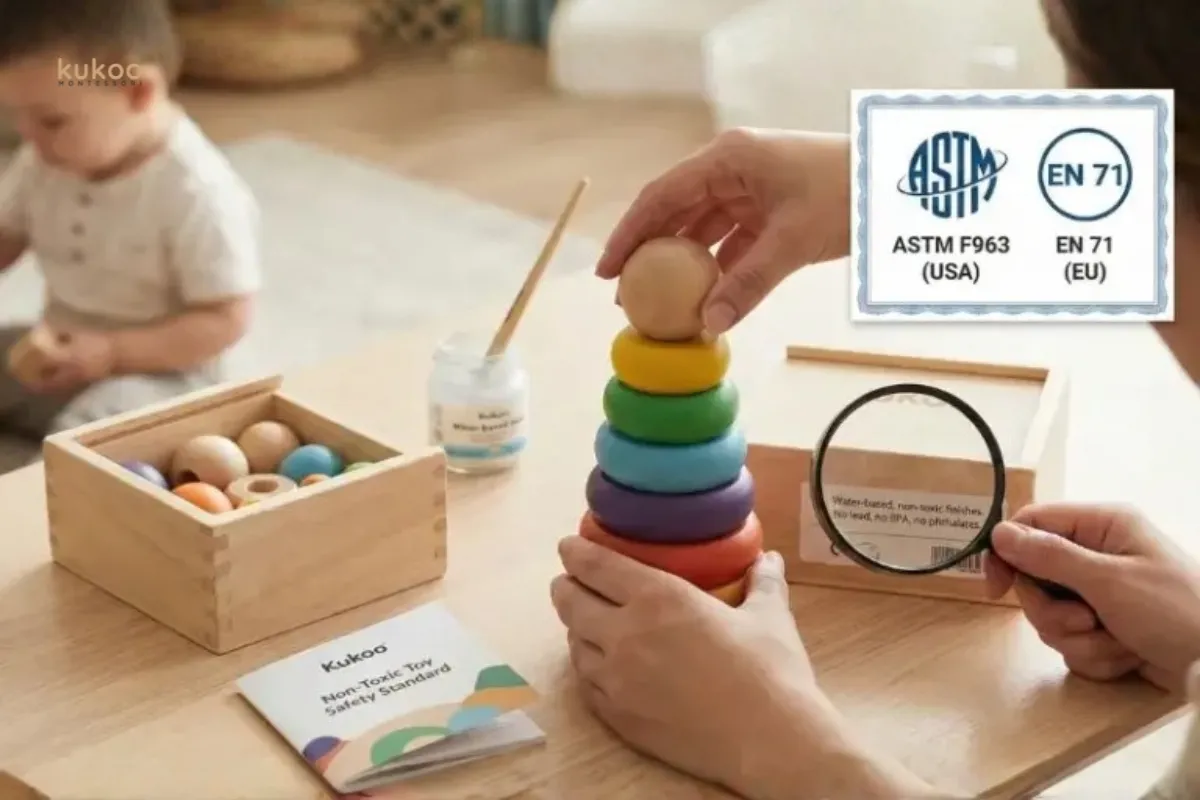
Every Kukoo toy meets ASTM F963 (USA) and EN 71 (EU) safety standards—two of the most rigorous toy safety certifications in the world.
What these standards cover:
- Mechanical and physical safety: No sharp edges, small parts appropriate for age, secure construction
- Flammability: Materials tested to ensure they don’t pose fire risks
- Chemical safety: Limits on toxic substances including lead, heavy metals, and harmful additives
These aren’t just logos on a box. They’re third-party verified standards that ensure every toy is safe for the way children actually play—dropping, throwing, mouthing, and testing limits.
Chemical Safety
- Water-based, non-toxic finishes: We use water-based paints and stains that allow the natural wood grain to show through. No harsh solvents, no questionable chemicals.
- Strict avoidance of harmful substances: No lead, no BPA, no phthalates, no microplastics. Every material is sourced with safety as the starting point — not an afterthought.
- Safe for mouthing: Because we know toddlers explore with their mouths, our finishes are formulated to be safe even when chewed or sucked on.
Design for Safe Play
- Rounded edges: Every corner is sanded smooth to reduce risks of bumps or scrapes.
- Age-appropriate sizing: We design piece sizes to minimize choking hazards while still being graspable for small hands.
- Rigorous internal testing: Our toys go through real-world testing—drop tests, throw tests, bite tests—to simulate how toddlers actually play. If it can’t survive toddler energy, it doesn’t ship.
Material Matters: How We Choose the Right Wood for the Right Toy
At Kukoo, we don’t just pick wood based on cost or availability. We ask: What does this toy need to do?
Does it need the heavy grounding of solid wood for sensory feedback? Or the lightweight stability of engineered wood to prevent warping? Every material choice serves the child’s experience.
The “No-Go” Zone: Why We Ban MDF & Particle Board
What they are: Sawdust mixed with synthetic resins and heavy glues, pressed under heat.
Why we refuse them:
- The “sponge effect”: They swell and crumble when wet. Toddlers spill things. Materials should handle real life.
- Chemical concerns: Often contain higher levels of formaldehyde and VOCs.
- Durability: Once chipped or broken, they cannot be sanded or repaired.
Kukoo’s Promise: “If it’s sawdust and glue, it’s not for you. We strictly avoid MDF in all our products.”
Solid Hardwood: The Master of Sensory Feedback
Best used for: Building blocks, grasping toys, teethers, rattles.
The benefit:
- Weight & proprioception: Dense wood helps children feel the “true weight” of an object.
- The patina: Can be sanded, re-oiled, and repaired. Lasts for generations.
- Seamlessness: No layers, just one continuous piece of nature.
Woods we use: Beech, rubberwood, maple—chosen for durability, smooth grain, and consistent quality.
Sustainable Plywood: The Master of Structure & Stability
Best used for: Name puzzles, busy board bases, large flat surfaces.
Why not solid wood here?
- Warp resistance: Large, thin sheets of solid wood can bow or crack with humidity changes. High-grade plywood uses cross-laminated layers (grains running in opposite directions) to lock the wood in place—your puzzle stays flat.
- Strength-to-weight ratio: Incredible strength without being too heavy for a child to lift or move.
The “Kukoo Grade” difference:
- We use Baltic Birch or equivalent premium-grade plywood—not construction plywood.
- Void-free core: No air pockets inside the layers, meaning no weak spots.
The Invisible Safety: Addressing the “Glue Question”
The concern: Parents worry about adhesives used in plywood layers.
The solution (Our standard):
- CARB P2 / EPA TSCA Title VI compliant: Our plywood meets the strictest global emission standards for formaldehyde—safe enough for indoor schools and nurseries.
- Water-based adhesives: Non-toxic binding agents that are safe even if mouthed.
We strictly refuse MDF for any toy meant for teething or heavy handling. Only carefully selected hardwoods touch your child’s hands and mouth.
Durability, Sustainability & True Value
Heirlooms vs. Landfill Toys
Plastic toys often crack, scratch, and lose their appeal quickly. Batteries die. Electronic components fail. Within months, they’re headed to the landfill.
High-quality wooden toys? They last. They get passed from child to child, from family to family, sometimes across generations. What starts as your toddler’s first puzzle can become your grandchild’s treasure.
The Patina Effect
Here’s something beautiful about wood: it ages well.
Over time, wooden toys absorb natural oils from little hands. Edges soften. Colors deepen. Instead of looking worn-out, they develop a warm patina—a visual story of all the hands that loved them.
Scratches and dents aren’t damage. They’re memories. That block tower that fell a hundred times. That puzzle piece your child finally mastered. These marks make wooden toys more meaningful, not less.
Cost-Per-Use Logic
Let’s talk honestly about price.
Scenario 1: A $50 wooden toy used daily by three siblings over 4+ years = thousands of hours of play.
Scenario 2: Multiple $15 plastic toys that break, lose pieces, or lose appeal within weeks = replaced multiple times.
On a cost-per-hour-of-play basis, quality wooden toys often win. Not because they’re cheap upfront, but because they keep delivering value long after the initial purchase.
And when your child outgrows them? Wooden toys hold resale value. They can be sold secondhand, donated with pride, or saved for the next generation.
Sustainability
- Wood is renewable. When sourced responsibly (FSC-certified or equivalent), it’s a material that can be regrown and replanted.
- Wood is biodegradable. At the end of its very long life, it returns to the earth—not to a landfill where it sits for centuries.
- Wood reduces plastic waste. Every wooden toy replaces a plastic one — one less item in circulation, one less source of microplastic pollution in your home.
We’re not perfect. Shipping has a carbon footprint. Manufacturing requires energy. But choosing natural, durable materials is one step toward a more sustainable future for the children who will inherit this planet.
Busting Myths About Wooden Toys
- Myth 1: “Wooden toys are boring.”
Reality: Open-ended toys create endless storylines. A wooden block isn’t boring—it’s a blank canvas. Today it’s a phone. Tomorrow it’s a bridge. Next week it’s a spaceship.
Electronic toys provide one script. Wooden toys invite infinite possibilities. That’s not boring—that’s imagination at work.
- Myth 2: “They’re too heavy and dangerous.”
Reality: High-quality wooden toys are designed with rounded corners, smooth surfaces, and age-appropriate sizing. They’re tested for safety and durability—drop tests, throw tests, real-world use.
Yes, wood is heavier than plastic. But that weight provides valuable proprioceptive feedback that helps children understand force, balance, and control. With proper design and supervision, wood is safe and beneficial.
- Myth 3: “Any wooden toy is Montessori.”
Reality: Not all wooden toys follow Montessori principles. A Montessori-aligned toy must:
- Use real, natural materials
- Offer purposeful design (not just decoration)
- Isolate one clear skill or concept
- Provide the right level of challenge for the child’s stage
Wood is the starting point, not the finish line. Kukoo designs every toy with these principles in mind.
- Myth 4: “They’re too expensive.”
Reality: Think in terms of cost-per-use, heirloom value, and resale potential.
A $50 wooden toy used daily for 4+ years by multiple children = pennies per play session. Quality wooden toys often retain value and can be sold secondhand or passed down.
Compare that to multiple $15 plastic toys that break, lose appeal, or end up in the landfill within months. Sometimes, the “cheaper” option costs more in the long run.
How to Choose Montessori Wooden Toys
Knowing why wood matters is one thing. Picking the right toy is another. Not every wooden toy follows Montessori principles, and not every pretty toy on Instagram actually supports development. Here’s how to tell the difference.
Step 1: Notice Your Child’s Sensitive Periods
Look for strong, repeated interests—putting things in and out, lining up objects, climbing, matching colors. These aren’t random phases. They’re windows when your child’s brain is primed to absorb specific skills, and the right toy at the right moment makes all the difference.
Step 2: Focus on Quality Over Quantity
Select 1–2 toys per developmental area: movement, language, fine motor, practical life, early math and logic. A minimalist play space encourages deeper engagement.
Step 3: The 5-Question Montessori Test
Before buying, ask:
- Is it made of real, natural materials?
- Does it isolate one clear skill?
- Does it encourage problem-solving or self-correction?
- Is the design simple and uncluttered?
- Will it engage my child for weeks, not days?
If you answer “yes” to most, you’re on the right track.
Step 4: The Safety Check
✓ Material: Solid wood or high-grade plywood (not MDF)
✓ Finish: Water-based, non-toxic
✓ Certifications: ASTM F963 and EN 71
✓ Construction: Smooth edges, secure parts, age-appropriate sizing
Not sure what to look for in practice? This guide to what makes wooden toys safe for babies walks through each point in detail.
Step 5: Think Long-Term
Wooden toys are investments. Choose pieces that grow with your child, work for multiple siblings, and maintain resale value.
Inside the Kukoo Workshop
From Raw Timber to Finished Toy
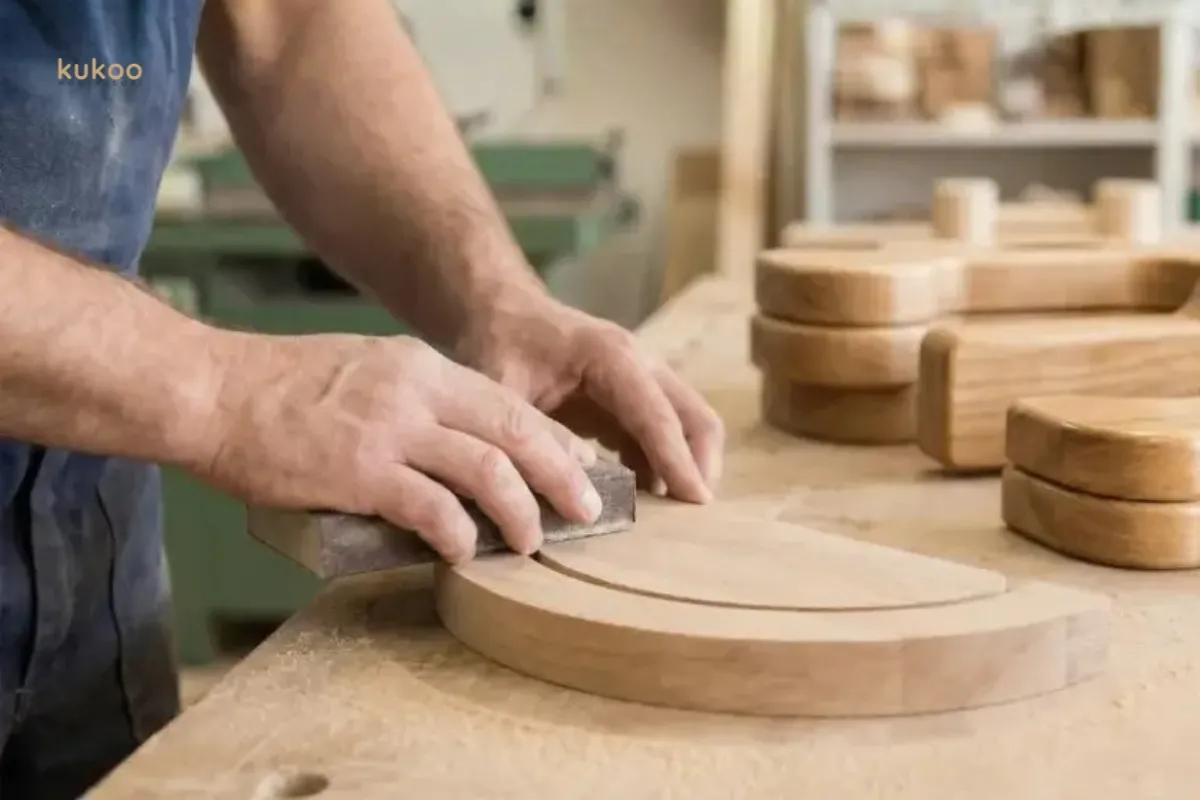
Every Kukoo toy starts with carefully selected hardwoods—beech, rubberwood, and premium plywood chosen for their strength, smooth grain, and sustainability.
The process:
- Kiln-drying: Wood is dried to the right moisture content to prevent warping or cracking over time.
- Cutting & shaping: Precise cuts ensure each piece fits perfectly and meets safety standards.
- Sanding: Multiple rounds of sanding create smooth, splinter-free surfaces safe for little hands.
- Finishing: Water-based paints and oils are applied by hand, allowing the natural wood grain to show through.
- Assembly & inspection: Each toy is assembled, tested, and inspected before it ships.
Design Process
We don’t design for catalogs. We design for children. Learn more about the Kukoo team and the philosophy behind every piece we make.
Each toy starts with observation: How do small hands actually grasp? What movements does a 15-month-old naturally make? Where does frustration happen, and how can we design around it?
From initial idea to prototype to real-world testing with children, we adjust until the toy works the way a child’s hands and brain expect it to. If it doesn’t feel right in a toddler’s grip, we redesign it.
Testing & The Drop Test Promise
Toddlers drop things. They throw things. They test limits. Our toys need to survive real life.
Kukoo’s internal rule: If it can’t survive toddler energy, it doesn’t ship.
Every toy goes through drop tests, throw tests, and durability checks. We simulate the chaos of real play—because we know your toddler won’t be gentle, and that’s exactly as it should be.
You’ve seen what goes into every piece. Shop Kukoo by Age and start building your wooden toy collection.
Frequently Asked Questions (FAQ)
- Why choose wooden toys instead of plastic?
Wood provides richer sensory information — real weight, natural texture, and a warmer acoustic quality that plastic can’t replicate. A 2016 JAMA Pediatrics study found traditional toys generated significantly more parent-child language interaction than electronic alternatives. Wooden toys also last longer, contain fewer chemical concerns, and don’t contribute to microplastic pollution.
- Are painted wooden toys safe for mouthing?
Yes — when the paint is water-based and non-toxic. Kukoo toys meet ASTM F963 (U.S.) and EN 71 (EU) standards, including specific oral contact testing. If evaluating other brands, look for these two certifications — marketing terms like “eco-friendly” don’t carry the same weight as third-party lab results.
- Will my child be bored without lights and sounds?
The opposite. Without pre-programmed responses, children stay with a single activity longer — what Montessori educators call a “work cycle.” Electronic toys keep interrupting the child’s own thinking. Simpler toys don’t. The less a toy does, the more the child’s brain does.
- Do wooden toys break easily?
Quality wooden toys survive drops, throws, and toddler chaos far better than plastic. If a surface gets roughed up, sanding and food-safe oil makes it new again. Avoid MDF or particle board — they chip and swell with moisture. Look for solid hardwood (beech, maple, rubberwood) or high-grade plywood.
- What’s the difference between solid wood and plywood?
Both are safe when certified. Solid wood is one continuous piece — ideal where weight and sensory feedback matter (blocks, rattles, grasping toys). Plywood uses cross-laminated layers that resist warping — better for flat surfaces like puzzle bases and busy boards. Kukoo uses premium Baltic Birch plywood for these pieces, never construction-grade material or MDF.
Conclusion: The Intentional Choice
Wooden Montessori toys aren’t just aesthetic — they’re science-backed tools for sensory development, safer materials that become family heirlooms, and a quiet rebellion against the overstimulated, disposable toy culture most families are drowning in.
When you choose wood, you’re choosing real materials that tell the truth, purposeful play that respects your child’s developing brain, and objects that grow more meaningful with every scratch, every dent, every little hand that holds them.
“In a world that’s louder and faster every day, choosing wood is a way of whispering to your child: ‘You don’t have to rush. You’re safe here. Let’s explore together.’”
Experience the difference. Start your child’s wooden Montessori journey with Kukoo Montessori today.
References & Citations
1. Pedagogy & Montessori Theory
Montessori, M. (1948). The Discovery of the Child.
Montessori, M. (1949). The Absorbent Mind.
Lillard, A. S. (2005). Montessori: The Science Behind the Genius. Oxford University Press.
2. Neuroscience & Sensory Science (Proprioception & Sensory)
Fell, D. R. (2010). Wood in the human environment: restorative properties of wood in the built indoor environment (Doctoral dissertation, University of British Columbia).
Ikei, H., Song, C., & Miyazaki, Y. (2017). Physiological effects of wood on humans: a review. Journal of Wood Science, 63(1), 1-23.
Buckingham, G., & Goodale, M. A. (2013). Size-weight illusion. Scholarpedia, 8(3), 30739.
Ross, H. E. (1969). When is a weight not a weight? Quarterly Journal of Experimental Psychology.
3. Child Development & Toys
Sosa, A. V. (2016). Association of the Type of Toy Used During Play With the Quantity and Quality of Parent-Infant Communication. JAMA Pediatrics, 170(2), 132-137.
Healey, A., Mendelsohn, A., & Council on Early Childhood (2019). Selecting Appropriate Toys for Young Children in the Digital Era. Pediatrics, 143(1).
Zosh, J. M., et al. (2015). Talking shape: Parental language with electronic versus traditional shape sorters. Mind, Brain, and Education.
4. Safety Standards & Toxicology
ASTM International. Standard Consumer Safety Specification for Toy Safety (ASTM F963-23).
European Committee for Standardization (CEN). Safety of toys (EN 71).
California Air Resources Board (CARB). Airborne Toxic Control Measure to Reduce Formaldehyde Emissions from Composite Wood Products (ATCM).
Note: This report has been compiled by research experts based on peer-reviewed scientific literature to provide a robust theoretical foundation for the application of wooden materials in early childhood education.