
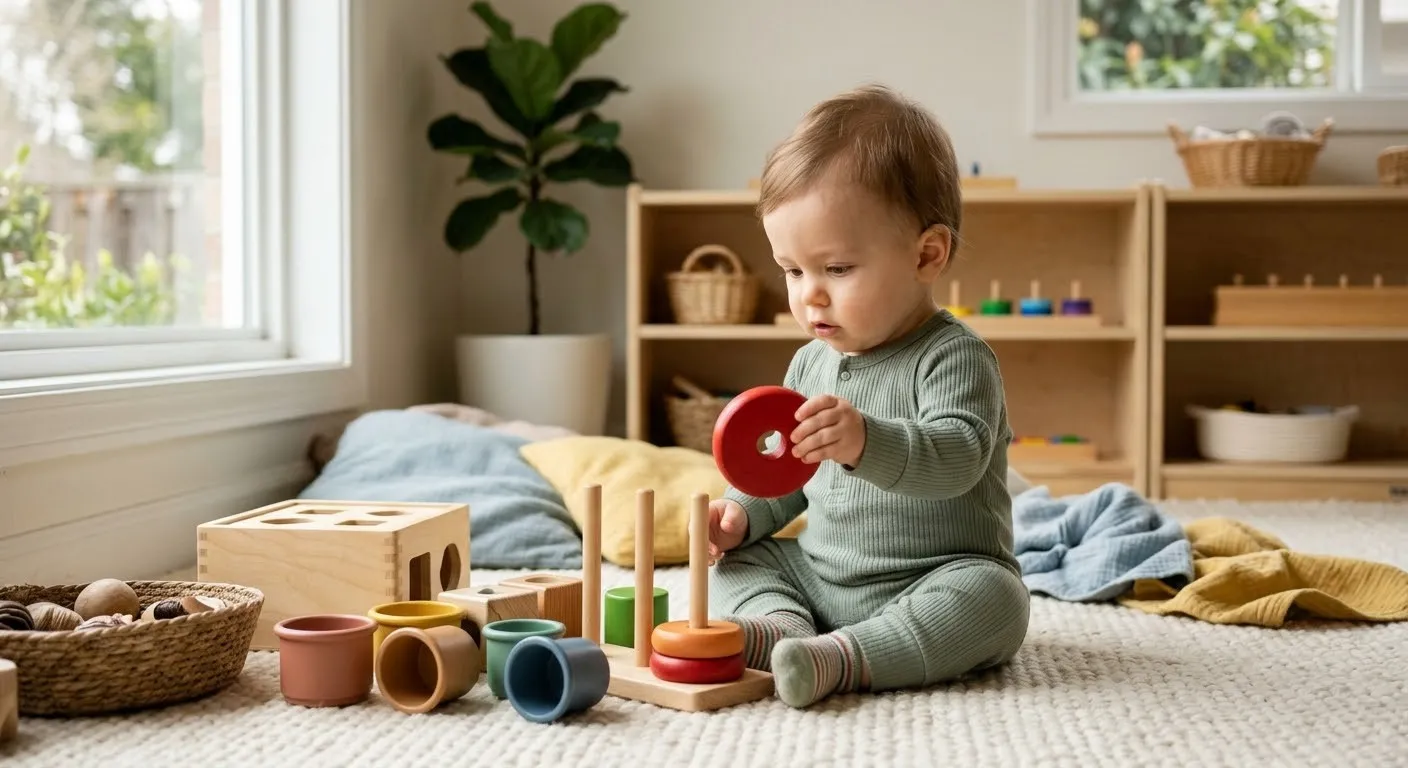
Your two-year-old melts down because you moved her cup to a different spot. Your toddler crouches on the sidewalk, absorbed by a tiny ant. Your son wants the same book read — again — for the fourteenth time. And every time you try to button his coat, he pushes your hands away: “No. Me do it.”
It’s easy to call this stubbornness. But these moments aren’t random. They’re windows — temporary periods when your child’s brain is unusually ready to absorb a specific kind of skill, and their whole being is quietly pushing them toward it.
These are Montessori sensitive periods. Understanding them reframes a whole category of “difficult” behavior as developmental signal — and changes how you respond.
(Note: Some sources list 5 sensitive periods, others 6. We’ll explain why shortly.)
| What are Montessori sensitive periods? Montessori sensitive periods are temporary windows, mostly from birth to age 6, when children are especially ready to develop certain skills with unusual ease and intense repetition. In this guide, we explain all 6 periods, the signs to watch for, and how to support them at home. |
What Are Montessori Sensitive Periods?
A simple definition
A sensitive period is a stretch of time when your child’s brain is turned up high for one particular kind of learning. Absorbing that skill feels almost effortless — the information gets pulled in rather than pushed. Your child is internally driven toward it, will seek it out repeatedly, and feels genuine frustration if prevented.
Outside of a sensitive period, children can still develop the same skills — but it takes more effort and more time.
Where the idea comes from
The concept originated in biology — Dutch scientist Hugo de Vries observed it in animals in the 1800s. Maria Montessori, trained as a physician before becoming an educator, brought it to her observations of children. AMI’s account of Montessori’s foundational observations describes how she watched thousands of children across her schools and noticed the same developmental pattern repeated: intense, self-directed focus toward specific types of activity at predictable age windows.. Watching thousands of children across her schools, she noticed the same pattern: children at certain ages were drawn powerfully and repeatedly toward particular types of activity. She built her entire educational philosophy around responding to it. This observation is the foundation of everything the Montessori method stands for.
Sensitive periods vs. milestones vs. critical periods
- A milestone is an outcome — something a child can now do. A sensitive period is the internal drive that builds toward it. Related, but not the same.
- Critical periods (a neuroscience term) are biologically fixed windows with harder cutoffs. Sensitive periods are more flexible — missing one doesn’t mean a skill is lost forever. It may simply require more conscious effort to develop later.
Are there 5 or 6 sensitive periods?
Both numbers appear in legitimate Montessori literature. The difference comes down to how sources classify small objects (some fold it into sensorial) and social behavior. For practical parent purposes, the 6-period framework is the most complete and the most observable at home:
- Order
- Language
- Movement
- Refinement of the Senses
- Small Objects
- Social Behavior
The number matters less than the practice. Labels are tools for recognizing patterns — age ranges are approximate, overlap is normal, and children are not textbooks.
Why Sensitive Periods Matter
- Learning is easier when the window is open. During a sensitive period, your child’s brain is more receptive — neural pathways form more readily. This is why a toddler picks up new words almost effortlessly while an adult works much harder for far smaller gains. Montessori called this the absorbent mind: the young child’s capacity to take in information deeply and almost unconsciously. This isn’t just Montessori theory. Research by Eric Knudsen at Stanford, published in the Journal of Cognitive Neuroscience, explains exactly why: during a sensitive period, experience shapes the actual architecture of neural circuits — the connections become more stable and energetically preferred. After the period closes, those same circuits can still change, but they require more effortful input to do so. This is the neuroscience behind why a toddler picks up language almost effortlessly while an adult works much harder for far smaller gains. And research published in Frontiers in Developmental Psychology found that adults who experienced Montessori education during these windows showed measurably higher long-term wellbeing outcomes — suggesting the quality of input during sensitive periods has effects that compound over decades.
- Repetition is not boredom. When a child does the same puzzle, pours the same water, reads the same book over and over — they are working. Repetition is how the neural pathway gets laid down firmly. Interrupting it to “offer variety” disrupts the process. When your child returns to the same thing again and again: let them.
- Many “difficult” behaviors are developmental signals. The child who needs sameness is in the sensitive period for order. The child who repeats the same movement endlessly is in the movement period. The child obsessed with tiny details is in small objects or sensorial refinement. The child asking “what’s that?” about everything is in the language period. None of these need correcting. They need understanding.
- Observation matters more than pressure. The adult’s most important job in Montessori isn’t to teach — it’s to observe. To recognize which window is open right now, and prepare an environment that meets the child there. The guiding question is: what is my child trying to construct? — not what do I want them to learn?
Montessori Sensitive Periods Chart: All 6 Windows at a Glance
| Sensitive Period | Typical Age Range | Peak Window | What Parents Notice | Best Support at Home |
|---|---|---|---|---|
| Order | Birth–3 | 18 months–3 years | Upset by changes, insists on sameness, fixed routines | Stable routines, fixed places for objects |
| Language | Birth–6 | Birth–3 (spoken); 3–6 (literacy) | Babbling, naming, “what’s that?”, loves stories | Rich conversation, read aloud daily |
| Movement | Birth–4.5 | 1–3 years | Climbing, carrying, pouring, “me do it” | Practical life tasks, child-sized tools |
| Refinement of the Senses | Birth–5 | 2.5–5 years | Touching everything, sorting, noticing differences | Sensorial activities, nature exploration |
| Small Objects | 1–4 | 1–2.5 years | Fascination with crumbs, bugs, buttons, details | Supervised fine-motor activities |
| Social Behavior | 2.5–6 | 3–6 years | Imitates manners, interested in rules, watches others | Grace and courtesy, modeled routines |
🗓️ Save this chart — Screenshot it now for quick reference, or pin it to your Montessori board. It’s the one thing that helps most when you’re in the middle of a toddler moment and can’t remember which window you’re in.
Share it with your co-parent, nanny, or daycare teacher — the more adults in your child’s life who understand these windows, the more consistent the support.
The 6 Montessori Sensitive Periods Explained in Depth

1. The Sensitive Period for Order
- What it is: More than tidiness — this is your child’s deep need for predictability, sequence, location, and routine as scaffolding for internal mental organization. Your toddler’s brain is building a map of the world. External order is the raw material. When the environment is consistent, the map forms clearly. When it keeps changing, the map keeps getting disrupted. A moved cup isn’t drama — it’s a signal the map is wrong.
| In my 12 years working with families, the order period is the one I see misread most often. Nearly every meltdown over a moved cup, a changed route, or a broken routine gets labelled as “stubborn” or “difficult.” Once parents understand it’s order sensitivity — the child’s map being disrupted — everything shifts. The behaviour doesn’t change immediately, but the parent’s response does. And that changes everything. – Katy Lenoir – AMI Primary (3–6), M.Ed |
- Typical age: Birth to 3. Peaks sharply around 18 months to 3 years.
- What you might notice: Distress when routine changes unexpectedly. Objects must stay in specific places. Insisting on the same cup, chair, route. A particular sequence for getting dressed or going to bed.
- Why it matters: When a child can predict what happens next, they feel safe — and safety is the prerequisite for learning. Routine gives security; consistency feeds cognitive development.
- How to support it: Stable daily rhythms. Consistent places for belongings. Give advance notice when changes are necessary: “Today we’re going a different way.” Involve your child in putting things back.
Activities: Putting-away routines, dressing sequences, snack prep with consistent steps, simple clean-up tasks.
What to avoid: Chaotic, frequently rotating environments. Dismissing distress over routine changes as “oversensitivity.”
2. The Sensitive Period for Language
- What it is: From birth, your baby’s brain is tuned to human language with an acuity that will never be quite this sharp again. This period spans an extraordinary arc — from first coos and babbling, through vocabulary explosion, all the way to reading and writing readiness. It’s one of the longest sensitive periods, running in various forms from birth to age 6.
- Typical age: Birth to 6. Spoken language absorption is strongest in the first three years; literacy interest intensifies from 3–6.
- What you might notice: Staring at your mouth when you speak. Asking “what’s that?” relentlessly. Repeating new words to themselves. Intense love of being read to. Beginning to notice and ask about letters.
- Why it matters: Language is the tool for almost all later learning. The vocabulary, grammar, and love of story absorbed now quietly underpin everything that follows — reading, writing, scientific thinking, social communication.
- How to support it: Talk a lot — narration, description, observation, not just instructions. Use specific words (“sparrow” not just “bird”). Read aloud every day. Sing songs and rhymes. Have real conversations even before your child can fully respond.
- Activities: Object baskets with real items and names, sound games and I-Spy, sandpaper letters, read-aloud rituals, language cards.
- What to avoid: Correcting every grammatical error (interrupts natural acquisition). Passive screen time as a substitute for real conversation — screens can’t respond to a child’s babble or adjust to meet them where they are.
3. The Sensitive Period for Movement
- What it is: In Montessori thinking, movement and intelligence are not separate.
- Typical age: Birth to 4.5. Gross motor acquisition dominates the first 18 months; refinement and coordination is strongest from roughly 1 to 4 years.
- What you might notice: Climbing everything. Carrying objects that are almost too heavy. Repeating the same motion — opening, closing, filling, emptying. A fierce “me do it.” Deep concentration when handling tools.
- Why it matters: Physical competence builds confidence that extends beyond the task itself. A child who can pour their own water and sweep up a mess learns that effort leads to mastery — and that they are capable. That’s not just motor development. That’s a growth mindset forming.. That’s a growth mindset forming.
- How to support it: Give real physical work — not toys that simulate sweeping, but an actual small broom. Not pretend pouring, but a real small pitcher and cup. Practical life tasks are the primary vehicle for movement development.
Activities: Pouring, spooning, tonging, bead threading, food prep, sweeping, dressing frames, walking on a line. “These aren’t just activities — they’re the core of Montessori Practical Life work, which explains why movement and real tasks are developmentally inseparable
- What to avoid: Extended time in passive containers. Doing physical tasks for your child because it’s faster. Treating movement as “just energy.”
4. The Sensitive Period for Refinement of the Senses
- What it is: Young children are sensory scientists, actively working to sharpen their ability to perceive and discriminate — rough vs. smooth, heavy vs. light, dark red vs. pale pink — and to build vocabulary for what they perceive. This is classification work, and it lays cognitive foundations for later abstraction in math, language, and science.
- Typical age: Birth to 5. Conscious refinement is strongest from roughly 2.5 to 5.
- What you might notice: Touching every surface. Sorting objects by color, size, or texture unprompted. Noticing tiny differences adults miss. Stopping to really smell something, really listen.
- Why it matters: The child who discriminates between shades of red is building the same perceptual machinery they’ll later use to distinguish the letter b from d.. Sensorial refinement is a direct precursor to reading.
- How to support it: Fewer, richer experiences beat more, louder ones. Use comparison language: “This blanket is rough. This one is soft. Which feels softer?” Nature is one of the best sensorial environments there is.
Activities: Color matching and grading, texture boards, sound cylinders, smelling jars, tasting activities, nature collections, size and weight comparison.
- What to avoid: Sensory overload — too many materials at once. Assuming all sensory play is automatically Montessori-style sensorial work. The key is comparison and discrimination, not just stimulation.
5. The Sensitive Period for Small Objects
- What it is: Your 18-month-old ignores an elaborate toy and spends ten minutes examining a button. Your toddler studies a dead fly with the focus of a scientist. This is the child’s intense fascination with tiny details — reflecting refined perceptual acuity and an emerging drive for fine motor precision.
- Typical age: Around 1 to 4. Strongest pull in toddlerhood, roughly 12 to 30 months.
- What you might notice: Noticing crumbs, insects, tiny buttons, fine patterns. Wanting to pick up extremely small items. Becoming absorbed in miniatures and details. Returning to tiny parts of the environment that adults overlook entirely.
- Why it matters: Supports visual discrimination (the same skill that later helps distinguish similar letters), pincer grasp and fine motor precision, and the capacity for sustained careful observation — the beginning of scientific thinking.
- How to support it safely: Supervised fine-motor activities with appropriate materials. Trays keep the work contained.
Activities: Bead threading, transferring small objects with tongs or tweezers, sorting stones or buttons, spooning dried beans between containers. This fascination with tiny detail is also where fine motor precision — the grip, pinch, and wrist control that later supports writing — quietly begins.
Period 1 — Order:
Toys that support this period: Stacking toys with a fixed sequence, simple shape sorters, and object permanence boxes all give your child consistent, predictable work — the same action produces the same result, every time.
Period 2 — Language:
Toys that support this period: Personalized Name puzzles are uniquely powerful here — your child sees their own name in letters, traces each piece, and hears the sounds daily.
Period 3 — Movement:
Toys that support this period: Balance boards, push toys, and stacking rings require whole-body coordination and hand control. Kukoo’s balance toys and stacking toys are sized for toddler hands specifically to make the movement challenge real, not just symbolic.
Period 4 — Refinement of the Senses:
Toys that support this period: Sensory toys with varied textures, weights, and sounds give your child material to discriminate — which is the actual cognitive work of this period. One texture isn’t useful; contrast is.
Period 5 — Small Objects:
Toys that support this period: Object permanence boxes, bead threading, and small-piece sorting sets all channel this fascination into purposeful fine motor work.
Period 6 — Social Behavior:
Toys that support this period: Social-emotional toys and kitchen role-play sets give children the material to rehearse courtesy, sharing, and collaborative rules — the social scripts they’re absorbing during this window.
⚠️ Safety note: Always supervise toddlers closely during small-object work. Choose age-appropriate materials and avoid anything that poses a choking risk.
- What to avoid: Dismissing the fascination as “weird.” Interrupting deep concentration just because you don’t find the object interesting.
6. The Sensitive Period for Social Behavior
- What it is: Around age 2.5 to 3, the child who was absorbed in objects begins to look outward. Other people become genuinely interesting. The rules of how people behave together — greetings, turn-taking, fairness, belonging — become an absorbing object of study in themselves.
- Typical age: 2.5 to 6. Unlike earlier periods, this one often grows stronger as the child moves through the preschool years.
- What you might notice: Watching other children very closely. Imitating social rituals — how adults greet each other, how a thank-you is said. Growing concern about fairness and whether rules are being followed. Suddenly caring about belonging.
- Why it matters: This period lays the groundwork for empathy, cooperation, and self-regulation. A child guided through grace and courtesy during this window builds an internal map for social interaction that serves them for life.
- How to support it: Model constantly. Children this age absorb social behavior through watching. Use simple grace and courtesy demonstrations: “When we want someone’s attention, we walk up, say their name, and wait.”
Activities: Snack sharing, table setting, greeting routines, collaborative clean-up, caring for plants or pets, simple role-play around courtesy.
- What to avoid: Forced sharing — it teaches resentment, not generosity. Shaming social mistakes. Expecting fully mature social behavior from a three-year-old. Over-lecturing instead of quietly modeling.
How to Recognize a Sensitive Period in Real Life
Seven signs to watch for:
- Repetition — returning to the same activity again and again
- Intense, almost adult-like concentration
- Strong pull toward one type of activity
- Frustration specifically when that activity is interrupted
- Unusually fast progress in one area
- Self-motivation — seeking the activity without prompting
- Natural loss of interest once mastery is reached
When “behavior problems” may be developmental work: A child who insists on the same bedtime route every night → order period. One who repeats the same pouring motion for twenty minutes → movement period. One who lines up every toy before playing → order or early mathematical patterning. The question isn’t “how do I stop this?” but “what is my child trying to construct?”
The Montessori art of observation: Observe before correcting. Notice what repeats over days, not just moments. Distinguish need from misbehavior — a child who keeps climbing the counter may need more gross motor challenge, not more correction.
| The most valuable thing my AMI training gave me wasn’t a technique — it was permission to just watch. In the first weeks of a new school year, Montessori teachers don’t intervene, don’t redirect, don’t teach. We observe. What does each child repeat? What absorbs them completely? What frustrates them when interrupted? That data tells you which windows are open far more reliably than any age chart — including this one. – Katy Lenoir – AMI Primary (3–6), M.Ed |
Mini observation checklist:
- What is my child repeating right now?
- What frustrates them most when interrupted?
- What do they consistently try to do independently?
- What could I simplify in their environment?
How to Use Sensitive Periods at Home Without Pushing
The risk once parents discover sensitive periods is going too far — turning the house into a Montessori school, buying every material, hovering over every activity. That’s not the idea.
- Step 1: Observe first. Spend a few days noticing what your child is drawn to, what they repeat, what frustrates them. This is your data.
- Step 2: Prepare the environment. Make it easier for your child to access what they’re already drawn to. What that looks like room by room — from the bedroom to the work space — is laid out in our honest guide to Montessori at home If they’re in a movement phase, give them real physical work. If they’re obsessing over small objects, set up a simple tray. You’re opening a door, not teaching a lesson.
- Step 3: Offer, don’t force. Present an activity once, then step back. If they’re not interested today, put it away. A sensitive period can’t be manufactured.
- Step 4: Protect repetition. When your child is deep in repetitive work, resist the urge to redirect or “mix things up.” The repetition is the work.
- Step 5: Rotate based on need, not novelty. Keep the environment limited and purposeful. Rotate materials based on what your child seems to need developmentally — not based on what’s new.
- Step 6: Step back and let mastery unfold. Once you’ve set the environment and protected the work, get out of the way. Let your child experience the satisfaction of mastering something on their own terms.
- What if you miss a sensitive period? Take a breath. It’s not a catastrophe. Learning can still happen after the window closes — it simply requires more deliberate effort. Notice what your child still seems to need and find age-appropriate ways to support it now. The brain stays plastic for a long time.
Montessori Sensitive Periods by Age
- Birth to 12 months: Language absorption, sensory exploration, early movement, and order through rhythm and routine are all active. Talk and sing constantly. Predictable daily rhythms support the order period from the very beginning. Floor time supports early movement.
- 12 to 18 months: Movement explosion, peak small objects interest, early language burst, and a stronger need for order. This is when “me do it” begins — and when a tiny crumb becomes more interesting than any toy. Toys calibrated to this exact window are in our 1-year-old collection — matched to grip size, weight, and what the toddler brain is actively building.
- 18 months to 3 years: Peak order sensitivity, vocabulary explosion, fierce independence, and strong repetition across all domains. The CDC’s developmental milestones for toddlers ages 1–3 reflect many of the same patterns Montessori observed — the emergence of language, the drive for independence, the need for routine — though framed in terms of observable behaviors rather than internal sensitive period windows. Classic toddler behaviors make the most sense through a sensitive period lens. Practical life work is the most powerful support at this age.
- 3 to 4.5 years: Sensorial refinement, fine motor coordination, growing literacy readiness, and early social structure. The child is moving from pure absorption to more deliberate classification. Interest in letters and written language often emerges.
- 4.5 to 6 years: Language refinement and significant literacy development, more structured social behavior, increasing readiness for abstraction, stronger rule awareness. Many children become deeply interested in writing and reading. Collaborative work and real responsibility become important.
Common Misconceptions About Montessori Sensitive Periods
- “Every child goes through them at exactly the same age.” The age ranges are averages, not schedules. Temperament, environment, and individual neurology all play a role. The chart is a map.
- “A tantrum always means bad behavior.” Intense emotional reactions in toddlerhood often reflect a disrupted developmental need, especially around order. Understanding this doesn’t excuse the behavior — it helps you respond with empathy rather than frustration.
- “Missing a period means the skill is lost forever.” Not true. Learning can happen afterward — it simply requires more support. Don’t panic; adjust calmly.
- “More toys means better support.” Often the opposite. A simpler environment with fewer, well-chosen materials supports concentration better than a room overflowing with options.
- “Sensitive periods only matter in Montessori schools.” They happen regardless of school choice or parental knowledge. Understanding them is just as useful — maybe more — at home.
- “If a toy says ‘Montessori,’ it supports a sensitive period.” The label doesn’t make the match. What matters is the fit between your child’s current need and the activity. A bowl of beans and a spoon that meets your child where they are right now is worth more than a beautiful wooden toy that doesn’t. Knowing what actually makes a toy genuinely Montessori-aligned — versus just Montessori-labeled — helps narrow that choice considerably.
The Biggest Mistakes Parents Make
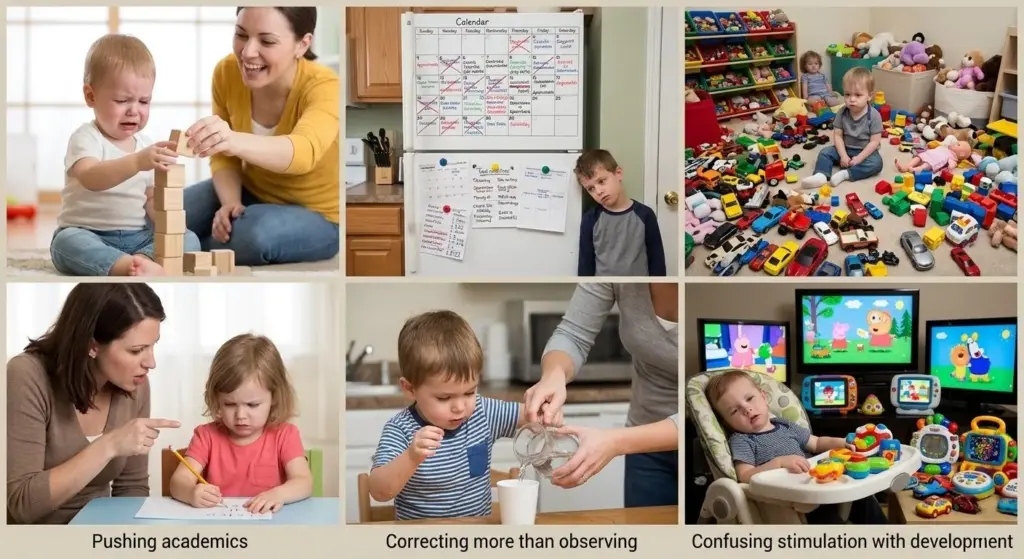
- Interrupting repetition too early. The repetition is the work. Protect it.
- Changing routines too often. Constant novelty is stressful for a child in the order period. Predictability isn’t boring — it’s secure.
- Buying more instead of simplifying. Clearing space often has more impact than adding anything new.
- Pushing academics because a child seems “smart.” A child absorbing language rapidly isn’t necessarily ready for formal instruction. Let the sensitive period work be the foundation first.
- Correcting more than observing. Build the habit of pausing — what’s driving this behavior? — before deciding how to respond.
- Confusing stimulation with development. Entertainment comes from outside. Development comes from within.
Frequently Asked Questions
- What are Montessori sensitive periods in simple terms?
They’re temporary windows in early childhood when a child’s brain is especially ready to learn a certain type of skill — and when the child is internally, almost urgently driven toward it. Think of them as nature’s own curriculum, built into the developmental timeline.
- How many Montessori sensitive periods are there?
Different sources list different numbers, most commonly 5 or 6. In this guide, we work with 6: Order, Language, Movement, Refinement of the Senses, Small Objects, and Social Behavior.
- At what age do sensitive periods begin?
Some begin at birth. The period for language and the period for order, in particular, are active from the very beginning of life. Most sensitive periods are strongest during the first plane of development — birth to age 6.
- Can sensitive periods overlap?
Yes, and they often do. A toddler might be in the heart of the order period and the small objects period simultaneously. This is normal. It’s also why a child’s behavior can seem to pull in multiple directions at once — because developmentally, it is.
- How do I know which sensitive period my child is in?
Observe what your child repeats, what frustrates them when interrupted, and what they seek out on their own. Use the chart and the “signs” descriptions in this guide as a reference. Trust your observations over any rigid timeline.
- Do I need special Montessori materials to support them?
No. Many sensitive period activities can be supported with everyday household items — a pitcher and cups for the movement period, natural objects for sensorial exploration, consistent daily routines for order. Dedicated Montessori materials can be helpful, but they’re not required.
Final Thoughts: Follow the Child
Maria Montessori’s most essential instruction is also the simplest: follow the child.
It asks something genuinely demanding of parents — to set aside what we think children should be doing, and to look carefully at what they are actually doing. To see the repetition and resist the urge to redirect. To see the meltdown over a moved object and think “sensitive period for order” instead of “power struggle.”
Understanding sensitive periods doesn’t make parenting effortless. But it makes it more compassionate. When you can see the developmental logic behind your child’s behavior, you respond differently — with more patience, more curiosity, more trust.
You don’t need to get it perfect. You need to be attentive. Watch your child. Notice the patterns. Simplify where you can. Protect the concentration.
The windows don’t stay open forever. But they’re open right now.