
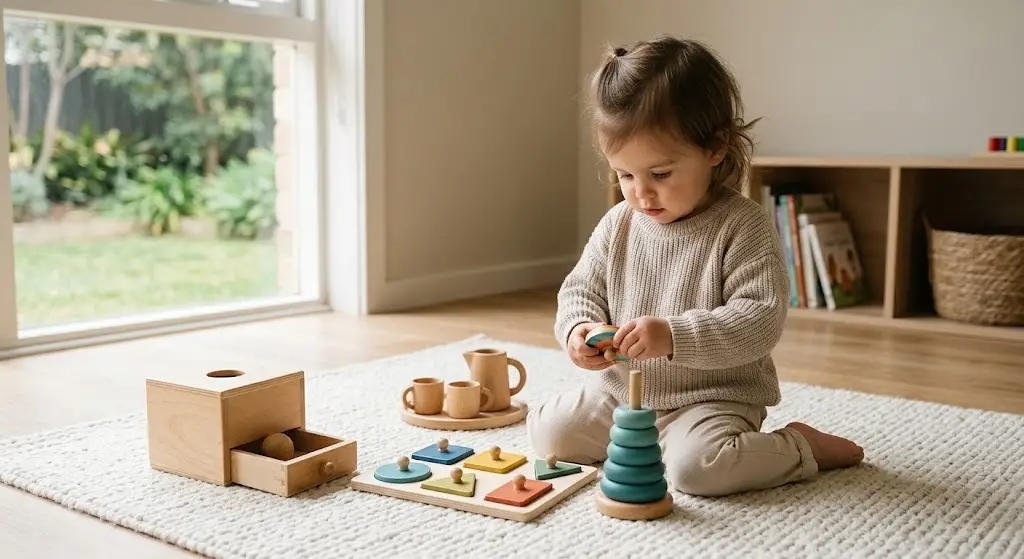
You’re scrolling through Amazon. Every second toy says “Montessori” on the listing. Colorful plastic shape sorters. Battery-operated activity centers. Flashcard sets with electronic voices. All Montessori, apparently.
Here’s the honest truth about Montessori toys that most articles won’t tell you: the word is not legally protected anywhere in the world. Since a 1967 US court ruling made it public domain, any manufacturer can label any product “Montessori” — including ones that directly contradict what the philosophy actually stands for.
This guide explains what the term actually means, the 4 design principles that distinguish genuine Montessori materials from ones that just carry the label, and how to evaluate any toy yourself.
What Are Montessori Toys?
Montessori toys are learning materials designed around Dr. Maria Montessori’s theory of child development — specifically, that children learn most effectively through hands-on, self-directed interaction with their environment. Authentic Montessori toys share 4 design principles: they are self-correcting (the child discovers their own mistake without adult input); they teach one concept at a time (isolation of quality); they require physical handling to produce their developmental effect (embodied learning); and they connect to real-world activities and objects (purposeful reality). Unlike conventional “educational” toys, the Montessori material is designed to be the teacher — no electronic voice, no adult direction required. Important caveat: “Montessori” is not a legally protected term. The label alone guarantees nothing. The 4 principles above are the only reliable test.
Why “Montessori Toy” Can Mean Anything — and What That Means for You
The 1967 Montessori trademark case in the US established that the word had become generic — and that ruling has shaped toy marketing ever since. Today, “Montessori” appears on battery-operated activity centers, multi-sensory electronic learning systems, and plastic busy boards with 20 simultaneous features. None of these would pass the design principles below.
This is not alarming — it’s useful. A parent who understands the 4 genuine design principles can evaluate any toy accurately, whether it carries the Montessori label or not. That’s a better position than trusting packaging.
So what do authentic Montessori materials actually look like? The answer is in the philosophy they came from.
The Philosophy Behind Montessori Toys
Montessori toys are not a product category — they are a physical embodiment of a developmental theory. To understand what they are, you need to understand what they’re based on.
Where the Toys Come From
In 1907, Dr. Maria Montessori gave children in a working-class Rome housing project access to carefully designed materials and freedom to choose their own work. What she observed — deep concentration, voluntary repetition of difficult tasks, spontaneous self-correction — became the foundation of her educational theory.
Her foundational insight: children have an innate drive to develop themselves. Given the right environment and materials, they will teach themselves without external rewards, without adult direction, without entertainment. She called this auto-education. The direct implication for materials: if children teach themselves, then the material must be designed to be the teacher. Every design decision — weight, complexity, the built-in feedback mechanism — matters developmentally. The four planes of development, the absorbent mind, and the sensitive periods are not separate ideas — they are one integrated theory that explains why the same child needs fundamentally different environments at 18 months and at 4 years.
Why Age Matching Matters
Montessori observed that children pass through sensitive periods — developmental windows when specific skills are absorbed with extraordinary ease. A material matched to an active sensitive period produces deep, sustained engagement.. A material outside the window — too advanced or already mastered — produces frustration or indifference.
This is why Montessori materials organized by age are not arbitrary. They map to the specific developmental drives most active at each stage: object permanence at 6–12 months; fine motor refinement at 12–24 months; sensory discrimination at 2–4 years; symbolic and practical life mastery at 3–6 years. Age matters.
The 4 Design Principles That Make a Toy Genuinely Montessori
Authentic Montessori materials share 4 design principles derived directly from the philosophy above. These are what separate a genuine Montessori toy from one that merely carries the label.

Principle 1: Control of Error (Self-Correcting Design)
Every authentic Montessori material has a built-in mechanism by which the child can discover their own mistake — without asking an adult, without being told they’re wrong. The knobbed puzzle piece that fits its hole only one way — or doesn’t fit at all. The stacking tower that falls when built out of size order. The ball drop toy that produces no result if the ball is placed incorrectly.
When a child discovers and corrects their own errors, they develop metacognition, problem-solving, and genuine persistence. Harvard’s framework for executive function development identifies metacognition and self-monitoring as core executive function capacities — built most reliably through experiences where the child receives real feedback from the environment rather than from adult correction. When an adult tells them they’re wrong, they develop dependence on external validation. These are not the same developmental outcomes.
The diagnostic question: “Can this child discover their own mistake without me?” If no — it’s missing the most important Montessori design feature. These self-correcting materials also build the fine motor skills that progress from palmar grasp through tripod grip across the 12 months–4 years window.
Principle 2: Isolation of Quality (One Concept at a Time)
Some Montessori materials are close-ended with one correct outcome, while others are open-ended by design, inviting the child to define both the problem and the solution — and the balance between the two shifts as your child develops. The Pink Tower varies only in size (not color, not shape). The Color Tablets vary only in color (not size). A stacking ring set is Montessori-principled if all rings are the same color and only size varies. The same set in six different colors violates isolation of quality — it teaches neither size nor color discrimination clearly.

The Montessori-washed failure: Busy boards with 20 simultaneous activities. Shape sorters that sort by both color and shape at once. Activity gyms with 8 different stimuli per panel. Each additional variable dilutes the learning of the previous one.
The practical test: what is the one concept this toy teaches? If the answer is “everything,” it’s a red flag.
Principle 3: Embodied Learning (Real Materials, Real Weight)
Montessori learning is grounded in physical interaction with real objects — the hands are the primary instrument of learning in early childhood. A Montessori material must be physically handled to produce its developmental effect. It cannot be watched, listened to, or pressed from a distance.
Why natural materials — primarily wood: real weight activates the proprioceptive system, so the child calibrates grip force to actual mass. Grain texture activates discriminative touch. Temperature response activates thermal discrimination. These are not aesthetic preferences — they are the sensory inputs the embodied learning principle requires. No synthetic material replicates all of them simultaneously. Wood delivers weight that activates the proprioceptive system, grain texture that activates discriminative touch, and acoustic dampening that reduces sensory noise — the material properties that make natural wood developmentally distinct from synthetic alternatives.
The battery test: Any toy that produces its primary developmental output through sounds or lights the child watches or listens to — rather than physically causes and manipulates — is not embodied learning. This eliminates most “educational” electronic toys from authentic Montessori classification. Sensory discrimination — the ability to perceive fine differences in weight, texture, temperature, and sound — is the bridge between physical experience and the abstract thinking that mathematics and reading require.
Principle 4: Purposeful Reality (Connected to Real Life)
Montessori materials connect to real activities and real objects in the world. A miniature watering can that actually waters. A realistic animal figurine, not a cartoon. A pouring set with a real ceramic pitcher. A name puzzle containing the child’s actual name. All have real-world referents.
Montessori observed that children under 6 are in a sensitive period for reality — they learn most deeply from real-world connections. A realistic wooden animal figurine develops vocabulary more durably than a cartoon version because the brain encodes it in the same semantic category as the real animal the child has seen and touched.
What this eliminates: Licensed fantasy characters, purely abstract “educational” manipulatives with no real-world referent, and materials designed around fictional premises rather than real activities. Pouring, sweeping, and food preparation are not supplementary activities — they develop the concentration, sequencing, and hand coordination that all later academic work depends on.
🔍 The 4-Question Test — use this before buying any toy labeled “Montessori”:
1. Can the child discover their own mistake without adult help? (Control of error)
2. Does this toy teach exactly one concept? (Isolation of quality)
3. Does the child have to physically handle it to learn from it? (Embodied learning)
4. Does it connect to a real skill or real-world object? (Purposeful reality)
All 4 yes = authentic Montessori design. Two or more no = Montessori-labeled, not Montessori-designed.
What Montessori Toys Are Not
Understanding what Montessori toys are not is as useful as understanding what they are — particularly because the label now appears on items that actively contradict the design principles above.
Not Electronic
Electronic toys work by activating the brain’s orienting reflex — the involuntary attentional response to novel sound and light stimuli. The AAP’s clinical report on appropriate toy selection specifically notes that electronic features may reduce social engagement and imaginative play — both of which are the developmental outcomes that Montessori materials are designed to cultivate. This is attentional capture, not voluntary concentration. The child is a receiver.
Sosa (2016, JAMA Pediatrics) found that during play with electronic toys, parent-infant interactions included significantly fewer adult words, fewer conversational turns, and fewer parental responses than play with traditional wooden materials or books — across all 26 parent-infant pairs studied. Electronic toys fill the communicative space that parent and child would otherwise inhabit together.
Authentic Montessori materials have no electronic components. The child’s own action is the only source of cause-and-effect. The learning comes from the child’s activity, not the toy’s output.
Not Necessarily Wooden — But Usually
“Montessori” does not mean “wooden.” Natural materials are strongly preferred because they satisfy the embodied learning principle better than any other material — real weight, tactile grain, temperature response, natural scent, and acoustic resonance. A ceramic pouring bowl, a glass bead, a piece of natural fabric: these are all Montessori materials. What matters is the design principles, not the material itself.
The practical reality: Wood is the most common Montessori material because it consistently and simultaneously satisfies all 4 principles. Plastic rarely delivers the proprioceptive and tactile input the embodied learning principle requires. For more on the developmental case for natural materials, see why choose wooden toys at kukoomontessori.com.
Not Multi-Feature
The most common “Montessori-washed” pattern: 20 elements on a single busy board, shape sorters sorting by both color and shape, activity sets with 8 simultaneous features. Every additional feature is a violation of isolation of quality. The Montessori shelf principle: 5–7 materials at a time, each doing one thing. Fewer, better, deeper.
Not Primarily Entertainment
Montessori materials are not designed to entertain. They’re designed to be intrinsically satisfying to master — which is a fundamentally different thing. Entertainment holds attention through novelty and stimulation. Mastery satisfaction is earned through effort, persistence, and genuine achievement. The difference is observable: entertainment toys produce short skimming engagement; mastery-designed materials produce deep, repetitive, voluntary concentration.
| I remember the moment this clicked for me. My daughter had a stacking ring set — wooden, simple, looked Montessori. But each ring was a different color, so she was always choosing by color instead of size. Three months in, she still couldn’t sequence by size. Not because she wasn’t ready — because the toy was presenting two variables at once. We switched to a single-color set. Two weeks later, she was sequencing independently. Same child. One design change. Completely different outcome. – Gloria B. Dombrowski, Kukoo’s customer |
Montessori Toys vs. Conventional Educational Toys
| Feature | Authentic Montessori Toy | Conventional “Educational” Toy |
| Who teaches | The toy (self-correcting design) | Adult or the toy’s electronic voice |
| Learning mechanism | Physical manipulation + self-discovery | Observation + response to toy output |
| Error feedback | Built into the material | External (adult praise, electronic sound) |
| Concept focus | One (isolation of quality) | Often multiple simultaneously |
| Motivation source | Intrinsic (mastery satisfaction) | External (light, sound, approval) |
| Material | Natural, real weight | Often plastic, lightweight |
| Engagement type | Long and deep (child-driven) | Short (novelty-dependent) |
The distinction isn’t material or price — it’s who does the developmental work, the child or the toy, and that single question separates principled design from Montessori-washed marketing.
How to Choose Authentic Montessori Toys by Age

The 4 principles apply at every stage. What changes by age is which sensitive period is most active — which tells you which type of material will produce the deepest engagement right now.
0–12 Months: Visual Development + Object Permanence + Early Grasping
At this stage the brain is building visual discrimination and early cause-and-effect understanding. Materials should produce a clear, predictable response to the child’s action — and should be visually stimulating without being overwhelming.
- Object permanence: a ball disappears into a slot, rolls out the side — cause-and-effect + the understanding that things continue to exist when hidden (the cognitive foundation for separation tolerance)
- Visual contrast materials: high-contrast mobiles designed for the infant’s focal range and developing visual cortex
- Grasping objects: real weight, graspable size, safe for mouthing — the child learns grip force calibration through solid hardwood, not hollow plastic
12–24 Months: Pincer Grasp + Practical Life + First Vocabulary
The pincer grasp emerges around 9–12 months and needs thousands of repetitions to stabilize. Practical life interest peaks. Vocabulary is exploding. Materials should target precise manipulation and real-world connection.
- Knobbed puzzles: each piece requires a 3-finger grip (the same grip used to hold a pencil) — self-correcting, single-concept (shape matching), connects to real vocabulary
- Stacking and nesting: single-variable only (size but not color simultaneously)
- Simple pouring and transfer sets: real consequence (a spill teaches the child about force and angle in a way no instruction can)
| A parent in one of our sessions told me her 14-month-old had been picking up the knobbed letters from her name puzzle and holding each one to her ear — then carefully setting it back down. Twenty minutes at a stretch. Several days running. She wasn’t solving the puzzle. She was connecting each shape to sounds she already recognized. The mother didn’t interrupt. Three weeks later, her daughter was placing every letter back in the correct position independently. That’s a sensitive period in action — and exactly what these materials are designed to support.” — Katy Lenoir, Preschool & Elementary Expert (Ages 3–12) |
2–3 Years: Fine Motor Refinement + Sensory Discrimination + Practical Life Mastery
Children at this age are in the peak of the practical life sensitive period — an intense drive to operate real mechanisms and do what adults do. Materials should meet that drive directly with real tools and graduated challenges.
- Busy boards (personalized, single-element focus): zippers, latches, buckles — each developing one specific hand skill used in real dressing
- Sensorial materials: one variable, perceptible differences, self-correcting — developing the fine sensory discrimination that underlies later academic learning
- Transfer activities: spooning, tonging, pouring — real materials, real consequence, real satisfaction
3–6 Years: Phonological Awareness + Mathematical Foundations + Symbolic Play
The conscious absorbent mind is fully active. Children are ready for materials that bridge sensory experience to abstract concept — letter shapes that connect to sounds; quantities that become symbols; practical life work that becomes genuine household contribution.
- Name puzzles with knobbed letters: tripod grip + first name recognition + letter-sound connection in a single material
- Sensorial math foundations: materials that make quantity physically tangible before the numeral appears
- Cooking and kitchen sets: sequencing, measurement concepts, social language — the richest practical life curriculum available at this age
A Note on Quantity and Safety
5–7 materials on the shelf at a time maximum. More choices produce choice overwhelm. Rotating materials based on observation rather than a fixed schedule ensures each swap serves your child’s current developmental work.
Safety baseline for any material you buy: non-toxic water-based or natural oil finish; solid hardwood (not hollow or MDF); ASTM F963 certification (US) or EN71 (EU/UK). These are not optional.
What Are Montessori Toys? Questions Parents Ask Most
Q: What makes a toy a Montessori toy?
Four design principles make a toy genuinely Montessori: it has a built-in control of error (the child discovers mistakes without adult input); it isolates one concept at a time; it requires physical handling to produce its developmental effect; and it connects to a real-world activity or object. These principles come from Montessori’s developmental philosophy, not from aesthetic choices. “Montessori” on the label guarantees none of them — which is why the principles, not the packaging, are what matter.
Q: What is the difference between Montessori toys and regular toys?
Regular educational toys are designed to deliver content to children — phonics songs, letter recognition through visual and audio input. The child receives. Montessori materials are designed so the child discovers content through their own physical activity — the child investigates. The distinction: educational toys deliver the learning; Montessori materials create the conditions for the child to construct it. Self-constructed learning produces deeper encoding, longer retention, and stronger intrinsic motivation than passive reception — and understanding how open-ended and close-ended materials balance on a Montessori shelf completes the picture.
Q: Do Montessori toys have to be wooden?
No — but wood is by far the most common Montessori material because it satisfies the embodied learning principle better than any other: real weight, tactile grain, temperature response, natural scent, and acoustic resonance. A ceramic pouring bowl, a glass bead, or natural fabric can all be Montessori materials. What matters is the 4 design principles, not the material itself. That said, plastic rarely delivers the proprioceptive and tactile input the embodied learning principle requires — which is why authentic Montessori environments overwhelmingly use wood.
Q: What is an example of a Montessori toy?
Five concrete examples: (1) Object permanence box — ball disappears into slot, emerges at bottom; cause-and-effect plus self-correcting, one concept; (2) Knobbed name puzzle — each letter fits only its position, requires 3-finger grip, connects to child’s real name; (3) Single-variable stacking rings — size only, self-correcting when sequenced incorrectly; (4) Pouring set with ceramic pitcher — real consequence (spills), connects to practical life; (5) Wooden animal figurines — realistic representation for vocabulary development during language sensitive period. Each satisfies all 4 design principles.
Q: Are Montessori toys worth it?
The right question is cost-per-developmental-month, not sticker price. A quality wooden stacking activity relevant from 9 months to 2+ years costs more than a $12 plastic alternative with a 6-week engagement window. Durable wooden materials can also be passed to siblings. Beyond economics: PNAS 2025 (Lillard et al.) found that authentic Montessori environments produced significantly better outcomes in reading, memory, executive function, and social understanding at kindergarten — the materials are the mechanism.
Q: What age are Montessori toys for?
Montessori toys span birth through age 12 and beyond, but the 0–6 window matters most because it corresponds to the Absorbent Mind — the period of fastest developmental change and greatest sensitivity to environmental input. Within 0–6: language sensitive period (birth–6); order (1–3); movement (birth–4.5); fine motor and small objects (~18 months–3 years); sensory refinement (birth–4.5). A well-chosen material matches the specific sensitive period most active at the child’s current stage — not a broad age range on a box.
Q: How are Montessori toys different from educational toys?
Most educational toys are designed by adults to transmit educational content to children. The child is a recipient. Montessori materials are designed so the child discovers educational content through their own hands-on activity. The educational toy delivers the learning; the Montessori material creates the conditions for the child to construct it. Auto-education — the child’s innate capacity to teach themselves given appropriate materials — is the design goal. External delivery of knowledge is not.
Now You Know What to Look For
The toy aisle hasn’t changed. “Montessori” is still everywhere. But you now have a framework — 4 principles, 4 questions — that makes the label irrelevant. You can evaluate any toy yourself.
The single most useful thing to remember: the question is not “does this say Montessori?” It’s “does this toy require my child to do the developmental work — or does it do the work for them?”
And one honest note: many wonderful Montessori-principled materials don’t carry the label at all. A real ceramic bowl and a wooden spoon for pouring practice. A basket of natural objects for sorting. A solid heavy wooden block. These are Montessori materials. The philosophy is about design, not branding.
If you want to start with materials designed around these 4 principles — solid hardwood, non-toxic finishes, each built around one developmental concept — explore our Montessori toys by age today!