
You’ve asked twice. Your 2-year-old still doesn’t have their shoes on — so you reach down and put them on yourself.
Full meltdown. Not because the shoes are wrong. Because you put them on. You just took the most important job in the world away from a 2-year-old.
The “terrible twos” aren’t a behavior problem. They’re the loudest developmental signal a toddler can send: I am ready to do real things, with my own two hands. Montessori’s entire approach to this age is built on one response: here is your work.
This guide covers every Montessori activity for 2-year-olds across the full 24–36 month window — split into three brackets, because the child who just turned 2 and the child nearly 3 are completely different people developmentally.
| Montessori activities for 2-year-olds are hands-on, independence-building tasks — water pouring, food preparation, threading, sorting, scissors work, and naming activities — matched to the child’s rapidly evolving sensitive periods across the 24–36 month window. This phase is defined by the autonomy drive (“me do it”), the peak of the sensitive period for order, and the vocabulary explosion — making it the most productive and most challenging age for Montessori work at home. |
Three Brackets, Three Different Children
24–27 Months — The Autonomy Peak
“Me do it” drive at maximum intensity. Sensitive period for order still active. Bilateral coordination established. Three-jaw chuck fully functional. 50–200 word vocabulary; first two-word combinations. The CDC’s developmental milestones for 2-year-olds confirm what parents at this stage already sense: the 50–200 word vocabulary range and first two-word combinations aren’t just language growth — they signal that your child’s cognitive readiness for complex, sequenced activities has arrived. The activities in this bracket are designed around exactly that window. This child needs activities they can complete ENTIRELY independently from start to finish. Any mid-work adult involvement triggers resistance.
27–30 Months — The Language Explosion
Vocabulary growing at 5–10 new words per day. First 3-word sentences. “Why?” questions beginning. Wrist dissociation emerging (first tripod precursor). Can follow 2-step instructions for activity presentation. Can maintain focus 15–20 minutes on chosen work. The Three-Period Lesson now reliably reaches Period 3 for most children — meaning your child can retrieve object names independently, not just recognize them when prompted.
30–36 Months — Pre-Normalization
Concentration windows extending to 20–25 minutes. First signs of normalization — long, uninterrupted work cycles. First signs of normalization in Montessori environments appear at this stage — long, uninterrupted work cycles where the child chooses, completes, and resets their own activity without adult direction. AMI describes this as the clearest indicator that the child’s environment is correctly prepared. Pre-tripod grip appearing. Associative play beginning. Pre-literacy awareness starting. This child is becoming independent, purposeful, and self-correcting. The 3-year-old who enters a Montessori classroom already normalized starts from a place of extraordinary readiness.
The Montessori Approach to the Autonomy Crisis
The “terrible twos” is not a phase to endure. It’s a developmental milestone to channel.
What the Autonomy Crisis Actually Is
At 24–30 months, the child’s developing sense of self crystallizes around independence — they are separate from the parent, capable of action, and desperate to prove it. Every “no” to a self-initiated action feels like an attack on their developing identity. This is not defiance. It’s the sensitive period for independence asserting itself — the same drive Montessori designed her entire practical life curriculum to channel.
Three Activity Principles That Reduce Tantrums
1. Activities that produce a real, visible outcome — the child who sweeps crumbs and sees them gone experiences genuine competence. Competence reduces the desperation behind tantrums.
2. Activities they can start and finish without adult intervention — when the child controls the beginning and end, the “me do it” drive is satisfied by design.
3. Activities at the edge of their current ability — the frustration threshold is narrow. An activity 2 weeks too advanced produces more tantrums, not fewer.
Readiness Signals for This Age
✅ Green light: Sustained engagement >2 minutes; deliberate, careful movement; watches demonstration to completion; attempts the activity again after initial failure.
🔴 Red light: Throws materials immediately; leaves every activity in <30 seconds across 3 days; cries when outcome isn’t instant — activity is 3–4 weeks early.
🏁 Mastery: Completes full work cycle without looking to adult; returns independently without prompt.
Montessori Activities — 24–27 Months
The newly 2-year-old wants to do everything — and can do more than most parents realize. Every activity here can be completed without adult involvement once correctly presented.
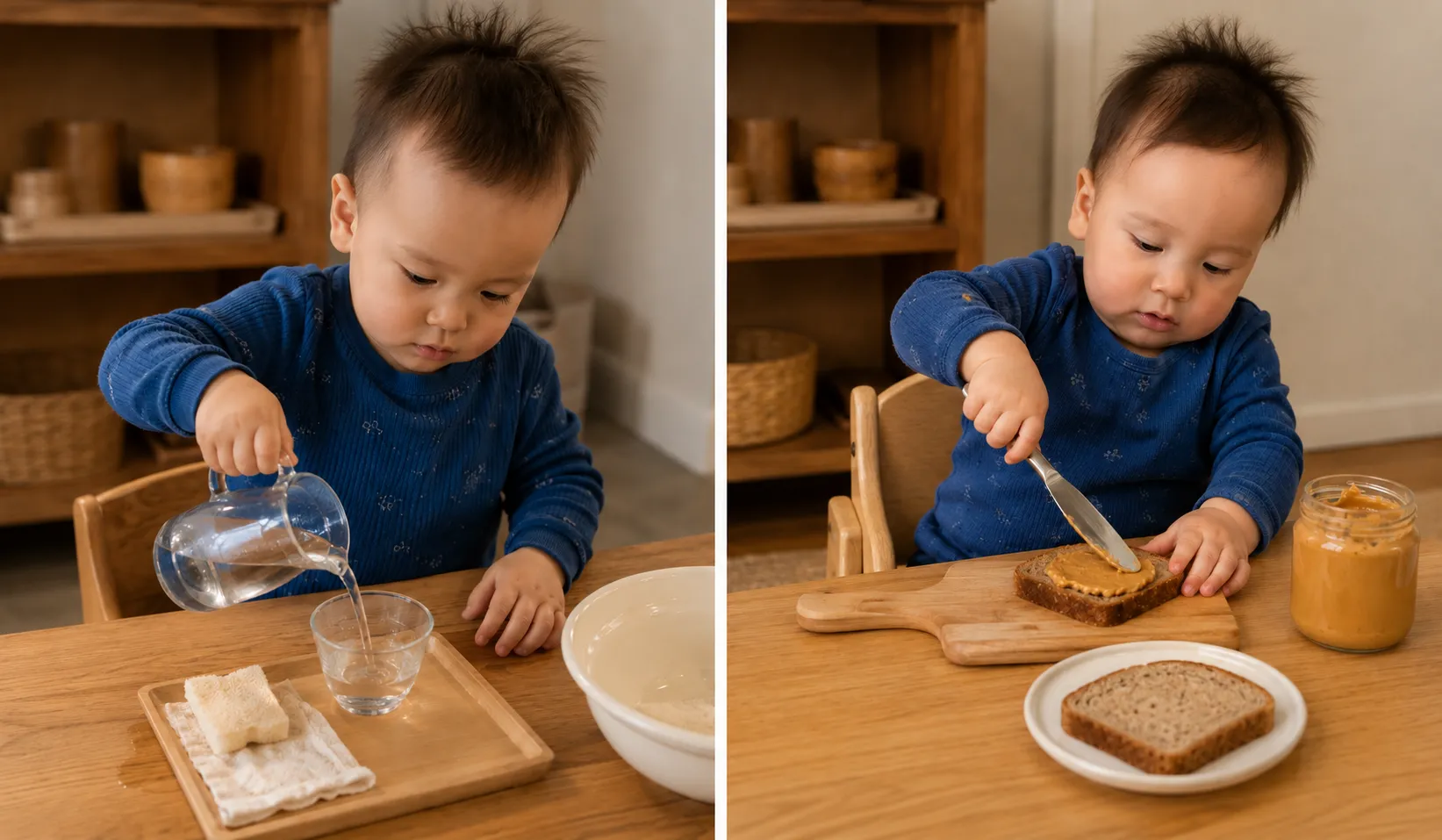
Advanced Water Pouring
- What it develops: Wrist rotation (advanced), bilateral coordination, concentration, care of environment. Upgrade from 18mo version: smaller pitchers, thinner spout (demands more wrist control), cloth folded intentionally on tray (child learns unfold/refold as part of the work cycle). Demonstrate once. Spills are the control of error.
Dressing Board — Zipper + Button Progression (HowTo)
- What it develops: Care of self, bilateral coordination, fine motor precision, concentration. Setup: 30 seconds.
1. Place dressing board at child’s table height.
2. Sit beside child at their level — not behind them.
3. For zipper: grip both sides; align the bottom slowly; slide pull upward in one continuous motion — do not narrate.
4. Open the zipper in the same deliberate manner.
5. Repeat the full open-close cycle one more time without speaking.
6. Place child’s hands near the board (not on it) and step back.
7. Observe — if child struggles with alignment, do not assist; let them discover the mechanism.
8. When zipper is mastered (completes without looking at adult): introduce large button.
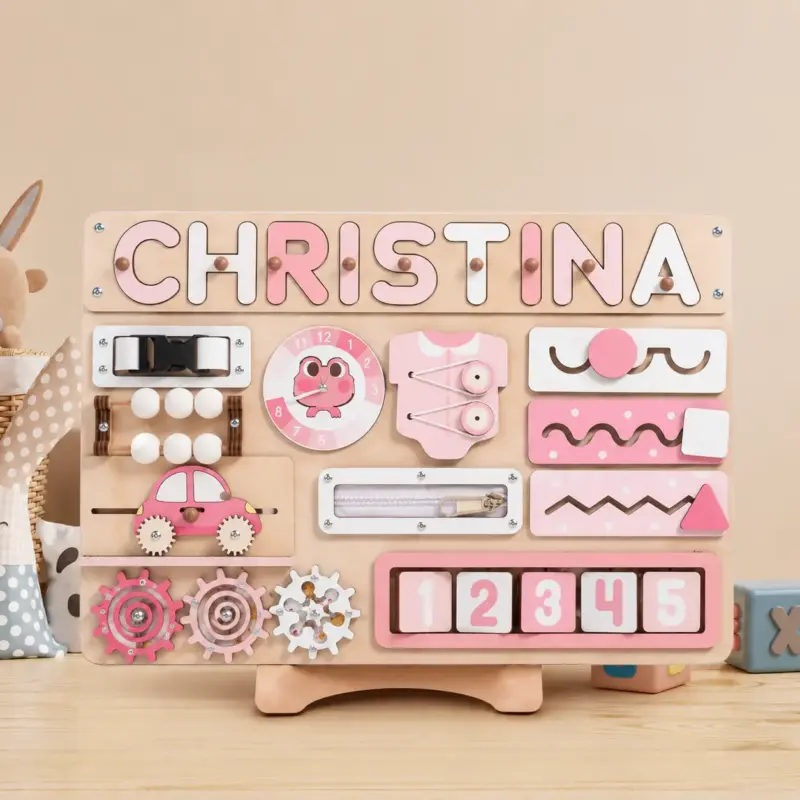
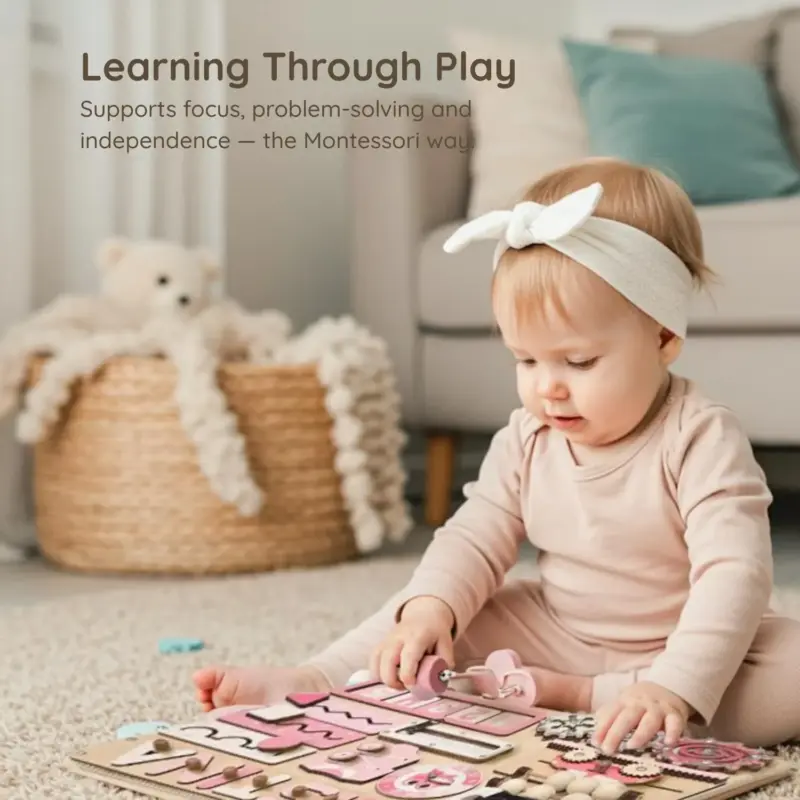
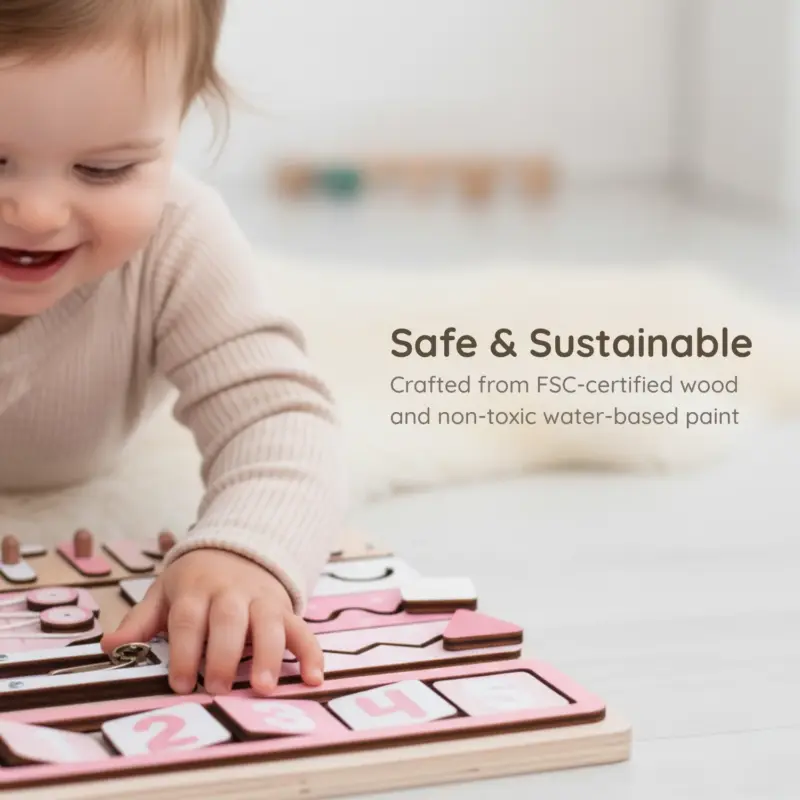

Dress Up Day – Wooden Montessori Busy Board
Color Sorting — 3 Categories
- What it develops: Visual discrimination, classification, vocabulary (color names). From 18mo: was 2 colors. Now: 3 colors, 9 objects, 3 containers. Three-Period Lesson integration: “These are all red.” Shuffle. “Show me red.” Then: “What color is this?” Period 3 now appropriate for primary colors.
Snipping Paper — First Scissors
- What it develops: Bilateral coordination, hand strength, wrist dissociation, cause-effect. Materials: child-safe real scissors with spring mechanism (not toy scissors), 1cm × 10cm paper strips, small bowl. Present: hold strip taut, make single snip — piece falls into bowl. Repeat twice. Offer scissors. Real scissors only — toy scissors that don’t cut produce frustration and no skill.

Object-to-Picture Matching — Advanced
- What it develops: Symbolic abstraction, pre-literacy, vocabulary precision. Progress sequence: real object → photo card → realistic illustration → name card (word only). This final step is early reading readiness.
Montessori Activities — 27–30 Months
The language explosion is in full force — this child is absorbing 5–10 new words a day and actively seeking names for everything. Activities that feed vocabulary while developing fine motor precision hit the developmental sweet spot.
Threading — Thick Cord to Lace (HowTo)
- What it develops: Bilateral coordination and pincer refinement — both direct precursors to pre-writing readiness — alongside precision placement and sustained concentration. Setup: 3 minutes.
1. Place tray with 8–10 large wooden beads and stiff cord on low table.
2. Sit beside child at their level.
3. Hold cord at end with dominant hand; pick up one bead with non-dominant hand.
4. Guide cord end through bead hole — slowly, watching both hands work.
5. Pull cord through until bead is threaded; slide bead toward cord’s end.
6. Thread a second bead in the same deliberate manner.
7. Place cord and remaining beads on tray; slide toward child; step back.
8. If child struggles to find the hole: wait 30 seconds. Say “try again” — not “let me show you.”
Progression: Stiff cord → soft lace → thinner cord → needle-and-thread (age 4+).

Advanced Vocabulary Baskets — Period 3
- What it develops: Expressive vocabulary, scientific naming, classification. From 15mo: was 3 objects, Period 1–2 only. Now: 5 objects, full Three-Period Lesson. Themes: tools, ocean animals, musical instruments. “What is this?” can be asked with confidence if Period 2 was solid.
Food Preparation — Spreading
- What it develops: Wrist rotation + pressure calibration, bilateral coordination, practical life (contributing to own meal). Child-safe Montessori kitchen tools — a spreading knife, soft food (hummus or cream cheese), a bread slice.. Show wrist angle for one slow stroke. Child eats what they prepare — Montessori’s most powerful principle at this age: the real consequence of real work.
Flower Arranging — Full 5-Step Sequence
- What it develops: Care of environment, sequencing, bilateral coordination, concentration (longest work cycle for this bracket). 5-step cycle: fill vase from pitcher → trim stems → arrange flowers → wipe water droplets → return materials. Montessori specifically included flower arranging because it combines aesthetic development, precision, and a 5-step sequence. A 28-month-old completing this independently is demonstrating early normalization — and, according to research on executive function development, the kind of sustained, self-directed sequencing this activity demands is precisely how attention regulation and working memory are built in the first years of life.
Name Puzzle (No-Peg) — Introduction
- What it develops: Pre-literacy, identity, fine motor (edge-pinch grip = tripod precursor), Three-Period Lesson for letters. No-peg version appropriate at 27–30mo as tripod pre-grip begins. The benefits of a name puzzle go deeper than letters — the child’s own name is the most motivating first reading material they’ll encounter.
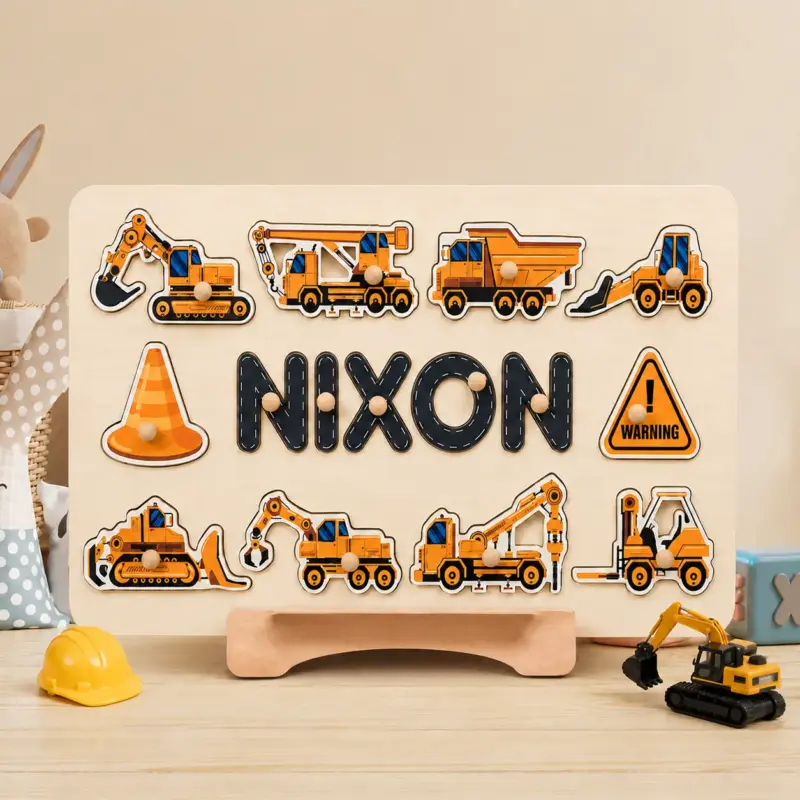
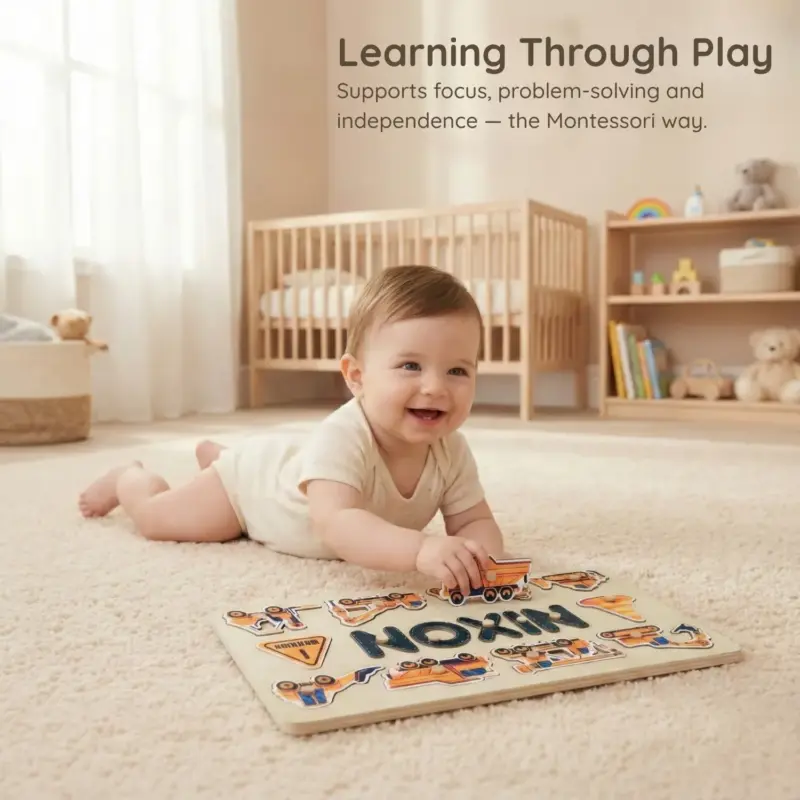
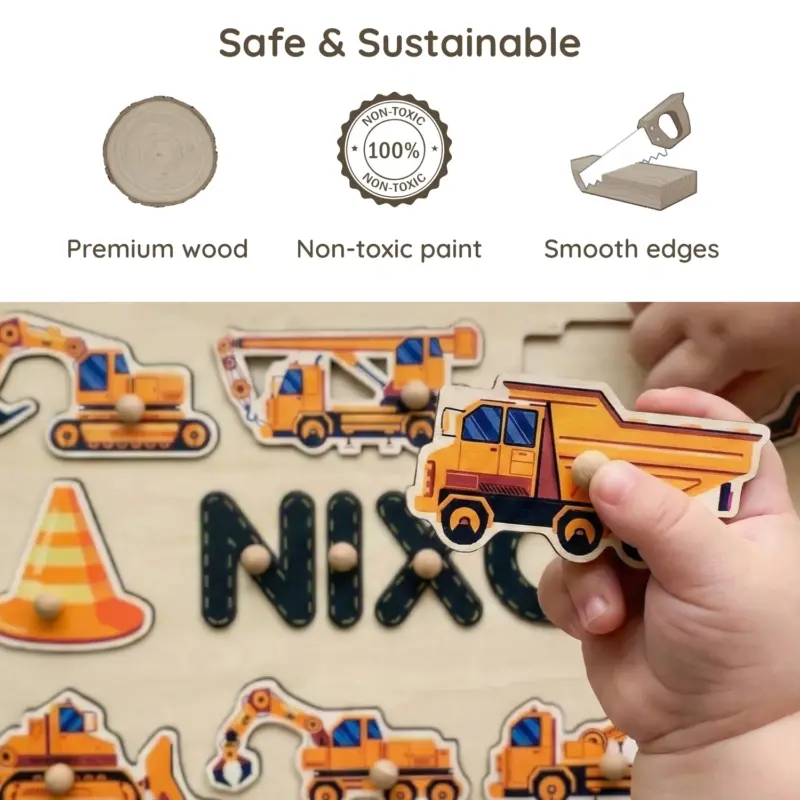


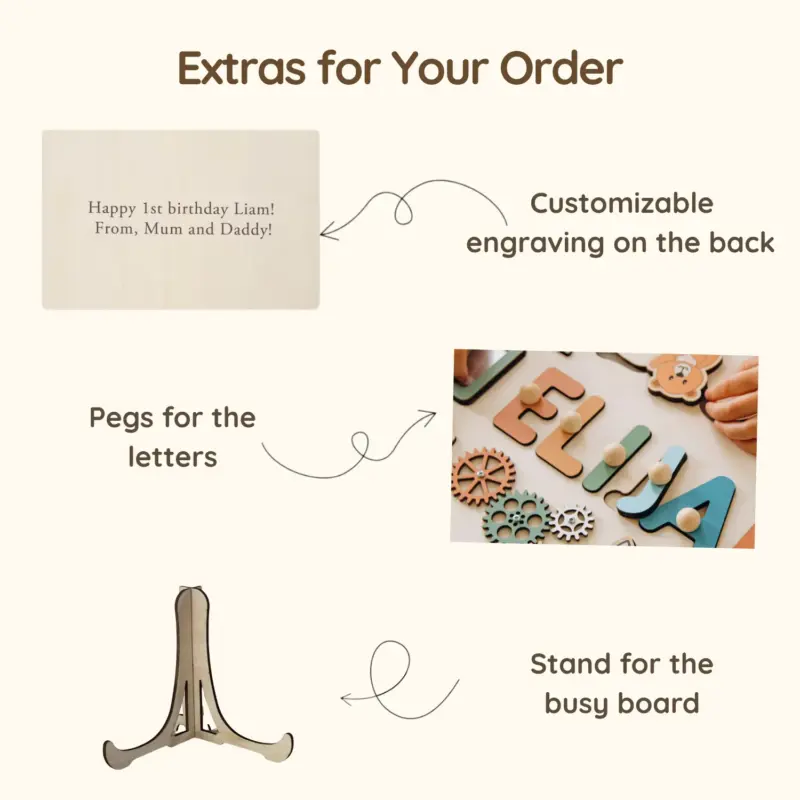
Construction Theme – Wooden Montessori Name Puzzle
Montessori Activities — 30–36 Months
The 30–36 month child is on the threshold of normalization — calm, purposeful, self-directing engagement. Activities here reflect longer sequences, more precision, first grace and courtesy, and early academic bridge materials.
Lacing Board — Full Work Cycle (HowTo)
What it develops: Bilateral coordination (mature), in-hand manipulation, wrist rotation, pre-writing preparation. Setup: 2 minutes.
1. Place lacing board flat on table; seat child at their level.
2. Thread cord through first hole from front to back — hold board steady with non-dominant hand.
3. Bring cord around edge to adjacent hole; thread back through — show over-under pattern.
4. Continue for 3–4 holes without narrating — let the visual pattern carry the instruction.
5. Pull cord taut at each step to show tension.
6. Place board in front of child; offer cord end; step back 3 feet.
7. Do not correct direction or pattern — the board itself is the control of error.

Advanced Sorting — 3 Attributes
- What it develops: Logic, mathematical thinking, visual discrimination. From 24mo: was 1 attribute. Now: 3 simultaneous attributes. Example: 18 objects — 3 colors × 3 sizes × 2 shapes. No demonstration needed — place materials and observe. The child’s sorting sequence reveals their current categorization logic.
Grace and Courtesy — Table Setting
- What it develops: Social awareness, care of environment, sequencing, spatial reasoning. Placemat with outlined positions (plate circle, cup circle, fork and knife lines). Name each position once. Place each item. Invite child to do the same at every meal. Sensitive period for order fading + social awareness emerging = optimal Grace and Courtesy window.
Pictorial Recipe — First Food Sequence
- What it develops: Sequential thinking (first, then, last), pre-reading (left-to-right), practical life, independence. 3-step visual recipe card for a simple preparation. Prepares for the 3-year-old cooking curriculum and mathematical sequencing.
Cutting — Curved Lines
- What it develops: Visual-motor integration, sustained concentration, hand strength, bilateral maturity. From 24mo: was straight snipping. Now: curved lines drawn on paper, then simple square outlines. Progress: straight strip → curved line → large square → circle (age 3+).
The 5 Mistakes Parents Make With Montessori Activities for 2-Year-Olds
- Mistake 1 — Choosing activities to keep them busy, not challenge them. Offering 18-month-level activities to a 28-month-old because they’re easier to set up produces chronic boredom expressed as behavior incidents. Fix: if the child completes every activity in under 2 minutes, every activity is behind their readiness.
- Mistake 2 — Offering help before frustration becomes educational. The child should experience 60–90 seconds of genuine challenge before support is considered. Most adults intervene in under 10 seconds. Fix: mental timer of 90 seconds. That’s the development window.
- Mistake 3 — Allowing too many transitions without completing the work cycle. A child who starts threading, abandons to pour, abandons to puzzle — never builds concentration. Fix: “Let’s finish and put the tray away before starting the next one.” Consistent application produces concentration within 2–3 weeks.
- Mistake 4 — Correcting the end product instead of resetting the beginning. Telling a 2-year-old their arrangement is “wrong” collapses intrinsic motivation. Fix: if control of error is built in, say nothing. If not, reset quietly and invite them to begin again.
- Mistake 5 — Using the activity as screen replacement. “Here, do your Montessori tray” as substitute for screen time works for 3 days, then the tray becomes associated with parental absence. The prepared environment sustains engagement; your warm presence during first presentation sustains the relationship with the work.
Is My 2-Year-Old Ready for Preschool? What These Activities Build Toward
These activities are not preparation for preschool. They ARE preschool — Montessori’s primary curriculum begins with everything listed above. But for parents wondering:
| Activity Now | Skill Being Built | What It Enables at 3–6 |
| Dressing board (all fasteners) | Bilateral fine motor + independence | Full dressing independence by age 3 |
| Lacing board | Pre-writing wrist control + bilateral | Scissors, sewing, writing preparation |
| Name puzzle (no-peg) | Tripod pre-grip + letter discrimination | Sandpaper letters, moveable alphabet, pre-reading |
| Vocabulary baskets (Period 3) | Receptive → expressive vocabulary | Nomenclature cards, classification |
| Flower arranging (5-step) | Long work cycle + care of environment | Classroom work cycles; multi-step practical life |
| Table setting | Social contribution + sequencing | Classroom community; mathematical ordering |
Every skill in this table connects to a specific position in the developmental arc from birth through age 6 — and the 2-year-old’s autonomy work is the bridge between the motor foundations of year 1 and the conscious learning that begins at 3.
The practical life curriculum that builds directly from this stage — rotation schedule, tray sequencing, room-by-room setup — follows the same progression your 2-year-old is already moving through.
Your Questions Answered
What Montessori activities are best for a 2-year-old?
Practical life tasks with real, visible outcomes: water pouring, food preparation, dressing frames, sweeping, flower arranging. Fine motor activities — threading, lacing boards, scissors work — bridge practical life to pre-academic readiness. The exact activities depend on the sub-bracket: 24–27, 27–30, and 30–36 months each have different readiness levels.
How do Montessori activities help with the “terrible twos”?
The autonomy crisis is driven by the child’s intense need to act independently. Montessori activities address this by providing real, completable work that satisfies the independence drive before conflict arises. A child absorbed in threading beads or arranging flowers has channeled their autonomy drive into purposeful work. Tantrums diminish not through discipline but through activity.
How long should a 2-year-old focus on a Montessori activity?
At 24 months, 5–10 minutes of focused work is appropriate. By 30 months, 15–20 minutes. By 36 months, some children demonstrate 20–25 minute concentration windows — normalization. Do not interrupt this concentration to praise, redirect, or transition.
When should I introduce scissors?
Real spring-loaded scissors at 24–27 months for most children, starting with snipping 1cm paper strips. Real scissors, not toy — toy scissors that don’t cut produce frustration without skill. Spring-loaded ones that open automatically after each cut are ideal. Two-hand technique is normal at this age; single-hand typically emerges around 3.
What about a 2-year-old who refuses all activities?
Usually signals wrong difficulty level (too easy = boredom, not resistance), too many options (reduce to 3–4 trays), or insufficient gross motor movement earlier in the day. Try reducing the shelf, confirming at least one practical life task with a real physical outcome, and ensuring 30–40 minutes of gross motor before fine motor work. If refusal persists 2 weeks, clear the shelf entirely and reintroduce one activity at a time.
One Activity. One Bracket. One Step Back.
The 2-year-old’s “terrible” phase is, from the Montessori view, the most hopeful moment in early childhood. That intensity — the “me do it,” the resistance, the fierce ownership — is not a problem to manage. It’s a drive to channel. Every activity in this guide is an answer to the same demand: I am capable. Let me prove it.
Find your child’s bracket. Pick one activity. Set it up correctly. Present it once, slowly. Step back completely — that last part is harder than it sounds, and it matters most.
If your child is moving faster than the bracket suggests — the activities matched to the 3-year-old’s conscious mind are the natural next step.
When you’re ready to equip the shelf, wooden toys built for the 24–36 month window — activity boards, name puzzles, and threading sets — are designed around exactly the skills in this guide.