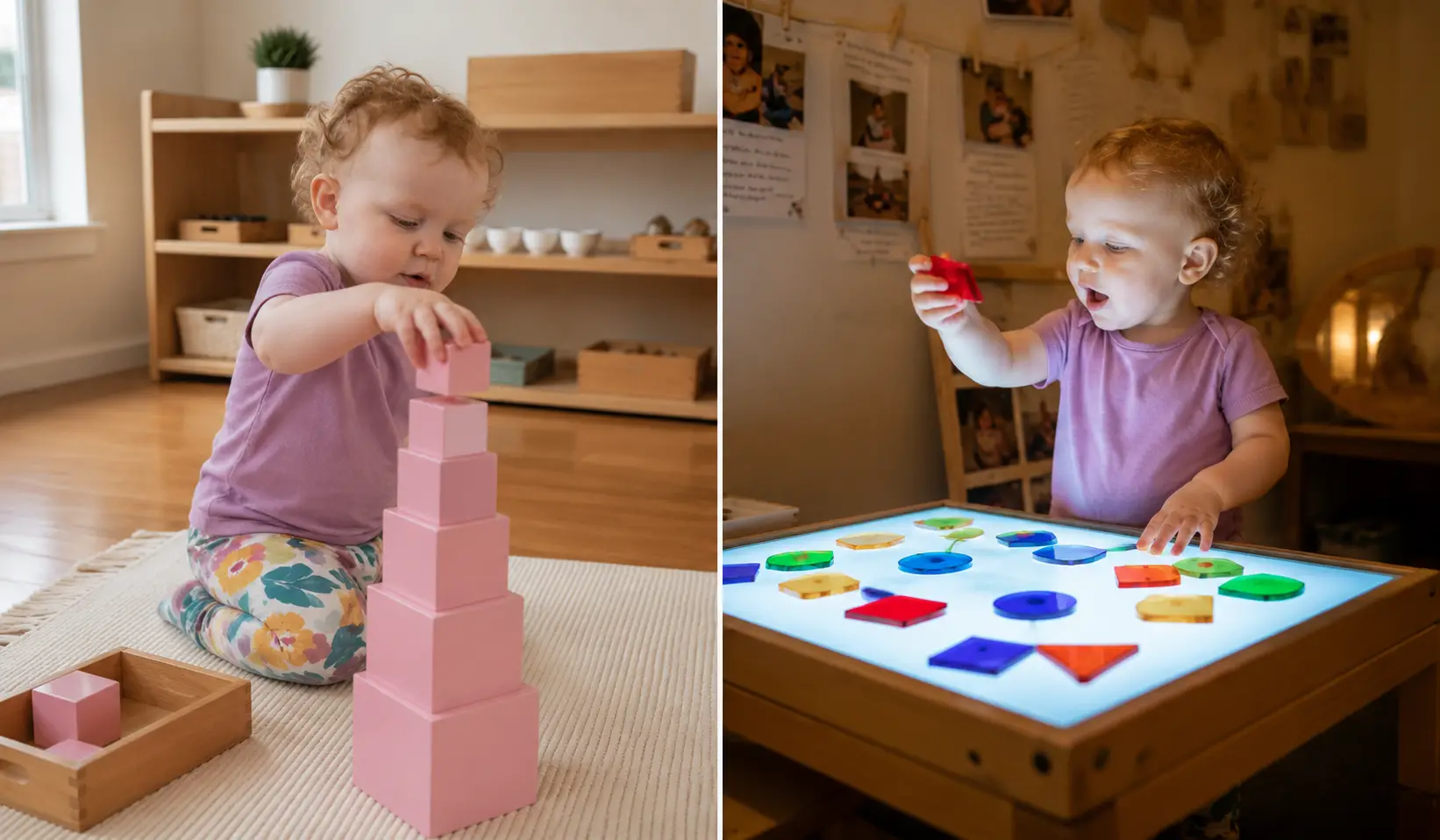
A parent visits a Reggio Emilia classroom and comes home describing beautiful light tables, children absorbed in clay sculptures, walls covered in documented learning. The next day they visit a Montessori classroom and describe an orderly room, children choosing their own work, a teacher who barely intervenes, and the quietest focused atmosphere they’ve ever seen. Both feel profoundly right. They look completely different. And the parent needs to choose.
These are not two flavors of the same thing. Montessori and Reggio Emilia share a surface vocabulary — child-centered, hands-on, respectful — but under that vocabulary are different assumptions about curriculum, evidence, verifiability, and what it means to “follow the child.”
How do Montessori vs Reggio Emilia compare?
Both are Italian-origin, child-centered philosophies that reject teacher-led instruction — but they differ fundamentally in curriculum structure (Montessori uses a defined sequence; Reggio uses emergent curriculum driven by children’s questions), teacher role (Montessori observes and guides; Reggio documents and co-investigates), and verifiability (Montessori has AMI/AMS certification; Reggio has no official certification, meaning any school can use the name without training).
| Dimension | Montessori | Reggio Emilia |
| Curriculum | Defined sequence of materials | Emergent — follows children’s interests |
| Teacher role | Observer and guide; steps back | Co-investigator and documenter |
| Age range | Birth–18 (full span) | Primarily birth–6 (nido + preschool) |
| Certification | AMI and AMS certification exists | No official certification |
| Research evidence | Substantial peer-reviewed base | Very limited peer-reviewed research |
| Community role | Parent partnership; child-centered | Community co-construction of learning |
| Home replicability | High — materials + behaviors | Lower — school environment is central |
The Origins — Two Italian Approaches, Two Different Catalysts
- Maria Montessori (1907): Italian physician and scientist who observed children in Rome’s poorest district. Core conviction: every child contains an inner capacity for development that the right environment can unlock. How Montessori translated that conviction into a replicable system of materials and practices is what separates her method from every other child-centered philosophy of the same era — including Reggio. Method: empirical, systematically observed, material-specific, globally replicable through teacher training. Result: a defined curriculum with specific materials, presented in a specific sequence, that can be taught and verified. The core principles and five curriculum areas Montessori built from those observations — from the prepared environment to practical life — are covered in full for parents who want the complete framework.
- Loris Malaguzzi and the city of Reggio Emilia (1945–1960s): Not founded by an individual — built collectively by a community. After World War II, parents in the bombed-out northern Italian city began building schools alongside educators, led by local teacher Loris Malaguzzi. Core conviction: children are competent, powerful, and full of potential; learning emerges from their relationships with others and their environment. Method: relational, emergent, documentation-based, and not replicable in the same way — each environment is shaped by its specific community. Result: an approach, not a curriculum — flexible, locally contextual, and intentionally uncertifiable.
The practical implication: Montessori can be standardized, certified, and measured. Reggio Emilia, by design, cannot — and its founders considered this a feature rather than a limitation.
The Two Concepts That Define Reggio — And That Nobody Explains
Two concepts are central to understanding Reggio Emilia in practice — and both are frequently mentioned and rarely explained in comparison guides.
The Hundred Languages of Children
Loris Malaguzzi’s concept holds that children have not one but one hundred ways of knowing and expressing: through clay, movement, light and shadow, dramatic play, music, drawing, mathematics, silence. The school’s role is to make all hundred languages visible and valued, rather than privileging written text and spoken answer. In practice: a child investigating a puddle might express that investigation through painting, physical re-enactment, dictated questions, and a clay model — all in the same project. Compared to Montessori: Montessori also values multi-modal learning (sensorial, tactile, kinesthetic), but its materials are specific to one quality at a time (isolation of quality), and the sequence is defined. Reggio’s hundred languages are deliberately un-sequenced and un-bounded.
Pedagogical Documentation
Reggio’s core practice: teachers observe, photograph, record, transcribe, and display children’s learning — not to evaluate, but to make the learning process visible to children, families, and teachers themselves. The documentation becomes a tool for planning, for community communication, and for the child’s own reflection. Reggio classrooms are typically filled with children’s work on the walls, annotated records of conversations, photographs of the process — not just the product. Compared to Montessori: Montessori teachers also observe and record developmental progress, but Montessori documentation is primarily internal (the teacher’s record of what to present next), while Reggio documentation is public, relational, and reflexive.
| In my work as an infant and toddler specialist, I’ve observed both Montessori nido environments and Reggio-inspired settings for very young children. The philosophical differences become most visible and most consequential in the 0–3 years — precisely the period most comparison guides overlook entirely. My goal here is what parents actually need: honesty, nuance, and the specific information that helps you make a decision for your child.— Zoe Paul, AMI Teacher Trainer (0-3) |
7 Dimensions — A Systematic Comparison
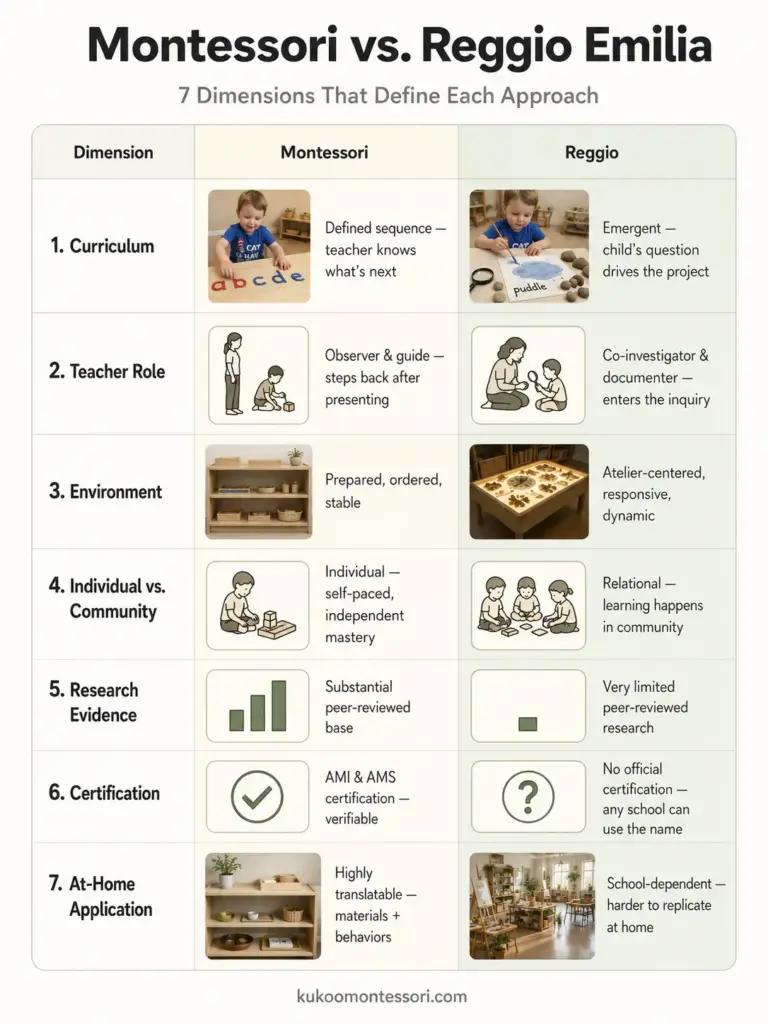
Seven dimensions separate how these philosophies operate in practice — and on several, the difference is more fundamental than most comparison guides acknowledge.
1. Curriculum: Defined Sequence vs. Emergent Discovery
- Montessori: A defined progression — sensorial materials precede academic materials; the moveable alphabet precedes writing on paper. The teacher knows where the child is in the sequence and what comes next. This sequence maps onto the sensitive periods Montessori observed in children from birth to 6 — windows of developmental readiness that define when each material produces its deepest impact.
- Reggio Emilia: An emergent curriculum with no pre-set sequence. A child’s question (“Where does light go when we turn it off?”) becomes a weeks-long project integrating science, art, story, and mathematics. Montessori’s sequence is why research can study it; outcomes are observable because the curriculum is consistent. Reggio’s emergence is its strength (genuine child-led inquiry) and its challenge (impossible to standardize or compare).
2. Teacher Role
- Montessori: Observer, guide, presenter — prepares the environment, presents materials one-to-one, then steps back.
- Reggio Emilia: Co-investigator, documenter, provocateur — stays actively involved in children’s projects, contributes questions rather than answers. Both respect the child’s intelligence. Montessori respects it by stepping back; Reggio respects it by entering the inquiry as an equal participant.
3. Environment
- Montessori: The prepared environment — ordered, beautiful, specific. Materials have defined places. Designed in advance to support developmental sequences.
- Reggio Emilia: The environment as the “third teacher” — flexible, responsive, shaped by the ongoing project. The atelier (studio space) and light table are characteristic features. Both produce beautiful, intentional spaces. Montessori’s is more stable and predictable; Reggio’s is more dynamic and responsive.
4. Individual vs. Community
- Montessori: Primarily individual — the child chooses their own work, progresses at their own pace, develops independence as the central goal.
- Reggio Emilia: Fundamentally relational — learning happens in community. Projects are collaborative; parents are genuine partners; the local community participates in learning.
5. Research Evidence
- Montessori: A meaningful body of peer-reviewed research. Among the most cited: Lillard and Else-Quest’s 2006 study in Science, finding significant advantages in literacy, mathematics, and executive function for children in higher-fidelity Montessori programs — with particularly strong effects at age 5.
- Reggio Emilia: Very limited peer-reviewed outcome research. Most published evidence is qualitative or practitioner-reported. A 2023 systematic review in Campbell Systematic Reviews covering 32 studies found Montessori education consistently associated with stronger academic and non-academic outcomes, with executive function showing a moderate-quality effect size of 0.36 — providing broader evidentiary support than any single study can offer. The asymmetry is significant. It does not prove Reggio is ineffective — it reflects a philosophical difference about whether education should be subject to empirical scrutiny. But for parents making evidence-based decisions, the gap is real.
6. Certification and Quality Verification
- Montessori: AMI (Association Montessori Internationale) and AMS (American Montessori Society) certify teachers and recognize schools — providing parents with a verifiable standard before enrollment. A school either meets AMI/AMS criteria or it doesn’t; the answer is publicly checkable.
- Reggio Emilia: No official certification exists. The Reggio Emilia Institute in Italy has no franchising or accreditation arm. Any school can call itself “Reggio-inspired” without training, oversight, or accountability. NAREA (North American Reggio Emilia Alliance) provides professional development, conferences, and community resources for Reggio-inspired educators in North America — but explicitly does not offer certification or accreditation of schools. This is the most practically important dimension for parents choosing a school.
7. At-Home Application
- Montessori: Highly translatable to the home — low shelves, practical life participation, natural materials, precise vocabulary during object exploration, the adult discipline of presenting once and stepping back. These practices are documented, teachable, and consistent.
- Reggio Emilia: More school-dependent — the atelier, collaborative documentation, teacher co-investigation, and community involvement are difficult to replicate without a school context. Elements can be brought home (open-ended materials, listening for children’s questions), but the full approach requires institutional support. For parents bringing an early childhood philosophy into the home environment, Montessori’s concrete materials and defined practices translate more directly — low shelves, practical life participation, and the adult habit of presenting once then stepping back are all practices real families can implement without a school environment.
What They Share — And Why Both Matter
The differences are real and consequential. But five genuine shared principles deserve honest acknowledgment:
1. The child is competent from birth — both reject the idea that children are empty vessels. Both hold that children actively construct their understanding of the world.
2. Environment is pedagogy — both invest deeply in physical space. The Montessori prepared environment and the Reggio “third teacher” both reflect the belief that the room itself is educating.
3. Natural materials over plastic and electronic — both prefer wood, clay, natural textures, and real-world objects over plastic toys and screens.
4. Documentation and observation over grades — neither uses grades or standardized tests in early childhood. Both rely on careful adult observation.
5. The learning relationship matters — both place genuine value on the quality of the relationship between child and educator.
The 0–3 Comparison — The Section Nobody Else Covers
Most comparisons focus on the 3–6 year preschool period. But both approaches have a 0–3 component — and the differences are most visible and most practically important for new parents at this earliest stage.
- Montessori 0–3 (Nido and Infant/Toddler): Highly systematized — specific materials for each developmental stage, specific practices for each sensitive period. Emphasis on movement freedom, physical independence (floor bed, weaning table, pull-up bar), and the infant’s right to complete their own movements without interruption. The CDC’s developmental milestones for infants and toddlers map directly onto the capacities Montessori’s 0–3 sequence supports: motor coordination, cause-and-effect understanding, and beginning language — each addressed through specific prepared environment elements at each sub-stage. The prepared environment supports emerging capacities sequentially. Strong research base on movement freedom and prepared environments for infants.
- Reggio Emilia 0–3 (Nido): Less systematized — relational and documentation-based, focused on building the infant’s sense of belonging, security, and expressive capacity. Deep attention to the quality of the adult-child relationship. Documentation of early expressive acts (how an infant reaches, what sounds they make, how they respond to materials) as the foundation for understanding the child. Parent involvement is particularly emphasized — the transition from home to school is designed with extraordinary care.
| At 0–3, both approaches do something that conventional infant care rarely does: they take the young child seriously as a learner. Montessori does this through systematic environmental preparation; Reggio does it through attentive relational documentation. Where I see Montessori’s advantage most clearly at this age is in the specificity of guidance available to parents and caregivers — the practices are defined, teachable, and verifiable in a way that the Reggio nido, for all its beauty, is harder to access without institutional support. — Zoe Paul, AMI Teacher Trainer (0-3) |
Which Approach Fits Which Child? — A Decision Framework
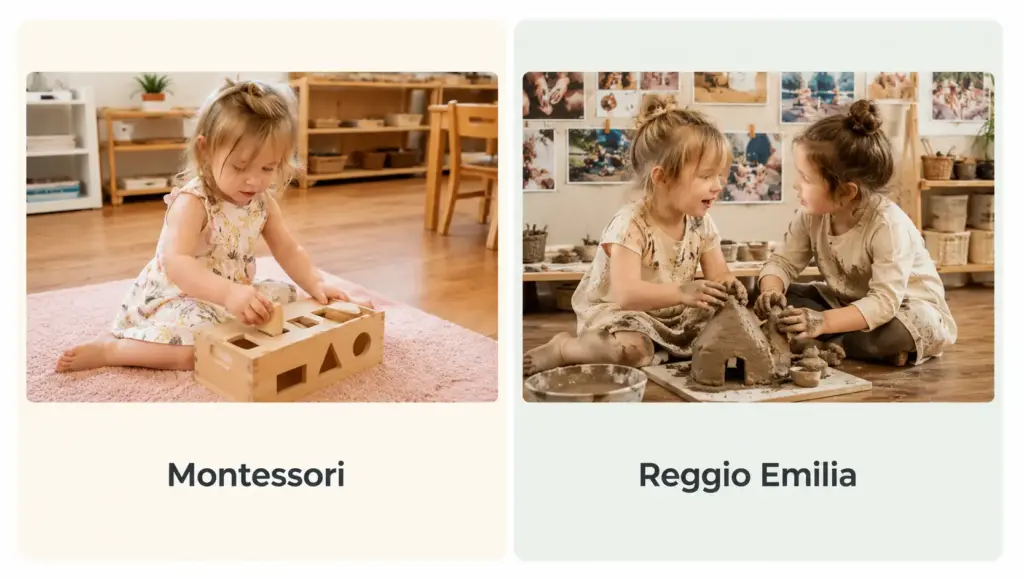
The most useful question is not “which is better?” but “which environment fits this child’s temperament and this family’s values?”
- Montessori tends to fit children and families who: value sequential, concrete skill-building with visible progress; have a child who thrives with clear boundaries and purposeful materials; want to replicate the approach at home with consistent practices; want to verify school quality before enrollment (AMI/AMS certification); have a child showing early interest in specific objects, tasks, or independent mastery.
- Reggio Emilia tends to fit children and families who: have a child who is primarily expressive — learns most powerfully through creative investigation; strongly value community and relational learning; have a child who thrives in collaborative, project-based environments; value artistic expression and the documentation of their child’s learning journey; are comfortable with emergent curriculum where academic skills are not explicitly sequenced.
- Honest caveat for Reggio school selection: Because no certification standard exists, the quality of “Reggio-inspired” schools varies dramatically. Visiting and asking specifically about teacher training, documentation practices, and connection to NAREA matters more for Reggio selection than for Montessori selection.
Frequently Asked Questions
What is the main difference between Montessori and Reggio Emilia?
Curriculum structure. Montessori operates through a defined sequence of materials that teachers present at developmental moments — advancing in a structured progression. Reggio Emilia operates through an emergent curriculum: children’s questions generate projects explored through multiple “languages” without a predetermined sequence. A Montessori classroom can be replicated and certified; a Reggio classroom is by design unique to its community and cannot be certified in the same way.
Is Reggio Emilia better than Montessori for creativity?
Reggio deliberately places creative expression at the center through its “hundred languages” principle — every mode of expression is treated as a legitimate way of knowing. Montessori also includes art, music, and cultural studies but these are not the organizing framework. For children whose primary learning mode is expressive and relational, Reggio’s atelier-centered environment may feel more aligned. For children whose learning is strongest when self-directed through concrete, sequenced materials, Montessori may be more productive.
Can I practice Reggio Emilia at home like I can Montessori?
Montessori translates to the home environment more directly and consistently. Its specific materials, presentation practices, and prepared environment principles are well-documented and home-accessible — low shelves, practical life participation, wooden materials, the adult behavior of presenting once and stepping back. Reggio is more school-dependent: documentation practices, collaborative projects, and atelier environments require institutional infrastructure. Elements of Reggio’s spirit — listening deeply to children’s questions, valuing many forms of expression — can be brought home, but the full approach requires community that a home environment struggles to replicate.
How do I verify the quality of a Reggio school vs. a Montessori school?
For Montessori: look for AMI or AMS teacher certification, a genuine 3-hour uninterrupted work cycle, multi-age classrooms, and a complete material set. These are checkable before enrollment. For Reggio: no equivalent certification exists — any school can use the name. Ask specifically about teacher professional development in the Reggio approach, connection to NAREA, how documentation is used in practice, and whether an atelier and atelierista are part of the program. Visiting is even more essential for a Reggio school, precisely because external verification is not available.
Two Genuine Approaches. Different Assumptions. Your Family’s Choice.
The parent who visited both classrooms at the beginning of this guide was right about both rooms. The Montessori classroom felt focused because it is — by design. The Reggio classroom felt alive and relational because it is — by design.
What separates them isn’t quality of care. It’s where learning begins: from a defined developmental sequence, or from a question nobody can predict in advance.
For home practice, the difference is concrete: Montessori gives you a shelf, specific materials, and a defined practice. Reggio gives you a way of listening — valuable, but harder to act on without a school behind it. For how Montessori compares to a third alternative — where Waldorf and Montessori actually diverge, and why Anthroposophy matters more than most parents realize.
Kukoo’s wooden toys are built around Montessori’s concrete-first principles — the same ones this guide describes. Find what belongs on your child’s shelf right now.