
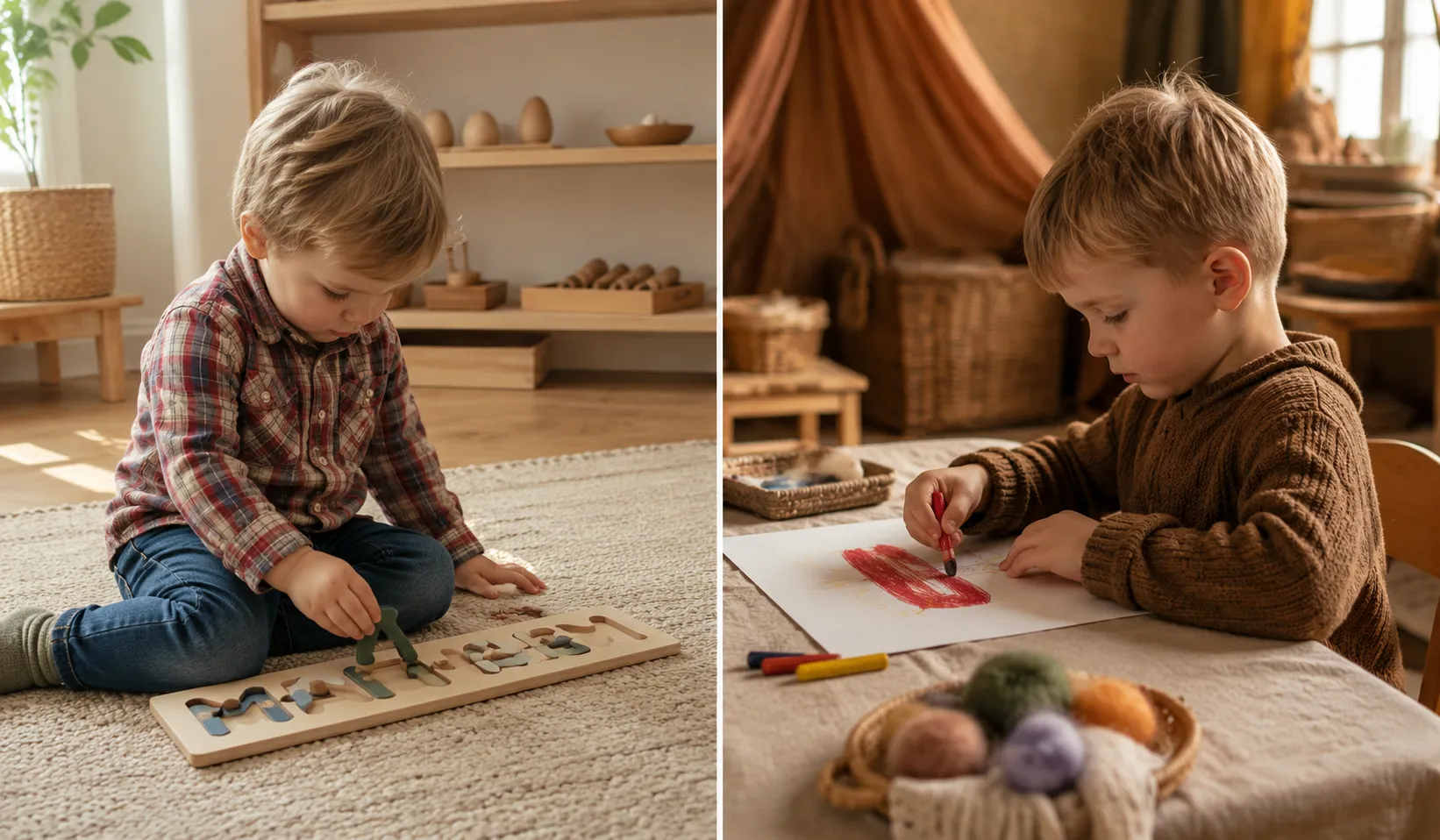
You’ve discovered that both Montessori and Waldorf reject the traditional classroom model, both emphasize hands-on learning, both use natural materials, and both have passionate advocates. So what actually makes them different? The honest answer: they are philosophically much further apart than most comparison guides suggest. The similarities are real but surface-level. The differences go all the way down to the foundational question of what a child is, what education is for, and who should be at the center of the learning process.
Montessori and Waldorf are the two most compared alternative educational philosophies — and often compared superficially. Most guides list differences without helping you understand which approach fits your child’s temperament, your family’s values, or your practical circumstances. This guide does the harder work.
| Montessori vs Waldorf are both child-centered philosophies that emerged in the early 20th century, reject passive learning, and emphasize hands-on development — but differ fundamentally in philosophical roots, academic timing, the role of imagination, teacher style, and the degree to which their methods are supported by peer-reviewed research. Montessori (1907) is grounded in empirical observation and developmental science; Waldorf (1919) is rooted in Anthroposophy — Rudolf Steiner’s spiritual-philosophical worldview. |
The Origins — Two Different Starting Points
- Maria Montessori (1870–1952): Physician, scientist, Italy’s first female doctor. The Montessori philosophy guide covers these foundational principles in depth — from the prepared environment to the role of the adult — for parents who want to understand the full framework before comparing it to alternatives? Answer: a carefully prepared environment with real, purposeful materials, freedom within limits, and an adult who observes rather than directs. The method is empirical — Montessori observed children and refined materials based on what she saw. The philosophy followed the science.
- Rudolf Steiner (1861–1925): Austrian philosopher and founder of Anthroposophy. The first Waldorf school opened in 1919 in Stuttgart — originally for the children of workers at the Waldorf-Astoria cigarette factory. Core question: How do we educate the whole human being — body, soul, and spirit? Answer: a rhythmic, art-infused environment that protects childhood and develops the whole child before engaging the intellect. The method is philosophically derived — it flows from Steiner’s Anthroposophy. The curriculum follows from the philosophy.
- The practical implication: Montessori is, by design, observable, measurable, and replicable. Waldorf is, by design, an expression of a worldview. This creates consequences for everything from academic timing to research evidence.
| Across my work with children from preschool through elementary — including children from Montessori backgrounds, Waldorf backgrounds, traditional schools, and no formal schooling — I’ve seen what each approach produces in practice. My goal here is what parents actually need: honesty, nuance, and a clear framework. I’m not here to sell either approach. – Katy Lenoir, Preschool & Elementary Expert (3–12) |
The Question Nobody Asks — What Is Anthroposophy, and Does It Matter?
Most Montessori vs. Waldorf guides skip this. This one won’t — because for many families, it’s the most important thing to understand before choosing a Waldorf school.
- What Anthroposophy is: Rudolf Steiner developed Anthroposophy as a spiritual philosophy holding that human beings have a spiritual nature that can be investigated through inner experience. It includes specific perspectives on reincarnation, karma, spiritual development through life stages, and the spiritual dimensions of the physical world.
- How it shapes Waldorf education: The three 7-year developmental stages in Waldorf are derived from Steiner’s Anthroposophical framework, not from developmental psychology research. Seasonal festivals, Eurythmy, and the protection of “childhood magic” are Anthroposophically motivated. The delayed academics stance — no formal literacy until age 7 — reflects the belief that early intellectual engagement can affect the child’s spiritual and physical development.
- Why this matters for parents: Many families enroll without knowing this background and discover it later. Waldorf schools vary in how explicitly Anthroposophical their practice is. Neither position is “wrong” — but informed consent matters when choosing a school for your child.
- What it doesn’t mean: Waldorf is not a religion, does not require families to hold spiritual beliefs, and does not teach Anthroposophy as doctrine to children. The influence is in the curriculum design, not in explicit instruction.
8 Dimensions — A Systematic Comparison

1. Academic Timing — The Most Practically Important Difference
- Montessori: Concrete academic work begins at 3, aligned with the sensitive period for language that peaks between 2–6. Sandpaper letters, number rods, and the moveable alphabet introduce literacy and numeracy through physical materials during the exact window children are most neurologically primed to absorb them. Children who complete the sequence often read and write spontaneously at 4–4.5 years.
- Waldorf: Formal reading and writing deliberately withheld until approximately age 7. Early years devoted entirely to imaginative play, rhythm, storytelling, and artistic activity.
- The honest framing: Both positions have internal logic. Montessori’s early academics are evidence-based and concrete-first. Waldorf’s delay is philosophically motivated. Peer-reviewed research more directly supports the Montessori sequence.
2. Teacher Role
- Montessori: Observer and guide — prepares the environment, presents materials, then steps back. The child’s self-direction is the central engine.
- Waldorf: A living presence — storyteller, rhythmic authority, artistic model. The group moves through the day together, led by a teacher often with the same class for 8 years. The Waldorf relationship is uniquely deep; the Montessori relationship is uniquely respectful of independence.
3. Materials and Environment
- Montessori: Specific, purposeful materials designed for one skill at a time. Beautiful, natural, ordered. Each has a defined place, presentation, and purpose.
- Waldorf: Open-ended natural materials — wood, wool, silk, beeswax, seasonal objects. No prescribed materials per skill; the open-endedness IS the point.
- For parents buying materials: Montessori materials can be purchased and used at home following the presentation sequence. Waldorf materials support imaginative play; the home rhythm (daily and seasonal routines) is what primarily carries the philosophy.
4. Imagination and Play
- Montessori: Prioritizes reality-based materials before age 6. From 6+, imagination and creativity expand fully in the elementary cosmic curriculum.
- Waldorf: Imaginative play is the primary medium of learning from birth through 7 and remains central thereafter.
- The nuance both sides miss: Montessori does not suppress imagination — it feeds it with real-world material before 6. Waldorf does not delay academics because it distrusts intellect — it trusts that well-nourished imagination produces stronger intellect.
5. Technology
- Montessori: Limited technology in early and primary years; concrete materials take precedence.
- Waldorf: No technology until high school — one of the most distinctive positions in education, Anthroposophically motivated. Both converge on limiting screen exposure in the early years, but Waldorf’s position is more philosophically absolute.
6. Research Evidence — The Honest Asymmetry
- Montessori: Has a meaningful body of peer-reviewed research. Lillard and Else-Quest’s landmark 2006 study in Science found significant advantages in literacy, mathematics, and executive function for children in higher-fidelity Montessori programs — with effect sizes particularly strong at the 5-year-old level.
- Waldorf: Has significantly less peer-reviewed research on academic and developmental outcomes. Most published evidence is qualitative or internally generated. A 2023 systematic review published in Campbell Systematic Reviews — covering 32 studies — found Montessori education consistently associated with better academic and non-academic outcomes, with executive function showing moderate-quality evidence and effect size of 0.36. The asymmetry doesn’t prove Waldorf is ineffective — it reflects that Waldorf’s outcomes are harder to measure conventionally and less empirically studied. But for evidence-informed parents, the asymmetry is real.
7. Classroom Structure
- Montessori: Multi-age classrooms spanning a 3-year range (3–6, 6–9, 9–12). Older children mentor younger.
- Waldorf: Single-age classes with the same teacher for 8 years (grades 1–8). Montessori produces mentorship and mixed-ability community; Waldorf produces deep belonging and long continuity with one trusted adult.
8. At-Home Application
- Montessori: Translates directly and concretely — low shelves, practical life participation, precise vocabulary, wooden materials with intentional presentation.
- Waldorf: Translates most powerfully through rhythm — consistent daily routines, seasonal celebrations, natural materials, limiting screens. Montessori gives you something concrete to present. Waldorf’s home practice is more about atmosphere and ritual. For parents choosing Montessori at home, the honest Montessori at home guide translates these principles into daily practice for real families — without requiring a dedicated classroom or expensive setup.
What They Share — And Why It Matters
The differences are real. So are the similarities — and understanding them helps you recognize what both approaches are reacting against.
1. The child is not a vessel to fill — both reject transmission-model education. Both believe children are active constructors of understanding.
2. Childhood deserves protection — neither treats childhood as a runway for adult achievement.
3. Beauty matters — both invest in aesthetically beautiful environments children find genuinely lovely to inhabit.
4. Natural materials over synthetic — both prefer wood, wool, cotton over plastic (Montessori: richer sensory feedback; Waldorf: spiritual and developmental protection).
5. The whole child, not just the academic child — both resist reducing childhood to test scores and benchmarks.
Parents comparing Montessori and Waldorf often also encounter Reggio Emilia — and the full 4-way comparison across consistent dimensions prevents apples-to-oranges reasoning that two-way comparisons can produce.
Which Approach Fits Which Child? — A Decision Framework

No educational approach is universally superior. The useful question is not “which is better?” but “which fits this child in this family at this time?”
- Montessori tends to fit children who: show early, intense curiosity about specific subjects; prefer working independently at their own pace; respond to concrete, self-correcting feedback; have emerging interest in letters, numbers, or real-world objects from early on; thrive with freedom and can tolerate self-directed environments.
- Waldorf tends to fit children who: are deeply imaginative and learn through narrative and story; thrive in warm, rhythmic environments with predictable daily rituals; are highly sensitive and may find academic pressure destabilizing; connect strongly to nature, seasons, and aesthetic beauty; benefit from the continuity of the same class teacher over 8 years.
- Neither approach is ideal for children who: need high levels of adult direction at every moment (neither is teacher-directed in the traditional sense); require intensive specialized academic intervention (both work best with properly trained guides).
| When families ask me which to choose, I always start with one question: does your child need more freedom to go deep on their own interests, or more warmth and rhythm to feel safe enough to learn? The answer points you more reliably than any philosophical comparison. – Katy Lenoir, Preschool & Elementary Expert (3–12) |
Can You Combine Them? — Montessori and Waldorf at Home
Many parents — particularly those practicing at home — find themselves drawn to elements of both. This is more common, and more workable, than the philosophical purists of either tradition would suggest.
| From Montessori | From Waldorf |
| Low, accessible shelves with purposeful materials | Daily and weekly rhythms (same time, same activity) |
| Practical life participation from earliest age | Seasonal celebrations and nature connection |
| Precise vocabulary and Three-Period Lesson | Storytelling before bed rather than screen media |
| Presenting once, then stepping back | Limiting technology with intentionality |
| Natural wooden materials with real weight | Open-ended toys: wool, silk, beeswax |
| Following the child’s current interest | Protecting childhood from rushed academics |
The honest caveat: Combining works better at home than in a classroom. In school, the two philosophies are deep enough that they don’t combine without one becoming subordinate. At home, you’re already adapting — you can take Montessori’s concrete materials alongside Waldorf’s rhythm and nature emphasis without contradiction.
Your Questions Answered
What is the main difference between Montessori and Waldorf?
The deepest difference is philosophical roots. Montessori is grounded in developmental science — the American Montessori Society describes her method as emerging directly from empirical observation of children rather than from a pre-existing philosophical worldview, which is precisely what distinguishes it from Waldorf’s Anthroposophical origins. Waldorf is grounded in Anthroposophy — Rudolf Steiner’s spiritual philosophy. In practice, the most visible difference is academic timing: Montessori introduces concrete literacy and numeracy from age 3; Waldorf delays formal academics until age 7. Both produce capable learners through fundamentally different paths. For more on how Montessori works, see the absorbent mind guide.
Which is better — Montessori or Waldorf?
Neither is universally better. Montessori has a substantially larger base of peer-reviewed research supporting academic outcomes — including Lillard and Else-Quest’s 2006 study in Science finding advantages in literacy, mathematics, and executive function for children in high-fidelity programs. Waldorf has less peer-reviewed evidence, not because it’s ineffective but because its outcomes are less easily measured conventionally. For evidence-based parents, this asymmetry matters. For parents prioritizing imagination, rhythm, and spiritual development, Waldorf’s holistic approach may align better regardless. Parents who also encounter Reggio Emilia in this comparison will find it diverges most sharply from Montessori on curriculum structure and documentation.
Is Waldorf religious?
Waldorf is not a religion and doesn’t teach religious doctrine to children. However, it is built on Anthroposophy — Steiner’s spiritual philosophy including beliefs about human spiritual development. These beliefs inform the curriculum design without being explicitly taught. The degree to which a specific school makes this visible varies widely. Parents considering Waldorf benefit from understanding this background before enrollment.
Can I practice Montessori or Waldorf at home without school?
Yes — both have meaningful home applications. Montessori translates concretely through low shelves, purposeful materials, practical life activities, and stepping back after presenting. Waldorf translates through daily rhythms, storytelling, nature connection, and natural materials. Many families find Montessori slightly easier to begin intentionally at home because the specific materials give you something concrete to work with. Waldorf’s home practice requires less purchasing but more consistency in family rhythms.
Two Different Answers to the Same Question
Montessori and Waldorf are not two versions of the same thing. They share a surface vocabulary — hands-on learning, natural materials, whole-child development — but beneath it are two genuinely different answers to the question of what education is for. Montessori answers: to give the child the environment and freedom to develop their full potential, as revealed by observation. Waldorf answers: to protect and nourish the whole child — body, soul, and spirit — as understood through a specific philosophical worldview.
Neither answer is wrong. They are different values, producing different experiences, fitting different children. For families particularly interested in evidence-based early academic preparation, at-home practice with concrete materials, and a curriculum grounded in developmental science — Montessori’s research base and practical replicability make it a particularly strong foundation.
If Montessori’s concrete materials fit how your child learns, start with what’s developmentally active right now — find toys matched to your child’s current stage.