Every article about Montessori education sounds the same. Independence. Love of learning. No grades. Famous alumni — Jeff Bezos, Larry Page, Sergey Brin, Beyoncé, Gabriel García Márquez. It’s a compelling picture. Then you read the other side: no structure, expensive, hard to transition out of, completely unregulated quality. Both sets of claims are circulating. Neither side usually shows you the research.
Several “cons” in circulation — no structure, no academics, only for wealthy families — are documented misconceptions that don’t survive contact with the evidence. What follows does. If you’re searching “Montessori pros and cons,” you’re not anti-Montessori. You’re doing your job — trying to make a genuinely informed decision for a specific child, not a generic one. The Montessori advocacy blogs won’t give you the full picture. Neither will the skeptic forums.
What follows draws on peer-reviewed research — including the largest randomized controlled trial of public Montessori education ever conducted (Lillard et al., PNAS, 2025) — and is reviewed by Zoe Paul, an AMI Teacher Trainer with credentials in Birth to 3. The goal is not to sell Montessori or dismiss it. It’s to help you decide.
| What are the Montessori pros and cons? Pros of Montessori education: – Builds independence and intrinsic motivation – Self-paced, individualized learning – Strong outcomes in literacy, math, and executive function – Mixed-age classrooms support social development – Practical life skills from birth–6 Cons of Montessori education: – Tuition ranges from $12,000–$35,000/year – “Montessori” is an unregulated name — quality varies widely – Limited availability, especially at secondary level – Less structured format doesn’t suit every learning profile Bottom line: Research consistently shows positive outcomes — particularly in the preschool years — but results depend on school quality and implementation fidelity. Common myth: Montessori children struggle academically after transitioning to traditional schools. Studies show the opposite is true. |
One of the most-repeated cons — that Montessori children struggle academically after transitioning to traditional schools — turns out to be largely a myth. We’ll show you what the data actually says.
What Is the Montessori Method? (The Foundation You Need Before Weighing the Pros and Cons)
Understanding the pros and cons of Montessori education starts with understanding what the method actually is — not the aesthetic version sold by toy marketing, but the original scientific framework that still shapes authentic programs today.
Dr. Maria Montessori and the Origins of the Method
Dr. Maria Montessori (1870–1952) was an Italian physician, anthropologist, and educator — the first woman to earn a medical degree in Italy. In 1907, she opened the first Casa dei Bambini (Children’s House) in the San Lorenzo slum district of Rome, originally serving children from low-income families.
Her central observation: given the right environment and materials, children direct their own learning with remarkable focus and joy — without rewards, punishments, or adult-imposed schedules. The method that followed wasn’t a curriculum in the traditional sense. It was a scientific observation framework about how children actually develop when the environment supports rather than controls them.
Montessori was never primarily about wooden toys or minimalist aesthetics. It was about the conditions that allow a child’s natural developmental drive to do its work.
The 5 Core Principles of Montessori Education
| Principle | What it means in practice |
|---|---|
| The Prepared Environment | Classroom designed for child independence — low shelves, child-sized furniture, materials at child’s eye level |
| The Child as Director | Children choose their activity from available options; teachers observe and guide, don’t instruct |
| Mixed-Age Groupings | 3-year age spans (0–3, 3–6, 6–9, 9–12) — older children model for younger; younger learn from observation |
| Sensitive Periods | Developmental windows when the brain is optimally primed for specific learning — language, order, movement, sensory |
| The Role of the Guide | Teachers introduce materials when each child is ready, not on a set schedule |
The Association Montessori Internationale describes the method as education designed around the child’s own developmental drive — an environment prepared to meet the child where their development actually is, not where adult expectations imagine it should be
Montessori vs. Traditional Education — The Key Structural Differences
| Feature | Montessori | Traditional |
|---|---|---|
| Curriculum | Child-chosen within prepared environment | Teacher-directed, standardized |
| Grading | Observational assessment; no letter grades | Letter grades, standardized tests |
| Class structure | Mixed ages (3-year spans) | Same-age cohorts |
| Learning pace | Individual | Group-synchronized |
| Teacher role | Guide / observer | Instructor |
| Physical environment | Child-scale, materials on open shelves | Desks facing front, teacher-centred |
| Homework | Rare to none | Standard |
This structure is what produces both the strongest advantages and the most legitimate concerns — depending on your child and your context.
The Research Behind Montessori — What Science Actually Shows
No other guide on this keyword will show you this section. Most Montessori pros and cons articles cite no research at all, or cite studies from the 1990s with known selection bias problems. Here’s what the most current, most rigorous science actually says.
The Landmark 2025 PNAS Study — The Most Important Montessori Research Ever Published
In October 2025, researchers from the University of Virginia, University of Pennsylvania, and American Institutes for Research published the first randomized controlled trial of public Montessori preschool in the Proceedings of the National Academy of Sciences.
Study design: 588 children across 24 public Montessori programs in 8 US states and Washington DC. Children were enrolled by lottery — random assignment, the gold standard for eliminating selection bias. This is why this study matters more than almost any prior Montessori research: the “Montessori families are wealthier and more educated” confound is designed out.
Key findings — by end of kindergarten:
- Reading: Montessori children significantly outperformed non-Montessori peers
- Short-term memory: Statistically significant advantage
- Executive function: Statistically significant advantage
- Social understanding: Significantly higher
Cost finding: Public Montessori programs cost districts approximately $13,127 less per child than traditional programs over 3 years.
The delayed emergence pattern: No significant differences appeared at the end of PK3 or PK4. Benefits became statistically significant only at the end of kindergarten. This is consistent with how Montessori builds foundations: gains accumulate gradually and surface later than typical preschool studies measure — which means early assessments may underestimate the method’s actual impact.
The 2023 Campbell Systematic Review — 32 Studies, 132,249 Data Points
Randolph et al. (2023) published a systematic review in Campbell Systematic Reviews analyzing 32 studies across 132,249 data points.
Key findings:
- Montessori outperformed traditional education across a wide range of academic and nonacademic outcomes
- Effect sizes: g = 0.26 for general academic ability (high quality evidence), g = 0.22 for mathematics, g = 0.17 for language
- Effect size g = 0.41 for students’ inner experience of school — the largest nonacademic effect found
- Larger effects in: random assignment studies, elementary age, private Montessori schools
What the Research Does NOT Definitively Show
The evidence is real — and it has honest limits.
Most non-RCT studies still carry self-selection bias (Montessori families are not randomly distributed). School implementation quality varies significantly and isn’t controlled in most research. Long-term follow-up beyond elementary school is limited. The evidence is strongest for ages 3–6 and notably weaker for middle and high school programs.
The key moderating variable across all studies is implementation fidelity: ‘classic’ Montessori consistently shows larger effect sizes than ‘supplemented’ Montessori where conventional materials and teacher-directed activities have been added.
Montessori Pros — The Advantages, Backed by Evidence
The following advantages are drawn from peer-reviewed research and the direct observations of AMI-credentialed educators. Each includes a note on the evidence quality — because not every Montessori claim has the same level of scientific support behind it.
Pro #1 — Develops Executive Function More Effectively Than Traditional Schooling
Evidence level: High (2025 PNAS RCT + multiple prior studies)
Executive function — self-regulation, working memory, cognitive flexibility, and impulse control — is arguably the strongest predictor of life outcomes in longitudinal research, stronger than IQ in many studies. The 2025 Lillard PNAS RCT found statistically significant executive function advantages in Montessori-educated children by end of kindergarten.
Why Montessori develops this: uninterrupted work periods of 90–180 minutes, child-chosen activity sequences, and the requirement to manage oneself in a mixed-age environment all exercise the executive function system repeatedly and voluntarily
Dr. Adele Diamond’s research suggests that executive functions—including inhibitory control—can be strengthened through repeated practice and progressively challenging activities.
| In my work with families during the 0–3 window, I consistently observe that children given long, uninterrupted stretches of purposeful activity — reaching for an object, filling and emptying a container, turning a page repeatedly — are already practicing the self-regulation that executive function studies measure in school-age children. The foundations are laid before language arrives. — Zoe Paul, AMI Teacher Trainer, Birth to 3 |
The pros make more sense when you understand the developmental theory behind them — the Montessori philosophy guide explains why self-direction produces executive function gains, and why that mechanism differs from teacher-directed instruction at the neural level.
Pro #2 — Cultivates Intrinsic Motivation and a Genuine Love of Learning
Evidence level: Moderate-High (multiple observational studies; self-determination theory alignment)
One of the most consistent findings in Montessori research: Montessori-educated children score significantly higher on measures of “inner experience of school” — how much they genuinely enjoy being there. The 2023 Campbell systematic review found an effect size of g = 0.41 for this outcome — the largest nonacademic effect in the entire review.
Why this matters beyond school years: intrinsic motivation in childhood is strongly predictive of academic persistence, creative problem-solving, and career satisfaction in adulthood.
The mechanism connects directly to self-determination theory (Deci & Ryan), which identifies autonomy, competence, and relatedness as the three psychological needs driving intrinsic motivation. The Montessori classroom structurally provides all three: choice (autonomy), mastery-paced learning (competence), and mixed-age mentorship (relatedness). The design isn’t coincidental — it’s a near-perfect structural match to what the motivation literature says children need.
Pro #3 — Individualized Learning Pace Eliminates “Falling Behind” Anxiety
Evidence level: Moderate (theoretical alignment with learning science; observational evidence)
In traditional schooling, the cohort moves as a unit. A child who masters a concept quickly waits. A child who needs more time falls “behind” — by institutional definition, not by any developmental reality. Both outcomes disengage children in different ways.
In Montessori, there is no “behind.” Your child works at the edge of their own competence — the zone of proximal development that Vygotsky identified as optimal for learning. The guide introduces the next material when your child is ready, not when the calendar says so.
Children who might carry a “learning delay” label in a traditional setting often thrive when pace pressure is removed. Children who would be bored and restless in a traditional setting continue advancing without waiting for the group. The structural design serves both.
Pro #4 — Mixed-Age Classrooms Build Social-Emotional Intelligence
Evidence level: Moderate (multiple observational studies; some RCT support)
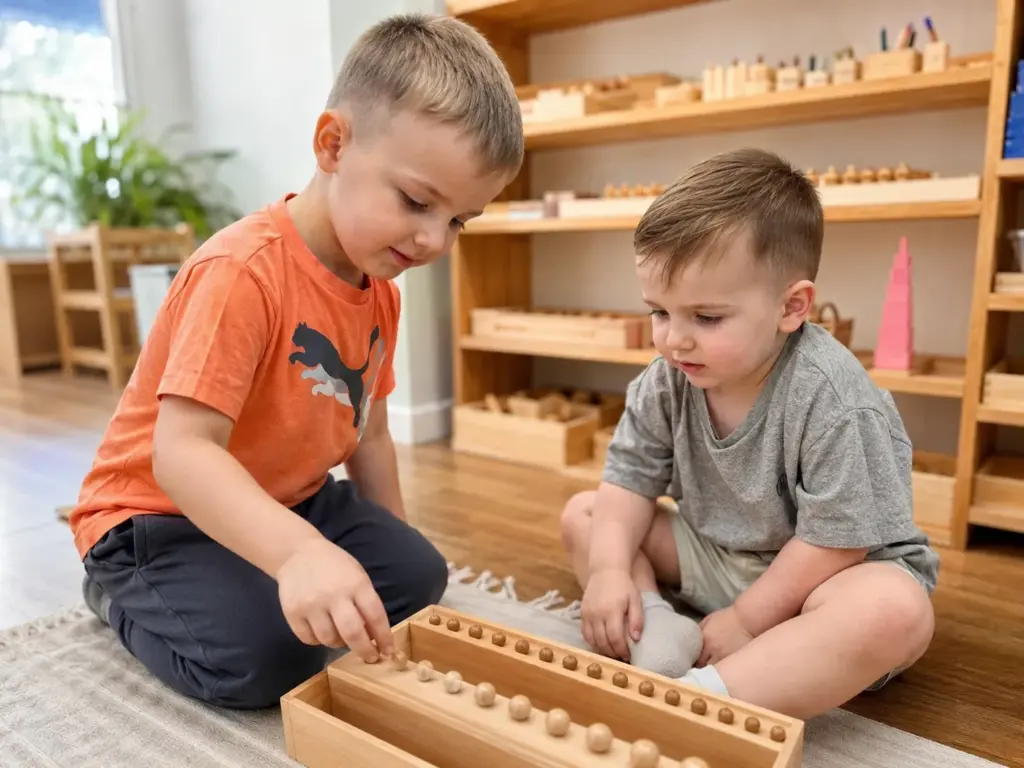
The 3-year age span in Montessori classrooms creates a naturally mentored social environment. Younger children observe and aspire. Older children teach and lead — and research consistently shows that children who teach a concept demonstrate deeper understanding of it than children who only receive instruction. The “protégé effect” is baked into Montessori’s structure, not added as an extra activity.
The 2025 PNAS RCT found significantly higher social understanding in Montessori-educated children — the ability to take another person’s perspective, understand intentions, and navigate social situations — by end of kindergarten.
Pro #5 — Stronger Academic Outcomes, Especially in Literacy and Mathematics
Evidence level: High (2025 PNAS RCT; 2023 Campbell systematic review)
The 2023 Campbell systematic review found high-quality evidence for Montessori advantages in language (g = 0.17) and mathematics (g = 0.22). The 2025 PNAS RCT found statistically significant reading advantages by end of kindergarten — in a randomized design that eliminates selection effects.
A 2025 Scientific Reports longitudinal RCT (Le Diagon et al.) found that early Montessori education showed delayed but meaningful benefits for mathematical problem-solving across a 5-year study — consistent with the ‘foundations-first, gains-later’ pattern seen in the PNAS study.
Key nuance: The evidence is strongest for the preschool-to-early-elementary window (ages 3–8). The research base for middle and high school Montessori is less robust, and secondary programs should be evaluated individually.
Pro #6 — Practical Life Skills Build Real-World Competence from the Beginning
Evidence level: Qualitative / observational (strong anecdotal evidence, limited quantitative research)
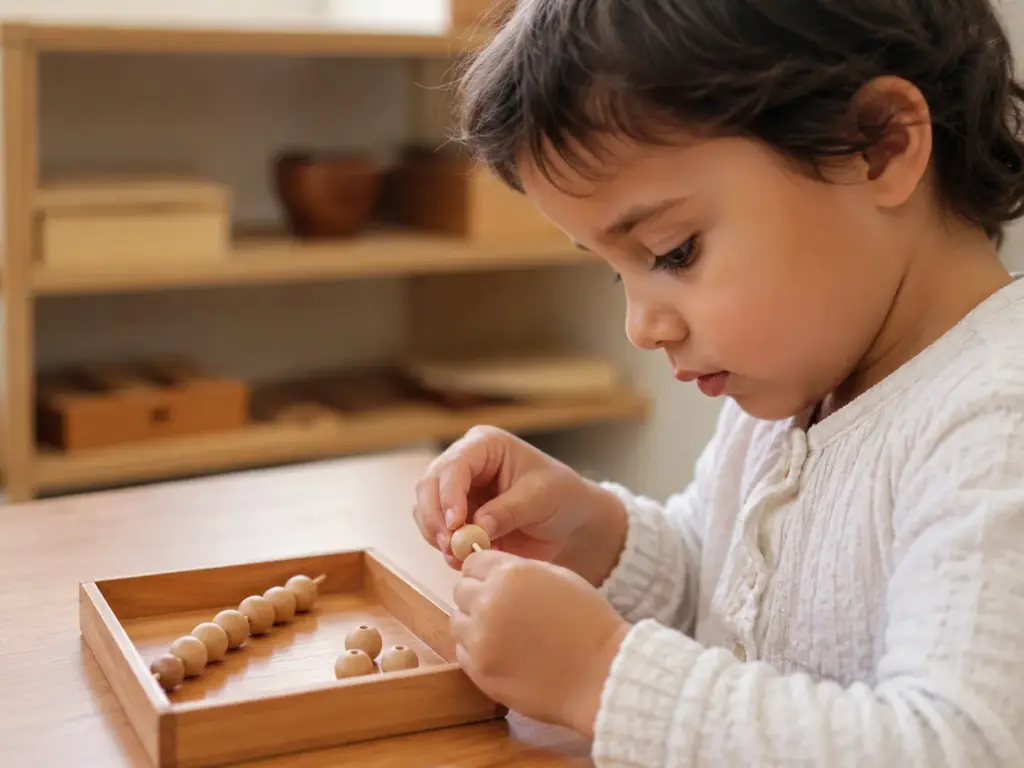
Practical Life — one of the four Montessori curriculum areas alongside Sensory, Language, and Mathematics — includes food preparation, cleaning, self-care, plant care, and basic household maintenance. Real activities with real tools, not pretend versions.
The Montessori conviction: a child who can care for themselves and their environment develops dignity and confidence that academic performance alone cannot provide. Parents of Montessori children consistently report earlier, calmer, more independent household participation.
And critically for home-implementing families: Practical Life is the most transferable curriculum area. You don’t need a school to implement it.
| One of the first things I say to families in the birth-to-3 window is: the most powerful Montessori activity in your home isn’t a toy. It’s a small pitcher of water your child can pour themselves. The focus, the precision, the satisfaction when they succeed — that’s the prepared environment working. And it costs almost nothing to set up. — Zoe Paul, AMI Teacher Trainer, Birth to 3 |
Pro #7 — No Standardized Testing Pressure During Critical Developmental Windows
Evidence level: Indirect (supported by early childhood stress research; no direct Montessori studies)
Montessori’s assessment approach — teacher observation, portfolio documentation, one-on-one demonstrated mastery — produces zero cortisol-spike moments for young children. Developmental neuroscience has documented negative effects of stress hormone activation during test-like situations in early childhood on hippocampal development, the brain structure most associated with long-term memory formation.
Honest counterpoint: The absence of standardized testing also means it is harder for parents to benchmark their child’s progress against national standards. This is a real limitation — addressed directly in the Cons section below.
Montessori Cons — The Real Drawbacks, Honestly Assessed
The following drawbacks are real. Some are structural limitations of the method itself. Others are practical limitations of how Montessori operates in the real world. Understanding them doesn’t mean rejecting Montessori — it means making a clearer decision.
Con #1 — Cost: Private Montessori Is Financially Out of Reach for Most Families
Evidence level: Factual (market data)
Annual private Montessori tuition in the US runs $12,000–$35,000 per year, with significant regional variation. This is not a pedagogical critique — it’s a structural access problem. The method was developed in 1907 for children from low-income families in Rome. The vast majority of US Montessori schools today serve high-income families.
Public Montessori is growing: approximately 500+ public Montessori charter and magnet schools in the US as of 2025, serving approximately 150,000 students. The 2025 PNAS study demonstrated that public Montessori can deliver outcomes comparable to private Montessori — at $13,127 less per child than traditional programs over 3 years. The access gap is real, and narrowing, but slowly.
Con #2 — The “Montessori” Label Is Unregulated — Quality Varies Enormously
Evidence level: Well-documented (AMI, AMS, academic literature on implementation fidelity)
“Montessori” is not a protected trademark. Any school can use the name without adhering to specific standards, training requirements, or materials. A “Montessori” school might offer AMI-certified materials, trained guides, and authentic 3-hour work periods — or it might be a conventional preschool with wooden furniture and a different color scheme.
How to evaluate quality:
- Look for AMI or AMS teacher certification — AMI requires 1,200+ hours of specialist training
- Visit the classroom and look for the three hallmarks: genuine mixed-age groupings, uninterrupted work periods of 2–3 hours, and complete sets of Montessori materials on accessible shelves
The research implication: studies consistently show higher-fidelity programs produce larger effect sizes. A low-fidelity “Montessori” school may deliver outcomes no different from a traditional preschool — without the label telling you so.
Con #3 — Transitioning to Traditional School Can Be Challenging for Some Children
Evidence level: Moderate (mixed evidence — some studies show challenges, others show resilience)
Here’s the open loop payoff: the claim that “Montessori kids struggle academically after they switch” is not well-supported by the research overall. The 2023 Campbell systematic review found that Montessori-educated students’ social and academic skills generally provide a strong foundation for diverse learning environments. The most documented adjustment challenge is unfamiliarity with standardized test formats — not academic ability or knowledge gaps.
The more accurate picture: transitions are individual, not universal. A child who transitions after 1st grade typically adjusts smoothly. A child who transitions after 3rd grade, having spent their entire educational life in a self-directed environment, may find the shift to a structured, graded, same-age classroom more disorienting.
Practical guidance: If you’re planning a transition to traditional schooling at a specific age, plan it actively — choose the transition point deliberately rather than leaving it to circumstance. Earlier transitions are generally smoother than later ones.
Con #4 — Not Ideal for Every Child’s Learning Profile
Evidence level: Expert consensus + observational evidence
Montessori’s self-directed model requires a degree of internal motivation and comfort with unstructured choice. Not every child has this — and that’s not a failure of the child.
Children who may need more structure than Montessori provides:
- Children who find open-ended choice anxiety-provoking rather than liberating
- Children who are strongly externally motivated and need grades or clear benchmarks to engage
- Some children with ADHD who require high external structure (though research shows Montessori benefits for some children with ADHD — this is not universal)
Children who typically thrive: self-motivated learners, curious explorers, kinesthetic learners who need to move while learning, children who feel stifled by rigid schedules.
Perspective worth keeping: No learning environment is right for every child. This con applies equally to traditional schooling.
Con #5 — Limited Availability, Especially at Secondary Level
Evidence level: Factual (AMI/AMS school directory data)
Most Montessori programs end at age 12 or earlier. Authentic Montessori secondary programs (ages 12–18) are rare. Montessori higher education does not exist. For families committed to the philosophy across a child’s full education, an eventual transition is almost inevitable.
Public Montessori availability is geographically concentrated — families in rural areas, many Southern states, and much of the Midwest have limited or no public Montessori access.
Con #6 — Less Emphasis on Competitive Academic Preparation
Evidence level: Fair characterization (structural observation)
Montessori does not explicitly prepare children for standardized tests, competitive admissions processes, or AP-style curricula. A child who has never taken a multiple-choice test before entering middle school will need intentional preparation for that format — not because they lack the knowledge, but because they’ve never practiced the test-taking skill itself.
Worth noting: The research actually shows Montessori children perform well on standardized tests when compared to traditional school peers. The preparation gap is about familiarity with the format, not underlying ability or knowledge.
Con #7 — Implementation Fidelity Determines Everything — And Is Difficult to Assess
Evidence level: High (academic consensus — the fidelity moderator is one of the most consistent findings in Montessori research)
The single most important Montessori con that parents consistently underestimate: the research benefits only reliably appear in high-fidelity Montessori environments. A supplemented or low-fidelity program may produce outcomes no different from traditional schooling — while using the Montessori name and charging Montessori prices.
Practical checklist for assessing any Montessori program:
✅ Do guides hold AMI or AMS certification?
✅ Are work periods genuinely uninterrupted for 2–3 hours minimum?
✅ Are children in real 3-year mixed-age groupings?
✅ Are materials complete, authentic, and accessible on open shelves?
✅ Do children choose their own work sequence?
❌ Are there teacher-directed whole-group lessons at set times?
❌ Are non-Montessori materials (tablets, workbooks) regularly used?
Montessori Pros and Cons Summary — A Side-by-Side Comparison
Here’s the full picture in one place — drawn from peer-reviewed research and AMI practitioner experience.
| Category | Pros | Cons |
|---|---|---|
| Academic outcomes | Strong literacy and math gains (2025 PNAS, 2023 Campbell) | Evidence weaker at secondary level; limited long-term studies |
| Executive function | Statistically significant EF gains (2025 PNAS) | Requires high-fidelity implementation to achieve these outcomes |
| Independence | Child develops self-direction from early age | Not all children thrive with reduced external structure |
| Social skills | Mixed-age mentorship builds social intelligence | Some children may need more same-age peer interaction |
| Cost | Public Montessori is effective AND costs less per child | Private Montessori: $12k–$35k/year — inaccessible to most families |
| Quality | AMI/AMS certified schools deliver research-backed outcomes | “Montessori” label is unregulated — quality varies enormously |
| Testing / assessment | No standardized test pressure during developmental windows | Limited benchmarking; transition to test-heavy environments requires preparation |
| Transitions | Research shows mostly successful academic transitions | Individual experiences can be challenging, especially post-3rd grade |
| Availability | 500+ public Montessori schools in US | Geographically limited; virtually no secondary options |
Is Montessori Right for YOUR Child? A Decision Framework
The research has answered “does Montessori work?” The harder question is: does it fit your child, your family’s circumstances, and the specific school you have access to?
Children Who Typically Thrive in Montessori
- Self-motivated and internally curious — driven to explore rather than to perform
- Kinesthetic learners who need to move while learning
- Children who feel stifled by rigid schedules or find waiting for the group frustrating
- Those who benefit from working at their own pace without cohort-based pressure
- Highly sensitive or introverted children who benefit from a calmer, self-directed environment
- Some children with neurodivergent profiles — particularly those who benefit from sensory-rich environments and individualized pacing
Children Who May Need to Evaluate Carefully
- Children who find open choice anxiety-provoking rather than freeing
- Strongly externally motivated children who need grades and clear benchmarks to stay engaged
- Children whose families need to prioritize standardized test performance from early elementary
- Families planning a transition to traditional school at a specific age — plan the transition intentionally, don’t leave it to chance
The Questions to Ask Before Enrolling
- What is this school’s Montessori certification — AMI or AMS?
- What is the teacher-to-child ratio, and do guides hold specialist training (not just a general teaching degree)?
- Are genuine 3-year mixed-age groupings maintained throughout the day?
- Are work periods truly uninterrupted for 2–3 hours minimum?
- Is there a Montessori program available through the full age range your family needs?
- What does this school’s transition support look like if your child moves to a traditional school?
- If private: does the tuition require financial strain that will affect family wellbeing? A stressed family environment undermines any educational benefit.
What If You Can’t Access or Afford a Montessori School?
The Montessori philosophy doesn’t require a Montessori school. The prepared environment, practical life work, and developmentally sequenced materials can all be established at home — and the principles that drive the research benefits are accessible to any family regardless of enrollment.
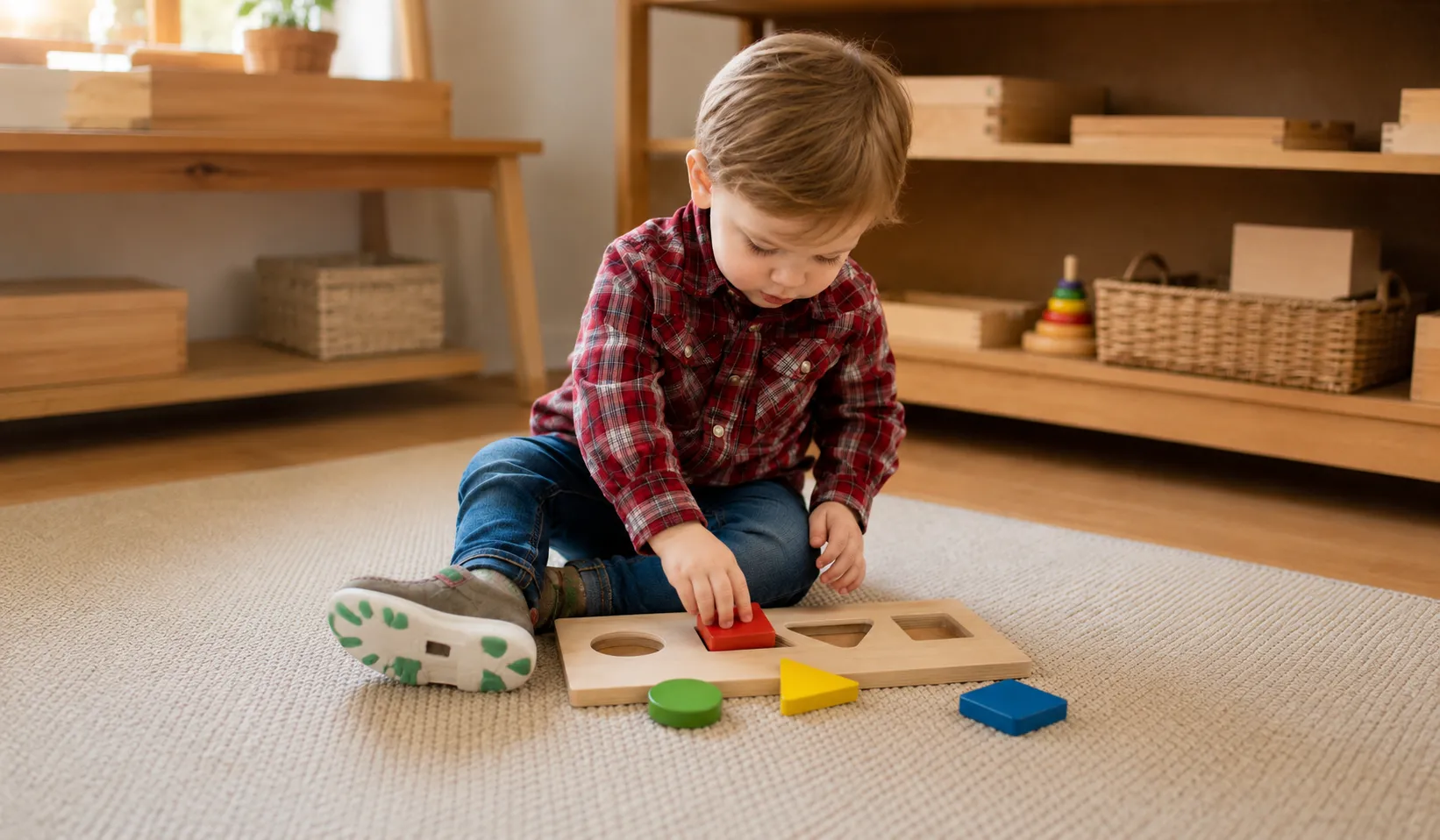
Montessori at home means: child-accessible shelves at child height, rotating age-appropriate materials, long uninterrupted play periods, practical life tasks (pouring, sweeping, food preparation), and natural wood toys designed for open-ended use across multiple developmental stages.
For families beginning a home Montessori environment, the toys designed for the 0–12 month developmental window and the materials matched to the first year of walking are both organised by the sensitive periods each stage is actively working through.
Montessori at Home — What Parents Can Do Without a School
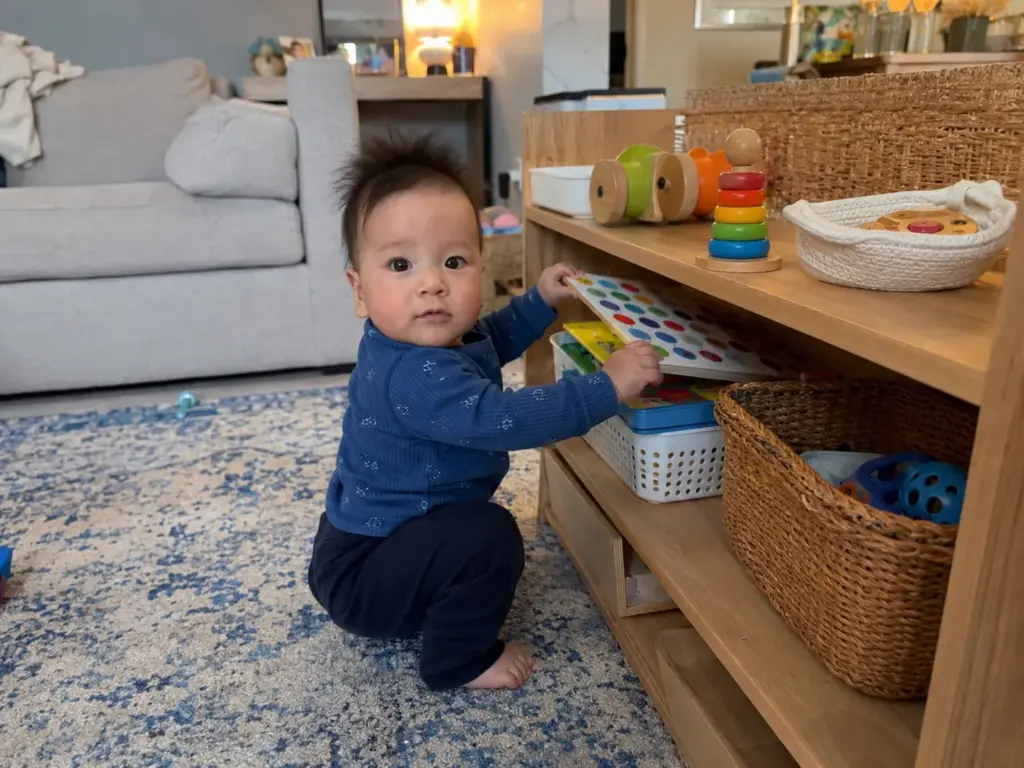
Whether you’re on a waiting list, can’t afford tuition, live outside Montessori catchment, or simply want to extend the principles beyond school hours — the core Montessori practices are fully replicable at home.
1. The Prepared Environment Design your child’s space for their independence, not adult aesthetics. Low shelves with rotating materials at child height. A defined area for independent activity where everything is within reach. The goal is a space your child can navigate without asking for help.
2. Uninterrupted Work Time Two to three hours of uninterrupted play and work daily — no adult-initiated transitions, no hovering. This is the single most impactful environmental change a parent can make. It is also the cheapest.
3. Real Objects Over Toys A child who sweeps with a real child-sized broom develops practical life competence and genuine confidence. A child who pours water from a real small pitcher develops fine motor control, concentration, and the satisfaction of a real task completed. Montessori materials are purposeful real objects — not pretend versions of them.
4. Natural Materials Wood, cotton, metal, and child-appropriate glass over plastic and synthetic. The sensory quality of natural materials — weight, texture, temperature, sound — engages the developing brain in ways that plastic cannot replicate.
5. Observe, Don’t Intervene Resist the impulse to help when your child is struggling with a task. The productive struggle is the learning. If your child genuinely needs a demonstration, offer one quietly — then step back. Your child’s concentration during a challenging independent task is one of the most valuable things you can protect.
Frequently Asked Questions About Montessori Pros and Cons
Is Montessori education better than traditional schooling?
Research consistently shows positive outcomes for Montessori-educated children, particularly in the preschool years. The largest randomized controlled trial of public Montessori (Lillard et al., PNAS, 2025) found statistically significant advantages in reading, memory, executive function, and social understanding by end of kindergarten. However, “better” depends on your child, the specific school’s implementation quality, and your family’s circumstances. High-fidelity Montessori from an AMI or AMS certified school consistently outperforms traditional schooling in peer-reviewed research. Low-fidelity programs using the Montessori name without proper certification may not.
What are the main drawbacks of Montessori education?
The most significant drawbacks are: (1) cost — private Montessori runs $12,000–$35,000/year, making it inaccessible to most families; (2) the unregulated “Montessori” label — any school can use the name without certification, creating enormous quality variance; (3) the transition challenge — some children find the shift from self-directed to structured, graded environments challenging, particularly after 3rd grade; and (4) limited secondary options — most programs end at age 12, requiring an eventual transition. Public Montessori availability is growing but remains geographically limited.
Do Montessori kids struggle when they transition to traditional schools?
This is one of the most commonly repeated concerns, but the research is more nuanced than the fear suggests.. The 2023 Campbell systematic review found that Montessori-educated students generally have strong academic, social, and emotional foundations that support successful transitions. The most documented adjustment challenge is unfamiliarity with standardized test formats — not underlying academic ability or knowledge gaps. Transitions after 3rd grade tend to be more challenging than earlier transitions.
Is Montessori good for children with ADHD or learning differences?
The evidence is mixed but generally positive. Children with ADHD, dyslexia, and other neurodivergent profiles often benefit from Montessori environments because self-pacing, freedom of movement, and hands-on learning reduce the environmental friction these children face in traditional settings. However, some children with ADHD need more external structure than Montessori provides. This decision should involve your child’s developmental pediatrician or specialist alongside any school visit.
Can you do Montessori at home without a Montessori school?
Yes — the core Montessori principles are fully implementable at home. A prepared environment with child-accessible shelves and rotating age-appropriate materials, uninterrupted work periods, practical life activities (cooking, cleaning, self-care), and natural wooden toys designed for open-ended use can all be established without enrollment. Many families who cannot access or afford Montessori schooling create a strongly Montessori-aligned home environment that captures the core developmental benefits the research identifies.
At what age is Montessori most effective?
Research is strongest for the 3–6 age range (the Children’s House level), but evidence supports benefits from birth through elementary. The birth-to-3 period — when the sensitive periods for language, order, movement, and sensory development are open — is where Montessori materials and environments have the greatest foundational impact. Earlier enrollment is associated with stronger long-term outcomes across multiple studies.
The Honest Verdict: What Montessori Gets Right, What It Gets Wrong, and How to Decide
The research has answered the big question. Montessori works — the evidence is real, the effect sizes are meaningful, and the 2025 PNAS randomized trial removed the last major objection about selection bias.
The harder question is the one only you can answer: is this specific school, for this specific child, the right fit right now? Most of what gets called a Montessori con is a school quality problem, not a method problem. The label is unprotected. Walk through the classroom before you sign anything.
And if a Montessori school isn’t accessible — the principles don’t require one. The prepared environment, practical life, the habit of stepping back while your child works — these are available in any home, starting from the earliest months.
For families who’ve worked through the evidence and decided Montessori fits — whether at school, at home, or both — the place to start is wherever your child is developmentally right now. The most direct evidence for that comparison comes from the 2025 PNAS RCT — and parents who want to see it mapped side by side will find the Montessori vs. traditional education breakdown the clearest application of that data to date.
Find Montessori toys for your child’s developmental stage now!