
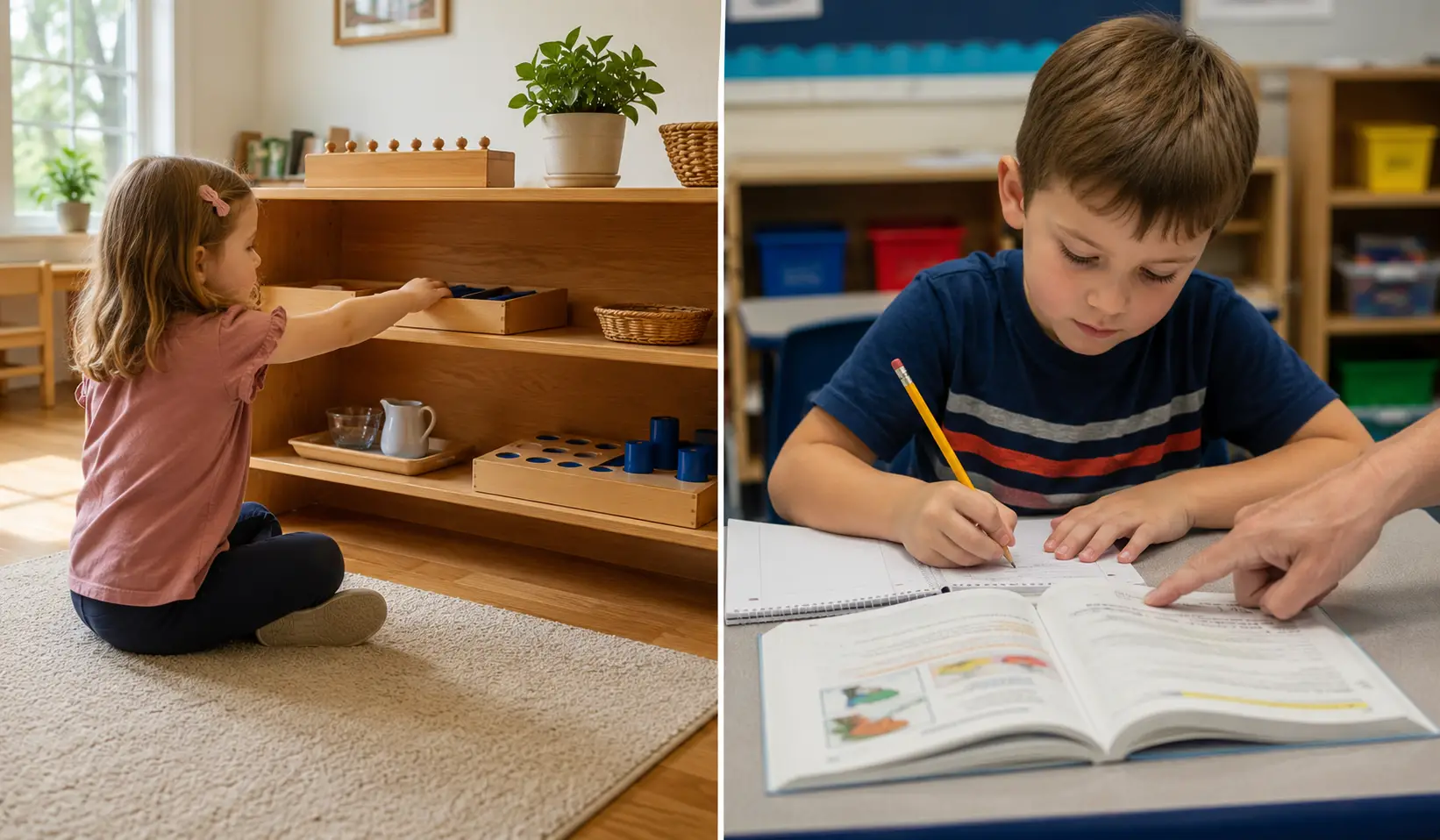
When you search “Montessori vs. traditional method,” most results are written by Montessori schools making a case for enrollment. They’re not wrong — but they’re not exactly neutral either. This article starts somewhere different: with the actual research, the genuine trade-offs, and the question most parents are really asking — not “which school should I choose?” but “how do children actually learn, and how do I support that at home?”
The Montessori method is not a school. It is a philosophy about how children develop — through observation, independence, hands-on engagement, and intrinsic motivation. That philosophy is as applicable in your living room as it is in a classroom.
| How do Montessori and traditional methods compare? The Montessori method is a child-centered approach where children self-direct their learning through hands-on materials, work at their own pace in mixed-age environments, and develop intrinsic motivation through real-world task completion — in contrast to the traditional method, where a teacher directs instruction through a standardized curriculum on a fixed timeline, assessed through standardized testing. |
| Dimension | Montessori Method | Traditional Method |
| Who leads learning | Child self-directs | Teacher directs |
| Pacing | Individual pace | Grade-level timeline |
| Assessment | Observation, portfolio, mastery | Standardized tests, grades |
| Classroom | Mixed ages (3-year spans) | Same-age groups |
| Curriculum | Integrated, child-chosen | Fixed, sequential subjects |
| Materials | Hands-on, self-correcting | Textbooks, worksheets |
| Teacher role | Guide / observer | Instructor / deliverer |
Table of Contents
The Core Philosophical Difference — Two Different Beliefs About Children
The Montessori method and the traditional method are not just different teaching techniques — they begin from different beliefs about what children are and how learning happens.
- The Montessori belief: Your child is born with an innate drive to learn — a curiosity and competence that, given the right environment and materials, will guide their development without external direction. Maria Montessori called this the absorbent mind — the capacity to take in and organize the world through sensory experience in the first six years. The adult’s role is to prepare an environment that meets this capacity, then step back and observe.
- The traditional belief: Knowledge is a body of content that must be transmitted from those who know (teachers) to those who don’t (students). The curriculum determines what is learned and in what sequence. Motivation is partly extrinsic — grades, tests, praise, and social comparison. The teacher’s role is to instruct, assess, and move the group forward together.
These are not small differences in classroom arrangement. They produce fundamentally different learning environments, different teacher-student dynamics, and — as the research increasingly shows — different developmental outcomes. Understanding the philosophical root helps you evaluate which elements to bring home, regardless of which school your child attends.
| The most consistent pattern I see across the 3–12 range: children who’ve had self-directed, hands-on learning from the early years arrive at formal academic work with concentration, resilience, and intrinsic motivation. Children directed from the outside from the beginning often need the external structure to function — and struggle when it’s removed. That’s not a criticism of traditional education. It’s an observation about what early independence produces. – Katy Lenoir — Preschool & Elementary Expert (Ages 3–12) |
7 Key Differences — Organized by Developmental Impact

The visible differences between Montessori and traditional classrooms are easy to list. What matters more is what each difference produces developmentally.
1. Self-Direction vs. Teacher Direction → Executive function. In Montessori, your child chooses their activity from a prepared shelf. In traditional education, the teacher assigns it. The Harvard Center on the Developing Child identifies executive function as comprising three core capacities — working memory, inhibitory control, and cognitive flexibility — that develop most reliably through activities requiring active self-direction rather than external instruction.
2. Individual Pacing vs. Grade-Level Pacing → Mastery vs. exposure. This pacing follows the sensitive periods — developmental windows when specific concepts are absorbed with unusual depth and ease — making advancement at the moment of readiness qualitatively different from advancement on a calendar schedule. Traditional education moves the group forward together, which means some children are bored (mastery reached, no progression) and some are lost (moved forward before mastery).
3. Mixed-Age vs. Same-Age Groupings → Social-cognitive development. Montessori classrooms group children in three-year spans (0–3, 3–6, 6–9). Older children reinforce learning by teaching younger ones; younger children observe and are inspired by older peers.
4. Hands-On Materials vs. Textbooks → Concrete-to-abstract learning. Montessori materials are physical, self-correcting, and designed for hands-on manipulation. Traditional education presents concepts symbolically before the child has concrete experience — but abstract symbols become meaningful when they follow concrete experience, not when they precede it. Practical life activities are one of the most direct ways to implement this hands-on principle at home — and they require no special materials beyond what’s already in your kitchen and living space.
5. No Grades vs. Standardized Assessment → Intrinsic motivation. Self-determination theory research is consistent: external reward systems — including grades, praise for performance, and social comparison — undermine intrinsic motivation over time by shifting the child’s focus from the work itself to the reward for completing it. Children who learn because the activity is inherently satisfying sustain engagement longer and demonstrate deeper understanding.
6. Freedom Within Structure vs. External Discipline → Self-regulation. Self-regulation develops more robustly in environments where your child practices making choices and managing the consequences of those choices — rather than having behavior managed externally through rules and rewards.
7. Integrated Curriculum vs. Subject Compartmentalization → Transfer of learning. In Montessori, a food preparation activity involves math, science, language, and practical life simultaneously. Integrated learning produces stronger transfer — the capacity to apply what’s learned in one context to a new one.
What Research Says About Montessori vs. Traditional Method
The research on Montessori vs. traditional education has historically been difficult to interpret because most studies lacked random assignment — making it hard to know if Montessori produced better outcomes or simply enrolled children who would have done better anyway. The 2025 national RCT changed that.
The 2025 National RCT — What It Found
A national randomized controlled trial published in PNAS in October 2025 — led by Angeline Lillard (University of Virginia) and following 588 children across 24 public Montessori programs — is the most methodologically rigorous Montessori study to date. Because children were randomly assigned through school lotteries, selection effects are controlled in a way previous Montessori studies were not.. Because children were randomly assigned, selection effects are controlled. Montessori children performed meaningfully better in reading by end of kindergarten. Memory performance was significantly stronger. Executive function — the suite of cognitive skills covering planning, self-control, and flexible thinking — showed meaningful advantages. And the Montessori programs produced these advantages at significantly lower cost.
What Earlier Meta-Analyses Found
A 2023 systematic review published in Campbell Systematic Reviews — covering 32 studies and 132,249 data points — found Montessori education produces meaningful positive effects on both academic and non-academic outcomes, with effect sizes ranging from 0.22 for mathematics to 0.41 for students’ inner experience of school.. Academic outcomes showed modest but meaningful Montessori advantages; non-academic outcomes showed more consistent and larger effects.
What the Research Does NOT Show
Intellectual honesty requires acknowledging gaps. Dose-response — whether more Montessori exposure produces proportionally better outcomes — is unclear. Long-term outcomes are understudied; most research ends at elementary age. And outcomes depend heavily on fidelity — whether schools implement authentic Montessori or merely use the name.
| The honest version of ‘Montessori works’ is more specific: authentic Montessori, well implemented, in the age windows when the sensitive periods are active, produces these advantages. A classroom with Montessori furniture but traditional instruction does not. – Katy Lenoir — Preschool & Elementary Expert (Ages 3–12) |
The Honest Limitations — What Each Method Gets Wrong
Every Montessori article you’ll find online is written by a Montessori school or advocate. Here’s the honest assessment — of both methods.
Where Montessori Has Real Limitations
Self-direction requires internal scaffolding that not all children arrive with equally. Children from chaotic or emotionally unpredictable home environments may need more external structure initially — the freedom can produce anxiety rather than engagement in children whose nervous systems aren’t yet regulated. Transition to traditional school can be difficult; the skills Montessori builds are extremely valuable, but the structural fluency of traditional school (sit, wait, follow directions) is also real. Without grades, parents have less comparative data — a philosophical strength and practical limitation simultaneously. And quality variance is enormous: The Montessori name is unprotected globally — any school can use it without AMI or AMS certification, which is the only reliable external signal that a program is implementing authentic Montessori rather than using the name as a marketing label.
Where Traditional Education Has Real Strengths
Clear benchmarks and accountability make it easier to identify learning gaps early. Structured social environments provide scaffolding for children who struggle with self-regulation or open choice. And scalability matters — traditional methods can be implemented by any trained teacher with any group size, while authentic Montessori requires specific materials, specific training, and ideally small groups.
The Hybrid Question — Can You Use Both?
The most common question: “My child is in a traditional school. Can I apply Montessori principles at home?” The answer is unambiguously yes — and for most parents, it’s the most relevant application of this entire comparison. Parents weighing traditional education against Montessori often encounter Waldorf as a third option — and the Montessori-Waldorf divergence on fantasy, academic timing, and spiritual foundations is sharper than the surface similarities suggest. But whether you’re navigating that three-way comparison or simply working within a traditional school system, what most parents need is specifics, not theory.
What those principles look like in a real home — with real constraints, real siblings, and a child who attends a traditional school is where most parents need specifics, not theory.. They require: a prepared environment at home with organized, accessible materials your child can select independently. Adult restraint — the willingness to step back. Natural materials with real outcomes. Freedom within clear limits. The 2025 PNAS advantages came from daily exposure to these principles during the sensitive periods — birth through 6 years. Parents implementing them at home during this window are applying the exact conditions that produced those advantages, regardless of school enrollment.
5 Montessori Principles That Transfer Directly to Your Home

You don’t need a Montessori school to implement Montessori principles. These five translate directly — and each one corresponds to a specific research-backed advantage.
1. Prepare the environment, then step back. Organize an accessible, limited, visually clear shelf — then don’t interfere with your child’s engagement. The executive function advantage comes from this: your child practices initiating, sustaining, and completing independent work every day. The observation framework that makes this prepared environment work is simpler than most parents expect.
2. Choose materials where your child’s precision produces the result. Any toy where sloppy engagement produces the same result as precise engagement isn’t building the capacities Montessori develops. The coin either enters the slot or it doesn’t. Materials like a wooden coin box or name puzzle develop concentration, persistence, and self-correction because accuracy actually matters. The 8 design criteria that distinguish genuinely self-correcting Montessori materials from those that merely use natural materials are worth understanding before buying anything.
3. Introduce materials once, then leave them for independent use. Demonstrate once, step back, return it to the shelf. This isn’t permissive parenting — it’s deliberate practice in the adult restraint that allows self-direction to develop.
4. Follow your child’s concentration, not a schedule. When your child is deeply concentrated — not looking up, not responding to the environment — that is the work cycle Montessori describes as the source of normalization. Don’t interrupt it. The reading advantage in the 2025 study comes partly from children who had sustained concentration experience before formal reading instruction.
5. Real materials with real outcomes over toy simulations. A child who pours real water, fastens a real zipper, and handles a real wooden coin is developing real-world competence. Montessori’s insistence on real materials isn’t aesthetic — it’s developmental. The complete framework on the adult’s role in making this work at home covers exactly how to step back without stepping away.
Frequently Asked Questions
What is the main difference between the Montessori method and the traditional method?
Who directs learning. In Montessori, your child self-directs by choosing activities from a prepared environment at their own pace — the teacher observes and guides. In traditional, the teacher directs instruction on a standardized timeline. This produces downstream differences in assessment (observation vs. grades), environment (mixed-age, open-shelved vs. same-age, desk-rows), materials (hands-on vs. textbooks), and motivation (intrinsic vs. extrinsic).
What does research say about Montessori vs. traditional education?
The most rigorous evidence: a 2025 national RCT (Lillard et al., PNAS) following 588 children across 24 programs found meaningful Montessori advantages in reading, memory, and executive function — at lower cost. A 2023 systematic review (32 studies, 132,249 data points) found modest but meaningful positive effects, with the strongest advantages in executive function, creativity, and social-emotional development. The important caveat: outcomes depend on authentic implementation.
Is the Montessori method better than traditional education?
That depends on what outcomes you prioritize. For executive function, self-regulation, intrinsic motivation, and creative problem-solving, research consistently favors authentic Montessori. For structured accountability through standardized benchmarks and smooth integration with traditional school systems, conventional methods have practical advantages. Authentic Montessori in the 0–6 window produces documented developmental advantages — but a well-implemented traditional program may serve a particular child better than a poorly-implemented Montessori one.
Can I apply the Montessori method at home if my child attends a traditional school?
Yes — and the research advantages apply regardless of school enrollment. The five principles that transfer directly: prepare an organized, accessible environment; choose materials where precision produces the result; introduce once and leave for independent use; follow concentration rather than a schedule; prioritize real materials over toy simulations. The PNAS advantages came from daily practice of self-directed, hands-on engagement — available in the home every day.
What are the disadvantages of the Montessori method?
Four honest limitations. Quality variance: the name is unprotected, meaning any school can use it without authentic implementation. Transition difficulty: fully self-directed children may need adjustment in traditional school environments. Reduced standardized data: no grades makes tracking specific gaps harder against benchmarks. Environmental dependency: the method works best when implemented consistently across home and school — a child receiving Montessori at school but a highly directed home environment may not get the full benefit of either approach.
Your Living Room Is a Classroom — Whether You Call It One or Not

Here’s what this entire comparison comes down to: a shelf, five activities, and a step back. Not a school. Not a curriculum. Not a complete overhaul of how you parent.
The research points in one direction — authentic Montessori, in the 0–6 window, produces documented advantages in the capacities that matter most. But the window is open right now, and it doesn’t require enrollment.
Get your child’s shelf right this week. Shop Kukoo’s wooden Montessori toys by developmental stage — each one built around the concrete-first principles this article describes, matched to the exact window your child is in right now.