You’ve read three different articles about early childhood education methods this week. One compared Montessori to Waldorf. One compared Reggio Emilia to Montessori. One compared Montessori to traditional school. You’re now more confused than when you started — because each article was written by someone promoting their own method, and none gave you the same comparison dimensions.
This guide puts all four approaches on the same table, uses the same criteria for each, cites the same evidence for all of them, acknowledges the genuine weaknesses of every one — and gives you a structured decision framework at the end that produces a clear direction for your specific child.
How do the 4 methods Montessori vs. Waldorf vs. Reggio Emilia vs. Traditional Education compare?
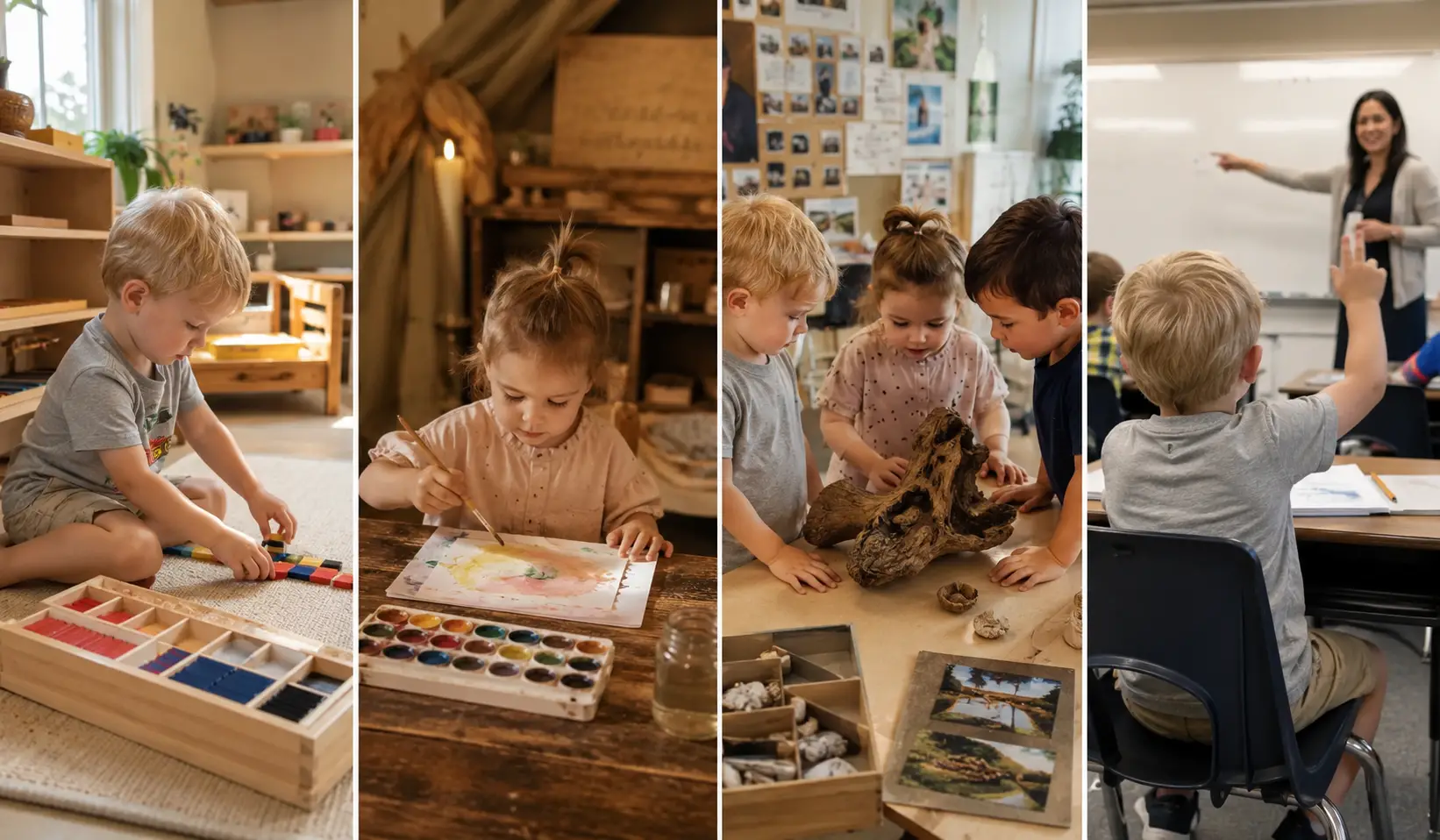
Montessori, Waldorf, Reggio Emilia, and traditional education are the four dominant approaches to early childhood education — each built on a different belief about how children learn: Montessori through self-directed hands-on work with structured materials; Waldorf through artistic immersion, imagination, and delayed formal academics; Reggio Emilia through child-initiated project inquiry; and traditional through teacher-directed instruction following a standardized curriculum. The most rigorous research to date — a 2025 national RCT following 588 children — found Montessori children showed meaningful advantages in reading, memory, and executive function.
| Dimension | Montessori | Waldorf | Reggio Emilia | Traditional |
| Who leads | Child self-directs | Teacher guides through arts/story | Child + teacher co-investigate | Teacher directs |
| Academic pacing | Individual mastery pace | Formal academics delayed to 7 | Emergent, project-driven | Grade-level timeline |
| Assessment | Observation + mastery | Narrative teacher report | Documentation portfolios | Grades + standardized tests |
| Materials | Structured, self-correcting wood | Handcrafted natural, art supplies | Diverse media, loose parts, studio | Textbooks, worksheets, digital |
| Fantasy role | Real-world focus; fantasy later | Central — imagination is the vehicle | Documentation of real inquiry | Varies; often secondary |
| Teacher role | Observer / guide | Artistic model / storyteller | Partner / researcher / documenter | Instructor / deliverer |
| Strongest window | Birth–6 (sensitive periods) | 7–14 (curriculum matures) | 3–6 (project depth) | 6+ (structured skill-building) |
| Research base | Largest; 2025 national RCT | Limited; observational only | Moderate; qualitative dominant | Largest overall; mixed outcomes |
| Parents consistently arrive with the same anxiety: ‘I’ve done so much research and I still don’t know which is right.’ Almost always, the issue isn’t lack of information — it’s too many advocacy articles and not enough honest comparison. This guide is the comparison I give parents when they ask me directly. – From Zoe Paul, AMI Teacher Trainer (0–3) |
The Four Methods at a Glance — Core Beliefs and Founders
Before comparing methods, it helps to understand what each one is built on — because the surface differences (classroom layout, teacher role, assessment) are downstream of deeper philosophical differences about childhood and learning.
- Montessori (Maria Montessori, Italy, 1907). The child is born with an intrinsic drive to learn — Maria Montessori’s foundational theory, documented in the Stanford Encyclopedia of Philosophy, holds that given a carefully prepared environment with purposeful materials, children will direct their own development through work they find intrinsically satisfying.. The adult’s role is to observe, prepare the environment, and step back. The first six years — the “first plane of development” — are the most important in Montessori’s framework, governed by sensitive periods for specific types of learning that open and close on a biological timeline.
- Waldorf (Rudolf Steiner, Austria, 1919). Child development moves through distinct seven-year phases, each requiring a different educational approach. The first phase (0–7) is governed by will and imitation; formal academics are deliberately delayed until around age 7. Artistic expression, imagination, and rhythm are the primary vehicles of learning. Relationships are paramount — the same teacher often stays with a class for 8 years.
- Reggio Emilia (Loris Malaguzzi, Italy, 1945). The child is seen as a powerful, capable co-constructor of knowledge. Learning emerges from children’s own questions, documented by teachers and displayed as “the hundred languages of children.” There is no fixed curriculum; projects emerge from genuine curiosity. The environment is called “the third teacher” — space, materials, and documentation are designed as carefully as adult-child interactions.
- Traditional/Conventional. Knowledge is a body of content systematically transmitted from teacher to students. The curriculum determines what is learned and in what sequence. Teacher-directed instruction, grade-level progression, and standardized assessment are the primary mechanisms. External motivation (grades, tests, praise) drives academic behavior.
7 Dimensions — What Each Method Actually Does
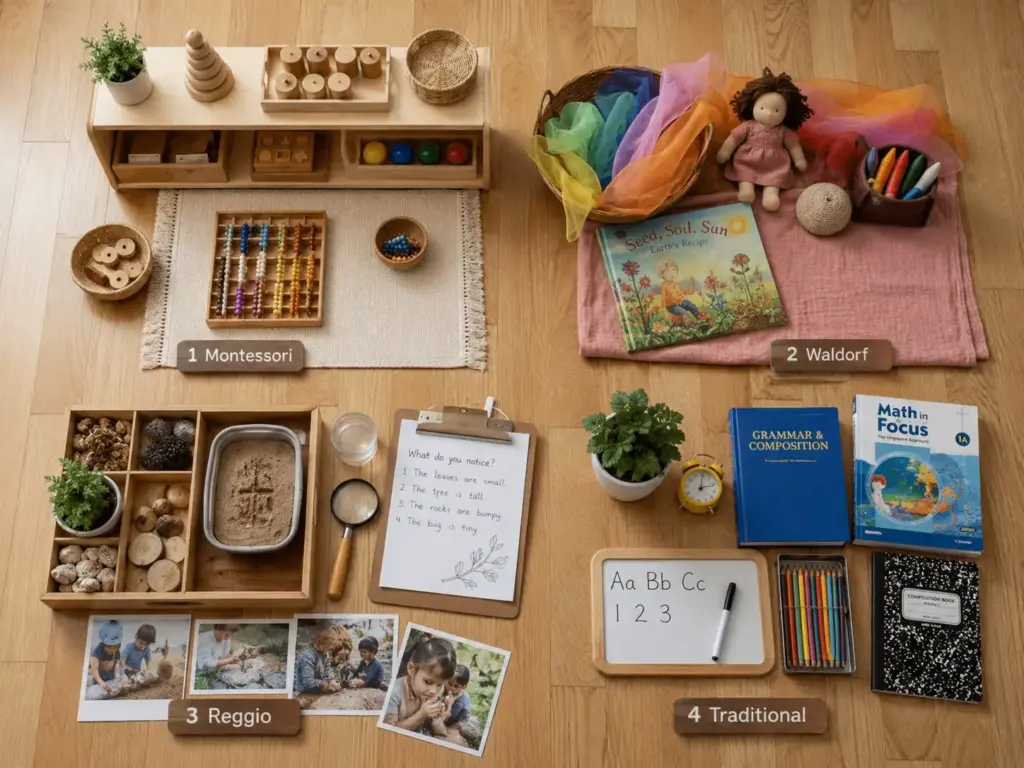
These seven dimensions reveal how each method’s philosophy plays out in practice — and which developmental outcomes each approach is specifically built to produce.
1. Who Initiates Learning → Executive Function Impact
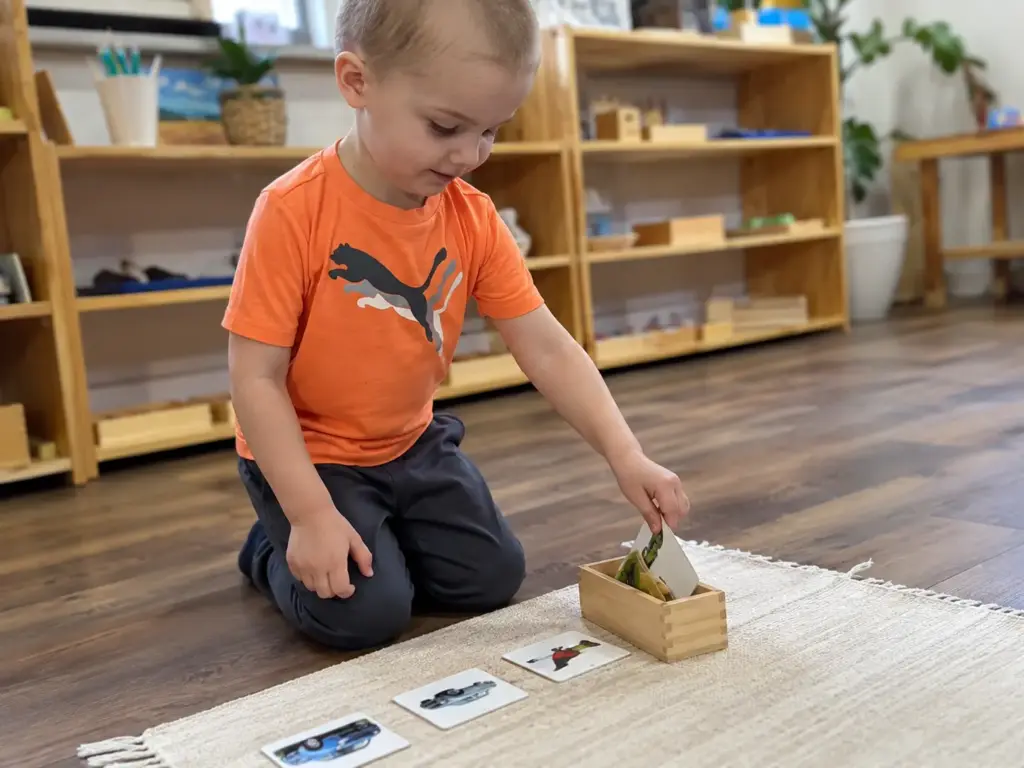
- Montessori: Child selects from prepared shelf; adult presents once and observes.
- Waldorf: Adult initiates through artistic storytelling; child engages through imitation.
- Reggio: Child + adult co-investigate; inquiry emerges from children’s questions.
- Traditional: Adult assigns; child completes. Montessori and Reggio produce the strongest executive function outcomes because both require the child to initiate and sustain work — the design difference between Montessori and conventional toys comes down to exactly this: who does the developmental work, the toy or the child.
2. Academic Pacing → Mastery vs. Delay vs. Exposure
- Montessori: Reading and math begin concretely from ~3yr — the sensitive periods for language and mathematical reasoning open in this window and make this pacing developmentally accurate, not artificially accelerated.
- Waldorf: Formal reading and math deliberately delayed until ~7yr.
- Reggio: No fixed timeline; literacy emerges organically from project documentation.
- Traditional: Kindergarten reading standard; math operations begin first grade. The 2025 Lillard PNAS RCT found Montessori children showed meaningful reading advantages by end of kindergarten. Waldorf’s delayed academics carry risk for children already developmentally ready for symbolic work.
3. Assessment → Motivation Impact
- Montessori: Teacher observation, mastery demonstration, no grades.
- Waldorf: Narrative reports; no standardized testing.
- Reggio: Detailed documentation (photos, transcripts, artwork).
- Traditional: Grades, standardized tests, percentile rankings. Motivation research is consistent: external reward systems undermine intrinsic motivation over time — a finding replicated across decades of Self-Determination Theory research and one of the strongest evidence-based arguments against grade-driven learning in the early years.
4. Fantasy and Imagination — The Sharpest Montessori/Waldorf Contrast
- Montessori: Real-world focused in the first plane (0–6yr); fantasy secondary until symbolic thinking matures.
- Waldorf: Imagination IS the educational vehicle — fairy tales, artistic imagination are how 0–7yr olds develop thinking.
- Reggio: Fantasy and symbolic play welcomed; documented and taken seriously.
- Traditional: Varies. Both Montessori’s and Waldorf’s positions have research support. They’re not contradictory — they target different developmental capacities.
5. Age Grouping → Social-Cognitive Impact
- Montessori: 3-year mixed-age spans.
- Waldorf: Same teacher keeps the class for 8 years.
- Reggio: Flexible multi-age groupings.
- Traditional: Same calendar-age grade levels; new teacher every year.
6. Physical Environment
- Montessori: Low child-height shelves; specific materials in specific positions; order is explicit.
- Waldorf: Warm, home-like; handmade materials; seasonal colors; soft light.
- Reggio: Atelier (studio); mirrors; children’s documentation displayed as art; provocations.
- Traditional: Desks in rows; teacher’s board as focal point.
7. What Children Do With Difficulty → Self-Regulation
- Montessori: Material provides control of error — child discovers mistake and self-corrects without adult.
- Waldorf: Teacher models and supports; difficulty is navigated in relationship.
- Reggio: Children bring questions to collaborative investigation.
- Traditional: Teacher corrects; correct answer confirmed by external authority.
Montessori vs. Waldorf vs. Reggio Emilia vs. Traditional
The four methods have very different research bases — which affects how much confidence parents can place in outcome claims.
| Method | Studies | RCT? | Key Finding | Key Caveat |
| Montessori | 100+ | ✅ 2025 national RCT (n=588) | Reading, memory, executive function advantages | Depends on implementation fidelity |
| Waldorf | ~20 | ❌ Observational only | Creative thinking, wellbeing, positive experience | Cannot rule out selection effects |
| Reggio Emilia | ~15 | ❌ Qualitative dominant | Language development, creativity, collaboration | Difficult to replicate; teacher-dependent |
| Traditional | Thousands | ✅ Extensive | Strong standardized skill acquisition at scale | Academic achievement without EF or intrinsic motivation gains |
A national randomized controlled trial published in PNAS in 2025 (Lillard, Loeb, Berg, Escueta, Manship, Hauser, Daggett) followed 588 children across 24 public Montessori programs and found Montessori children significantly outperformed controls in reading, memory, and executive function at end of kindergarten. Findings: Montessori children significantly outperformed controls in reading, memory, and executive function at end of kindergarten — at lower cost. This is the strongest evidence for any alternative education method currently in the literature. Waldorf and Reggio have no equivalent studies.
A 2023 systematic review published in Educational Research Review found modest but meaningful positive effects of Montessori vs. traditional education — with the strongest effects in executive function, creativity, and social-emotional development.
| “When parents ask ‘which is proven?’ — the honest answer is that Montessori has the strongest research base of any alternative method, with a national RCT now published. Waldorf and Reggio have passionate advocates and compelling qualitative evidence, but they haven’t been tested at the same rigor. That doesn’t make them wrong. It means the evidence question has a different answer for each one. – From Zoe Paul, AMI Teacher Trainer (0–3) |
The Honest Limitations — What Each Method Gets Wrong
Every comparison article you’ll find is written by someone advocating for their preferred method. Here is the honest assessment — what each approach genuinely gets wrong.
Montessori — Real Limitations
Quality variance is enormous — the name is legally unprotected; any school can call itself Montessori without AMI or AMS certification. Transition to traditional school can be difficult for fully self-directed children. Assessment invisibility — without grades, tracking specific skill gaps requires extra diligence.
Waldorf — Real Limitations
Deliberate academic delay carries documented risk for early-ready learners — systematically withholding formal literacy tools from a child developmentally ready at 4–5 has real cost. No RCT evidence base. The imagination-heavy curriculum assumes a fantasy base that media-saturated children may need support building.
Reggio Emilia — Real Limitations
Extremely teacher-quality dependent — the emergent, documentation-heavy approach requires highly trained, reflective teachers. No standardized materials or curriculum means parents have limited visibility into what children are learning. Transfer to traditional primary school can be structurally difficult.
Traditional Education — Real Limitations
Extrinsic motivation (grades) undermines intrinsic learning engagement over time. Passive instruction is developmentally suboptimal for the 0–6 sensitive periods — the AAP’s clinical report on play and early development explains that the pre-frontal cortex at this age is not suited for sustained passive reception, and that child-directed play produces stronger executive function outcomes than teacher-directed instruction.. Executive function development is systematically under-addressed — the 2025 PNAS study found EF as one of Montessori’s strongest advantages precisely because traditional education rarely targets it.
Developmental Stage Matching — Which Method Is Best at Which Age?
Each method is not equally effective at every age. The sensitive periods, developmental phases, and learning modes that define each stage create windows of particularly strong fit.
| Method | 0–3 Years | 3–6 Years | 6–9 Years | 9–12 Years |
| Montessori | ✅ Optimal — sensitive periods peak | ✅ Optimal — Sensorial + Language + Practical Life | ✅ Strong — cosmic education begins | ⚡ Good — curriculum thins in some programs |
| Waldorf | ⚡ Good — rhythm and imitation | ⚠️ Partial — academic delay intentional | ✅ Optimal — artistic curriculum deepens | ✅ Strong — humanities integration peaks |
| Reggio Emilia | ⚡ Good — documentation-based nido | ✅ Optimal — project inquiry natural fit | ⚡ Good — needs structure addition | — Less commonly implemented |
| Traditional | ⚠️ Partial — developmentally misaligned | ⚠️ Partial — too early for passive academics | ✅ Strong — structure aligns with 6–7yr shift | ✅ Strong — systematic instruction appropriate |
The 5-Question Decision Framework
Every comparison article ends with “it depends on your child” — which is true but useless. Here are five specific questions that produce a clear directional answer.
Q1 — What age is your child now? 0–3 years → Montessori nido / home Montessori (strongest evidence-backed fit). 3–6 years → Montessori (2025 RCT) or Reggio Emilia (strongest project-inquiry window). 7+ years → Waldorf curriculum matures; traditional becomes more developmentally appropriate.
Q2 — Does your child show strong internal drive or need external structure? Strong internal drive → Montessori or Reggio. Needs external structure initially → Traditional or Waldorf.
Q3 — Do you prioritize early academics or holistic creative development? Early academic readiness → Montessori (strongest reading/math evidence before 6). Holistic creative → Waldorf. Both through inquiry → Reggio.
Q4 — How important is teacher continuity? Continuity paramount → Waldorf (same teacher 8 years) or Reggio (long-term projects). Flexibility preferred → Montessori or Traditional.
Q5 — Is certified Montessori available in your area? AMI/AMS certified available → research strongly favors it for 0–6. “Montessori-labeled” but not certified → evaluate the specific program, not the label — the four design criteria that define genuine Montessori materials apply equally to programs and products: control of error, isolation of quality, child-directed use, and sequential complexity. Home Montessori implementation is accessible regardless.
Can You Combine Methods? The Hybrid Home Approach
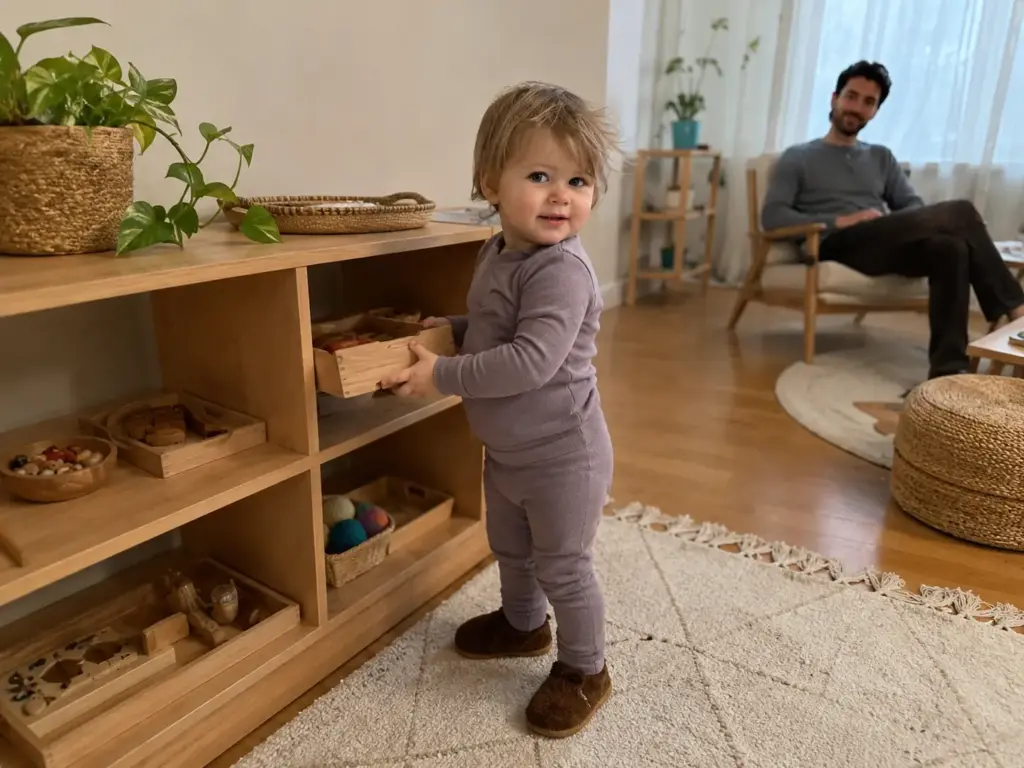
The most practical question — which no comparison article addresses: can parents implement Montessori principles at home if their child attends a Waldorf, Reggio, or traditional school?
The answer is yes. The methods are philosophically different, but their principles are not mutually exclusive at the level of home practice. A child attending a traditional school can have a Montessori-prepared shelf at home building self-direction and executive function outside school hours. A child attending Waldorf can have real wooden materials supporting the concrete math preparation Waldorf delays.
Implementing these five principles at home — accessible shelf, self-correcting materials, adult non-intervention, real outcomes, following concentration — is what produced the 2025 PNAS advantages, and it works regardless of which school your child attends. Choose materials where the child’s precision produces the result — the eight-criteria framework for evaluating any Montessori material makes this test concrete and applicable to both toys you buy and activities you already own.. Present materials once, step back, observe independently. Prioritize real materials with real outcomes. Follow the child’s concentration rather than a schedule.
The research implication: The 2025 Lillard PNAS advantages came from daily practice of these principles during the sensitive periods. That daily practice is available in every home — and supplements every school approach.
Frequently Asked Questions
What is the main difference between Montessori and Waldorf?
The role of imagination during the first six years. Montessori prioritizes real-world, concrete engagement — materials that mirror reality, activities that develop real-world skills — with the belief that fantasy becomes meaningful after a rich concrete foundation. Waldorf treats imagination as the primary educational vehicle in the same window — fairy tales and artistic expression are how children develop thinking. Montessori produces measurably stronger early academic outcomes (2025 RCT); Waldorf produces stronger artistic development by many practitioner accounts, with less rigorous evidence.
What is the difference between Reggio Emilia and Montessori?
Both are child-centered and observation-based. Key differences: Montessori uses specific, structured materials designed for isolated skill development with built-in control of error; Reggio uses diverse open-ended materials supporting emergent project inquiry. Montessori follows a structured curriculum sequence; Reggio follows no predetermined curriculum — projects emerge from children’s questions. Montessori has a strong individual work component; Reggio is primarily collaborative. Both are developmentally appropriate for 3–6, with Montessori having significantly more rigorous outcome research.
What does research say about Montessori vs. traditional education?
A 2025 national RCT (Lillard et al., PNAS, n=588, 24 programs) found Montessori children significantly outperformed traditionally-educated controls in reading, memory, and executive function at end of kindergarten. A 2023 systematic review (32 studies, 132,249 data points) found modest but meaningful positive effects, with the strongest advantages in executive function, creativity, and social-emotional development. Traditional education has extensive research showing strong standardized skill acquisition; the area where it consistently underperforms Montessori is executive function.
Is Waldorf or Montessori better for young children?
For the 0–6 window, the research case is stronger for Montessori. The 2025 national RCT specifically measured outcomes at end of kindergarten and found meaningful Montessori advantages in reading and executive function. Waldorf’s deliberate academic delay until age 7 is developmentally supported for many children — but carries risk for early-ready readers. For 7+, Waldorf’s curriculum deepens and the artistic-holistic approach becomes more developmentally aligned. Many families choose Montessori for 0–6 and Waldorf from age 7 — a legitimate hybrid approach.
Can I use Montessori at home if my child goes to a traditional school?
Yes — and the research advantages are accessible at home regardless of school enrollment. The 2025 PNAS advantages came from daily exposure to Montessori principles during the sensitive periods. Those principles — prepared accessible environment, self-correcting materials, adult non-intervention, following concentration — are fully implementable at home. Children in traditional school who have a Montessori-prepared home environment benefit from both the structured accountability of traditional school and the self-direction, intrinsic motivation, and executive function development that Montessori home practice builds.
What are the disadvantages of each method?
Quality variance is enormous — the name is legally unprotected, meaning any school can call itself Montessori without AMI or AMS certification, the two internationally recognized bodies that verify authentic implementation., transition to traditional school can be initially difficult, assessment without grades means less comparative data. Waldorf: deliberate academic delay carries risk for early-ready learners, no RCT evidence, assumes an imagination base that media-saturated children may need support building. Reggio: extremely teacher-quality dependent, no standardized curriculum means outcomes vary widely, transition to traditional primary can be structurally difficult. Traditional: extrinsic motivation reduces intrinsic engagement over time, passive instruction is developmentally misaligned for under-6, executive function development systematically under-addressed.
The Question Is Never Which Method Is Best — It’s Which Combination Your Child Needs Right Now
Montessori, Waldorf, Reggio Emilia, and traditional education are not competitors — they are different answers to the same honest question: what does this specific child need at this specific moment in their development? The research says Montessori has the strongest evidence base for the 0–6 window. It also says Waldorf’s artistic depth, Reggio’s inquiry culture, and traditional education’s structural accountability each offer things Montessori does not prioritize.
And for parents not enrolled in any of these programs: the Montessori principles that produced the 2025 RCT advantages — prepared environment, self-directing materials, adult restraint, real outcomes from real work — are available at home, every day, for any child in any school.
The principles that produce the strongest outcomes at home are embodied most clearly in Practical Life activities — purposeful household tasks that develop concentration, order, and real-world competence from 12 months onward, regardless of which school approach you’ve chosen.
Kukoo’s wooden materials implement the Montessori principles at home — organized by age, developmental stage, and skill type. Browse Kukoo Montessori Toys by your child’s age now!