
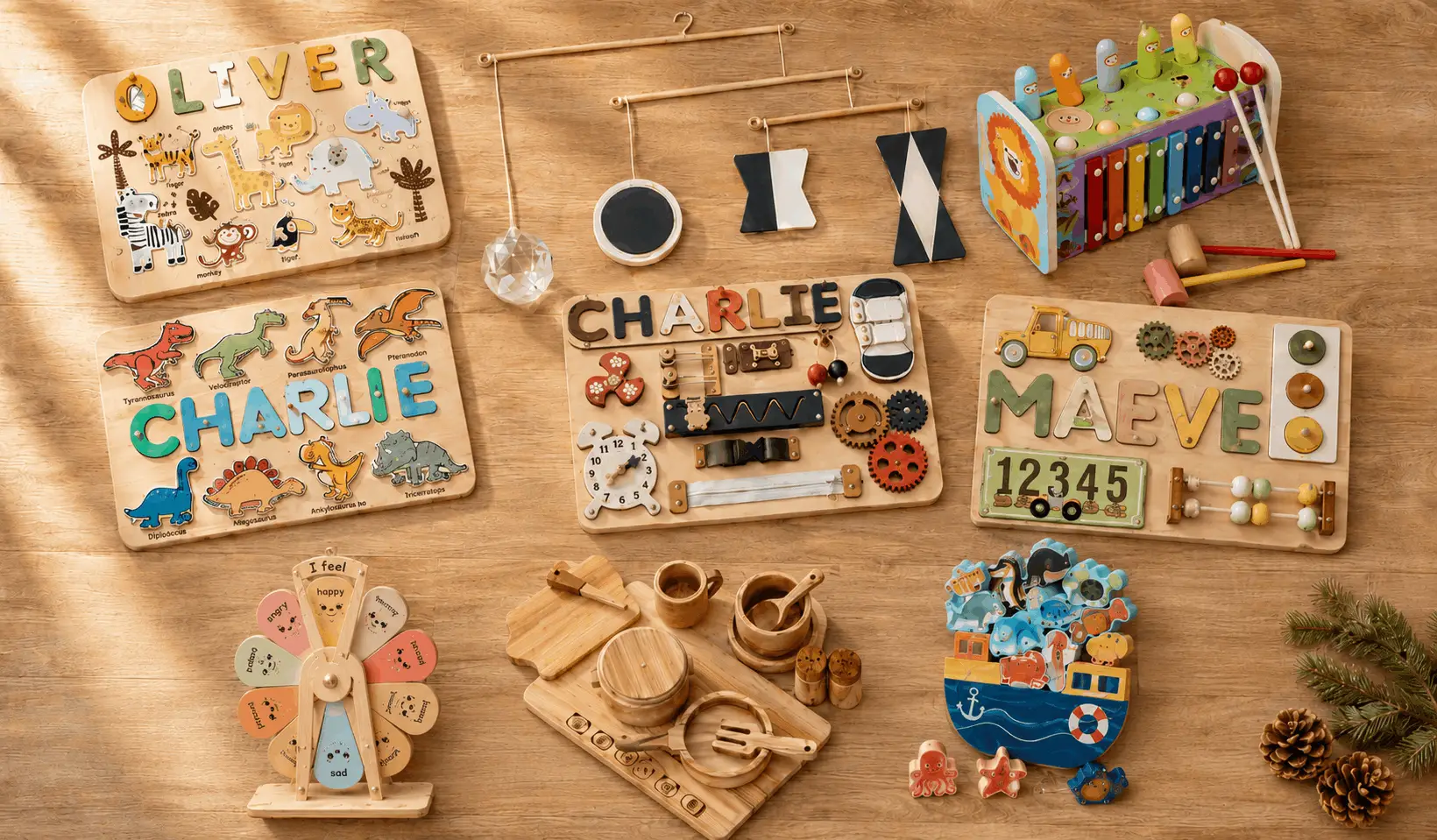
🎄 Ordering personalized gifts? Name puzzles and busy boards are made with your child’s name — order now for guaranteed Christmas delivery.
🎁 All 10 Picks at a Glance
- Montessori Mobile Set — 0–5 months | Visual development
- Musical Hammer Xylophone — 12–36 months | Cause-and-effect + auditory
- Safari Name Puzzle ⭐ Personalized — 12m–4 years | First name recognition + fine motor
- Dinosaur Name Puzzle ⭐ Personalized — 18m–4 years | Literacy + vocabulary for dino fans
- All-in-One Busy Board ⭐ Personalized — 14m–3 years | Practical life fine motor mastery
- Vehicles & Numbers Busy Board ⭐ Personalized — 14m–3 years | Fine motor + numeracy
- Toy Car Parking Garage — 2–4 years | Spatial reasoning + imaginative play
- Ocean Balance Stacking Toy — 18m–4 years | Balance, spatial reasoning, concentration
- Cooking Toy Set — 3–6 years | Practical life + imaginative play
- Emotions Feelings Chart Wheel — 3–6 years | Emotional vocabulary + self-regulation
It’s Christmas morning. The living room is a wrapping paper disaster. Your child is sitting inside the cardboard box the main gift came in, completely ignoring the gift itself.
This isn’t ingratitude — it’s a mismatch. A toy that’s 6 months too advanced is just a frustrating object. A toy matched to exactly where your child is right now? That’s the one still getting played with in February. This list is organized by precise developmental windows, not vague “toddler” ranges, so every gift lands right. These are the best Montessori Christmas gifts for kids aged 0–6 — chosen not by trend, but by developmental fit.
Why Developmental Age Matching Matters More Than Price
Most Christmas gift lists say “ages 1–3.” The problem: a 14-month-old and a 34-month-old are in completely different developmental stages. What engages one frustrates or bores the other.
Children pass through what Maria Montessori called sensitive periods — windows of heightened receptivity to specific types of learning. This periods is when children can absorb particular skills with unusual ease and enthusiasm. A gift matched to an active sensitive period produces deep, sustained play. A gift outside it produces brief novelty, then gets pushed aside.
Children in Montessori programs showed significantly stronger cognitive and social outcomes — attributed largely to the use of age-matched, self-correcting materials rather than passive instruction. The principle applies directly to gift-giving: match the material to the window.
The gifts being played with enthusiastically in January are the developmentally matched ones — which is the same principle behind how Kukoo’s toy range is organized by developmental stage rather than by broad age label.
🎄 Best Montessori Christmas Gifts for Babies (0–12 Months)
Christmas gifts for babies are for the long game. A 2-month-old won’t engage in December — but the right materials become foundational at 4, 6, and 8 months in the new year. The CDC’s developmental milestones for the first year confirm that visual tracking and reaching develop rapidly in the first 4 months — the ideal window to have the right materials already in place.. Choose for what’s coming, not just today.
🎁 Gift #1 — Montessori Mobile Set
🎂 Age: 0–5 months | ⭐ 5.0 | 📦 In stock
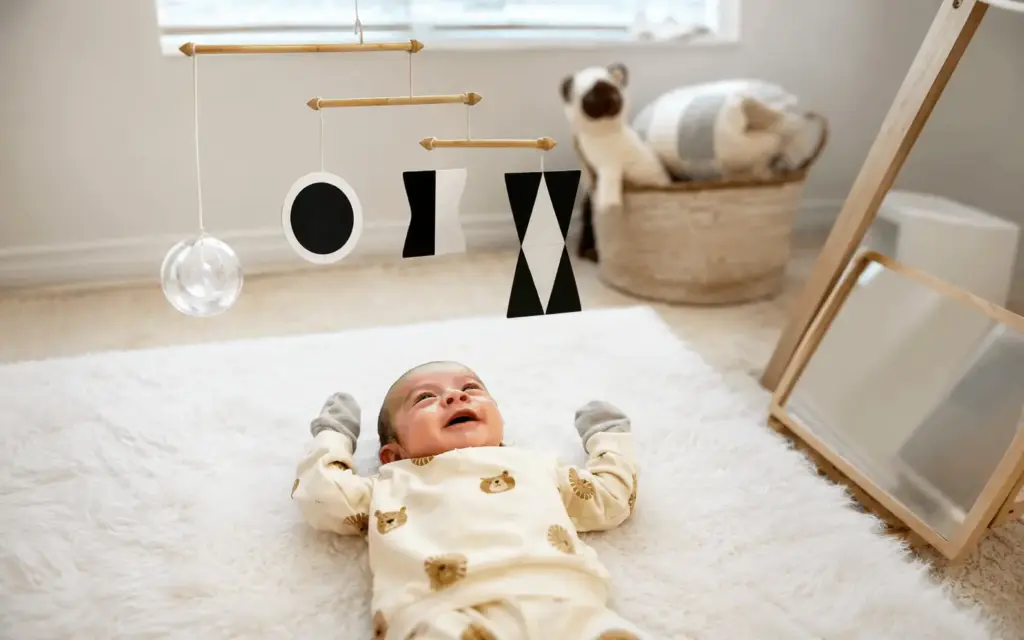
Montessori Mobile Set
WHY IT MADE THE LIST
Newborns have a focal length of roughly 30cm and process high-contrast images before they can perceive pastels. Their visual cortex is building the neural foundations for all future visual discrimination — and this window moves fast. What holds attention at 2 weeks is irrelevant by 6 weeks.
Montessori mobiles are sequenced for this exact trajectory: high-contrast black-and-white for weeks 1–6; primary colors for weeks 6–12; shimmering reflective surfaces for weeks 12–16. One set, four developmental stages across the first year. Most baby Christmas gifts have zero developmental purpose in the first 3 months. This one is specifically designed for it — and parents consistently say it’s the most beautiful object in the nursery.
GOOD TO KNOW
For babies already 4+ months, start from the later mobiles. This gift rewards early ordering — it should be hanging before Christmas, not still in a box.
🎄 Best Montessori Christmas Gifts for Young Toddlers (12–24 Months)
Between 12 and 24 months, children are in a critical window for fine motor development and early language acquisition — they’re discovering cause-and-effect, building vocabulary, and developing the pincer grasp. A well-matched gift at this age gets played with for months, not days.
🎁 Gift #2 — Wooden Musical Hammer Xylophone Toy
🎂 Age: 12–36 months | ⭐ 5.0 | 📦 In stock
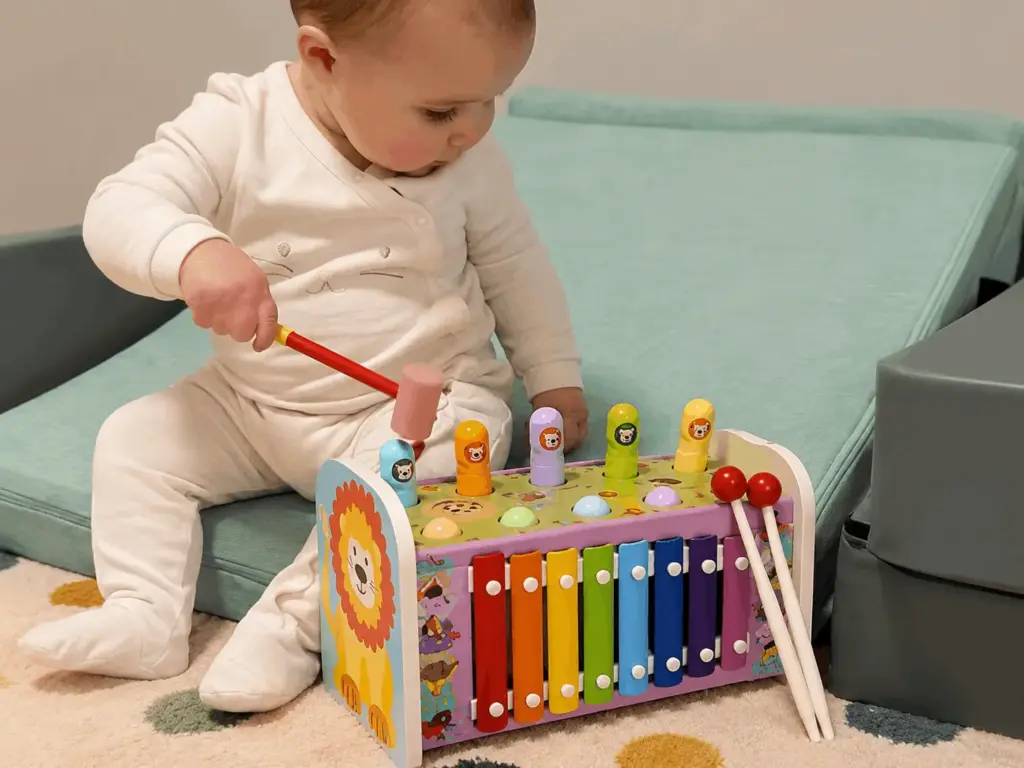
Musical Hammer Xylophone Toy
WHY IT MADE THE LIST
Cause-and-effect is the dominant cognitive drive at 12–24 months: strike the bar, hear the note — immediate, repeatable, satisfying. Children at 14–18 months regularly sustain 20+ minutes of independent play with a xylophone, which is a remarkable concentration window for this age.
This is a real acoustic instrument — wood on wood produces authentic resonance, not digital sound. Research published in PNAS found that musical engagement in infancy enhances the neural processing of temporal structure — the same auditory pathway that supports phoneme discrimination in speech and early reading preparation. The same neural pathways. And on Christmas morning, it produces immediate engagement that adults actually enjoy hearing.
GOOD TO KNOW
Pleasant to listen to — unlike most toddler toys, adults don’t mind being in the same room.
🎁 Gift #3 — Safari Nursery Theme Wooden Montessori Name Puzzle ⭐ Personalized
🎂 Age: 12 months – 4 years | ⭐ 5.0 | ⭐ Personalized — order early
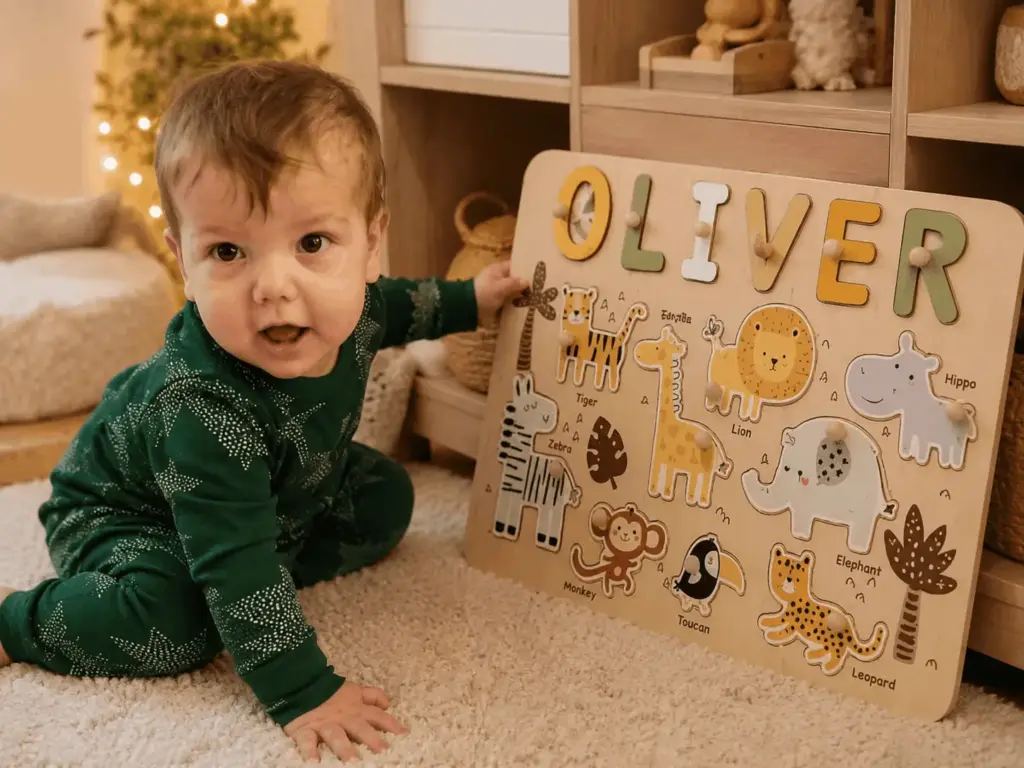
Safari Nursery Name Puzzle
🎄 Personalized — requires your child’s name. Order now for Christmas delivery.
WHY IT MADE THE LIST
Each knobbed letter requires a 3-finger grip — thumb, index, middle finger — the same grip used to hold a pencil. A child using this puzzle regularly arrives at early writing with that hand position already established. Research linking fine motor development in toddlers to writing readiness at school entry is consistent — Cameron et al. found that fine motor skills measured before kindergarten predicted academic achievement at both fall and spring of the kindergarten year.
The safari theme adds a vocabulary layer: lion, elephant, giraffe, and zebra are among the earliest animal names children acquire. The developmental arc runs from 12 months (picking up pieces, tactile exploration) through 4 years (placing letters in order, connecting each to its sound). One gift, four years of relevance.
GOOD TO KNOW
Safari vs Dinosaur (Gift #4): Safari is warmer and more universal. Dinosaur is better for children 18m+ already showing specific dino interest. Both follow the same fine motor and early literacy development sequence — knobbed grip → letter recognition → name-sound connection.
🎁 Gift #4 — Dinosaur Theme Wooden Montessori Name Puzzle ⭐ Personalized
🎂 Age: 18 months – 4 years | ⭐ 5.0 | ⭐ Personalized — order early
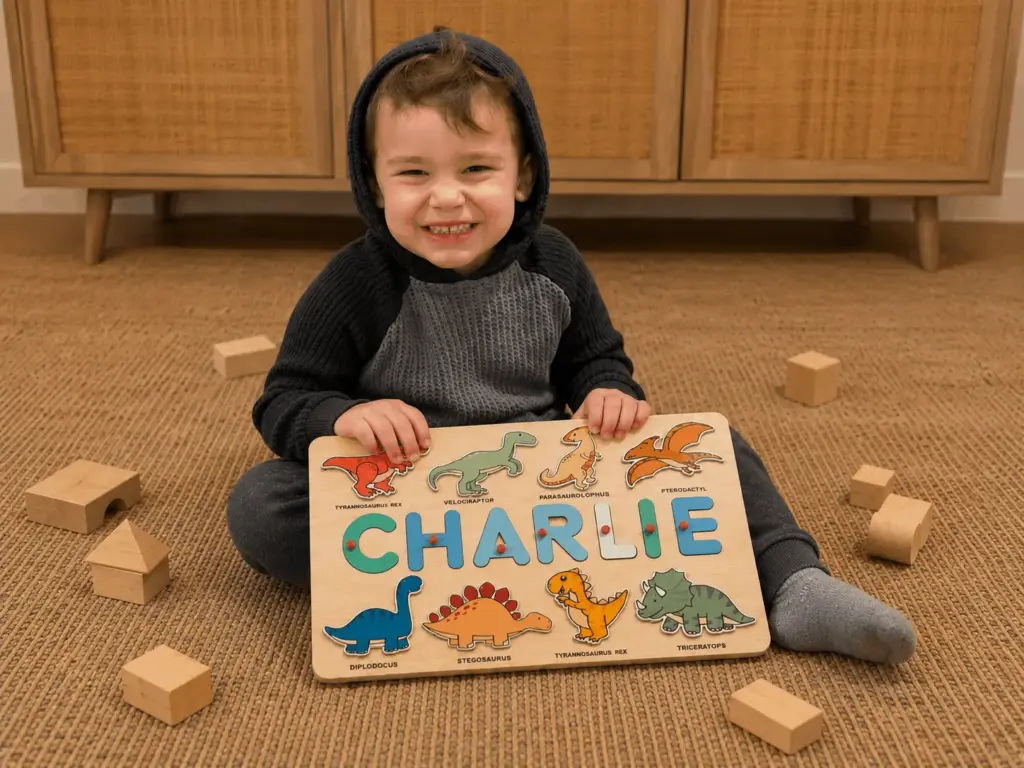
Dinosaur Theme Name Puzzle
🎄 Personalized — requires your child’s name. Order now for Christmas delivery.
WHY IT MADE THE LIST
Same fine motor and literacy mechanics as the Safari puzzle — knobbed letters, tripod grip, 3-year developmental arc. What’s different is the context, and context matters deeply at this age.
Dinosaur fascination is one of the most developmentally significant childhood interests. Research has found that children with intense topic interests (“little professors”) develop larger vocabulary, stronger categorization skills, and longer sustained attention spans. Dinosaur names — Tyrannosaurus, Brachiosaurus, Triceratops — are among the longest words children voluntarily master, and that voluntary mastery generalizes to broader language acquisition.
GOOD TO KNOW
The gift that makes a dinosaur-obsessed child go silent for 20 minutes on Christmas morning.
🎄 Best Montessori Christmas Gifts for Toddlers (2–3 Years)
Two and three-year-olds are in the peak of what Montessori described as the practical life sensitive period — an intense drive to do what adults do, operate real mechanisms, and practice independence. The AAP’s guidance on age-appropriate toy selection notes that fine motor skills and self-help skills — dressing, feeding, fastening — develop most rapidly in the 2–3 year window, making this the highest-return stage for practical life materials.
. Gifts that meet this drive get used every day.
🎁 Gift #5 — All-in-One Wooden Montessori Busy Board ⭐ Personalized
🎂 Age: 14 months – 3 years | ⭐ 5.0 | ⭐ Personalized — order early
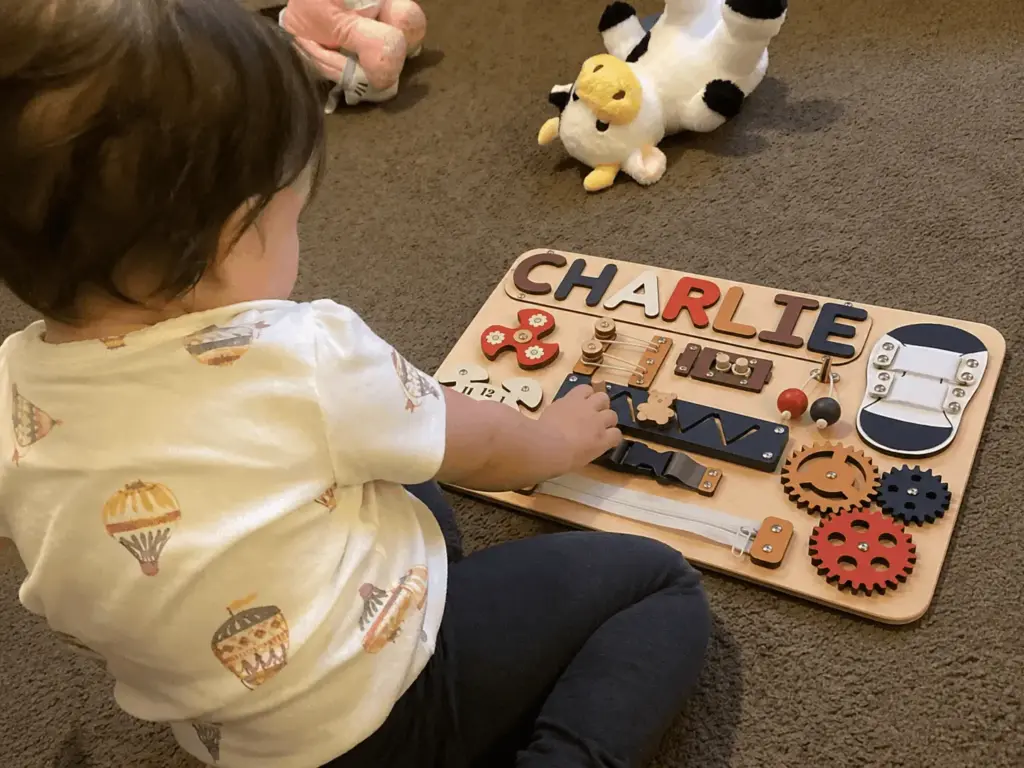
All-in-One Busy Board
🎄 Personalized with your child’s name. Order now for Christmas delivery.
WHY IT MADE THE LIST
Children at 18 months–3 years have an almost compulsive interest in operating real-world mechanisms — zippers, latches, buckles, switches. The busy board channels this drive directly — each element develops one practical life fine motor skill that maps to a real-world task: the zipper IS zipping their jacket, the buckle IS fastening their car seat.. The zipper IS zipping their jacket. The buckle IS fastening their car seat. This isn’t play preparation for real life — it is real life, practiced.
The all-in-one format sustains interest across months: mastering the zipper leads to the buckle, then the latch, then the snap — always something new to figure out. One Kukoo parent told us her 22-month-old spent the entire Christmas morning with the busy board — she got through two cups of coffee before he looked up. The child’s name on the board matters more than adults expect — at 2–3 years, ownership and identity are actively forming.
GOOD TO KNOW
Active engagement begins at ~14 months. At 12 months, expect mostly exploration. By 18 months, focused mastery of individual elements begins.
🎁 Gift #6 — Vehicles & Numbers Wooden Montessori Busy Board ⭐ Personalized
🎂 Age: 14 months – 3 years | ⭐ 5.0 | ⭐ Personalized — order early
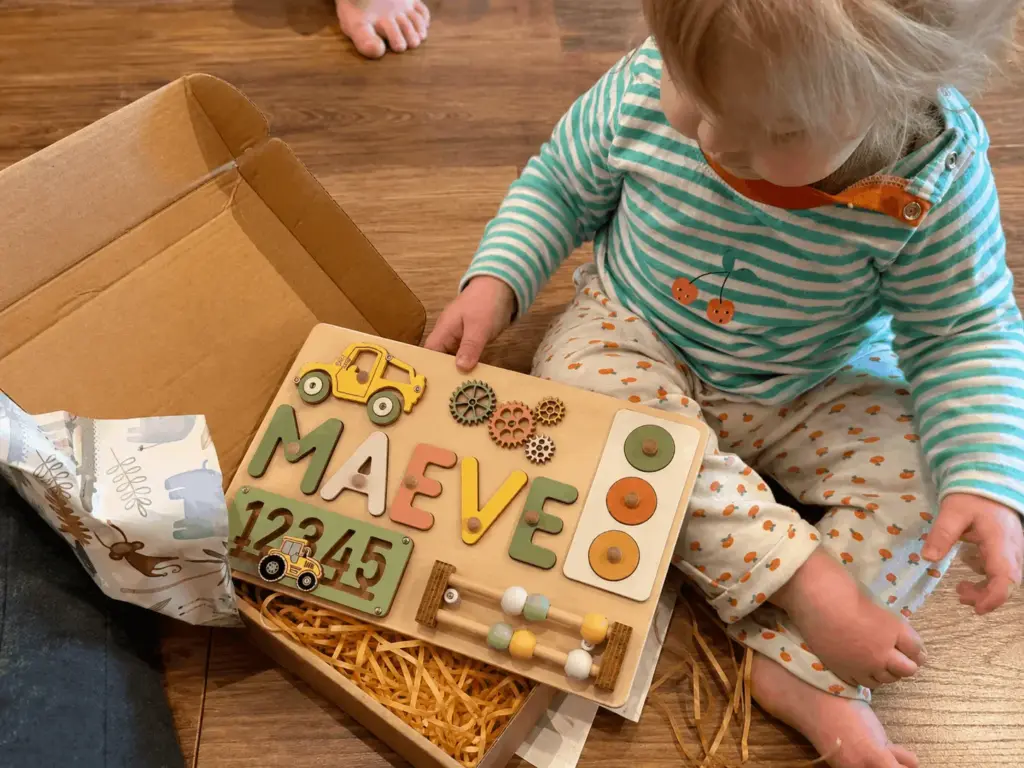
Vehicles & Numbers Busy Board
🎄 Personalized with your child’s name. Order now for Christmas delivery.
WHY IT MADE THE LIST
Identical fine motor development to Gift #5. The distinction is theme — for the vehicle-obsessed child, a transport-themed board creates instant connection that a neutral board cannot. The mechanisms feel more meaningful when they’re part of a world the child already loves.
The numbers woven alongside the vehicles provide ambient numeracy exposure — not a lesson, just repeated visual familiarity that builds numeral recognition naturally over time. Two developmental tracks, one engaging board.
GOOD TO KNOW
Choosing between #5 and #6: Both deliver identical fine motor development. All-in-One is the theme-neutral universal choice. Vehicles & Numbers is perfect for the child already fixated on trucks and transport. If unsure: Gift #5.
🎁 Gift #7 — Toy Car Parking Garage
🎂 Age: 2–4 years | ⭐ 5.0 | 📦 In stock
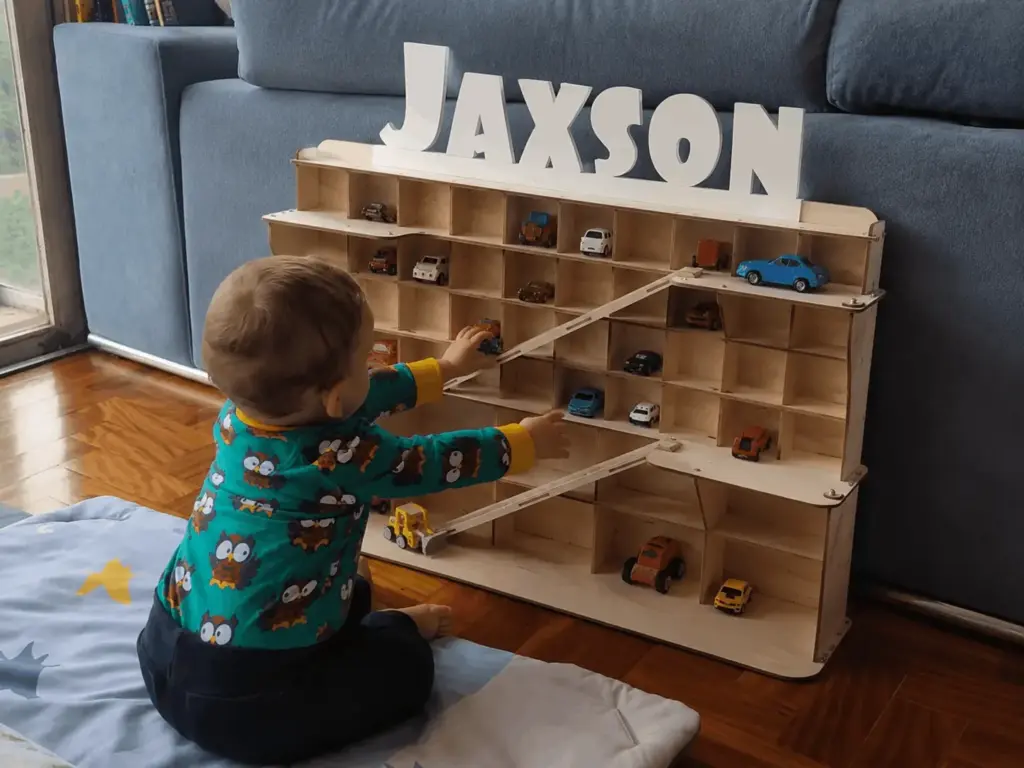
Toy Car Parking Garage
WHY IT MADE THE LIST
From approximately 18 months, children begin creating narratives around their play — cars “go to work,” “come home,” “need to park.” The garage provides the physical structure for this narrative play to unfold and grow in complexity over months. Spatial reasoning develops as the child figures out where each car fits, how to navigate ramps, how to sequence arrivals and departures.
Vehicle play environments consistently produce the longest independent play sessions for 2–4 year olds — 30 to 45 minutes is common. For parents managing Christmas with multiple children, a toy that sustains that level of independent engagement is genuinely valuable.
GOOD TO KNOW
Pairs well with the Cooking Set for a 3-year-old receiving both — vehicle play and kitchen play cover entirely different developmental and imaginative modes.
🎁 Gift #8 — Ocean Balance Stacking Toy
🎂 Age: 18 months – 4 years | ⭐ 5.0 | 📦 In stock
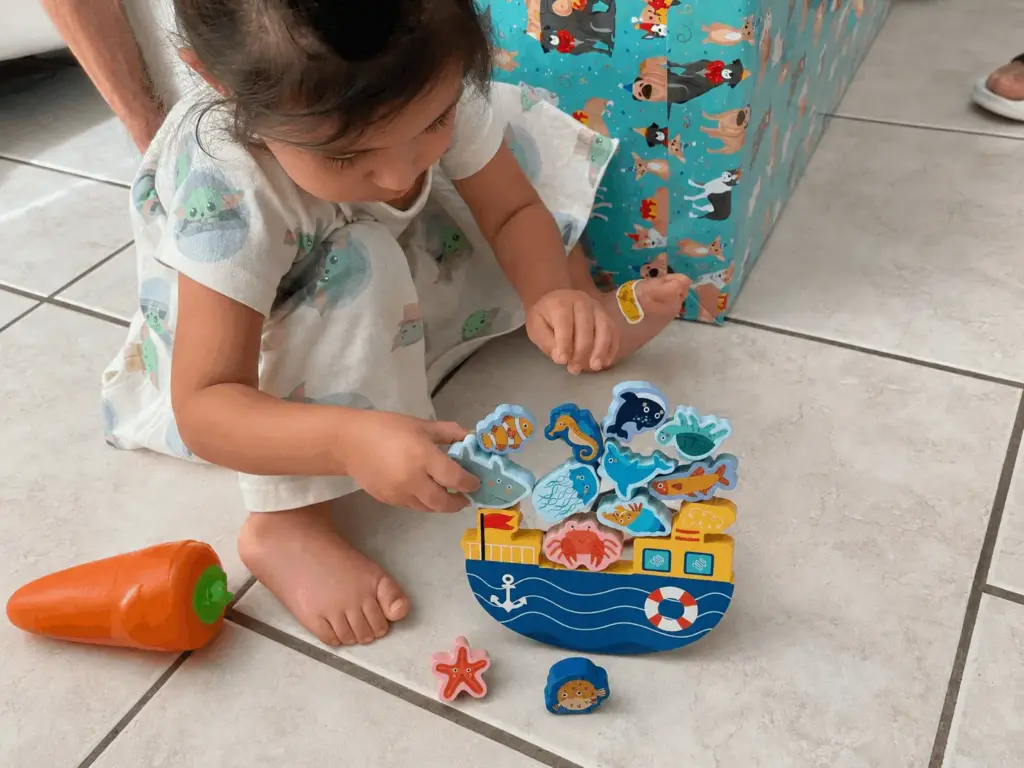
Ocean Balance Stacking Toy
WHY IT MADE THE LIST
Stacking and balance toys target a different developmental track than the busy board or garage: spatial reasoning, size discrimination, and the fine motor control required to place pieces precisely without toppling the stack. The child must adjust grip pressure, observe balance feedback, and self-correct — all independently, with no adult input needed.
Zero to Three identifies stacking and spatial play as foundational for mathematical thinking — noting that children who develop strong spatial reasoning in the toddler years consistently show stronger mathematics performance later.. The connection is direct and well-documented.
The open-ended format extends the developmental window: at 18 months, it’s about stacking as high as possible. At 3 years, it’s about balance and precision. At 4, it’s about creative asymmetrical constructions. Same toy, three different engagements.
GOOD TO KNOW
When the tower falls, that’s not failure — that’s the learning. The self-correction moment is the developmental value.
🎄 Best Montessori Christmas Gifts for Preschoolers (3–6 Years)
Preschoolers have real interests, real opinions, and the capacity for deep, sustained engagement. The gifts that land at this age respect their growing capability and give them something genuinely challenging to master — not something that does the work for them.
🎁 Gift #9 — Wooden Cooking Toy Set
🎂 Age: 3–6 years | ⭐ 5.0 | 📦 In stock
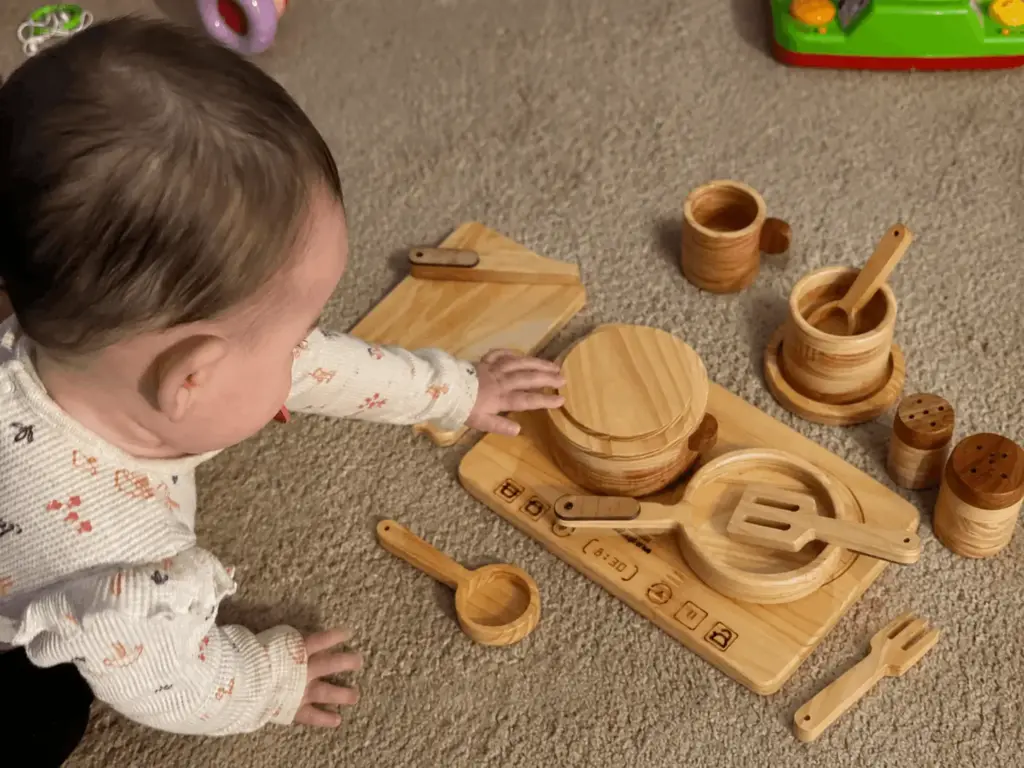
Cooking Toy Set
WHY IT MADE THE LIST
At 3–6 years, children want to participate in real adult activities. Cooking is one of the most universally observed adult activities — and at Christmas, kitchens are active for days. A cooking set mirrors exactly what the child sees happening around them in December, which makes it immediately resonant and engaging.
The developmental content is wider than it appears: measurement concepts (more/less, big/small containers); sequencing (cooking has a start, middle, and end — recipe-following is sequential thinking); fine motor (stirring, ladling, chopping); social language (hosting, taking orders, describing food); early mathematical concepts (counting ingredients). Wooden materials provide real heft and tactile feedback that plastic alternatives cannot — a wooden pot feels purposeful in small hands.
A quality cooking set becomes the backdrop for sustained imaginative play. A 4-year-old can run a “restaurant” for an entire afternoon — assigning roles, taking orders, preparing dishes for guests. Few gifts produce this depth of independent creative play.
GOOD TO KNOW
Best for children already showing kitchen interest — wanting to help cook, watching adults, “playing restaurant.” This gift meets that interest directly.
🎁 Gift #10 — Emotions Feelings Chart Wheel
🎂 Age: 3–6 years | ⭐ 5.0 | 📦 In stock
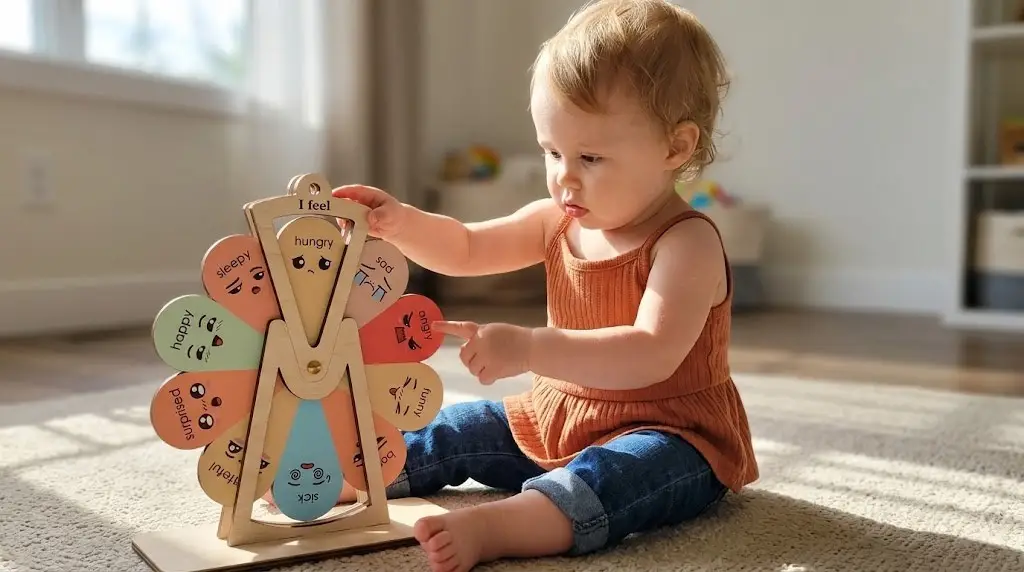
Emotions Feelings Chart Wheel
WHY IT MADE THE LIST
At 3–6 years, children are in a critical window for emotional vocabulary development. Without words to name what they feel, big emotions produce behavior — tantrums, hitting, shutting down. With emotional vocabulary, children can identify, communicate, and begin to regulate.
Research consistently links emotional vocabulary in early childhood to stronger social competence, academic success, and mental health outcomes through the school years — the capacity to name a feeling is a prerequisite for regulating it.. The wheel makes emotions concrete and nameable for a stage when they often feel overwhelming and wordless.
In practice: used proactively during calm moments to build vocabulary, as a tool in upset moments to find the right word, and as a family check-in ritual.
A Kukoo parent shared this after Christmas: “My 4-year-old pointed to the wheel mid-tantrum and said ‘frustrated.’ First time she’d ever used that word. We both stopped.” It’s the rare children’s gift that makes parenting measurably easier — and parents are often more moved by it than the child.
GOOD TO KNOW
Buy this even if you have to explain what it is. The parents will understand by February.
Beyond Toys: Other Montessori Christmas Gift Ideas Worth Knowing
The 10 picks above are curated from Kukoo’s range. But a complete Montessori Christmas gift guide should acknowledge that the best gifts for some children aren’t toys at all. Here are the non-toy categories that Montessori educators most commonly recommend alongside wooden toys:
Good Montessori gifts aren’t limited to wooden toys. Montessori educators most commonly recommend pairing toys with books — Maria Montessori’s The Absorbent Mind for parents, or board books with realistic (not cartoon) illustrations for children. Practical life tools are equally valuable: child-sized pitchers, peelers, and watering cans give preschoolers real tools for real tasks, developing independence more directly than any toy. Art materials with no templates (beeswax crayons, watercolors, clay) let the process be the point. And at 4–6 years, experience gifts — a museum membership, a nature class, a cooking session at a children’s kitchen — often outlast any physical gift in memory and meaning.
These categories don’t replace well-chosen wooden toys — they extend the Montessori gift ecosystem. A name puzzle + a child-sized pitcher + a nature journal is a more complete Christmas gift than any single item alone — and Montessori toy rotation principles explain how to introduce new materials gradually rather than all at once.
Christmas Gifts by Age — Quick Reference
| Gift | Age | Personalized? | Focus |
| Montessori Mobile Set | 0–5 months | ❌ No | Visual development |
| Wooden Xylophone | 12–36 months | ❌ No | Cause-effect + auditory |
| Safari Name Puzzle | 12m–4 years | ✅ Order early | Literacy + vocabulary |
| Dinosaur Name Puzzle | 18m–4 years | ✅ Order early | Literacy + dino interest |
| All-in-One Busy Board | 14m–3 years | ✅ Order early | Practical life + fine motor |
| Vehicles Busy Board | 14m–3 years | ✅ Order early | Fine motor + numeracy |
| Toy Car Parking Garage | 2–4 years | ❌ No | Spatial + imaginative play |
| Stacking Balance Toy | 18m–4 years | ❌ No | Balance + spatial math |
| Wooden Cooking Set | 3–6 years | ❌ No | Practical life + social play |
| Emotions Chart Wheel | 3–6 years | ❌ No | Emotional vocabulary |
- Want something they’ll keep forever: Any name puzzle (Safari or Dinosaur)
- Want something they’ll use every day in the new year: Busy Board (All-in-One or Vehicles)
- Want something different from everything else under the tree: Emotions Feelings Chart Wheel
Best combinations: Mobile + Xylophone for a baby’s first Christmas. Name Puzzle + Busy Board for a toddler. Parking Garage + Cooking Set for a 3-year-old. Any of these pairs covers both the personal and developmental dimensions — and the full Kukoo gift guide extends these combinations across occasions beyond Christmas.
The Gifts That Last Beyond December
Most Christmas toys have a 2-week engagement window. Developmentally matched wooden toys have a 12–24 month window. This is the design: when a toy meets the child where they are, mastery is gradual, challenge is sustained, and the toy evolves in how the child uses it.
They’re safe to mouth (no BPA, phthalates, or PVC — verified against ASTM F963 and EN71 standards), beautiful enough to keep visible in the home, and designed to teach through use. No batteries, no adult direction required. The approach comes from Montessori education: real materials, real feedback, child figures it out independently.
Frequently Asked Questions
Q: What are the best Montessori Christmas gifts for toddlers aged 1–3?
Match the exact age, not the whole range. 12–18 months: xylophone and name puzzles. 18–24 months: add busy boards (practical life sensitive period is peaking). 2–3 years: busy boards, parking garage, and cooking set. Use the age table above — a gift perfect at 14 months won’t challenge a 30-month-old.
Q: What are the best Montessori Christmas gifts for kids overall?
The ones still being played with in March. By category: mobile set (visual, 0–5 months), xylophone (cause-effect, 12–36 months), name puzzles (literacy + identity), busy boards (practical life), parking garage (spatial play), cooking set (imaginative life), emotions wheel (emotional intelligence). Developmental match is why engagement lasts months, not weeks.
Q: Are personalized Montessori Christmas gifts worth the extra planning?
Yes. A name puzzle or personalized busy board is the only gift under the tree that couldn’t have been bought for any other child. That distinction extends developmental engagement. The planning: order 1–2 weeks ahead of your market’s Christmas deadline for a gift with a 3–4 year arc.
Q: What Montessori Christmas gifts are best for overstimulated children?
Wooden toys with natural materials activate calm focus rather than arousal. Best picks: name puzzles, stacking balance toy, busy boards — all pass the 8 Montessori toy design criteria that distinguish genuinely calming materials from ones that merely look natural.
Q: How far in advance do I need to order personalized Christmas gifts?
Order name puzzles and busy boards by mid-November. Exact order-by dates for each market (US, UK, Canada, Australia) are listed at the top of this page. Non-personalized gifts can be ordered later.
Q: What’s the best Montessori Christmas gift for a child who has everything?
The Emotions Feelings Chart Wheel — it opens a new capability rather than adding to an existing one, and it’s unlikely to duplicate anything they have. A personalized name puzzle in their favorite theme is also uniquely theirs. For play: the Cooking Set opens an entirely different imaginative mode than most existing toys.
Christmas Gifts They’ll Still Love When the Decorations Come Down
The cardboard-box child isn’t a gifting failure — it’s a developmental reality. A toy that’s exactly right for where they are is the thing that makes even that child look up from the box. Not because it flashes or sings. Because it fits.
- Personalized picks: Safari or Dinosaur Name Puzzle, All-in-One or Vehicles Busy Board — uniquely theirs, years of return.
- Developmental picks: Mobile Set, Xylophone, Parking Garage, Stacking Balance Toy, Cooking Set — matched to exact windows.
- The different pick: Emotions Feelings Chart Wheel — the gift that makes parents as grateful as the child.
🎄 Final reminder: personalized gifts (name puzzles + busy boards) need advance ordering. Order soon at Kukoo Montessori for guaranteed Christmas delivery.