
Your 3-year-old has started asking “why” for everything. Why is the sky blue? Why do leaves fall? Why is the dog’s nose wet? Somewhere around the third follow-up, you run out of answers — and they don’t. That relentless “why” isn’t exhausting behavior. It’s the most important signal a 3-year-old can send: my conscious mind has switched on, and I am hungry for the world’s logic. Montessori built an entire curriculum around that hunger.
Age 3 is where Montessori changes fundamentally. The child under 3 absorbs the world without deliberate effort. At 3, your child begins to pursue knowledge actively — seeking names, reasons, and categories. This guide is organized by the five curriculum areas Montessori uses for this age — Practical Life, Sensorial, Language, Math, and Cultural — because that’s how development actually unfolds at 3.
| Montessori activities for 3-year-olds are organized across five curriculum areas — Practical Life, Sensorial, Language, Mathematics, and Cultural — matching the structure of the Montessori primary environment. Age 3 marks the transition from the unconscious absorbent mind to the conscious learning mind. The 3-year-old is no longer absorbing passively — they are actively seeking to understand, classify, and name every part of their world. |
The Age-3 Transition — Why Activities Must Change
The child under 3 absorbs language, movement, and culture without deliberate effort. At approximately 3, this absorption becomes conscious — the child actively pursues knowledge, seeks names and reasons, and engages as a learner. Four observable shifts mark this transition:
1. Questions replace observation — the relentless “why” is intellectual appetite, not behavior. Feed it with real answers and real materials.
2. Symbols become interesting — letters and numbers, previously abstract, now attract. Sandpaper letters fascinate a child who ignored them at 2.5.
3. Classification becomes exciting — sorting animals by habitat, ordering by size, grouping by type. The mathematical mind is becoming conscious.
4. Concentration deepens — the 3-year-old can work on a single activity for 20–30 uninterrupted minutes. This window is precious; protect it.
Implication: A balanced shelf now includes all five curriculum areas. Practical life alone — sufficient at 2 — will no longer satisfy the 3-year-old’s intellectual appetite. This shift is not isolated — it’s one specific point in the developmental arc from birth through age 6, and the activities at 3 build directly on the practical life and sensorial foundations the child established during the two years before
| The shift I see at exactly age 3 is unmistakable. A child who spent their second year in purposeful practical life work arrives at 3 ready for intellectual engagement. The activities below are the environment that engagement requires. – Katy Lenoir, Preschool & Elementary Expert (3–12) |
Practical Life Activities
At 3, practical life activities deepen from single-task work into full multi-step sequences with real outcomes. The 3-year-old’s extended concentration window makes these longer work cycles deeply satisfying.
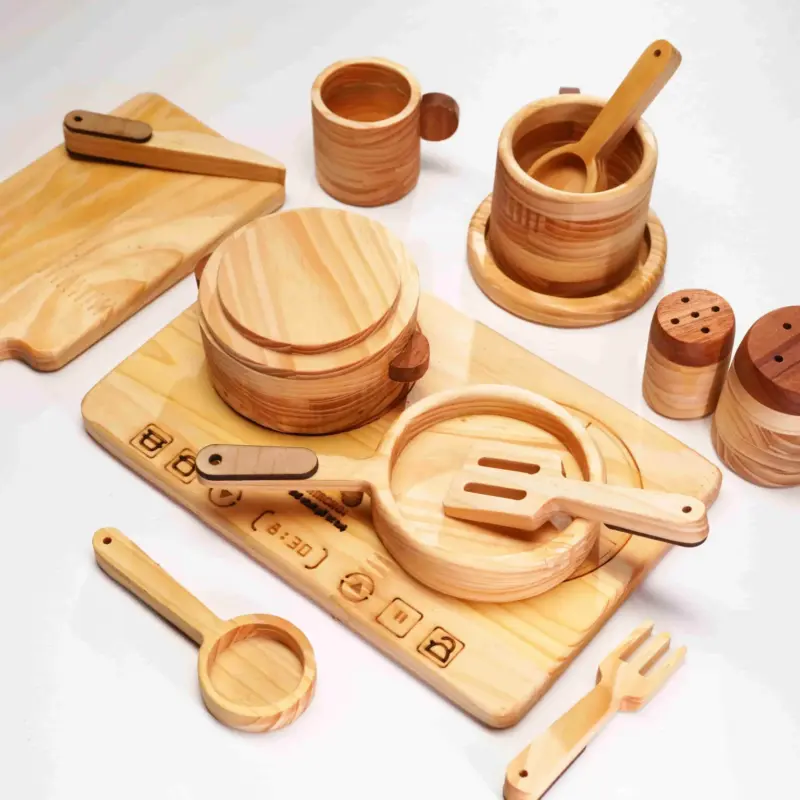
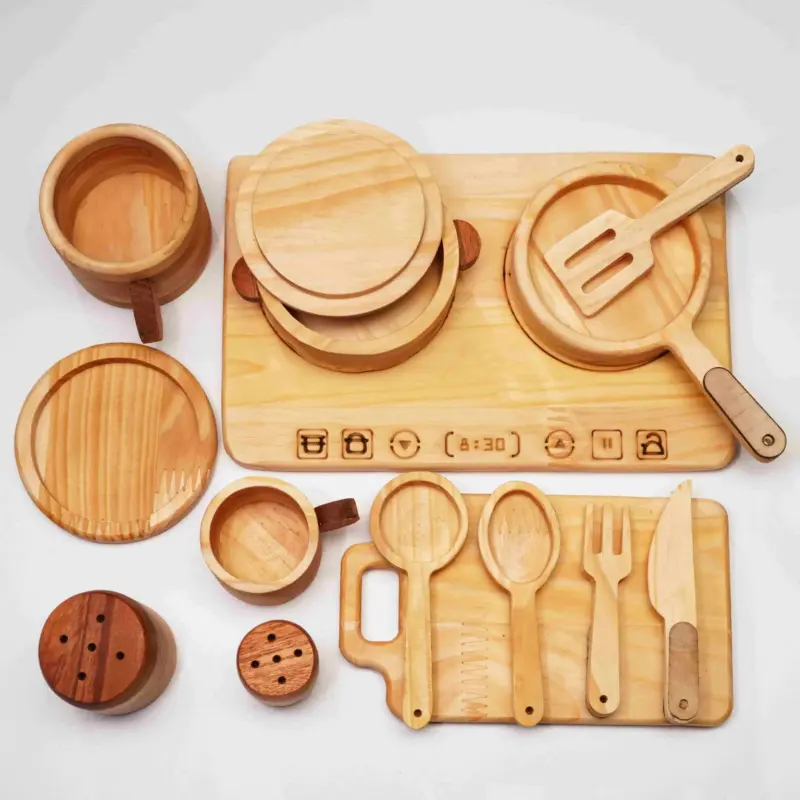
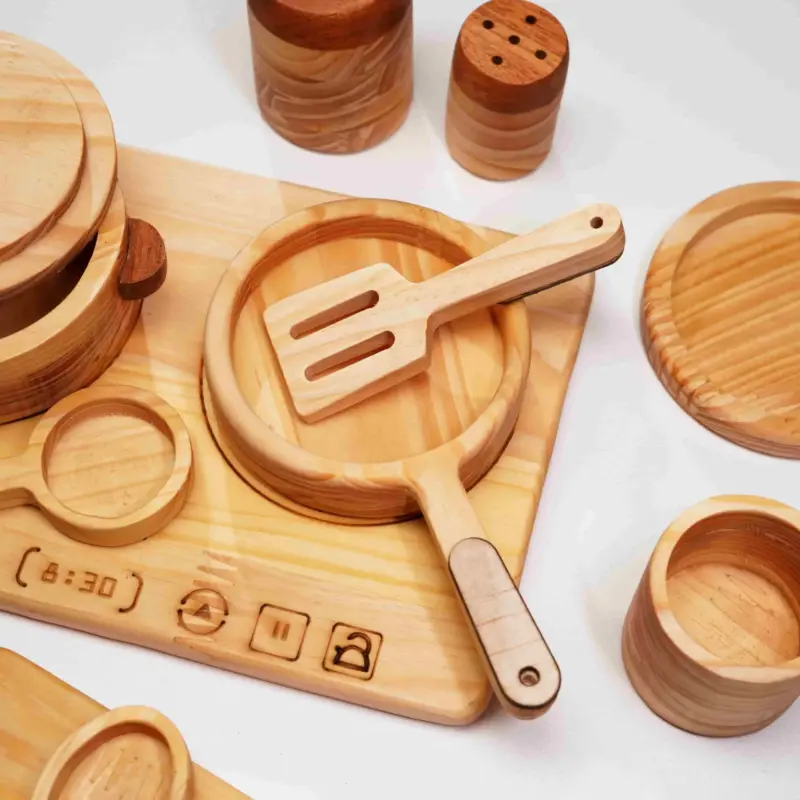
Advanced Food Preparation — From Ingredients to Serving
- What it develops: Multi-step sequencing, bilateral coordination (mature), genuine family contribution, concentration. Full snack sequence using Montessori kitchen tools: cutting soft food → spreading → plating → serving → washing up. Real outcome matters: the child eats what they prepare. This is not simulation.
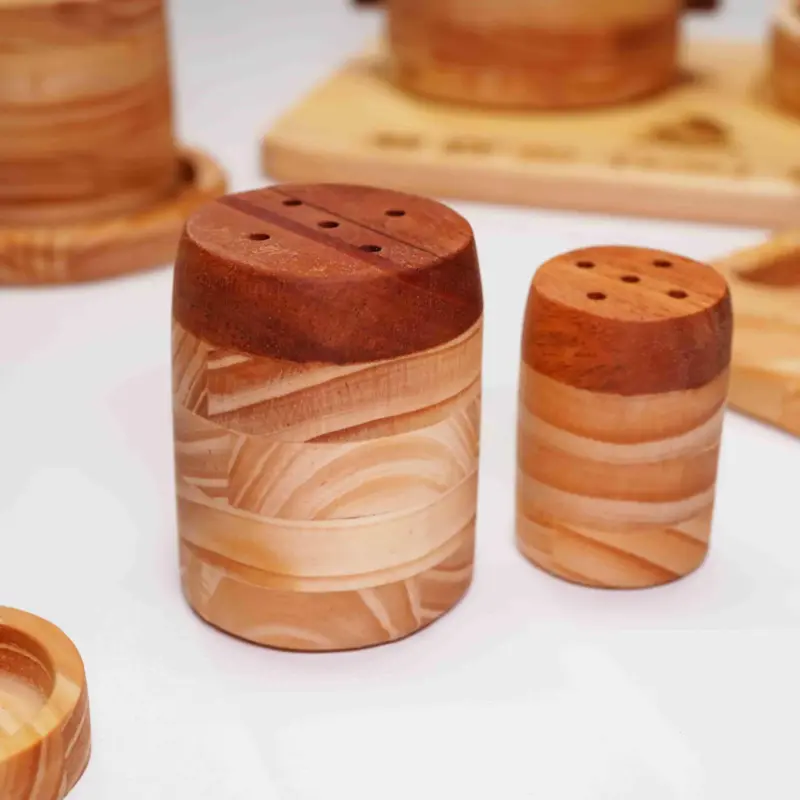
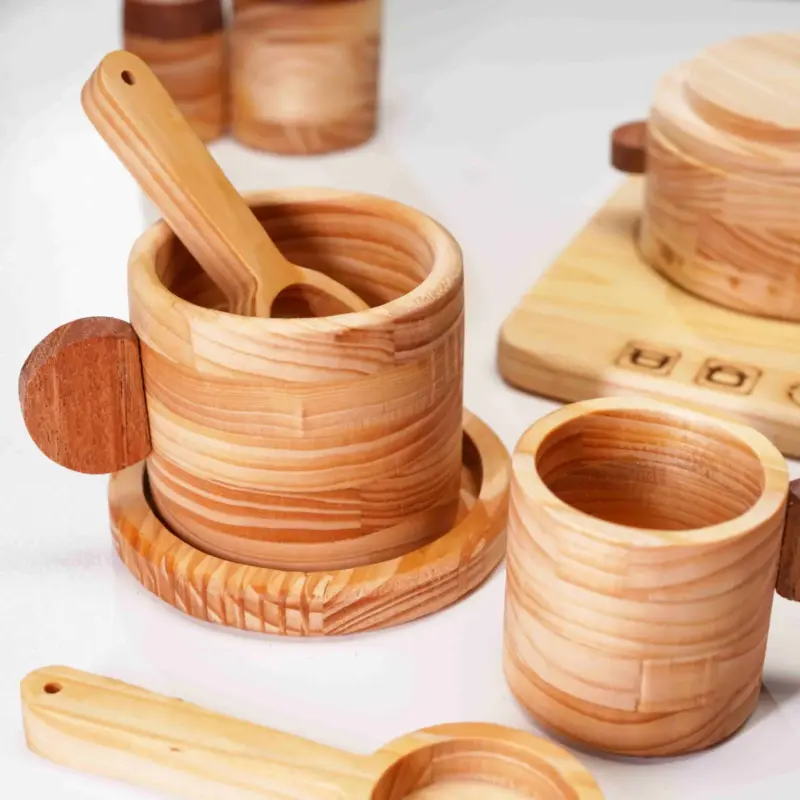
Folding — Cloth to Precision (HowTo)
- What it develops: Bilateral coordination, visual-spatial precision, geometric awareness. Setup: square cloth on low table.
1. Lay cloth flat; smooth with both hands.
2. Bring bottom edge to top edge — align corners exactly.
3. Run finger along fold from center outward; press firmly.
4. Bring right edge to meet left; align again.
5. Place folded cloth in designated location.
6. Unfold; slide toward child; step back.
- Progression: Half fold → quarter fold → triangle → napkin fold for table setting.
Table Washing — Full 7-Step Sequence
- What it develops: Concentration, sequencing, care of environment. Fill bucket → soap sponge → wash in circles → rinse → dry → empty bucket → hang cloths. The 7-step sequence requires the concentration window reliably present only from ~3 years. Provide a pictorial sequence card — child self-directs from the card without adult narration.

Sensorial Activities
Montessori’s sensorial curriculum was designed specifically for the 3–6 year old’s conscious drive to classify and discriminate. Each sensorial material isolates one quality — size, sound, shape — inviting the child to order, grade, and name it Color grading (color tablets) and texture discrimination (texture tablets) work on the same isolation-of-quality principle; the three materials below develop different sensory channels.
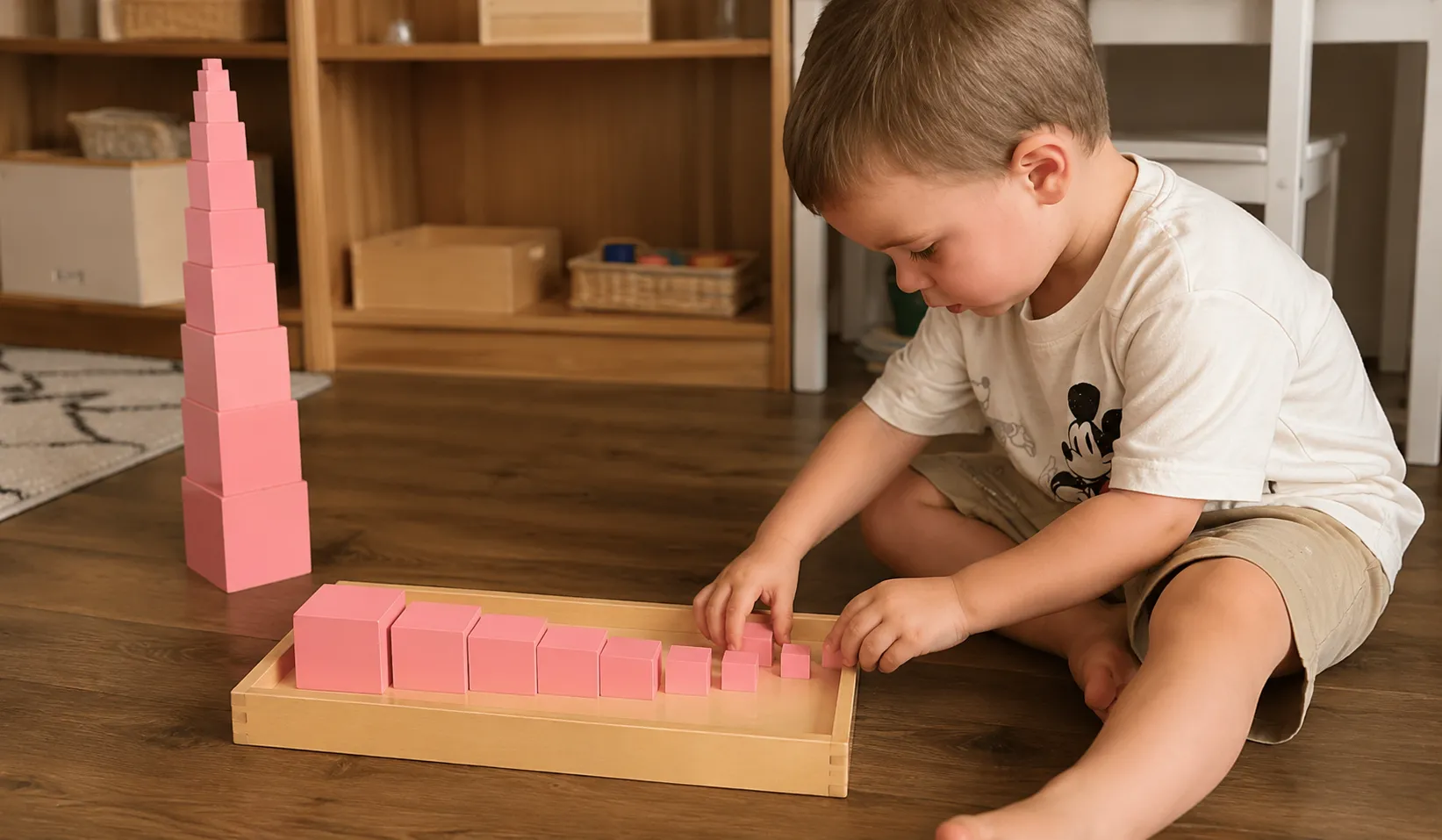
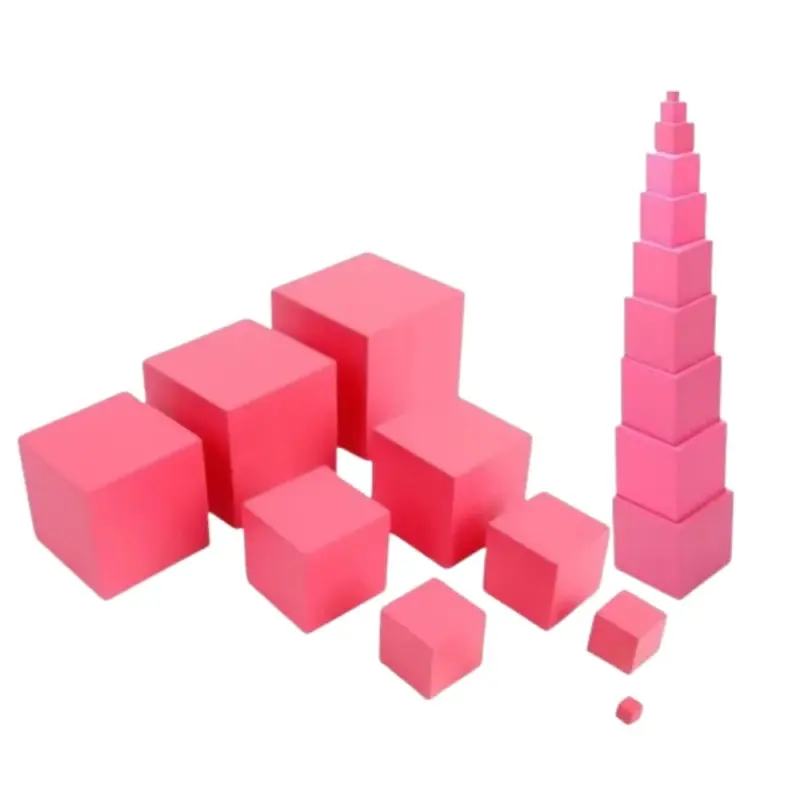
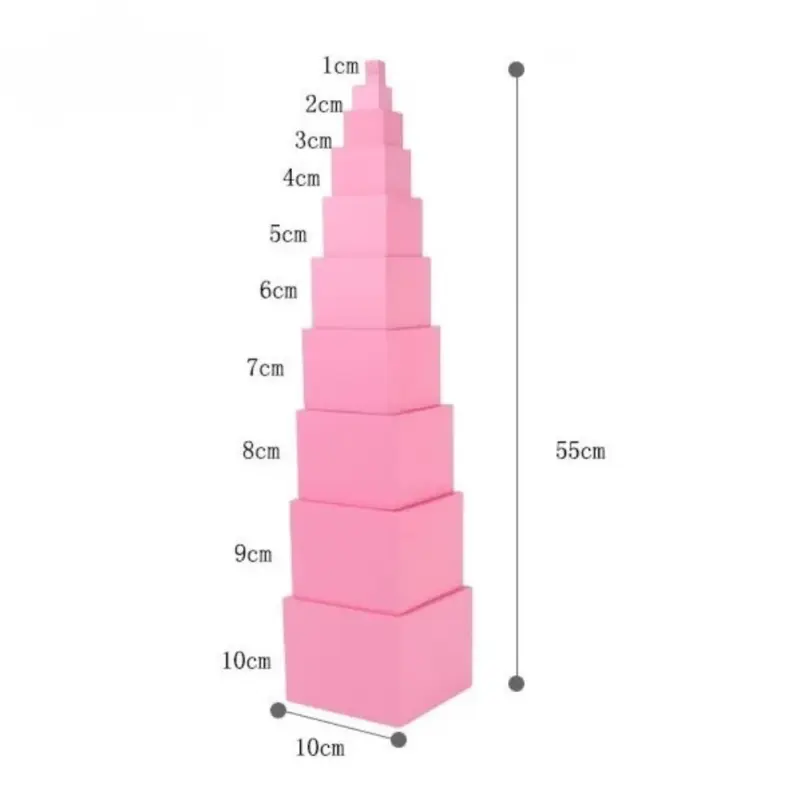
Pink Tower — Visual Size Discrimination
- What it is: 10 cubes from 1cm³ to 10cm³, graduated in one dimension only.
- What it develops: Visual discrimination of size in 3D, systematic ordering, comparative vocabulary (bigger/smaller/biggest/smallest), mathematical mind (10-unit sequence). Three-Period Lesson: “This is the big cube. This is the small cube. Show me the big cube. What is this?” Extensions: build vertically (tower) → horizontally (stair) → mix with Brown Stair → close-eyed ordering by feel alone. Each extension deepens the same concept through a different sensory channel. The Pink Tower is Montessori’s most recognized sensorial material because it’s also its most effective — the child learns size gradation by holding the difference in both hands simultaneously.
Sound Cylinders — Auditory Discrimination
- What they are: 6 pairs of identical containers with different fills (sand, rice, metal pellets) creating different sound volumes. Child matches pairs by shaking and comparing, without visual cue.
- What it develops: Auditory discrimination (precise), systematic pairing without visual confirmation, vocabulary (loud/soft/loudest/softest). Present: shake one cylinder, invite child to find its match from the opposing set. Red-capped cylinders match blue-capped — child self-corrects using color coding. Auditory sensorial work is overlooked in most activity guides, but sound cylinder work directly prepares the ear for phonological awareness — the same discrimination skill that makes I Spy and sandpaper letters effective.
Mystery Bag — Tactile-Spatial Shape Identification
- What it is: Opaque bag with 5–8 geometric wooden shapes; child reaches in, identifies by touch only, names before withdrawing to confirm.
- What it develops: Tactile-spatial reasoning, geometric vocabulary (sphere, cube, cylinder, prism), in-hand manipulation, concentration. Three-Period Lesson integration: introduce shape names with physical solids first (Period 1) → identify by sight (Period 2) → identify by touch alone in the bag (most advanced). The bag removes visual input entirely, isolating tactile intelligence. Extension: two mystery bags — match identical shapes between bags by touch alone, without withdrawing either piece.
Language Activities
The 3-year-old’s language drive is at its most powerful — they want names for everything, including long, precise scientific ones. Maria Montessori wrote that the child loves strange, long words like the names of dinosaurs and constellations. Feed this drive with precision.
Sandpaper Letters — Three-Channel Encoding (HowTo)
- What it develops: Phonological awareness (letter sounds), pre-reading, pre-writing, tactile learning. Setup: 2–3 sandpaper letter boards.
1. Choose 2–3 contrasting letters (m, s, a) — never similar-looking pairs (b/d) first.
2. Trace first letter with first two fingertips, following stroke direction.
3. While tracing: say the sound “mmm” — not the letter name “em.”
4. Hand to child; let them trace; say sound once more.
5. Period 2: “Show me the one that says mmm” — child points or picks up.
6. Period 3 only when Period 2 is solid: “What sound does this make?”
- Critical: Say the SOUND not the letter NAME. Sounds are the reading foundation. Introduce 2–3 letters per week maximum. Spiraling back is more powerful than racing forward. Nomenclature cards (three-part picture-label-control sets) extend precise vocabulary to scientific naming — animals, plants, geography — using the same self-correcting Three-Period Lesson principle.

I Spy — Beginning Sounds
- What it develops: Phonological awareness, attention, vocabulary. Small basket of 5–8 real objects: “I spy something that starts with /b/.” Appropriate at 3.5yr for sound-based I Spy; for younger 3yr, use color or shape version only.
Name Puzzle — Full Pre-Literacy Work
- What it develops: Pre-literacy, identity, fine motor (edge-pinch grip = tripod precursor). No-peg version at 3 — each letter is handled, named, sounded. Move to Period 3: child names each letter. Begin letter-sound connection once sandpaper letters are established. The developmental case for a name puzzle at this stage goes well beyond pre-literacy
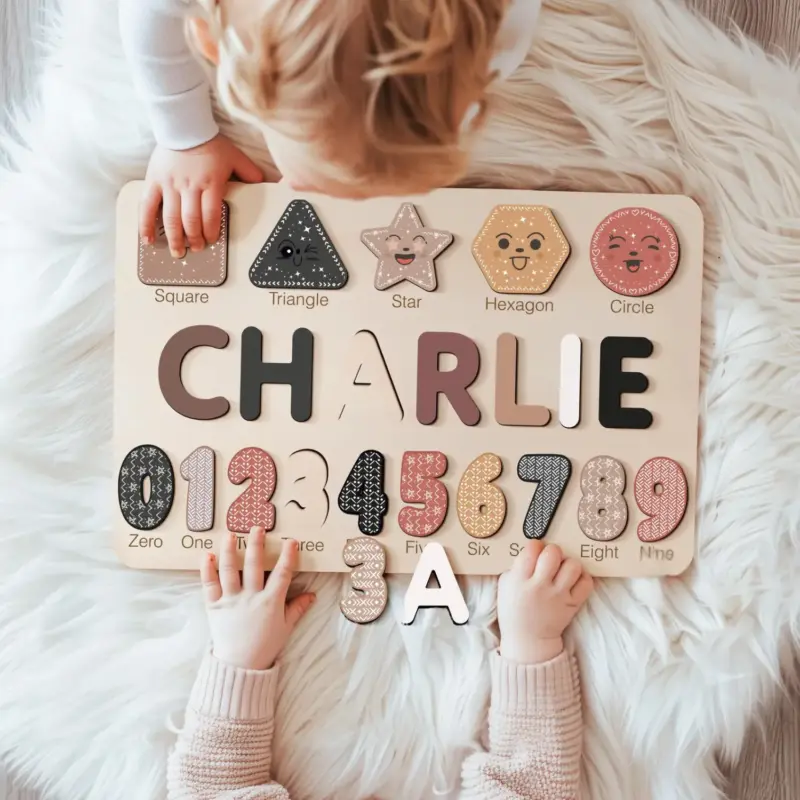
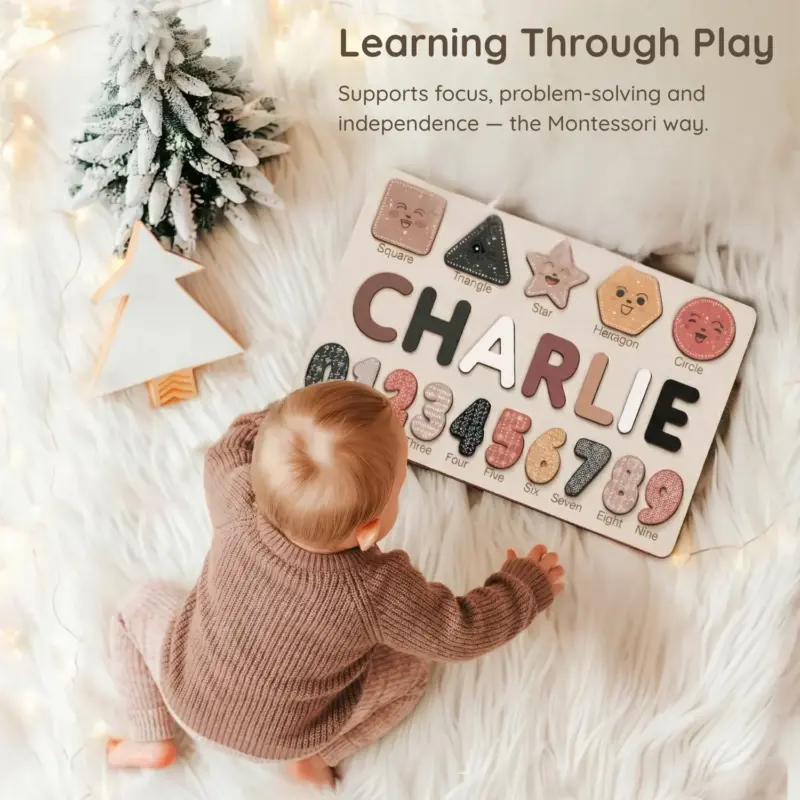
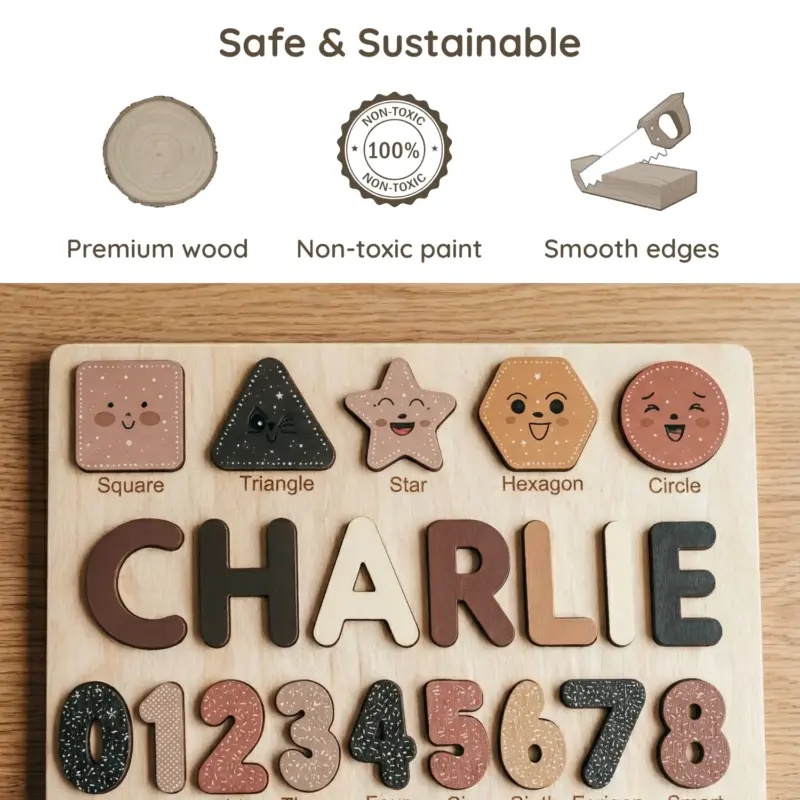
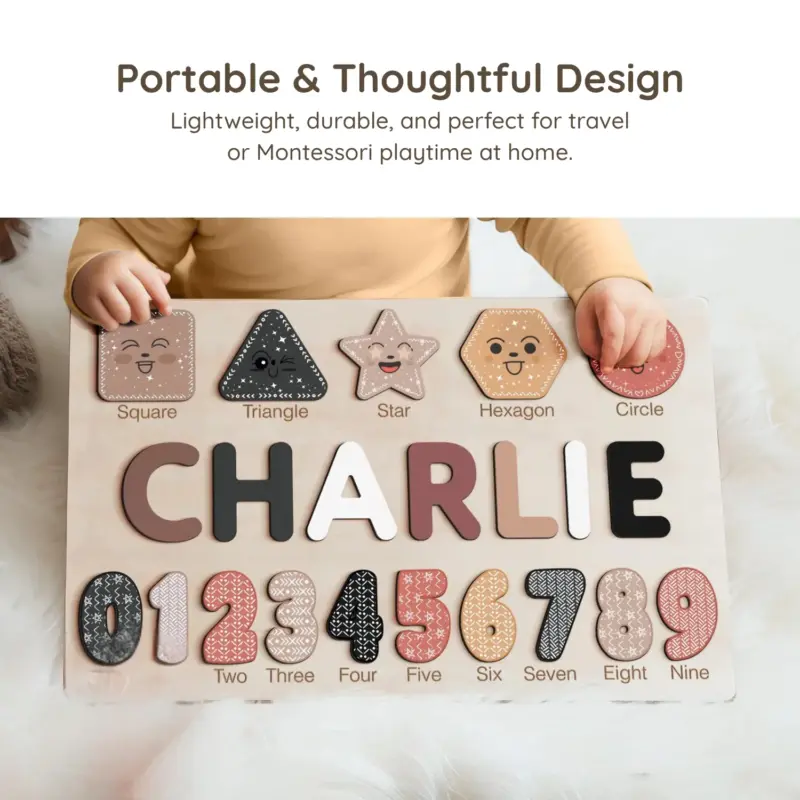
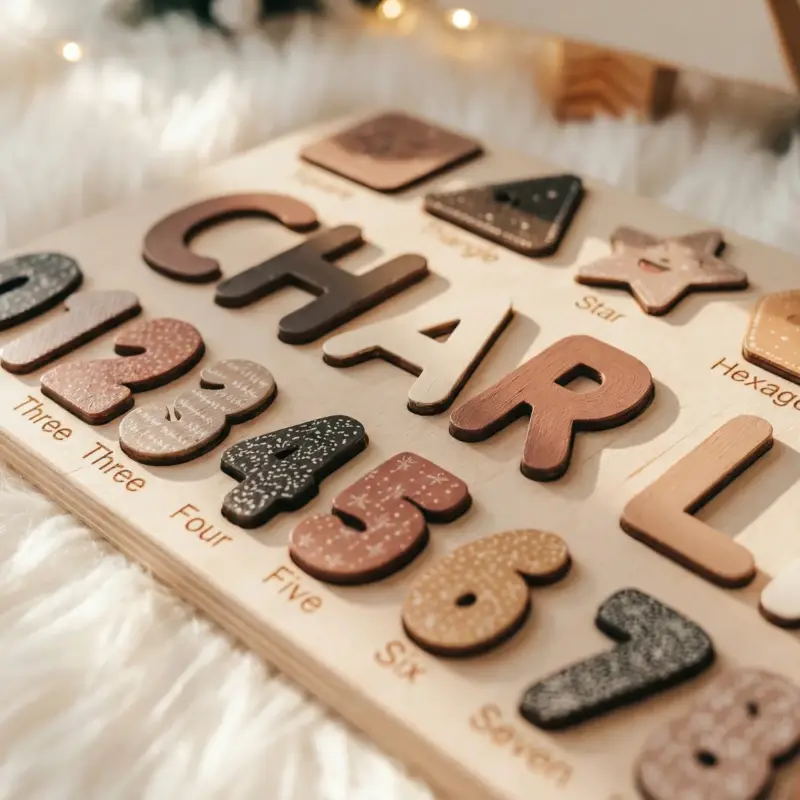
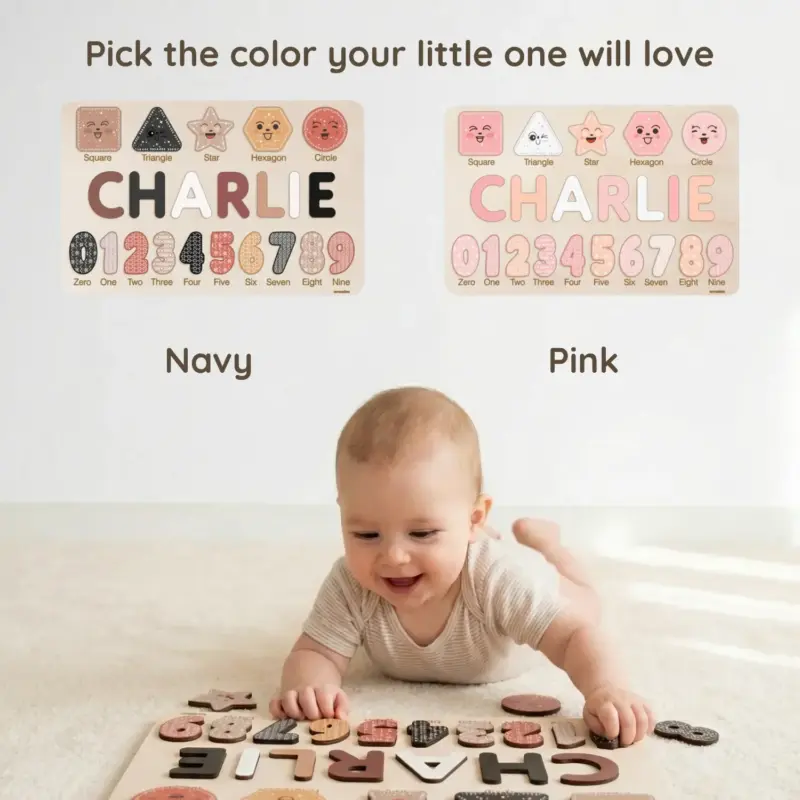
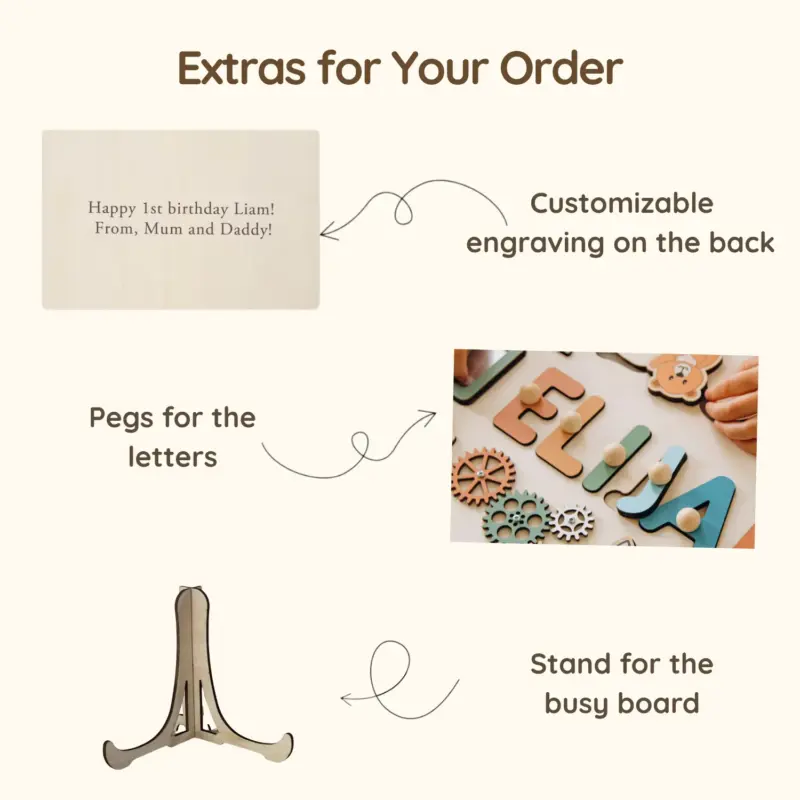
Shapes & Numbers – Wooden Montessori Name Puzzle
Math Activities
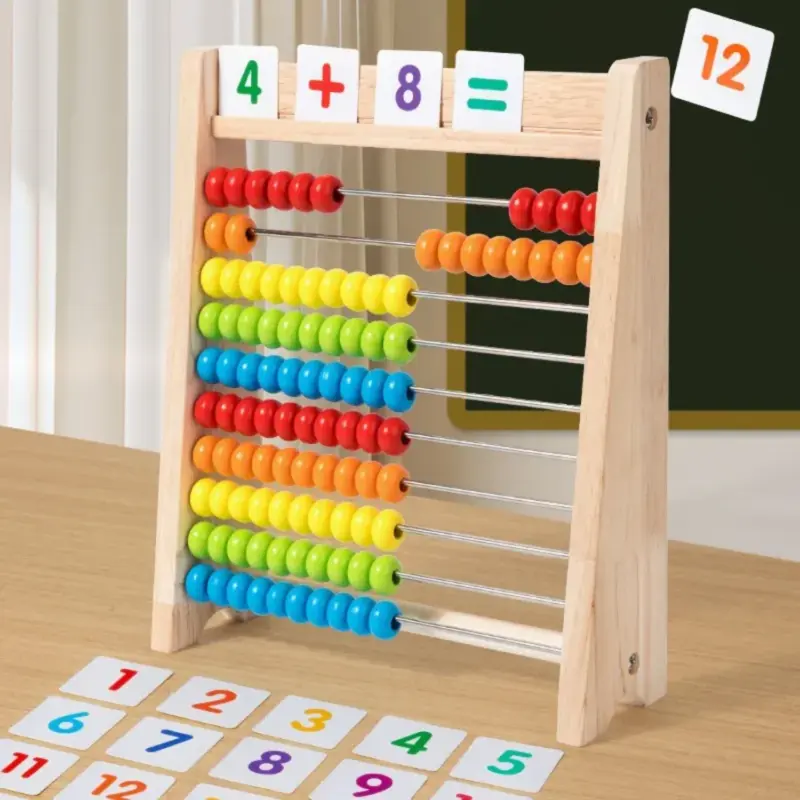
The 3-year-old’s mathematical mind actively seeks to count, compare, and connect quantities to symbols. Two materials form the core of this transition.
Cards and Counters — Quantity-Symbol Matching (HowTo)

- What it develops: One-to-one correspondence, cardinality, quantity-symbol matching, odd/even concept.
1. Place numeral cards 1–10 left to right.
2. Place “1” card; count out 1 counter below it.
3. Place “2”; count out 2 counters in paired arrangement.
4. Place “3” — note the unpaired counter; this is the odd/even visual.
5. Continue to 5; invite child to continue.
6. When complete: “These have a partner for every counter — even. These have one left over — odd.”
7. If error: point to numeral, count fingers up to it, re-count counters — no verbal correction.
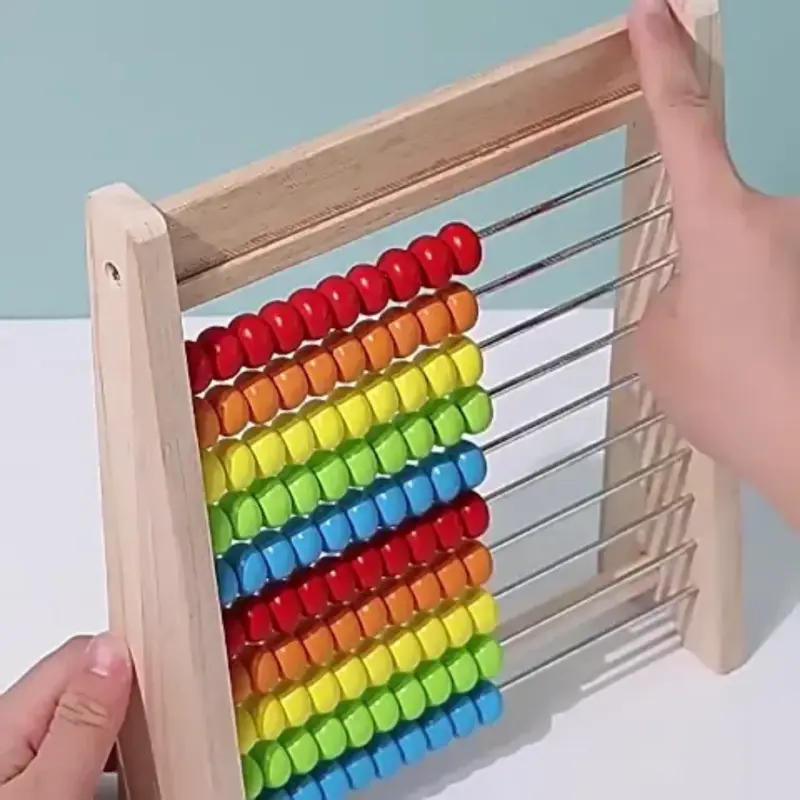
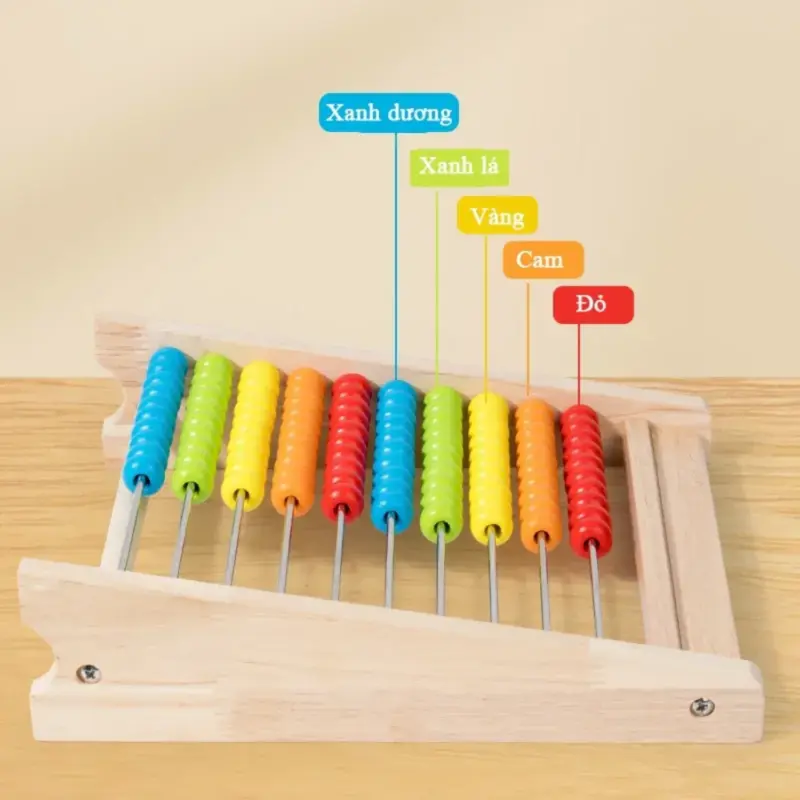
- Use paired arrangement throughout — the odd/even pattern emerges visually without instruction. Total: exactly 55 counters for numbers 1–10. Too many or too few at the end is the built-in control of error.
Sandpaper Numbers — Tactile Numeral Introduction
- What it develops: Numeral recognition, three-channel encoding (visual + tactile + auditory). Cards 0–9 with numerals in sandpaper; trace while saying quantity. Same principle as sandpaper letters. Bridge to quantity: “This is 5” [show card] → count 5 objects → trace numeral while saying “five.” Symbol anchored to real quantity every time. The full range of concrete math materials for this stage follows the same principle.
Cultural Activities — Feeding the WHY Questions
The 3-year-old’s “why” questions cluster around living things, natural phenomena, and geography. Two cultural activities address the most common question categories while building scientific observation habits.
Nature Observation Journal
- Work cycle: Observe one natural object → draw what they see → adult writes dictated observation → child traces the label. Develops scientific observation (look before concluding), botanical vocabulary, pre-writing, narration. Real Montessori principle: observation before classification before naming — concrete-to-abstract in science.
Animal Classification — Figurines + Three-Part Cards
- What it develops: Scientific naming, classification logic. Realistic figurines sorted by habitat (land/sea/air), then by diet (carnivore/herbivore). Start with land/sea/air at 3yr. Introduce mammal/reptile/amphibian at 3.5–4yr. Feeds the “why do sharks live in water?” and “why do birds have wings?” question clusters — gives the hunger a concrete, nameable answer.
When Your Child Is in Montessori School
If your 3-year-old attends a Montessori school, three principles resolve the home question: 1. Practical life at home, academic work at school — advanced food prep, gardening, and household care are richer at home. Academic materials stay exciting when reserved for school. 2. Follow the child’s questions, not the curriculum — when they come home asking about volcanoes, that’s a Cultural invitation. Go deep on their current obsession. 3. Protect the concentration window — uninterrupted free time (no screens, no structured activities) between 3–5pm matters more than any prepared activity.
Your Questions Answered
What Are the Best Montessori Activities for 3-Year-Olds?
All five curriculum areas contribute. Practical Life: multi-step food prep and table washing. Sensorial: Pink Tower, sound cylinders, mystery bag. Language: sandpaper letters, I Spy, name puzzle. Math: cards and counters, sandpaper numbers. Cultural: nature journaling and animal classification. The most effective shelf includes at least one activity from each area.
When should I introduce sandpaper letters?
Between 3 and 3.5 years — the CDC’s developmental milestones for 3-year-olds mark this window as when language comprehension and expression accelerate most rapidly, making it the optimal entry point for sound-based literacy work. Preparation — vocabulary work, sound games, I Spy by color — should come first. Introduce 2–3 letters per week, always saying the SOUND not the letter NAME. Spiraling back to review is more powerful than racing forward.
How is Montessori for 3 different from Montessori for 1 or 2?
The fundamental shift: from unconscious to conscious learning. The 1 and 2-year-old absorbs through physical experience. The 3-year-old seeks to understand — they want names, categories, reasons, and symbols. This makes intellectual content (sandpaper letters, science observation) suddenly appropriate and deeply engaging, where it would have been premature at 2. The fundamental shift from Montessori activities for 2-year-olds is exactly this: from physical experience to deliberate understanding.
What does a “normalized” 3-year-old look like?
Normalization is Montessori’s term for the calm, purposeful, self-directing child who has found their work. Signs at 3: choosing activities independently, working 20+ minutes without interruption, returning materials without being asked. Activities accelerate normalization when the shelf has 5–8 activities across all curriculum areas matched to current readiness, and the adult presents once then steps back fully. If a child moves through every activity in under 2 minutes, the shelf is behind their readiness — reduce to 3–4 and observe which produces absorption.
The Conscious Mind Has Switched On
The 3-year-old has crossed a threshold. The unconscious absorption of the first three years is giving way to something even more remarkable — a child who deliberately pursues knowledge, who loves long words, who wants to know why. That mind deserves a prepared environment. These five curriculum areas are that environment.
Start with practical life — your child already knows this territory. Add one language activity. Add one cultural investigation. Watch what happens when the intellectual appetite finds its food.
When you’re ready to build the shelf, wooden toys designed for the 3–6 year window — name puzzles, sensorial sets, and natural materials — are built around exactly the five curriculum areas this guide covers. And if your child is already moving faster than this guide, the activities calibrated to the 4-year-old’s writing readiness window are where deliberate learning deepens into true independence.