
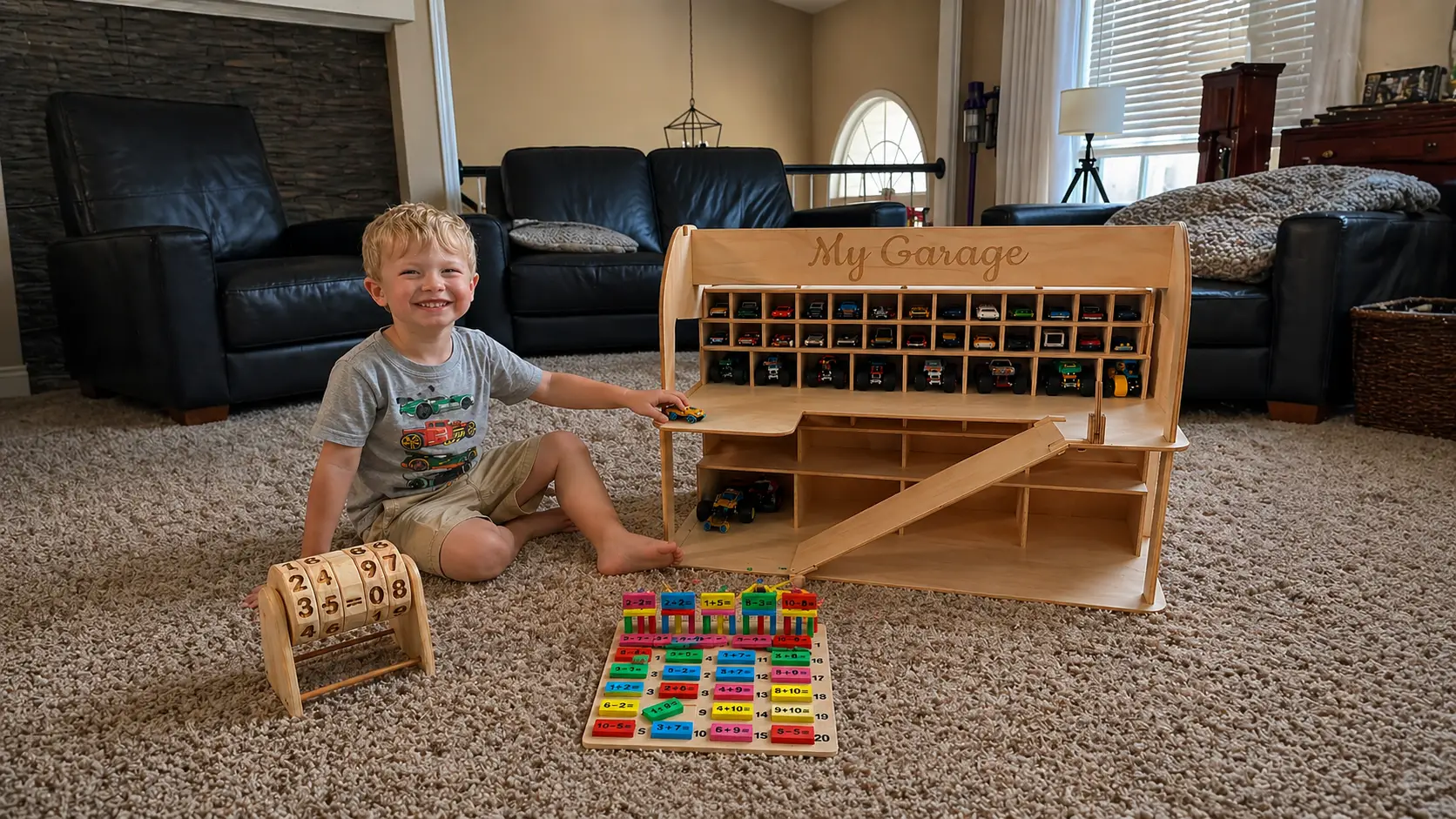
Six is not five-plus-a-year. It is a developmental threshold — the point where Montessori’s First Plane of childhood closes and the reasoning mind begins to emerge. The toys that capture a 6-year-old’s deep concentration are more complex, more systematic, and more mathematically abstract than anything that worked at 5. This guide covers five picks matched to exactly those capacities.
| Best Montessori toys for 6-year-olds (summary): The best Montessori toys for 6-year-olds respond to the developmental transition that defines this age: the beginning of abstract reasoning, the emergence of early mathematical operations, complex collaborative rule-following, and the organizational mind that wants to categorize and systematize. At 6, the toy that produces the deepest engagement is not the most stimulating — it is the one that meets the reasoning mind where it is, offering enough complexity to require genuine thinking while remaining concretely manipulable by hand. 1. Garage Toy Car Display 2. 100-Piece Wooden Domino Set 3. Montessori Arithmetic Wheels 4. Wooden Cake and Fruit Toy Set 5. Wooden Crane Truck Toy |
Your 6-year-old just spent 45 minutes setting up a domino trail, testing it, rebuilding the part that fell early, and running the full chain — twice. And then asked: “How many dominoes would I need to go around the entire room?” That question is not a 5-year-old question. These toys are the materials — the activities calibrated to the Second Plane transition at 6 show how the reasoning mind’s new capacities translate into daily curriculum work across math, language, and practical life.
At 6, the reasoning mind is arriving. The child who was satisfied with concrete exploration at 5 now wants to understand systems — how things connect, how sequences work, how numbers abstract beyond counting. The toys in this guide respond to exactly that shift: they are more complex, more mathematical, and more systematically demanding than anything on the 5-year-old list.
The 4 Best Montessori Toys for 6-Year-Olds
Five picks, five developmental domains. Each evaluated using the same framework as the rest of the Kukoo age-guide series: who it’s best for, why it works at this specific stage, and what to know before buying.
1. Garage Toy Car Display — Best for Organizational Systems Thinking
⭐ 4.97 | 874 Reviews
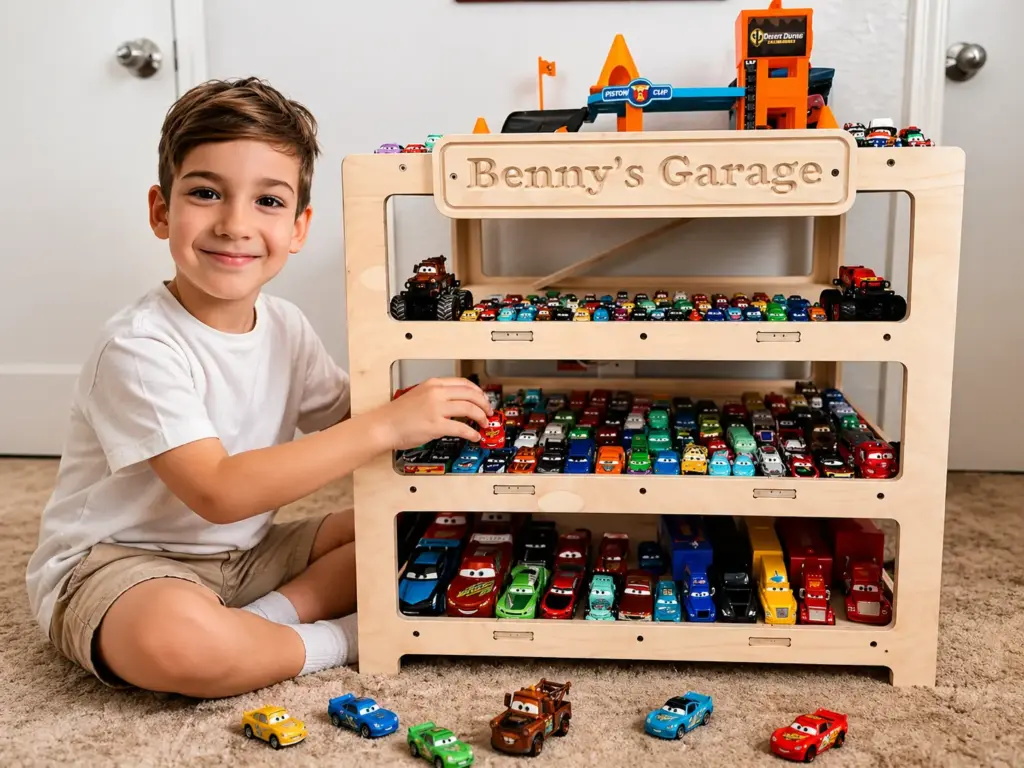
Garage Toy Car Display
- BEST FOR: Six-year-olds who have moved beyond using a garage for narrative vehicle play and are now interested in the garage as a system — organizing vehicles by type, size, color, or function; planning which level each vehicle “belongs” on; and maintaining an ordered classification scheme they designed themselves.
- WHY IT WORKS: At 6, the organizational taxonomy capacity is actively developing — the mind wants to categorize, systematize, and create rules for classification. A garage display with multiple levels and spaces for individual vehicles is not just storage: it is a classification problem. Which vehicles go on which level? What is the organizing principle? Size? Function? Type? The child who applies a consistent classification logic is doing the same cognitive work as Montessori’s Three-Part Cards at 3 — but at the abstraction level the 6-year-old’s developing Second Plane mind can engage with. The spatial planning dimension adds another layer: how vehicles fit, how much space each level holds, whether the plan needs adjusting when constraints change.
- GOOD TO KNOW: This serves a different developmental purpose than the car garages in the 4yr and 5yr articles. Those served narrative STEM play (cause-and-effect ramps, collaborative story). This one serves organizational taxonomy and systematic classification. A child who already has an earlier garage will engage with this one in a completely different way — not redundant, developmentally complementary.
2. 100-Piece Wooden Domino Set — Best for Sequential Logic + Collaborative Planning

100-Piece Wooden Domino Set
⭐ 5.00 | 599 Reviews
- BEST FOR: Six-year-olds in the full height of sequential systems thinking — the child who wants to understand chains: if this falls, that falls, which makes that fall. Also ideal for the child whose mathematical curiosity extends into quantity questions: “How many dominoes fit in a line? How many lines make a rectangle?”
- WHY IT WORKS: The domino set serves the 6-year-old at multiple levels simultaneously. At the simplest: cause-and-effect investigation at its most satisfying — the chain reaction converting patient setup into a single kinetic event. Mathematically: counting, spatial reasoning research published in npj Science of Learning identifies pattern arrangement and geometric thinking as foundational to mathematical development — exactly what 100-piece domino arrangement requires. Logically: planning a chain that works requires understanding how each piece affects the next — sequential logic applied spatially, the same cognitive structure as early algebraic thinking. The 100-piece count is specifically important at 6: enough material for genuinely complex arrangements while remaining physically manageable.
- GOOD TO KNOW: One of the most socially rich activities in this list — domino planning with a sibling or peer produces collaborative problem-solving a solo activity cannot replicate. The planning negotiation, the shared frustration when the chain breaks early, and the shared celebration when it runs completely are all social-emotional capacities the 6-year-old is actively developing.
3. Montessori Arithmetic Wheels — Best for the Concrete-to-Abstract Math Transition

Montessori Arithmetic Wheels
⭐ 4.96 | 351 Reviews
- BEST FOR: Six-year-olds at the most important mathematical transition of the elementary years: the move from counting (physically counting 5 objects and 3 objects to know 5+3=8) to early operations (knowing that 5+3=8 without needing objects). The child who can count to 100 and is now ready to understand what number relationships mean.
- WHY IT WORKS: The arithmetic wheel — a rotating circular tool demonstrating number relationships visually and physically — is precisely what the transitioning mind needs: a concrete material modeling an abstract principle. Your child holds the wheel, rotates it, watches number relationships change, and develops an intuitive sense of mathematical operations through physical manipulation before any abstract notation is required. The wheel is not a single addition problem — it is a structure containing the entire family of relationships for a given number, visible simultaneously. That systems view of number relationships is qualitatively different from drilling individual facts on a worksheet.
- GOOD TO KNOW: The Arithmetic Wheels bridge directly to the Montessori elementary mathematics curriculum — bead chains, multiplication board, division board all use the same concrete-first principle. A child who has worked with these is cognitively prepared for those more advanced materials. This is foundational mathematical preparation for the 6–9 year range.
4. Wooden Cake and Fruit Toy Set — Best for Multi-Step Practical Life + Classification
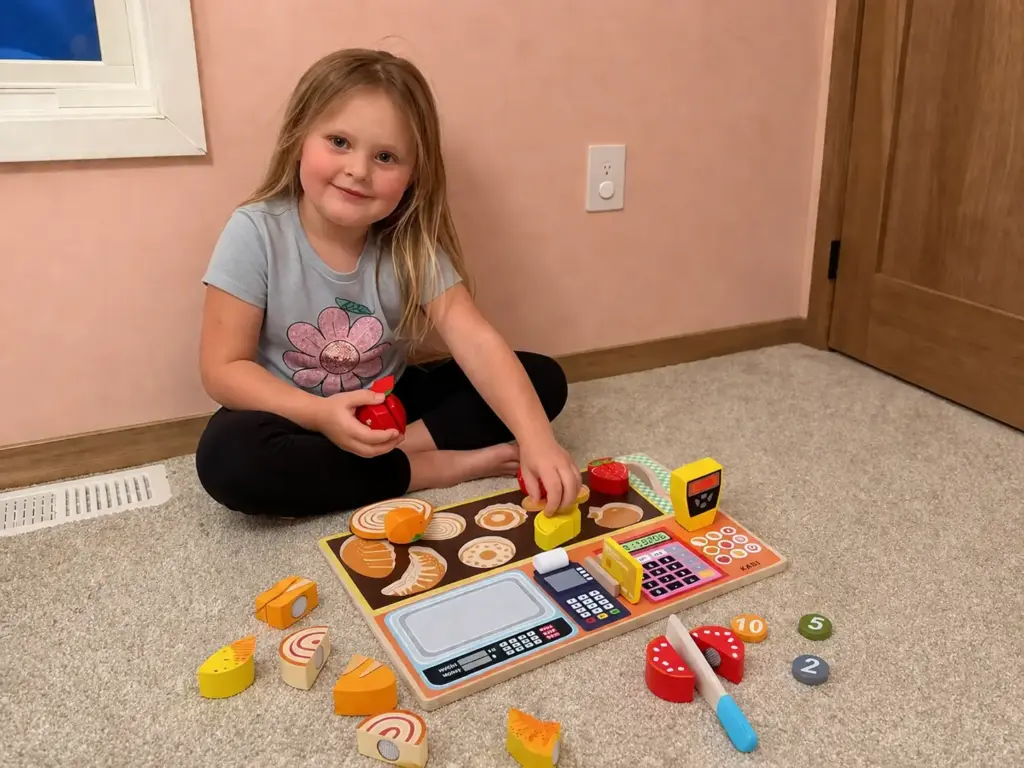
Cake And Fruit Toy Set
⭐ 4.96 | 316 Reviews
- BEST FOR: Six-year-olds who have moved beyond simple food play and are now interested in the culinary activity as a complete social experience: the planning, the preparation, the service, the sharing. The child who creates a menu, assigns roles, and insists on correct procedure for serving.
- WHY IT WORKS: At 6, the practical life engagement that began with spooning transfer at 18 months has reached its most sophisticated expression: multi-step food preparation with social hosting. The cutting and slicing component develops fine motor precision and force calibration. The classification component — sorting fruits by color, category, or ingredient role — serves the organizational taxonomy capacity peaking at 6. The collaborative component — hosting, serving, taking orders, tracking who has what — serves the perspective-taking and social logic defining 6-year-old play at its highest development. This looks like play; it is doing four developmental domains of work simultaneously.
- GOOD TO KNOW: Categorically different from kitchen toys in earlier age guides. At 3–4, kitchen play is imitative practical life — copying adult food preparation. At 6, kitchen play is organizing, planning, and hosting — the social executive function of the dinner party. The material looks similar; the developmental engagement is completely different.
| In my work with children at the 5–7 transition, the single clearest signal that the Second Plane is beginning is the appearance of ‘how many’ and ‘what if’ questions. The 5-year-old tells you what they observe. The 6-year-old asks what it means. The materials that hold that mind — that offer enough complexity to require the question — are completely different from what worked the year before. – Katy Lenoir, Preschool & Elementary Expert (Ages 3–12) |
How to Know It’s the Right Toy for Your 6-Year-Old Right Now
Five picks covering five domains — which one is right for your specific 6-year-old this week?
- The child asking “how many?” questions → Start with the 100-Piece Domino Set or Arithmetic Wheels. The quantification impulse is active; feed it with materials making numbers concrete and manipulable.
- The child asking “how does it work?” about machinery → Start with the Wooden Crane Truck. The mechanical systems investigation drive is the active developmental current.
- The child organizing everything into categories → Start with the Garage Toy Car Display. The taxonomy impulse needs a sufficiently complex physical system to organize.
- The child who wants to host, plan, and manage a social experience → Start with the Wooden Cake and Fruit Toy Set. Social executive function — planning and executing a multi-person experience — is what this material serves.
- The child whose math readiness is emerging → Start with the Arithmetic Wheels. Concrete manipulation of number relationships now will make abstract operations accessible in 6–12 months. The age-organized collections filter beyond these 5 picks — so the full range of materials matched to the Second Plane threshold is already pre-selected by developmental stage.
Shelf note: At 6, the concentration window can sustain 20–30 minutes on a single activity. Avoid putting all five on the shelf simultaneously — three at a time from complementary domains produces deeper engagement than five competing for the same attention
What Makes 6 Different — The Second Plane Threshold
Six is the closing of Montessori’s First Plane of Development — and the opening of the Second. This is not a gradual transition. It is a developmental threshold producing a qualitatively different kind of learner.
- The First Plane (0–6) is closing. The First Plane child learns through the senses and through physical manipulation of the concrete world. Their intelligence is embodied — they learn by touching, doing, and absorbing. The prepared environment with real materials, sensorial work, and practical life activities serves this intelligence. At 6, this mode is completing.
- The Second Plane (6–12) is opening. The child entering the Second Plane has a new intelligence: the reasoning mind. They can now hold an abstraction — ‘4 + 3 = 7’ — without needing physical objects in front of them. They want to understand systems, not just objects. They ask “why” and “how many” and “what if I changed this” — questions about principles, not just observations.
- Six is the hinge. The child is not fully in the Second Plane yet — they still need concrete material support for abstract concepts. The best materials at 6 bridge this gap: physical manipulation pointing toward abstract principles. The arithmetic wheel you can hold and spin is more appropriate than a worksheet — but it serves a more abstract cognitive goal than the stacking tower served at 2.
The 5 capacities defining 6:
- Early mathematical abstraction — counting transitions to operations and number relationships.
- Sequential systems logic — if A causes B and B causes C, what happens if A changes?
- Collaborative rule-based complexity — multi-player activities with genuine strategic logic.
- Organizational taxonomy — systematic categorization, not just sorting.
- Engineering systems thinking — how does this mechanism work as a system, not just as an object?
| The materials that hold a 6-year-old’s attention share one characteristic: they have more depth than the surface shows. The domino set that a 5-year-old uses for knocking things over is the same set a 6-year-old uses to explore cause-effect chains, counting, and spatial planning. The material didn’t change. The mind did. – Katy Lenoir, Preschool & Elementary Expert (Ages 3–12) |
What Makes a Montessori Toy Right for the 6-Year-Old Transition
Not every toy labeled “Montessori” serves the specific developmental transition happening at 6. Four criteria identify the ones that do.”
1. Does it bridge concrete and abstract? The best materials at 6 provide physical manipulation (concrete) modeling an abstract principle. If the toy only works at the concrete level, it may serve an earlier stage.
2. Does it have systems complexity, not just single-mechanism interest? A toy revealing its complete function in one session is a 5-year-old toy. A toy with enough depth to generate new questions across multiple sessions is a 6-year-old toy
3. Does it reward sustained thinking, not just sustained doing? Physical repetition building a skill (stacking, pouring) is primary-level work. Logical planning requiring sustained reasoning (domino chain design, vehicle classification) is Second Plane work. The 6-year-old needs both, but the toys producing the deepest concentration at this age reward thinking.
4. Is it made from natural materials with real sensory feedback? At the Second Plane threshold, the child is still learning through the hands. Natural wood with real weight, texture, and mechanical feedback continues providing the concrete sensory information abstract reasoning needs to anchor itself.
Frequently Asked Questions
- What are the best Montessori toys for a 6-year-old?
Toys responding to the developmental capacities of this transitional age — the beginning of abstract reasoning, early mathematical operations, sequential systems logic, organizational taxonomy, and engineering systems thinking. The five picks: the Garage Toy Car Display (organizational systems + spatial taxonomy), the 100-Piece Wooden Domino Set (sequential logic + counting + collaborative planning), the Montessori Arithmetic Wheels (concrete-to-abstract math transition), the Wooden Cake and Fruit Toy Set (multi-step practical life + classification + hosting), and the Wooden Crane Truck Toy (mechanical systems thinking + engineering vocabulary).
- What is the Montessori Second Plane and why does it matter at 6?
Montessori’s Second Plane of Development (6–12 years) is the phase when intelligence shifts from primarily sensory-concrete (learning through direct physical experience) to primarily reasoning-abstract (learning through logic, systems, and principles). At 6, this transition is beginning. Toys that serve it bridge concrete and abstract: the arithmetic wheel physically held and spun is serving early mathematical operations (Second Plane thinking) through concrete manipulation (First Plane learning). Pure concrete toys will feel understimulating; pure abstract challenges without concrete support will frustrate. The sweet spot is physical materials modeling abstract principles.
- How is 6 developmentally different from 5 for choosing toys?
Five-year-olds are in the advanced First Plane — their peak capacities are collaborative narrative play, precise vocabulary, and sustained concrete exploration. Six-year-olds are at the First-to-Second Plane threshold — their emerging capacities are early mathematical abstraction, sequential systems logic, organizational taxonomy, and engineering systems thinking. Concretely: a 5-year-old uses a domino set to knock things over. A 6-year-old uses the same set to plan chain architecture, counts pieces, adjusts the design, and asks how many pieces would circle the room. Same material, completely different cognitive engagement.
- Are wooden toys still important at 6?
Yes — specifically because of the Second Plane transition. The 6-year-old whose abstract reasoning is beginning still needs concrete sensory feedback to anchor abstract concepts. The arithmetic wheel that can be physically spun provides richer sensory-cognitive integration than any digital equivalent — because the abstract principle (number relationships) is learned simultaneously with the physical act. Natural wood provides temperature, weight, and texture variation that continues to be developmentally relevant as long as concrete material support is appropriate — which the educational research consistent with Montessori’s approach suggests extends through the elementary years.
When the Question Becomes the Toy
The domino chain that fell early. The 45 minutes of patient rebuilding. The question — “how many would I need to go around the room?”
That sequence is what every toy in this guide is designed to hold. The 6-year-old whose mind is crossing into the Second Plane needs materials that meet them in the question — not just the activity. The best Montessori toys for 6-year-olds don’t entertain longer than a 5-year-old toy. They reward thinking longer.
Pick one from the five — start with the domain your child’s most-repeated question points to. Set it on the shelf with two complementary materials and rotate the rest. Deep concentration when the material matches the mind is the only feedback you need.
When you’re ready, the full 3–6 year Kukoo collection is built for exactly this threshold — FSC-certified natural wood, real weight, real complexity.